Surah Al-Masad is revealed in Makkah in response to Abu Lahab’s violent rejection of the Prophet Muhammad. This five-verse surah shows every reader that no amount of wealth, status, or family connection shields a person who wars against truth.
What makes Surah Al-Masad uniquely powerful is that its benefits are inseparable from its message. Reciting it, memorizing it, and studying its Tafsir all reinforce the same core conviction: that divine promise is certain, that justice reaches every soul, and that the Quran’s language carries precision no translation can fully capture.
Table of Contents
1. Surah Al-Masad Confirms That Divine Justice Is Absolute and Certain
Surah Al-Masad opens with an immediate divine verdict:
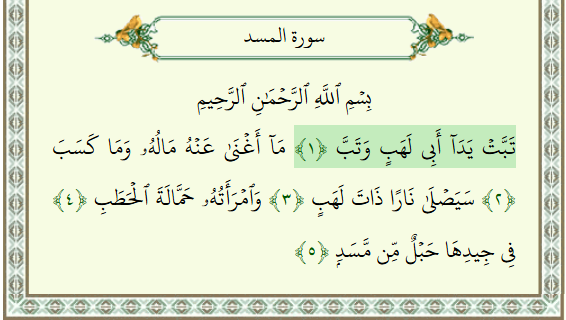
تَبَّتْ يَدَآ أَبِى لَهَبٍ وَتَبَّ — “May the hands of Abu Lahab be ruined, and ruined is he.” (Al-Masad 111:1).
This is not a prediction framed in doubt. It is a declaration already fulfilled in the divine record.
The benefit for every reciting Muslim is a deepened certainty that Allah’s promise never fails.
Abī Lahabin wa tabb — the repetition of the root ta-ba-ba in the same verse is a rhetorical device that classical scholars describe as confirmation layered upon invocation. The first instance is a supplication; the second is its immediate divine endorsement.
This surah was revealed when Abu Lahab, the Prophet’s own uncle, threw rocks at him and called him a liar publicly. Yet the Quran addressed his fate with finality. For a believer, reading this surah reinforces tawakkul — complete reliance on Allah — because it demonstrates that those who harm the truth are already accounted for.


2. Wealth and Status Cannot Override Allah’s Decree
One of the profound benefits of Surah Al-Masad is how it dismantles the assumption that material power translates into spiritual security.
مَآ أَغْنَىٰ عَنْهُ مَالُهُۥ وَمَا كَسَبَ
Mā aghnā ‘anhu māluhu wa mā kasab
“His wealth will not avail him or that which he gained.” (Al-Masad 111:2)
Abu Lahab was among the wealthiest men in Makkah. His tribal standing was unquestioned. Yet both are declared worthless before the divine verdict.
For non-Arabic speaking Muslims living in Western societies — where wealth and social standing carry enormous cultural weight — this verse lands with particular force. Reciting it regularly recalibrates priorities in a way few short surahs achieve so efficiently.
At Riwaq Al Quran, our tutors often assign Surah Al-Masad early in the Online Quran Memorization Course — not only for its brevity, but because its message gives students an immediate sense of the Quran’s theological weight. Students who understand what they are memorizing memorize it far more durably.
Start your Hifz journey with a Free Trial
3. Surah Al-Masad Illustrates the Quranic Precision of Describing Punishment
The surah’s third and fourth verses describe Abu Lahab’s punishment with imagery that classical Tafsir scholars have analyzed in remarkable depth:
سَيَصْلَىٰ نَارًا ذَاتَ لَهَبٍ وَٱمْرَأَتُهُۥ حَمَّالَةَ ٱلْحَطَبِ
Sayaṣlā nāran dhāta lahab. Wa-mra’atuhu ḥammālatal-ḥaṭab
“He will [enter to] burn in a Fire of [blazing] flame. And his wife [as well] — the carrier of firewood.” (Al-Masad 111:3–4)
The word لَهَبٍ (lahab) means blazing flame, and it is the same root as Abu Lahab’s name — a name he was given for his red-flushed complexion and fiery temperament.
The Quran’s use of his nickname here is noted by scholars of Tafsir as a literary precision: the very name he carried in pride becomes the description of his punishment.
His wife, Umm Jamil, used to carry thorny branches and scatter them on the path the Prophet ﷺ walked. The reference to her as a “carrier of firewood” operates on two levels simultaneously — her literal act in this world and her station in the next.
This dual-layered linguistic construction is what makes studying this surah through a proper Online Quran Tafseer Course so valuable for deepening comprehension.
Enroll Now in Riwaq’s Tafseer Course with a FREE trial

4. Strengthening a Believer’s Certainty in Quranic Prophecy
Surah Al-Masad is unique in that it is among the few places in the Quran where a specific named individual is condemned by name. Scholars of Ulum al-Quran have noted that this itself is a proof of prophethood: the surah was revealed years before Abu Lahab’s death, yet he never accepted Islam — which would have theoretically invalidated the surah’s verdict. He did not.
This is a benefit that goes beyond recitation. Understanding this background through authentic Tafsir sources deepens a Muslim’s confidence in the divine origin of the Quran. The prophecy was made, and history fulfilled it without exception.
Students in our Best Islamic Studies Online Course explore precisely this type of Quranic evidence — connecting historical context with theological implication in a way that builds genuine, grounded faith rather than surface-level familiarity.
Begin your Islamic Studies with a FREE trial lesson

5. Enmity Toward Truth Has Defined Consequences
The account of Abu Lahab and Umm Jamil preserved in Surah Al-Masad carries a universal lesson that transcends its historical occasion. Every generation has its own forms of opposition to truth. Reciting this surah reminds the believer that such opposition is not new, not unanswered, and not without consequence in the divine account.
The Prophet ﷺ faced his own family’s hostility with patience, not retaliation. The response came from Allah directly. This is a profoundly stabilizing understanding for Muslims navigating hostility to their faith in contemporary contexts.
Understanding seerah alongside surah is part of what authentic Islamic education provides. This is why integrating Islamic Studies with Quranic learning produces students who recite with meaning rather than by rote.
Why Students Love Learning with Riwaq Al Quran
Hear directly from our students about how Riwaq Al Quran Academy has transformed their connection with the Book of Allah. Their experiences reflect the dedication, care, and quality that guide every step of our teaching.
Begin Memorizing and Understanding Surah Al-Masad with Riwaq Al Quran
Surah Al-Masad’s five verses carry a weight far exceeding their length. Its benefits — theological clarity, linguistic appreciation, Tajweed application, and spiritual grounding — are fully accessible only when studied with a qualified guide.
Riwaq Al Quran offers:
- Azhari-certified tutors with Ijazah in Quranic recitation and memorization
- One-on-one instruction tailored to non-Arabic speaking students
- 24/7 scheduling across all time zones
- 2 Free Trial Classes — no commitment required
- Starting from $32/month with a 100% Money-Back Guarantee
Enroll in the Online Quran Memorization Course, the Online Quran Tafseer Course, or the Best Islamic Studies Online Course and study this surah the way it deserves — with precision, depth, and authentic scholarship.
We offer courses in Online Quran & Tajweed Classes, Arabic Language, and Islamic Studies.
- Online Quran Memorization Course
- Tafseer Course
- Tajweed Classes
- Online Quran Classes for Kids.
- Ijazah Program.
- Arabic Language Classes.
- Islamic Studies Courses.
Enroll now for 2 Free Trial Classes and Begin Learning Islam and Quran Today

Frequently Asked Questions About Surah Al-Masad Benefits
What are the main benefits of reciting Surah Al-Masad regularly?
Reciting Surah Al-Masad regularly strengthens a believer’s conviction in divine justice, reinforces tawakkul, and serves as a reminder that neither wealth nor lineage grants immunity from Allah’s decree. It is also a Tajweed-rich surah containing Idgham, Qalqalah, and Ghunnah rules, making it valuable for both spiritual reflection and recitation practice.
What is the difference between Surah Al-Masad and Surah Lahab — are they the same surah?
Yes, Surah Al-Masad and Surah Lahab refer to the same surah — Chapter 111 of the Quran. “Al-Masad” (the palm fiber) is its official name in the Uthmani mushaf, referring to the twisted rope of Umm Jamil. “Lahab” (flame) comes from the name Abu Lahab mentioned in its first verse. Both names are used in scholarly literature.
Is reciting Surah Lahab 41 times or 100 times for a specific purpose an authentic practice?
There is no authentic hadith or verified scholarly basis for assigning specific counts — such as 41 or 100 repetitions — to Surah Al-Masad for worldly purposes. Such practices fall into the category of uninvestigated bid’ah (innovation). Muslims should recite all surahs for the general reward of Quran recitation and for reflection, without assigning unverified ritual numbers to them.
Can Surah Lahab be recited against an enemy or for protection from harm?
No authentic hadith establishes Surah Al-Masad as a specific ruqyah against enemies or a protective formula. The surah’s context is a specific divine verdict regarding Abu Lahab. Treating it as a prescribed tool for use against personal enemies without scholarly evidence is not supported in mainstream Fiqh. Seek guidance from a qualified scholar regarding authentic ruqyah practices.