
The very first word Allah ﷻ revealed to the Prophet Muhammad ﷺ was not a command to pray or fast. It was a command aimed at the foundation of all knowledge:
“اقْرَأْ بِاسْمِ رَبِّكَ الَّذِي خَلَقَ““
Read in the name of your Lord who created.” — Surah Al-Alaq, 96:1
The command اقْرَأْ — “Read” — arrived before any ruling about prayer, charity, or fasting. Islam opened with a call to learning. It was addressed to the Prophet ﷺ and through him to all of humanity, with no distinction of gender. For any Muslim woman who has ever felt that Quranic education was optional or secondary to her role, this verse closes that question before it begins.
Yet for millions of sisters, access to qualified female teachers remains the real barrier. Geography, family schedules, privacy concerns, and the absence of all-female Islamic learning spaces have kept many women from what their faith placed as a first priority.
Riwaq Al Quran is a comprehensive online institute that brings personalized Quran, Arabic, and Islamic Studies education to women, children, and families of all ages and backgrounds worldwide.
With a structured curriculum delivered by experienced female instructors and live interactive sessions, the platform makes learning the Quran online as accessible as opening a laptop. Women from more than 40 countries now learn Tajweed, memorize the Quran, study Tafseer, and earn formal Ijazah — at their own pace, in their own language, from the full privacy of their homes.
This article covers the Islamic basis for women’s Quranic education, every course Riwaq offers with realistic timelines, the correct learning sequence by level, what happens in your two free trial sessions, and the qualifications that distinguish a legitimate female Quran teacher from an unverified one.
What You’ll Learn in This Article
- The authenticated Quranic verses and hadiths that establish women’s Quranic education as a religious priority, not a lifestyle choice.
- Which course at Riwaq matches your current level, and the sequence that prevents wasted effort.
- The specific Tajweed rules covered — named, explained, and linked to the Quranic command behind them.
- What happens in your two free trial sessions, step by step.
- The 1:5 revision framework that determines whether Hifz students retain what they memorize.
- The four qualifications every legitimate female Quran teacher must hold before teaching.
Online Quran Classes for Sisters at Riwaq Al Quran — Courses and Timelines
Riwaq Al Quran offers a full curriculum for women and families at every level — from complete beginners through to Ijazah certification. The range includes specialized Quran classes for kids, online Arabic language courses, and a comprehensive Islamic Studies program.
Every course is taught one-on-one or in small groups by certified female instructors, available in English, Arabic, or Urdu, with session times built around the student’s schedule — not the institute’s.
The table below maps each course to its entry level, typical duration, and language availability before the individual sections explain each one in detail:
| Course | Entry Level | Typical Duration | Languages |
|---|---|---|---|
| Noorani Qaida | Complete beginner | 6–8 weeks | EN / AR / UR |
| Tajweed & Recitation | Basic reader | 3–18 months | EN / AR / UR |
| Hifz (Memorization) | Solid Tajweed required | 2–5 years | EN / AR / UR |
| Tafseer | Any level | Ongoing | EN / AR / UR |
| Ten Qirat | Advanced | Varies | EN / AR / UR |
| Ijazah | Advanced | Varies | EN / AR / UR |
| Islamic Studies | Any level | Ongoing | EN / AR / UR |
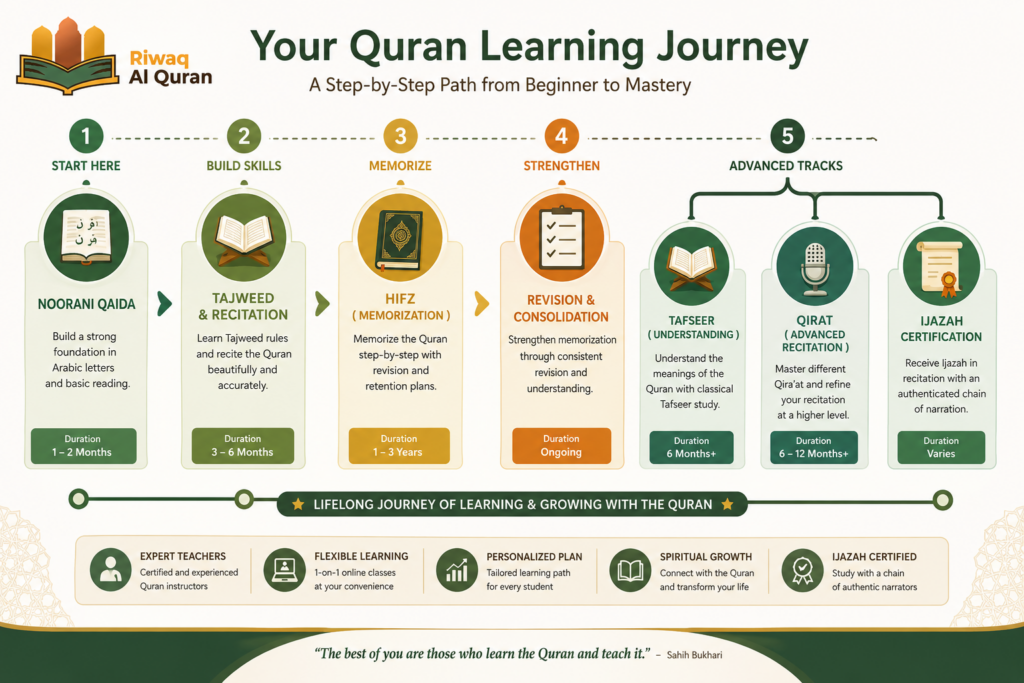
a. Noorani Qaida — The Non-Negotiable Starting Point
The Noorani Qaida course is the correct entry point for any sister with no prior Arabic reading ability. Taught by native Arabic tutors, it covers four foundational areas in sequence:
- Arabic letters in all three positional forms — at the beginning, middle, and end of a word.
- The precise distinct sound of each letter, produced correctly — not approximated.
- Basic syllable combinations that form the structural building blocks of Quranic reading.
- Short vowels (harakaat), long vowels (madd), sukoon, and tanween — the diacritical system that governs every sound in the Quran.
Skipping this course and moving directly into Tajweed or Hifz is one of the most common and costly errors in online Quran education. Students who skip it learn to approximate words without understanding the letter sounds producing them — and those approximations solidify into habits that grow exponentially harder to correct the further they advance.
Typical timeline: Six to eight weeks for students attending two one-hour sessions per week, with 15–20 minutes of daily independent practice between sessions.
b. Recitation and Tajweed — Learning to Recite the Quran Correctly
Allah ﷻ did not simply encourage careful recitation — He commanded it with a specific verb form:
“وَرَتِّلِ الْقُرْآنَ تَرْتِيلًا“
“And recite the Quran with measured recitation.” — Surah Al-Muzzammil, 73:4
رَتِّلِ is a command form — imperative, not advisory. Tajweed is the applied science that fulfills this command precisely: it defines what “measured recitation” means at the level of each individual letter and rule. Scholars of Islamic jurisprudence are in broad agreement that reciting the Quran with correct Tajweed is an individual obligation (fard ‘ayn) on every Muslim who has the ability to learn it.
Riwaq’s online Tajweed classes for sisters fulfill this obligation through direct application from the Quran — not through abstract rule memorization in isolation. For guidance on finding qualified instructors, the institute’s resource on Tajweed tutors is a useful reference.
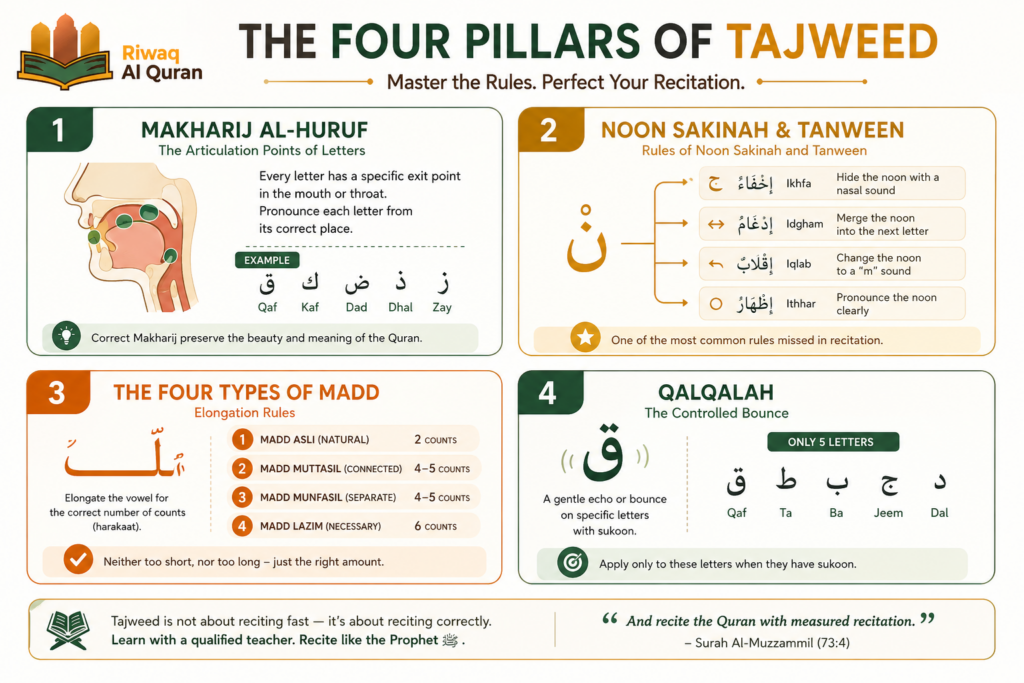
The recitation program covers four core rule categories. Most sisters who read independently have never formally studied any of them — and a trained Al-Azhar teacher identifies violations across all four within the first session:
- Makharij al-Huruf — the anatomical exit points of each Arabic letter. Several letters that look similar on the page (ذ / ز / ظ) originate from entirely different positions in the mouth and throat. The letter ق (qaf) articulates from the back of the soft palate; substituting it with the lighter ك (kaf) — as most non-native speakers do — changes how the word sounds and in some cases alters its meaning. This error is identifiable and correctable within the first few sessions.
- Rules of Noon Sakinah and Tanween — four rules (Ikhfa, Idgham, Iqlab, Ithhar) governing how the letter Noon and Tanween interact with the following letter. These are among the most frequently violated rules in everyday recitation, including among long-practicing Muslims who have been reading for decades.
- The Four Types of Madd (Elongation) — each Madd type carries a defined number of counts (harakaat) for which the vowel must be held. Cutting it short or extending it past its limit is a Tajweed violation. Most self-taught readers have an inconsistent, habitual relationship with Madd without knowing it.
- Qalqalah — a controlled bounce or echo applied specifically to five letters (ق ط ب ج د) when they carry a sukoon. Students most commonly either skip it entirely or apply it to letters outside the five — both errors a qualified teacher corrects within the first few sessions.
Typical timeline: Three to six months to apply core rules consistently in recitation. Twelve to eighteen months for fully automatic application during reading, without conscious effort.
c. Quran Memorization (Hifz) — Preserving the Quran in Your Heart
Allah ﷻ gave a direct promise about His Book’s accessibility to memory:
“وَلَقَدْ يَسَّرْنَا الْقُرْآنَ لِلذِّكْرِ فَهَلْ مِنْ مُدَّكِرٍ“
“And We have certainly made the Quran easy for remembrance, so is there any who will remember?” — Surah Al-Qamar, 54:17
يَسَّرْنَا — “We have made easy” — is divine past tense: the facilitation is already in place. The question فَهَلْ مِنْ مُدَّكِرٍ repeats four times in Surah Al-Qamar, each time after a different historical example, pressing the invitation with renewed emphasis. The memorization is made easy; what remains is the decision to begin.
The reward for Hifz is permanent and precisely defined:
«يُقَالُ لِصَاحِبِ الْقُرْآنِ اقْرَأْ وَارْتَقِ وَرَتِّلْ كَمَا كُنْتَ تُرَتِّلُ فِي الدُّنْيَا، فَإِنَّ مَنْزِلَكَ عِنْدَ آخِرِ آيَةٍ تَقْرَأُهَا»
“It will be said to the companion of the Quran: Recite and ascend — recite with the same Tarteel you used in the worldly life, for your rank in Paradise will be at the last verse you recite.”— Narrated by Abdullah ibn Amr (RA) — Sunan Abu Dawud, Hadith 1464
ارْتَقِ — “ascend” — means ascending ranks in Paradise, one verse at a time. The phrase “the same Tarteel you used in the worldly life” connects quality of memorization directly to rank in the hereafter — giving Tajweed before Hifz not only a practical justification but a theological one. The more of the Quran memorized correctly, the higher the permanent station.
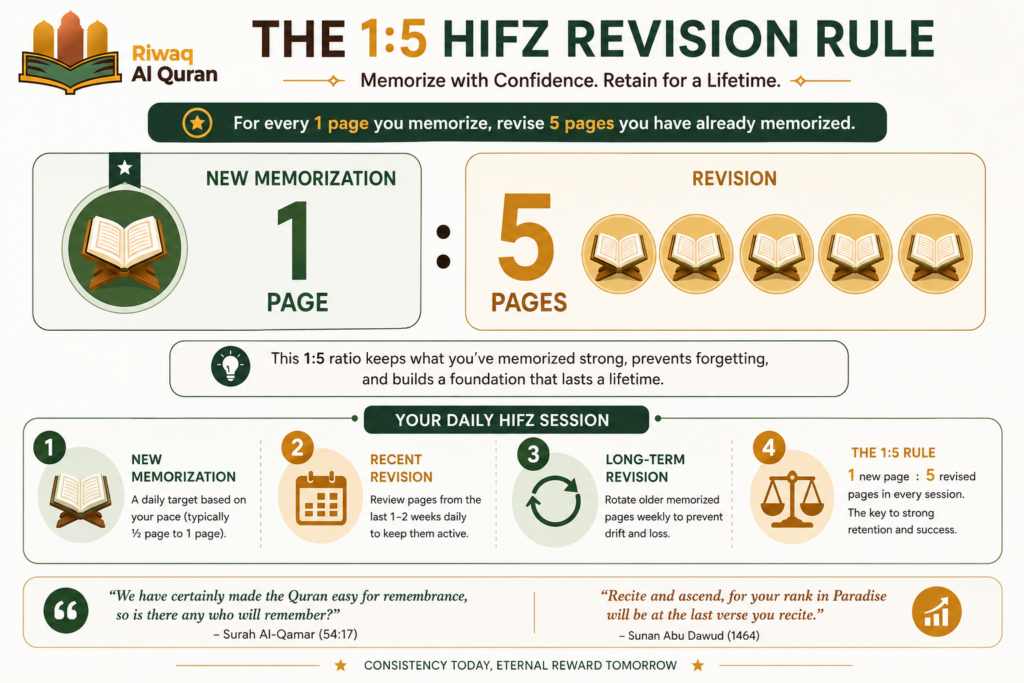
Riwaq’s Quran memorization course for sisters assigns each student a dedicated female instructor who builds a structured plan from the first session. The plan addresses the element most self-directed Hifz students neglect entirely: revision. A proven framework used by experienced Hifz teachers structures daily sessions as follows:
- New memorization target — a daily amount calibrated to the student’s realistic pace, typically half a page to one full page
- Recent revision — pages memorized in the last one to two weeks, reviewed daily to keep them active in short-term memory before they consolidate
- Long-term revision — older memorized sections rotated on a weekly schedule to prevent gradual drift and loss
- The 1:5 ratio — for every one new page memorized, five previously memorized pages are reviewed in the same session. This ratio is the standard framework used by experienced Hifz teachers to prevent the most common failure point: memorizing forward while losing backward
Typical timeline: Students dedicating 30–45 minutes daily to combined memorization and revision typically complete Juz ‘Amma in two to three months. Completing the full Quran takes two to five years depending on daily time available — the instructor sets a realistic target in the second free trial session.
d. Tafseer — Understanding the Quran’s Meaning and Message
The Quran was not revealed simply to be recited — it was revealed to be understood. Allah ﷻ stated His own purpose in sending it down, and that purpose is reflection.
This verse makes clear that engagement with the Quran does not end at correct pronunciation or complete memorization — those are the entry point. What lies beyond them is the level the Quran itself calls for:
كِتَابٌ أَنزَلْنَاهُ إِلَيْكَ مُبَارَكٌ لِّيَدَّبَّرُوا آيَاتِهِ وَلِيَتَذَكَّرَ أُولُو الْأَلْبَابِ”
“[This is] a blessed Book which We have revealed to you, that they might reflect upon its verses and that those of understanding would be reminded.”— Surah Sad, 38:29
لِيَدَّبَّرُوا (liyatadabbarū) — “that they might reflect” — was stated as the reason the Quran was sent down. Correct recitation and memorization are the first level of engagement with the Book.
Understanding what the verses mean, why they were revealed, and what they require from the believer is the second level — and it is the stated purpose of the revelation itself. Tafseer is not enrichment for advanced students; it is what the Book was sent for.
Riwaq’s online Tafseer course for sisters guides students through four interconnected areas of study:
- The historical context of each verse (asbab al-nuzul — the circumstances of revelation).
- Linguistic analysis of key Arabic terms whose meanings are not fully captured by any translation.
- Classical scholarly commentary drawn from recognized Tafseer sources.
- The jurisprudential and spiritual implications of key passages for daily Muslim life.
The course is designed for sisters at any level. A student does not need completed Hifz or advanced Tajweed to begin — the only prerequisite is the desire to understand what she is reading.
e. Advanced Studies — Ten Qirat, Ijazah, and Islamic Studies
For sisters who want to go beyond recitation and memorization, Riwaq offers three advanced-level programs that represent the highest credentials in Quranic and Islamic scholarship.
- Ten Qirat Course — The Ten Qirat program covers all ten recognized recitation styles of the Quran, each with its distinct pronunciation rules, historical lineage, and documented chain of transmission. Designed for sisters who have already mastered standard Hafs recitation, this course opens the full authentic diversity of Quranic transmission.
- Quran Ijazah Course — The Ijazah is the highest level of formal Quranic certification. To understand fully what an Ijazah means — including the chain of narration (Sanad) and how it connects back to the Prophet ﷺ — Riwaq’s dedicated guide covers the full background. In practice: the student demonstrates complete mastery of recitation with Tajweed, is tested live by a qualified Shaykha, and receives a documented Sanad — an unbroken chain of named teachers spanning approximately fifteen generations back to the Prophet ﷺ himself. This is not an academic certificate; it is a document of living transmission.
Allah ﷻ guaranteed the preservation of the Quran, and the Ijazah chain is one of its primary active mechanisms:
“إِنَّا نَحْنُ نَزَّلْنَا الذِّكْرَ وَإِنَّا لَهُ لَحَافِظُونَ“
“Indeed, it is We who sent down the Quran and indeed, We will be its guardian.” — Surah Al-Hijr, 15:9
Divine preservation operates through two parallel channels: the written mushaf and the living memory of the Huffaz transmitted through verified Sanad chains. Every sister who earns a documented Ijazah becomes an active part of Allah’s preservation of His Book — not metaphorically, but in the literal, scholarly sense the tradition has maintained for fourteen centuries.
Islamic Studies Course — The Islamic Studies program for sisters covers Aqeedah, Fiqh, Seerah, and Islamic ethics in a structured curriculum accessible at any knowledge level. Designed for sisters who want a grounded, comprehensive understanding of their faith beyond Quranic recitation alone.

All courses above start with two free one-on-one trial sessions — no payment required. Register and book your trial at Riwaq Al Quran to meet your instructor and begin.
Which Riwaq Course Matches Your Level? A Simple Decision Guide
Choosing the wrong starting point is the most common reason sisters plateau early in online Quran learning. The three scenarios below map each possible starting level to the correct course — apply whichever matches your current situation before enrolling anywhere.
The following table provides a quick reference; the three sections below explain the reasoning behind each recommendation:
| Your Current Situation | Recommended First Course | Entry Link |
|---|---|---|
| No Arabic reading ability | Noorani Qaida | Start here |
| Read Arabic, pronunciation rough | Tajweed & Recitation | View the course |
| Solid recitation, ready to memorize | Hifz Course | Explore the program |
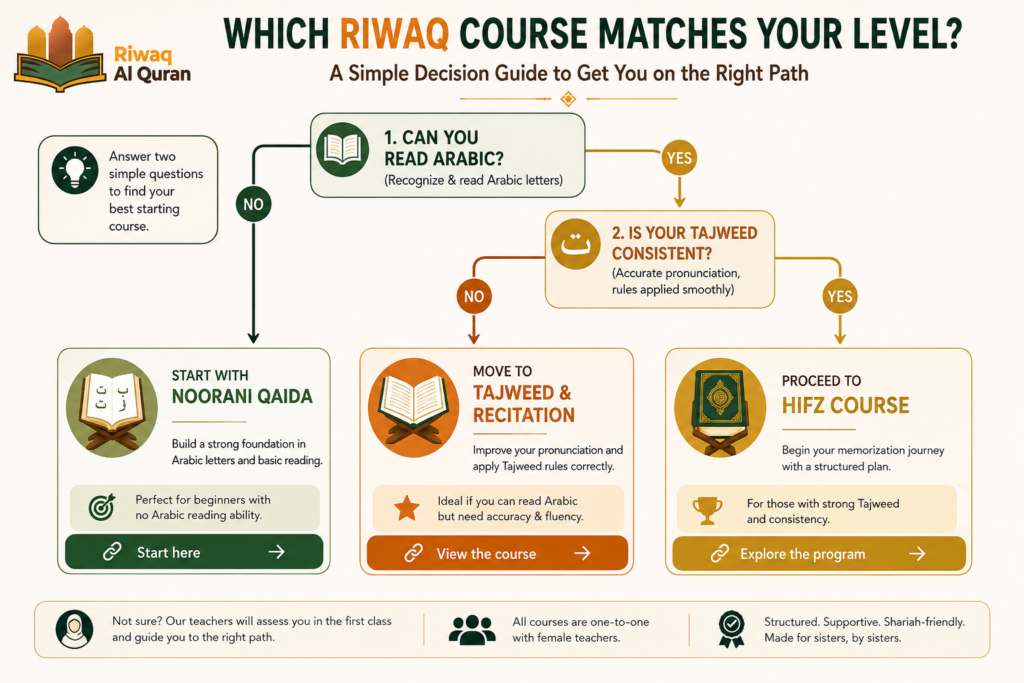
1. Complete Beginners with No Arabic Reading Background
Begin with the Noorani Qaida course. No exceptions, regardless of age or how many years a sister has been listening to the Quran. Familiarity with the sounds of the Quran through listening is not the same as the ability to produce those sounds correctly while reading.
The Noorani Qaida takes six to eight weeks and provides a foundation that makes every subsequent stage faster and more accurate. Skipping it creates compounding pronunciation errors that grow harder to fix at each level that follows.
2. Sisters Who Read Arabic but Struggle with Pronunciation
The correct starting point is the Recitation with Tajweed course. In the first free trial session, the instructor will listen to a short passage and identify which specific rules are being violated. Most sisters in this position discover they have been mispronouncing three to five letters or rules consistently — sometimes for years — without any feedback.
The assessment is clarifying rather than judgmental, and it produces a precise list of exactly what the course will address from session one.
3. Sisters with Solid Recitation Ready to Memorize
Move directly into the Hifz course. The prerequisite is established Tajweed — consistent application of the core rules, not perfection. Memorizing with active pronunciation errors encodes those errors into long-term memory, where they become the automatic pattern the brain retrieves.
Correcting pronunciation after memorization takes an estimated three to four times longer than learning correctly from the beginning, because it requires dismantling patterns that are already consolidated.
What Happens in Your First Two Free Trial Sessions
Most hesitation before enrolling in an online Quran course comes from uncertainty about what to expect. Riwaq provides two complete, no-cost one-on-one sessions to every new student — with a qualified female instructor, at a time the student selects, with no payment information required to book. Here is exactly what happens in each.
Session 1 — Placement Assessment
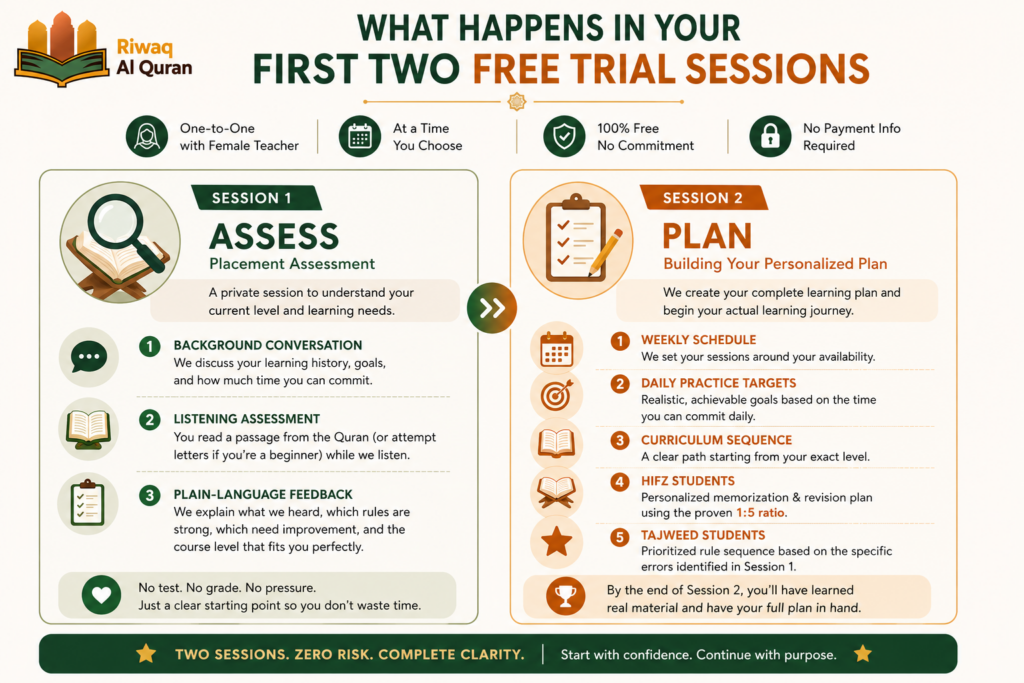
The first session is a private video call following a three-part structure:
- Background conversation — a short discussion about the student’s learning history, goals, and how much time she can realistically commit per week.
- Listening assessment — the student reads a passage from the Quran (or attempts to sound out letters if she is a complete beginner) while the instructor listens without interruption.
- Plain-language feedback — the instructor explains what she heard: which rules apply correctly, which do not, and which course level matches exactly where the student is.
There is no test format, no grade, and no pressure. The session is purely diagnostic — its purpose is to identify a starting point so precise that no time is wasted in the course itself.
Session 2 — Building the Personalized Learning Plan
The second session begins the actual coursework. The instructor presents a complete structured plan covering:
- Weekly session schedule, set around the student’s stated availability.
- Daily practice targets between sessions — realistic and achievable based on actual time commitments
- The specific curriculum sequence, beginning from the identified level.
- For Hifz students: a memorization and revision schedule using the 1:5 ratio framework, calibrated to daily time available.
- For Tajweed students: a prioritized rule sequence beginning with the specific errors identified in session one.
By the end of the second session, the student has already covered real material, holds a written plan, and can make a fully informed enrollment decision — with no obligation attached to either session.
Book both free sessions at no cost — register here to get started, no payment required.
Why All-Female Online Quran Classes Produce Better Results for Sisters
The all-female format at Riwaq is not a marketing feature — it is a deliberate academic and Islamic decision with measurable effects on learning outcomes. Three factors explain why female-only online Quran education consistently outperforms mixed-gender alternatives for sisters.
1. The Privacy Advantage and Its Effect on Learning Performance
Adult learners consistently perform better when social friction is absent from the learning environment. For Muslim women — particularly those who observe hijab or niqab — a camera-on session with an unknown male teacher introduces a layer of social awareness that competes directly with focus on the lesson. All-female sessions remove that layer entirely, and the student’s full cognitive attention goes to the Quran.
Islamic tradition recognized this dynamic long before modern educational research. Aisha (RA), wife of the Prophet ﷺ, taught thousands of Companions with full scholarly authority while maintaining her own boundaries — typically from behind a screen when the student was male. The female Islamic teacher who creates a private, protected learning space follows a model established in the first generation of Islam.
2. A Tradition of Female Islamic Scholarship from the First Generation
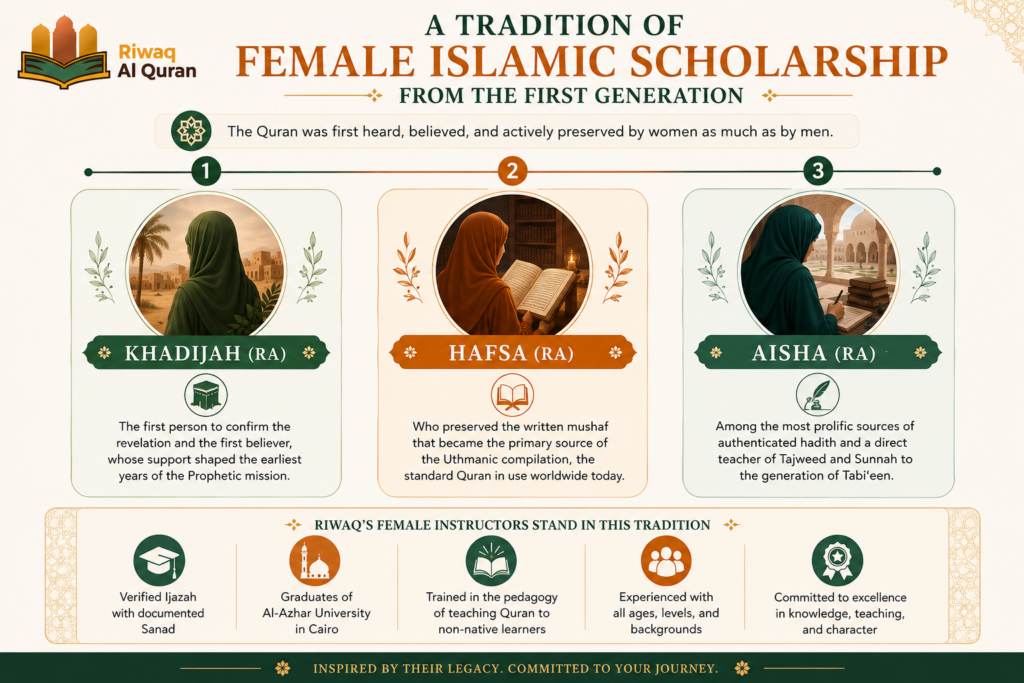
The Quran was first heard, believed, and actively preserved by women as much as by men. Three foundational examples from the earliest generation establish this tradition clearly:
- Khadijah (RA) — the first person to confirm the revelation and the first believer, whose support shaped the earliest years of the Prophetic mission.
- Hafsa (RA) — who preserved the written mushaf that became the primary source of the Uthmanic compilation, the standard Quran in use worldwide today.
- Aisha (RA) — among the most prolific sources of authenticated hadith in Islamic history and a direct teacher of Tajweed and Sunnah to the generation of Tabi’een who followed the Companions.
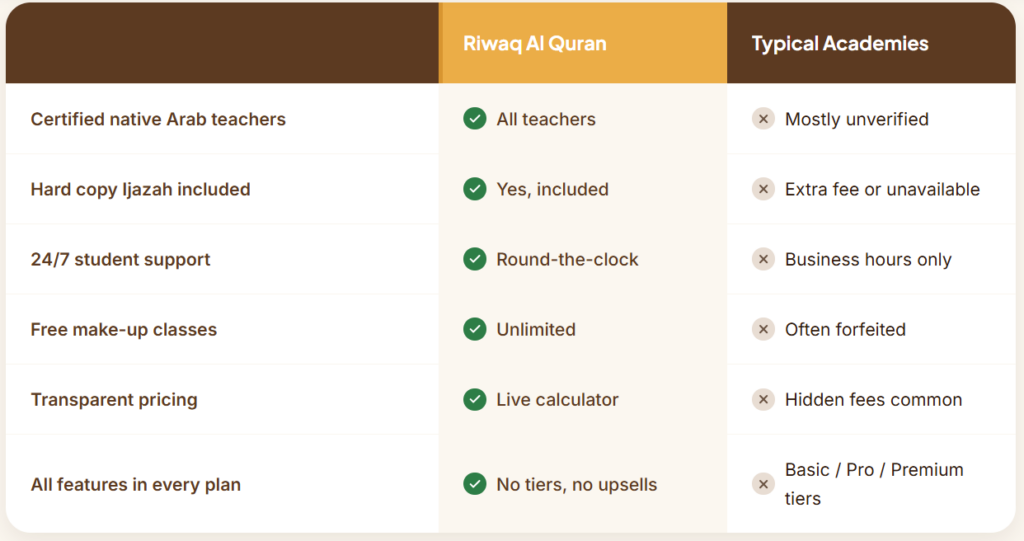
Riwaq’s female instructors stand in this tradition. They hold verified Ijazah with a documented Sanad, graduated from Al-Azhar University in Cairo — the oldest continuously operating Islamic university in the world — and are trained specifically in the pedagogy of teaching Quran to non-native learners across different ages and levels.
3. The Four Qualifications That Distinguish a Legitimate Female Quran Teacher
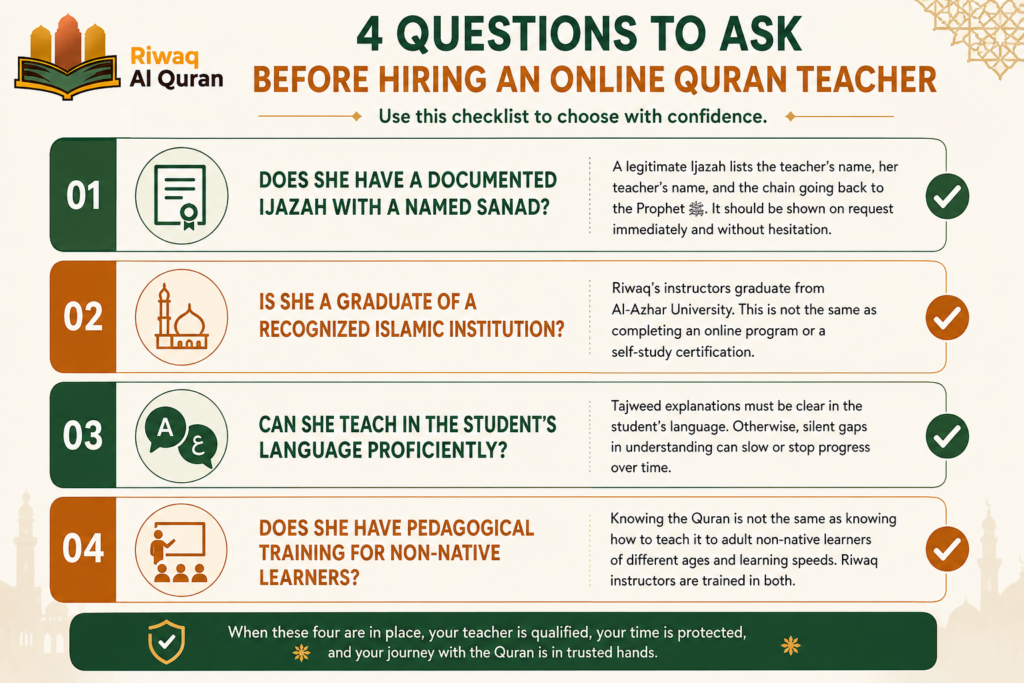
The online Quran teaching space has expanded rapidly and now contains large numbers of unverified instructors. These are the four qualifications that separate genuinely certified teachers from unverified ones — and the criteria Riwaq’s instructors are vetted against before joining the platform:
- Documented Ijazah with a named Sanad — not self-reported. A legitimate Ijazah is a physical certificate listing the teacher’s name, her teacher’s name, and the chain going back to the Prophet ﷺ. A qualified teacher provides it on request immediately and without hesitation.
- Academic credential from a recognized Islamic institution — Riwaq’s instructors graduate from Al-Azhar University. This is not equivalent to completing an online Quran program or a self-study certification.
- Language proficiency in the student’s language — Tajweed explanations that do not translate clearly into the student’s language create comprehension gaps that undermine progress silently over time. Riwaq teachers instruct in English, Arabic, and Urdu.
- Pedagogical training for non-native learners — knowing the Quran and knowing how to teach it to adult non-native speakers at different ages and learning speeds are two separately trained skill sets. Riwaq’s instructors hold both.
The Islamic Foundation — Why Every Muslim Woman Is Called to Learn the Quran
Many sisters approach Quranic education as a personal ambition — something meaningful but ultimately optional, to pursue when life allows. The Quran and the authenticated Sunnah present it differently: as a religious act with specific, documented rewards and a direct relationship to one’s standing in the hereafter. The three texts below establish that foundation with clarity.
1. The Prophet ﷺ Named the Learner and Teacher of Quran “the Best Among You”
Among all descriptions the Prophet ﷺ could have chosen — the most devout, the most generous, the most patient — he chose this one. It is worth pausing on why, and on what it means for every woman who opens a Quran today:
«خَيْرُكُمْ مَنْ تَعَلَّمَ الْقُرْآنَ وَعَلَّمَهُ»
“The best among you is the one who learns the Quran and teaches it.” — Narrated by Uthman ibn Affan (RA) — Sahih al-Bukhari, Hadith 5027
The word خَيْرُكُمْ — “the best of you” — is a superlative the Prophet ﷺ reserved for the highest categories of believers. It carries no restriction to scholars, to men, or to those with formal training. A woman who learns the Quran correctly and passes that knowledge to her children, neighbors, or students enters this category directly.
The hadith sets two conditions — learning and teaching — which explains why formal credentials like Ijazah, which culminate in the certified ability to transmit the Quran, hold such weight in the tradition.
2. Why the Reward Is Doubled for Those Who Find It Difficult
It is easy to assume that the reward for recitation belongs to those for whom it comes naturally — the fluent, the young, those who grew up with the language. This hadith addresses that assumption directly, and in doing so, changes the terms entirely:
«الْمَاهِرُ بِالْقُرْآنِ مَعَ السَّفَرَةِ الْكِرَامِ الْبَرَرَةِ، وَالَّذِي يَقْرَأُ الْقُرْآنَ وَيَتَتَعْتَعُ فِيهِ وَهُوَ عَلَيْهِ شَاقٌّ لَهُ أَجْرَانِ»
“The one who is proficient in the Quran will be with the noble, righteous messenger-angels. And the one who reads the Quran but stutters through it, finding it difficult — for that person are two rewards.” — Narrated by Aisha (RA) — Sahih al-Bukhari, Hadith 4937
يَتَتَعْتَعُ (yatatata’u) describes the physical effort of pushing through difficult articulation. وَهُوَ عَلَيْهِ شَاقٌّ (wa huwa ‘alayhi shaqq) confirms it is genuinely hard for that person — not just unfamiliar, but effortful. Both conditions together unlock a doubled reward.
This hadith is among the most important texts for sisters who feel too old, too far behind, or that their accent makes correct pronunciation unreachable. The difficulty itself is what the reward is built on — not a reason to delay, but a reason the effort matters more.
3. The Quran Will Intercede for You on the Day of Judgement
On a day when no wealth, no status, and no connection will help — only specific deeds will carry weight. The Prophet ﷺ described one of those deeds directly, and tied it to a word that reveals the nature of the relationship the Quran expects from you:
«اقْرَءُوا الْقُرْآنَ فَإِنَّهُ يَأْتِي يَوْمَ الْقِيَامَةِ شَفِيعًا لِأَصْحَابِهِ»
“Recite the Quran, for it will come on the Day of Resurrection as an intercessor for its companions.” — Narrated by Abu Umamah al-Bahili (RA) — Sahih Muslim, Hadith 804
أَصْحَابِهِ — “its companions” — shares the same Arabic root as Sahabi (Companion). It implies a continuous, living relationship — not a one-time encounter. Women who recite the Quran regularly, learn its rules, memorize its verses, and study its meaning qualify for this intercession. That relationship begins with a single enrollment decision.
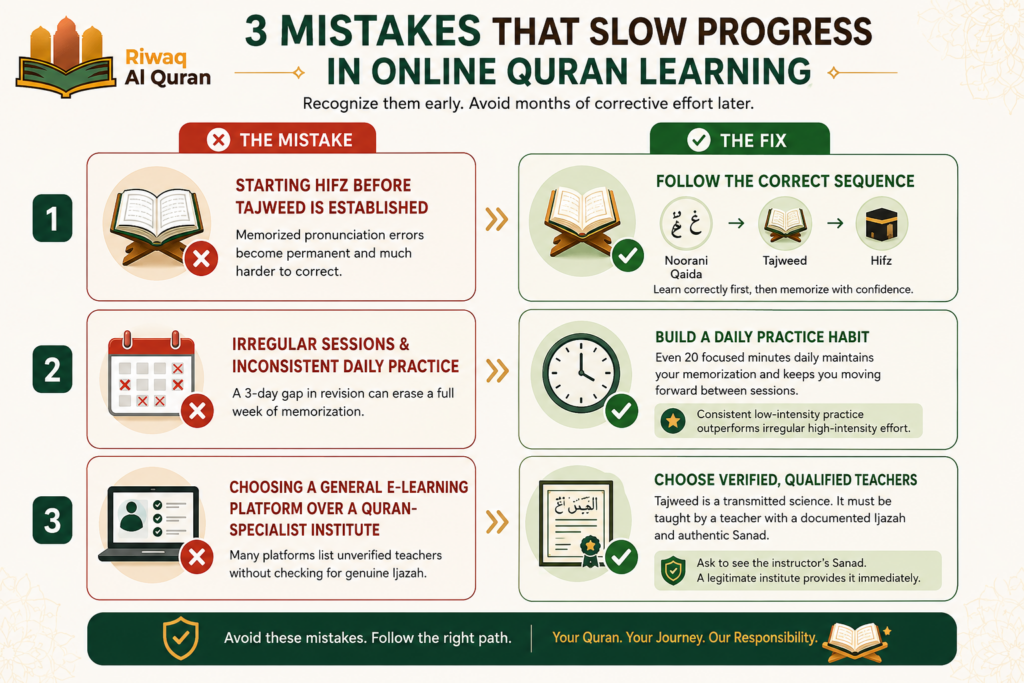
Three Common Mistakes That Slow Progress in Online Quran Learning
These three patterns appear consistently across all levels of online Quran education. Recognizing them before starting removes months of corrective effort later.
1. Starting Hifz before Tajweed is established
This is the most consequential error in Quranic education and the one experienced Hifz teachers encounter most often. Memorized pronunciation errors are permanent in a way reading errors are not — they become the automatic pattern the brain retrieves when the student recites.
Correcting pronunciation after memorization requires a process of un-memorizing, which experienced teachers estimate at three to four times the effort of learning correctly from the start. The correct sequence is always: Noorani Qaida (if needed) → Tajweed → Hifz.
2. Irregular session attendance and inconsistent daily practice
Quranic memorization degrades without daily engagement. A three-day gap in revision can erase a full week of previously memorized material, depending on how recently it was memorized. Riwaq’s instructors help each student establish a minimum sustainable daily practice routine — even 20 focused minutes per day maintains progress between weekly sessions.
Consistent low-intensity practice outperforms irregular high-intensity effort every time in memorization contexts.
3. Choosing a general e-learning platform over a Quran-specialist institute
Tajweed is a transmitted science. Its rules must be received from a certified teacher in a documented chain going back to the Prophet ﷺ — not from a video, a PDF, or an unverified tutor listed on a general marketplace. General platforms frequently list instructors without verifying whether they hold a genuine Ijazah.
When evaluating any online Quran provider: ask to see the instructor’s documented Sanad. A legitimate institute provides it immediately.
Start Your Quran Journey — Two Free Sessions, No Commitment Required
Riwaq Al Quran provides every new sister with two complete free one-on-one sessions with a qualified female instructor — at a time she selects, in her preferred language, with no payment information required to book.
In those two sessions: a placement assessment that identifies exactly where to start, a personalized learning plan built around her actual schedule, and the first real lesson — all before any commitment is made. Thousands of Muslim women from over 40 countries began their Quranic journey exactly this way.
Watch real moments from our live sessions at Riwaq Al Quran and see how we bring learning to life:
Conclusion
Online Quran classes for sisters have made qualified Islamic education available to Muslim women regardless of geography, schedule, or family commitments. The Quran’s opening command was to read. The Prophet ﷺ named the learner and teacher of Quran as the best among believers.
The hadith of Aisha (RA) assured those who struggle that their reward is doubled. The hadith of Abdullah ibn Amr (RA) connected each memorized verse to a permanent rank in Paradise — one that rises with every page learned correctly.
Riwaq Al Quran builds on this foundation with Al-Azhar-credentialed female instructors, documented Ijazah with verified Sanad, one-on-one sessions across three languages, and a complete curriculum from Noorani Qaida through Hifz, Tafseer, Qirat, and Ijazah certification. The correct starting point is identified in the first free trial session. The second session produces a written plan. Everything after that is the work itself.
The first step requires only a decision. The free trial removes every practical barrier to making it.
Frequently Asked Questions
The questions below address the most common concerns sisters raise before starting an online Quran course — covering qualifications, timelines, language requirements, and what the free trial actually involves. If a question is not answered here, the Riwaq Al Quran course catalog covers the full range of offerings in detail.
Can Muslim women learn the Quran online with female teachers?
Yes. Riwaq Al Quran offers one-on-one and small-group online sessions taught exclusively by certified female instructors over private video call. Every course — from Noorani Qaida through Ijazah certification — is available with a female teacher in English, Arabic, or Urdu, with no mixed-gender component at any stage.
How long does it take to learn Tajweed from scratch?
Most students apply the core Tajweed rules consistently in recitation within three to six months of twice-weekly sessions. Full fluency — where rules apply automatically without conscious effort — typically takes twelve to eighteen months. Students who already read Arabic fluently progress faster. The first free trial session produces a specific, personal estimate based on the student’s actual level at the time of assessment.
What is the difference between Tajweed and Tarteel?
Tajweed is the science of correct articulation — the precise rules governing the pronunciation of each Arabic letter and how letters interact during recitation. Tarteel is the measured, unhurried pace of delivery that allows those rules to be applied with precision. Allah ﷻ commanded Tarteel directly in Surah Al-Muzzammil (73:4): وَرَتِّلِ الْقُرْآنَ تَرْتِيلًا. Riwaq’s Quran recitation course teaches both as an integrated unit from the first session.
Do I need to know Arabic before starting Quran classes online?
No. Sisters with no prior Arabic reading ability begin with the Noorani Qaida program, which builds letter recognition and correct sound production from the ground up. Attempting Tajweed or Hifz before completing this step is one of the three most common mistakes that slow progress — the Noorani Qaida’s six to eight weeks of investment is recovered many times over at every stage that follows.
What qualifications do Riwaq Al Quran’s female teachers hold?
Riwaq’s instructors are Hafizat (have memorized the complete Quran), hold a documented Ijazah with a named chain of transmission, and the majority are graduates of Al-Azhar University in Cairo. They are trained in pedagogical methods for non-native learners across different age groups and instruct in English, Arabic, and Urdu. All four qualification criteria are verified before any instructor joins the platform.