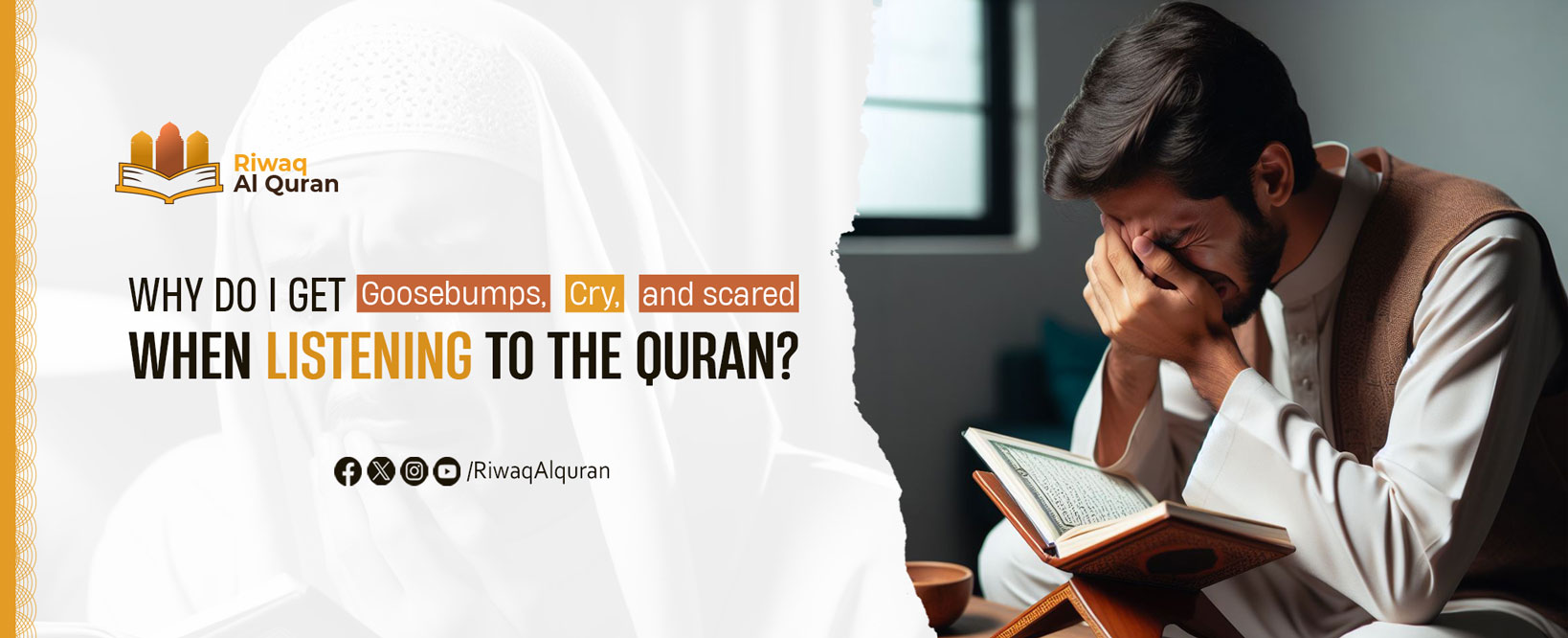
If you’ve ever felt your skin tremble, your eyes fill with tears, or a wave of fear pass through you while listening to the Quran, you’re not alone, and you’re not imagining it. These reactions are described directly in the Quran itself, and understanding what they mean can deepen rather than worry you.
This article explains why goosebumps, crying, and fear happen when listening to the Quran, what each reaction signals about the heart, and when a physical symptom like a headache needs a doctor’s attention rather than a spiritual explanation.
What You’ll Learn in This Article
- Why goosebumps and trembling skin are described in the Quran as a sign of a healthy heart.
- Why crying while listening often reflects recognition of truth, not sadness.
- How fear, love, and hope are meant to work together in worship, not fear alone.
- When a headache while listening needs medical attention first, before anything else.
- What current research says about Quran recitation and stress, with the actual studies behind it.
Before looking at what happens when someone truly engages with these words, it’s worth remembering what disengagement from them looked like:
Table of Contents
Why Listening to the Quran Causes Goosebumps and Trembling
Feeling your skin react while listening to the Quran is a documented response, not an unusual or concerning one. Allah describes this directly in the Quran itself, tying it to a specific spiritual state and telling you exactly what should follow it.
What Goosebumps Signal, and What Comes After
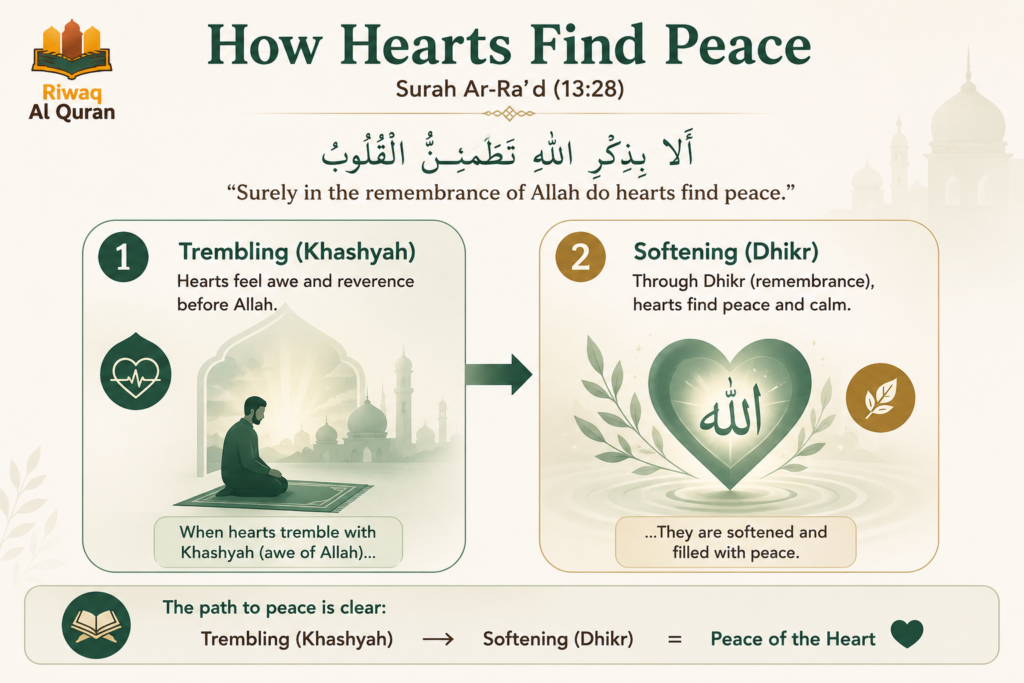
Goosebumps while hearing or reciting the Quran are described as a sign of khashyah—a reverent fear of Allah arising from a spiritually responsive heart.
Allah SWT says in the Quran:
(اللَّهُ نَزَّلَ أَحْسَنَ الْحَدِيثِ كِتَابًا مُتَشَابِهًا مَثَانِيَ تَقْشَعِرُّ مِنْهُ جُلُودُ الَّذِينَ يَخْشَوْنَ رَبَّهُمْ ثُمَّ تَلِينُ جُلُودُهُمْ وَقُلُوبُهُمْ إِلَىٰ ذِكْرِ اللَّهِ)
“Allah has sent down the best message: a Book of perfect consistency and repeated lessons. The skin of those who fear their Lord trembles at it, then their skin and hearts soften at the remembrance of Allah.”(Surah Az-Zumar, 39:23)
This single verse describes the full pattern in two stages:
- The trembling itself is a sign of khashyah, a reverent fear of Allah, generally described as a marker of a spiritually alive heart, not something to worry about.
- The softening afterward is the intended follow-up — the reaction is meant to settle into calm reflection, not stay as heightened emotion or anxiety.
If you want to understand more of what you’re feeling in the moment, rather than only the sound of the words, Riwaq Al Quran’s online Tafseer course walks through the meaning behind verses like this one directly.
Why Listening to the Quran Makes You Cry
Why does the Quran move someone to tears specifically, rather than describing a general emotional response? Allah answers this by describing crying not as sadness or grief, but as a reaction to recognizing something true:
(وَإِذَا سَمِعُوا مَا أُنْزِلَ إِلَى الرَّسُولِ تَرَىٰ أَعْيُنَهُمْ تَفِيضُ مِنَ الدَّمْعِ مِمَّا عَرَفُوا مِنَ الْحَقِّ يَقُولُونَ رَبَّنَا آمَنَّا فَاكْتُبْنَا مَعَ الشَّاهِدِينَ)
“And when they hear what has been revealed to the Messenger, you see their eyes overflowing with tears because of what they have recognized of the truth. They say: Our Lord, we have believed, so register us among the witnesses.” (Surah Al-Ma’idah, 5:83)
The phrase “because of what they have recognized of the truth” is doing the real work in this verse — it names recognition (ma’rifah) as the trigger, not grief or distress. This distinction matters if you’ve ever wondered whether crying during recitation is a sign something is wrong; according to this verse, it’s closer to the opposite.
The verse describes a consistent three-part pattern rather than an isolated emotional moment:
- An emotional reaction — tears, triggered by recognition rather than grief.
- A verbal declaration of belief spoken immediately afterward.
- A request to be counted among those who bear witness to the truth.
Crying, in this context, is the first step of that pattern, not the whole of it — a sign the words have landed, not a symptom to manage. Read on its own, the tears might look like the entire response; read in context, they’re the opening move that’s supposed to be followed by an actual statement of belief, not left to stand alone as pure feeling.
Why You Might Feel Scared or Fearful When Listening to the Quran
This section answers a question many listeners quietly wonder about but rarely ask directly: is it healthy to feel afraid while listening to the Quran, or is that a sign something’s wrong? The short answer is that fear is a natural and expected response — but Islamic tradition is specific about how that fear needs to sit alongside two other emotions to stay healthy, rather than standing on its own.
1. Balancing Fear With Love and Hope
Before looking at what happens when fear stands alone, it helps to see how the Quran frames the healthy version first. Allah describes this balance directly:
(إِنَّهُمْ كَانُوا يُسَارِعُونَ فِي الْخَيْرَاتِ وَيَدْعُونَنَا رَغَبًا وَرَهَبًا وَكَانُوا لَنَا خَاشِعِينَ)
“Indeed, they used to hasten to good deeds and call upon Us in hope and fear, and they were humbly submissive to Us.” (Surah Al-Anbiya, 21:90)
Notice that this verse doesn’t isolate fear as a standalone virtue — it pairs raghaban (hope) and rahaban (fear) in the same breath, describing the same people calling on Allah with both at once, not alternating between them.
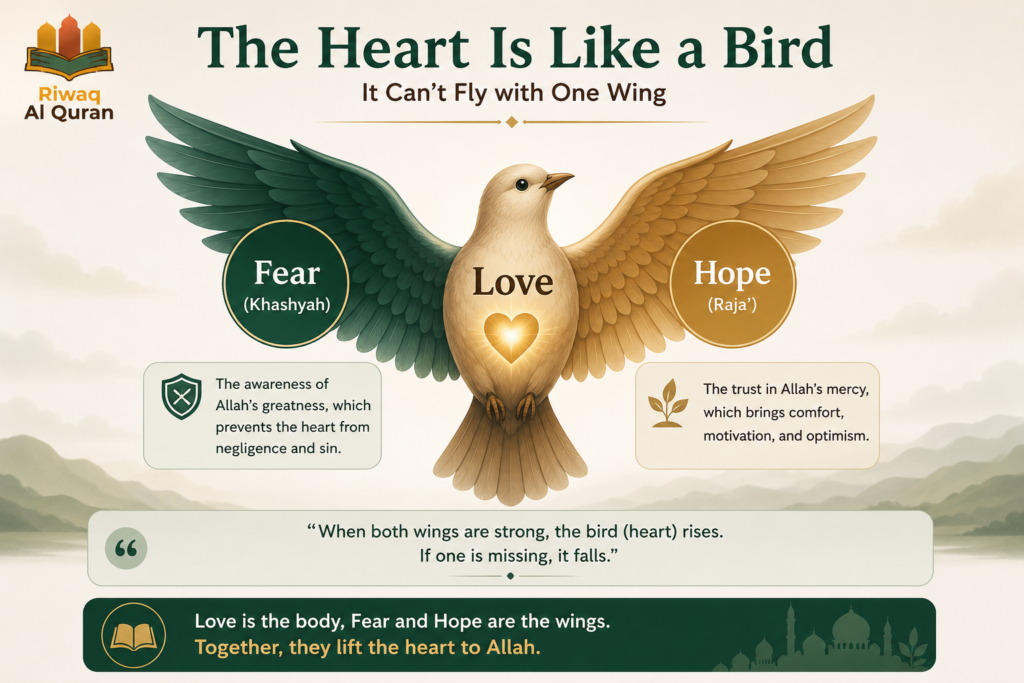
Scholars commonly illustrate this balance using the image of a bird: love is the bird’s body, fear is one wing, and hope is the other. A bird missing either wing cannot fly — meaning fear alone, without the other two, isn’t the complete or intended state of worship.
2. What Happens When Fear Stands Alone
The Quran also addresses the opposite failure — despair — which shows why fear needs its counterbalance rather than being left unchecked. Allah states:
(قَالَ وَمَنْ يَقْنَطُ مِنْ رَحْمَةِ رَبِّهِ إِلَّا الضَّالُّونَ)
“He said: ‘And who despairs of the mercy of his Lord except for those who are astray?'” (Surah Al-Hijr, 15:56)
This verse directly links despairing of Allah’s mercy — the endpoint of fear left unbalanced by hope — to being astray, which is a serious characterization, not a minor spiritual lapse.
On the other side of the same coin, hope without fear can slide into complacency, assuming reward is guaranteed regardless of one’s actions, which the Quran treats as its own distinct problem elsewhere.
Feeling scared while listening to the Quran is not a problem in itself — it becomes one only if fear is left to stand alone, without the balance of hope and love the verse in Al-Anbiya describes.
Understanding the meaning behind the verses you’re reacting to changes how these emotions settle — Riwaq Al Quran’s Tafseer classes are built specifically around this kind of verse-by-verse understanding, rather than recitation alone.
When a Headache While Listening to the Quran Needs Medical Attention
If you experience a headache while or after listening to the Quran, check with a doctor first, especially if the headache is severe, sudden, or repeats often. A headache has many physical causes, and ruling those out comes before considering any other explanation.
1. See a Doctor First, Every Time
Persistent, severe, or recurring headaches should be evaluated by a medical professional before being attributed to anything else. This isn’t a footnote — it’s the first and most important step, since a treatable physical cause is far more common than any alternative explanation.
2. What Islamic Tradition Adds, After a Medical Check
Once a medical cause has been ruled out, some scholars describe the Quran’s effect on the body using the language of a cure that can temporarily cause discomfort as it addresses an underlying spiritual affliction, such as the influence of magic or the evil eye.
If you want to approach this angle after seeing a doctor, tradition recommends:
- Being in a state of wudu while listening or reciting.
- Reciting the dua the Prophet ﷺ taught: “I seek refuge in Allah and His power from what I find and fear.”
3. Chapters Traditionally Recited for Comfort
Surah Al-Fatihah is widely known as Ash-Shifa (the Healing) and is traditionally recited as Ruqyah, a spiritual remedy, for various bodily discomfort, including headaches. Also commonly recited for comfort:
- The final three chapters of the Quran — Surah Al-Ikhlas, Surah Al-Falaq, and Surah An-Nas.
- Surah Ar-Rahman.
- Specific verses referred to as Ayat Ash-Shifa (Verses of Healing), found scattered throughout the Quran.
None of this replaces medical care — it’s a companion practice, not a substitute for it.
What Scientific Research Says About Quran Recitation and Stress
A growing body of peer-reviewed research has looked specifically at how listening to Quran recitation affects measurable stress markers, separate from any spiritual explanation.
a. Cortisol, Stress Markers, and Clinical Use
A randomized controlled trial published in Universa Medicina measured stress using biofeedback indicators — including heart rate and skin conductance — after participants listened to Quran recitation.
A separate systematic review found reductions in anxiety across multiple studies of Quran listening, and a small pilot study published in the Journal of Religion and Health examined its use with ICU patients being weaned off mechanical ventilation, as one example of clinical application.
These are specific, named studies, not a general claim — the effect size and populations studied still vary between them.
b. What EEG Studies Show About Brain Activity
Separately, EEG-based studies — including one reviewed in the Iranian Journal of Psychiatry — have found increased alpha-wave brain activity during Quran listening compared to control conditions, a pattern generally associated with relaxed alertness rather than acute stress.
This is a genuinely researched area, though it remains an active field of study rather than a fully settled one.
If understanding the Quran more deeply, rather than only its acoustic effect, is what draws you in, Riwaq Al Quran’s online Quran and Tafseer courses are designed to build that connection with a qualified instructor.
Here’s what that deeper connection looks like for one of our own students:
Deepen Your Connection to the Quran With Riwaq Al Quran
Reacting to the Quran is only the beginning — understanding what you’re hearing is what turns that reaction into lasting connection.
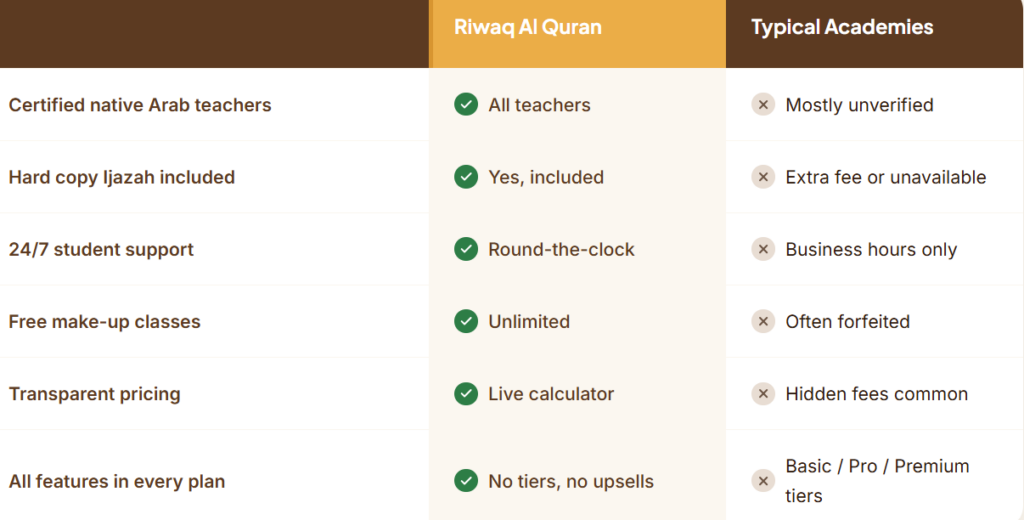
Riwaq Al Quran is a comprehensive online platform that offers personalized Quran, Arabic, and Islamic Studies online classes for individuals of all ages and backgrounds. Their experienced instructors use a structured curriculum to cover Tajweed, Tafsir, and Memorization, providing easy and effective access to learning the Quran. The advanced online classes allow for seamless communication and interaction between students and teachers. Join Riwaq Al Quran for a deeper connection with the Quran.
We offer several courses, including:
- Online courses for kids
- Online Quran classes for kids and adults
- Online Arabic courses
- Online Ijazah courses
- Online Islamic Studies courses

 Here is a sample of our Quran courses that will be helpful for you:
- Online Tafseer Course: Delve into Quranic meanings with our insightful online Tafseer course.
- Noorani Qaida Online: Learn Quranic basics efficiently through our Noorani Qaida online program.
- Online Quran Recitation Course: Enhance Quranic recitation skills through our expert-led online course.
- Online Tajweed Classes: Master Tajweed rules for beautiful Quranic recitation in online classes.
- Quran Memorization Online Course: Memorize the Quran effectively with our specialized online memorization course.
- Online Qirat Course: Explore diverse Qirat styles with our comprehensive online Qirat course.
- Online Quran Classes for Kids: Nurture a love for the Quran in kids through interactive online classes.
Conclusion
Goosebumps, tears, and fear while listening to the Quran are described in the Quran itself as signs of a heart responding to truth — trembling skin as reverence, tears as recognition, and fear as one part of a balance that also includes love and hope.
A headache is different: check with a doctor first, and only afterward consider it alongside Islamic tradition or the growing research on Quran recitation and stress. Understanding why these reactions happen, rather than only noticing them, is what lets you respond to them with reflection instead of concern.
FAQs
The questions below cover what most people search after noticing one of these reactions in themselves — from whether it’s normal, to what to do about a headache specifically.
Is it normal to get goosebumps when listening to the Quran?
Yes, goosebumps or trembling skin while listening to the Quran is described directly in Surah Az-Zumar (39:23) as a sign of reverent fear of Allah, generally considered a marker of a healthy, responsive heart rather than a cause for concern.
Why do I cry every time I hear certain Quran verses?
Crying while listening to the Quran is often a reaction to recognizing truth rather than sadness, a pattern described in Surah Al-Ma’idah (5:83) where believers weep upon hearing revelation and then declare their faith aloud.
Is it bad to feel scared when listening to the Quran?
No, feeling fear is a natural and encouraged response as long as it’s balanced with love and hope rather than left on its own, since fear without hope can lead to despair, which the Quran specifically warns against in Surah Al-Hijr (15:56).
What should I do if I get a headache while listening to the Quran?
See a doctor first if the headache is severe, sudden, or recurring, since a medical cause should always be ruled out before considering any other explanation.
Does science support Quran recitation reducing stress?
Yes, several peer-reviewed studies, including a randomized controlled trial in Universa Medicina and EEG research reviewed in the Iranian Journal of Psychiatry, have found reduced stress markers and increased alpha-wave brain activity linked to Quran listening, though this remains an active area of ongoing research.