The right Quran memorization techniques make the difference between a page that sticks for life and one you re-memorize every Ramadan. Hifz is not primarily a talent — it’s a set of repeatable methods: how you repeat a verse, when you review it, which Mushaf you use, and whether your recitation was corrected before you locked it into memory.
“وَلَقَدْ يَسَّرْنَا ٱلْقُرْءَانَ لِلذِّكْرِ فَهَلْ مِن مُّدَّكِرٍۢ”
“We have made the Quran easy to remember. So is there anyone who will be mindful?”” (Surah Al-Qamar, 54:17)
This guide walks through ten techniques used by working Hifz students and teachers, plus the parts most guides skip: how long memorization realistically takes, the mistakes that quietly slow students down, and how to decide whether to go it alone or study with a teacher.
Table of Contents
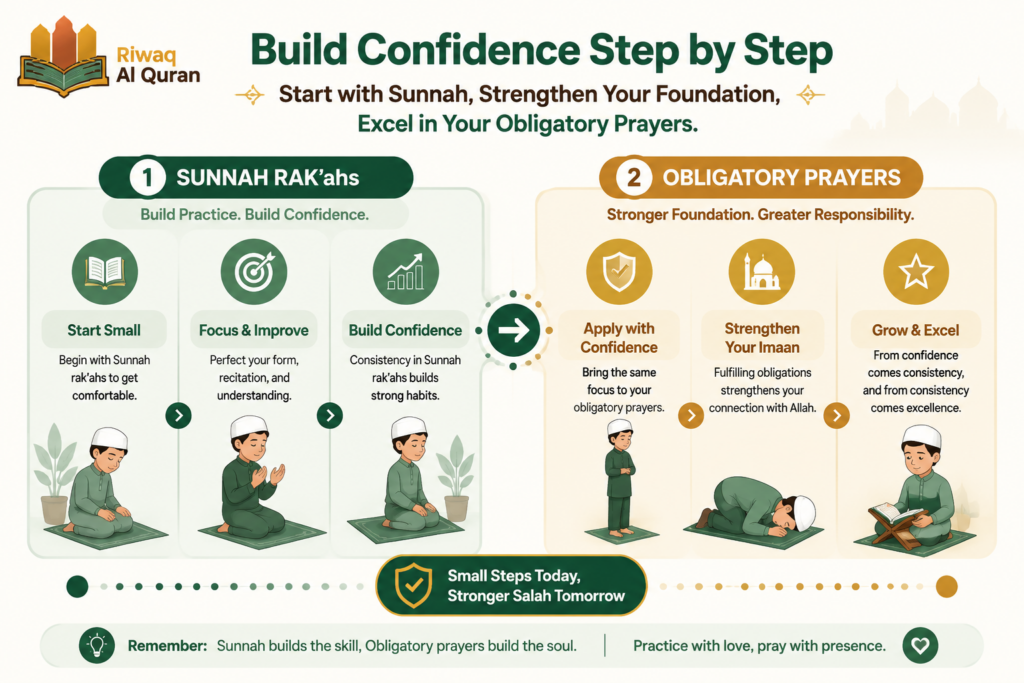
1. Recite What You’ve Memorized During Salah
Praying with the verses you’ve memorized is one of the most effective Quran memorization techniques because it forces retrieval under real conditions, not just recognition on a page.
To build this into your prayers gradually:
- Start with short memorized verses in the sunnah rak’ahs.
- Move them into your obligatory prayers as your confidence grows.
Recalling a verse from memory while standing in prayer, with no Mushaf in front of you, is a harder test than reading it silently at your desk — and harder retrieval builds stronger memory.
Which Prayer to Start with Matters
Maghrib and Isha give you more flexibility in the third and fourth rak’ahs, where only Al-Fatiha is obligatory — a good low-pressure slot to test a newly memorized short Surah before using it in Fajr or Dhuhr, where longer recitation is expected.
If you freeze mid-verse: don’t stop the prayer to think. Repeat the last phrase you’re sure of, and if it still doesn’t come, move to Al-Fatiha alone and continue — then go back to that exact verse in your next review session rather than trying to force it in the moment. Forcing a blocked recall under prayer pressure tends to reinforce the freeze, not fix it.
A common mistake here is rushing the sunnah-to-obligatory transition to “prove” progress. If a verse isn’t automatic in a low-stakes sunnah rak’ah, it isn’t ready for a fard prayer where a stumble is more disruptive — treat the sunnah rak’ahs as your actual test, not a formality.
Don’t Memorize Mistakes
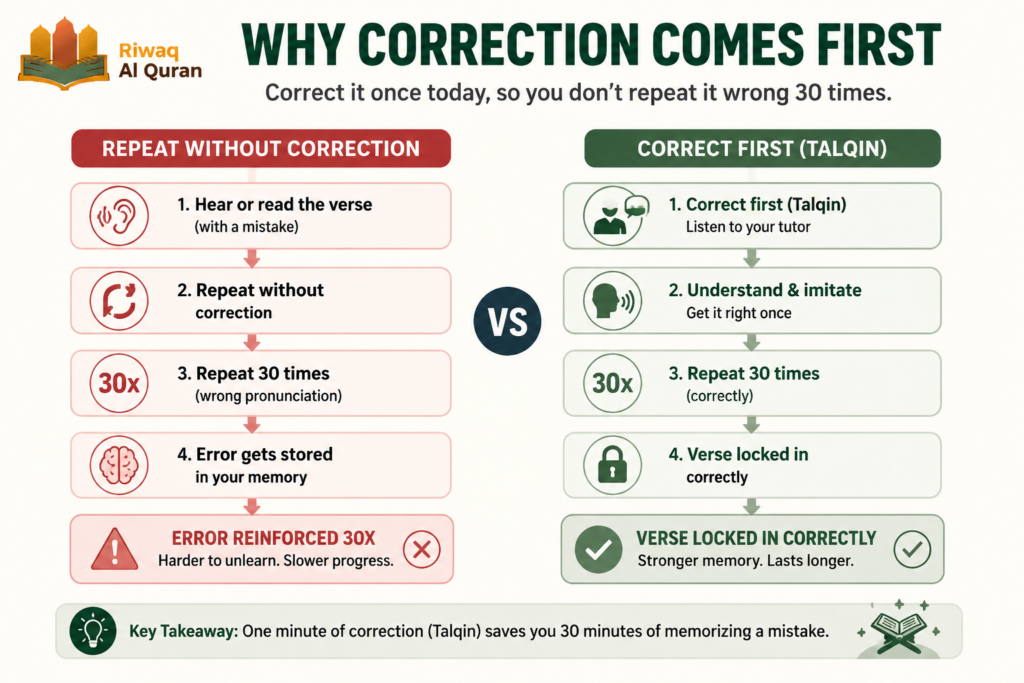
A mistake memorized during Salah gets repeated daily, which makes it harder to unlearn than a mistake you catch while reading. This is why correction has to happen before repetition, not after.
At Riwaq Al Quran’s Online Quran Memorization course, the guiding rule is Tashih before Hifz:
- Tashih before Hifz — correction comes before memorization, not after.
- Fossilized error — a wrong Makhraj (articulation point) repeated so often it becomes automatic and resistant to correction; common among self-taught students.
- Talaqqi — receiving each verse orally from a qualified teacher before committing it to memory, rather than relying on self-checking.
This is the traditional safeguard against fossilized errors, and it’s why the course pairs students with an Azhari tutor from the first verse.
2. Divide Each Page and Learn the Meaning First
Splitting a Mushaf page into two halves makes memorization more manageable, but the technique only works well when it’s paired with understanding the meaning of what you’re memorizing.
Memorize the first half, confirm it’s solid, then move to the second half rather than trying to absorb a full page at once. This reduces the working-memory load on any single session.
If half a page still feels heavy — especially on pages with long, complex ayahs rather than short ones — drop to quarter-page or even single-ayah blocks. The half-page split is a default, not a rule; the right unit size is whatever you can recite back without hesitation on the first attempt.
Why Meaning Speeds Up Memorization
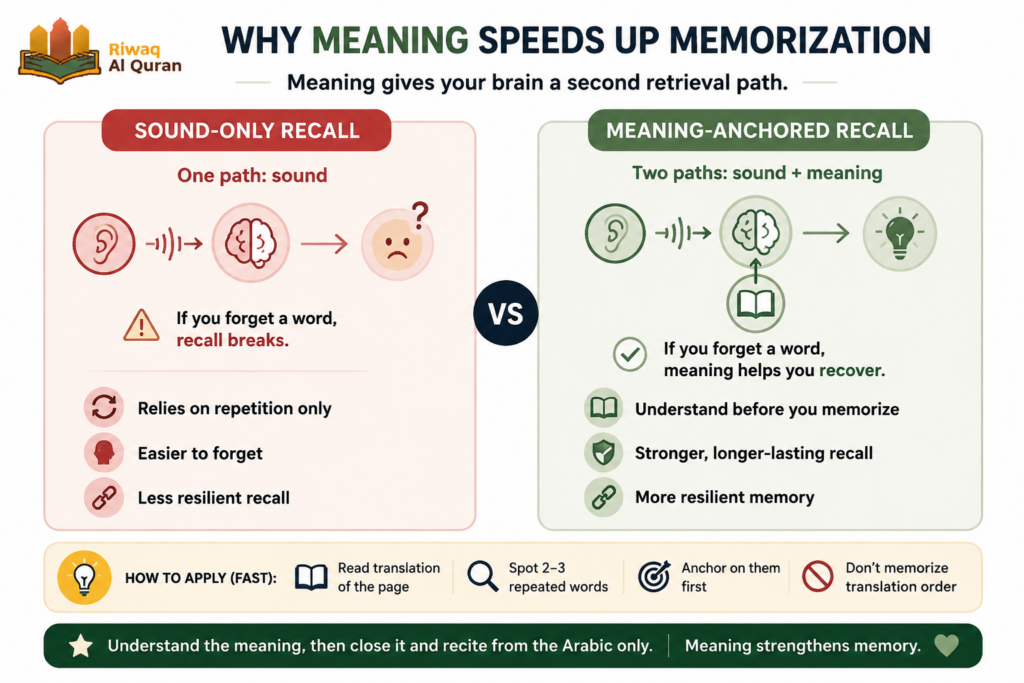
Meaning gives your brain a second retrieval path beyond sound alone — you’re not just recalling how a verse sounds, you’re recalling what it says. This matters most for non-Arabic speakers, who often retain verses more permanently once they understand them than when they memorize sound patterns alone.
A short Tafseer pass on the page you’re about to memorize — even five minutes — turns memorization from mechanical repetition into something you can reconstruct from meaning if you forget a word.
A practical way to do this without a full Tafseer session:
read a word-for-word translation of just the page you’re about to memorize, and note which words repeat across the page — many pages reuse two or three key words (a name, a command, a recurring root). Anchoring on those first gives you a skeleton the rest of the verse hangs off, which is faster than reading a full explanatory Tafseer for every page.
One mistake to avoid: memorizing the translation’s word order instead of the Arabic’s. Read the meaning to understand it, then close the translation and go back to reciting only from the Arabic text — mixing the two during recitation slows recall rather than helping it.
3. The 3/10 Method and the 30-Times Method
Repetition is the mechanical core of Hifz, and these two methods structure it so the repetition actually converts into long-term memory instead of short-term familiarity.
The 3/10 method:
- Read each verse from the Mushaf 10 times.
- Recite it from memory 3 times without looking.
- Move to the next verse and repeat the pattern until the end of the page.
- Recite the full page once from memory and revise any part that broke down.
The 30-Times Method
Read each verse directly from the Mushaf 30 times in a row before moving to the next one, relying on sheer repetition volume rather than the read/recall split.
The 3/10 method works better if you’re prone to distraction, because the forced recall step every 10 reps keeps you actively testing yourself instead of passively reading. The 30-times method suits verses that are already fairly familiar — from prior exposure in prayer or recitation — where the goal is locking in wording rather than building recognition from scratch.
Trying to force a genuinely new, unfamiliar verse through pure 30x reading without an active-recall check tends to produce recognition (“I know this verse”) without actual recall (“I can say this verse cold”) — the two feel similar but aren’t.
If you still can’t recall the verse after finishing either cycle, the problem is usually chunk size, not repetition count — split the verse at its natural pause points (waqf marks) and drill the piece that keeps breaking down on its own before rejoining it to the rest.
Why Flawless Recitation Must Come First
Repeating a verse 30 times only helps if the 30th repetition is as correct as the first. If a Tajweed error — wrong Ghunnah length, a dropped Qalqalah, a mispronounced heavy letter — is present from repetition one, all 30 repetitions reinforce the mistake equally.
This is why Talqin, receiving the verse orally from a teacher, traditionally comes before any repetition cycle begins. A short correction session with a certified Azhari tutor before you start repeating a page can save months of unlearning errors later.
Not sure what these Tajweed slips actually sound like in practice? This short clip walks through the most common beginner mistakes — the exact ones Talaqqi correction is meant to catch before they fossilize:
4. The Whole-Page Method With Audio Reinforcement
This method suits students who can sit and focus for an extended stretch: you memorize one full page per day rather than splitting it into smaller sessions.
- Read and listen to the page multiple times before attempting to recite it from memory.
- Pay close attention to Tajweed rules as you go.
- Pray with the memorized page the same day to reinforce it.
Listening to a skilled Qari recite the page adds melodic and rhythmic cues that pure silent reading doesn’t provide.
This method isn’t for everyone, It assumes you already recite reasonably fluently and can sustain focus for a long, unbroken session — if you’re newer to Hifz or tend to lose concentration after 15–20 minutes, the smaller-unit methods above (half-page, 3/10) will get better results than forcing a whole page in one sitting.
Pick one reciter and stay with them for a stretch of Hifz — at least through a Surah or a juz’. Switching between Qaris with different Qira’at riwayahs or different pacing mid-memorization can blur your internal rhythm for a page, making it harder to recall which version you actually memorized.
Why Listening Alone Can Mislead You
Self-perception is the weak point of audio-based memorization: you can believe you’re matching a Qari’s recitation exactly while missing subtle rules like Ghunnah intensity or Tafkheem (letter heaviness) that an untrained ear doesn’t catch.
You cannot correct an error you cannot hear. A teacher listening alongside you catches these drifts before they turn into habits — functioning as an audio check that self-study can’t replicate.
5. Bind the End of a Surah to Its Beginning
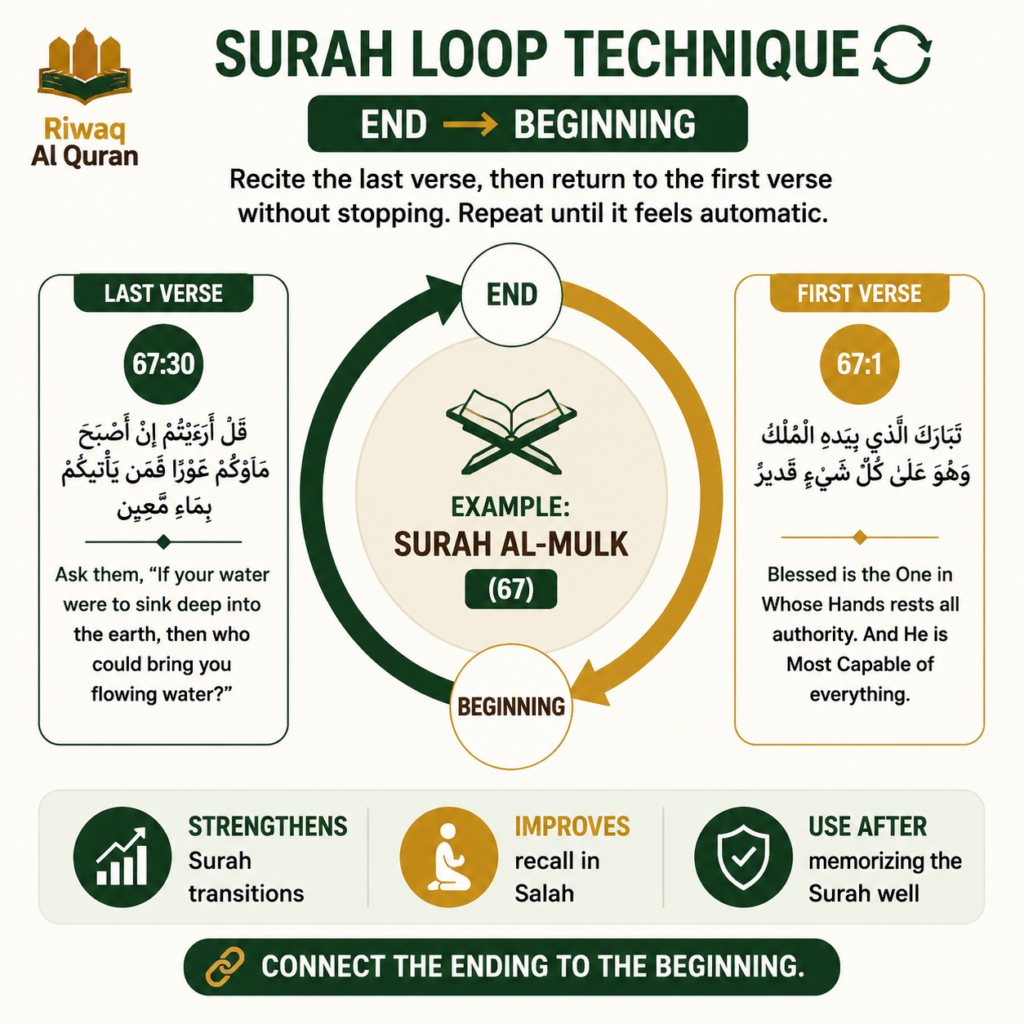
This technique creates a rhythmic loop between where a Surah ends and where it begins, which strengthens your ability to move between Surahs fluently during prayer instead of pausing to recall the start of the next one.
After finishing a Surah, recite its final verse and continue immediately into the first verse of the same Surah again, without pausing. Repeat this loop until the transition feels automatic.
Example — Surah Al-Mulk (67):
“قُلْ أَرَءَيْتُمْ إِنْ أَصْبَحَ مَآؤُكُمْ غَوْرًۭا فَمَن يَأْتِيكُم بِمَآءٍۢ مَّعِينٍۭ”
“Ask ˹them, O Prophet˺, “Consider this: if your water were to sink deep into the earth, then who could bring you flowing water?”(Surah Al-Mulk, Ayah 30)
Loop back to the beginning:
“تَبَـٰرَكَ ٱلَّذِى بِيَدِهِ ٱلْمُلْكُ وَهُوَ عَلَىٰ كُلِّ شَىْءٍۢ قَدِيرٌ”
“Blessed is the One in Whose Hands rests all authority. And He is Most Capable of everything.”(Surah Al-Mulk, Ayah 1 (67:1)”
Practicing this loop a few times before moving to a new Surah reinforces both endpoints and makes recall more reliable under pressure, such as leading prayer or reciting in front of others.
Use this after the Surah is already solid, not while you’re still learning it. Looping a half-memorized Surah just rehearses the parts you’re already confident in while the weak middle sections stay weak — this technique is a final consolidation step, not a substitute for memorizing the body of the Surah properly.
For longer Surahs (Al-Baqarah, Al-Kahf, longer sections of a juz’), apply the same loop logic at the boundary of each page or section rather than waiting for the whole Surah — bind the end of today’s new page to the beginning of yesterday’s, so your daily portions connect instead of sitting as isolated blocks.
6. One Fixed Mushaf and One Fixed Time
Memory is visual as well as auditory. Using a single, consistent copy of the Mushaf throughout your Hifz journey lets your brain memorize verse placement and page layout alongside the sound of the verse — a form of spatial memory that switching copies disrupts.
a. Why One Mushaf Matters
Changing between Mushafs with different line breaks, fonts, or page splits forces your brain to relearn the visual location of every verse, which slows recall and increases misplaced-verse errors.
Scholars and experienced memorizers consistently recommend sticking to one specific Mushaf edition for the entire journey — not just for convenience, but because the eyes end up memorizing alongside the ears.
In practice, this means picking one standard early — most Hifz programs default to the 15-line Madani Mushaf because its page breaks align with juz’ and Hizb divisions, which makes daily portions easier to plan around. Whatever edition you choose, keep a second identical physical copy as a backup so travel or a damaged copy doesn’t force a switch mid-journey.
If you also use a Quran app for on-the-go review, check whether its page layout matches your print Mushaf — many don’t, and using both interchangeably undoes the spatial-memory benefit this technique is built on.
b. Why Early Morning After Fajr Works Best
The period right after Fajr is widely used for new memorization because the mind is rested and external distractions are at their lowest point of the day.
Starting the day with a phone, TV, or other input before your Hifz session competes with the fresh cognitive state you need for memorizing new material, so protecting that window matters more than its length.
If Fajr genuinely isn’t workable — shift work, small children, inconsistent sleep — the principle still applies at a different time: pick whichever slot in your day comes right after your longest uninterrupted rest and before your attention gets consumed by work or screens.
Late morning after a full night’s sleep, or right before Isha before fatigue sets in, are the next-best windows. The consistency of the slot matters more than which exact hour it is.
Read also: Top Quran Memorization Habits
7. The Tahayyul Technique and Why You Should Prepare the Night Before
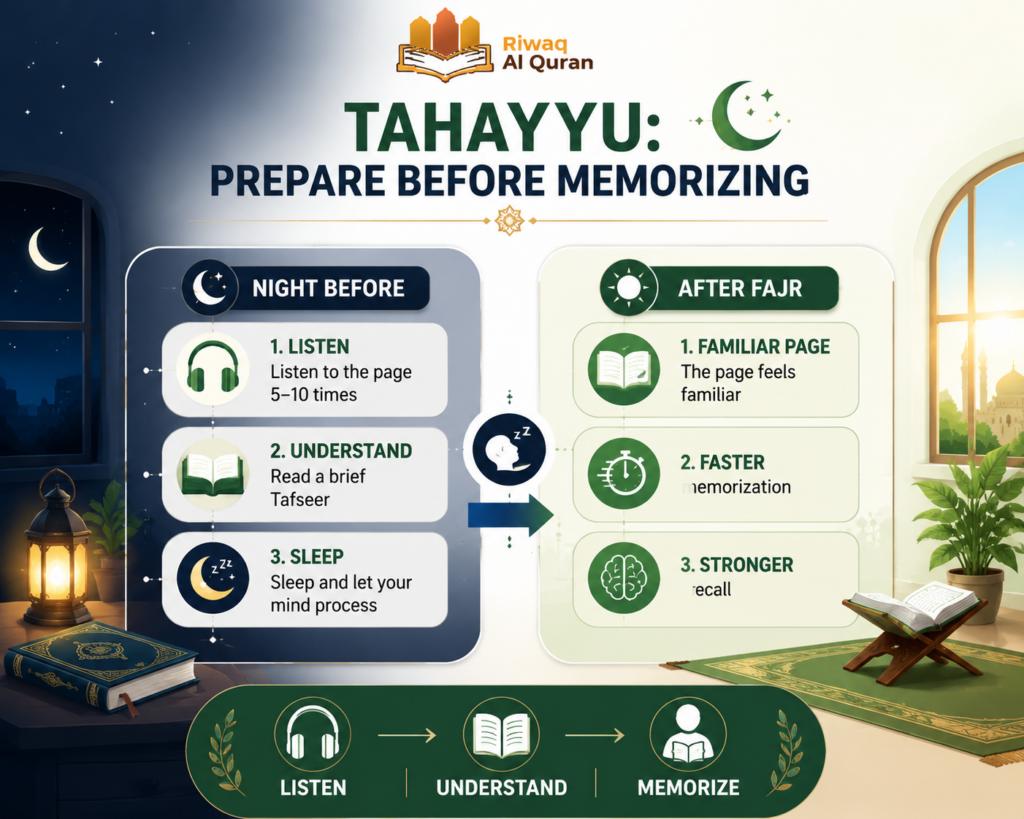
Tahayyu is the practice of priming a new page the night before you actually memorize it, so the material feels familiar rather than brand new when you sit down after Fajr.
The three-step routine:
- Before sleeping, listen to the new page recited by a Qari 5 to 10 times.
- Read a brief Tafseer of the page to understand its context.
- Go to sleep without further review.
Memory consolidation happens during sleep, so feeding your brain the sound pattern and meaning right before rest gives it material to process overnight. By the time you sit down with the page the next morning, the verses are no longer unfamiliar — you’re reinforcing a pattern your brain has already started processing, rather than starting from zero.
Use the same reciter for your Tahayyu listening that you use for your main memorization sessions (see technique 4) — this keeps the audio pattern you prime at night identical to the one you’ll be matching against the next morning, instead of asking your memory to reconcile two different recitation styles for the same page.
A useful check the next morning before opening the Mushaf, try to recall the page’s general theme or the first few words from memory alone. If nothing comes, the priming didn’t take — try listening to the page one more time immediately before your Fajr session rather than assuming last night’s five reps were enough.
8. Start With Short Surahs and Story-Based Surahs
Beginning with short Surahs like Al-Fatiha, Al-Ikhlas, Al-Falaq, and An-Nas builds early, visible progress, and because these Surahs are recited in daily prayers, they get reinforced automatically without extra review sessions.
Story-based Surahs — Yusuf, Al-Kahf, Al-Qasas — work well as a next step because the brain retains narrative sequences more easily than disconnected verses, and these Surahs naturally break into scenes that double as memorization chunks.
A practical sequence:
- Start with a cluster of short Surahs: Al-Fatiha → Al-Ikhlas → Al-Falaq → An-Nas.
- Move into short narrative Surahs: Al-Fil, Quraysh, Al-Balad.
- Transition into longer narrative Surahs — Yusuf or Al-Kahf — once your recall speed has improved.
A common mistake at this stage:
starting with Al-Baqarah or Yaseen because of their virtue, before the short-Surah foundation is solid. These are long, structurally dense chapters — attempting them first, without the confidence and rhythm built from shorter Surahs, is where many beginners stall out and lose motivation in the first few weeks. Virtue is a reason to memorize a Surah eventually, not a reason to start with the hardest one.
How to judge you’re ready to move up a level:
if you can recite your current cluster of Surahs from memory in prayer without hesitation for about a week straight, that’s the signal to add the next, longer Surah — not a fixed calendar date. Pace should follow demonstrated recall, not a schedule.
Read also: Tips to Help You Memorize Quran Online
9. Balance New Memorization With Murajah (Review)
Murajah is the review of previously memorized material, and it’s the part of Hifz that most self-taught students under-invest in — they keep pushing forward with new pages while older ones quietly fade.
Memory strengthens through repeated exposure, not one-time acquisition. Without a structured review cycle, a Surah memorized six months ago can weaken even if it was solid when first learned.
Signs your review is falling behind:
Noticeable hesitation before verses you used to recite instantly, needing to glance at the Mushaf to confirm a verse you’re “sure” you know, or skipping a Surah in prayer because you’re not confident reciting it in front of others.
Any of these means it’s time to pause new memorization and shore up the older material — pushing forward while these signs are present just adds more content on top of a shaky foundation.
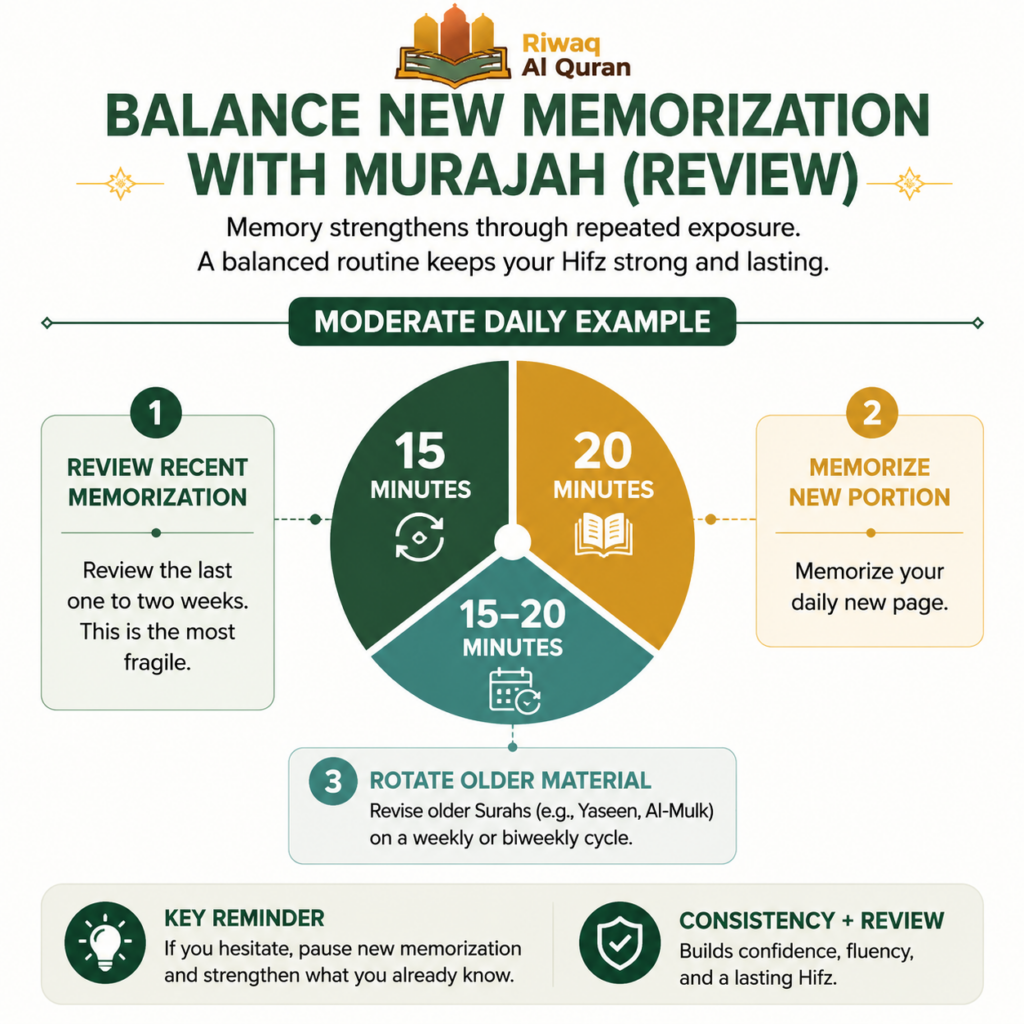
The 3-Part Hifdh Formula
Review recent memorization — the last one to two weeks, since it’s the most fragile.
- Memorize your daily new portion second.
- Rotate through older material — Surahs memorized months or years earlier — on a weekly or biweekly cycle.
A moderate daily example:
- 15 minutes reviewing the last two pages
- 20 minutes memorizing one new page
- 15–20 minutes revising an older Surah such as Yaseen or Al-Mulk
10. Write From Memory and Teach Others
Writing out a memorized page of the Quran on paper, matching the exact line breaks of the Mushaf page, exposes weak spots that reciting alone can hide, because writing forces you to reconstruct every word rather than let familiar rhythm carry you through gaps.
This is especially useful for catching a specific type of error, confusing two verses that sound similar but differ in a single word (Mutashabihat) — a mix-up that’s easy to miss by ear because the rhythm and most of the wording match, but immediately visible on paper when the word doesn’t fit the sentence you’re writing.
Teaching what you’ve memorized reinforces it further, and it carries its own weight in the Islamic tradition. As narrated by Uthman:
“خَيْرُكُمْ مَنْ تَعَلَّمَ الْقُرْآنَ وَعَلَّمَهُ“
“the Prophet ﷺ said, “The best among you are those who learn the Quran and teach it” (Sahih al-Bukhari 5027).
Teaching doesn’t need to be formal to work. Reciting a short memorized Surah to a family member and asking them to follow along on a Mushaf while you recite is enough — having someone else track your recitation against the text adds a layer of accountability that reciting alone in your head doesn’t have, and it surfaces mistakes you’d otherwise only catch with a teacher.
Start with short verses and family members before moving to longer passages or a wider group — read more on why teaching matters in Islam.
How Long Does Quran Memorization Take? A Realistic Timeline
This section answers the question most guides skip: what pace actually gets you through the Quran, and how long should you expect it to take.
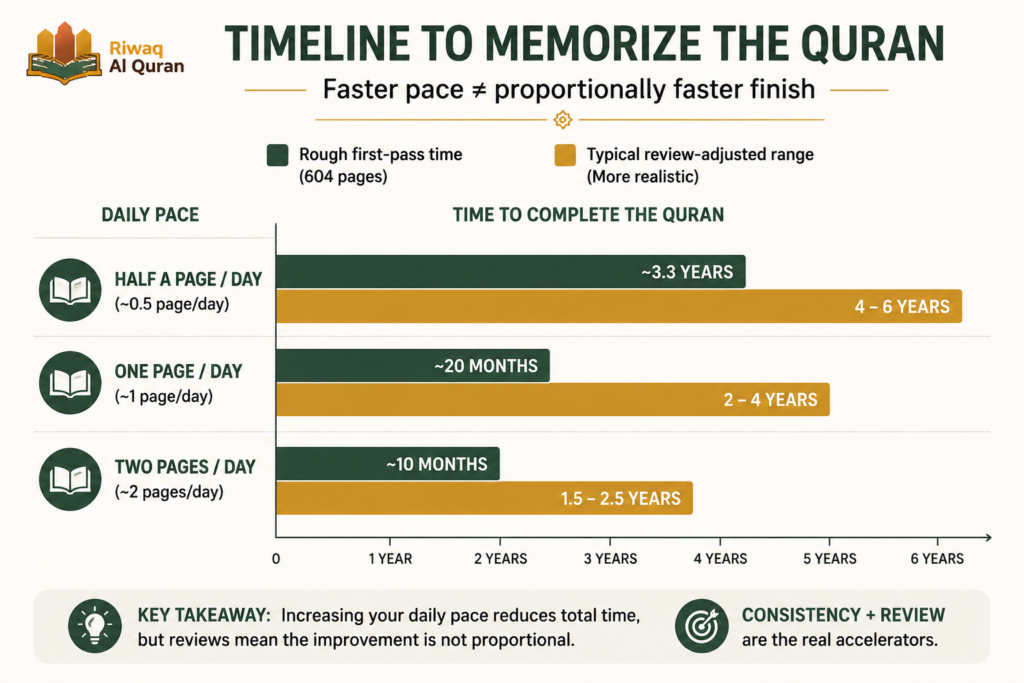
The standard printed Mushaf runs 604 pages across 30 Juz. A first read-through pace, before accounting for review, gives a rough baseline — but Murajah is what actually determines your real completion time, since every new page adds to your review load.
Timeline by Daily Page Target
The table below breaks the first-pass estimate down against the more realistic, review-adjusted range for three common daily paces.
| Daily pace | Rough first-pass time (604 pages) | Typical review-adjusted range |
|---|---|---|
| Half a page/day | ~3.3 years | 4–6 years |
| One page/day | ~20 months | 2–4 years |
| Two pages/day | ~10 months | 1.5–2.5 years |
The review-adjusted range is wider because consistency, not raw pace, is the real variable — students who maintain a fixed Murajah cycle from the first month tend to land at the shorter end; students who memorize fast but review inconsistently often re-memorize the same pages more than once, which is what stretches timelines toward the longer end.
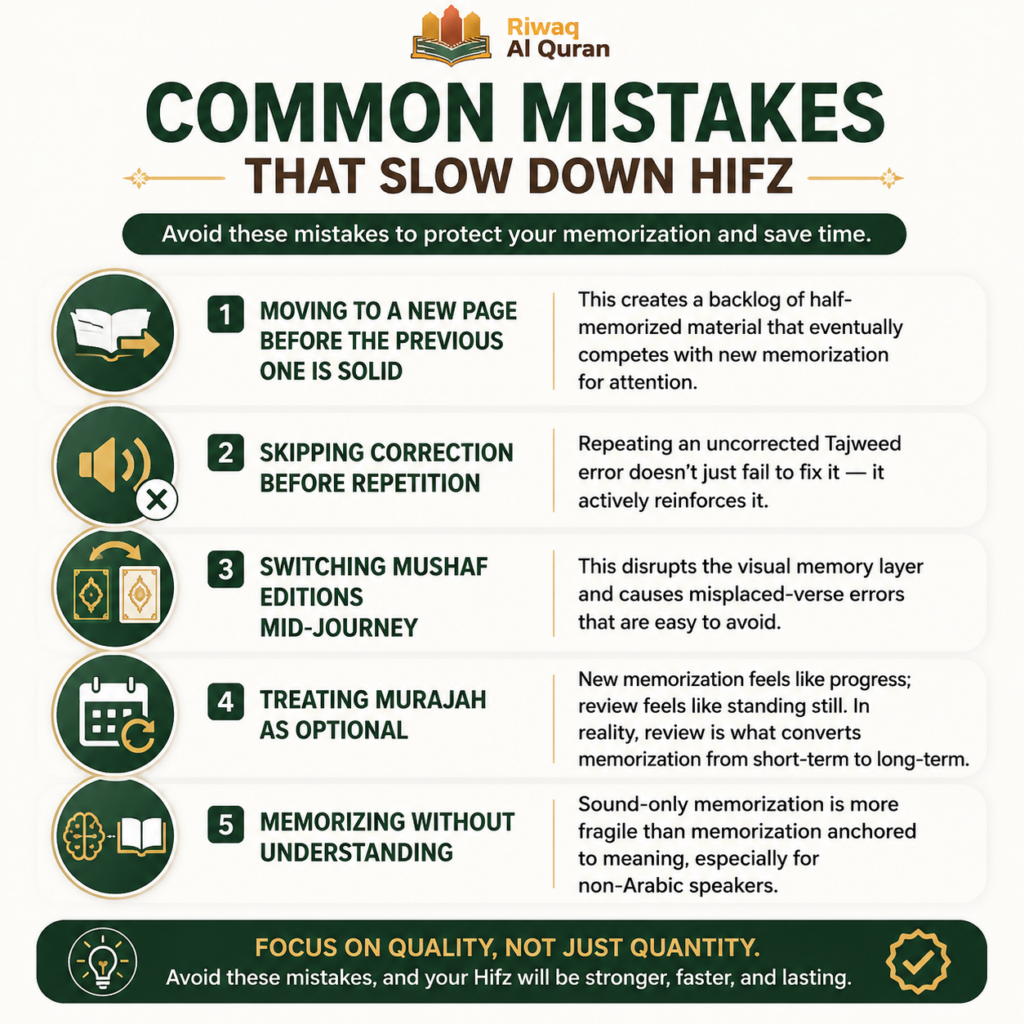
Common Mistakes That Slow Down Hifz
These are the errors that show up repeatedly among self-taught students, independent of which memorization technique they’re using.
- Moving to a new page before the previous one is solid. This creates a backlog of half-memorized material that eventually competes with new memorization for attention.
- Skipping correction before repetition. Repeating an uncorrected Tajweed error doesn’t just fail to fix it — it actively reinforces it, since every repetition cycle treats the error as the correct baseline.
- Switching Mushaf editions mid-journey. As covered in Technique 6, this disrupts the visual memory layer and causes misplaced-verse errors that are easy to avoid by picking one copy from day one.
- Treating Murajah as optional. New memorization feels like progress; review feels like standing still. In reality, review is what converts memorization from short-term to long-term.
- Memorizing without understanding. Sound-only memorization is more fragile than memorization anchored to meaning, particularly for non-Arabic speakers reconstructing a verse from a partial memory.
Self-Study or a Teacher? How to Decide
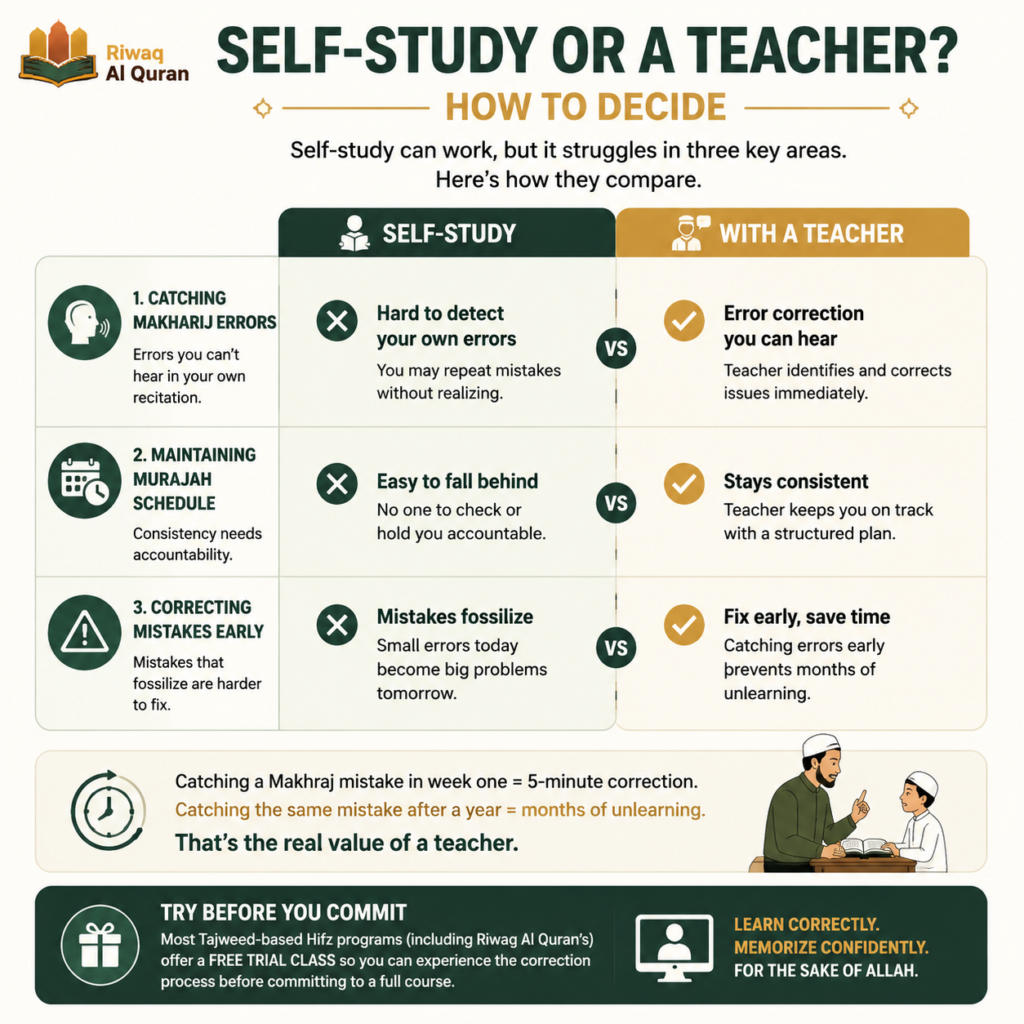
This section answers a practical question: when does self-study stop being enough, and when does a teacher become necessary?
Self-study can work for short Surahs and highly disciplined students who already have solid Tajweed. It struggles in three specific places:
- Catching Makharij errors you can’t hear in your own recitation.
- Maintaining a consistent Murajah schedule without external accountability.
- Correcting mistakes early enough that they don’t fossilize.
A teacher’s main value isn’t motivation — it’s error correction at the point where it’s still cheap to fix. Catching a Makhraj mistake in week one costs a five-minute correction. Catching the same mistake after a year of repetition costs months of deliberate unlearning. That asymmetry is the real argument for Talaqqi-based learning, whether from a local teacher or through a structured online program.
If cost or time is the hesitation, most Tajweed-based Hifz programs, including Riwaq Al Quran’s, start with a free trial class specifically so you can evaluate the correction process before committing to a full course.
Read also: How to Memorize the Quran
About Riwaq Al Quran
Riwaq Al Quran is a comprehensive online platform offering personalized Quran, Arabic, and Islamic Studies classes for individuals of all ages and backgrounds. Instructors follow a structured curriculum covering Tajweed, Tafsir, and Memorization, with live, interactive sessions built for seamless communication between student and teacher.
The platform is organized into five main categories:
- Online courses for kids
- Online Quran classes for kids and adults
- Online Arabic courses
- Online Ijazah courses
- Online Islamic Studies courses


Within those categories, a few courses map directly onto the techniques covered in this guide:
| Course | Relevant to |
|---|---|
| Online Tafseer Course | Technique 2 — memorizing with meaning |
| Noorani Qaida Online | Foundational reading before Hifz begins |
| Online Quran Recitation Course | Correcting recitation before repetition (Techniques 1, 3, 4) |
| Quran Memorization Online Course | The full Hifz program this article is built around |
| Online Qirat Course | Advanced recitation styles post-Hifz |
| Online Quran Classes for Kids | Starting young learners on Techniques 8 and 1 |
Browse the full course catalog for the complete list.
Consistent Murajah and a corrected foundation eventually lead somewhere real — watch Hafiz Taha Siddiqi’s completion moment, the kind of milestone these ten techniques are built to get you to:
Start Your Hifz Journey on a Flawless Foundation
Every technique in this guide works better when the recitation underneath it is already correct. That’s the one variable self-study can’t fully control, and it’s the one a qualified teacher exists to solve.
Riwaq Al Quran’s Online Quran Memorization course pairs you with a certified Azhari tutor for one-on-one Talaqqi correction before you begin building repetition cycles, so the foundation you memorize on is right from the first verse — not something you have to unlearn later.

Conclusion
Quran memorization techniques work best combined, not used in isolation. Reciting memorized verses in prayer builds a spiritual anchor. The 3/10 method and 30-repetition technique cement the words in memory.
Listening to a Qari, using one Mushaf, and following a fixed routine train your ears and eyes to work together. Tahayyu preparation, starting with short and story-based Surahs, and balancing review with new memorization protect what you’ve already learned while you keep moving forward.
None of these techniques replace a correct foundation. Every method on this list assumes the recitation being repeated, prayed, or reviewed is accurate to begin with. A verse memorized with a mispronounced letter doesn’t get corrected by repeating it more — it gets reinforced. This is why Talaqqi, hearing the verse from a qualified teacher before committing it to memory, comes before every technique here, not after.
The single most useful habit you can build is consistency: the same time each day, the same Mushaf, and a routine that protects your review as seriously as your new memorization. Students who succeed at Hifz aren’t necessarily the ones with the best memory — they’re the ones who show up daily, correct mistakes early, and never let review lapse.
Quran memorization is a long-term commitment, but it’s built one page, one verse, and one correction at a time.
Frequently Asked Questions
The questions below are the ones students most often search alongside Quran memorization techniques — from realistic pacing to whether Arabic fluency is required.
What is the fastest way to memorize the Quran?
The fastest reliable approach combines correct recitation from the start, structured repetition (such as the 3/10 method), and daily Murajah — speed without review typically results in re-memorizing the same pages later, which is slower overall than a steady, review-backed pace.
How many pages of Quran should I memorize per day?
There’s no universal number — half a page to two pages per day are all common targets, and the right pace depends on how much time you can commit to Murajah, since new memorization without matching review tends to fade.
Can you memorize the Quran without knowing Arabic?
Yes. Non-Arabic speakers regularly complete Hifz, and pairing memorization with a basic understanding of each verse’s meaning, rather than sound alone, tends to produce more durable retention for this group specifically.
What is Talaqqi and why does it matter for Hifz?
Talaqqi is receiving a verse orally from a qualified teacher before memorizing it, rather than self-checking your own recitation. It matters because errors caught before repetition are easy to fix, while errors repeated dozens of times become difficult habits to unlearn.
How do you stop forgetting Quran after memorizing it?
Consistent Murajah is the main defense against forgetting — a structured review cycle, such as the 3-part Hifdh formula covered above, keeps older material active in memory instead of letting it fade after the initial memorization push.
What age is best to start Quran memorization?
Children can begin with short Surahs as soon as they can speak clearly, while adults can start Hifz at any age — the determining factor is consistency and correct foundational recitation, not age itself.