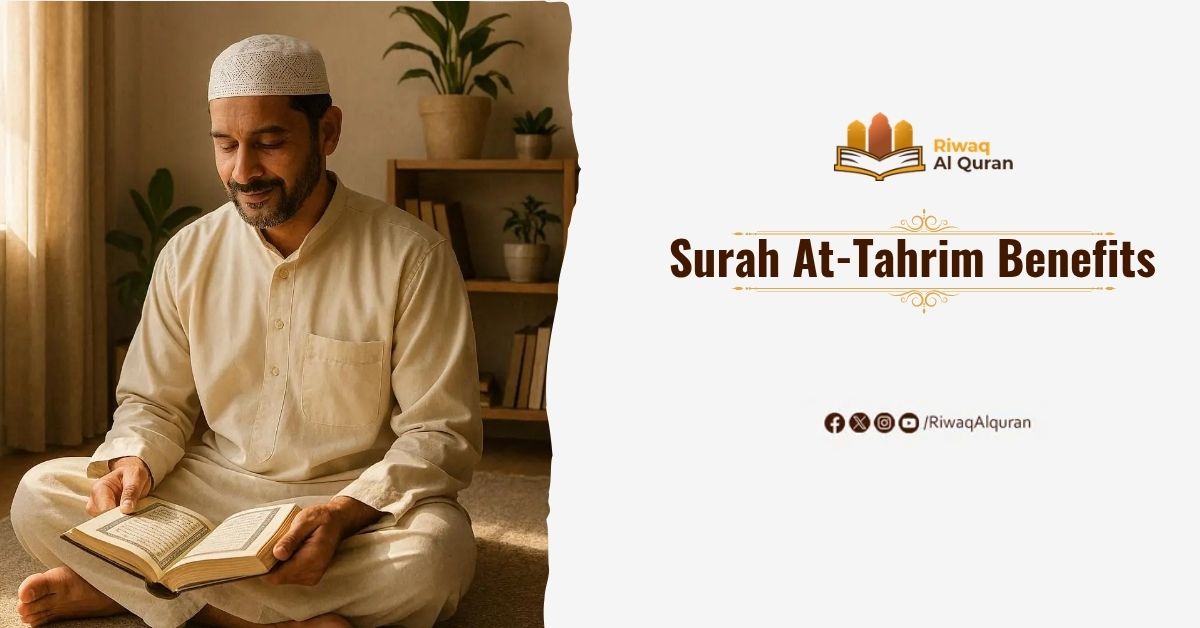
Surah At-Tahrim carries a weight that students often feel before they fully understand it. Revealed in Madinah, this 12-verse chapter speaks directly to the Prophet ﷺ and his household — yet its lessons reach every Muslim managing faith, family, and private conduct simultaneously.
The benefits of Surah At-Tahrim are rooted in its themes: sincere repentance, protecting one’s family through faith, and the sobering reality that household closeness to a prophet does not guarantee salvation.
Table of Contents
1. Surah At-Tahrim Builds a Profound Awareness of Personal Accountability Before Allah
Surah At-Tahrim opens by addressing the Prophet ﷺ directly — reminding even him that private decisions carry divine consequence. This establishes the Surah’s central benefit: a heightened, ongoing awareness that no action, however private, escapes Allah’s knowledge. For the reader, this awareness becomes a living internal check.
The opening verse establishes this immediately:
يَٰٓأَيُّهَا ٱلنَّبِىُّ لِمَ تُحَرِّمُ مَآ أَحَلَّ ٱللَّهُ لَكَ ۖ تَبْتَغِى مَرْضَاتَ أَزْوَٰجِكَ ۚ وَٱللَّهُ غَفُورٌ رَّحِيمٌ
Yā ayyuha an-nabiyyu lima tuḥarrimu mā aḥalla Allāhu lak, tabtaghī marḍāta azwājik, waAllāhu ghafūrun raḥīm
“O Prophet, why do you prohibit [yourself from] what Allah has made lawful for you, seeking the approval of your wives? And Allah is Forgiving and Merciful.” (At-Tahrim 66:1)
This verse teaches something most students at Riwaq Al Quran find unexpectedly moving: if divine guidance corrects the Prophet ﷺ openly, then no Muslim should feel immune from needing correction.
That realization, absorbed through repeated recitation, cultivates genuine humility and self-monitoring — qualities that Tajweed and Quran memorization scholars identify as foundational to consistent worship.
2. Guidance on Sincere Repentance (Tawbah Nasuhah)
The Surah contains one of the most significant calls to repentance found anywhere in the Quran. Verse 8 introduces the term tawbah nasuhah — sincere, wholehearted repentance — a concept that classical scholars and Tafsir authorities have discussed extensively for its depth and practical conditions.
يَٰٓأَيُّهَا ٱلَّذِينَ ءَامَنُوا۟ تُوبُوٓا۟ إِلَى ٱللَّهِ تَوْبَةً نَّصُوحًا
Yā ayyuha alladhīna āmanū tūbū ilā Allāhi tawbatan naṣūḥā
“O you who have believed, repent to Allah with sincere repentance.” (At-Tahrim 66:8)
The word nasuhah carries layers of meaning: pure, honest, complete, and lasting. Classical scholars of Tafsir — including Ibn Kathir in his Tafsir al-Qur’an al-Azim — describe tawbah nasuhah as repentance that meets four conditions: genuine remorse, immediate cessation of the sin, firm resolution not to return, and (where applicable) restoring the rights of others.
Reciting and studying this verse regularly instills a mature understanding of repentance — one that moves beyond surface-level regret toward actual behavioral change. This is among the most cited benefits by students who make Surah At-Tahrim part of their regular recitation.
If you want to connect more deeply with meanings like this, our Online Quran Tafseer Course at Riwaq Al Quran guides students through the linguistic and scholarly layers that make verses like this transformative.
Enroll Now in Riwaq’s Tafseer Course
3. Strengthening the Reciter’s Connection to the Prophetic Household
One underappreciated benefit of Surah At-Tahrim is the intimacy of its revelation context. It speaks about real events within the Prophet’s ﷺ household — not as gossip or critique, but as permanent divine guidance preserved for all Muslims. Engaging with this Surah connects the reader to prophetic history in a deeply human way.
The Surah reminds believers that the Prophet ﷺ was a husband navigating real domestic complexity, that his wives were independent human beings with personal accountability, and that divine guidance entered the most intimate spaces of prophetic life. This humanizes the Sunnah without diminishing its authority.
For students working through a Quran memorization schedule, Surah At-Tahrim’s short length (12 verses) combined with its thematic richness makes it an excellent target for meaningful memorization — one that rewards the memorizer intellectually and spiritually long after the words are fixed in memory.
4. Finding The Model of Devoted Worship in Maryam (AS)
The final verse of Surah At-Tahrim presents Maryam bint Imran — mother of Prophet Isa (AS) — as the supreme example of female faith, completing a set of four women discussed across the Surah’s final verses.
وَمَرْيَمَ ٱبْنَتَ عِمْرَٰنَ ٱلَّتِىٓ أَحْصَنَتْ فَرْجَهَا فَنَفَخْنَا فِيهِ مِن رُّوحِنَا وَصَدَّقَتْ بِكَلِمَٰتِ رَبِّهَا وَكُتُبِهِۦ وَكَانَتْ مِنَ ٱلْقَٰنِتِينَ
Wa-Maryama abnata ‘Imrāna allatī aḥṣanat farjahā fa-nafakhnā fīhi min rūḥinā wa-ṣaddaqat bi-kalimāti rabbihā wa-kutubihī wa-kānat mina al-qānitīn
“And [the example of] Mary, the daughter of ‘Imran, who guarded her chastity, so We blew into [her garment] through Our angel, and she believed in the words of her Lord and His scriptures and was of the devoutly obedient.” (At-Tahrim 66:12)
The Surah closes with qanitīn — the devoutly obedient — deliberately using the plural masculine form to include all believers regardless of gender. This is a nuance that Tafsir study illuminates clearly, and it affirms that the Surah’s ultimate message is universal: sincere obedience and guarded faith are the highest human achievement.
Experience Riwaq Al Quran Classes
Watch real moments from our live sessions at Riwaq Al Quran and see how we bring learning to life. These clips highlight our interactive, student-focused approach designed to keep learners engaged, motivated, and actively involved in every step of their educational journey.
5. Understanding the Foundation of a Muslim Household
Surah At-Tahrim directly addresses spousal dynamics, making it one of the most relevant chapters for Muslim couples. Surah At-Tahrim benefits for marriage lie in its honest portrayal: proximity to a righteous spouse does not guarantee one’s own righteousness — and a believing spouse in a hostile household is not abandoned by Allah.
The Surah presents two contrasting pairs. The wives of Nuh (Noah) and Lut (Lot) — peace be upon them — are mentioned as cautionary examples: despite being married to prophets, they betrayed their husbands’ trust and chose disbelief.
Then Asiyah, wife of Pharaoh, is presented as a model of faith despite her husband’s extreme tyranny.
| Example in Surah | Relationship | Lesson for Marriage |
| Wife of Prophet Nuh (AS) | Married to a prophet | Righteousness is personal — not transferred by spouse |
| Wife of Prophet Lut (AS) | Married to a prophet | Personal righteousness remains individual and is never simply inherited from a partner. |
| Asiyah, wife of Pharaoh | Married to a tyrant | True faith survives the worst household environment |
| Maryam bint Imran | Single, devoted worshipper | Personal dedication to Allah is the highest standard |
This framework benefits Muslim couples by removing two dangerous assumptions: that a pious spouse automatically elevates you, and that a difficult home environment excuses spiritual neglect.
These are lessons most relevant for Muslim marriages navigating mixed-faith families or community pressures.
6. A Direct Reminder of Leadership Accountability
The Surah’s opening context — where the Prophet ﷺ himself receives divine guidance about decisions affecting his household — carries a specific benefit for husbands. Surah At-Tahrim for husbands establishes that the husband’s role as qawwam (responsible caretaker) includes accountability for choices made to please family members at the expense of divine guidance.
The companion verse reinforces this accountability:
يَٰٓأَيُّهَا ٱلَّذِينَ ءَامَنُوا۟ قُوٓا۟ أَنفُسَكُمْ وَأَهْلِيكُمْ نَارًا
Yā ayyuha alladhīna āmanū qū anfusakum wa-ahlīkum nārā
“O you who have believed, protect yourselves and your families from a Fire.” (At-Tahrim 66:6)
Classical scholars of Tafsir explain this verse as a direct obligation on every believer — and particularly on family leaders — to ensure their household is grounded in faith, knowledge of halal and haram, and regular worship.
For husbands specifically, reciting this verse with awareness transforms it into a practical reminder: leadership is not comfort management. It is spiritual stewardship.
At Riwaq Al Quran, our instructors have observed that male students who study this Surah closely often report a meaningful shift in how they approach their families’ religious education. That shift begins with understanding what the Surah actually requires. Our Islamic Studies Classes help families build the knowledge base to act on obligations like these.
Begin your Islamic Studies with a FREE trial lesson
A Summary of Surah At-Tahrim’s Core Benefits
| Benefit | Quranic Basis | Practical Application |
| Accountability awareness | Verse 1 — correction of the Prophet ﷺ | Self-monitoring in private conduct |
| Sincere repentance (tawbah nasuhah) | Verse 8 | Complete return to Allah, not surface regret |
| Marriage guidance | Verses 10–11 — wives of prophets vs. Asiyah | Personal accountability within marriage |
| Family protection obligation | Verse 6 | Active spiritual leadership of household |
| Supplication in hardship | Verse 11 — prayer of Asiyah | Turning to Allah entirely in difficulty |
| Maryam as devotion model | Verse 12 | Consistent worship as highest standard |
Why Students Love Learning with Riwaq Al Quran
Hear directly from our students about how Riwaq Al Quran Academy has transformed their connection with the Book of Allah. Their experiences reflect the dedication, care, and quality that guide every step of our teaching.
Begin Your Quran Study at Riwaq Al Quran
Surah At-Tahrim rewards those who study it with depth — not just recitation. Its 12 verses carry lessons on repentance, marriage, family leadership, and the nature of sincere faith that surface new meaning with every reading.
At Riwaq Al Quran, our Azhari-certified tutors guide students through exactly this kind of engaged Quran study — connecting recitation, Tajweed, and Tafsir in one-on-one sessions built around your schedule. Since 2017, we’ve helped thousands of non-Arabic speaking Muslims worldwide build a lasting, meaningful relationship with the Quran.
✅ Azhari-certified instructors
✅ One-on-one personalized sessions
✅ 24/7 scheduling flexibility
✅ 2 Free Trial Classes
✅ 100% Money-Back Guarantee
Book your free trial class today and begin studying the Quran the way it deserves to be studied.
We offer courses in Online Quran & Tajweed Classes, Arabic Language, and Islamic Studies.
- Online Quran Memorization Course
- Tajweed Classes
- Online Quran Classes for Kids.
- Ijazah Program.
- Arabic Language Classes.
- Islamic Studies Courses.
Enroll now for 2 Free Trial Classes and Begin Learning Islam and Quran Today
Frequently Asked Questions About Surah At-Tahrim Benefits
What are the main benefits of reciting Surah At-Tahrim regularly?
Regular recitation of Surah At-Tahrim cultivates awareness of personal accountability, reinforces the concept of sincere repentance (tawbah nasuhah from verse 8), and provides practical guidance for family and marital life. Its 12 verses carry concentrated moral instruction relevant to both personal conduct and household faith management.
What are the benefits of Surah At-Tahrim for marriage?
Surah At-Tahrim benefits marriage by establishing that righteousness is personal — not transferred by proximity to a pious spouse. The contrasting examples of the wives of Nuh and Lut (AS) versus Asiyah teach couples that each spouse bears independent accountability before Allah, which grounds a healthy, faith-centered marital relationship.
Is there a specific benefit of Surah At-Tahrim for husbands?
Verse 6 — “protect yourselves and your families from a Fire” — is the most directly relevant to husbands. It establishes that family leadership carries spiritual stewardship responsibility. Classical Tafsir scholars explain this as an obligation to educate one’s household in faith, not merely provide material support.
Does Surah At-Tahrim have a specific benefit for debt relief?
No, verified hadith establishes Surah At-Tahrim as a prescribed recitation specifically for debt.
How long is Surah At-Tahrim and is it suitable for memorization?
Surah At-Tahrim contains 12 verses and is relatively short, making it accessible for memorization. Its thematic depth means students who memorize it with understanding gain far more than those who memorize it mechanically. Pairing memorization with basicTajweed rules and Tafsir study maximizes both retention and spiritual benefit.