
The benefits of Surah Naba are not limited to the spiritual rewards associated with its recitation. They include the transformation of a believer’s worldview, the awakening of conscience, and the anchoring of daily life in the awareness of ultimate accountability.
Understanding what this surah actually teaches is the most meaningful benefit any reciter can receive.
Table of Contents
1. Surah Naba Grounds the Believer in the Reality of the Hereafter
Surah An-Naba’s most immediate and lasting benefit is its power to make the Hereafter feel real. The surah opens by referencing “the great news” — النَّبَإِ الْعَظِيمِ — which exegetes from Ibn Kathir to Al-Qurtubi consistently interpret as the resurrection and judgment.
Within Surah Naba specifically, Allah states:
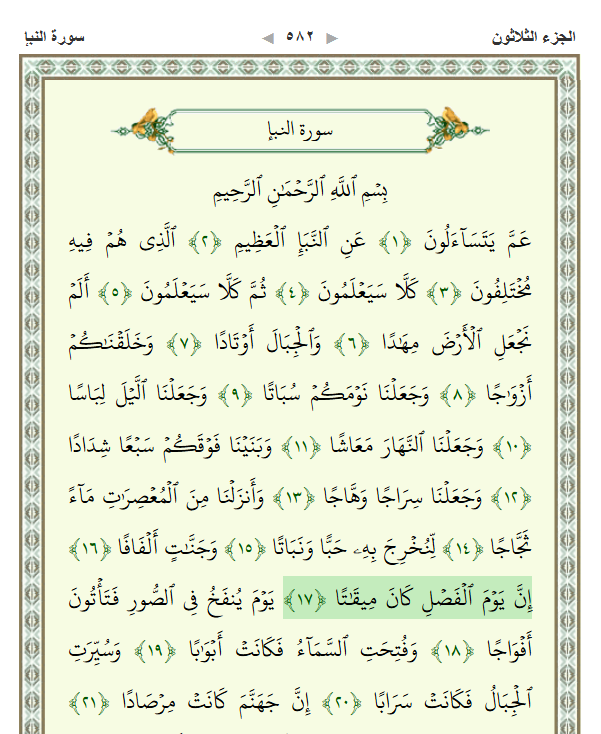
إِنَّ يَوْمَ الْفَصْلِ كَانَ مِيقَاتًا
Inna yawmal-faṣli kāna mīqātā
“Indeed, the Day of Judgment is an appointed time.” (Surah An-Naba 78:17)
Reciting this verse regularly instills what scholars call Yaqeen — certainty — about what awaits. This is not abstract theology. It reshapes how a Muslim approaches every decision, every prayer, every interaction.
2. Deepening Gratitude and Awareness of Allah’s Power
Before describing the Day of Judgment, Surah An-Naba walks the reader through the signs of Allah embedded in creation — the earth as a resting place, mountains as stabilizers, sleep as rest, night and day as paired opposites.
أَلَمْ نَجْعَلِ الْأَرْضَ مِهَادًا
Alam naj’alil-arḍa mihādā
“Have We not made the earth a resting place?” (Surah An-Naba 78:6)
This rhetorical style — inviting reflection through questions — is one of the Quran’s most effective pedagogical tools. In our sessions at Riwaq Al Quran, we observe that students who understand the meaning of the verses they recite develop noticeably stronger connection to their recitation.
The Quran stops feeling like sounds and begins feeling like speech directed at them personally.
The progression from signs of creation to the Day of Judgment is deliberate. Allah first establishes His power through what we see daily, then connects that power to His authority over what we have yet to experience.
Connect with our Azhari tutors to learn Quran with Tafseer

3. Surah Naba Offers Vivid Descriptions of Both Reward and Punishment
One of the distinctive features of Surah An-Naba — and a core reason scholars recommend its regular recitation — is its balanced, detailed account of the fate of the righteous and the wrongdoers.
| Group | Description in Surah Naba | Verses |
| The Wrongdoers (Tagheen) | Described as dwelling in Hell, tasting only boiling water and filth | 78:21–25 |
| The Righteous (Muttaqeen) | Given gardens, companions, and a cup of pure drink | 78:31–34 |
| Both groups | Facing the Day with full account and no falsehood accepted | 78:38–40 |
This explicit contrast serves a profound purpose for the reciter. It prevents spiritual complacency. The believer who regularly recites these verses cannot remain indifferent to their own standing before Allah.
إِنَّ لِلْمُتَّقِينَ مَفَازًا
Inna lil-muttaqīna mafāzā
“Indeed, for the righteous is attainment.” (Surah An-Naba 78:31)
This verse alone — four words in Arabic — carries enough motivational weight to reshape a person’s spiritual priorities.
Experience Riwaq Al Quran Classes
Watch real moments from our live sessions at Riwaq Al Quran and see how we bring learning to life. These clips highlight our interactive, student-focused approach designed to keep learners engaged, motivated, and actively involved in every step of their educational journey.
4. Strengthening Tawbah and Spiritual Accountability
The surah closes with one of the most moving supplications in the entire Quran — a direct plea from the believing servant:
يَوْمَ يَنظُرُ الْمَرْءُ مَا قَدَّمَتْ يَدَاهُ وَيَقُولُ الْكَافِرُ يَا لَيْتَنِي كُنتُ تُرَابًا
Yawma yanẓurul-mar’u mā qaddamat yadāhu wa yaqūlul-kāfiru yā laytanī kuntu turābā “The Day when a man will look at what his hands have put forth, and the disbeliever will say, ‘Oh, I wish I were dust!'” (Surah An-Naba 78:40)
This final verse strikes at the heart of every reciter. The spiritual benefit here is an intensified sense of Muhasabah — self-accounting. Classical scholars of Tafsir, including Ibn Kathir in his well-known Tafsir al-Quran al-Azim, highlight that this verse is among the most effective in the Quran for awakening the believer to the urgency of repentance before that day arrives.
If you want to understand Surah Naba at this level of depth, Riwaq Al Quran’s Online Quran Tafseer Course connects you with Azhari-certified scholars who teach the meanings, context, and exegetical tradition behind every surah — not just translation.
Enroll Now in Riwaq’s Tafseer Course

5. Surah Naba Is an Ideal Surah for Memorization and Tajweed Practice
From a purely pedagogical standpoint, Surah An-Naba is one of the most valuable surahs for non-Arabic speaking Muslims to memorize and study. Its structure makes it uniquely suited to Hifz beginners.
Why Surah Naba supports memorization:
- Its verses are short and rhythmically consistent, which supports auditory memorization
- Thematic grouping (creation signs, Day of Judgment, Hell, Paradise) creates natural memory anchors
- Its repeated rhetorical questions and parallel structures reinforce retention
- It appears in Juz’ Amma (Juz’ 30), the most commonly memorized portion for beginners
Tajweed features worth practicing in Surah Naba:
- Heavy letters (Tafkhim) appear regularly — Sad, Dad, Ta, Dha — making this surah excellent for practicing letter weight
- Qalqalah letters appear in multiple verse endings, providing consistent echo-consonant practice
- Madd rules (vowel elongation) are frequent and varied, offering natural Madd practice
For students working through Tajweed rules for the first time, Surah Naba provides real recitation situations — not contrived exercises — in which to apply what they are learning.
Riwaq Al Quran’s Online Quran Memorization Course begins many adult students with Juz’ Amma for exactly these reasons, pairing each surah’s memorization with the Tajweed rules it naturally contains, taught by Ijazah-certified Huffaz in one-on-one sessions available 24/7.
Start your Hifz journey with a Free Trial

6. Surah Naba Benefits for Marriage and Eyesight Require Careful Scholarly Evaluation
Many Muslims search specifically for Surah Naba benefits for marriage and Surah Naba benefits for eyesight. This topic deserves an honest, scholar-grounded answer rather than unverified claims.
What the scholarly record shows:
There is no authenticated hadith in the major collections — Sahih Bukhari, Sahih Muslim, the Sunan, or the Musnad — that specifically attributes fixed worldly benefits such as improved eyesight or facilitation of marriage to the recitation of Surah An-Naba alone.
Fabricated or extremely weak narrations circulate widely online. A Muslim who cites such narrations unknowingly as authentic is repeating something that scholars of hadith have not validated. This matters because attributing a reward to the Prophet ﷺ that he did not actually state is a serious matter.
What is soundly established:
The general virtue of Quranic recitation is firmly authenticated. The Prophet ﷺ said:
“Whoever recites a letter from the Book of Allah will have a good deed credited for it, and a good deed is multiplied tenfold.” (Sunan At-Tirmidhi 2910)
This applies to every letter of Surah An-Naba without exception. The benefit is real, authenticated, and sufficient.
| Claim Type | Status | Guidance |
| General reward for Quran recitation | Authenticated (Tirmidhi 2910) | Accept and apply |
| Specific reward for Surah Naba after Asr | No authenticated hadith found | Do not attribute to the Prophet ﷺ |
| Surah Naba curing eyesight | No authenticated hadith found | Do not attribute to the Prophet ﷺ |
| Surah Naba facilitating marriage | No authenticated hadith found | Do not attribute to the Prophet ﷺ |
This is not dismissiveness toward the surah. It is scholarly honesty — and that honesty is itself a form of respect for the Quran and its Prophet ﷺ.
Surah Naba Benefits After Asr and the Question of Timing
The specific practice of reciting Surah An-Naba after Asr prayer is mentioned in some popular Islamic content. Students frequently ask about it in our sessions at Riwaq Al Quran, and the answer requires care.
There is no specifically authenticated report establishing the time after Asr as uniquely designated for Surah Naba recitation. However, the broader practice of dedicating time after obligatory prayers to Quranic recitation and dhikr is strongly supported in the Sunnah.
The Prophet ﷺ described the one who recites Quran as like a citron — pleasant in smell and taste — and the one who does not recite as still carrying goodness within them. (Sahih Bukhari 5427)
Making a personal habit of reciting Surah An-Naba at a consistent time — whether after Asr or another prayer — builds the regularity that produces genuine spiritual benefit.
Consistency is what classical memorization pedagogy and modern retention science both affirm as the single most critical variable in meaningful engagement with the Quran.
If you are building a consistent recitation or memorization habit, the practical guidance in our Quran memorization schedule resource at Riwaq Al Quran gives a structured framework that works specifically for non-Arabic speakers.


Regular Engagement with Surah Naba Builds the Habit of Quranic Reflection
Perhaps the most overlooked benefit of Surah An-Naba is what consistent engagement with it does to a Muslim’s thinking over time. The surah’s structure trains the mind to move from observation of the world to reflection on its Creator, and from that reflection to accountability.
This is the Quranic method of building faith — not through abstract doctrine but through directed attention. Understanding this method is part of what Riwaq Al Quran’s Best Islamic Studies Online Course teaches — how the Quran builds belief, shapes character, and orients the Muslim’s entire life toward Allah.
Engaging with the Quran through Tafsir — not just recitation — is what separates a Muslim who reads the Quran from one whose life is genuinely shaped by it. Surah Naba, studied with proper Tafsir, offers both the form and the substance of that transformation.
Begin your Islamic Studies with a FREE trial lesson
Why Students Love Learning with Riwaq Al Quran
Hear directly from our students about how Riwaq Al Quran Academy has transformed their connection with the Book of Allah. Their experiences reflect the dedication, care, and quality that guide every step of our teaching.
Begin Your Quran Journey with Riwaq Al Quran
Surah An-Naba’s benefits are real — grounded in authentic scholarship, not fabrication. Its power lies in what it teaches every time it is recited with understanding. If you want to recite with accuracy, memorize with retention, and understand with depth, structured guidance makes all the difference.
Riwaq Al Quran has helped thousands of non-Arabic speaking Muslims since 2017 through:
- Azhari-certified instructors — Al-Azhar University graduates with Ijazah
- One-on-one sessions — personalized to your level and pace
- 24/7 scheduling — for students across all time zones
- 2 Free Trial Classes with a 100% Money-Back Guarantee
We offer courses in Online Quran & Tajweed Classes, Arabic Language, and Islamic Studies.
- Online Quran Memorization Course
- Tafseer Course
- Tajweed Classes
- Online Quran Classes for Kids.
- Ijazah Program.
- Arabic Language Classes.
- Islamic Studies Courses.
Enroll now for 2 Free Trial Classes and Begin Learning Islam and Quran Today

Frequently Asked Questions About Surah Naba Benefits
What are the main benefits of reciting Surah Naba regularly?
Surah An-Naba’s consistent recitation strengthens Iman by grounding the believer in the reality of the Day of Judgment, deepens gratitude through reflection on Allah’s signs in creation, and sharpens the spiritual accountability known as Muhasabah. The surah’s vivid descriptions of both Paradise and Hellfire serve as a continuous reminder of what is ultimately at stake in every believer’s life.
Is there an authenticated hadith about Surah Naba benefits?
No authenticated hadith in the major collections assigns specific rewards to Surah An-Naba alone. The general reward for Quran recitation is firmly established in Tirmidhi 2910. Claims attributing fixed worldly benefits — such as improved eyesight or facilitation of marriage — to this surah specifically have not been verified against authenticated hadith sources and should not be attributed to the Prophet ﷺ.
When should Surah Naba be read and is after Asr specifically recommended?
No authenticated narration establishes a unique virtue for reciting Surah Naba specifically after Asr. However, building a personal habit of consistent Quranic recitation after any obligatory prayer is broadly supported by the Sunnah. Regularity and understanding matter far more than a specific timing that lacks authenticated textual support.
Is Surah Naba good for memorization beginners?
Surah An-Naba is excellent for beginners. Its placement in Juz’ Amma, short rhythmic verses, clear thematic structure, and natural Tajweed practice opportunities — including Tafkhim, Qalqalah, and Madd — make it one of the most pedagogically effective surahs for non-Arabic speaking students starting their memorization path.
How can I understand Surah Naba more deeply beyond just recitation?
Studying Surah An-Naba through authenticated Tafsir — such as Ibn Kathir’s Tafsir al-Quran al-Azim or Al-Tabari’s exegesis — reveals the linguistic precision and theological depth beneath the translation. Enrolling in a structured Tafseer course with a qualified scholar provides the contextual knowledge that turns recitation into genuine understanding and sustained spiritual benefit.