The Arabic letter ك (Kaf) sits among the most phonetically accessible letters for English-speaking learners, yet it holds remarkable linguistic depth that most basic resources never address. Its articulation connects directly to the middle of your tongue, and mastering it opens a wide vocabulary door across both Modern Standard Arabic and the Quran.
Understanding ك – Arabic letter k—goes beyond simply equating it to the English letter “k.” Its precise makhraj, its behavioral shifts in classical texts, and its positional script forms each carry specific rules that, once internalized, accelerate reading fluency significantly. This guide covers all of it with the accuracy your learning deserves.
Table of Contents
What Is the Arabic Letter K?
The Arabic letter ك (Kaf) represents a voiceless velar plosive stop. This means the sound is produced by raising the back portion of the tongue against the soft palate (velum), completely blocking airflow, then releasing it with a burst of sound.
This articulation point places ك firmly in the category of “lingual letters” — specifically the back-tongue category (أقصى اللسان and what precedes the velum).
Notably, its makhraj is positioned slightly more forward than the letter ق (Qaf), which is produced deeper in the throat against the uvula.
The essential distinction between ك and English “k” lies in emphasis and consistency. English “k” often carries slight aspiration (a puff of air) at the start of words, while Arabic ك is cleaner and more controlled. This aspiration must be consciously reduced for accurate Arabic pronunciation.
At Riwaq Al Quran, our Online Arabic Course systematically addresses these phonetic nuances from the very first lessons, taught by Al-Azhar-certified Arabic instructors in personalized 1-on-1 sessions designed for non-native learners.
Book Your FREE Trial in Riwaq’s Arabic Classes

How to Identify the Makhraj of the Arabic Letter Kaf?
The makhraj (articulation point) of ك is classified as the middle section of the back of the tongue pressing against the area just in front of the soft palate. Classical Arabic phoneticians define this as أدنى اللسان (the forward portion of the back tongue) meeting the corresponding area of the roof of the mouth.
To locate this point yourself, say the English word “key” slowly. Notice how the blade of your tongue rises toward the middle-back of your mouth’s roof — that contact zone is where ك is produced. The touch is firm and complete, creating a momentary full stop of airflow.
| Feature | Description |
| Makhraj Category | Lingual (tongue-based) |
| Exact Position | Back of tongue, forward of soft palate |
| Airflow | Completely blocked, then released |
| Voicing | Voiceless (no vocal cord vibration) |
| Arabic Classification | حرف لساني |
This table summarizes the core phonetic identity of ك. Knowing these features helps learners distinguish it clearly from visually or phonetically similar letters like ق.
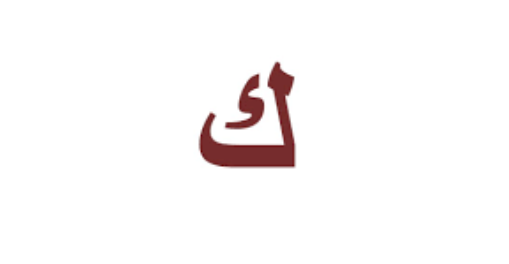
How the Arabic Letter Kaf Changes Form Across Word Positions
One of the most important skills for any Arabic learner is recognizing how ك changes shape depending on its position within a word. Like most Arabic letters, ك connects to surrounding letters and adapts its form accordingly.
The isolated form ك is the most recognizable. It features a distinctive cup-like shape with a small diagonal stroke inside its upper-left area — a feature unique to ك among all Arabic letters. This internal mark is one of the letter’s most reliable visual identifiers.
| Position | Form | Example | Transliteration |
| Isolated | ك | ك | k |
| Initial | كـ | كَتَبَ | kataba (he wrote) |
| Medial | ـكـ | مَكْتَب | maktab (desk) |
| Final | ـك | مَلِك | malik (king) |
The internal diagonal marker present in the isolated and final forms is one of the most consistent visual anchors you will use when scanning Arabic text.
Experience Riwaq Al Quran Classes
Watch real moments from our live sessions at Riwaq Al Quran and see how we bring learning to life. These clips highlight our interactive, student-focused approach designed to keep learners engaged, motivated, and actively involved in every step of their educational journey.
Common Pronunciation Mistakes English Speakers Make with the Arabic Letter Kaf
English speakers generally find ك easier than many Arabic letters, but several consistent errors arise during early learning and in Quranic recitation specifically.
Excessive Aspiration at Word Beginnings
In English, “k” at the start of a word is noticeably aspirated — a puff of air follows the stop release. Arabic ك is not aspirated. To correct this, practice producing ك after a vowel sound first (like في كِتاب — fi kitab) to feel the unaspirated release, then gradually move it to word-initial positions.
Confusion Between ك and ق
This is perhaps the most significant error at intermediate levels. Both letters share the back-tongue region, but ق is produced deeper, against the uvula, with a distinctly heavier, more resonant quality. ك is produced further forward and is completely light. Minimal pair practice with words like كَلْب (dog) and قَلْب (heart) is the most effective correction method.
Over-Emphasizing Kaf Near Emphatic Letters
When ك appears near emphatic letters like ص, ض, or ط, some learners unconsciously allow those letters’ heaviness to affect ك. This is phonetically incorrect. The sifa of istifal means ك remains light and unchanged regardless of its phonetic environment.


How the Arabic Letter Kaf Appears in the Quran?
The letter ك appears thousands of times throughout the Quran in diverse grammatical roles — as a root letter in verbs and nouns, and as a pronominal suffix meaning “you” (singular masculine). Recognizing it in recitation is therefore not optional — it is central to Quranic reading fluency.
A well-known verse containing ك in multiple positions illustrates its varied roles clearly:
إِيَّاكَ نَعْبُدُ وَإِيَّاكَ نَسْتَعِينُ
Iyyaka na’budu wa-iyyaka nasta’een
“It is You we worship and You we ask for help.” (Al-Fatiha 1:5)
(Note: The ك here appears as a second-person singular pronoun suffix, lightly pronounced with a short fatha vowel. In recitation, the letter must be clean and voiceless, with no aspiration. The vowel on ك is short — avoid lengthening it.)
For students working toward Quranic recitation accuracy, Riwaq Al Quran’s Online Quranic Arabic Course bridges letter-level phonetics with classical recitation rules through expert, structured instruction.
Book Your FREE Trial in Riwaq’s Quranic Arabic Classes

How to Practice Writing the Arabic Letter Kaf Correctly at Every Stage?
Writing ك correctly requires attention to stroke direction, proportion, and the distinctive internal marker that sets it apart. Rushing this stage creates habits that become difficult to correct in later learning.
Starting with the Isolated Form
Begin by drawing the outer cup shape from right to left, following the natural flow of Arabic script. The cup should be open at the top-right, with a slight upward curve. After forming the outer shape, add the interior diagonal stroke from top-left to bottom-right inside the cup.
Read Also: The Arabic Letter Ayn ع
Practicing Initial Kaf in Connected Words
The initial form كـ drops most of the cup’s roundness and becomes an angular, open shape that connects rightward to the following letter. Practice writing كَتَبَ (kataba) repeatedly to build muscle memory for this transition.
Read also: Learn Letter Ghayn غ in Arabic
Building Medial and Final Forms
The medial ـكـ is a compressed version of the initial form, connecting on both sides. The final ـك returns to a fuller cup shape with the internal marker restored. Consistent daily tracing of full words in all four positions, rather than isolated letter drills, produces faster recognition and writing fluency.
Read Also: Learn The Letter Fa ف in Arabic
Why Students Love Learning with Riwaq Al Quran
Hear directly from our students about how Riwaq Al Quran Academy has transformed their connection with the Book of Allah. Their experiences reflect the dedication, care, and quality that guide every step of our teaching.
Learn Arabic Letters with Riwaq Al Quran’s Expert Arabic Instructors
Mastering ك — from its makhraj to its Quranic usage — is exactly the kind of focused, expert-guided work that produces real reading fluency.
At Riwaq Al Quran, we offer:
- Al-Azhar-certified Arabic instructors with 9+ years teaching non-native speakers
- 1-on-1 personalized sessions tailored to your level and goals
- 24/7 flexible scheduling for learners worldwide
- Affordable plans starting at just $32/month
- 2 Free Trial Classes — no credit card required
- 100% Money-Back Guarantee
- Trusted by students globally since 2017
Book your free trial today and begin learning Arabic letters the right way, Insha’Allah.
Beyond Arabic, we offer courses in Online Tajweed Classes, Arabic Language, and Islamic Studies.
- Online Quran Memorization Course
- Tajweed Classes
- Online Quran Classes for Kids.
- Ijazah Program.
- Arabic Language Classes.
- Islamic Studies Courses.
Enroll now for 2 Free Trial Classes and Begin Learning Arabic or Memorizing Quran Today

Conclusion
The letter ك combines phonetic accessibility with rich linguistic depth. Its voiceless, non-emphatic character makes it consistent across all Arabic contexts, yet distinguishing it from ق and eliminating English aspiration habits remain critical pronunciation goals for every learner.
Recognizing ك across its four positional forms — with its unique internal marker as a visual anchor — builds a reading foundation that extends directly into Quranic fluency. Each position follows predictable patterns that reward regular, deliberate practice.
Connecting ك to its Quranic presence, particularly as a second-person pronoun suffix repeated throughout Al-Fatiha and hundreds of other verses, reminds learners that this letter is not merely a phonetic building block — it is a gateway to understanding the speech of the Quran itself.