The Arabic alphabet holds 28 letters, each with its own shape, sound, and soul. Among them, the letter س — called Seen — is one of the first letters children recognize because its sound feels familiar. For English speakers, it carries the clean “s” of “sun” and “sky,” making it one of the more approachable Arabic letters to master early.
Learning Seen properly means understanding not just its sound but its three written forms, its precise articulation point, and how it behaves inside real Arabic words. Master these elements now, and you build a foundation that speeds up every Arabic and Quranic reading skill that follows, Insha’Allah.
Table of Contents
What the Arabic Letter Seen Looks Like in Its Isolated Form?
The isolated form of Seen (س) is immediately recognizable: three small “teeth” sitting on a horizontal baseline, with a tail that curves gently to the left beneath them. This distinctive shape makes Seen one of the easier Arabic letters to spot on a page.
Think of those three bumps as three rounded humps above the line. They are uniform in size and evenly spaced. No dots appear above or below Seen, which helps distinguish it from its sister letter Sheen (ش), which carries three dots above the same shape.
Here is a quick visual comparison to build your recognition from the start:
| Feature | Seen (س) | Sheen (ش) |
| Dots | None | Three dots above |
| Sound | /s/ as in “sun” | /sh/ as in “ship” |
| Base Shape | Three teeth + tail | Identical base shape |
| Example Word | سَلَام (salaam) | شَمْس (shams) |
Recognizing that Seen and Sheen share the same skeleton but differ only by dots is a vital early lesson. Many beginners confuse them in reading. Always check for dots first.
If you want structured handwriting practice with a qualified teacher watching your progress, Riwaq Al Quran’s Online Arabic Classes for Kids provides exactly this — live, one-on-one sessions that catch errors before they become habits.
Enroll Your Kid in Riwaq’s Arabic Classes for Kids with a FREE trial

How to Pronounce the Arabic Letter S (Seen) with Correct Articulation?
Seen produces a pure, unemphasized /s/ sound — identical to the English “s” in “see” or “sit.” It is classified in Arabic phonetics as a sibilant fricative, produced by directing a stream of air between the tip of the tongue and the upper front teeth.
The Makhraj (Articulation Point) of Seen
The makhraj of Seen is the tip of the tongue meeting the area between the upper and lower front teeth — the same general zone as the letters Zay (ز) and Saad (ص). Together, these three letters share one articulation point and are called the “tip-of-tongue, teeth-edge” group in classical Arabic phonetics.
The Sifat (Phonetic Attributes) of Seen
Understanding the sifat helps you produce Seen with precision. The key attributes are:
| Sifat (Attribute) | Classification | Meaning for Seen |
| Hams (هَمْس) | Whispered | Vocal cords do not vibrate |
| Rakhawa (رَخَاوَة) | Fricative | Airflow continues without stopping |
| Istifaal (اسْتِفَال) | Low tongue | Tongue stays flat, not raised |
| Infitaah (انْفِتَاح) | Open | No contact between back of tongue and palate |
| Ismaат (إِصْمَات) | Non-original root consonant position | Appears in all root patterns |
The most critical attribute for English speakers is Hams — the fact that Seen is voiceless. Your vocal cords must not vibrate when producing it.
For learners who want to move from letter recognition to full reading fluency, Riwaq Al Quran’s Online Arabic Course provides a structured, expert-guided progression from the alphabet through connected reading and beyond.
Book Your FREE Trial in Riwaq’s Arabic Classes

Common Pronunciation Errors English Speakers Make with Seen
English speakers generally produce Seen well, but two errors are common. First, some learners inadvertently voice the sound, producing a /z/ quality — especially when Seen appears between two vowels, as in “naseem” (نَسِيم). Monitor your vocal cord vibration carefully in those positions.
Second, beginners sometimes confuse Seen with Saad (ص), the emphatic /s/. Saad is produced with the back of the tongue raised toward the soft palate, creating a deep, heavy resonance. Seen has no such heaviness. Keep your tongue flat and your jaw relaxed.
How the Arabic Letter Seen Changes Shape in Different Word Positions?
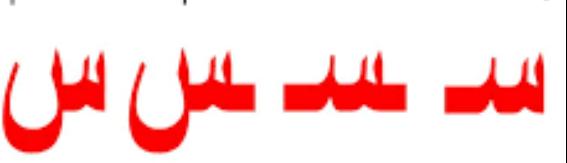
Like most Arabic letters, Seen changes form depending on where it appears in a word. It connects to letters before and after it in most positions. Recognizing these forms is essential for reading fluency in Arabic and the Quran.
Study the four positional forms carefully before practicing writing:
| Position | Form | Example | Transliteration |
| Isolated | س | — | Seen |
| Initial (word-beginning) | سـ | سَلَام | Salaam |
| Medial (word-middle) | ـسـ | مُسْلِم | Muslim |
| Final (word-end) | ـس | نَفْس | Nafs |
Notice that in the initial and medial positions, the three teeth are preserved but the tail is removed and replaced with a connecting stroke. In the final position, the tail returns but the right side connects to the letter before it.
Step-by-Step Guide to Writing the Arabic Letter Seen Correctly
Writing Seen requires mastering the rhythm of its three teeth before connecting them. Rushing this step produces uneven humps that affect readability. Practice each component separately first.
How to Write the Arabic Letter Seen in Its Isolated Form?
Begin by drawing a small upward curve from left to right — this is your first tooth. Without lifting your pen, continue to a second identical curve, then a third. After the third tooth, extend a horizontal line rightward, then curve it downward and sweep it back to the left in a gentle hook beneath the baseline. This complete form is isolated Seen (س).
How to Write the Arabic Letter Seen at the Beginning of a Word?
For initial Seen (سـ), draw the three teeth exactly as above, but instead of adding the tail, extend a short horizontal connecting stroke to the right. The letter then joins the next letter through this stroke. The teeth sit visibly above the baseline.
How to Write the Arabic Letter Seen in the Middle of a Word?
Medial Seen (ـسـ) connects on both sides. A horizontal baseline enters from the right, rises into the three teeth, then exits to the right again as a connecting stroke. The three-tooth profile remains clearly visible between the two connecting lines.


How to Write the Arabic Letter Seen at the End of a Word?
Final Seen (ـس) receives a connection from the right, moves through the three teeth, and then completes with the full tail curving left beneath the baseline — just like isolated Seen, but with an entry stroke on the right side.
Writing Practice Exercises for the Arabic Letter Seen
These exercises are designed for both children and adults. Work through them in order. If you are a parent or teacher using this with kids, guide them through each step orally while they trace and write.
Exercise 1: Tracing the Three Teeth
On lined paper, practice drawing three evenly spaced humps in a row, ten times. Focus on keeping all three humps the same size and height. This trains your hand for the defining feature of Seen.
Exercise 2: Writing Isolated Seen
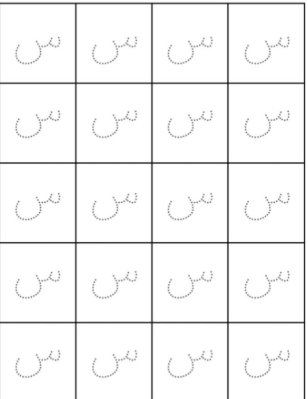
Write isolated س fifteen times in a row. Say the letter name “Seen” aloud with each repetition. After every five repetitions, pause and compare your last letter to your first — look for improvement in the roundness of the humps and the smoothness of the tail.
Exercise 3: Connecting Seen in All Positions
Practice writing these four words, each containing Seen in a different position. Write each word five times:
| Target Word | Seen Position | Meaning |
| سَمَاء | Initial | Sky |
| مَسْجِد | Medial | Mosque |
| شَمْس | Final | Sun |
| س | Isolated | The letter itself |
Say each word aloud as you write it. Connecting sound to script from day one accelerates both reading and writing simultaneously.
Experience Riwaq Al Quran Classes
Watch real moments from our live sessions at Riwaq Al Quran and see how we bring learning to life. These clips highlight our interactive, student-focused approach designed to keep learners engaged, motivated, and actively involved in every step of their educational journey.
How Seen Appears in the Quran and Why Correct Pronunciation Matters?
Seen appears extensively throughout the Quran, including in some of the most recited verses and chapters. Surah Al-Fatihah, recited in every unit of prayer, contains Seen in the word “mustaqeem” (مُسْتَقِيم). Pronouncing it correctly is therefore an act of precision in worship.
One of the most recognizable appearances of Seen in Quranic Arabic is in Surah Yasin itself — the chapter named after the two opening letters Ya (ي) and Seen (س):
يس
Yaa-Seen
“Ya, Seen.” (Yasin 36:1)
These are among the Huroof Al-Muqatta’at — the disconnected letters — recited by their letter names with no interpretive translation. Seen here is pronounced with a full elongated “see-n” sound, held for two counts of madd.
The Quranic recitation of Seen demands the same voiceless, flat, fricative quality described in the sifat above. There must be no emphasis, no heaviness, and no accidental voicing into a /z/ sound. These distinctions matter deeply in Tajweed.
Enroll Now in the Best Online Tajweed Classes

How Seen Sounds in Real Arabic Words You Already Know?
One of the fastest ways to internalize Seen is to connect it to Arabic words that already exist in your vocabulary. Many English speakers already pronounce Seen correctly in borrowed Arabic words without realizing it.
Consider: salaam (سَلَام) — peace, Islam (إِسْلَام) — submission, masjid (مَسْجِد) — mosque, and Muslim (مُسْلِم).
In every one of these words, Seen produces exactly the clean /s/ you already know. This familiarity is a genuine advantage — use it to build confidence in your early reading practice.
Read Also: Learn Arabic Letter Tha ث
Why Students Love Learning with Riwaq Al Quran
Hear directly from our students about how Riwaq Al Quran Academy has transformed their connection with the Book of Allah. Their experiences reflect the dedication, care, and quality that guide every step of our teaching.
Learn the Arabic Letter Seen with Expert Instructors at Riwaq Al Quran
Seen is one step in a 28-letter foundation that opens the Quran and the Arabic language to you completely. Knowing the letter alone is valuable — learning it within a full, structured Arabic program multiplies that value many times over.
At Riwaq Al Quran, our Al-Azhar-certified instructors teach Arabic letters with the precision, patience, and pedagogical depth that self-study simply cannot replicate. Here is what makes our program distinct:
- Native Arabic-speaking, Al-Azhar-certified teachers
- Specialized Online Arabic Classes for Kids with child-friendly methods
- One-on-one live sessions tailored to your exact level
- Handwriting correction in real time
- Quranic Arabic integration from day one
- Flexible scheduling across all global time zones
Book your free trial lesson today at Riwaq Al Quran and take your first real step toward reading Arabic with confidence, Insha’Allah.
Beyond Arabic, we offer courses in Online Tajweed Classes, Arabic Language, and Islamic Studies.
- Online Quran Memorization Course
- Tajweed Classes
- Online Quran Classes for Kids.
- Ijazah Program.
- Arabic Language Classes.
- Islamic Studies Courses.
Enroll now for 2 Free Trial Classes and Begin Learning Arabic or Memorizing Quran Today

Conclusion
The Arabic letter Seen (س) is phonetically clean and script-friendly for English speakers — its /s/ sound requires no new mouth position, and its three-tooth shape makes it visually memorable from first exposure. These qualities make it an ideal early anchor letter.
Mastering the four positional forms of Seen — isolated, initial, medial, and final — builds the core script-reading skill that every Arabic letter requires. Practicing these forms in real words, as outlined in the exercises above, moves knowledge from passive recognition into active reading ability.
Consistent, guided practice separates learners who recognize letters from those who genuinely read Arabic. Return to these exercises regularly, add new words containing Seen to your practice list, and Alhamdulillah, fluency builds faster than most beginners expect.