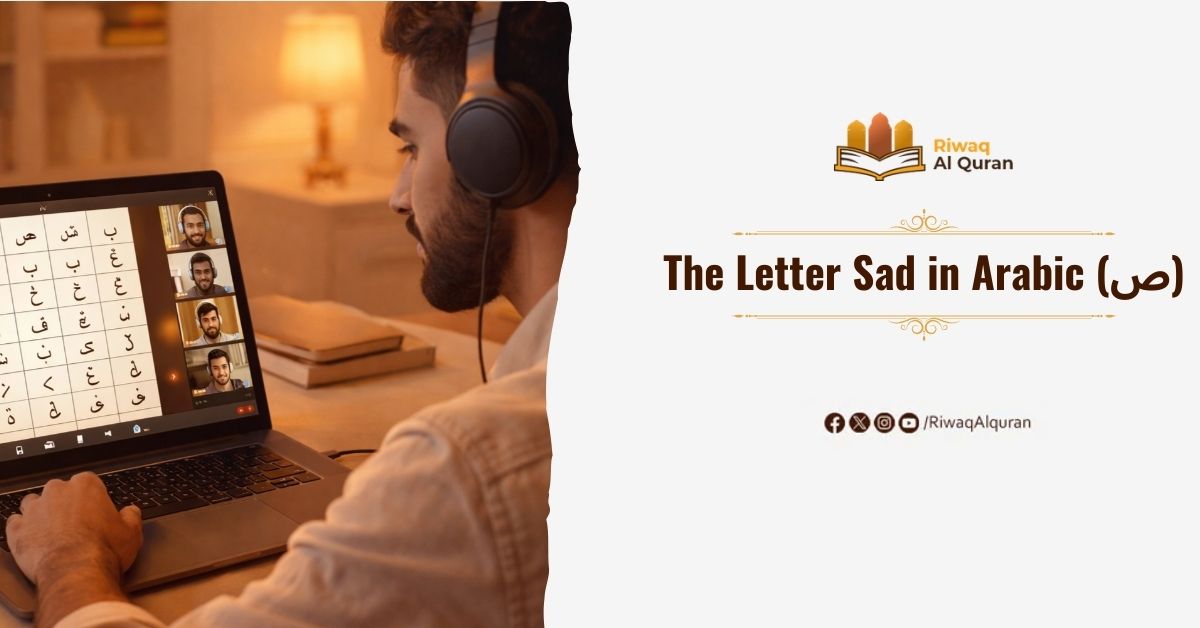
The Arabic alphabet holds letters that have no equivalent in English, and ص (Sad) is one of the most distinctive among them. This emphatic letter carries a deep, full-bodied sound that shapes countless Arabic words — and mispronouncing it can completely change a word’s meaning.
Mastering ص means understanding where it’s produced in your mouth, how to write it across different word positions, and how to recognize it confidently in Quranic text. This guide walks you through every step, complete with examples and exercises to practice right away.
Table of Contents
What Is the Letter Sad in Arabic?
The letter ص (Sad) is the fifteenth letter of the Arabic alphabet. It is an emphatic consonant — meaning it carries a heavy, back-of-mouth quality called tafkheem that affects surrounding vowels and gives Arabic its characteristic depth.
Unlike the letter س (Sin), which sounds similar to the English “s,” ص is produced much further back in the mouth with the tongue pressed firmly against the upper gum ridge while the back of the throat is slightly constricted. English has no equivalent sound, which is exactly why learners need focused guidance.
Understanding ص matters deeply for Quran learners. Confusing ص with س changes words entirely — for example, صَبَرَ (sabara) means “he was patient,” while سَبَرَ (sabara with Sin) means “he probed or sounded the depths.” The difference is spiritually and linguistically significant.
If you’re starting your Arabic learning path, consider exploring Riwaq Al Quran’s Online Arabic Course that cover Arabic letters with this level of phonetic depth.
Book Your FREE Trial in Riwaq’s Arabic Classes

How to Pronounce the Letter Sad in Arabic Correctly?
ص belongs to the emphatic category of Arabic consonants. Its correct pronunciation requires precise positioning of three parts of your mouth working together simultaneously.
The Makhraj of Letter Sad in Arabic
The makhraj (articulation point) of ص is the tip and blade of the tongue meeting the area just behind the upper front teeth (the upper alveolar region). What makes ص different from س is its sifat (phonetic attributes).
The Sifat of Letter Sad in Arabic
The phonetic attributes of ص according to classical Arabic linguistics are as follows:
| Attribute | Arabic Term | Description |
| Emphatic (Heavy) | تَفْخِيم (Tafkheem) | The sound is produced with the back of the tongue raised toward the soft palate |
| Voiceless | مَهْمُوسَة (Mahmosa) | The vocal cords do not vibrate during production |
| Whistling | صَفِير (Safeer) | A faint whistling or hissing quality accompanies the sound |
These attributes together create ص’s characteristic heavy, resonant “s” sound. Practice saying a deep, back-of-mouth “s” while rounding your lips slightly — that is the starting point for producing ص accurately.
Common Mistakes English Speakers Make with Letter Sad
The most common error is substituting ص with a simple “s” sound. This flattens the letter completely. Another frequent mistake is tensing the throat excessively, which produces an unnatural guttural quality. The emphasis in ص comes from the tongue position and lip rounding — not from the throat alone.


How to Write the Letter Sad in Arabic Across All Word Positions?
The shape of ص changes slightly depending on where it appears in a word. Recognizing these variations is essential for reading Arabic fluently, whether in textbooks or Quranic text.
Here is a complete overview of ص in all four positional forms:
| Position | Form | Example | Transliteration |
| Isolated | ص | ص | Sad |
| Initial (beginning of word) | صـ | صَبْر | Sabr (patience) |
| Medial (middle of word) | ـصـ | فَصْل | Fasl (chapter / season) |
| Final (end of word) | ـص | حَرَص | Haras (eagerness) |
The core shape of ص is a rounded, open loop resembling a small bowl with a tooth on its right side. In its initial and medial forms, the right tail is replaced by a connecting stroke. The final and isolated forms retain the full loop with a small downward tail.
For young learners, tracing the isolated form of ص repeatedly — drawing the bowl first, then adding the tooth — is the most effective way to build handwriting confidence early.
Common Arabic Words Containing the Letter Sad for Beginners
Learning ص through real vocabulary is far more effective than drill-based repetition alone. The following words are frequently used in everyday Arabic and appear throughout the Quran, making them ideal for study.
| Arabic Word | Transliteration | Meaning |
| صَبْر | Sabr | Patience |
| صَلَاة | Salah | Prayer |
| صِيَام | Siyam | Fasting |
| صَحِيح | Sahih | Correct / Authentic |
| صَغِير | Saghir | Small / Young |
| صَدِيق | Sadiq | Friend |
| صَوْت | Sawt | Voice / Sound |
| صِدْق | Sidq | Truthfulness |
| صَحِيفَة | Sahifa | Newspaper / Page |
| صَبَاح | Sabah | Morning |
| صَنَعَ | Sana’a | He made / He crafted |
| صَعْب | Sa’b | Difficult |
Notice how many of these words carry profound meanings in Islamic vocabulary — صَلَاة, صِيَام, and صِدْق are pillars of daily spiritual life. Connecting the letter to its meaning helps young learners retain it far more effectively than memorizing shapes alone.
Experience Riwaq Al Quran Classes
Watch real moments from our live sessions at Riwaq Al Quran and see how we bring learning to life. These clips highlight our interactive, student-focused approach designed to keep learners engaged, motivated, and actively involved in every step of their educational journey.
How the Letter Sad Appears in Quranic Recitation?
ص appears extensively throughout the Quran, and its precise pronunciation is a matter of both linguistic accuracy and respectful recitation. The letter even names an entire Surah — Surah Sad (سورة ص), the 38th chapter of the Quran.
One of the most spiritually significant occurrences of ص is in Surah Al-Baqarah, where the word صَبْر (patience) and its derivatives appear repeatedly as a divine instruction to believers.
Consider this beautiful verse from Surah Al-Baqarah:
وَاسْتَعِينُوا بِالصَّبْرِ وَالصَّلَاةِ
Wasta’eenu bis-sabri was-salah
“And seek help through patience and prayer.” (Al-Baqarah 2:45)
Both صَبْر and صَلَاة in this verse begin with ص — making it an ideal recitation exercise for distinguishing the emphatic sound from the lighter س.
When reciting this verse, ensure the ص in both words carries full tafkheem. The vowels surrounding ص should sound deeper and more rounded than vowels surrounding a regular س. This is one of the fundamental Tajweed distinctions that Riwaq Al Quran’s Online Tajweed Classes address in structured depth.
Enroll Now in the Best Online Tajweed Classes

Read Also: Learn The Letter Z ز in Arabic
Practice Exercises for the Letter Sad in Arabic for Kids and Adults
Consistent practice with targeted exercises is how ص moves from recognition to fluency. The following exercises are designed progressively — starting with sounds, moving to words, and ending with sentences.
Exercise 1: Pronunciation Warm-Up for Letter Sad
Repeat each of the following sounds aloud five times, paying attention to the heaviness in your mouth:
- صَ / صِ / صُ (Sa / Si / Su — with short vowels)
- صَا / صِي / صُو (Saa / Sii / Suu — with long vowels)
- صْ (Sad with sukoon — a stopped, consonant-only sound)
Focus on keeping the back of your tongue slightly raised and your lips gently rounded on each repetition.
Exercise 2: Word Recognition for Letter Sad
Look at the words below. Circle the ones that contain ص (not س):
سَبْر / صَبْر / سَلَام / صَلَاة / سِيَام / صِيَام / سَدِيق / صَدِيق
This exercise sharpens the visual distinction between ص and س — a common confusion point for beginners.
Exercise 3: Writing Practice for Letter Sad
On a blank piece of paper or in a notebook, practice writing ص in each of its four positional forms. Write each form at least five times:
- Isolated: ص
- Initial: صـ
- Medial: ـصـ
- Final: ـص
Exercise 4: Fill in the Blank with Letter Sad
Complete these Arabic words by inserting ص in the correct position:
- ـَبْر (patience) → Answer: صَبْر
- فَـْل (chapter) → Answer: فَصْل
- حَرَـ (eagerness) → Answer: حَرَص
Exercise 5: Minimal Pair Discrimination for Letter Sad
Say these pairs aloud and identify the difference in meaning:
| With ص | With س | Difference |
| صَبَرَ (he was patient) | سَبَرَ (he probed) | Meaning changes entirely |
| صَقرَ (falcon, name form) | سَقَرَ (a name for Hellfire in Quran) | Critical Quranic distinction |
| صَالَ (he attacked) | سَالَ (it flowed) | Different roots entirely |
This minimal pair exercise trains the ear and the tongue simultaneously, which is exactly how Arabic linguists recommend learning emphatic consonants.
Read Also: Learn Letter Ḍād ض in Arabic
Why Students Love Learning with Riwaq Al Quran
Hear directly from our students about how Riwaq Al Quran Academy has transformed their connection with the Book of Allah. Their experiences reflect the dedication, care, and quality that guide every step of our teaching.
Learn the Letter Sad in Arabic with Riwaq Al Quran Expert Arabic Instructors
Mastering ص requires more than reading a guide — it needs qualified feedback on your pronunciation and writing from day one.
At Riwaq Al Quran, our Al-Azhar-certified instructors have guided thousands of non-native learners through exactly this process since 2017. Here is what sets our programs apart:
- One-on-one live sessions tailored to your pace and level
- Dedicated Online Arabic Classes for Kids with age-appropriate methods
- Expert phonetic correction for emphatic letters like ص
- Structured Tajweed integration for Quran recitation accuracy
- Flexible scheduling for learners worldwide
Book your free trial lesson today and start pronouncing ص — and every Arabic letter — with confidence, Insha’Allah.
Beyond Arabic, we offer courses in Online Tajweed Classes, Arabic Language, and Islamic Studies.
- Online Quran Memorization Course
- Tajweed Classes
- Online Quran Classes for Kids.
- Ijazah Program.
- Arabic Language Classes.
- Islamic Studies Courses.
Enroll now for 2 Free Trial Classes and Begin Learning Arabic or Memorizing Quran Today

Conclusion
The letter ص stands apart in the Arabic alphabet precisely because of its emphatic nature. Its correct production depends on tongue position, lip rounding, and the tafkheem quality — all of which can be trained systematically with the right approach and consistent daily practice.
Recognizing ص in its four written forms and connecting it to high-frequency vocabulary like صَلَاة and صِدْق accelerates both reading ability and comprehension simultaneously. Every word you learn containing ص builds a stronger phonetic and semantic foundation.
Arabic letters are never just shapes — they carry meaning, sound, and in many cases, spiritual significance. As you continue learning, return to these exercises regularly, record your own pronunciation for comparison, and let each letter become a doorway to deeper understanding of this beautiful language. Alhamdulillah for every step forward.