Learning a single Arabic letter correctly can open an entire language to you. The Arabic letter هـ (Haa) appears in hundreds of everyday words, from greetings to names to Quranic verses, making it one of the most practically useful letters to master early in your studies.
Understanding هـ means grasping its unique sound, recognizing its four written forms, and knowing how it behaves across different word positions. This guide walks you through everything — pronunciation, script, common words, and practice exercises — so you can use this letter with confidence from day one.
Table of Contents
What the Arabic Letter Haa Looks Like and How It Changes Form in a Word?
The Arabic letter هـ is one of the letters that changes shape significantly depending on where it appears in a word. Unlike some letters that show only minor variation, هـ takes on four distinct forms that beginners must learn individually.
The key to recognizing هـ in all its forms is the small loop or eye-shaped core that defines most of its positional variants. Once your eye learns to spot that loop, you will identify this letter instantly, even inside unfamiliar words.
| Position | Arabic Form | Example Word | Transliteration |
| Isolated | هـ / ه | هَوَاء | Hawaa’ (air) |
| Initial (start) | هـ | هَدِيَّة | Hadiyyah (gift) |
| Medial (middle) | ـهـ | مَهَارَة | Mahaarah (skill) |
| Final (end) | ـه | وَجْه | Wajh (face) |
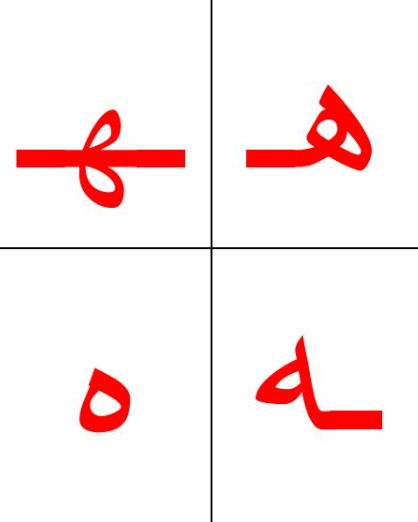
Notice that the medial form ـهـ is the most condensed in shape. The final form ـه drops the connecting tail and sits more openly at the word’s end. Studying these forms as a set — rather than memorizing them randomly — speeds up your reading significantly.
For families who want structured guidance on teaching children these letters, Riwaq Al Quran’s Online Arabic Classes for Kids pairs young learners with qualified instructors who teach the Arabic alphabet through age-appropriate methods and repetition techniques proven to build retention.
Enroll Your Kid in Riwaq’s Arabic Classes for Kids with a FREE trial

How to Pronounce the Arabic Letter Haa Correctly as a Non-Native Speaker?
The Arabic letter هـ produces a voiceless glottal fricative sound. Its articulation point (makhraj) is the glottis — the space between the vocal cords deep in the throat.
To produce هـ correctly, breathe out gently while keeping your throat open and relaxed. The sound is similar to the English “h” in “hello” or “happy,” but with slightly more breath pressure from deeper in the throat. It is not a harsh or scratchy sound.
The Phonetic Attributes (Sifat) of Arabic Letter Haa
From the science of Arabic phonetics, هـ carries specific attributes (Sifat) that define its character. Understanding these helps you produce the letter accurately rather than guessing.
| Attribute | Classification | Explanation |
| Airflow | Continuous (Rikhwa) | Air flows freely without complete obstruction |
| Articulation Point | Glottis (Al-Jawf / Adnal Halq) | Produced at the base of the throat |
| Emphasis | Plain (Mustafil) | No velarization or darkening of the vowel |
Common Pronunciation Mistakes English Speakers Make with Haa
English speakers generally find هـ easier than letters like خ or ح, but two errors appear consistently.
First, some learners swallow the sound entirely, especially in final position, producing silence where the letter should be audible.
Second, some confuse هـ with the emphatic ح (Haa with a dot underneath), which is produced much lower and with stronger throat constriction.
The rule is simple: هـ is breathy and light. If your throat feels strained, you are producing the wrong letter.


Common Arabic Words That Contain the Letter Haa for Everyday Use
Building vocabulary around هـ is the fastest way to internalize both its sound and its written forms simultaneously. The following words appear regularly in spoken Arabic, written Arabic, and Quranic text.
Words Where Haa Appears at the Beginning
| Arabic Word | Transliteration | Meaning |
| هَوَاء | Hawaa’ | Air / Wind |
| هَدِيَّة | Hadiyyah | Gift |
| هُدُوء | Hudoo’ | Calm / Tranquility |
| هِلَال | Hilaal | Crescent moon |
| هَاتِف | Haatif | Telephone |
Words Where Haa Appears in the Middle or End
Arabic words with هـ in medial or final positions are equally common and worth practicing separately, since the letter’s shape differs in those positions.
| Arabic Word | Transliteration | Meaning |
| مَهَارَة | Mahaarah | Skill |
| وَجْه | Wajh | Face |
| شَهْر | Shahr | Month |
| فَاكِهَة | Faakihah | Fruit |
| مَنْهَج | Manhaj | Curriculum / Method |
Practicing these words aloud while looking at their written forms builds the connection between sound and script much faster than studying them separately.
If you are helping a child learn, try using the words هَدِيَّة (gift) and هِلَال (crescent) since children respond well to meaningful, familiar concepts.
Adults learning Arabic for general use will find that building vocabulary in sets like this — grouped around a single letter — accelerates both reading and listening comprehension. Riwaq Al Quran’s Online Arabic Course for adults is structured precisely this way, moving from letter mastery to word recognition to sentence reading with a certified instructor guiding every stage.
Book Your FREE Trial in Riwaq’s Arabic Classes

How to Write the Arabic Letter Haa Step by Step with Correct Stroke Order?
Writing هـ correctly requires following the natural stroke direction of Arabic script, which moves from right to left. Rushing the stroke or reversing direction produces shapes that look inconsistent and are harder to connect to other letters.
Writing the Isolated and Initial Form of Haa
Begin with a small rightward curve at the top, then loop downward and leftward to form the characteristic eye shape. For the initial form هـ, extend a short connecting stroke to the left so the next letter can attach smoothly.
Practice writing the initial form هـ five times slowly before increasing speed. Accuracy before speed is the correct order for every letter in the Arabic script.
Writing the Medial and Final Form of Haa
The medial form ـهـ sits between two connecting strokes. The loop becomes slightly smaller and more compact. The final form ـه is the most open — it ends with a downward tail or a looping descent, depending on the calligraphic style.
Experience Riwaq Al Quran Classes
Watch real moments from our live sessions at Riwaq Al Quran and see how we bring learning to life. These clips highlight our interactive, student-focused approach designed to keep learners engaged, motivated, and actively involved in every step of their educational journey.
How Arabic Letter Haa Behaves in Quranic Recitation and Tajweed?
In Quranic recitation, هـ has specific rules that affect how it is pronounced depending on the letters surrounding it. The most important rule for learners to understand early is the silent هـ of the pronoun.
In the Quran, the third-person masculine pronoun هُ or هِ (meaning “him / his”) sometimes has its vowel lengthened and sometimes remains short, depending on what precedes it. This is called Silat Al-Haa — the connection rule for the pronoun هـ.
A beautiful example featuring هـ prominently in Quranic text is:
هُوَ ٱللَّهُ ٱلَّذِي لَآ إِلَـٰهَ إِلَّا هُوَ
Huwa Allahu alladhee laa ilaaha illaa huwa
“He is Allah, other than whom there is no deity.” (Al-Hashr 59:22)
The word هُوَ (Huwa) opens with هـ in its initial form and demonstrates the breathy, light pronunciation that defines this letter in Quranic recitation.
Correct recitation of هـ in Quranic verses requires that the breath remain relaxed and that no tension enters the throat. Learners who confuse هـ with ح during recitation alter the meaning of words, which is why precise makhraj training matters.
For those committed to reciting the Quran correctly, Riwaq Al Quran’s Online Tajweed Classes offers dedicated instruction on letter articulation points, including precise guidance on هـ and its behavior in connected recitation.
Enroll Now in the Best Online Tajweed Classes

Read Also: Learn The Arabic Letter Ya (ي)
Practice Exercises to Strengthen Your Recognition and Use of Arabic Letter Haa
Consistent practice with targeted exercises produces far better results than passive reading. The following exercises move from recognition to production, following the natural learning progression.
Exercise 1 — Letter Identification
Read the following Arabic words and circle every هـ you find, noting its position:
هَدِيَّة — شَهْر — هِلَال — فَاكِهَة — هُدُوء — مَنْهَج — هَاتِف — وَجْه
Read Also: The Arabic Letter W/و (Waw)
Exercise 2 — Pronunciation Drill
Practice saying each word below three times, focusing on keeping the هـ sound light and breathy throughout. Do not tighten your throat.
هَوَاء — هُدُوء — مَهَارَة — وَجْه — شَهْر
Record yourself if possible and compare to a native speaker model. The gap between what you think you said and what you actually produced often surprises learners — and that gap closes fastest with audio feedback.
Read Also: The Arabic Letter Lam ل
Exercise 3 — Writing Practice
Write the following words three times each from memory after studying them:
- هَدِيَّة (gift)
- شَهْر (month)
- مَهَارَة (skill)
Check your هـ forms against the table in the earlier section. Pay particular attention to whether your medial form ـهـ is compact enough and properly connected on both sides.
Read Also: The Arabic Letter Meem م
Exercise 4 — Vocabulary Matching
Match the Arabic word to its English meaning without looking back at earlier tables:
| هِلَال | a) Telephone |
| هَاتِف | b) Crescent moon |
| فَاكِهَة | c) Face |
| وَجْه | d) Fruit |
(Answers: هِلَال = b, هَاتِف = a, فَاكِهَة = d, وَجْه = c)
Read Also: The Arabic Letter Nun ن
Why Students Love Learning with Riwaq Al Quran
Hear directly from our students about how Riwaq Al Quran Academy has transformed their connection with the Book of Allah. Their experiences reflect the dedication, care, and quality that guide every step of our teaching.
Learn the Arabic Letter Haa with Expert Instructors at Riwaq Al Quran
Mastering هـ is a strong foundation, and with proper guidance, every Arabic letter becomes genuinely accessible. Riwaq Al Quran has helped thousands of non-Arabic speakers build real reading and recitation skills since 2017.
Here is what sets our programs apart:
- Al-Azhar-certified Arabic instructors with expertise in phonetics and alphabet pedagogy
- Dedicated Online Arabic Classes for Kids with child-friendly methodology
- Comprehensive Online Arabic Course for adult learners at all levels
- Specialized Online Tajweed Classes for Quranic recitation accuracy
- Flexible scheduling across all time zones
- Free trial lesson with no commitment required
Book your free trial today and take your first step toward reading Arabic with confidence, Insha’Allah.
Beyond Arabic, we offer courses in Online Tajweed Classes, Arabic Language, and Islamic Studies.
- Online Quran Memorization Course
- Tajweed Classes
- Online Quran Classes for Kids.
- Ijazah Program.
- Arabic Language Classes.
- Islamic Studies Courses.
Enroll now for 2 Free Trial Classes and Begin Learning Arabic or Memorizing Quran Today

Conclusion
The Arabic letter هـ holds a distinct phonetic identity — light, breathy, and produced effortlessly at the glottis — that makes it one of the more accessible Arabic sounds for English-speaking learners. Knowing its four written forms and connecting them to real vocabulary builds durable reading skills.
Recognizing هـ across word positions, from the open initial form to the compact medial shape, trains the eye to process Arabic script fluidly. Consistent writing practice, especially with words like مَهَارَة and وَجْه, reinforces both form recognition and correct stroke production simultaneously.
Every letter mastered in Arabic is a step closer to reading the Quran and understanding a language spoken by hundreds of millions. Alhamdulillah, the path is clear — practice daily, use structured resources, and approach each letter with patience and curiosity.