The Arabic alphabet holds letters that have no true equivalent in English, and the letter Qaf ق is one of the most distinctive among them. Its sound is deep, resonant, and produced far back in the throat — a quality that immediately sets Arabic apart from European languages and gives it its unmistakable character.
Mastering Qaf ق is not just about pronunciation. It opens the door to hundreds of everyday Arabic words, builds your confidence with the script, and — for those approaching the Quran — sharpens your recitation in ways that matter deeply. This guide walks you through every dimension of the letter, step by step.
Table of Contents
What the Letter Qaf in Arabic ق?
Qaf ق is the twenty-first letter of the Arabic alphabet. It represents a sound classified in Arabic phonetics as a majhoor (voiced in classical classification) qalqalah letter and a shaddid (stop consonant).
Its presence in Arabic is frequent — appearing in the Quran, in everyday vocabulary, and in fundamental grammatical structures.
For parents teaching their children Arabic at home, Qaf ق is a letter that requires early, deliberate attention. Because it has no English equivalent, children cannot rely on their native language as a guide.
Structured learning — such as Riwaq Al Quran’s Online Arabic Classes for Kids — provides the phonetic scaffolding young learners need to produce this sound correctly from the start.
Enroll Your Kid in Riwaq’s Arabic Classes for Kids with a FREE trial

| Feature | Detail |
| Letter Name | Qaf (قَاف) |
| Alphabet Position | 21st letter |
| Letter Category | Shaddid (Stop), Qalqalah letter |
| Voicing | Majhoor (Voiced) in classical classification |
| Emphasis (Tafkhim) | Heavy (Mufakham) |
Where Exactly Is the Letter Qaf ق Produced in the Mouth?
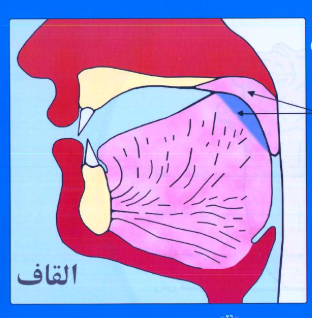
The makhraj (articulation point) of Qaf ق is at the back of the tongue meeting the soft palate (uvular area). More precisely, it is produced from the aqsa al-lisan — the furthest rear portion of the tongue — pressing against the aqsa al-hanakiyyah — the soft palate (velum) at its rearmost point.
This places Qaf ق significantly further back than any English consonant. English has the “k” sound (as in “king”), which also uses the back of the tongue, but English “k” contacts the soft palate at a more forward position. Qaf ق goes deeper, producing that characteristic heavy resonance.
How to Find the Correct Articulation Point for Qaf ق
Place the back of your tongue flat against the rear of the roof of your mouth — further back than you would for “k.”
When you release that contact with a slight push of air, you should hear the distinctive Qaf sound. The sound has body and depth that English “k” simply does not have.
Why the Sifat of Qaf ق Shape Its Sound
Qaf ق carries several phonetic attributes (sifat) that define its quality. It is shaddid (a complete stop of airflow), mufakham (heavy/emphatic — the mouth cavity opens with a fuller resonance), and it is one of the five qalqalah letters, meaning it produces a slight echo or bounce when vowelless (sukoon) in recitation.
How to Recognize the Letter Qaf ق in All Its Written Forms?
Arabic letters change shape depending on their position in a word. Qaf ق is a connecting letter, meaning it connects to the letter that follows it within a word. Recognizing it in all four positions is essential for reading fluency.
The defining feature of Qaf ق is its distinctive bowl-shaped body — similar to the letter Fa (ف) — but with two dots above instead of one. This double-dot marker is your clearest visual anchor when identifying Qaf ق in printed or handwritten Arabic.
| Position | Form | Example Word |
| Isolated | ق | — |
| Initial (beginning of word) | قـ | قَلَم (pen) |
| Medial (middle of word) | ـقـ | يَقْرَأ (he reads) |
| Final (end of word) | ـق | طَرِيق (road) |
Study these four forms carefully. In initial and medial positions, the tail of Qaf ق is shortened to allow connection to the next letter.
In isolated and final positions, the full sweeping tail appears beneath the bowl. Both dots remain consistently above the letter across all positions.


Common English-Speaker Errors When Pronouncing the Letter Qaf ق
The most frequent mistake English speakers make with Qaf ق is substituting it with the English “k” or “q” (as in “queen”). While these sounds are related phonetically, they are produced at different contact points, producing a noticeably lighter sound that Arabic native speakers immediately detect.
A second common error is confusing Qaf ق with Kaf ك. Both are back-of-tongue stop consonants, but Kaf ك contacts the soft palate at a more forward position and is rakhwah in some qualities, while Qaf ق is deeper and carries qalqalah — making them phonemically distinct in Arabic.
The Difference Between Qaf ق and Kaf ك at a Glance
| Feature | Qaf ق | Kaf ك |
| Makhraj | Furthest back of tongue + rear soft palate | Back of tongue + mid-soft palate (more forward) |
| Dots | Two dots above | No dots (distinct shape) |
| Qalqalah | Yes | No |
| Tafkhim (Heaviness) | Yes (always heavy) | No (always light) |
| Common Confusion | Replaced with English “k” | Confused with Qaf by beginners |
This contrast table is worth practicing daily. Record yourself saying word pairs containing Qaf ق and Kaf ك side by side, and compare with native audio. The ear trains faster than the tongue, so listening must precede speaking.
Book Your FREE Trial in Riwaq’s Quranic Arabic Classes

Essential Arabic Words Containing the Letter Qaf ق
Learning vocabulary that contains Qaf ق is one of the fastest ways to internalize both its sound and its written forms. The examples below span everyday Arabic across family, nature, education, and daily life — giving both children and adult learners rich, usable material.
Everyday Words with Qaf ق at the Beginning
- قَلَم (Qalam) — Pen
- قَمَر (Qamar) — Moon
- قِطَّة (Qittah) — Cat
- قَهْوَة (Qahwah) — Coffee
- قَلْب (Qalb) — Heart
- قُرْآن (Qur’an) — The Holy Quran
Common Words with Qaf ق in the Middle
- يَقْرَأ (Yaqra’) — He reads
- مَقْعَد (Maq’ad) — Seat/Chair
- صَقْر (Saqr) — Falcon
- عَقْل (Aql) — Mind/Intellect
Familiar Words Ending with Qaf ق
- طَرِيق (Tariq) — Road/Way
- صَدِيق (Sadiq) — Friend
- سُوق (Suq) — Market/Bazaar
- حَقّ (Haqq) — Truth/Right
- شَوْق (Shawq) — Longing/Yearning
Exposure to these words in context — not just as isolated examples — builds lasting recognition. Try using three new Qaf ق words in a sentence each day as a simple practice habit.
Experience Riwaq Al Quran Classes
Watch real moments from our live sessions at Riwaq Al Quran and see how we bring learning to life. These clips highlight our interactive, student-focused approach designed to keep learners engaged, motivated, and actively involved in every step of their educational journey.
How the Letter Qaf ق Appears in the Quran and Why It Matters for Recitation?
Qaf ق holds a special place in Quranic Arabic. An entire surah bears its name — Surah Qaf (سورة ق), the 50th chapter — beginning with the single letter ق as one of the huruf muqatta’at (disconnected letters whose full wisdom belongs to Allah alone).
The correct pronunciation of Qaf ق in recitation is non-negotiable.
Flattening this echo or replacing Qaf ق with a “k” sound alters the recitation in a way that scholars of Tajweed consider a significant error.
For adult learners focused on Quranic recitation, Riwaq Al Quran’s Online Tajweed Classes provide structured guidance on qalqalah and all articulation points, taught by qualified instructors with Ijazah certifications. This level of precision matters enormously for worship-centered learning.
Enroll Now in the Best Online Tajweed Classes

Step-by-Step Exercises to Practice the Letter Qaf ق
Practice is where understanding becomes skill. The exercises below progress logically — from sound production to reading to writing — so both children and adults can use them at any stage.
Exercise 1 — Sound Isolation Practice
Repeat the following sequence aloud ten times, pausing between each:
قَ — قِ — قُ — قْ
(Qa — Qi — Qu — Q with sukoon)
Focus on keeping the contact point at the very back of your tongue. If your sound resembles English “k,” move the tongue further back until you feel it touch the soft palate at its rearmost point.
Exercise 2 — Word Recognition Drill
Read each word aloud, then identify whether Qaf ق is at the beginning, middle, or end:
| Word | Transliteration | Qaf ق Position |
| قَمَر | Qamar | Beginning |
| صَدِيق | Sadiq | End |
| مَقْعَد | Maq’ad | Middle |
| قَلْب | Qalb | Beginning |
| طَرِيق | Tariq | End |
Exercise 3 — Writing Practice
Write each of the four forms of Qaf ق — isolated, initial, medial, final — five times each on paper. Then copy the words from Exercise 2 in full. Connecting Qaf ق to surrounding letters requires practice, especially in medial position where the tail shortens.
Exercise 4 — Minimal Pair Discrimination
Listen to or produce these word pairs, focusing on the contrast between Qaf ق and Kaf ك:
- قَلَم (Qalam — Pen) vs. كَلَام (Kalam — Speech)
- قَلْب (Qalb — Heart) vs. كَلْب (Kalb — Dog)
The difference in these pairs is entirely determined by one letter. Accuracy here is not optional — it changes meaning entirely.
Read Also: The Arabic Letter Ayn ع
Exercise 5 — Sentence Reading
Read this short sentence aloud three times:
صَدِيقِي يَقْرَأُ الْقُرْآنَ فِي السُّوق
Sadiqiy yaqra’u al-Qur’ana fi al-suq. “My friend reads the Quran in the market.”
This sentence contains Qaf ق in three different positions and two different forms, making it an excellent single-sentence drill.
Read also: Learn Letter Ghayn غ in Arabic
Why Students Love Learning with Riwaq Al Quran
Hear directly from our students about how Riwaq Al Quran Academy has transformed their connection with the Book of Allah. Their experiences reflect the dedication, care, and quality that guide every step of our teaching.
Learn the Letter Qaf ق with Riwaq Al Quran’s Expert Arabic Instructors
Mastering Qaf ق — its sound, its script, its Quranic weight — is far more effective with a qualified teacher guiding your articulation from the start.
Riwaq Al Quran has been teaching Arabic and Quran to non-native speakers since 2017. Here is what sets the academy apart:
- Al-Azhar-certified Arabic and Tajweed instructors
- Specialized Online Arabic Course for adult learners at all levels
- Dedicated Online Arabic Classes for Kids with age-appropriate pedagogy
- Structured Online Tajweed Classes for precise Quranic pronunciation
- Flexible scheduling built for busy Western families and professionals
- Free trial lesson — no commitment required
Book your free trial today and let a qualified instructor correct your Qaf ق from your very first session, Insha’Allah.
Beyond Arabic, we offer courses in Online Tajweed Classes, Quran Learning, and Islamic Studies.
- Online Quran Memorization Course
- Tajweed Classes
- Online Quran Classes for Kids.
- Ijazah Program.
- Arabic Language Classes.
- Islamic Studies Courses.
Enroll now for 2 Free Trial Classes and Begin Learning Arabic or Memorizing Quran Today

Conclusion
Qaf ق is a letter that rewards patience and precise practice. Its deep articulation point, its heavy resonance, and its qalqalah echo make it one of the most phonetically rich letters in Arabic — and one of the most rewarding to master correctly.
Once you internalize the distinction between Qaf ق and Kaf ك, your Arabic ear sharpens in ways that carry across the entire alphabet. Accuracy with one difficult sound builds the discipline that elevates your reading across the board.
Whether your goal is everyday Arabic conversation, teaching your children the alphabet, or perfecting your Quranic recitation, Qaf ق is a letter worth investing real effort in — because that effort compounds with every word you read and every verse you recite, Alhamdulillah.