The Arabic alphabet holds 28 letters, and among them, ل (Lam) stands as one of the most frequently used. Whether you’re helping your child take their first steps in Arabic or beginning your own adult learning path, mastering Lam opens doors to hundreds of everyday words and Quranic verses.
Lam carries a unique distinction in Arabic phonetics — it is the only letter that changes its pronunciation entirely when it appears in the word الله (Allah). Understanding how Lam works in general Arabic, in connected script, and in Quranic recitation gives learners a genuinely strong foundation from the very start.
Table of Contents
What the Arabic Letter Lam Looks Like and How It Connects in Script
Lam is one of the most visually recognizable letters in Arabic. In its isolated form, it resembles a tall, upright stroke with a curved base — like a shepherd’s staff leaning slightly to the right.
What makes Lam especially important for beginners is that it connects to letters on both sides, meaning it changes shape depending on its position inside a word.
| Position | Form | Example Word | Meaning |
| Isolated | ل | — | — |
| Initial (word-beginning) | لـ | لَيْل | Night |
| Medial (word-middle) | ـلـ | عَلَم | Flag / Knowledge |
| Final (word-end) | ـل | جَمَل | Camel |
Notice how the core shape — that upright stroke with a curved base — remains recognizable across all four positions. Teaching children to spot this consistent shape helps them identify Lam quickly in any text.
If you’re looking for a structured way to teach your child the Arabic alphabet from the very beginning, Riwaq Al Quran‘s Online Arabic Classes for Kids are designed specifically to build letter recognition, reading, and writing skills in a warm, engaging environment.
Enroll Your Kid in Riwaq’s Arabic Classes for Kids with a FREE trial

Common Arabic Words That Contain the Letter Lam
One of the best ways to internalize any Arabic letter is through real vocabulary. Lam appears in some of the most commonly used words in everyday Arabic speech, classical texts, and the Quran.
Lam at the Beginning of Words
| Arabic Word | Transliteration | Meaning |
| لَوْن | Lawn | Color |
| لِسَان | Lisan | Tongue / Language |
| لَبَن | Laban | Milk |
| لَيْل | Layl | Night |
| لَحْم | Lahm | Meat |
Lam in the Middle of Words
| Arabic Word | Transliteration | Meaning |
| عَلَم | Alam | Flag / Knowledge |
| كَلِمَة | Kalima | Word |
| قَلَم | Qalam | Pen |
| وَلَد | Walad | Boy / Child |
| سَلَام | Salam | Peace |
Lam at the End of Words
| Arabic Word | Transliteration | Meaning |
| جَمَل | Jamal | Camel |
| عَسَل | Asal | Honey |
| رَجُل | Rajul | Man |
| جَبَل | Jabal | Mountain |
| فِعْل | Fi’l | Verb / Action |
Encourage children to say each word aloud while pointing to the Lam in the written form. Connecting sound to script from the beginning builds reading instincts that last.


How the Definite Article ال (Al-) Works with Lam
Every Arabic learner encounters the definite article ال (Al-) within their first lessons. Lam is the second letter of this article, and understanding how it behaves here is essential for reading Arabic correctly.
Arabic letters are divided into two categories: Shamsiyya (solar) and Qamariyya (lunar). When ال precedes a Shamsiyya letter, the Lam of ال is assimilated — it merges into the following letter, doubling it instead of being pronounced separately.
When ال precedes a Qamariyya letter, the Lam is clearly pronounced.
Examples of Al- with Shamsiyya and Qamariyya Letters
| Type | Arabic Word | Transliteration | English |
| Shamsiyya (Lam silent) | الشَّمْس | Ash-shams | The Sun |
| Shamsiyya (Lam silent) | النُّور | An-noor | The Light |
| Qamariyya (Lam heard) | الْقَمَر | Al-qamar | The Moon |
| Qamariyya (Lam heard) | الْكِتَاب | Al-kitab | The Book |
This distinction directly affects how correctly you read the Quran and any Arabic text. Adults learning Arabic through Riwaq Al Quran‘s Online Arabic Course cover this rule systematically with native-speaking instructors.
Book Your FREE Trial in Riwaq’s Arabic Classes

How to Pronounce the Arabic Letter Lam Correctly as a Non-Native Speaker?
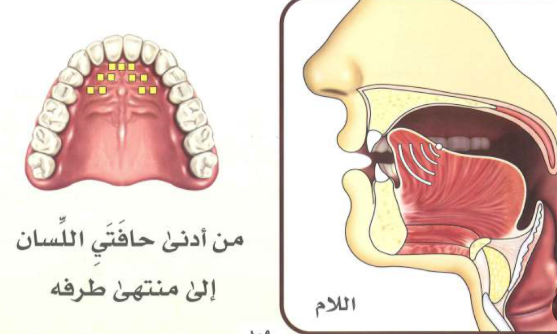
Lam is pronounced like the English letter “L” in the word love — a lateral consonant produced by placing the tip of your tongue against the upper gum ridge (the alveolar ridge), just behind your upper front teeth.
In classical Arabic phonetic science, the articulation point (makhraj) of Lam is defined as the edge of the tongue making contact with the gum ridge adjacent to the upper molars, extending toward the front teeth. This is classified as a lingual-alveolar lateral consonant.
Common Pronunciation Errors English Speakers Make with Lam
The biggest mistake English learners make is using a “dark L” — the heavy, back-of-the-throat “L” heard in English words like ball or full. Arabic Lam (in most contexts) is a clear, forward L, produced near the front of the mouth.
Train yourself to always use the front-of-mouth “L” as in lean or love — never the heavy “L” as in full. Keeping the tongue tip firmly against the upper gum ridge prevents the heavy sound from creeping in.
Experience Riwaq Al Quran Classes
Watch real moments from our live sessions at Riwaq Al Quran and see how we bring learning to life. These clips highlight our interactive, student-focused approach designed to keep learners engaged, motivated, and actively involved in every step of their educational journey.
How Lam Behaves Differently in the Word Allah (الله)?
This is one of the most important phonetic rules a Quran learner must know.
Lam Al-Jalala is pronounced heavily (with a full, deep resonance) when the letter before it carries a Fatha (ـَ) or Damma (ـُ). It is pronounced lightly when the preceding letter carries a Kasra (ـِ).
بِسْمِ اللَّهِ الرَّحْمَٰنِ الرَّحِيمِ
Bismi Allahi alrrahmani alrraheem
“In the name of Allah, the Entirely Merciful, the Especially Merciful.” (Al-Fatiha 1:1)
The Lam in الله here follows a Kasra — بِسْمِ — so it is pronounced lightly, as Tarqeeq. This is a key Tajweed observation for reciters.
Understanding Lam Al-Jalala is a core component of proper Quranic recitation. Riwaq Al Quran‘s Online Tajweed Classes cover this rule in detail with live instructor feedback, so you can recite with confidence.
Enroll Now in the Best Online Tajweed Classes

Step-by-Step Exercises to Practice the Arabic Letter Lam
Practice is where learning moves from passive recognition to active skill. These exercises are designed progressively — start with the first and move forward only when comfortable.
Exercise 1 — Letter Recognition
Look at the following Arabic words and circle every Lam you find:
كَلِمَة — لَيْل — جَمَل — سَلَام — قَلَم — وَلَد — لَبَن — رَجُل
Answer: Lam appears in every one of these words. Check each position — beginning, middle, or end — and notice how the shape shifts while remaining identifiable.
Read Also: The Arabic Letter Haa (هـ)
Exercise 2 — Pronunciation Practice
Read each word below aloud, focusing on producing a clear, forward “L” with your tongue tip firmly on the upper gum ridge. Avoid any heaviness in the sound (except when practicing الله):
لَوْن — لِسَان — عَلَم — سَلَام — جَبَل — كَلِمَة — لَحْم — قَلَم
Repeat each word three times. Record yourself and compare your pronunciation with a native speaker audio source if possible.
Read Also: Learn The Arabic Letter Ya (ي)
Exercise 3 — Writing Practice
Write each form of Lam five times in sequence: ل — لـ — ـلـ — ـل
Then practice writing these full words by hand: لَيْل (night) — قَلَم (pen) — جَمَل (camel) — سَلَام (peace)
Read Also: The Arabic Letter W/و (Waw)
Exercise 4 — Al- Recognition
Read the following words and identify whether the Lam in ال is pronounced or silent:
الشَّمْس — الْقَمَر — النُّور — الْكِتَاب — الرَّحْمَن — الْعِلْم
(Tip: If the word begins with a Shamsiyya letter — like ش، ن، ر — the Lam is silent and the next letter is doubled. If it begins with a Qamariyya letter — like ق، ك، ع — you hear the Lam clearly.)
Read Also: The Arabic Letter Meem م
Exercise 5 — Reading Connected Text
Read this short phrase aloud carefully, identifying every Lam and whether it is light or heavy:
اللَّهُ نُورُ السَّمَاوَاتِ وَالْأَرْضِ
“Allah is the Light of the heavens and the earth.” (An-Nur 24:35)
Notice: The Lam in الله is heavy (Tafkheem) because the preceding word carries a Damma. The Lam in السَّمَاوَات is silent (Shamsiyya). The Lam in وَالْأَرْضِ is clearly pronounced (Qamariyya). Three different behaviors — one letter.
Read Also: The Arabic Letter Nun ن
Why Students Love Learning with Riwaq Al Quran
Hear directly from our students about how Riwaq Al Quran Academy has transformed their connection with the Book of Allah. Their experiences reflect the dedication, care, and quality that guide every step of our teaching.
Learn the Arabic Letter Lam with Riwaq Al Quran’s Expert Arabic Instructors
Mastering Lam — with all its forms, rules, and Quranic implications — becomes significantly easier with a qualified teacher guiding you.
At Riwaq Al Quran, you get:
- Al-Azhar-certified instructors with deep specialization in Arabic phonetics and Tajweed
- Online Arabic Classes for Kids designed for young learners with engaging, age-appropriate methods
- Online Arabic Course for adults covering alphabet, grammar, and reading fluency
- Online Tajweed Classes for precise Quranic recitation with live feedback
- Flexible scheduling for families and individuals worldwide
- Free trial lesson — no commitment required
Book your free trial lesson today at Riwaq Al Quran and experience expert-guided Arabic learning from the very first session, Insha’Allah.
Beyond Arabic, we offer courses in Online Tajweed Classes, Arabic Language, and Islamic Studies.
- Online Quran Memorization Course
- Tajweed Classes
- Online Quran Classes for Kids.
- Ijazah Program.
- Arabic Language Classes.
- Islamic Studies Courses.
Enroll now for 2 Free Trial Classes and Begin Learning Arabic or Memorizing Quran Today

Conclusion
The Arabic letter Lam is both accessible and nuanced — its clear pronunciation makes it friendly for beginners, while its behavioral rules inside connected speech and Quranic recitation reward careful study with genuine linguistic depth.
Recognizing Lam across its four positional forms, understanding the solar-lunar rule with ال, and knowing when to apply Tafkheem versus Tarqeeq gives learners a real functional command of this letter — not just surface familiarity with its shape.
Every Arabic letter carries layers worth exploring, and Lam is a perfect example of how Arabic rewards patient, structured learning. With consistent practice of the exercises above, both children and adults can build confident, accurate reading skills that carry them naturally into Quranic recitation, Alhamdulillah.