Learning to recite the Quran correctly requires mastering the rules that govern how letters interact — and Idgham in Tajweed is one of the most frequently encountered. It is part of the broader set of Noon Sakinah and Tanween rules that every Tajweed student must work through, and understanding it in full — including the exception most learners never hear about — is what separates surface knowledge from confident recitation.
Whether you are just starting your Tajweed journey or consolidating rules you have covered before, this article gives you the complete picture of Idgham: its definition, types, pronunciation mechanics, and annotated Quranic examples. If you have no prior foundation in Tajweed at all, it is worth beginning with a Noorani Qaida Online program first to build the basics before approaching these rules.
What You’ll Learn in This Article
- The precise definition of Idgham in Tajweed and why it occurs.
- The six Idgham letters and the mnemonic scholars use to memorize them.
- The difference between Idgham with Ghunnah and without Ghunnah — and exactly how each sounds.
- The critical same-word exception that overrides Idgham entirely, with the four specific Quranic words.
- All extended types of Idgham with annotated Quranic examples.
- A step-by-step decision guide for applying any Idgham rule correctly.
Table of Contents
What Is Idgham in Tajweed?
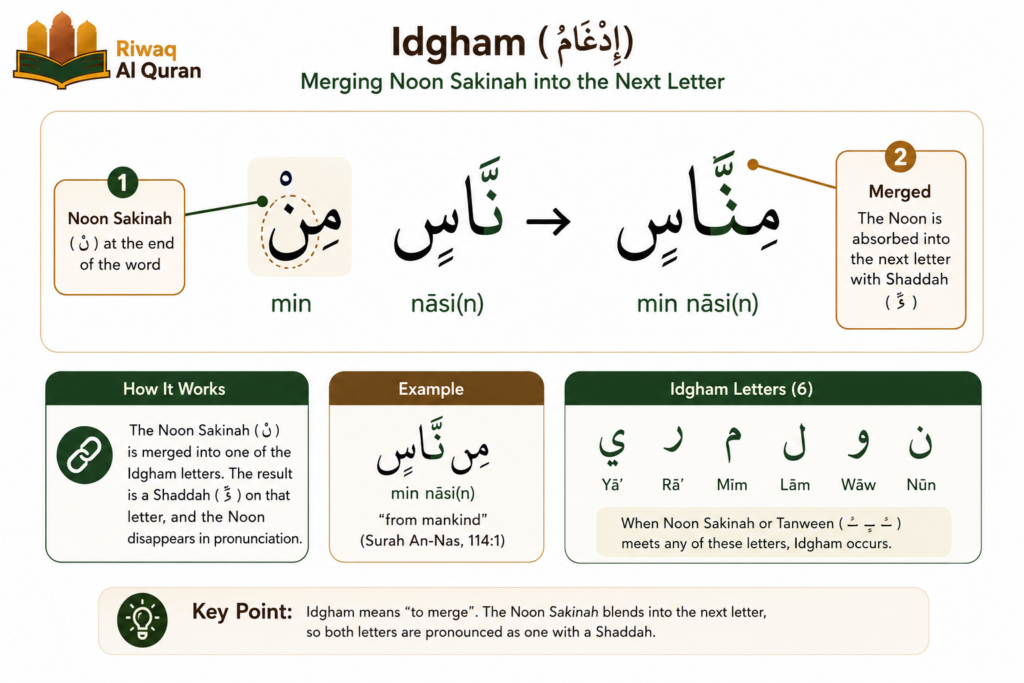
Idgham (إدغام) is one of the four rules that govern what happens to Noon Sakinah (نْ) and Tanween (ً ٍ ٌ) when they are followed by certain letters. The other three rules are Izhar, Ikhfa, and Iqlab — but Idgham is the one most frequently encountered in connected recitation because its trigger letters appear throughout the Quran.
a. The Definition of Idgham in Quran Recitation
Idgham means merging or assimilation. In Tajweed, it describes what happens when a Noon Sakinah or Tanween is followed by one of six specific letters:
- The Noon loses its individual sound entirely.
- It merges into the following letter.
- The following letter carries a Shaddah (ّ) to signal that the sound has doubled.
The result is that two letters become acoustically one — you hear only the second letter, either with or without a nasal resonance, depending on which letter follows.
b. The Letters of Idgham and How to Memorize Them
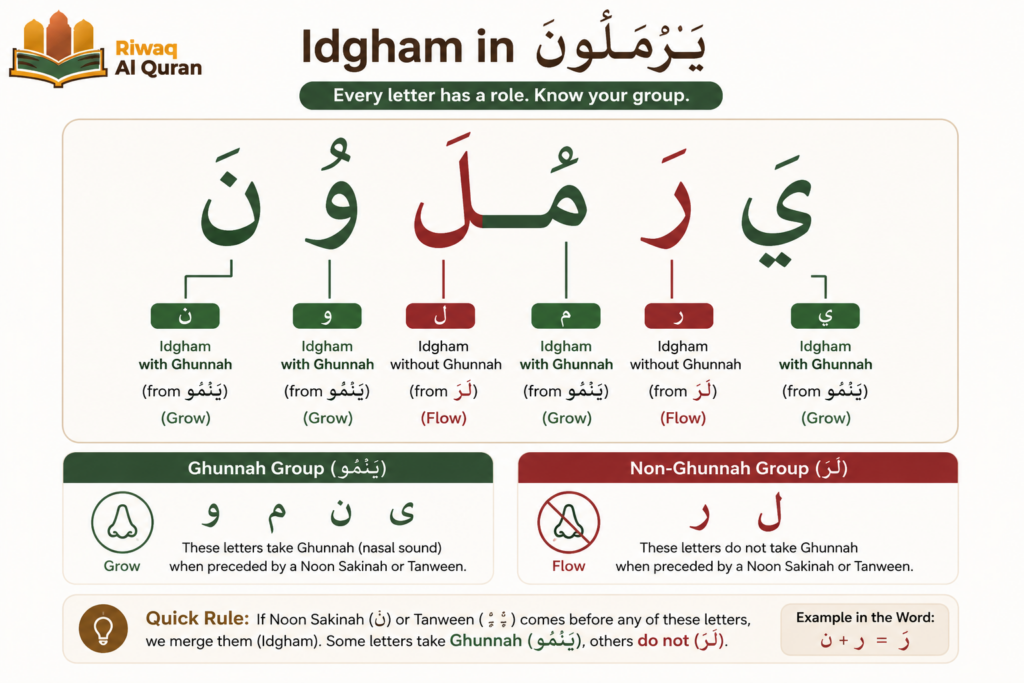
The six Idgham letters are ي، ر، م، ل، و، ن. Scholars of Tajweed grouped them into the mnemonic word يَرْمَلُون, meaning “they become lax” in Arabic. The mnemonic holds all six letters in a single word that can be memorized immediately, and it divides into two clear sub-groups based on which type of Idgham each letter produces:
- يَنْمُو (ي، ن، م، و) → Idgham with Ghunnah (nasal resonance).
- لَر (ل، ر) → Idgham without Ghunnah (no nasal resonance).
The Two Main Types of Idgham in Tajweed
The primary classification of Idgham applies specifically to Noon Sakinah and Tanween, and it divides based on whether the merging produces a nasal sound or not. Both types share one non-negotiable condition: Noon Sakinah or Tanween must appear at the end of one word, and the Idgham letter must appear at the start of the next word.
1. Idgham with Ghunnah (إدغام بغنة)
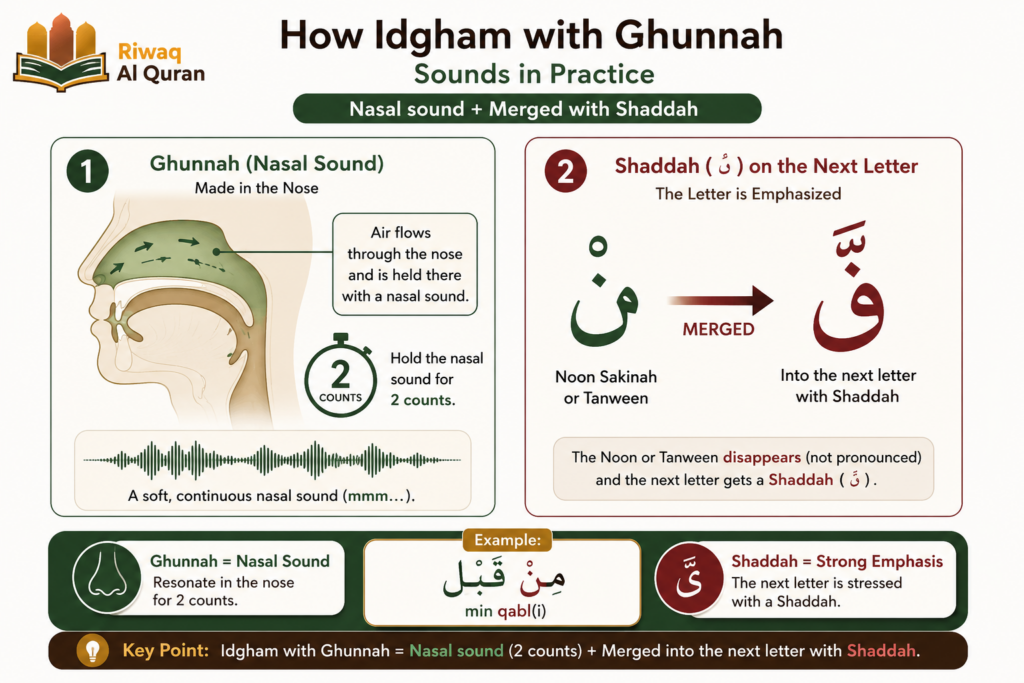
Idgham with Ghunnah occurs when Noon Sakinah or Tanween is followed by one of the four letters ي، ن، م، و. When this rule applies:
- The Noon is absorbed completely into the following letter.
- A nasal resonance — the Ghunnah — is held for two counts (two harakas) through the nasal cavity.
- The following letter carries a Shaddah to mark the merge.
- The tongue never touches the roof of the mouth to produce the Noon at all.
To check your own pronunciation, place your fingers lightly under your nose while reciting: you should feel vibration during those two counts. If you feel nothing, the nasal sound is not being produced correctly.
Quranic examples:
“فَمَن يَعْمَلْ مِثْقَالَ ذَرَّةٍ خَيْرًا يَّرَهُ”
“So whoever does an atom’s weight of good will see it.”(Al-Zalzalah: 7)
— The Tanween on خَيْرًا meets يَ; the Noon-sound drops, يَّ carries a Shaddah, and the Ghunnah sounds for two counts.
“أَوْ كَصَيِّبٍ مِّنَ السَّمَاءِ فِيهِ ظُلُمَاتٌ وَّرَعْدٌ وَّبَرْقٌ”
“Or like a rainstorm from the sky within which is darkness, thunder and lightning.” (Al-Baqarah: 19)
— The Tanween on رَعْدٌ meets وَ; Tanween merges with Waw, Ghunnah held for two counts.
“آتِنَا مِن لَّدُنكَ رَحْمَةً وَّهَيِّئْ لَنَا مِنْ أَمْرِنَا رَشَدًا”
“Grant us from Yourself mercy and prepare for us from our affair right guidance.”(Al-Kahf: 10)
— The Tanween on رَحْمَةً meets وَ; Idgham with Ghunnah across two words.
2. Idgham without Ghunnah (إدغام بلا غنة)
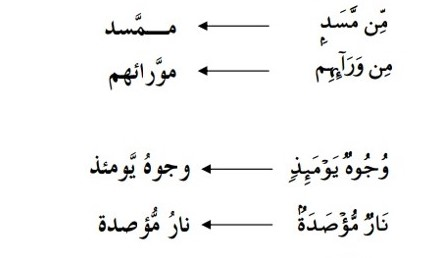
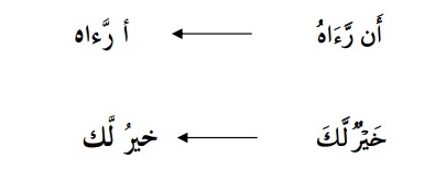
Idgham without Ghunnah applies only when Noon Sakinah or Tanween is followed by ل (Lam) or ر (Ra). When this rule applies:
- The Noon is dropped completely with no nasal resonance.
- The transition to the following letter is immediate and clean.
- The following letter carries a Shaddah.
- No holding time — the merge is instant.
This type is often harder for students than Idgham with Ghunnah, because the mind expects a sound that simply isn’t there. The most common error is a “ghost Noon” — a brief involuntary nasal hum before the Lam or Ra. Eliminating it requires deliberate slow practice: read the two words as one, treating the Shaddah-carrying letter as your entry point with nothing before it.
Quranic examples:
“أُولَٰئِكَ عَلَىٰ هُدًى مِّن رَّبِّهِمْ”
“Those are upon guidance from their Lord.”(Al-Baqarah: 5)
— مِنْ + رَّبِّهِمْ: Noon Sakinah meets Ra; Ra carries a Shaddah and the Noon vanishes with no nasal sound whatsoever.
“وَمَن لَّا يَسْتَجِيبُ لَهُ إِلَىٰ يَوْمِ الْقِيَامَةِ”
“And whoever does not respond to Allah will not cause failure to Him on earth… [until] the Day of Resurrection.” (Al-Ahqaf: 5)
— مَنْ + لَّا: Noon Sakinah meets Lam; merge directly into Lam with no Ghunnah.
3. Idgham with Ghunnah vs. without Ghunnah — Side by Side
The table below summarizes the defining differences between the two types to help you distinguish between them quickly during recitation.
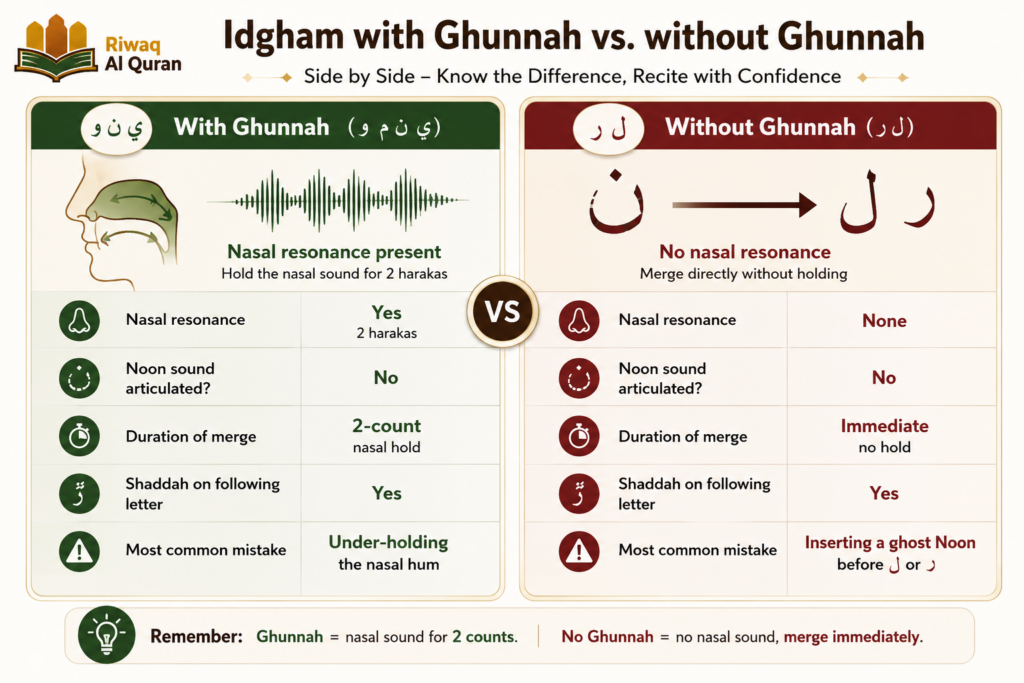
| Feature | With Ghunnah (ي ن م و) | Without Ghunnah (ل ر) |
| Nasal resonance | Yes — 2 harakas | None |
| Noon sound articulated | No | No |
| Duration of merge | 2-count nasal hold | Immediate, no hold |
| Shaddah on following letter | Yes | Yes |
| Most common mistake | Under-holding the nasal hum | Inserting a ghost Noon before ل or ر |
The Critical Exception Most Learners Miss
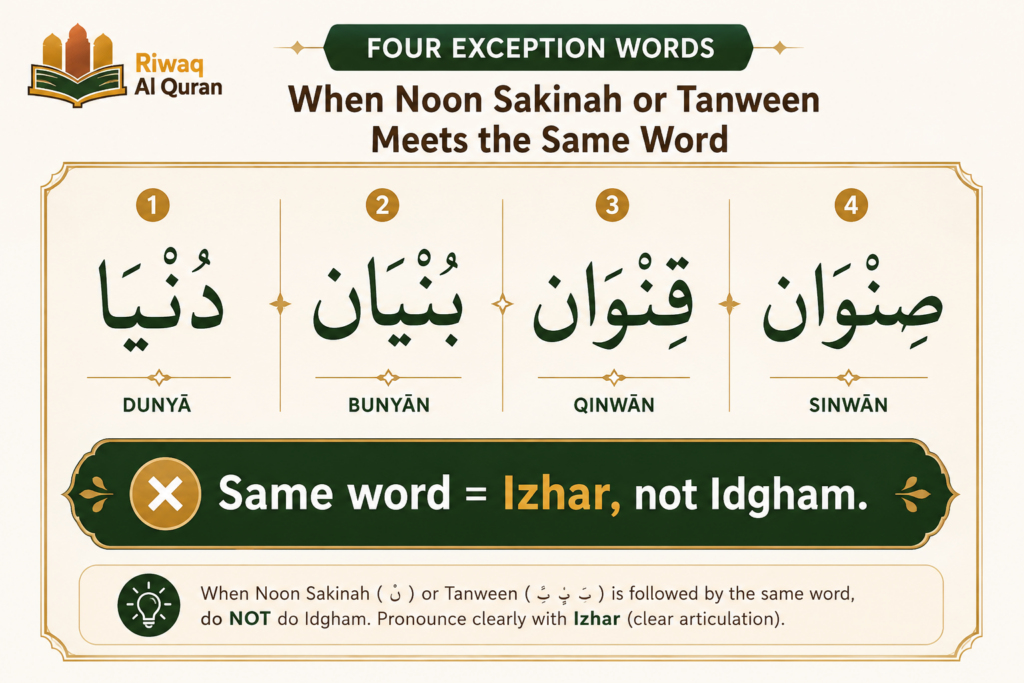
Idgham does not apply when Noon Sakinah and an Idgham letter appear within the same word. When they occur inside one word, the rule switches to Izhar — clear, distinct pronunciation — not Idgham. This exception applies to exactly four words in the entire Quran:
- دُنْيَا — “the worldly life” (Noon Sakinah + يَ within the same word; found throughout the Quran)
- بُنْيَانٌ — “a structure”
“إِنَّ اللَّهَ يُحِبُّ الَّذِينَ يُقَاتِلُونَ فِي سَبِيلِهِ صَفًّا كَأَنَّهُم بُنْيَانٌ مَّرْصُوصٌ”
“Indeed, Allah loves those who fight in His cause in a row as though they were a solid structure. (As-Saff: 4)
- قِنْوَانٌ — “clusters of dates”
“وَمِنَ النَّخْلِ مِن طَلْعِهَا قِنْوَانٌ دَانِيَةٌ”
“And from the palm trees – of its emerging fruit are clusters hanging low.” (Al-An’am: 99)
- صِنْوَانٌ — “offshoots of the same root”
” وَنَخِيلٌ صِنْوَانٌ وَغَيْرُ صِنْوَانٍ يُسْقَىٰ بِمَاءٍ وَاحِدٍ”
“And palm trees, [growing] several from one root or otherwise, watered with one water.” (Ar-Ra’d: 4)
In all four words, the Noon is pronounced clearly as Izhar. This is a standard examination point in formal Tajweed study and a real recitation error if ignored.
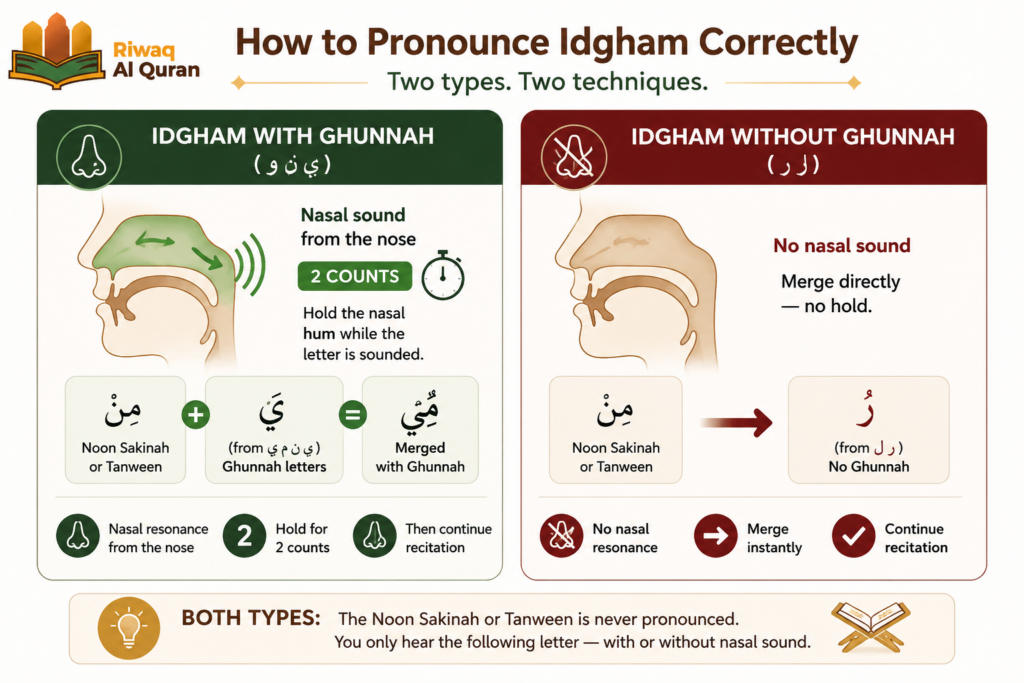
How to Pronounce Idgham Correctly
Understanding the rule on paper and executing it in recitation are two different skills. Correct pronunciation depends on which type of Idgham is being applied, and the technique for each is distinct.
For Idgham with Ghunnah:
- The nasal resonance must come from the nose — not the throat or the mouth.
- The two-harakah hold is not a pause; it is active nasal vibration while the following letter’s articulation is already in place.
- Think of it as overlapping: the letter sounds while the nose hums simultaneously for two counts, then recitation continues.
- The finger test (feeling vibration under the nostrils) is the fastest self-check when practicing alone.
For Idgham without Ghunnah:
- Treat مِنْ رَّبِّهِمْ as if it reads مِرَّبِّهِمْ — the Noon simply does not exist.
- Any fraction of nasal sound before the Ra or Lam is an error.
- Record yourself, listen back, and practice at half-speed until the merge is instantaneous.
The shared principle for both types: the Noon Sakinah or Tanween is never voiced. Your mouth moves as though it isn’t there. What reaches the listener is only the following letter — either with the nasal overlay or without it.
For learners who want structured guidance with live pronunciation correction rather than self-practice alone, Riwaq Al Quran’s Online Tajweed Classes pair each student with a qualified instructor who identifies and corrects these exact errors in real time.
The Other Types of Idgham in Tajweed
Beyond Noon Sakinah and Tanween, Idgham describes a broader principle in Tajweed: when two adjacent letters share the same or a similar articulation point, the first merges into the second. These additional types are not restricted to Noon — they appear wherever specific letter combinations occur across the Quran, each governed by the characteristics and positions of the letters involved.
1. Idgham Mutamathilayn (إدغام المتماثلين)
Idgham Mutamathilayn occurs when two identical letters appear consecutively — the first carrying Sukun (consonant), the second carrying a vowel. The first is absorbed completely into the second, which carries a Shaddah.
Quranic examples:
“اذْهَب بِّكِتَابِي هَٰذَا”
“Take this letter of mine.” (An-Naml: 28)
— Baa Sakinah at the end of اذْهَب merges into the voweled Baa of the next word.
“اضْرِب بِّعَصَاكَ الْحَجَرَ”
“Strike the stone with your staff.” (Al-Baqarah: 60)
— Baa Sakinah followed by voweled Baa across two words.


2. Idgham Mutaqaribayn (إدغام المتقاربين)
Idgham Mutaqaribayn applies when two letters are close in articulation point but differ in characteristics. The first (Sakinah) merges into the second (voweled). The most frequently cited instance involves Lam Sakinah followed by Ra.
Quranic examples:
“قُل رَّبِّ أَعُوذُ بِكَ مِنْ هَمَزَاتِ الشَّيَاطِينِ “
“And say: My Lord, I seek refuge in You from the incitements of the devils.”(Al-Mu’minun: 97)
— Lam Sakinah in قُلْ merges into Ra, which carries a Shaddah
“بَطل رَّفَعَهُ اللَّهُ إِلَيْهِ”
“Rather, Allah raised him to Himself.” (An-Nisa: 158)
— Lam Sakinah in بَلْ merges into Ra
3. Idgham Mutajanisayn (إدغام المتجانسين)
Idgham Mutajanisayn occurs when two letters share the same articulation point but differ in characteristics — such as one being heavy and one light. The first (Sakinah) merges into the second (voweled).
Quranic examples:
“قَدْ تَّبَيَّنَ الرُّشْدُ مِنَ الْغَيِّ”
“Right guidance has become distinct from error.”(Al-Baqarah: 256)
— Dal Sakinah meets Ta; Dal merges into Ta
“وَلَوْ أَنَّهُمْ إِذ ظَّلَمُوا أَنفُسَهُمْ”
“And if, when they wronged themselves…” (An-Nisa: 64)
— Dhal Sakinah meets Dha
“فَمَثَلُهُ كَمَثَلِ الْكَلْبِ إِن تَحْمِلْ عَلَيْهِ يَلْهَثْ ذَّٰلِكَ”
“So his example is like that of the dog: if you chase him away, he pants.” (Al-A’raf: 176)
— Tha Sakinah meets Dhal
“وَقَالَت طَّائِفَةٌ مِّنْ أَهْلِ الْكِتَابِ”
“And a group among the People of the Scripture said…” (Al-‘Imran: 72)
— Ta Sakinah meets emphatic Ta
4. Idgham Shafawi (إدغام شفوي)
Idgham Shafawi is the rule specific to Meem Sakinah: when a silent Meem is followed by another voweled Meem, the first merges into the second with a full two-count Ghunnah. It is called Shafawi — meaning “labial” — because Meem is articulated at the lips (Shafah), and both letters share that articulation point.
Quranic examples:
“وَلَكُم مَّا كَسَبْتُمْ وَلَا تُسْأَلُونَ”
“And you will have that which you have earned, and you will not be asked.” (Al-Baqarah: 134)
— Meem Sakinah in لَكُمْ merges into the Meem of مَّا with a full two-count Ghunnah
“وَلَهُم مَّغْفِرَةٌ وَرِزْقٌ كَرِيمٌ”
“And for them is forgiveness and noble provision.” (Al-Baqarah: 25)
— Meem Sakinah in لَهُمْ merges into مَّغْفِرَةٌ
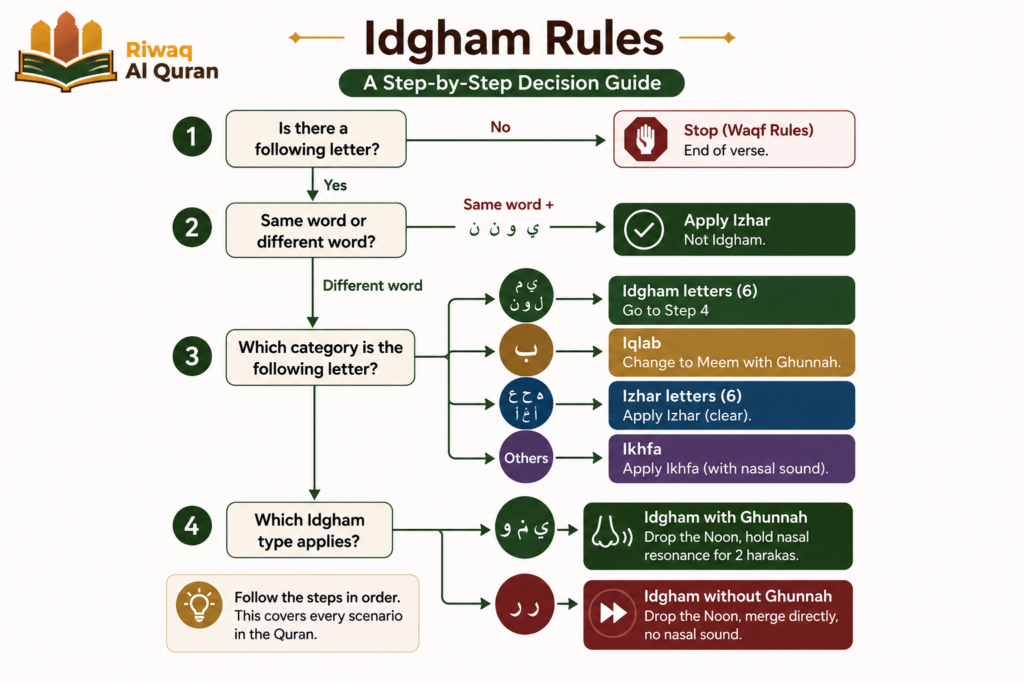
Idgham Rules — A Step-by-Step Decision Guide
When you encounter Noon Sakinah or Tanween in recitation, work through these steps in order. This framework covers every scenario you will encounter across the Quran.
1. Is there a following letter? If you are at the end of a verse with a pause, apply the Waqf (stopping) rules. If recitation continues, move to Step 2.
2. Is the following letter in the same word or a different word? Same word + the letter is one of ي، و، ن، م → apply Izhar, not Idgham. Different word → move to Step 3.
3. Which category does the following letter fall into?
- One of the six Idgham letters (ي، ر، م، ل، و، ن) → proceed to Step 4
- ب → apply Iqlab
- One of the six Izhar letters (ه، ح، خ، ع، غ، أ) → apply Izhar
- Any remaining letter → apply Ikhfa
4. Which Idgham type applies?
- ي، ن، م، و → Idgham with Ghunnah — drop the Noon, hold the nasal resonance for 2 harakas
- ل، ر → Idgham without Ghunnah — drop the Noon, merge directly, no nasal sound
Join Riwaq Al Quran
Riwaq Al Quran is a comprehensive online platform that offers personalized Quran, Arabic, and Islamic Studies classes for individuals of all ages and backgrounds. Their experienced instructors use a structured curriculum to cover Tajweed, Tafsir, and Memorization, providing easy and effective access to learning the Quran. The advanced online classes allow for seamless communication and interaction between students and teachers.
At Riwaq Al Quran, our Quran with Tajweed Online Course is designed to make learning Tajweed and Idgham rules straightforward for online learners — using structured examples, guided activities, and step-by-step instruction at every stage. Contact us now to start this rewarding journey and get a free trial class.
Hear directly from our students about how Riwaq Al Quran Academy has transformed their connection with the Book of Allah:
Here is a selection of our Quran courses that will be most relevant for learners at this stage:
- Online Tafseer Course: Delve into Quranic meanings with our insightful online Tafseer course.
- Noorani Qaida Online: Learn Quranic basics efficiently through our Noorani Qaida online program.
- Online Quran Recitation Course: Enhance Quranic recitation skills through our expert-led online course.
- Online Tajweed Classes: Master Tajweed rules for beautiful Quranic recitation in online classes.
- Quran Memorization Online Course: Memorize the Quran effectively with our specialized online memorization course.
- Online Qirat Course: Explore diverse Qirat styles with our comprehensive online Qirat course.
- Online Quran Classes for Kids: Nurture a love for the Quran in kids through interactive online classes.

Conclusion
Idgham in Tajweed is the rule of merging — specifically, the absorption of Noon Sakinah or Tanween into one of six following letters, producing either a nasal sound (Idgham with Ghunnah, letters ي، ن، م، و) or a clean, immediate merge (Idgham without Ghunnah, letters ل، ر). The six letters are encoded in the mnemonic يَرْمَلُون, with the sub-groups يَنْمُو and لَر making the type-classification immediate to recall.
The most important distinction to carry forward is the two-word condition. Idgham only applies when Noon Sakinah or Tanween and the trigger letter appear across two separate words. When they appear inside one word — as in دُنْيَا، بُنْيَان، قِنْوَان، صِنْوَان — the rule is Izhar, and this error is widespread even among students who know the Idgham letters well.
Beyond the primary two types, Idgham extends to Mutamathilayn, Mutaqaribayn, Mutajanisayn, and Shafawi — each governing a distinct class of letter-combination found throughout the Quran. Mastering all of them is a matter of structured practice under qualified guidance. The decision framework in this article maps the logic; a certified teacher at Riwaq Al Quran gets you through the execution.
Frequently Asked Questions
Tajweed students consistently return to the same core questions about Idgham — how to define it, how to distinguish between its types, and when not to apply it at all. The answers below address the most common points of confusion directly.
What is Idgham in Tajweed?
Idgham in Tajweed is the merging of Noon Sakinah (نْ) or Tanween (ً ٍ ٌ) with one of six letters (ي، ر، م، ل، و، ن) that appear at the start of the following word. The Noon sound is dropped entirely and absorbed into the following letter, which carries a Shaddah to mark the merge.
What are the letters of Idgham in Tajweed?
The six Idgham letters are ي، ر، م، ل، و، ن, memorized through the word يَرْمَلُون. They split into two groups: ي، ن، م، و for Idgham with Ghunnah, and ل، ر for Idgham without Ghunnah.
What is the difference between Idgham with and without Ghunnah?
Idgham with Ghunnah (ي، ن، م، و) produces a nasal resonance held for two harakas during the merge. Idgham without Ghunnah (ل، ر) drops the Noon with no nasal sound — the transition to the following letter is immediate and clean.
When does Idgham not apply even if the letters appear together?
Idgham does not apply when Noon Sakinah and an Idgham letter occur within the same word. In that case, Izhar is used instead. The four specific Quranic words where this exception applies are: دُنْيَا، بُنْيَان، قِنْوَان، صِنْوَان.
What is the difference between Idgham and Ikhfa?
In Ikhfa, the Noon is concealed — partially hidden with a reduced nasal sound — before any of 15 specific letters. In Idgham, the Noon is completely absorbed into the following letter with no remnant of the Noon sound. Ikhfa is a concealment; Idgham is a full merge.
What is Idgham Shafawi?
Idgham Shafawi is the merging of Meem Sakinah with a following Meem that carries a vowel. The two Meems merge into one with a full two-count Ghunnah. It is called Shafawi — meaning “labial” — because Meem is produced at the lips, and both letters share that articulation point.