If you’ve ever recited Surah Al-Fil and felt uncertain about how to connect “تَرْمِيهِم” with “بِحِجَارَةٍ” — whether to fully pronounce the Meem or merge it entirely — you’ve already encountered Ikhfaa Shafawi. This Tajweed rule governs one of the three rulings of Meem Sakinah, and getting it right is what separates a careful recitation from a precise one.
Ikhfaa Shafawi is the partial concealment of Meem Sakinah (مْ) when it is followed by the letter Baa (ب) across two words, while sustaining a nasal resonance (Ghunnah) for two counts. It is one of only three rulings for Meem Sakinah in Tajweed — alongside Idgham Shafawi and Izhar Shafawi.
This guide goes beyond the standard definition. You’ll get the linguistic reason Baa is the only triggering letter, a step-by-step pronunciation guide, the three most common mistakes students make, and clear Quran examples with full tashkeel, translations, and verified source links.
The Prophet ﷺ said:
“الْمَاهِرُ بِالْقُرْآنِ مَعَ السَّفَرَةِ الْكِرَامِ الْبَرَرَةِ، وَالَّذِي يَقْرَأُ الْقُرْآنَ وَيَتَتَعْتَعُ فِيهِ وَهُوَ عَلَيْهِ شَاقٌّ لَهُ أَجْرَانِ”
“The one who is proficient in the Quran will be with the noble, righteous scribes (angels). And the one who reads the Quran and stammers through it, finding it difficult, will have two rewards.”— Narrated by ʿĀʾishah (RA) | Sahih al-Bukhari, 4937 | Sahih Muslim, 798
This Hadith establishes two things at once. Proficiency in recitation — the kind that comes from internalizing rules like Ikhfaa Shafawi — carries a distinct honor in the sight of Allah. And for every student who struggles with the rule, the effort is doubly rewarded. There is no stage of learning Tajweed that goes unacknowledged.
What You’ll Learn in This Article:
- The precise definition of Ikhfaa Shafawi and why it involves exactly one letter.
- Why this rule is called “Shafawi” and the articulation-point logic behind it.
- Two valid pronunciation methods, with step-by-step guidance for each.
- Three specific mistakes that turn Ikhfaa Shafawi into a different rule.
- Quranic examples with Arabic tashkeel, English translations, and verified source links.
- The practical differences between Ikhfaa Shafawi, Ikhfaa Haqiqi, and Idgham Shafawi.
Table of Contents
What Is Ikhfaa Shafawi?
Ikhfaa Shafawi is a Tajweed rule under the rulings of Meem Sakinah. It is the partial concealment of Meem Sakinah (مْ) when the following word begins with the letter Baa (ب), with the Ghunnah maintained for two Harakat (two counts).
Unlike Izhar Shafawi — where the Meem is pronounced fully and clearly — and Idgham Shafawi — where the Meem merges completely into a following Meem — Ikhfaa Shafawi occupies the middle position.
The Meem is neither fully sounded nor fully merged; its sound is partially hidden as the lips move toward the Baa, and the nasal resonance continues through the transition.
1. Why Is It Called “Shafawi”?
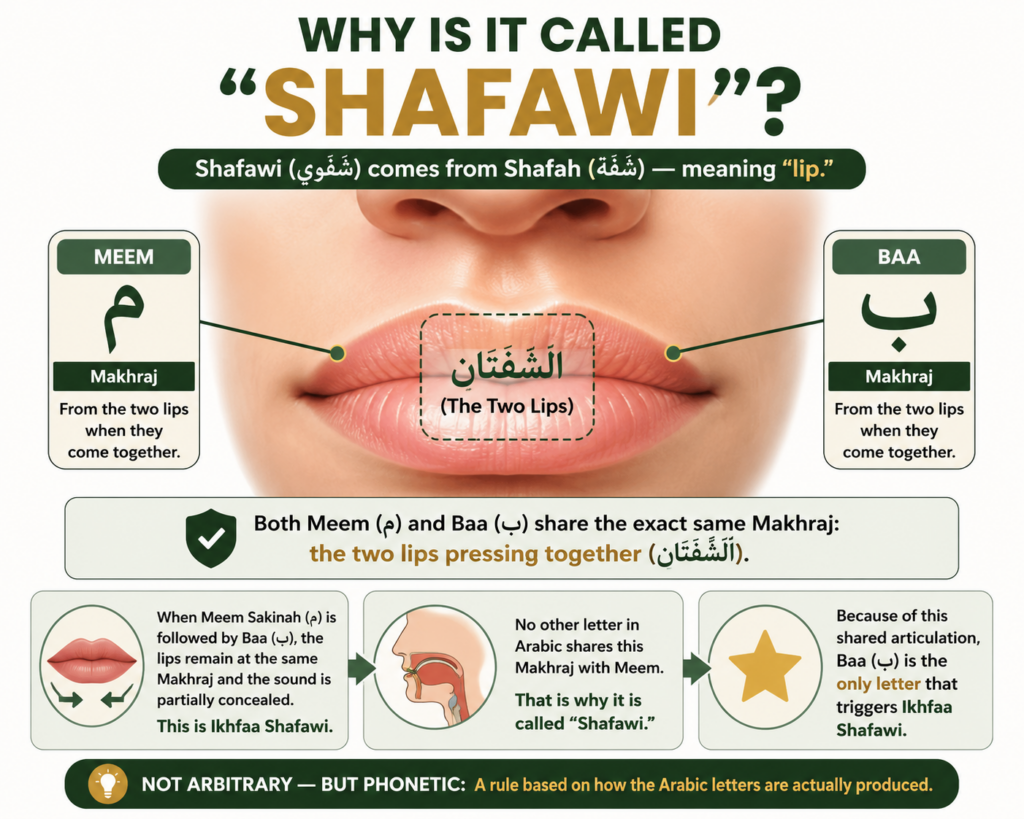
The name Shafawi (شَفَوِي) comes from the Arabic word Shafah (شَفَة), meaning “lip,” and it describes the Makhraj — the place of articulation — shared by both letters involved in this rule. Both Meem (م) and Baa (ب) share the exact same Makhraj: the two lips pressing together (الشَّفَتَانِ). Because both letters are produced at the identical articulation point, the transition from Meem Sakinah to Baa creates the natural partial concealment that defines Ikhfaa Shafawi.
No other letter in Arabic shares this Makhraj with Meem, which is the precise reason Baa is the only letter that triggers this rule — not an arbitrary assignment, but a phonetic consequence of shared articulation.
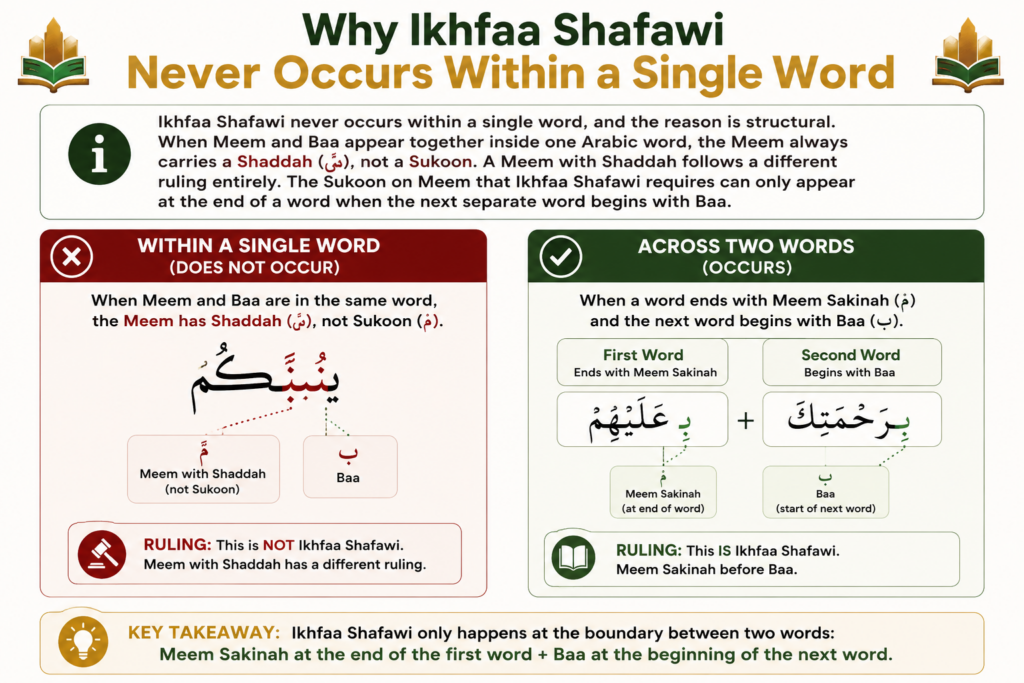
2. Why Ikhfaa Shafawi Never Occurs Within a Single Word
Ikhfaa Shafawi never occurs within a single word, and the reason is structural. When Meem and Baa appear together inside one Arabic word, the Meem always carries a Shaddah (مَبَّ), not a Sukoon. A Meem with Shaddah follows a different ruling entirely. The Sukoon on Meem that Ikhfaa Shafawi requires can only appear at the end of a word when the next separate word begins with Baa.
The Letter of Ikhfaa Shafawi
Ikhfaa Shafawi involves exactly one letter: Baa (ب). While Ikhfaa Haqiqi — the other main type of Ikhfaa — has 15 triggering letters, Ikhfaa Shafawi has only one because it governs Meem Sakinah specifically, and Meem shares its Makhraj only with Baa.
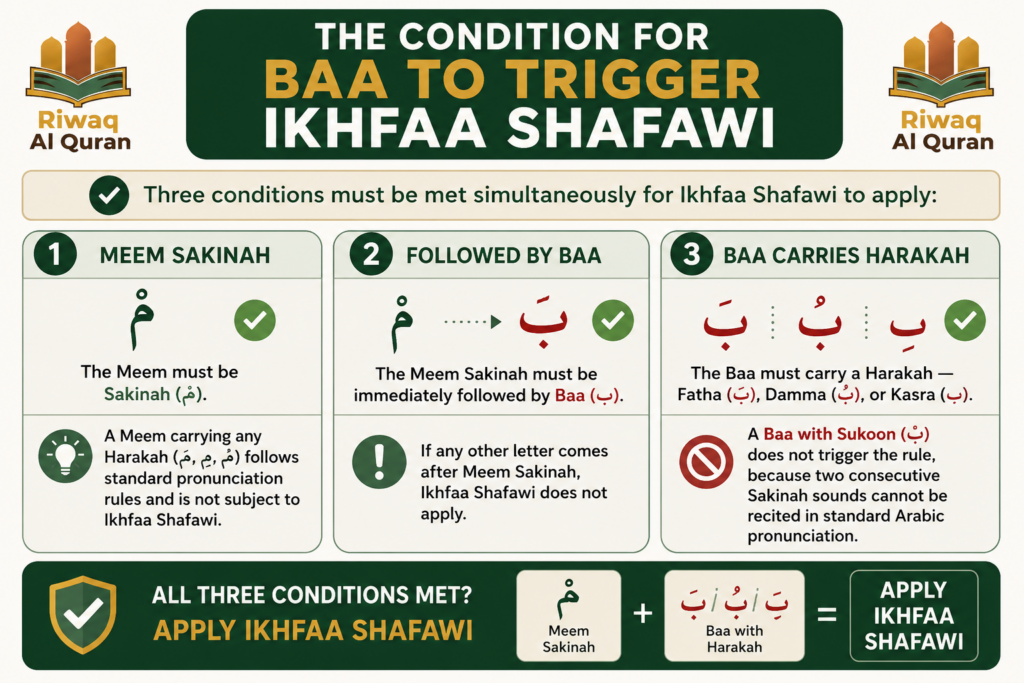
The Condition for Baa to Trigger Ikhfaa Shafawi
Not every instance of Baa activates this rule. Three conditions must be met simultaneously for Ikhfaa Shafawi to apply:
- The Baa must carry a Harakah — Fatha (بَ), Damma (بُ), or Kasra (بِ).
- A Baa with Sukoon (بْ) does not trigger the rule, because two consecutive Sakinah sounds cannot be recited in standard Arabic pronunciation.
- The Meem must be Sakinah (مْ) — a Meem carrying any Harakah follows standard pronunciation rules and is not subject to Ikhfaa Shafawi.
The Ghunnah of Ikhfaa Shafawi
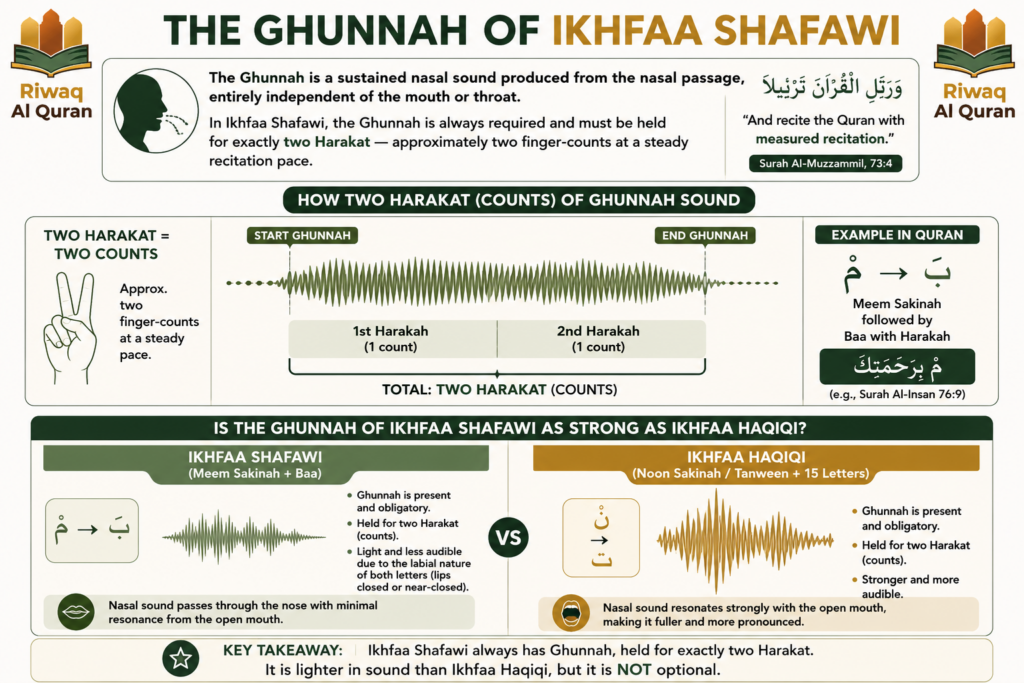
The Ghunnah is a sustained nasal sound produced from the nasal passage, entirely independent of the mouth or throat. In Ikhfaa Shafawi, the Ghunnah is always required and must be held for exactly two Harakat — approximately two finger-counts at a steady recitation pace.
Allah commanded measured, careful recitation directly in the Quran:
“وَرَتِّلِ الْقُرْآنَ تَرْتِيلًا“
“And recite the Quran with measured recitation.”— Surah Al-Muzzammil, 73:4
The Arabic word Tarteel (تَرْتِيل) means deliberate, unhurried recitation that gives each letter its full right — correct Makhraj, proper Sifat, and adherence to every Tajweed ruling. Sustaining the Ghunnah of Ikhfaa Shafawi for its full two counts, rather than rushing through the Meem into the Baa, is a direct application of this divine command. Tarteel is not a stylistic preference — it is an obligation, and rules like Ikhfaa Shafawi are its technical expression.
A question many students ask: is the Ghunnah of Ikhfaa Shafawi as strong as that of Ikhfaa Haqiqi? The answer, according to classical Tajweed scholars, is no.
The Ghunnah of Ikhfaa Haqiqi — which involves Noon Sakinah and Tanween — is considered stronger and more audible. The Ghunnah of Ikhfaa Shafawi is present and obligatory, but its nasal quality is slightly less pronounced due to the labial nature of both letters: with the lips closed or near-closed for Meem and Baa, the nasal channel carries the sound rather than amplifying it through an open oral cavity.
For a quick refresher on why precise Tajweed matters before you practice the steps below, watch this:
How to Pronounce Ikhfaa Shafawi — Step by Step
The Prophet ﷺ instructed:
“زَيِّنُوا الْقُرْآنَ بِأَصْوَاتِكُمْ”
“Adorn the Quran with your voices.”— Narrated by Al-Barāʾ ibn ʿĀzib (RA) | Sunan Abi Dawud, 1468, graded Sahih by Al-Albani
Beautifying recitation is not about adding melody — it is about precision. The smooth transition from Meem Sakinah through the nasal Ghunnah into the Baa, without stumbling through a fully released Meem or swallowing it entirely, is part of what makes Arabic Quranic phonetics acoustically coherent. Applying Ikhfaa Shafawi correctly is one of the specific ways a reciter fulfills this prophetic instruction.
Pronouncing Ikhfaa Shafawi correctly means executing a partial concealment: the Meem is not fully released, and it is not fully merged into the Baa. Two valid methods exist in classical Tajweed scholarship, and both are acceptable in recitation.
1. Lips Fully Closed (More Widely Taught)
This method is predominant in the Egyptian school of Tajweed and is what most students encounter first with a trained instructor. Apply it in the following sequence:
- Recite the word ending in Meem Sakinah up to the Meem.
- Close both lips together fully — the same position as a complete Meem sound.
- Do not open the lips to release the Meem. Hold the closed position.
- Sustain the Ghunnah from the nasal passage for two Harakat.
- From the closed-lip position, move directly into pronouncing the Baa of the next word.
2. Lips Held Apart with a Small Gap
This method is also valid and appears in some scholarly traditions. The gap between the lips physically represents the “concealment” quality of Ikhfaa — the Meem is neither fully articulated nor absent. Apply it as follows:
- Recite the word ending in Meem Sakinah up to the Meem.
- Bring the lips close together but leave a slight gap — do not seal them fully.
- Sustain the Ghunnah through the nasal passage for two Harakat.
- Move into the Baa of the following word.
3. Common Mistakes That Change the Ruling
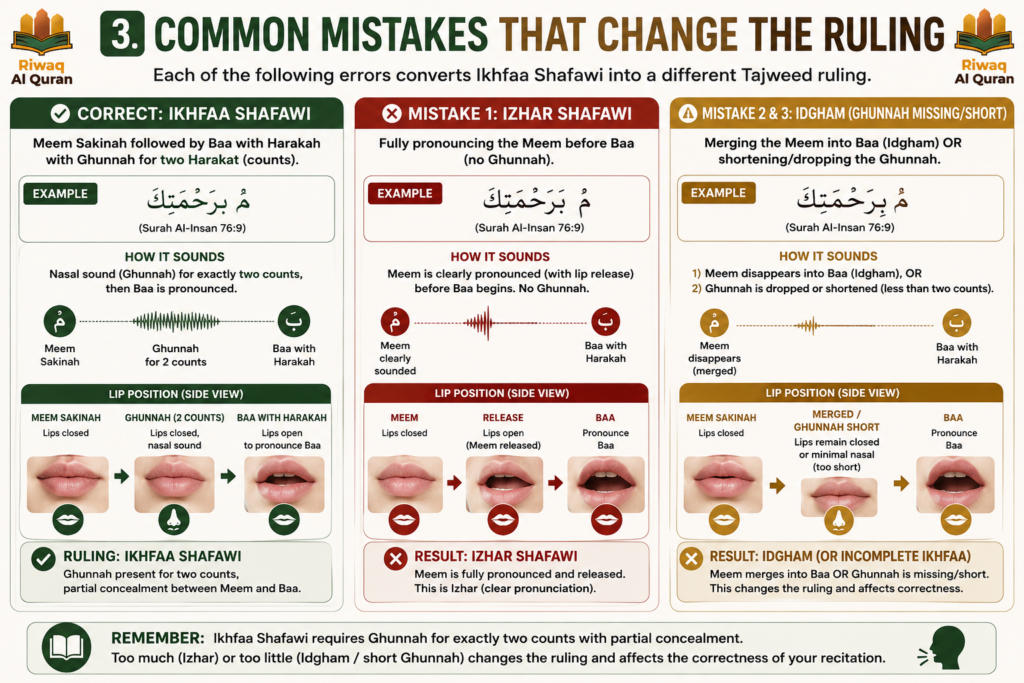
Understanding the specific error each mistake produces helps you self-correct during practice. Each of the following errors converts Ikhfaa Shafawi into a different Tajweed ruling:
- Mistake 1 — Fully pronouncing the Meem before Baa: This converts Ikhfaa Shafawi into Izhar Shafawi — the Meem is clearly sounded with lip release before the Baa begins. Especially common in slow, careful recitation where students over-articulate each letter.
- Mistake 2 — Fully merging the Meem into the following sound: This converts Ikhfaa Shafawi into a form of Idgham — the Meem disappears entirely. Frequent among students who have drilled Idgham Shafawi heavily and apply it by reflex to any Meem Sakinah situation.
- Mistake 3 — Dropping or shortening the Ghunnah to one count: Some students rush the transition between words and skip or shorten the two-count nasal resonance. The Ghunnah is not optional — it is a defining condition of the rule, and dropping it changes the recitation quality fundamentally.
Ikhfaa Shafawi Examples in the Quran
Ikhfaa Shafawi appears throughout the Quran wherever a word ending in Meem Sakinah is followed by a word beginning with Baa carrying a Harakah. In every case, the ruling is the same: partial concealment of the Meem with a two-count Ghunnah sustained through the nasal passage.
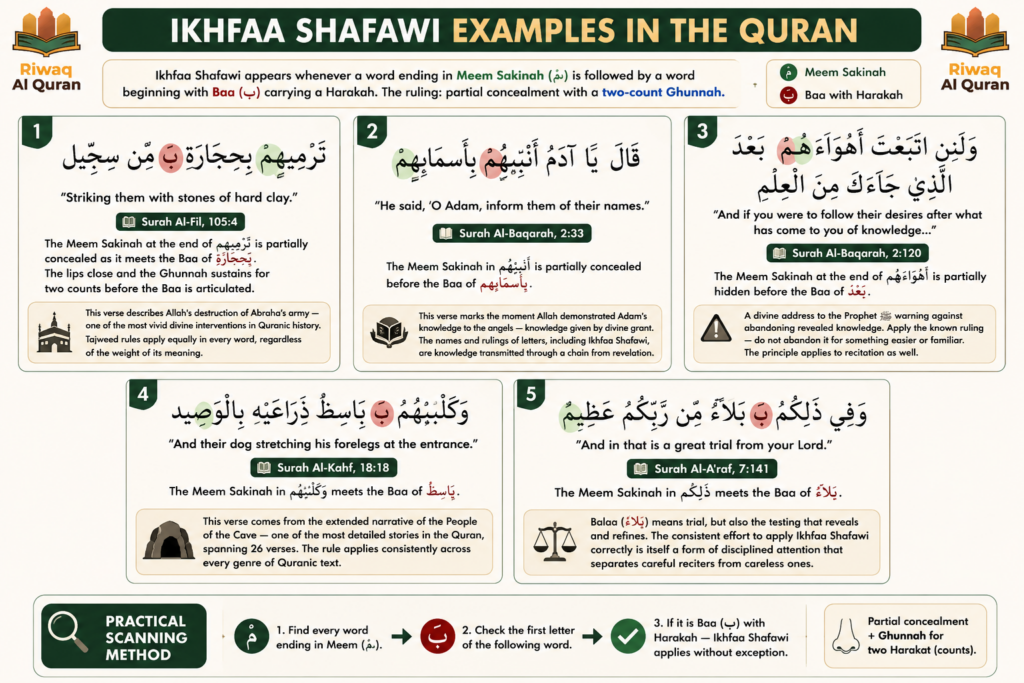
Example 1:
“تَرْمِيهِم بِحِجَارَةٍ مِّن سِجِّيلٍ“
“Striking them with stones of hard clay.”— Surah Al-Fil, 105:4
The Meem Sakinah at the end of تَرْمِيهِم is partially concealed as it meets the Baa of بِحِجَارَةٍ. The lips close and the Ghunnah sustains for two counts before the Baa is articulated. This verse describes Allah’s destruction of Abraha’s army — one of the most vivid divine interventions in Quranic history — contained within one of the shortest Surahs.
The presence of Ikhfaa Shafawi in such a charged passage is a reminder that Tajweed rules govern every word of the Quran equally, regardless of the weight of its meaning.
Example 2:
“قَالَ يَا آدَمُ أَنبِئْهُم بِأَسْمَائِهِمْ“
“He said, ‘O Adam, inform them of their names.'”— Surah Al-Baqarah, 2:33
The Meem Sakinah in أَنبِئْهُم is partially concealed before the Baa of بِأَسْمَائِهِمْ. This verse marks the moment Allah demonstrated Adam’s knowledge to the angels — knowledge given by divine grant. The connection to Tajweed study is direct: the names and rulings of Arabic letters, including Ikhfaa Shafawi, are a form of knowledge transmitted through a chain that began with revelation and runs through qualified teachers to this day.
Example 3:
“وَلَئِنِ اتَّبَعْتَ أَهْوَاءَهُم بَعْدَ الَّذِي جَاءَكَ مِنَ الْعِلْمِ“
“And if you were to follow their desires after what has come to you of knowledge…”— Surah Al-Baqarah, 2:120
The Meem Sakinah at the end of أَهْوَاءَهُم is partially hidden before the Baa of بَعْدَ. The verse is a divine address to the Prophet ﷺ warning against abandoning revealed knowledge. For the Tajweed student, the principle applies to recitation itself: once you know the correct ruling for Meem Sakinah before Baa, applying something easier or more familiar — and abandoning the correct ruling — is precisely what this verse cautions against.
Example 4:
“وَكَلْبُهُم بَاسِطٌ ذِرَاعَيْهِ بِالْوَصِيدِ“
“And their dog stretching his forelegs at the entrance.”— Surah Al-Kahf, 18:18
The Meem Sakinah in وَكَلْبُهُم meets the Baa of بَاسِطٌ. This verse comes from the extended narrative of the People of the Cave — one of the most detailed stories in the Quran, spanning 26 verses. Even within a long narrative passage, Ikhfaa Shafawi occurs without exception wherever the conditions are met. The rule has no narrative exceptions; it applies consistently across every genre of Quranic text.
Example 5:
“وَفِي ذَلِكُم بَلَاءٌ مِّن رَّبِّكُمْ عَظِيمٌ“
“And in that is a great trial from your Lord.”— Surah Al-A’raf, 7:141
The Meem Sakinah in ذَلِكُم meets the Baa of بَلَاءٌ. The word Balaa (بَلَاءٌ) carries a dual meaning in Arabic — trial, but also the testing that reveals and refines. The consistent effort required to apply Ikhfaa Shafawi correctly — identifying Meem Sakinah, checking the next letter, executing the partial concealment, sustaining the Ghunnah — is itself a form of disciplined attention that separates careful reciters from careless ones.
A practical scanning method: when reviewing a new Surah, locate every word ending in Meem (م) and check the first letter of the word that follows. If it opens with Baa carrying a Harakah — Ikhfaa Shafawi applies without exception.
Ikhfaa Shafawi vs. Ikhfaa Haqiqi
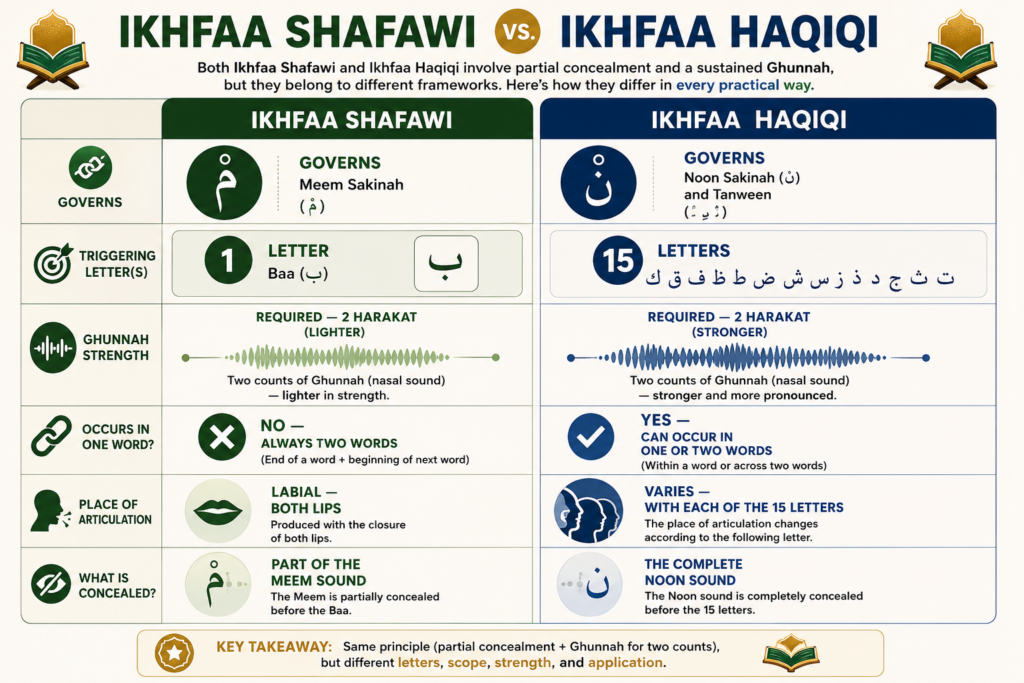
Both Ikhfaa Shafawi and Ikhfaa Haqiqi involve partial concealment and a sustained Ghunnah, but they belong to fundamentally different frameworks: one governs Meem Sakinah, the other governs Noon Sakinah and Tanween. They differ in the letters they cover, the number of triggering letters, the strength of the Ghunnah, and where each can occur in Quranic text. The table below maps every point of distinction a reciter needs in practice.
| Point of Comparison | Ikhfaa Shafawi | Ikhfaa Haqiqi |
|---|---|---|
| Governs | Meem Sakinah (مْ) | Noon Sakinah (نْ) and Tanween |
| Triggering letter(s) | 1 letter: Baa (ب) | 15 letters: ت ث ج د ذ ز س ش ص ض ط ظ ف ق ك |
| Ghunnah strength | Required — 2 Harakat (lighter) | Required — 2 Harakat (stronger) |
| Occurs in one word? | No — always two words | Yes — can occur in one or two words |
| Place of articulation | Labial — both lips | Varies with each of the 15 letters |
| What is concealed | Part of the Meem sound | The complete Noon sound |
Ikhfaa Shafawi example:
“خُذُوا مَا آتَيْنَاكُم بِقُوَّةٍ“
“Take what We have given you with determination.”— Surah Al-Baqarah, 2:63
The Meem Sakinah in آتَيْنَاكُم is partially hidden; lips stay closed through the Ghunnah before the Baa. The command in this verse — to take what has been given with quwwah (strength, determination) — applies directly to the Tajweed student: the rules of recitation are given knowledge, and holding them with precision and care is the application of that command.
Ikhfaa Haqiqi example:
“كُلُّ نَفْسٍ ذَائِقَةُ الْمَوْتِ“
“Every soul shall taste death.”— Surah Al-Ankabut, 29:57
The Tanween Kasrah in نَفْسٍ is completely concealed before the letter Thal (ذ); the tongue holds mid-position through the Ghunnah. This verse — one of the most universally recognized in the Quran — delivers a complete, self-standing truth in a single phrase.
Reciting it with correct Ikhfaa Haqiqi gives the Noon its full concealment and the Ghunnah its stronger nasal resonance, which in turn underscores the weight of the statement.
Ikhfaa Shafawi vs. Idgham Shafawi
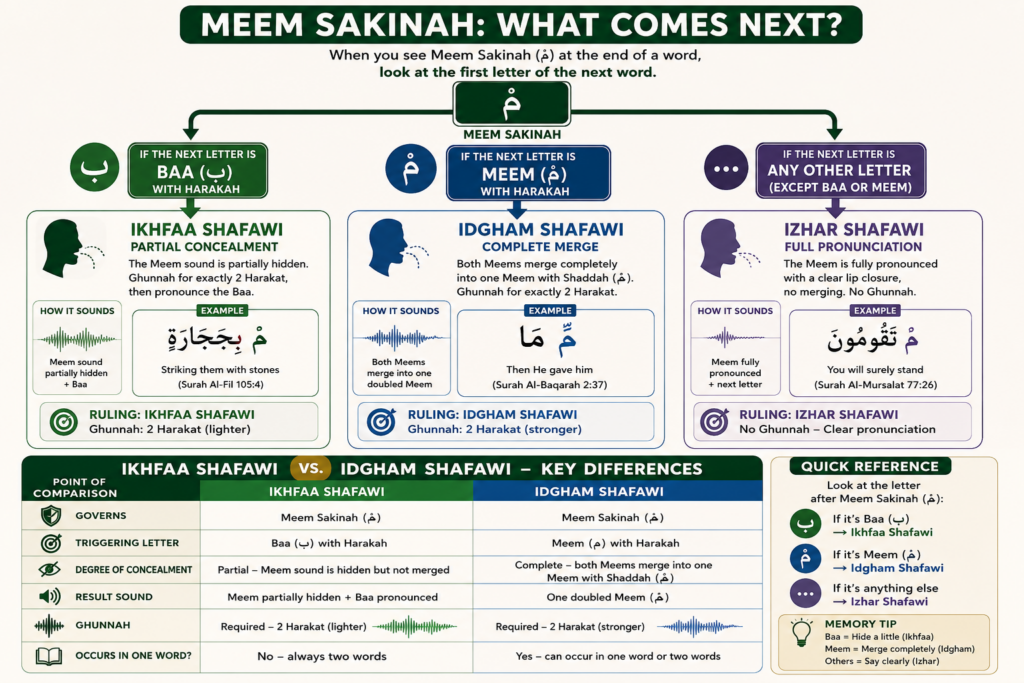
Of all the comparisons in the rules of Meem Sakinah, this is the one that most frequently causes confusion — because both rules involve Meem Sakinah, both produce a labial sound, and both sustain a Ghunnah. The critical difference lies in the letter that follows the Meem Sakinah and the degree of concealment that results: Ikhfaa Shafawi produces a partial hiding, while Idgham Shafawi produces a complete merger into a doubled Meem.
The table below clarifies every point of distinction between the two rulings:
| Point of Comparison | Ikhfaa Shafawi | Idgham Shafawi |
|---|---|---|
| Governs | Meem Sakinah (مْ) | Meem Sakinah (مْ) |
| Triggering letter | Baa (ب) with Harakah | Meem (م) with Harakah |
| Degree of concealment | Partial — Meem sound is hidden but not merged | Complete — both Meems merge into one Meem with Shaddah (مّ) |
| Result sound | Meem partially hidden + Baa pronounced | One doubled Meem (مّ) |
| Ghunnah | Required — 2 Harakat | Required — 2 Harakat |
| Occurs in one word? | No | Yes or two words |
Ikhfaa Shafawi example:
“قَالَ الَّذِينَ اسْتَكْبَرُوا إِنَّا بِالَّذِي آمَنتُم بِهِ كَافِرُونَ“
“Said those who were arrogant, ‘Indeed, in that which you have believed, we are disbelievers.'”— Surah Al-A’raf, 7:76
“آمَنتُم بِهِ” — the Meem Sakinah in آمَنتُم is partially concealed before the Baa of بِهِ. The Baa remains distinct after the Ghunnah. This verse records the words of those who rejected the message of the Prophet Salih (AS).
The Tajweed student who applies the rule here — preserving the Meem’s partial sound rather than swallowing it — gives the Arabic its full phonetic integrity, word by word.


Idgham Shafawi example:
“أَطْعَمَهُم مِّن جُوعٍ“
“Who has fed them, [saving them] from hunger.”— Surah Quraysh, 106:4
The Meem Sakinah at the end of أَطْعَمَهُم merges completely into the Meem of مِّن, producing a single stressed Meem with Shaddah. The original Meem disappears entirely. This verse — from a Surah describing the divine blessings of security and sustenance given to Quraysh — has its own acoustic continuity when recited correctly: the merged Meem carries the flow of the blessing in a single, unbroken nasal sound.
The practical decision rule during recitation: next word starts with Baa → Ikhfaa Shafawi (partial concealment). Next word starts with Meem → Idgham Shafawi (complete merge). Never apply Idgham Shafawi before a Baa; never apply Ikhfaa Shafawi before a Meem.
Start Mastering Tajweed with a Qualified Native Instructor
The Prophet ﷺ said:
“خَيْرُكُمْ مَنْ تَعَلَّمَ الْقُرْآنَ وَعَلَّمَهُ”
“The best among you are those who learn the Quran and teach it.”— Narrated by ʿUthmān ibn ʿAffān (RA) | Sahih al-Bukhari, 5027
Learning Tajweed — including rules like Ikhfaa Shafawi — is inseparable from learning the Quran correctly. This Hadith covers both roles: the student who works to master these rules, and the teacher who transmits them with precision. Both positions carry the highest praise from the Prophet ﷺ. The chain of Tajweed transmission from teacher to student is not incidental to Quranic study — it is central to it.
[image: marketing visual — student in online Tajweed class with Riwaq Al Quran]
Knowing the rules of Ikhfaa Shafawi is the first step. Applying them correctly in flowing recitation — where Ghunnah length, lip position, and split-second letter identification all converge — is what an instructor’s live correction makes possible.
Riwaq Al Quran is a comprehensive online platform offering personalized Quran, Arabic, and Islamic Studies classes for students of all ages and backgrounds. Experienced native Arab instructors use a structured curriculum covering Tajweed, Tafsir, and Memorization — with live, interactive sessions designed to keep every learner actively engaged and progressing at their own pace.
Watch real moments from our live sessions at Riwaq Al Quran and see how we bring learning to life:
Whether you are building your phonetic foundation from scratch with the Noorani Qaida program before moving to the Mushaf, or refining an established reading through dedicated Online Tajweed Classes, every course is delivered one-on-one with a qualified native instructor — at a schedule that works for you, from anywhere in the world.
Explore the full range of Quran and Islamic courses:
| Course | What you will build |
|---|---|
| Online Tajweed Classes | Accurate, rule-governed recitation from beginner through advanced level |
| Quran Memorization Online Course | Structured Hifz with personalized revision and long-term retention plans |
| Online Tafseer Course | In-depth understanding of Quranic meanings and interpretive context |
| Online Qirat Course | Fluency across multiple accepted styles of Quranic recitation |
| Online Quran Recitation Course | Accuracy and fluency in recitation with live expert feedback |
| Noorani Qaida Online | The essential phonetic foundation for new readers of every age |
| Online Quran Classes for Kids | Interactive, age-appropriate Quran learning designed for young students |
For a complete Islamic education alongside Quran studies, Riwaq Al Quran also offers Online Arabic courses to build language proficiency, Online Islamic Studies courses covering core pillars of the faith, and Online courses for kids that bring Quran, Arabic, and Islamic practice together in one structured program designed for young learners.

Conclusion
Ikhfaa Shafawi is precise and consistent: Meem Sakinah followed by Baa across two words always requires partial concealment of the Meem with a two-count Ghunnah. It applies to exactly one letter, never occurs within a single word, and sits between two related rulings on a clear spectrum — Izhar Shafawi (full pronunciation) on one end and Idgham Shafawi (full merging) on the other.
The Makhraj connection is the key to internalizing this rule. Because Meem and Baa are both labial sounds produced by the two lips meeting, the partial concealment is a natural phonetic consequence — not an arbitrary rule to memorize. Understanding that makes it impossible to confuse Ikhfaa Shafawi with Ikhfaa Haqiqi, which involves entirely different articulation points.
Allah commanded Tarteel as a divine obligation. The Prophet ﷺ promised reward for every sincere effort with the Quran, and double reward for those who find it difficult. The scholars of Tajweed preserved these rules across generations so that recitation remains exactly as it was revealed. Mastering Ikhfaa Shafawi as part of the full three-ruling framework of Meem Sakinah — Izhar, Ikhfaa, and Idgham Shafawi — is the reliable path to correct, consistent recitation. The distinctions become instinctive through practice with feedback, not through reading alone.
Frequently Asked Questions About Ikhfaa Shafawi
Below are the most common questions students ask about Ikhfaa Shafawi — covering its definition, conditions, triggering letter, and how it compares with the other rulings of Meem Sakinah.
What is Ikhfaa Shafawi in simple terms?
Ikhfaa Shafawi is a Tajweed rule that requires the partial hiding of Meem Sakinah (مْ) when the next word begins with Baa (ب), while holding a nasal sound (Ghunnah) for two counts. It always occurs across two words, never within a single word, and involves exactly one letter.
How many letters does Ikhfaa Shafawi have?
Ikhfaa Shafawi has only one letter: Baa (ب). Baa is the sole triggering letter because it shares the same Makhraj as Meem — both are produced by the two lips pressing together — making it the only letter that creates the partial concealment condition for Meem Sakinah.
What is the difference between Ikhfaa Shafawi and Idgham Shafawi?
Ikhfaa Shafawi occurs when Meem Sakinah is followed by Baa — the Meem is partially concealed and the Baa is then pronounced. Idgham Shafawi occurs when Meem Sakinah is followed by Meem — both Meems merge completely into one stressed Meem with Shaddah. Both involve Meem Sakinah and require Ghunnah, but the following letter and the degree of concealment are different.
Is Ghunnah obligatory in Ikhfaa Shafawi?
Yes. The Ghunnah is an obligatory condition of Ikhfaa Shafawi and must be sustained for two Harakat. Dropping or shortening the Ghunnah is one of the most common errors in this rule and effectively converts the recitation to a form of Izhar Shafawi.
Can Ikhfaa Shafawi occur inside one word?
No. Ikhfaa Shafawi always occurs across two words. When Meem and Baa appear together inside a single Arabic word, the Meem carries a Shaddah rather than a Sukoon, which follows a different ruling. The Sukoon required for Ikhfaa Shafawi can only appear on a Meem at the end of one word when the next word begins with Baa.
What is the difference between Ikhfaa Shafawi and Ikhfaa Haqiqi?
Ikhfaa Shafawi governs Meem Sakinah before one letter (Baa only), occurs only across two words, and involves labial articulation. Ikhfaa Haqiqi governs Noon Sakinah and Tanween before 15 letters, can occur within one word or across two, and involves concealment at various articulation points. The Ghunnah of Ikhfaa Haqiqi is also considered stronger than that of Ikhfaa Shafawi in classical Tajweed scholarship.