Ghusl is the full-body ritual purification in Islam performed to remove the state of major ritual impurity (Hadath Akbar) and restore the state of Tahara (purity). It is an act of worship, not simply a bath — the distinction lies in the intention and the conditions that must be met for it to be legally valid.
The Prophet ﷺ placed Tahara at the very foundation of the faith:
عَنْ أَبِي مَالِكٍ الأَشْعَرِيِّ قَالَ: قَالَ رَسُولُ اللَّهِ ﷺ: «الطُّهُورُ شَطْرُ الإِيمَانِ»
Narrated by Abu Malik al-Ash’ari: The Messenger of Allah ﷺ said: “Purification is half of faith.”— Sahih Muslim 223
Scholars have interpreted “half of faith” in two complementary ways. Practically, Tahara is a prerequisite for half the pillars of worship — Salah is impossible without it, and Ghusl is what restores it after major impurity.
Spiritually, Ibn al-Qayyim explains that faith has an inward dimension (belief, intention, repentance) and an outward dimension (action, purification, worship) — Tahara represents the outward half. The two together constitute complete Iman expressed in daily life.
The Quranic Command for Ghusl
Allah (SWT) commands Ghusl directly. The obligation for those in a state of major impurity is stated in Surah Al-Ma’idah:
“يَا أَيُّهَا الَّذِينَ آمَنُوا إِذَا قُمْتُمْ إِلَى الصَّلَاةِ فَاغْسِلُوا وُجُوهَكُمْ وَأَيْدِيَكُمْ إِلَى الْمَرَافِقِ وَامْسَحُوا بِرُءُوسِكُمْ وَأَرْجُلَكُمْ إِلَى الْكَعْبَيْنِ وَإِن كُنتُمْ جُنُبًا فَاطَّهَّرُوا“
“O believers! When you rise up for prayer, wash your faces and your hands up to the elbows, wipe your heads, and wash your feet to the ankles. And if you are in a state of full impurity, then take a full bath.”— Al-Ma’idah 5:6
The word “فَاطَّهَّرُوا” (take a full bath / purify yourselves completely) is a divine command in the imperative form — not a recommendation. The verse directly links Janabah to the obligation of Ghusl before prayer, establishing that Salah cannot validly begin while this state remains.
Significantly, the Quran mentions Wudu and Ghusl in the same verse, distinguishing minor from major impurity and establishing a different response for each — Ghusl addresses a fundamentally different level of impurity than Wudu alone can resolve.
The spiritual reward of purification is further affirmed in Surah Al-Baqarah:
“إِنَّ اللَّهَ يُحِبُّ التَّوَّابِينَ وَيُحِبُّ الْمُتَطَهِّرِينَ“
“Surely Allah loves those who always turn to Him in repentance and those who purify themselves.”— Al-Baqarah 2:222
The word “الْمُتَطَهِّرِينَ” (those who purify themselves) carries both physical and spiritual meaning in classical Arabic. Ibn Kathir notes in his Tafsir that this verse was revealed in the context of menstruation, yet scholars extend its meaning to encompass all acts of ritual purification.
Understanding Ghusl fully also means understanding its place within the broader concept of Tahara — learn more in Benefits of Taharah and Its Importance in Islam and Types of Tahara in Islam and How to Correctly Perform It.
For a deeper look at where purification fits within the pillars of Islam, watch this short clip:
Table of Contents
How to Perform Ghusl – Minimum Valid Method vs. Complete Sunnah Method
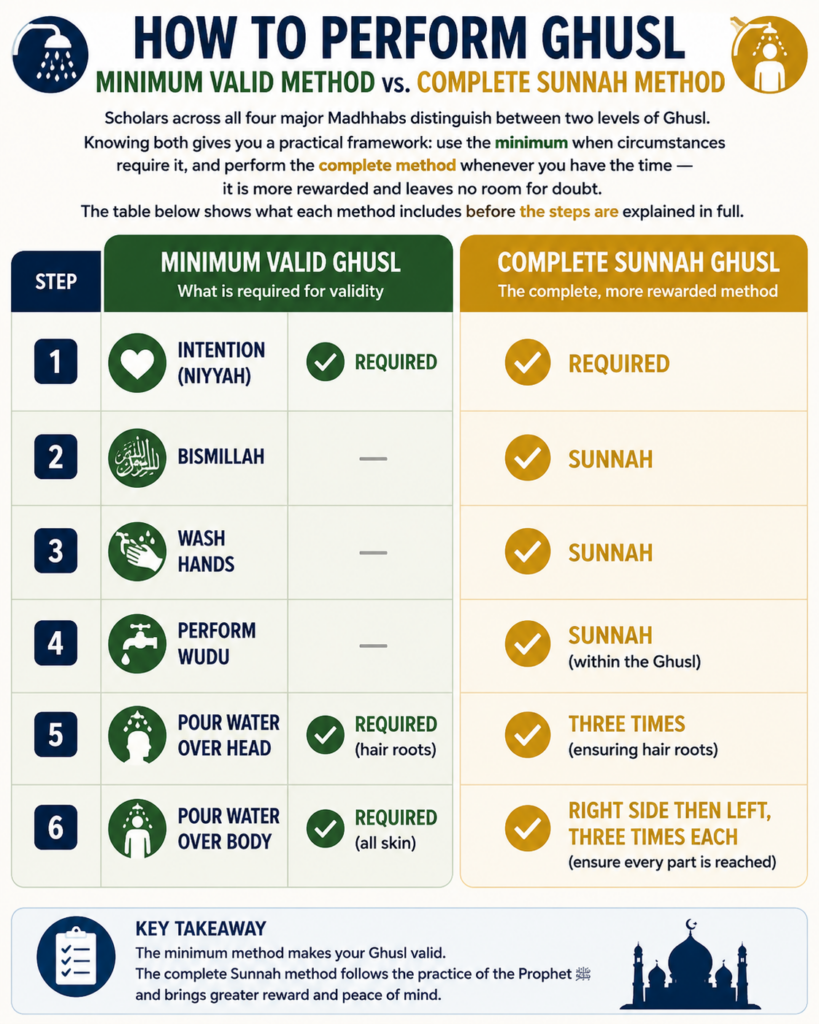
Scholars across all four major Madhhabs distinguish between two levels of Ghusl. Knowing both gives you a practical framework: use the minimum when circumstances require it, and perform the complete method whenever you have the time — it is more rewarded and leaves no room for doubt.
The table below shows what each method includes before the steps are explained in full:
| Step | Minimum Valid Ghusl | Complete Sunnah Ghusl |
|---|---|---|
| Intention (Niyyah) | Required | Required |
| Bismillah | — | Sunnah |
| Wash hands | — | Sunnah |
| Perform Wudu | — | Sunnah (within the Ghusl) |
| Pour water over head | Required (hair roots) | Three times |
| Pour water over body | Required (all skin) | Right side then left, three times each |
1. The Minimum Valid Ghusl – 3 Obligatory Conditions
If all three conditions below are met, the Ghusl is legally valid regardless of anything else:
Condition 1 — Intention (Niyyah)
Make the intention in your heart to remove the state of impurity. There is no verbal formula required; the Niyyah is an internal act. Specify the reason — Janabah, Hayd, Nifas — since each requires its own distinct intention.
The governing principle for this condition comes from the most foundational hadith in Islamic jurisprudence:
عَنْ عُمَرَ بْنِ الخَطَّابِ رضي الله عنه قَالَ: سَمِعْتُ رَسُولَ اللَّهِ ﷺ يَقُولُ: «إِنَّمَا الأَعْمَالُ بِالنِّيَّاتِ، وَإِنَّمَا لِكُلِّ امْرِئٍ مَا نَوَى»
Narrated by Umar ibn al-Khattab (may Allah be pleased with him): I heard the Messenger of Allah ﷺ say: “Actions are judged by their intentions, and every person will get what they intended.”— Sahih al-Bukhari 1, Sahih Muslim 1907
Imam al-Bukhari chose this hadith to open his entire collection — a deliberate choice signaling that Niyyah governs every act of worship, including Ghusl. A person who washes their entire body with pure water in the correct sequence, without making the Niyyah, has performed a thorough physical bath but not a legally valid Ghusl.
The Niyyah is what transforms the washing from routine hygiene into an act of worship accepted before Allah. Imam al-Nawawi specifies that the Niyyah for Ghusl must accompany the first action — the beginning of the washing — and not come after it.
Condition 2 — Remove Every Physical Barrier Blocking Water from the Skin
Before water touches your body, remove or reposition anything that prevents skin contact:
- Rings and tight bracelets must be twisted or removed.
- Nail polish must be fully removed (unless it is water-permeable).
- Adhesive bandages should be lifted if medically possible.
Water that pools on top of nail polish does not count as reaching the skin beneath it. This condition is the one most commonly overlooked.
Condition 3 — Water Reaches Every Part of the External Body Surface
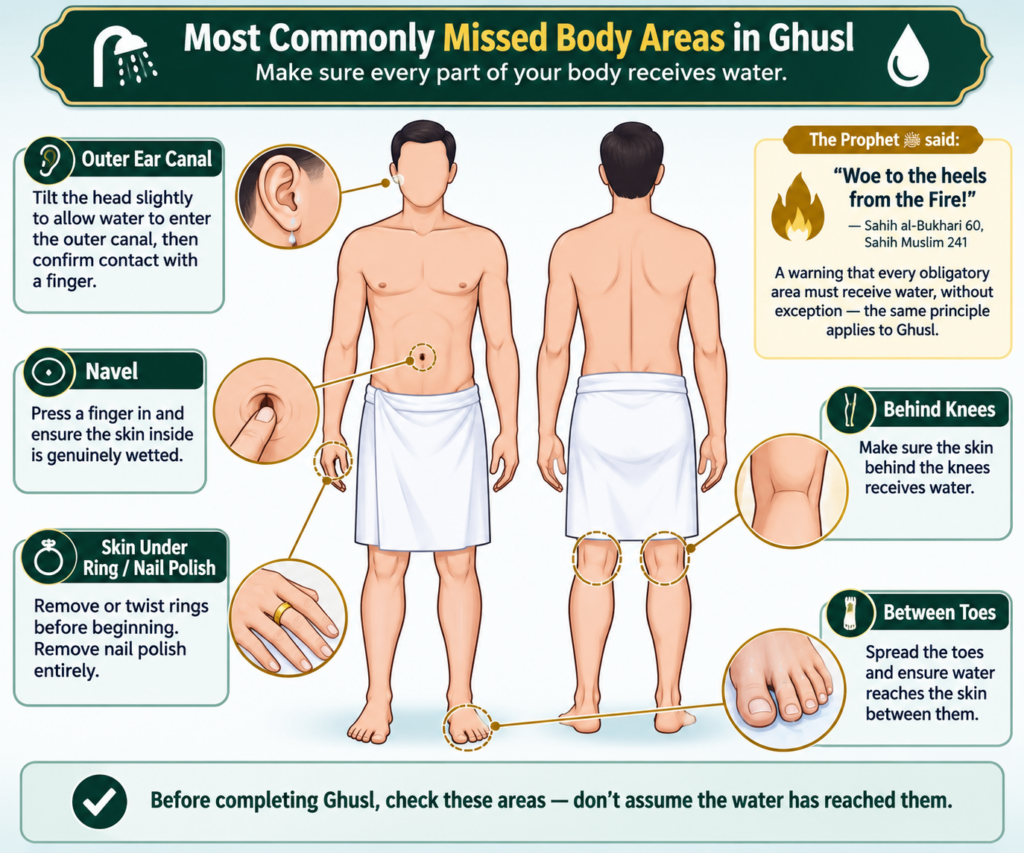
Every inch of the body’s outer surface must receive water — without exception. The areas most commonly missed are:
- The navel (water must enter and wet the inside, not merely run past it).
- The ear canals (the outer canal must be wetted).
- Beneath a thick beard (water must reach the skin).
- Under the armpits.
- Between the toes.
- The back of the knees.
- The hair roots.
- The back.
Missing even one area invalidates the Ghusl for that area.
2. The Complete Sunnah Ghusl Through 6 Steps
Aisha (may Allah be pleased with her), who observed the Prophet’s ﷺ private worship as his wife, narrated the most precise account of his Ghusl:
عَنْ عَائِشَةَ رضي الله عنها قَالَتْ: «كَانَ رَسُولُ اللَّهِ ﷺ إِذَا اغْتَسَلَ مِنَ الجَنَابَةِ بَدَأَ فَغَسَلَ يَدَيْهِ، ثُمَّ يَتَوَضَّأُ كَمَا يَتَوَضَّأُ لِلصَّلَاةِ، ثُمَّ يُدْخِلُ أَصَابِعَهُ فِي الْمَاءِ فَيُخَلِّلُ بِهَا أُصُولَ شَعَرِهِ، ثُمَّ يَصُبُّ عَلَى رَأْسِهِ ثَلَاثَ غُرَفٍ بِيَدَيْهِ، ثُمَّ يُفِيضُ الْمَاءَ عَلَى جِلْدِهِ كُلِّهِ»
“Whenever Allah’s Messenger ﷺ took the bath of Janabah, he started by washing his hands, then performed ablution as for prayer, then put his fingers in water and worked them through the roots of his hair, then poured three handfuls of water over his head, then poured water all over his body.”— Sahih al-Bukhari 248
Three details in this narration carry specific jurisprudential weight:
- First, “يُخَلِّلُ بِهَا أُصُولَ شَعَرِهِ” — he worked his fingers through the roots of his hair — this is deliberate, precise contact with the scalp at the roots, documented Prophetic practice, not merely a scholarly recommendation.
- Second, the Wudu is performed inside the Ghusl process, before the head and body are washed — not after the Ghusl is complete.
- Third, the hadith concludes “يُفِيضُ الْمَاءَ عَلَى جِلْدِهِ كُلِّهِ” — he poured water over all of his skin — universal coverage is a Prophetic standard.
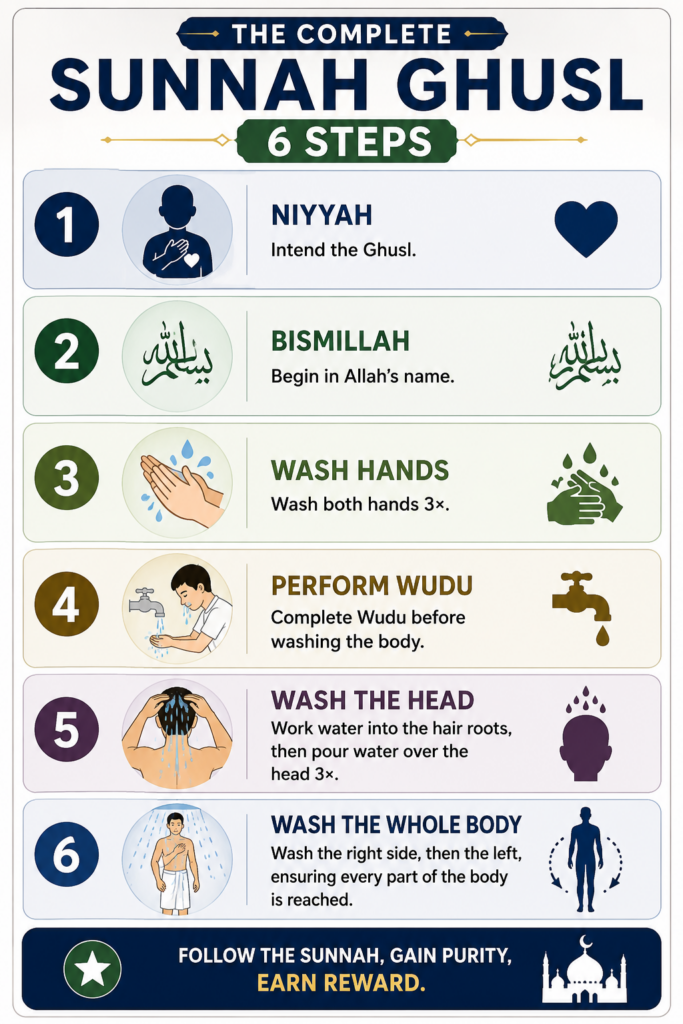
Following this narration, the complete Ghusl is performed in these six steps:
- Intention (Niyyah): Set the intention in your heart for the specific Ghusl you are performing: Janabah, Hayd, or Nifas.
- Say “Bismillah”: Begin with the Basmalah as you do with all acts of worship.
- Wash both hands three times: Wash the hands up to the wrists before touching any other part of the body.
- Perform Wudu: Perform a complete Wudu as you would before Salah. This is a Sunnah (Mustahabb) step performed inside the Ghusl process — before washing the head and body, not after the Ghusl is finished. For the full method, see How to Perform Wudu. Upon completing the Wudu, recite:
«أَشْهَدُ أَنْ لَا إِلَهَ إِلَّا اللَّهُ وَحْدَهُ لَا شَرِيكَ لَهُ، وَأَشْهَدُ أَنَّ مُحَمَّدًا عَبْدُهُ وَرَسُولُهُ، اللَّهُمَّ اجْعَلْنِي مِنَ التَّوَّابِينَ وَاجْعَلْنِي مِنَ الْمُتَطَهِّرِينَ»
“I testify that none has the right to be worshipped except Allah alone, with no partner, and I testify that Muhammad is His servant and Messenger. O Allah, make me among those who repent and among those who purify themselves.”The Prophet ﷺ said that whoever recites this after completing Wudu, “eight gates of Paradise will be opened for him to enter from whichever he wishes.” — Jami at-Tirmidhi 55
Since the complete Sunnah Ghusl includes performing Wudu at Step 4, this Du’a is recited as part of the Ghusl itself — before moving on to washing the head and body. This means performing the full Sunnah Ghusl carries within it the reward of perfecting Wudu and its Du’a. One act of worship holds within it another, multiplying its spiritual weight.
- Pour water over the head three times — Use your fingertips to work the water into the hair roots across the entire scalp — including the hairline at the forehead and the nape of the neck. No part of the scalp should remain dry.
- Pour water over the right side of the body, then the left — Pour water over the right side three times, then the left side three times. Use your hands to rub the water across the skin as you go, paying specific attention to the navel, armpits, between the toes, the back of the knees, and the back — the areas most prone to being missed.
How to Perform Ghusl for Females After the Menstrual Cycle (Hayd)
Once a woman’s period ends completely, she must perform Ghusl before resuming Salah, fasting, touching the Mushaf, or having intercourse with her husband. She should confirm the bleeding has fully stopped before beginning.
The steps are identical to the complete Sunnah Ghusl described above: Niyyah for Hayd, Bismillah, wash hands, Wudu, pour water over the head and body. What differs from Janabat Ghusl is one specific ruling about hair. For a full guide on Wudu specific to women, see Wudu Steps for Women — How to Perform Wudu for Females.
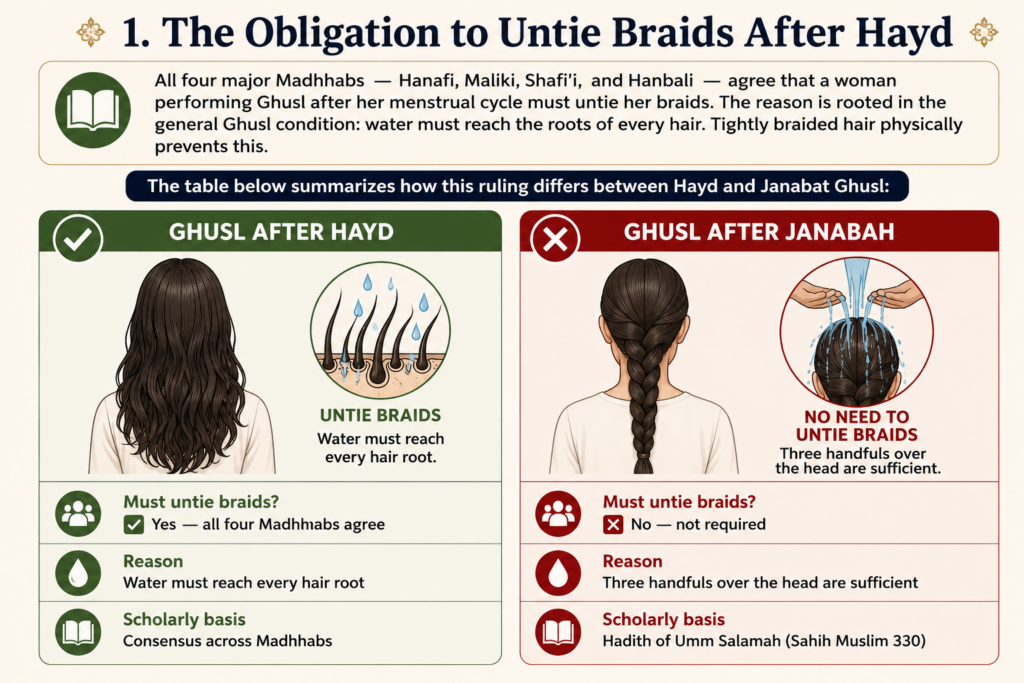
1. The Obligation to Untie Braids After Hayd
All four major Madhhabs — Hanafi, Maliki, Shafi’i, and Hanbali — agree that a woman performing Ghusl after her menstrual cycle must untie her braids. The reason is rooted in the general Ghusl condition: water must reach the roots of every hair. Tightly braided hair physically prevents this.
The table below summarizes how this ruling differs between Hayd and Janabat Ghusl:
| Ghusl After Hayd | Ghusl After Janabah | |
|---|---|---|
| Must untie braids? | ✅ Yes — all four Madhhabs agree | ❌ No — not required |
| Reason | Water must reach every hair root | Three handfuls over the head are sufficient |
| Scholarly basis | Consensus across Madhhabs | Hadith of Umm Salamah (Sahih Muslim 330) |
2. Using Musk After the Period – The Sunnah of Completion
It is Sunnah for a woman to apply musk to a piece of cotton and use it to purify the area where the blood was, after completing Ghusl. Aisha (may Allah be pleased with her) narrated:
عن عائشة رضي الله عنها أنَّ امرأةً مِنَ الأَنصارِ سَأَلَتِ النَّبِيَّ ﷺ عَنْ غُسْلِهَا مِنَ الحَيضِ، فَأَمَرَهَا كَيفَ تَغتَسِلُ، ثُمَّ قَالَ: «خُذِي فِرْصَةً مِنْ مِسْكٍ فَتَطَهَّرِي بِهَا». قَالَتْ: كَيفَ أَتَطَهَّرُ بِهَا؟ قَالَ: «تَطَهَّرِي بِهَا». قَالَتْ: كَيفَ؟ قَالَ: «سُبحَانَ اللَّهِ! تَطَهَّرِي بِهَا». فَاجتَذَبتُهَا إِلَيَّ فَقُلتُ: تَتَبَّعِي بِهَا أَثَرَ الدَّمِ
A woman of the Ansar asked the Prophet ﷺ about Ghusl after menstruation. He instructed her, then said: “Take a piece of cotton with musk and purify yourself with it.” She asked: “How?” He replied: “Purify yourself with it.” She asked again, and he repeated: “Purify yourself with it — Glory be to Allah!” Aisha then drew her aside and said: “Pass it over the area where the blood was.”— Sahih Muslim 332
The exchange reveals something important about how the Sunnah was preserved. The Prophet ﷺ repeated “purify yourself with it” three times — the modesty of the subject made explicit specification difficult in that moment. Aisha’s intervention completed what the Prophet ﷺ left to be understood: the cotton with musk is applied specifically to the area where the blood was, addressing both residual odor and the completeness of the purification.
Scholars note that Aisha’s role in transmitting the full practical detail of purification rulings for women — rulings the Prophet ﷺ could not always specify in public company — was indispensable. Her presence in the chain of transmission for these hadiths is itself a mercy to Muslim women.
For a deeper study of these rulings, Riwaq Al Quran’s Online Islamic Studies courses are taught by scholars holding formal Ijazah, with live sessions where you can ask questions directly. Women can also learn with qualified female Quran teachers in a comfortable, dedicated setting.
How to Perform Ghusl After Janabat
Janabah is the state of major ritual impurity caused by sexual intercourse or ejaculation, including from a wet dream. Ghusl Al-Janabah follows the complete Sunnah method described above without any additional steps. Allah commands it directly in Al-Ma’idah 5:6: “And if you are in a state of full impurity, then take a full bath.”
The Braids Ruling in Ghusl After Janabat vs. After Hayd
Unlike Ghusl after Hayd, a woman performing Ghusl Al-Janabah is not required to untie her braids. This is established directly from the Prophet’s ﷺ own words. Umm Salamah (may Allah be pleased with her) asked:
عَنْ أُمِّ سَلَمَةَ رضي الله عنها قَالَتْ: قُلتُ: يَا رَسُولَ اللَّهِ، إِنِّي امرَأَةٌ أَشُدُّ ضَفرَ رَأسِي أَفَأَنقُضُهُ لِغُسلِ الجَنَابَةِ؟ قَالَ: «لَا، إِنَّمَا يَكفِيكِ أَن تَحثِي عَلَى رَأسِكِ ثَلَاثَ حَثَيَاتٍ، ثُمَّ تُفِيضِي عَلَيكِ الْمَاءَ فَتَطهُرِينَ»
“O Messenger of Allah, I am a woman with tightly plaited hair — should I undo it for the Ghusl of Janabah?” He ﷺ replied: “No. It is sufficient for you to pour three handfuls of water over your head, then pour water over yourself, and you will be purified.”— Sahih Muslim 330
Umm Salamah’s question was specific and direct, and the Prophet’s ﷺ answer was equally specific — not a general principle, but a ruling tailored to a real practical concern. The exemption from undoing braids in Janabah Ghusl rests on the condition that three handfuls of water are poured over the head, ensuring the water contacts the scalp.
The ruling difference between Hayd and Janabat on this point is unanimously agreed upon: braids must be untied for Hayd Ghusl, and they need not be untied for Janabat Ghusl. The Prophet ﷺ treated these as two distinct obligations with two distinct conditions — conflating them is a practical error with jurisprudential consequences.
Types of Ghusl – Obligatory and Recommended
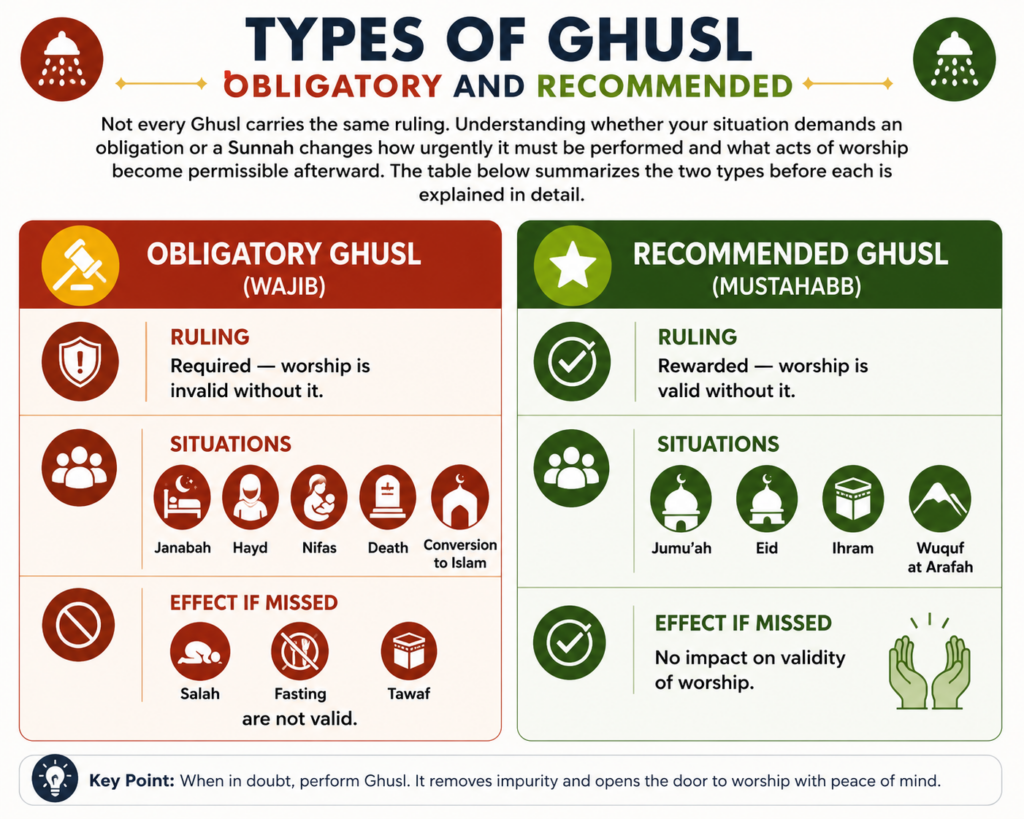
Not every Ghusl carries the same ruling. Understanding whether your situation demands an obligation or a Sunnah changes how urgently it must be performed and what acts of worship become permissible afterward. The table below summarizes the two types before each is explained in detail.
| Obligatory Ghusl (Wajib) | Recommended Ghusl (Mustahabb) | |
|---|---|---|
| Ruling | Required — worship is invalid without it | Rewarded — worship is valid without it |
| Situations | Janabah, Hayd, Nifas, death, conversion | Jumu’ah, Eid, Ihram, Wuquf at Arafah |
| Effect if missed | Salah, fasting, and Tawaf are not valid | No impact on validity of worship |
1 . Obligatory Ghusl (Ghusl Wajib)
Obligatory Ghusl is required after states of major ritual impurity. Without it, Salah, touching the Mushaf, fasting, and Tawaf are not valid. The situations that obligate Ghusl are:
- Sexual intercourse (Janabah).
- Ejaculation, including from a wet dream — applies equally to men and women.
- The end of the menstrual cycle (Hayd).
- The end of postpartum bleeding (Nifas).
- Death — performed by others on behalf of the deceased (Ghusl Al-Mayyit).
- Converting to Islam — obligatory according to the majority of scholars.
A ruling many women are unaware of — Ghusl after a wet dream
Umm Sulaym (may Allah be pleased with her) asked the Prophet ﷺ directly about this:
عن أُمِّ سُلَيْمٍ رضي الله عنها أنها قالت: يَا رَسُولَ اللَّهِ، إِنَّ اللَّهَ لَا يَسْتَحْيِي مِنَ الْحَقِّ، فَهَلْ عَلَى الْمَرْأَةِ مِنْ غُسْلٍ إِذَا هِيَ احْتَلَمَتْ؟ فَقَالَ رَسُولُ اللَّهِ ﷺ: «نَعَمْ، إِذَا رَأَتِ الْمَاءَ»
“O Messenger of Allah, Allah is not shy of the truth — does a woman have to perform Ghusl if she has a wet dream?” The Prophet ﷺ replied: “Yes, if she sees discharge.”— Sahih al-Bukhari 130, Sahih Muslim 313
Umm Sulaym’s question — prefaced with “Allah is not shy of the truth” — is a model of how the Companions sought religious knowledge: with courage, precision, and sincerity. The Prophet’s ﷺ ruling establishes that the obligation of Ghusl after a wet dream applies equally to men and women, conditional on the presence of discharge.
A dream without discharge does not obligate Ghusl. This ruling is widely unknown among women, which means prayers may be offered unknowingly without valid Tahara.
2. Recommended Ghusl (Ghusl Mustahabb)
Recommended Ghusl is rewarded but not obligatory. These are performed as acts of reverence before significant occasions:
- Before the Friday (Jumu’ah) prayer.
- Before Eid prayers.
- Before entering Ihram for Hajj or Umrah.
- Before the Wuquf at Arafah.
Common Mistakes That Make Ghusl Incomplete
These are the errors practicing Muslims most commonly make — often unknowingly, because they were never pointed out in the original instruction. Each one renders the Ghusl incomplete.
1. Missed Body Areas – The Navel, Ear Canals, and Skin Under Jewelry
The navel and outer ear canal are the two most consistently missed areas:
- Navel: Water running across the surface is not sufficient — press a finger in and ensure the skin inside is genuinely wetted.
- Ear canal: Tilt the head slightly to allow water to enter the outer canal, then confirm contact with a finger.
- Rings and nail polish: A tight ring worn during Ghusl means the skin beneath it never received water — and that skin is part of the obligatory coverage. Remove or twist rings before beginning; remove nail polish entirely.
The Prophet ﷺ made clear that leaving any area of the body uncovered in purification carries serious consequences:
عَنْ عَبْدِ اللَّهِ بْنِ عَمْرٍو رضي الله عنهما: أَنَّ النَّبِيَّ ﷺ رَأَى قَوْمًا يَتَوَضَّؤُونَ وَأَعْقَابُهُمْ تَلُوحُ لَمْ يَمَسَّهَا الْمَاءُ، فَقَالَ: «وَيْلٌ لِلأَعْقَابِ مِنَ النَّارِ»
Narrated by Abdullah ibn Amr: The Prophet ﷺ saw people performing Wudu and their heels were shining — water had not touched them. He said: “Woe to the heels from the Fire!”— Sahih al-Bukhari 60, Sahih Muslim 241
This warning was issued during Wudu, but scholars apply the same governing principle to Ghusl — every obligatory area must receive water, without exception. The Prophet ﷺ did not merely say “be more careful”; he issued a warning of serious consequence for what seemed like a minor oversight.
The heel was the area at risk in this incident; in Ghusl, the equivalents are the navel, the skin under rings, and the outer ear canals. The practical lesson: before completing Ghusl, consciously check these specific areas rather than assuming the water reached them passively.
2 . Mixing Ghusl with a Regular Shower in the Wrong Order
A common pattern: a person steps into the shower, lathers with shampoo and soap, rinses off, and then makes the Niyyah for Ghusl partway through. The problem is twofold:
- Soap residue may act as a physical barrier on the skin.
- The Niyyah came after the washing, not before it — invalidating the process.
The correct sequence: make the Niyyah first, meet all three obligatory conditions with pure water, and then continue with soap and shampoo as a regular shower. The Ghusl must be completed as its own process before regular hygiene begins.
Does Ghusl Count as Wudu?
Yes — Ghusl counts as Wudu and replaces it. A deeper look at this question with full scholarly references is covered in Does Ghusl Count as Wudu? The essential ruling breakdown:
- When the complete Sunnah Ghusl is performed (including the Wudu step within it): the person is in full Tahara and does not need a separate Wudu before praying.
- When only the minimum valid Ghusl was performed (without the Wudu step): the majority scholarly position holds that Ghusl removes both the major impurity (Hadath Akbar) and the minor impurity (Hadath Asghar) together — a separate Wudu is still not required.
- If after completing Ghusl the person does something that breaks Wudu — using the bathroom, passing gas, or sleeping: only Wudu needs to be repeated; the Ghusl remains valid and a new full Ghusl is not required unless a new state of major impurity occurs.
Ghusl vs. a Regular Shower – Key Differences
A regular shower cleans the body physically but does nothing to the state of ritual impurity. Ghusl removes Hadath Akbar by meeting three specific conditions:
- A sincere intention (Niyyah).
- The absence of any physical barrier preventing water from reaching the skin.
- Water reaching every external part of the body without exception.
Soap and shampoo play no role in Ghusl’s validity — only pure water counts as the means of purification.
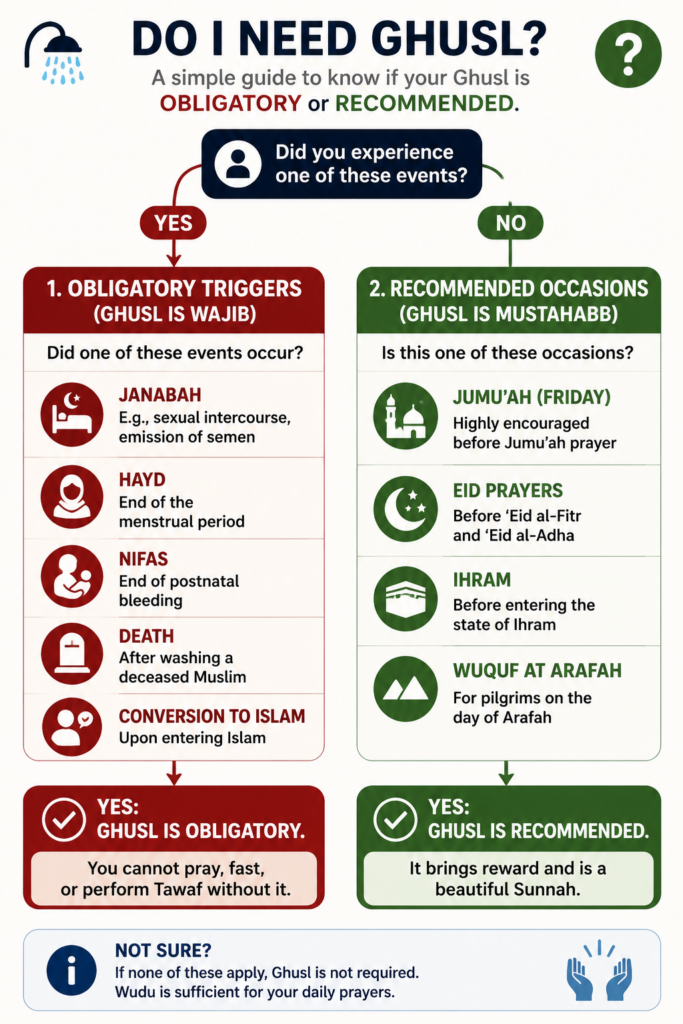
When Is Ghusl Required?
Ghusl is required whenever a Muslim enters a state of major ritual impurity. The situations agreed upon across all schools of Islamic jurisprudence are as follows:
Obligatory situations:
- After sexual intercourse
- After ejaculation, including from a wet dream — applies to both men and women
- When the menstrual cycle ends
- When postpartum bleeding ends
- Upon death, performed by those washing the body
- Upon converting to Islam, according to the majority of scholars
Recommended situations:
- Before Jumu’ah prayer
- Before Eid prayers
- Before entering Ihram for Hajj or Umrah
- Before the Wuquf at Arafah
Start Learning Fiqh at Riwaq Al Quran
Understanding how to perform Ghusl correctly is the foundation of valid worship — but the rulings of Tahara extend into every part of daily Islamic life.
Riwaq Al Quran is a comprehensive online platform offering personalized Quran, Arabic, and Islamic Studies courses for all ages and backgrounds. Experienced instructors use a structured curriculum covering Tajweed, Tafsir, Memorization, and Fiqh — through live, interactive sessions that allow seamless communication between students and teachers, wherever you are.
If you’d like to go further with Fiqh and Quran recitation at Riwaq Al Quran, take a look at this:
Course categories:
| Category | What You’ll Study |
|---|---|
| Islamic Studies | Fiqh of worship, Tahara, and daily rulings |
| Quran Classes | Recitation, Tajweed, and Hifz for all levels |
| Arabic Language | Reading and understanding the Quran in Arabic |
| Ijazah Program | Certified chain of transmission from the Prophet ﷺ |
| Kids’ Courses | Age-appropriate Quran and Islamic learning |
Your first two sessions are completely free — no commitment required.

Conclusion
Ghusl is the full-body ritual purification that removes major ritual impurity (Hadath Akbar) in Islam. Its validity rests on three conditions: a sincere intention for the specific type of Ghusl, removing any physical barrier that blocks water from reaching the skin, and ensuring water reaches every part of the external body surface without exception.
The complete Sunnah method — documented by Aisha in Sahih al-Bukhari 248 — adds Wudu, washing the hands first, and pouring water over the head and body three times on each side, for the most rewarded and complete form.
The critical distinctions to carry forward: women must untie braids for Ghusl after Hayd but not after Janabah; Ghusl counts as Wudu and a separate Wudu is not needed unless something breaks it afterward; and the most common reason a Ghusl falls short is not a missed step but a missed body area — the navel, ear canals, and skin beneath rings or nail polish. Performing Ghusl on these terms means every act of worship that follows is built on sound, valid Tahara.
Frequently Asked Questions About Ghusl
The following questions reflect what Muslims most commonly ask about Ghusl in daily practice — from the basics of what makes it valid to specific rulings that differ by situation and gender.
What Is Ghusl in Islam?
Ghusl is the full-body ritual purification in Islam that removes the state of major ritual impurity (Hadath Akbar). It is performed by making a sincere intention and ensuring that pure water reaches every external part of the body without any physical barrier blocking it. Ghusl is an act of worship, not a regular shower, and is required before Salah, fasting, and other acts of worship can be validly performed after a state of major impurity.
What Are the 3 Obligatory Conditions for Ghusl to Be Valid?
The three obligatory conditions are: (1) a sincere intention (Niyyah) specifying the type of impurity being removed, (2) removing any physical barrier that prevents water from reaching the skin — including nail polish, tight rings, and adhesive coverings — and (3) ensuring that water reaches every external part of the body, including the navel, ear canals, hair roots, and skin beneath any beard or thick body hair. If all three conditions are met, the Ghusl is valid.
Does Ghusl Replace Wudu?
Yes. Ghusl removes both major impurity (Hadath Akbar) and minor impurity (Hadath Asghar), so a separate Wudu before prayer is not required after performing Ghusl. The exception: if after completing Ghusl the person does something that normally breaks Wudu — such as using the bathroom — then Wudu must be repeated before prayer, but the Ghusl itself remains valid.
Does a Woman Need to Untie Her Braids for Ghusl?
It depends on the type of Ghusl. For Ghusl after the menstrual cycle (Hayd), all four major Madhhabs require a woman to untie her braids so water reaches the hair roots. For Ghusl after Janabah, she does not need to untie her braids — the Prophet ﷺ explicitly told Umm Salamah it is sufficient to pour three handfuls of water over the head (Sahih Muslim 330). The ruling is different for each type of Ghusl.
Can I Perform Ghusl in the Shower?
Yes. Set the intention before turning on the water, then ensure water reaches every part of your body — starting from the head down — before using soap or shampoo. The Ghusl conditions must be fully met with pure water first. Using soap or shampoo before completing the Ghusl may introduce residue that acts as a barrier, so complete the Ghusl first, then continue with your regular shower routine.
Is Soap Required for Ghusl to Be Valid?
No. Soap, shampoo, and body wash have no role in the validity of Ghusl. Only pure water is required. Using soap is part of general hygiene and may be done before or after the Ghusl, but it neither contributes to nor is required for the Ghusl to be complete.