The five daily prayers are the backbone of a Muslim’s worship — but they were never meant to be the ceiling. The optional prayers in Islam are where the relationship with Allah deepens beyond duty, where the believer moves from fulfilling an obligation to earning Allah’s love. If your five daily prayers have started to feel like a checklist, voluntary prayers are the practice that transforms that.
This guide covers every major type of optional prayer in Islam: the 12 Rawatib Sunnah Rakat, Witr, Qiyam Al-Layl, Dhuha, and prayers for specific occasions — with the Quranic and hadith evidence behind each, and a practical framework for building them into your day.
What You’ll Learn in This Article
- The three tiers of optional prayers: Sunnah Muakkadah, Sunnah Ghair Muakkadah, and Nafl — and why the distinction matters.
- All 12 Rawatib Sunnah Rakat and which to establish first.
- Witr prayer: its ruling, timing, and how it relates to Tahajjud.
- Qiyam Al-Layl, Tahajjud, and Tarawih — and the differences between them.
- Dhuha, Istikharah, Tahiyyat al-Masjid, Salat al-Wudu, and Janazah.
- The most common mistakes Muslims make with voluntary prayers.
Table of Contents
What Are Optional Prayers in Islam?
Optional prayers in Islam are all voluntary prayers performed beyond the five obligatory daily prayers (Fajr, Dhuhr, Asr, Maghrib, Isha). They carry no sin if omitted but earn substantial reward when performed — and in certain categories, leaving them habitually without reason is considered reproachable by scholars.
Their spiritual purpose is explained in a Hadith Qudsi narrated by Abu Hurairah (may Allah be pleased with him):
“وَمَا يَزَالُ عَبْدِي يَتَقَرَّبُ إِلَيَّ بِالنَّوَافِلِ حَتَّى أُحِبَّهُ، فَإِذَا أَحْبَبْتُهُ كُنْتُ سَمْعَهُ الَّذِي يَسْمَعُ بِهِ، وَبَصَرَهُ الَّذِي يُبْصِرُ بِهِ، وَيَدَهُ الَّذِي يَبْطِشُ بِهَا، وَرِجْلَهُ الَّذِي يَمْشِي بِهَا”
“My servant keeps drawing closer to Me through voluntary prayers until I love him. And when I love him, I become the hearing with which he hears, the sight with which he sees, the hand with which he strikes, and the foot with which he walks.”— Sahih Bukhari: 6502
This Hadith Qudsi is one of the most profound in all of Islamic literature. Notice that Allah does not simply say He rewards the servant — He says He loves him. That shift from obligation to love is the entire spiritual logic behind voluntary prayer.
The continuation of the hadith — that Allah becomes the faculty through which the believer perceives and acts — describes a state of alignment between the servant’s will and Allah’s guidance that is only accessible through voluntary devotion beyond the minimum.
Prayer sits at the heart of Islam’s five pillars — second only to the Shahada. Here’s how it fits in:
The Three Tiers of Optional Prayers – Sunnah Muakkadah, Ghair Muakkadah, and Nafl
Most articles on this topic treat all voluntary prayers as one category. The table below breaks them into their three distinct tiers — because knowing this taxonomy is what allows you to prioritize correctly and build a practice that actually holds.
| Tier | Arabic Name | Definition | Leaving It Habitually | Examples |
|---|---|---|---|---|
| 1 | Sunnah Muakkadah | Prayers the Prophet ﷺ almost never abandoned | Reproachable by scholars | 2 Rakat before Fajr, 2 after Maghrib, Witr |
| 2 | Sunnah Ghair Muakkadah | Prayers the Prophet ﷺ performed sometimes and omitted at others | No blame | 2–4 Rakat before Asr |
| 3 | Nafl | Any additional voluntary prayer, no specific occasion | No blame | Any 2 Rakat at permitted times |
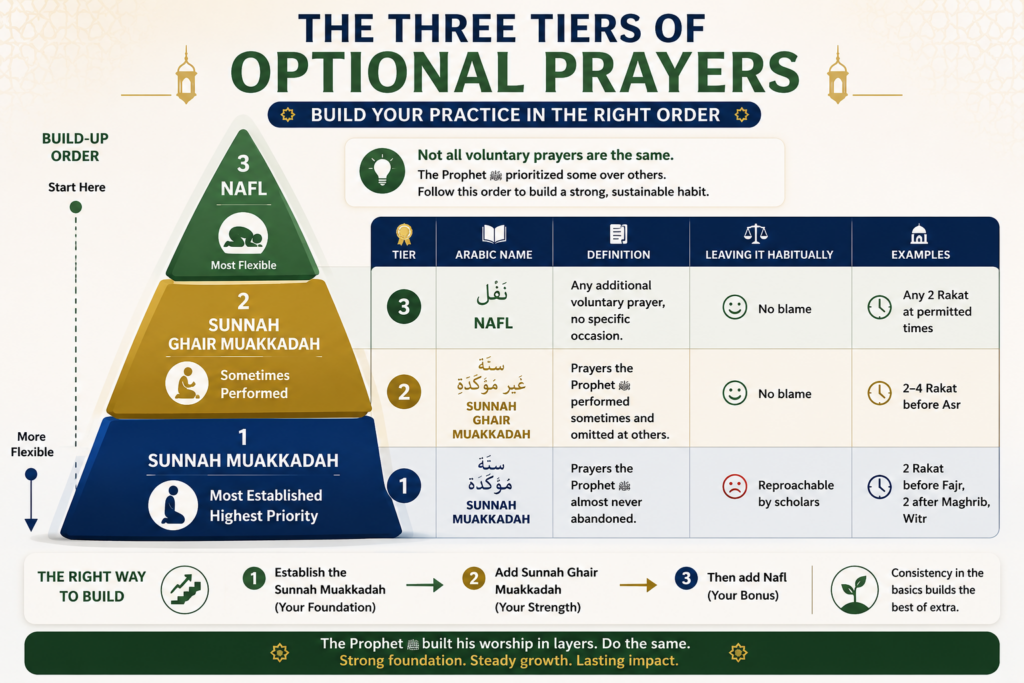
The practical framework: establish Sunnah Muakkadah first. Add Ghair Muakkadah once those are stable. Layer Nafl on top as your practice deepens.
Why Consistency Matters More Than Quantity
A mistake many Muslims make is praying many voluntary prayers for a week and then abandoning them entirely. The Prophet ﷺ addressed this directly:
“أَحَبُّ الأَعْمَالِ إِلَى اللَّهِ أَدْوَمُهَا وَإِنْ قَلَّ”
“The most beloved deeds to Allah are the most consistent, even if they are small.”— Sahih Bukhari: 6465
The word أَدْوَمُهَا comes from the root دَوَمَ — to persist, to last. The Prophet ﷺ is not talking about intensity or volume; he is talking about staying power. A small deed that endures is structurally more beloved to Allah than a large deed that collapses.
This is one of the most practical pieces of worship guidance in the entire Sunnah: it tells you exactly how to build a prayer practice that Allah loves — consistently, not heroically.
Two Rakat before Fajr, every single day without exception, outweighs twelve Rakat for a week then nothing. Build the habit before you expand it.
The Rawatib Sunnah Prayers – The 12 Daily Sunnah Rakat
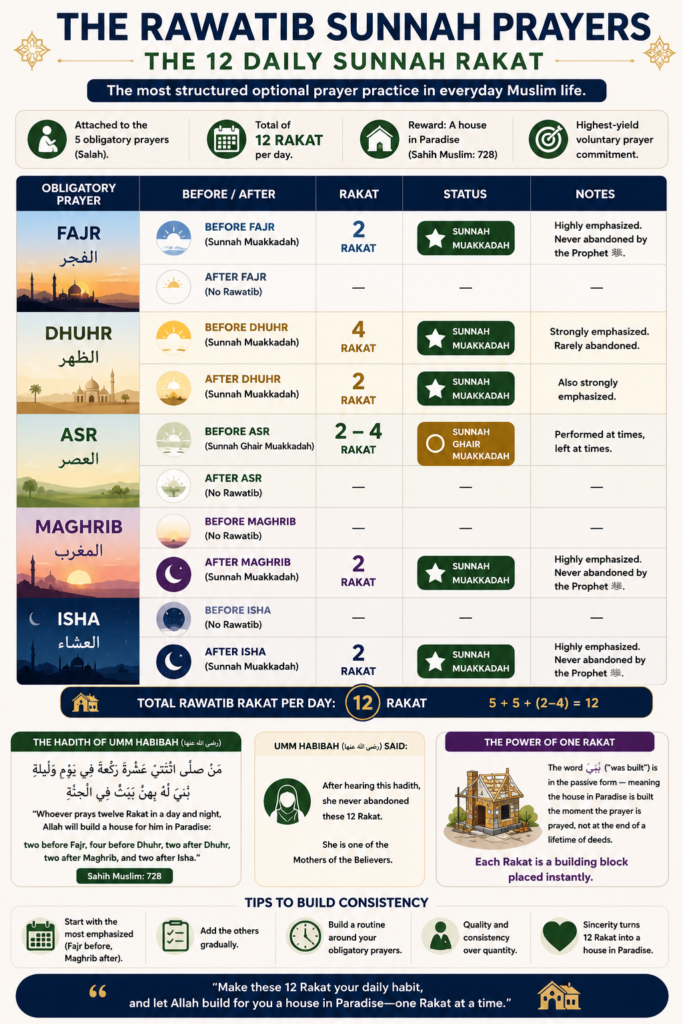
The Rawatib are the regular Sunnah prayers attached to the five obligatory prayers. They total 12 Rakat per day and form the most structured optional prayer practice available in everyday Muslim life. Establishing these 12 Rakat is the highest-yield voluntary prayer commitment a Muslim can make.
Their collective reward is established in the hadith of Umm Habibah (may Allah be pleased with her):
“مَنْ صَلَّى اثْنَتَيْ عَشْرَةَ رَكْعَةً فِي يَوْمٍ وَلَيْلَةٍ بُنِيَ لَهُ بِهِنَّ بَيْتٌ فِي الْجَنَّةِ”
“Whoever prays twelve Rakat in a day and night, Allah will build a house for him in Paradise: two before Fajr, four before Dhuhr, two after Dhuhr, two after Maghrib, and two after Isha.”— Sahih Muslim: 728
Umm Habibah (may Allah be pleased with her), one of the Mothers of the Believers, narrated that she never abandoned these 12 Rakat after hearing this hadith.
The Arabic word بُنِيَ (“was built”) is in the passive form — signaling that the construction of that house in Paradise begins the moment the prayer is prayed, not at the end of a lifetime of deeds. Each Rakat is a building block placed the instant it is performed.
A. Tier 1 — Sunnah Muakkadah Rawatib
These are the Rawatib the Prophet ﷺ almost never abandoned, including while traveling:
1. Two Rakat before Fajr
— the single most emphasized voluntary prayer in Islam. The Prophet ﷺ said:
“رَكْعَتَا الْفَجْرِ خَيْرٌ مِنَ الدُّنْيَا وَمَا فِيهَا”
“The two Rakat of Fajr are better than the world and everything in it.”— Sahih Muslim: 725
This is not rhetorical emphasis — the Prophet ﷺ is making a direct comparison between the entire material world and two Rakat before Fajr, and the two Rakat win.
The scholars note this is precisely because these Rakat capture the moment before the day begins, when the heart is most free of distraction and most receptive to Allah. Missing them is not merely missing a Sunnah — it is, according to this hadith, a greater loss than any worldly opportunity missed that day.
2. Four Rakat before Dhuhr
(prayed as two + two, after the Adhan, before the obligatory prayer begins):
“مَنْ حَافَظَ عَلَى أَرْبَعِ رَكَعَاتٍ قَبْلَ الظُّهْرِ وَأَرْبَعٍ بَعْدَهَا حَرَّمَهُ اللَّهُ عَلَى النَّارِ”
“Whoever prays four Rakat before Dhuhr and four after it, Allah will forbid him from the Fire.”— Abu Dawud: 1269, Tirmidhi: 428
The word حَرَّمَهُ — “forbids him” — is the same root used for what is made impermissible (haram). Allah makes the Fire impermissible for this person. This hadith covers 8 Rakat total (4 before + 4 after Dhuhr), encompassing both Sunnah Muakkadah and Ghair Muakkadah Rawatib for the midday prayer. Scholars note the combination of these 8 Rakat around Dhuhr makes this the most rewarded single daily prayer window.
3. Two Rakat after Dhuhr
These two Rakat are part of the same twelve emphasized Rawatib the Prophet ﷺ maintained without fail, completing the Dhuhr set that begins with the four Rakat before it:
“مَنْ حَافَظَ عَلَى أَرْبَعِ رَكَعَاتٍ قَبْلَ الظُّهْرِ وَأَرْبَعٍ بَعْدَهَا حَرَّمَهُ اللَّهُ عَلَى النَّارِ”
“Whoever prays four Rakat before Dhuhr and four after it, Allah will forbid him from the Fire.” — Abu Dawud: 1269, Tirmidhi: 428
The same twelve-Rakat hadith from Umm Habibah also confirms these two Rakat after Dhuhr as part of the emphasized Rawatib:
“مَنْ صَلَّى فِي يَوْمٍ وَلَيْلَةٍ ثِنْتَيْ عَشْرَةَ رَكْعَةً… وَرَكْعَتَيْنِ بَعْدَهَا”
“Whoever prays twelve Rakat in a day and night — a house will be built for him in Paradise… two after Dhuhr.” — Sunan At-Tirmidhi: 415 (graded Sahih by Al-Albani)
A’ishah (may Allah be pleased with her) further narrated:
“The Prophet ﷺ never omitted four Rakat before Dhuhr and two Rakat after it.” — Sahih Muslim: 727
Scholars note that these two Rakat mark the point where the Dhuhr obligation is fully “closed out” — after the four before and the obligatory four, these two after complete the fuller reward tied to the hadith of forbiddance from the Fire, since that hadith speaks of four before and four after combined, while the twelve-Rakat Rawatib hadith counts only two after as part of the daily Sunnah Muakkadah.
Practically, this means a person praying the full package around Dhuhr — 4 before + 4 obligatory + 4 after (2 of which are Muakkadah, 2 additional Nafl) — is combining two separate virtues in one prayer window, which is part of why scholars regard Dhuhr’s surrounding Sunnah as the richest of the day.
4. Two Rakat after Maghrib
— Ibn Umar and other companions observed the Prophet ﷺ never leave these, even at home. This is one of the twelve emphasized Rawatib the Prophet ﷺ maintained consistently, whether at home or traveling:
“مَنْ صَلَّى فِي يَوْمٍ وَلَيْلَةٍ ثِنْتَيْ عَشْرَةَ رَكْعَةً… وَرَكْعَتَيْنِ بَعْدَ الْمَغْرِبِ”
“Whoever prays twelve Rakat in a day and night — a house will be built for him in Paradise: four before Dhuhr, two after it, two after Maghrib, two after Isha, and two before Fajr.” — Sunan At-Tirmidhi: 415 (graded Sahih by Al-Albani)
These two Rakat after Maghrib fall right after sunset, when the day’s obligations are winding down. Scholars note this makes them one of the easier Rawatib to maintain consistently, since they immediately follow a prayer most people are already present for in the masjid or at home.
5. Two Rakat after Isha
The final Rakat of the twelve emphasized Sunnah prayers, closing out the daily Rawatib cycle:
Same hadith (Tirmidhi: 415) confirms these two Rakat after Isha are part of the twelve that earn “a house built in Paradise” for whoever maintains them daily.
A separate narration from Umm Habibah in Sahih Muslim (728) reinforces the same twelve Rakat, and she is reported to have said she never abandoned them after hearing this from the Prophet ﷺ herself — a detail scholars often cite to show how a companion internalized and lived by this hadith.
B. Tier 2 — Sunnah Ghair Muakkadah Rawatib
Two to four Rakat before Asr — prayed in pairs. The Prophet ﷺ made a specific supplication for those who maintain this:
“رَحِمَ اللَّهُ امْرَأً صَلَّى قَبْلَ الْعَصْرِ أَرْبَعًا”
“May Allah have mercy on the one who prays four Rakat before Asr.”— Abu Dawud: 1271
Scholars point out that this statement — a du’a rather than a command — is what places the pre-Asr prayer in the Ghair Muakkadah category. The Prophet ﷺ prayed for those who do it rather than consistently doing it himself. Still, a supplication from the Prophet ﷺ asking Allah’s mercy for you is a standing intercessory du’a on your behalf every time you pray these Rakat.
A note on timing:
- Sunnah prayers performed before an obligatory prayer should be prayed between the Adhan and Iqamah.
- Those performed after should be prayed promptly — not delayed to the point where their association with the main Salah is broken.
Witr Prayer
Witr is the odd-numbered prayer performed after Isha and before the Fajr Adhan. It is among the most emphasized Sunnah prayers in Islam, and the Prophet ﷺ never abandoned it — not even while traveling on a mount.
“الْوِتْرُ حَقٌّ، فَمَنْ شَاءَ فَلْيُوتِرْ بِخَمْسٍ، وَمَنْ شَاءَ فَلْيُوتِرْ بِثَلاَثٍ، وَمَنْ شَاءَ فَلْيُوتِرْ بِوَاحِدَةٍ”
“Witr is a right (haqq). Whoever wishes should pray five, whoever wishes should pray three, and whoever wishes should pray one.”— Abu Dawud: 1422
The word حَقٌّ — “a right” or “an established truth” — is significant. The Prophet ﷺ is not saying Witr is recommended or good — he is saying it is a due. Something owed. This language places Witr closer to obligation than ordinary Sunnah in terms of moral weight, which is precisely why the Hanafi school classified it as Wajib.
At minimum, 1 Rakat is valid; 3 Rakat is the most common practice; 11 Rakat is narrated from A’isha (may Allah be pleased with her) as the Prophet’s ﷺ own night prayer structure.
A. The Ruling on Witr Across the Four Schools
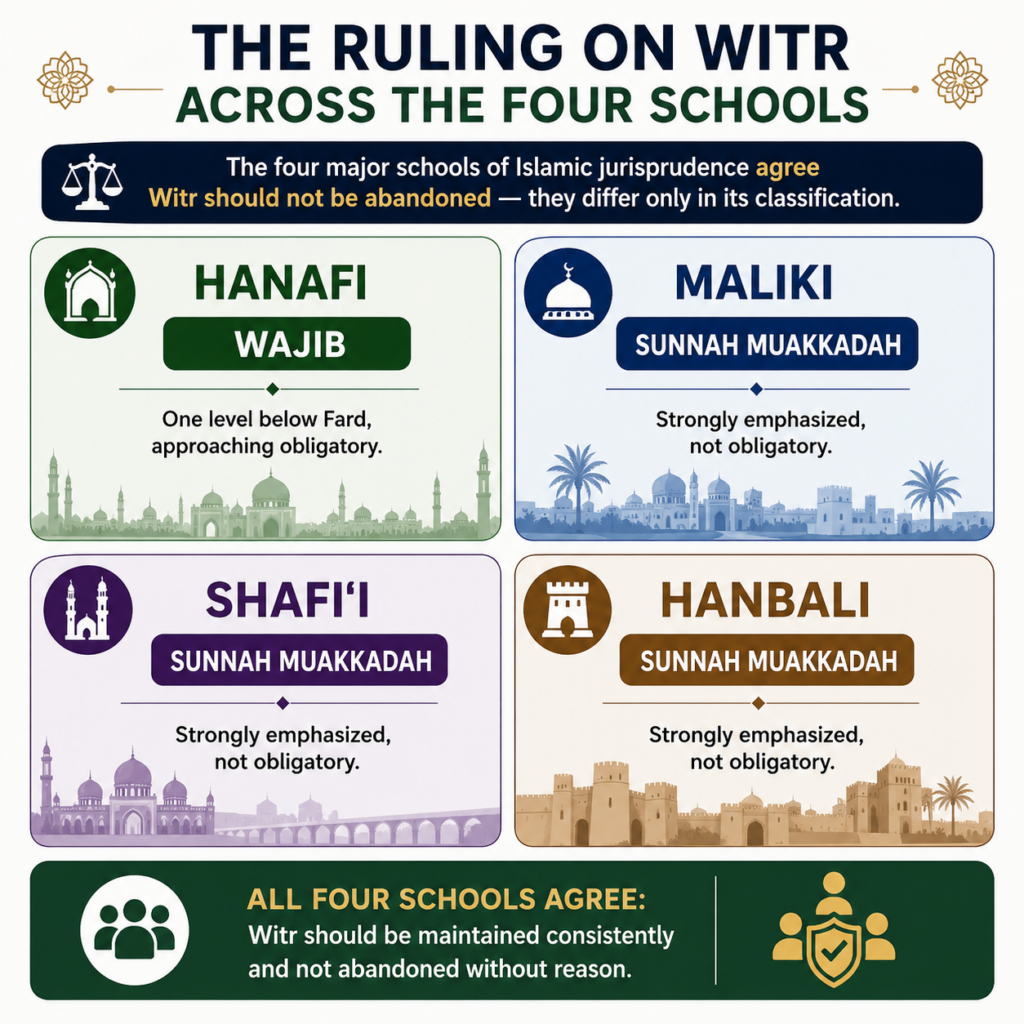
The four major schools of Islamic jurisprudence agree Witr should not be abandoned — they differ only in its classification:
- Hanafi: Wajib — one level below Fard, approaching obligatory.
- Maliki: Sunnah Muakkadah — strongly emphasized, not obligatory.
- Shafi’i: Sunnah Muakkadah — strongly emphasized, not obligatory.
- Hanbali: Sunnah Muakkadah — strongly emphasized, not obligatory.
- All four schools: agree it should be maintained consistently and not abandoned without reason.
B. When to Pray Witr If You Plan to Pray Tahajjud
If you intend to wake for Qiyam Al-Layl or Tahajjud, delay Witr until after your night prayer. The Prophet ﷺ was explicit:
“اجْعَلُوا آخِرَ صَلاَتِكُمْ بِاللَّيْلِ وِتْرًا”
“Make Witr the last of your night prayers.”— Sahih Bukhari: 998
The command اجْعَلُوا is plural and imperative — addressed to the entire Muslim community. Witr is the seal on the night. Just as the day begins with the 2 Rakat of Fajr Sunnah as the first act of worship, it ends with Witr as the last. This symmetry is deliberate: the day is framed in voluntary worship at both ends. If you are not confident you will wake up, pray Witr before sleeping — it still counts.
Qiyam Al-Layl – The Night Prayer
Qiyam Al-Layl is any voluntary prayer performed between Isha and Fajr. It holds a historically unique status: before the five daily prayers were established, night prayer was the first act of worship commanded to the Prophet ﷺ and the early Muslim community in Makkah.
Allah addresses this directly in Surah Al-Muzzammil:
قُمِ اللَّيْلَ إِلَّا قَلِيلًا ﴿٢﴾ نِّصْفَهُ أَوِ انقُصْ مِنْهُ قَلِيلًا ﴿٣﴾ أَوْ زِدْ عَلَيْهِ وَرَتِّلِ الْقُرْآنَ تَرْتِيلًا ﴿٤﴾
“Stand in prayer at night, except for a little — half of it, or a little less, or a little more — and recite the Quran with measured recitation.”— Surah Al-Muzzammil, 73:2–4
The command قُمِ اللَّيْلَ — “stand in the night” — was the opening instruction to the Prophet ﷺ at the very start of revelation. Before rules, before community, before anything else: night prayer. The phrase وَرَتِّلِ الْقُرْآنَ تَرْتِيلًا connects Qiyam to Quran recitation inseparably — the night prayer is the prayer where the Quran is meant to be heard slowly, felt deeply, and reflected upon at length.
And in Surah Al-Isra:
“وَمِنَ اللَّيْلِ فَتَهَجَّدْ بِهِ نَافِلَةً لَّكَ عَسَىٰ أَن يَبْعَثَكَ رَبُّكَ مَقَامًا مَّحْمُودًا'”
“And during part of the night, pray Tahajjud as an additional prayer for you; perhaps your Lord will raise you to a praised station.”— Surah Al-Isra, 17:79
The word نَافِلَةً (nafilah) in this verse is the Quranic root of the entire category of Nafl prayers — a voluntary addition beyond what is required. The “praised station” (مَقَامًا مَحْمُودًا) is understood by the majority of classical scholars as the Station of Intercession granted to the Prophet ﷺ on the Day of Judgment.
The path to that station runs through voluntary night prayer. For the believer, Qiyam is the path to one’s own elevated standing with Allah.
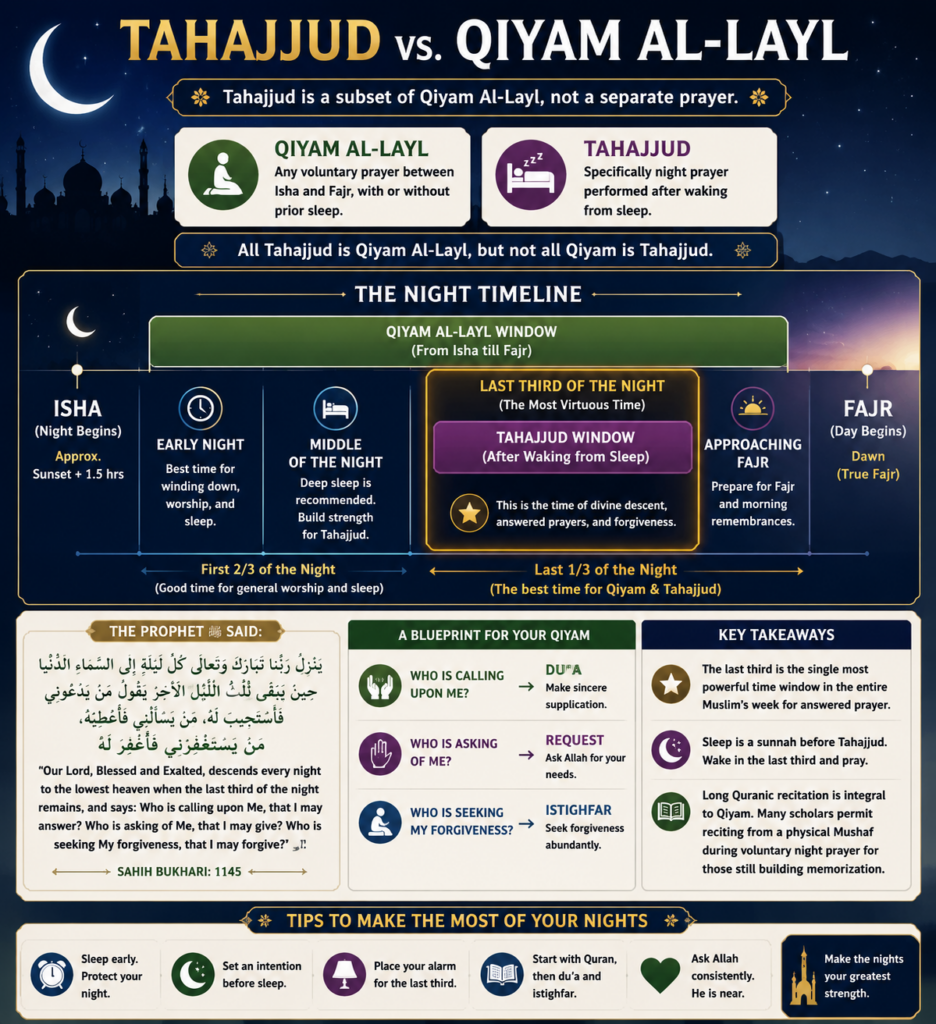
A. Tahajjud vs. Qiyam Al-Layl
Tahajjud is a subset of Qiyam Al-Layl, not a separate prayer. The distinction:
- Qiyam Al-Layl = any voluntary prayer between Isha and Fajr, with or without prior sleep
- Tahajjud = specifically night prayer performed after waking from sleep
All Tahajjud is Qiyam Al-Layl, but not all Qiyam is Tahajjud. The optimal time for both is the last third of the night. The Prophet ﷺ said:
“يَنْزِلُ رَبُّنَا تَبَارَكَ وَتَعَالَى كُلَّ لَيْلَةٍ إِلَى السَّمَاءِ الدُّنْيَا حِينَ يَبْقَى ثُلُثُ اللَّيْلِ الآخِرُ يَقُولُ: مَنْ يَدْعُونِي فَأَسْتَجِيبَ لَهُ، مَنْ يَسْأَلُنِي فَأُعْطِيَهُ، مَنْ يَسْتَغْفِرُنِي فَأَغْفِرَ لَهُ”
“Our Lord, Blessed and Exalted, descends every night to the lowest heaven when the last third of the night remains, and says: Who is calling upon Me, that I may answer? Who is asking of Me, that I may give? Who is seeking My forgiveness, that I may forgive?”— Sahih Bukhari: 1145
The three questions Allah asks — Who is calling? Who is asking? Who is seeking forgiveness? — map precisely to the three acts that define a productive Qiyam session: du’a, request, and istighfar. The hadith is essentially a blueprint for what to do in the last third of the night. The last third is the single most powerful time window in the entire Muslim’s week for answered prayer.
Long Quranic recitation is integral to Qiyam. Many scholars permit reciting from a physical Mushaf during voluntary night prayer for those still building memorization.
B. Tarawih Prayer in Ramadan
Tarawih is the collective night prayer performed in Ramadan after Isha and before Witr. It is a form of Qiyam Al-Layl specific to Ramadan, established by the Prophet ﷺ and organized into congregation by Umar ibn al-Khattab (may Allah be pleased with him). Key facts:
- Prayed in congregation at the mosque, or individually at home.
- Scholars differ on the number of Rakat: 8, 20, and 36 are all practiced, each with valid scholarly grounding.
- Always followed by Witr before Fajr.
Allah describes the character of those who sustain this practice in Surah Al-Dhariyat:
كَانُوا قَلِيلًا مِّنَ اللَّيْلِ مَا يَهْجَعُونَ ﴿١٧﴾ وَبِالْأَسْحَارِ هُمْ يَسْتَغْفِرُونَ ﴿١٨﴾
“They used to sleep but little of the night, and in the hours before dawn, they would seek forgiveness.”— Surah Al-Dhariyat, 51:17–18
This ayah describes the people of Paradise — not prophets, not scholars exclusively, but the general believers. Their distinguishing practice: minimal sleep, maximal pre-dawn istighfar. The phrase وَبِالْأَسْحَارِ — “in the hours of sahr (pre-dawn)” — is the same time the Prophet ﷺ identified as the window of Allah’s descent in Bukhari 1145.
The Quran and Sunnah are pointing to exactly the same moment. If there is one time window a Muslim should protect for voluntary worship, Surah Al-Dhariyat and Bukhari 1145 are both unanimous: it is the last third of the night.
Dhuha Prayer
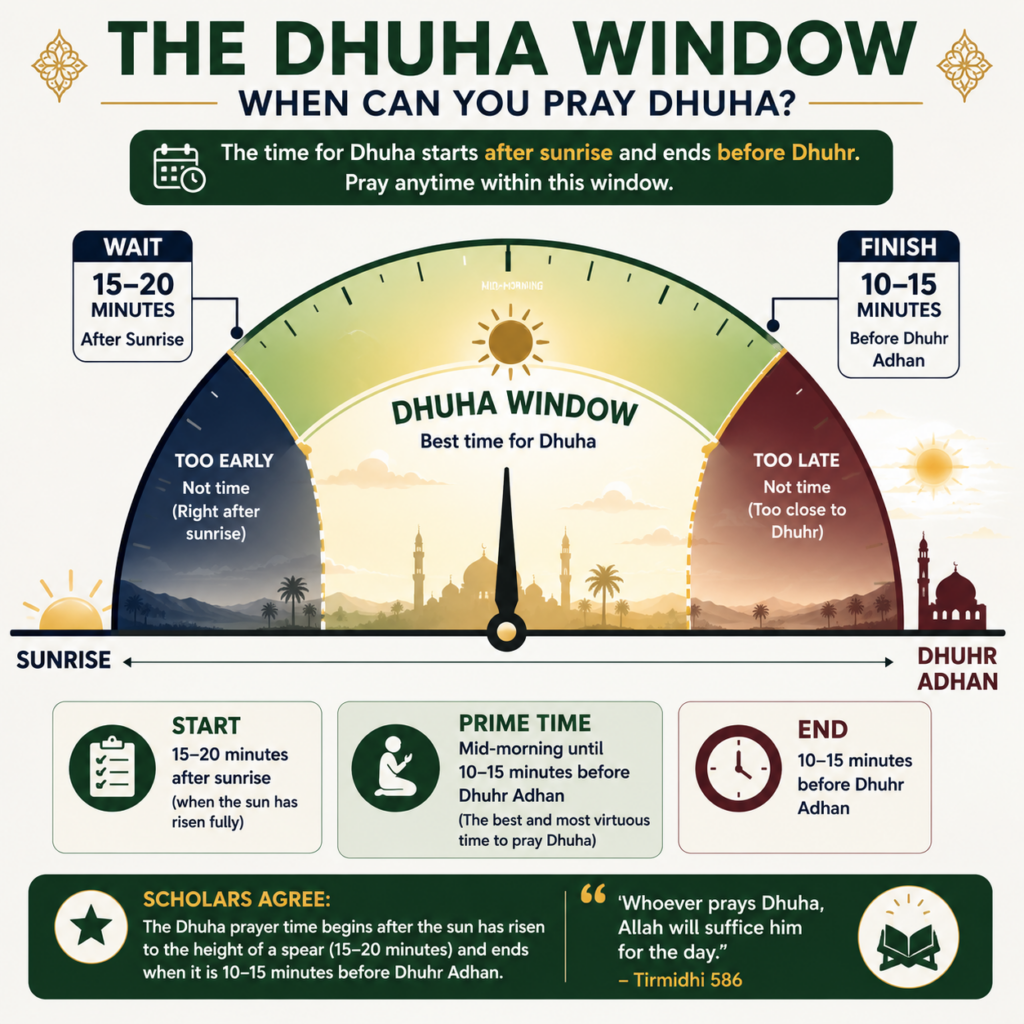
Dhuha prayer is the voluntary prayer performed after the sun has fully risen — approximately 15 to 20 minutes after sunrise — and before roughly 10 to 15 minutes prior to the Dhuhr Adhan. It is prayed in pairs of two Rakat, from a minimum of 2 to a maximum of 12.
The Prophet ﷺ gave Dhuha a remarkable daily standing:
“يُصْبِحُ عَلَى كُلِّ سُلاَمَى مِنْ أَحَدِكُمْ صَدَقَةٌ، فَكُلُّ تَسْبِيحَةٍ صَدَقَةٌ، وَكُلُّ تَحْمِيدَةٍ صَدَقَةٌ، وَكُلُّ تَهْلِيلَةٍ صَدَقَةٌ، وَكُلُّ تَكْبِيرَةٍ صَدَقَةٌ، وَأَمْرٌ بِالْمَعْرُوفِ صَدَقَةٌ، وَنَهْيٌ عَنِ الْمُنْكَرِ صَدَقَةٌ، وَيُجْزِئُ مِنْ ذَلِكَ رَكْعَتَانِ يَرْكَعُهُمَا مِنَ الضُّحَى”
“Every joint of a person must give charity each day the sun rises. Every Tasbih is charity, every Tahmid is charity, every Tahlil is charity, every Takbir is charity, every command of good is charity, every forbidding of evil is charity — and two Rakat of Dhuha serve in place of all that.”— Sahih Muslim: 720
The human body has 360 joints. According to this hadith, each of those 360 joints owes a daily charity — an act of gratitude for the movement it enables. The Prophet ﷺ then offers a complete substitute: 2 Rakat of Dhuha covers the entire debt.
This is not a minor concession — it is an extraordinary simplification of what would otherwise require 360 separate acts throughout the day. For anyone who feels burdened by the weight of daily worship, Dhuha prayer is the most efficient mercy in the Sunnah.
The Prophet ﷺ also named Dhuha with a specific honorific:
“صَلاَةُ الأَوَّابِينَ حِينَ تَرْمَضُ الْفِصَالُ”
“The prayer of the Awwabin (those who frequently return to Allah) is when the ground becomes scorching hot (mid-morning).”— Sahih Muslim: 748
الأَوَّابِينَ (Al-Awwabin) is derived from the root أَوَبَ — to return, again and again. It describes people who do not just repent once but who are in a constant state of turning back to Allah whenever they drift. The Prophet ﷺ naming Dhuha as their prayer is a character statement: the people who pray Dhuha are the people who stay close to Allah not only at the prescribed times but in the unscheduled middle of the day, when the world is fully awake and pulling their attention elsewhere.
And in a related narration:
“Every morning, alms are due for every joint… Two Rakat which one prays in the Duha serve instead of that.”— Sahih Abu Dawud: 1286
For anyone building a voluntary prayer habit for the first time, Dhuha is the most practical entry point: flexible time window, minimum of just 2 Rakat, and the most clearly articulated rewards of any optional prayer in the Sunnah.
Other Optional Prayers in Islam
Beyond the Rawatib and the major night and morning prayers, the Sunnah establishes several additional voluntary prayers tied to specific occasions. Each responds to a distinct moment in the believer’s day — completing the full picture of optional worship in Islam.
A. Salat al-Istikharah — Guidance Prayer
Salat al-Istikharah is two Rakat prayed when a Muslim faces a significant decision and needs Allah’s guidance. After the prayer, the Istikharah du’a is recited, asking Allah to facilitate the matter if it is good and divert the person from it if it is not.
A widespread misunderstanding worth addressing: Istikharah is not about waiting for a dream or an emotional sign. The guidance manifests through the unfolding of circumstances after the decision is made with sincere tawakkul (reliance on Allah). The action is to decide, then move, and watch what opens.
B. Tahiyyat al-Masjid — Greeting the Mosque
Tahiyyat al-Masjid is two Rakat prayed upon entering a mosque before sitting. The Prophet ﷺ instructed:
“إِذَا دَخَلَ أَحَدُكُمُ الْمَسْجِدَ فَلاَ يَجْلِسْ حَتَّى يُصَلِّيَ رَكْعَتَيْنِ”
“When one of you enters the mosque, let him not sit until he has prayed two Rakat.”— Sahih Bukhari: 1163
The phrasing فَلاَ يَجْلِسْ — “let him not sit” — is a gentle prohibition. The mosque is the house of Allah, and this prayer is an act of honoring that house before claiming a place in it. Scholars note that if the congregational prayer has already begun when you enter, joining it fulfills the Tahiyyat al-Masjid — no separate prayer is needed.
C. Salat al-Wudu — Prayer After Ablution
Two Rakat prayed immediately after completing wudu. This prayer is grounded in the practice of Bilal ibn Rabah (may Allah be pleased with him). When the Prophet ﷺ heard his footsteps ahead of him in Paradise and asked what deed brought him there, Bilal answered:
“مَا عَمِلْتُ عَمَلاً أَرْجَى عِنْدِي مِنْ أَنِّي لَمْ أَتَطَهَّرْ طَهُورًا تَامًّا فِي سَاعَةٍ مِنْ لَيْلٍ أَوْ نَهَارٍ إِلَّا صَلَّيْتُ بِذَلِكَ الطُّهُورِ مَا كُتِبَ لِي أَنْ أُصَلِّيَ”
“I never broke my wudu at any hour of the day or night without praying whatever was written for me to pray with that wudu.”— Riyad al-Salihin: 1146
Bilal’s answer is remarkable for what it is not: it is not fasting, not Quran memorization, not years of tahajjud. It is a simple, repeatable act — praying two Rakat every time wudu is made — performed with absolute consistency. Bilal did not do extraordinary things. He did an ordinary thing extraordinarily consistently. This is the model the Prophet ﷺ endorsed by recognizing it as the path to Paradise.
The Prophet ﷺ also linked this prayer to comprehensive forgiveness:
“مَنْ تَوَضَّأَ نَحْوَ وُضُوئِي هَذَا ثُمَّ صَلَّى رَكْعَتَيْنِ لاَ يُحَدِّثُ فِيهِمَا نَفْسَهُ غُفِرَ لَهُ مَا تَقَدَّمَ مِنْ ذَنْبِهِ”
“Whoever performs wudu as I have done, then prays two Rakat without letting his mind wander, Allah will forgive all his past sins.”— Sahih Bukhari: 1934
The condition لاَ يُحَدِّثُ فِيهِمَا نَفْسَهُ — “without letting his mind wander” — is worth dwelling on. This is a prayer of full presence: the person who completes wudu and immediately stands before Allah, mind undivided, earns complete forgiveness for all past sins.
This prayer requires no additional time commitment — it is built into the act of purification itself. The only barrier is intention and focus.
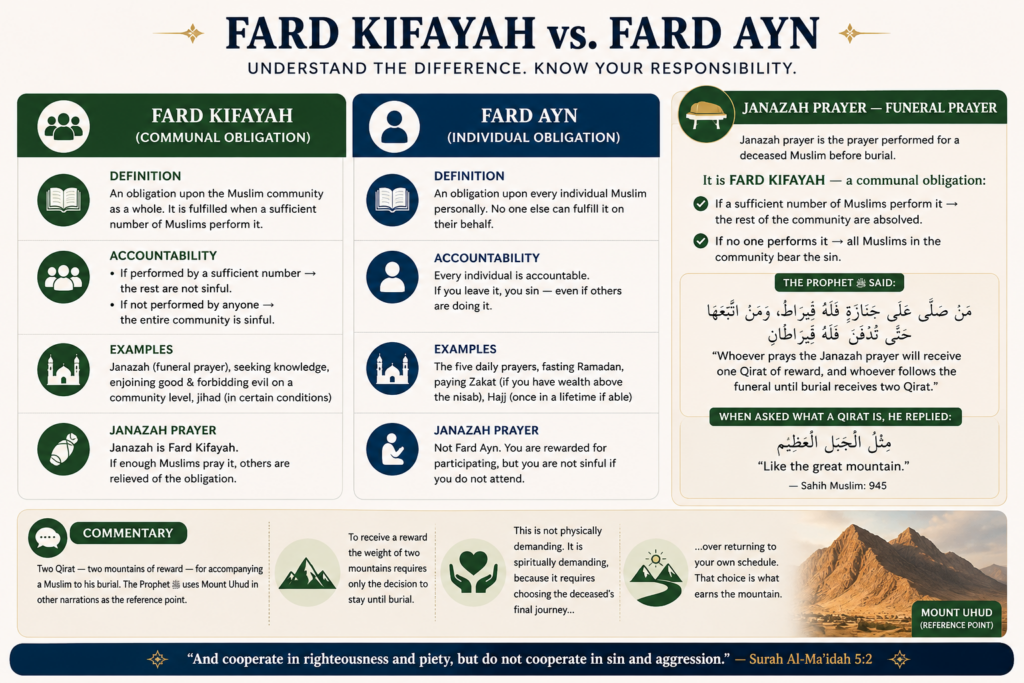
D. Janazah Prayer — Funeral Prayer
Janazah prayer is the prayer performed for a deceased Muslim before burial. Unlike all other prayers in this article, Janazah is Fard Kifayah — a communal obligation:
- If a sufficient number of Muslims perform it → the rest of the community are absolved
- If no one performs it → all Muslims in the community bear the sin
The Prophet ﷺ said:
“مَنْ صَلَّى عَلَى جَنَازَةٍ فَلَهُ قِيرَاطٌ، وَمَنِ اتَّبَعَهَا حَتَّى تُدْفَنَ فَلَهُ قِيرَاطَانِ””Whoever prays the Janazah prayer will receive one Qirat of reward, and whoever follows the funeral until burial receives two Qirat.” — Sahih al-Bukhari, Hadith 1325; Sahih Muslim, Hadith 945
When asked what a Qirat is, he replied:
“مِثْلُ الْجَبَلِ الْعَظِيمِ”
“Like the great mountain.”— Sahih Muslim: 945
Two Qirat — two mountains of reward — for accompanying a Muslim to his burial. The Prophet ﷺ uses Mount Uhud in other narrations as the reference point. To receive a reward the weight of two mountains requires only the decision to stay until burial.
This is not physically demanding. It is spiritually demanding, because it requires choosing the deceased’s final journey over returning to your own schedule. That choice is what earns the mountain.
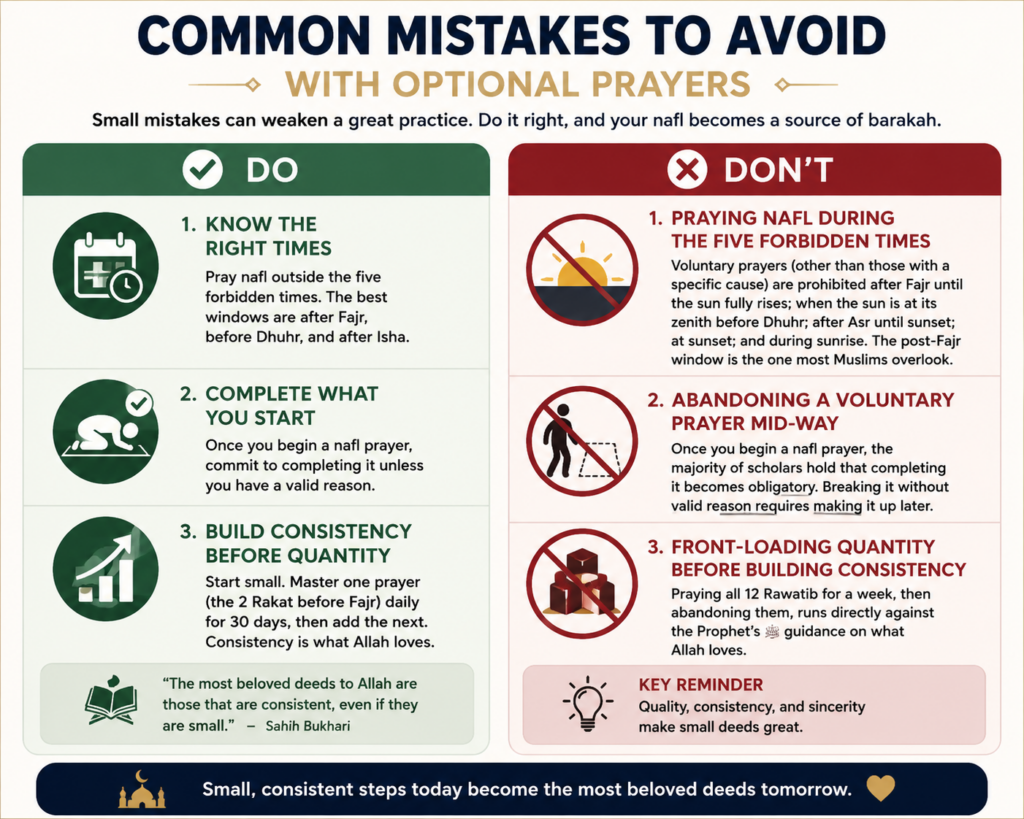
Common Mistakes to Avoid With Optional Prayers
These are the missteps scholars most frequently identify — and the ones most likely to undermine an otherwise solid voluntary prayer practice:
- Praying nafl during the five forbidden times. Voluntary prayers — other than those with a specific cause, like Tahiyyat al-Masjid — are prohibited after Fajr until the sun fully rises; when the sun is at its exact zenith before Dhuhr; after Asr until sunset; at the moment of sunset; and during sunrise. The post-Fajr window is the one most Muslims overlook.
- Abandoning a voluntary prayer mid-way. Once you begin a nafl prayer, the majority of scholars hold that completing it becomes obligatory. Breaking it without valid reason requires making it up later.
- Front-loading quantity before building consistency. Praying all 12 Rawatib for a week, then abandoning them, runs directly against the Prophet’s ﷺ guidance on what Allah loves. Establish a single prayer — the 2 Rakat before Fajr — and make it daily for 30 days before adding the next.
Deepen Your Quran Connection — Start with a Free Trial at Riwaq Al Quran
Your optional prayers — especially Qiyam Al-Layl and Tarawih — are only as deep as your relationship with the Quran. When recitation is strong, night prayer stops being an exercise and becomes a conversation.
At Riwaq Al Quran, students of all levels — from absolute beginners to those pursuing Ijazah — learn directly with native Arabic-speaking instructors in live, one-on-one online sessions, for all ages, on a schedule that works around your life.
Watch real moments from our live sessions at Riwaq Al Quran and see how we bring learning to life:
What do you want to achieve? Browse by goal
I want to read Quran correctly:
→ Noorani Qaida Online — build fluent Quranic reading from scratch with a structured foundation course
→ Online Quran Recitation Course — improve accuracy and flow with expert-led guidance
→ Online Tajweed Classes — master the rules of Tajweed for correct, beautiful recitation
I want to memorize and go deeper:
→ Quran Memorization Online Course — structured Hifz with Tajweed integrated throughout
→ Online Tafseer Course — understand the meanings and context behind the verses
→ Online Qirat Course — explore the ten authentic styles of Quranic recitation
I want to learn with my child:
→ Online Quran Classes for Kids — interactive, age-appropriate Quran learning designed for children
→ Browse the full kids’ curriculum across all age groups
I want to go further in Islamic sciences:
→ Online Ijazah courses — earn a certified chain of transmission in Quranic recitation
→ Online Arabic courses — learn the language of the Quran directly
→ Online Islamic Studies courses — deepen your knowledge across Islamic sciences


Conclusion
Optional prayers in Islam form a complete, layered system — the 12 daily Rawatib Sunnah Rakat anchor every prayer time; Witr closes each night; Qiyam Al-Layl and Tarawih give structure to night worship; Dhuha opens the morning with reward; and prayers like Istikharah, Tahiyyat al-Masjid, Salat al-Wudu, and Janazah respond to the specific circumstances of daily life.
The taxonomy is what makes this actionable: Sunnah Muakkadah prayers come first, starting with the 2 Rakat before Fajr. Once those are consistent, build the remaining Rawatib. Then add Witr with care for its timing relative to Tahajjud. Layer in Dhuha and Qiyam as your practice matures.
The single principle that runs through every optional prayer in Islam is consistency. Small deeds, repeated daily, are the most beloved to Allah. Begin with one prayer, hold it, then let it grow.
Frequently Asked Questions
The questions below address what readers most commonly search about optional prayers in Islam — from the basics of what they are to the finer rulings on specific prayer types and timing.
What are optional prayers in Islam?
Optional prayers in Islam are voluntary prayers performed in addition to the five obligatory daily prayers. They include the Sunnah Rawatib prayers, Witr, Qiyam Al-Layl, Dhuha, and occasion-based prayers such as Istikharah and Tahiyyat al-Masjid. They are not required but earn reward and bring the believer closer to Allah, as confirmed in Hadith Qudsi Sahih Bukhari: 6502.
Which optional prayer is the most important in Islam?
The 2 Rakat before Fajr are the most emphasized optional prayer in Islam — the Prophet ﷺ described them as better than the world and everything in it (Sahih Muslim: 725) and almost never abandoned them. Witr is equally emphasized, particularly in the Hanafi school where it is classified as Wajib.
What is the difference between Sunnah and Nafl prayers?
Sunnah prayers are voluntary prayers practiced by the Prophet Muhammad ﷺ with varying regularity: Sunnah Muakkadah (almost never abandoned) and Sunnah Ghair Muakkadah (performed sometimes, omitted at others). Nafl prayers are any additional voluntary prayers with no specific occasion — performed at any permitted time purely for additional reward.
Is Witr prayer obligatory or optional?
Witr is Sunnah Muakkadah according to the Maliki, Shafi’i, and Hanbali schools — strongly emphasized but not obligatory. The Hanafi school classifies it as Wajib, one level below Fard. All four major schools agree it should be maintained consistently and not abandoned without reason.
Can I pray nafl at any time of day?
No. Voluntary prayers are prohibited during five specific windows: after Fajr until the sun fully rises; when the sun is exactly at its zenith before Dhuhr; after Asr until Maghrib; at sunset; and during sunrise. Prayers with a specific cause — such as Tahiyyat al-Masjid upon entering a mosque — are exempt from some of these restrictions according to many scholars.
How many Rakat is Dhuha prayer?
Dhuha prayer is a minimum of 2 Rakat and a maximum of 12 Rakat, always prayed in pairs of two. The time window begins approximately 15 to 20 minutes after sunrise and closes roughly 10 to 15 minutes before the Dhuhr Adhan.