The five prayers in Islam, known collectively as Salah, are the fixed acts of worship that structure a Muslim’s entire day. Whether you’re new to Islam, teaching a child their first prayers, or want a clear, sourced answer to how many prayers Muslims perform daily, this guide breaks down each one by name, time, and structure — backed directly by the Quran and authentic hadith, not just summary claims.
You’ll find Salah Al-Fajr, Al-Dhuhr, Al-Asr, Al-Maghrib, and Al-Isha explained individually below, followed by the Quranic and prophetic evidence behind fixed prayer times, the mistakes that most often break a prayer habit, and what to do if you miss a prayer or need to travel.
What You’ll Learn in This Article
- The name, Arabic meaning, and time window of each of the five daily prayers.
- How many rakats each prayer contains and whether its recitation is silent or aloud.
- The Quranic verses and authentic hadiths behind each prayer’s timing and virtue, each linked to its original source.
- The most common mistakes that break prayer consistency, and how to fix them.
- What to do if you miss a prayer, or how to combine and shorten prayers while traveling.
Table of Contents
What Are the 5 Daily Prayers in Islam?
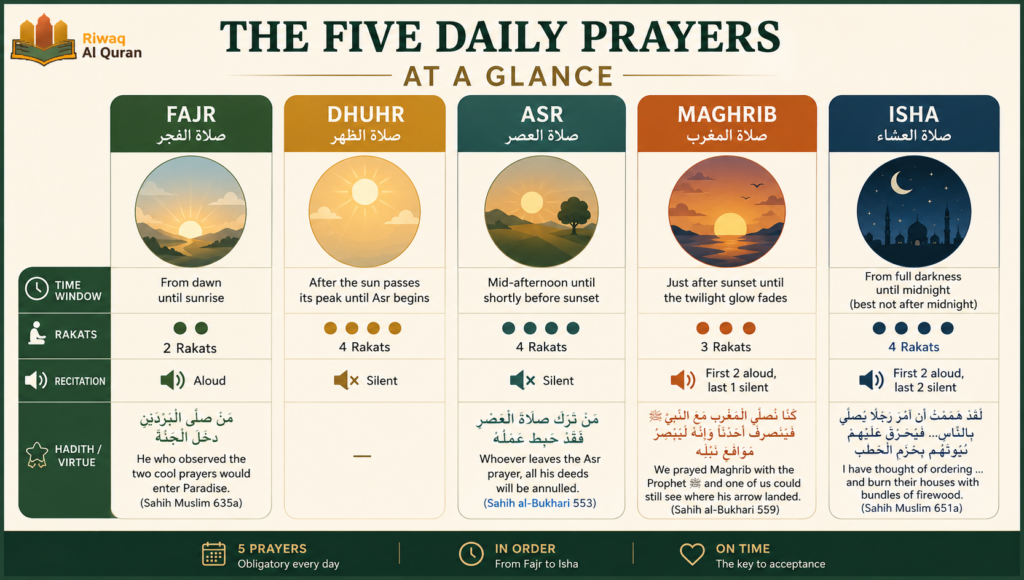
The five daily prayers in Islam are Salah Al-Fajr, Al-Dhuhr, Al-Asr, Al-Maghrib, and Al-Isha. Each one falls inside a window tied to the sun’s position rather than a fixed clock time, which is why prayer times shift slightly every day of the year.
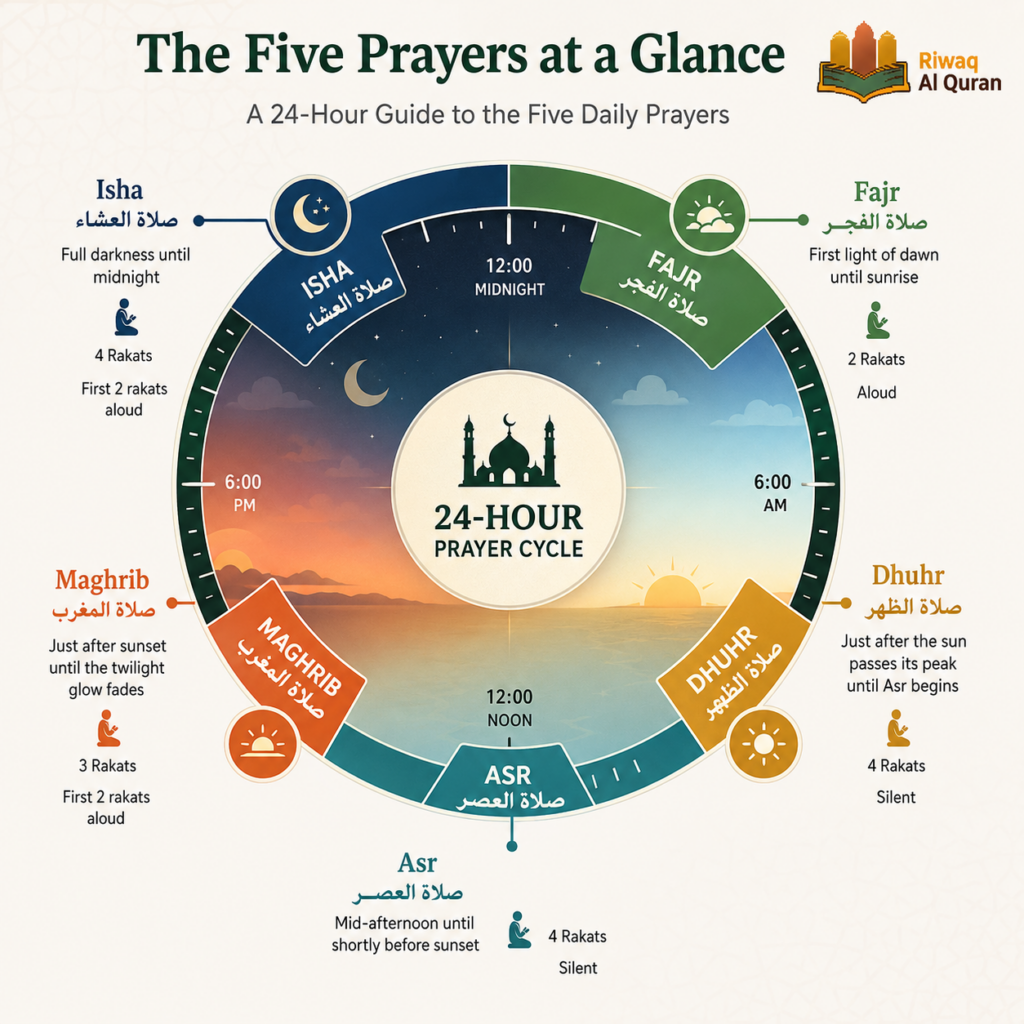
The Five Prayers at a Glance
Before looking at each prayer individually, here is how the five compare side by side.
| Prayer | Arabic | Time window | Rakats | Recitation |
|---|---|---|---|---|
| Fajr | صلاة الفجر | First light of dawn until sunrise | 2 | Aloud |
| Dhuhr | صلاة الظهر | Just after the sun passes its peak until Asr begins | 4 | Silent |
| Asr | صلاة العصر | Mid-afternoon until shortly before sunset | 4 | Silent |
| Maghrib | صلاة المغرب | Just after sunset until the twilight glow fades | 3 | First 2 rakats aloud |
| Isha | صلاة العشاء | Full darkness until midnight | 4 | First 2 rakats aloud |
Salah is the second of Islam’s five pillars — this short clip places it in that wider context.
Why the Five Prayers Are Fixed at These Times
The Quran describes prayer as a duty tied to specific times, not a routine you schedule around your day. Three verses together lay out the basis for this:
“فَإِذَا قَضَيْتُمُ ٱلصَّلَوٰةَ فَٱذْكُرُوا۟ ٱللَّهَ قِيَـٰمًۭا وَقُعُودًۭا وَعَلَىٰ جُنُوبِكُمْ ۚ فَإِذَا ٱطْمَأْنَنتُمْ فَأَقِيمُوا۟ ٱلصَّلَوٰةَ ۚ إِنَّ ٱلصَّلَوٰةَ كَانَتْ عَلَى ٱلْمُؤْمِنِينَ كِتَـٰبًۭا مَّوْقُوتًۭا”
“Indeed, performing prayer is a duty on the believers at appointed times.”(Surah An-Nisa 4:103)
This verse is the direct textual basis for treating Salah as time-bound rather than optional — the phrase “kitaban mawquta” (a decree of fixed times) is why scholars rule that a prayer performed outside its window, without a valid excuse, is not the same act of worship as one performed on time.
“أَقِمِ ٱلصَّلَوٰةَ لِدُلُوكِ ٱلشَّمْسِ إِلَىٰ غَسَقِ ٱلَّيْلِ وَقُرْءَانَ ٱلْفَجْرِ ۖ إِنَّ قُرْءَانَ ٱلْفَجْرِ كَانَ مَشْهُودًۭا”
“Establish prayer from the decline of the sun until the darkness of the night, and [also] the dawn recitation — indeed, the dawn recitation is witnessed.”(Surah Al-Isra 17:78)
Between this verse and the one above, four of the five prayer windows are already outlined: from the sun’s decline (Dhuhr) through the darkness of night (covering Asr, Maghrib, and Isha), with Fajr named separately as “the dawn recitation.”
“حَـٰفِظُوا۟ عَلَى ٱلصَّلَوَٰتِ وَٱلصَّلَوٰةِ ٱلْوُسْطَىٰ وَقُومُوا۟ لِلَّهِ قَـٰنِتِينَ”
“Observe the ˹five obligatory˺ prayers — especially the middle prayer — and stand in true devotion to Allah.”(Surah Al-Baqarah 2:238)
This verse singles out one prayer, “Al-Wusta” (the middle prayer), for special emphasis. Most classical commentators identify it as Asr — a point that matters practically, since it explains why Asr carries some of the strongest warnings in the hadith literature, covered further down in this guide
Reading these verses in Arabic is different from reading a translation — the wording carries legal weight that translations only approximate. If you’ve ever wanted to follow along in the original text instead of relying on someone else’s summary, Riwaq Al Quran’s Quran and Tajweed classes teach you to read exactly this kind of verse with a native tutor, one live session at a time.
The Five Daily Prayers Explained One by One
Each of the five prayers has its own name, timing logic, rakat count, and — for several of them — a specific hadith describing its virtue or the warning attached to neglecting it. Here they are in the order they’re prayed through the day.
1. Salah Al-Fajr as the Dawn Prayer
Fajr means “dawn” and opens the day before sunrise, when the first light appears on the horizon.
- Timing: starts at true dawn and ends at sunrise. Once the sun begins to rise, the window closes and the prayer must wait until the next day.
- Structure: two rakats, and it’s recommended to recite longer surahs than in other prayers.
- Recitation: aloud — loud enough for anyone praying behind the imam to hear, or for you to hear yourself clearly if praying alone.
“مَنْ صَلَّى الْبَرْدَيْنِ دَخَلَ الْجَنَّةَ”
“He who observed the two cool prayers would enter Paradise.” (Sahih Muslim 635a)
“Al-Bardayn” (the two cool prayers) refers to Fajr and Asr, prayed at the cooler edges of the day. This hadith is one of the most frequently cited reasons these two specific prayers are singled out for extra caution against missing or delaying them.
2. Salah Al-Dhuhr as the Midday Prayer
Dhuhr refers to the time just after noon, when the sun has passed its highest point and shadows begin lengthening again.
- Timing: begins once the sun passes the middle of the sky and ends when Asr time starts.
- Structure: four rakats — a Tashahhud after the first two, then two more rakats with Al-Fatiha only.
- Recitation: silent. You should hear your own words, but the person beside you shouldn’t. Only the transitions between movements are said aloud by the imam so the congregation can follow.
3. Salah Al-Asr As The Afternoon Prayer
Asr covers the stretch of afternoon before sunset, once an object’s shadow roughly matches its own length.
- Timing: runs until sunset, but it’s recommended to pray it at least half an hour before sunset if it gets delayed — scholars caution against pushing it right to the edge of the window.
- Structure and recitation: four rakats, silent — structurally identical to Dhuhr.
“مَنْ تَرَكَ صَلَاةَ الْعَصْرِ فَقَدْ حَبِطَ عَمَلُهُ”
“Whoever leaves the Asr prayer, all his deeds will be annulled.”(Sahih al-Bukhari 553)
This is one of the sharpest warnings attached to any single prayer in the hadith corpus, and it lines up directly with Asr’s likely identity as the “middle prayer” singled out in Surah Al-Baqarah 2:238 above.
“تِلْكَ صَلَاةُ الْمُنَافِقِ، يَجْلِسُ يَرْقُبُ الشَّمْسَ حَتَّى إِذَا كَانَتْ بَيْنَ قَرْنَيِ الشَّيْطَانِ قَامَ فَنَقَرَهَا أَرْبَعًا، لَا يَذْكُرُ اللَّهَ فِيهَا إِلَّا قَلِيلًا”
“This is how the hypocrite prays: he sits watching the sun, and when it is between the horns of the devil, he rises and strikes the ground four times, mentioning Allah only a little.”(Sahih Muslim 622)
This hadith describes someone who technically prays Asr but only at the very last moment, rushed and distracted — a direct, sourced description of the exact habit this guide’s “common mistakes” section warns against further down.
4. Salah Al-Maghrib As The Sunset Prayer
Maghrib means “sunset” and is the only one of the five prayers with an odd number of rakats.
- Timing: begins right after sunset and lasts until the twilight afterglow disappears from the sky.
- Structure: three rakats. The first two are recited aloud, and the third — after the Tashahhud — is silent.
- Recitation habit: short surahs are commonly recited, since Maghrib also marks the end of the fasting day, when the fast is broken at the Maghrib call to prayer.
“كُنَّا نُصَلِّي الْمَغْرِبَ مَعَ النَّبِيِّ صلى الله عليه وسلم فَيَنْصَرِفُ أَحَدُنَا وَإِنَّهُ لَيُبْصِرُ مَوَاقِعَ نَبْلِهِ”
“We used to pray Maghrib with the Prophet ﷺ, and afterward one of us could still see where his arrow landed [when shot].”(Sahih al-Bukhari 559)
The companion Rafi’ bin Khadij is describing how early Maghrib was prayed — there was still enough daylight left to see where a shot arrow fell. This is the practical, first-hand basis for praying Maghrib immediately at sunset rather than waiting.
5. Salah Al-Isha As The Night Prayer
Isha refers to the point when all daylight has fully disappeared.
- Timing: technically extends to Fajr, but it’s best not to delay it past midnight.
- Structure and recitation: four rakats. Unlike Dhuhr or Asr, the first two rakats are recited aloud, while the last two are silent — the reverse pattern of a fully silent prayer.
“لَقَدْ هَمَمْتُ أَنْ آمُرَ رَجُلًا يُصَلِّي بِالنَّاسِ، ثُمَّ أُخَالِفَ إِلَى رِجَالٍ يَتَخَلَّفُونَ عَنْهَا، فَآمُرَ بِهِمْ فَيُحَرِّقَ عَلَيْهِمْ بِحُزَمِ الْحَطَبِ بُيُوتَهُمْ، وَلَوْ عَلِمَ أَحَدُهُمْ أَنَّهُ يَجِدُ عَظْمًا سَمِينًا لَشَهِدَهَا”
“I have thought of ordering someone to lead the people in prayer, and then go to the houses of those who stay away from it and burn their houses down with bundles of firewood — if any of them knew he would find a fat, fleshy bone, he would attend it.” (Referring to Isha prayer.)
(Sahih Muslim 651a)
Scholars read this as emphatic rhetorical language, not a literal instruction — the Prophet ﷺ never ordered any house burned. The point is the intensity of the warning: staying away from congregational Isha was treated as a sign of hypocrisy, precisely because it’s one of the two prayers easiest to skip when no one is watching.
How Many Prayers Are There in Islam?
There are many types of prayers in Islam, but the five daily prayers are the only ones mandatory for every Muslim. Beyond these five, there are the optional sunnah prayers as well.
The number five has a specific, narrated origin. It was supposed to be fifty prayers originally, reduced step by step down to five:
- 50 prayers first commanded
- Reduced to 40
- Reduced to 30
- Reduced to 20
- Reduced to 10
- Reduced to 5 — with the reward of 50 kept in place
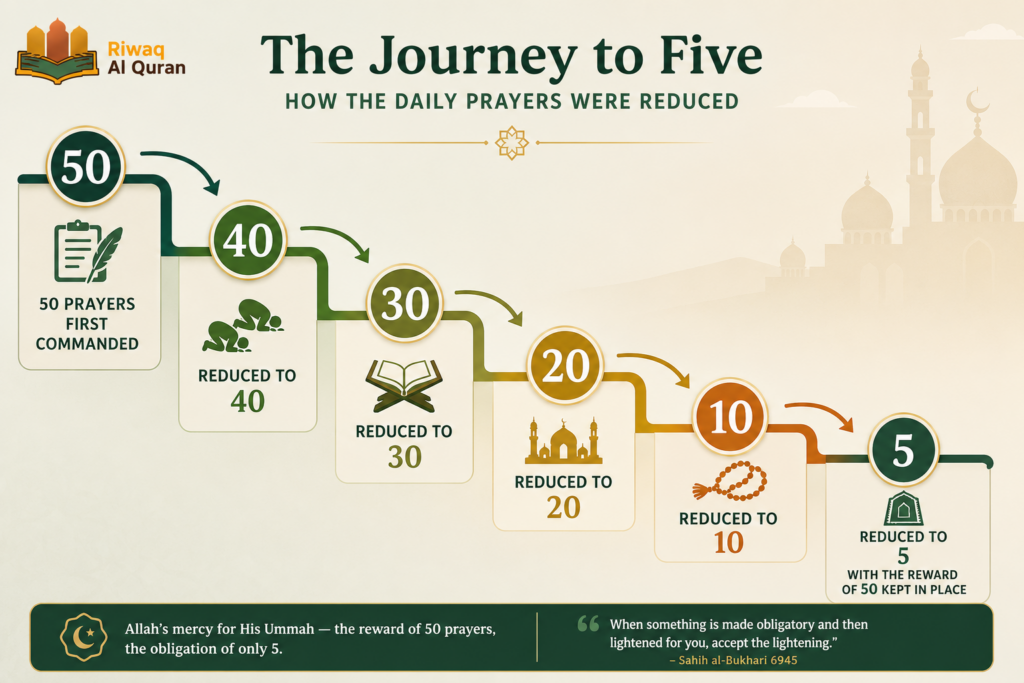
“ثُمَّ فُرِضَتْ عَلَيَّ الصَّلَوَاتُ خَمْسِينَ صَلَاةً كُلَّ يَوْمٍ… فَرَجَعْتُ فَأُمِرْتُ بِخَمْسِ صَلَوَاتٍ كُلَّ يَوْمٍ… نَادَى مُنَادٍ: أَمْضَيْتُ فَرِيضَتِي وَخَفَّفْتُ عَنْ عِبَادِي”
“Then the prayers were made obligatory upon me: fifty prayers each day… I returned and was ordered [instead] to observe five prayers each day… A voice called out: ‘I have passed My decree and lightened the burden on My worshippers.'”(Sahih al-Bukhari 3887, excerpted)
This is from the long narration of Isra and Mi’raj: fifty prayers were first commanded, then reduced to five after the Prophet ﷺ repeatedly appealed on his followers’ behalf, while the reward for the five was kept equal to that of fifty. The fuller account of the five prayers’ individual timings is recorded in Sunan an-Nasa’i 502.
Why Are the Five Daily Prayers Mandatory in Islam?
Salah holds a distinct place among Islamic obligations: it’s the one commanded directly, during the Prophet’s night journey, rather than revealed gradually like most other rulings. Two things explain why it carries this weight.
1. The Night Journey (Isra and Mi’raj)
In the account above (Sahih al-Bukhari 3887), the Prophet Muhammad ﷺ was taken from Makkah to Jerusalem and then ascended through the heavens, where the command to pray was given directly, face to face, rather than through the usual channel of revelation. That direct, in-person command is part of why Salah carries such weight in Islamic practice.
2. The Spiritual Purpose Behind the Five Prayers
Beyond the reward tied to specific prayers, one hadith explains what the five prayers actually do for a person, day after day.
“الصَّلَوَاتُ الْخَمْسُ وَالْجُمُعَةُ إِلَى الْجُمُعَةِ كَفَّارَاتٌ لِمَا بَيْنَهُنَّ”
“The five prayers, and one Friday prayer to the next, are expiations for whatever [sins] fall between them.”(Sahih Muslim 233b)
This hadith frames the five prayers as recurring resets, not just checkpoints — each prayer is described as clearing the accumulated minor faults of the hours before it, on the condition that major sins are avoided. It’s the clearest authentic basis for describing Salah as five daily anchors rather than five daily obligations.
Common Mistakes That Break Prayer Consistency
Most people who struggle to keep all five prayers aren’t failing from lack of belief — they’re tripped up by a handful of avoidable habits.
1. Delaying Asr and Isha Until the Last Minute
Asr and Isha have the widest windows, which makes them the easiest to push back and the easiest to lose entirely once the window closes — the exact pattern described in the “hypocrite’s prayer” hadith cited earlier (Sahih Muslim 622).
To fix it, treat the recommended earlier time as the real deadline, rather than the technical cutoff.
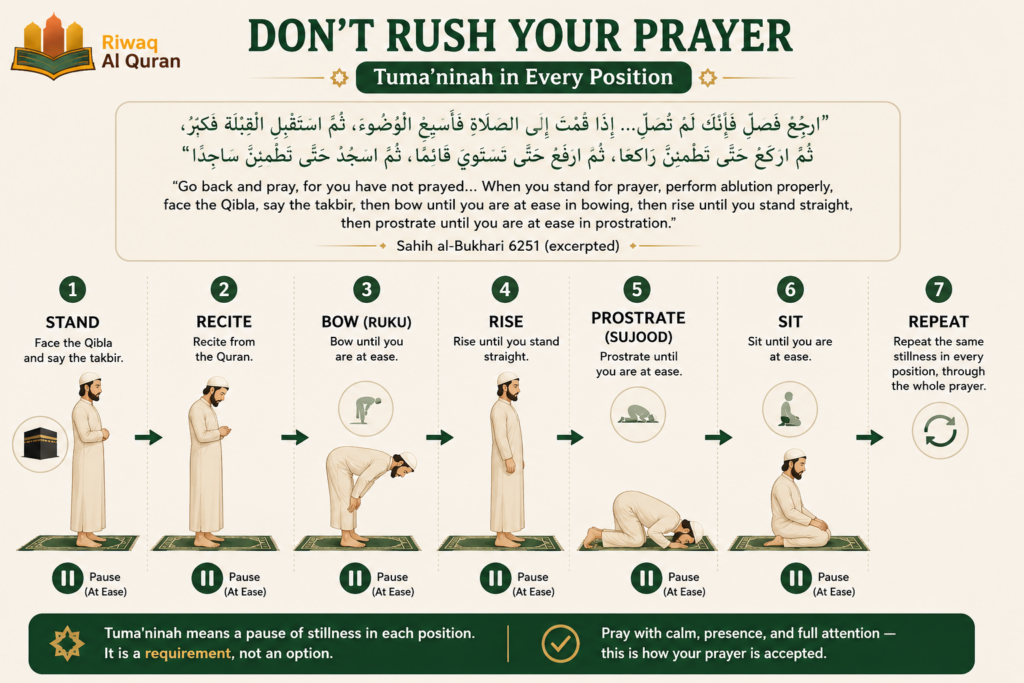
2. Rushing Through Rakats Without Settling (Tuma’ninah)
An authentic hadith records the Prophet ﷺ correcting this exact mistake in a companion, three times in a row:
“ارْجِعْ فَصَلِّ فَإِنَّكَ لَمْ تُصَلِّ… إِذَا قُمْتَ إِلَى الصَّلَاةِ فَأَسْبِغِ الْوُضُوءَ، ثُمَّ اسْتَقْبِلِ الْقِبْلَةَ فَكَبِّرْ، ثُمَّ ارْكَعْ حَتَّى تَطْمَئِنَّ رَاكِعًا، ثُمَّ ارْفَعْ حَتَّى تَسْتَوِيَ قَائِمًا، ثُمَّ اسْجُدْ حَتَّى تَطْمَئِنَّ سَاجِدًا”
“Go back and pray, for you have not prayed… When you stand for prayer, perform ablution properly, face the Qibla, say the takbir, then bow until you are at ease in bowing, then rise until you stand straight, then prostrate until you are at ease in prostration.”(Sahih al-Bukhari 6251, excerpted)
In this hadith, a man prayed in the mosque, greeted the Prophet ﷺ, and was told three times to go back and pray again — because he had rushed through the movements. The sequence the Prophet ﷺ taught him breaks down as:
- Perform wudu properly.
- Face the Qibla and say the takbir.
- Recite from the Quran.
- Bow (ruku) and pause until at ease.
- Rise to a full standing position.
- Prostrate (sujood) and pause until at ease.
- Repeat the same stillness in every position, through the whole prayer.
“Tuma’ninah,” the pause of stillness in each position, is what the man was missing, and many scholars treat it as a requirement, not an option. This hadith is the direct authentic source for that ruling, not just a general principle.
3. Skipping Wudu Checks or Facing the Wrong Qibla
Both wudu and Qibla direction are addressed directly in the Quran, not left to convention.
“يَـٰٓأَيُّهَا ٱلَّذِينَ ءَامَنُوٓا۟ إِذَا قُمْتُمْ إِلَى ٱلصَّلَوٰةِ فَٱغْسِلُوا۟ وُجُوهَكُمْ وَأَيْدِيَكُمْ إِلَى ٱلْمَرَافِقِ وَٱمْسَحُوا۟ بِرُءُوسِكُمْ وَأَرْجُلَكُمْ إِلَى ٱلْكَعْبَيْنِ”
“O believers! When you rise up for prayer, wash your faces and your hands up to the elbows, wipe your heads, and wash your feet to the ankles.”
(Surah Al-Ma’idah 5:6)
This verse is the direct textual basis for wudu as a precondition of every prayer:
- Wash the face.
- Wash the hands and arms to the elbows.
- Wipe the head.
- Wash the feet to the ankles.
Confirming intact wudu isn’t a formality — it’s a stated requirement in the same verse that establishes prayer itself.
“قَدْ نَرَىٰ تَقَلُّبَ وَجْهِكَ فِى ٱلسَّمَآءِ ۖ فَلَنُوَلِّيَنَّكَ قِبْلَةًۭ تَرْضَىٰهَا ۚ فَوَلِّ وَجْهَكَ شَطْرَ ٱلْمَسْجِدِ ٱلْحَرَامِ”
“We see you ˹O Prophet˺ turning your face towards heaven. Now We will make you turn towards a direction that will please you. So turn your face towards the Sacred Mosque.”
(Surah Al-Baqarah 2:144)
This verse fixed the Qibla toward the Ka’bah in Makkah for every Muslim, everywhere. Confirming direction takes seconds with a compass app, but skipping this step under time pressure — especially somewhere unfamiliar — is a frequent, easily fixed error.
What to Do If You Miss a Prayer or Are Traveling
Missing a prayer or needing to adjust for travel isn’t a break in the system — Islamic practice has specific, well-established, textually sourced provisions for both.
1. Making Up a Missed Prayer (Qada)
The ruling on a forgotten prayer comes from a specific hadith, not general practice.
“مَنْ نَسِيَ صَلَاةً فَلْيُصَلِّ إِذَا ذَكَرَهَا، لَا كَفَّارَةَ لَهَا إِلَّا ذَلِكَ”
“If anyone forgets a prayer, he should pray it when he remembers it. There is no expiation for it except that.”(Sahih al-Bukhari 597)
After narrating this, the Prophet ﷺ recited the following verse as its basis:
“إِنَّنِىٓ أَنَا ٱللَّهُ لَآ إِلَـٰهَ إِلَّآ أَنَا۠ فَٱعْبُدْنِى وَأَقِمِ ٱلصَّلَوٰةَ لِذِكْرِىٓ”
“It is truly I. I am Allah! There is no god worthy of worship except Me. So worship Me alone, and establish prayer for My remembrance.”(Surah Taha 20:14)
Together, the verse and the hadith give a complete, sourced answer: pray the missed prayer as soon as you remember, in its full original form, and continue with your next scheduled prayer.
2. Combining and Shortening Prayers While Traveling
While traveling a qualifying distance, the following concessions apply:
- Dhuhr and Asr can be combined, at either one’s time.
- Maghrib and Isha can be combined, at either one’s time.
- The four-rakat prayers — Dhuhr, Asr, and Isha — can be shortened to two rakats each.
- Fajr and Maghrib are never shortened, and are not combined with a different-rakat prayer.
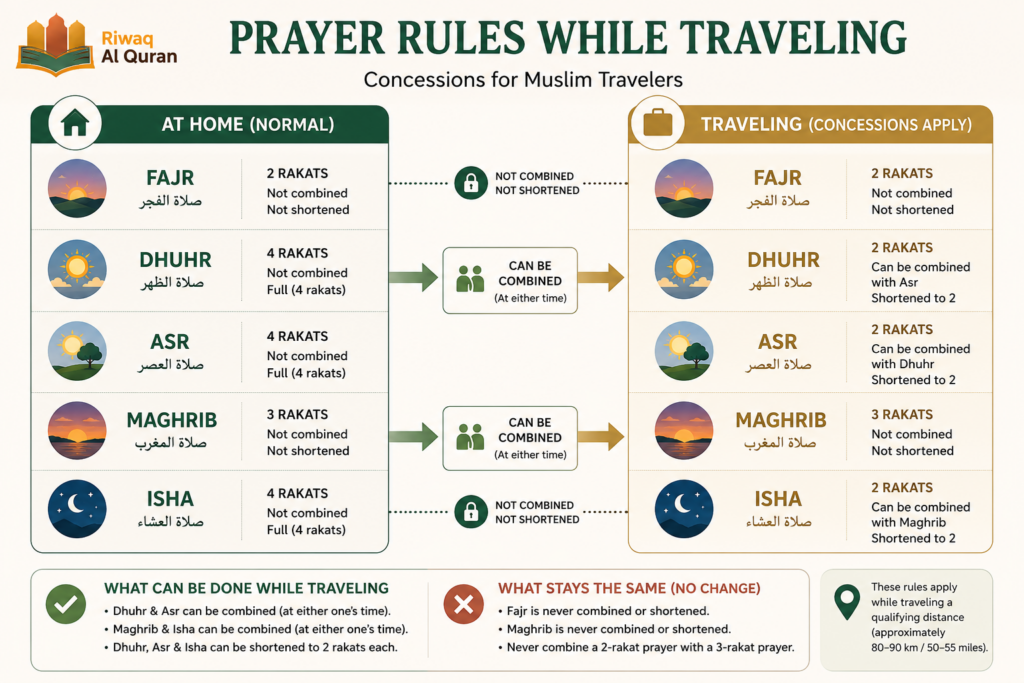
This concession is a well-established, widely agreed-upon rule across the schools of Islamic jurisprudence, built specifically to prevent travel from becoming a reason to miss prayer altogether.
Tips to Stay Consistent With the Five Daily Prayers
Consistency comes from habit-building, not willpower alone. Committing to the five daily prayers works best as a set of small, repeatable habits rather than one big resolution.
1. Set a Time-Bound Personal Challenge: Commit to all five prayers for a fixed stretch — 30 or 40 days — rather than an open-ended promise. A defined endpoint makes the habit easier to start and easier to measure.
2. Focus on One Prayer at a Time: Rather than tracking a perfect month in your head, focus only on the prayer directly in front of you. This prevents the overwhelm that causes people to give up after a single missed prayer.
3. Pray Alongside Supportive Company: Praying near people with the same commitment creates accountability that’s hard to build alone, especially in the first weeks of a new habit.
4. Learn Arabic to Understand What You’re Reciting: If the words of Al-Fatiha or the surahs you recite are memorized sound without meaning, the prayer stays mechanical. Learning even basic Quranic Arabic — starting with reading the Quran itself — changes what those five daily moments feel like.


Riwaq Al Quran’s Arabic courses are built around exactly this — reading and understanding the words you already say five times a day, not starting Arabic from an unrelated textbook.
5. Study the Meaning of the Quranic Verses You Recite: Beyond the language itself, understanding what a verse means — its context and its message — turns recitation into reflection. A short Tafsir session on the surahs you already recite in Salah does more for consistency than any productivity trick.
Learn Quran, Arabic, and Islamic Studies Online With Riwaq Al Quran
Riwaq Al Quran is a comprehensive online platform that offers personalized Quran, Arabic, and Islamic Studies classes for individuals of all ages and backgrounds. Their experienced instructors use a structured curriculum covering Tajweed, Tafsir, and Memorization, giving students easy and effective access to learning the Quran.
Here’s a sample of the courses most relevant to what this guide covers:
| Course | What you’ll get |
|---|---|
| Online Tafseer Course | Explore Quranic meanings in depth, guided by an instructor |
| Noorani Qaida Online | Learn the Quranic reading basics, from the ground up |
| Online Quran Recitation Course | Build accurate, confident recitation with expert-led guidance |
| Online Tajweed Classes | Master correct pronunciation for beautiful recitation |
| Quran Memorization Course | Memorize the Quran with a specialized, structured plan |

Conclusion
The five daily prayers in Islam — Fajr, Dhuhr, Asr, Maghrib, and Isha — are fixed acts of worship, not a flexible routine. Each has its own time window, rakat count, and recitation style, and each is backed directly by the Quran and authentic hadith rather than tradition alone.
Two prayers carry the sharpest warnings for a reason. Asr is widely held to be the “middle prayer” singled out in Surah Al-Baqarah, which is why missing it is described as annulling a person’s deeds. Isha is the prayer most associated in hadith with the gap between sincere practice and empty habit, since it’s the easiest one to skip when no one is watching.
Missing a prayer or traveling doesn’t break the system. Qada and the rules for combining and shortening prayers exist precisely for those situations, each with its own textual basis — Islam accounts for real life, it doesn’t just demand perfection from it.
What actually separates people who keep all five prayers from those who drift is rarely belief. It’s a handful of avoidable habits: delaying Asr and Isha until the last minute, rushing through rakats without tuma’ninah, or reciting words without understanding what they mean.
Get those three things right, and the five prayers in Islam stop being five daily obligations. They become five fixed points in the day that keep pulling your attention back to what actually matters.
FAQs
The questions below cover what readers most often search for about the five daily prayers — rakat counts, combining prayers, missed prayers, and how Salah differs from Dua.
1. What are the five daily prayers called in Islam?
The five daily prayers are Salah Al-Fajr, Al-Dhuhr, Al-Asr, Al-Maghrib, and Al-Isha, prayed from before sunrise through the night.
2. How many rakats are in each of the five prayers?
Fajr has 2 rakats, Dhuhr has 4, Asr has 4, Maghrib has 3, and Isha has 4 — 17 rakats total across the five obligatory prayers each day.
3. Can I combine two prayers into one?
Yes, but only under specific circumstances such as travel. Dhuhr can be combined with Asr, and Maghrib can be combined with Isha, at either prayer’s designated time.
4. What should I do if I miss a prayer?
Pray it as soon as you remember, in its full form, per Sahih al-Bukhari 597 — then continue with your next scheduled prayer. If several were missed, pray them in the order you missed them.
5. Do Sunni and Shia Muslims pray at the same five times?
Both traditions hold five daily prayers as obligatory. Sunni practice typically prays each at five separate times, while common Shia practice combines Dhuhr with Asr and Maghrib with Isha, performed across three gathering times rather than five.
6. Is Salah different from Dua?
Yes. Salah is the structured, obligatory prayer performed at five fixed times with specific movements and recitations, while Dua is personal, informal supplication that can be made in any words, at any time.