Nafl and Sunnah prayers are the voluntary prayers Muslims perform in addition to the five obligatory (Fard) prayers, following the example of the Prophet Muhammad ﷺ. This article lists all 13 of them — grouped by category, with their timing, the hadith behind each one, and how to perform it.
Allah instructs believers to guard their prayers carefully:
(حَافِظُوا عَلَى الصَّلَوَاتِ وَالصَّلَاةِ الْوُسْطَىٰ وَقُومُوا لِلَّهِ قَانِتِينَ)
“Guard strictly your prayers, especially the middle prayer, and stand before Allah in devout obedience.”(Surah Al-Baqarah, 2:238)
Voluntary prayers extend that same devotion beyond what’s obligatory. This guide also resolves a common point of confusion: how many prohibited times for Nafl prayer actually exist, since different scholarly summaries state the number differently depending on how finely they split the same restriction.
Table of Contents
A. The 5 Sunnah Mu’akkadah Sunnah Prayers (Confirmed)
These fiveThese five prayers total 12 rak’ahs a day, and a specific, named hadith is the basis for the “house in Paradise” promise attached to them — not a general saying, but a direct narration from Umm Habibah, the Prophet’s ﷺ wife:
عَنْ أُمِّ حَبِيبَةَ رضي الله عنها قَالَتْ: قَالَ رَسُولُ اللَّهِ ﷺ: “مَنْ صَلَّى فِي يَوْمٍ وَلَيْلَةٍ ثِنْتَيْ عَشْرَةَ رَكْعَةً بُنِيَ لَهُ بَيْتٌ فِي الْجَنَّةِ”
“Whoever prays twelve rak’ahs in a day and night, a house will be built for him in Paradise.” — (Sahih Muslim 728; also narrated in Jami’ at-Tirmidhi 415 and Sunan Ibn Majah 1140)
Umm Habibah herself added a detail worth noting: she said she never abandoned these twelve rak’ahs after hearing this from the Prophet ﷺ — treating the hadith not as something to admire, but as a habit to actually keep.
Scholars including Ibn Uthaymeen have also clarified a practical point that matters if you’re trying to build this habit: the reward applies per day, meaning consistent daily practice builds toward a house for each day observed, not a single house regardless of how long you keep it up.
This general instruction to guard prayer consistently has its own basis in the Quran itself:
(حَافِظُوا عَلَى الصَّلَوَاتِ وَالصَّلَاةِ الْوُسْطَىٰ وَقُومُوا لِلَّهِ قَانِتِينَ)
“Guard strictly your prayers, especially the middle prayer, and stand before Allah in true devotion.” (Surah Al-Baqarah, 2:238)
While this verse addresses the obligatory prayers specifically, scholars commonly cite it alongside Sunnah-prayer hadith to establish the broader principle: consistency in prayer, not occasional intensity, is the standard the Quran and Sunnah both point to.
Each of the five confirmed prayers below attaches to a specific obligatory prayer, and together they form what many scholars consider the minimum daily Sunnah routine for a practicing Muslim.
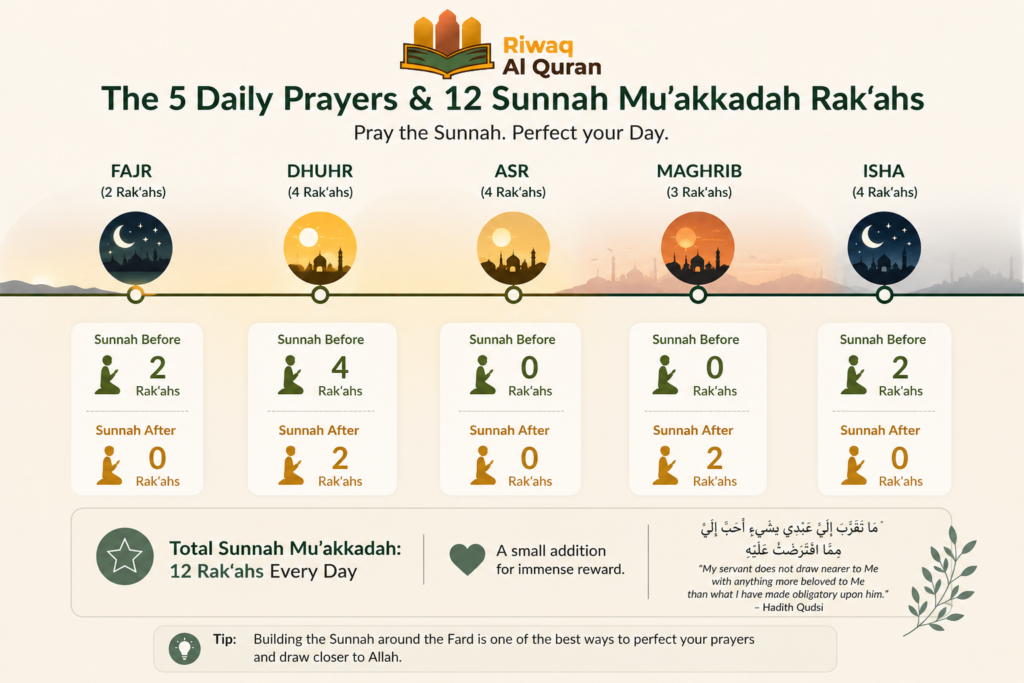
1. Two Rak’ahs Before Fajr
Prayed before the Fajr prayer, these two rak’ahs carry one of the most striking virtues attached to any single Sunnah prayer. The Prophet ﷺ said:
(رَكْعَتَا الْفَجْرِ خَيْرٌ مِنَ الدُّنْيَا وَمَا فِيهَا)
“The two rak’ahs of Fajr are better than the world and everything in it.” (Sahih Muslim 725)
This is a striking statement given how short and light these two rak’ahs are compared to other prayers — the reward clearly isn’t tied to length or effort. This is exactly why scholars stress not skipping them even when short on time before Fajr.
Recite them lightly, with Surah Al-Kafirun in the first rak’ah and Surah Al-Ikhlas in the second — a practice attributed to the Prophet ﷺ himself. If they’re missed before the obligatory prayer, the majority of scholars hold that they can still be made up after Fajr, or even after sunrise.
2. Four Rak’ahs Before Dhuhr and Four After
These eight rak’ahs — four before Dhuhr and four after — carry one of the strongest promises attached to any Sunnah prayer. The Prophet ﷺ said:
(مَنْ حَافَظَ عَلَى أَرْبَعٍ قَبْلَ الظُّهْرِ وَأَرْبَعٍ بَعْدَهَا حَرَّمَهُ اللَّهُ عَلَى النَّارِ)
“Whoever maintains four rak’ahs before Dhuhr and four after it, Allah will forbid him from the Fire.” (Sunan Abu Dawood 1269; Jami’ at-Tirmidhi 427, graded Hasan Sahih)
Pray the four before Dhuhr as two separate sets of two rak’ahs, with a short pause between sets, rather than as one continuous four-rak’ah prayer — this is the method most consistent with how the Prophet ﷺ prayed voluntary prayers generally, two rak’ahs at a time.
If you’re building a daily prayer habit and want a structured way to make sure the timing and recitation of each Sunnah prayer is correct, Riwaq Al Quran‘s Islamic Studies classes cover exactly this kind of practical fiqh, with a tutor checking your practice rather than you working it out alone from articles.
Read more: Optional Prayers in Islam And Their Types
3. Two Rak’ahs After Dhuhr
The two rak’ahs prayed immediately after Dhuhr complete the eight-rak’ah virtue mentioned above, and were part of the Prophet’s ﷺ consistent daily practice.
A separate, related hadith — narrated in Sunan Abi Dawud and graded Hasan by Tirmidhi (exact hadith number varies between editions, so no direct link here to avoid pointing you to the wrong page) — notes that Dhuhr specifically carries added virtue for extra voluntary prayer around it: “Whoever prays Dhuhr, then prays four rak’ahs before Asr, may Allah have mercy on him.”
This is why some scholars note that the period around Dhuhr is a good point in the day to add extra voluntary rak’ahs beyond the confirmed two — though only the two after Dhuhr are Mu’akkadah; anything beyond that falls under the broader, non-confirmed category of Sunnah.
4. Two Rak’ahs After Maghrib
Performed right after the Maghrib prayer, before moving on to other activities.
The same twelve-rak’ah hadith cited above (Sahih Muslim 728) specifically lists these two rak’ahs among the twelve, and the Prophet ﷺ was known to pray them regularly, treating them as a fixed part of the evening rather than an optional extra to skip when busy.
5. Two Rak’ahs After Isha
The final two rak’ahs of the confirmed set, closing out the daily 12 named in the same hadith from Umm Habibah. Many people pray these at home rather than at the mosque, which is consistent with a broader principle found in a separate hadith about voluntary prayer generally:
(صَلُّوا أَيُّهَا النَّاسُ فِي بُيُوتِكُمْ فَإِنَّ أَفْضَلَ الصَّلَاةِ صَلَاةُ الْمَرْءِ فِي بَيْتِهِ إِلَّا الْمَكْتُوبَةَ)
“Pray in your homes, O people, for the best prayer is a person’s prayer in his home, except the obligatory prayer.” (Sahih al-Bukhari 731; Sahih Muslim 781)
This is why the obligatory prayers were generally communal at the mosque, while these final two rak’ahs of Isha, like most Sunnah prayers, are often treated as a personal, private practice rather than something to perform publicly.
B. The Sunnah Ghair Mu’akkadah Prayers (Non-Confirmed Sunnah Prayers)
Unlike the five prayers above, these were encouraged by the Prophet ﷺ but not performed with the same regularity — he prayed them often, but not every single time. That distinction is what separates “Ghair Mu’akkadah” from “Mu’akkadah”: both are rewarded, but only the confirmed set carries the expectation of daily consistency.
6. Four Rak’ahs Before Asr
The Prophet ﷺ said:
(رَحِمَ اللَّهُ امْرَأً صَلَّى قَبْلَ الْعَصْرِ أَرْبَعًا)
“May Allah have mercy on a person who prays four rak’ahs before Asr.” (Sunan Abi Dawud 1271; Jami’ at-Tirmidhi 430)
This is phrased as a prayer for those who do it, rather than a strict command — part of why it sits in the non-confirmed category despite the clear virtue attached to it. Pray it as two sets of two rak’ahs, timed so it’s finished before the Asr adhan.
Read more: How to Learn the Quran for Prayer?
7. Two Rak’ahs Before Maghrib
A short prayer in the narrow window between the Maghrib adhan and the obligatory prayer itself. A hadith from the companion Abdullah ibn Mughaffal captures exactly why this one carries a lighter status than the confirmed five:
(صَلُّوا قَبْلَ الْمَغْرِبِ، صَلُّوا قَبْلَ الْمَغْرِبِ، ثُمَّ قَالَ فِي الثَّالِثَةِ: لِمَنْ شَاءَ)
“Pray before Maghrib, pray before Maghrib” — then he said the third time, “for whoever wants to.” (Sahih al-Bukhari 1183)
That final phrase, “for whoever wants to,” is the clearest evidence in the Sunnah of why this specific prayer is optional rather than confirmed — the Prophet ﷺ repeated the encouragement twice, then explicitly left the choice open on the third mention. The encouragement was consistent; the obligation was not.
8. Two Rak’ahs Before Isha
Performed in the same spirit as the two before Maghrib — occasional rather than habitual in the Prophet’s ﷺ own practice. These fall under the same general category of optional prayers the Quran encourages broadly:
(وَمِن سَحَرِهِمْ يَسْتَغْفِرُونَ)
“…and in the hours before dawn, they would seek forgiveness.” (Surah Adh-Dhariyat, 51:18)
While this verse describes late-night worship rather than the specific two rak’ahs before Isha, scholars cite it as part of the broader Quranic encouragement toward voluntary night worship that this prayer, and several others on this list, fall under.
Some people pair the two rak’ahs before Maghrib and before Isha together in their evening routine since they share the same non-confirmed status and light structure.
C. Special Nafl Prayers
Beyond the Sunnah tied to the five daily prayers, five additional Nafl prayers each have their own occasion, timing, and specific purpose — some tied to a time of day, others to a specific life situation.
9. Tahajjud Prayer (Night Prayer)
Prayed after Isha and before Fajr, ideally in the last third of the night, Tahajjud is the only Nafl prayer Allah addresses directly to the Prophet ﷺ in the Quran:
(وَمِنَ اللَّيْلِ فَتَهَجَّدْ بِهِ نَافِلَةً لَّكَ عَسَىٰ أَن يَبْعَثَكَ رَبُّكَ مَقَامًا مَّحْمُودًا)
“And rise at night for prayer as an additional devotion for you. It may be that your Lord will raise you to a station of praise and glory.” (Surah Al-Isra, 17:79)
Notice the phrasing: the verse specifically calls it “an additional devotion for you,” language directed at the Prophet ﷺ personally, which is part of why classical commentators debate whether Tahajjud was obligatory for the Prophet ﷺ specifically even though it remains voluntary for everyone else. The Prophet ﷺ reinforced its virtue further, describing it directly:
(أَفْضَلُ الصَّلَاةِ بَعْدَ الْفَرِيضَةِ صَلَاةُ اللَّيْلِ)
“The best prayer after the obligatory prayers is the night prayer.” (Sahih Muslim 1163)
It’s typically prayed in sets of two rak’ahs, with no fixed maximum — some companions prayed as few as two, others considerably more. Common question: what time exactly is “the last third of the night”? Divide the hours between Isha and Fajr into three equal parts; the final third is considered the most virtuous window, though Tahajjud prayed any time after Isha still counts.
Read more: A Special Guide to Ramadan Nafl Prayers
10. Duha Prayer (Forenoon Prayer)
Prayed any time from shortly after sunrise until just before Dhuhr, Duha was one of three practices Abu Hurairah said his close friend, the Prophet ﷺ, advised him never to abandon:
(أَوْصَانِي خَلِيلِي بِثَلَاثٍ: صِيَامِ ثَلَاثَةِ أَيَّامٍ مِنْ كُلِّ شَهْرٍ، وَرَكْعَتَيِ الضُّحَىٰ، وَأَنْ أُوتِرَ قَبْلَ أَنْ أَنَامَ)
“My close friend advised me to do three things: fasting three days of every month, praying two rak’ahs of Duha, and praying Witr before I sleep.” (Sahih al-Bukhari 1178; Sahih Muslim 721)
Grouping Duha alongside monthly fasting and Witr in a single piece of advice signals these three practices were treated as a connected package of consistent, moderate worship — not three unrelated recommendations.
Two rak’ahs is the minimum for Duha, but it can be extended to eight or more, making it a flexible option for anyone who wants a longer voluntary prayer during the workday.
11. Witr Prayer
Prayed after Isha and before Fajr, Witr holds a stronger recommendation than most other Nafl prayers. The Prophet ﷺ said:
(إِنَّ اللَّهَ زَادَكُمْ صَلَاةً وَهِيَ الْوِتْرُ، فَصَلُّوهَا فِيمَا بَيْنَ صَلَاةِ الْعِشَاءِ إِلَى صَلَاةِ الْفَجْرِ)
“Allah has given you an additional prayer, which is Witr — so pray it between the Isha prayer and the Fajr prayer.” (Jami’ at-Tirmidhi 425, graded Sahih by Al-Albani)
Scholars point to the strength of this phrasing — Allah “prescribing” an additional prayer — as evidence of just how emphasized Witr is, even though it isn’t obligatory; some scholars, including within the Hanafi school, have gone as far as treating it as close to obligatory.
It’s prayed in an odd number of rak’ahs (one, three, five, or more), and is commonly the very last prayer someone performs before sleeping, which is also why it pairs naturally with Tahajjud for those who wake later in the night.
If you’re unsure whether you’ll wake for the last third of the night, the Sunnah recommends praying Witr before sleeping rather than risking missing it entirely.
12. Salatul Istikhara (Prayer for Guidance)
Prayed at any permitted time, Istikhara is less about a fixed schedule and more about a specific moment of need — before marriage, travel, a job decision, or any major life choice where the outcome isn’t clear. The Prophet ﷺ taught his companions this prayer directly, as recorded by Jabir ibn Abdullah:
(كَانَ رَسُولُ اللَّهِ ﷺ يُعَلِّمُنَا الِاسْتِخَارَةَ فِي الأُمُورِ كُلِّهَا كَمَا يُعَلِّمُنَا السُّورَةَ مِنَ الْقُرْآنِ)
“The Messenger of Allah ﷺ used to teach us Istikhara for all matters, just as he would teach us a Surah of the Quran.” (Sahih al-Bukhari 1166)
That comparison — teaching Istikhara with the same seriousness as teaching a Surah — signals how central this prayer was considered to everyday decision-making, not a niche or occasional practice.
It’s two rak’ahs followed by a specific dua asking Allah to guide the person toward whichever outcome is genuinely better for them, even if their own preference points elsewhere.
Common question: do you need to see a dream after praying Istikhara? No — this is a common misconception. The guidance often comes through a growing sense of ease or difficulty around the decision, not necessarily a dream.
Read more:How to Pray Istikhara?
13. Salatul Tasbih
Also prayed at any permitted time, Salatul Tasbih is built specifically around seeking forgiveness. It consists of four rak’ahs, and what sets it apart structurally from every other prayer on this list is the fixed set of glorifications — Subhan Allah, Alhamdulillah, La ilaha illallah, Allahu Akbar — repeated a specific number of times within each rak’ah, making it one of the more detailed prayers to learn correctly.
When Can You Not Pray Nafl? The Prohibited Times
This is the point where sources commonly disagree — not because scholars dispute the underlying rule, but because they describe the same restriction at different levels of detail. Understanding both levels clears up the confusion entirely.
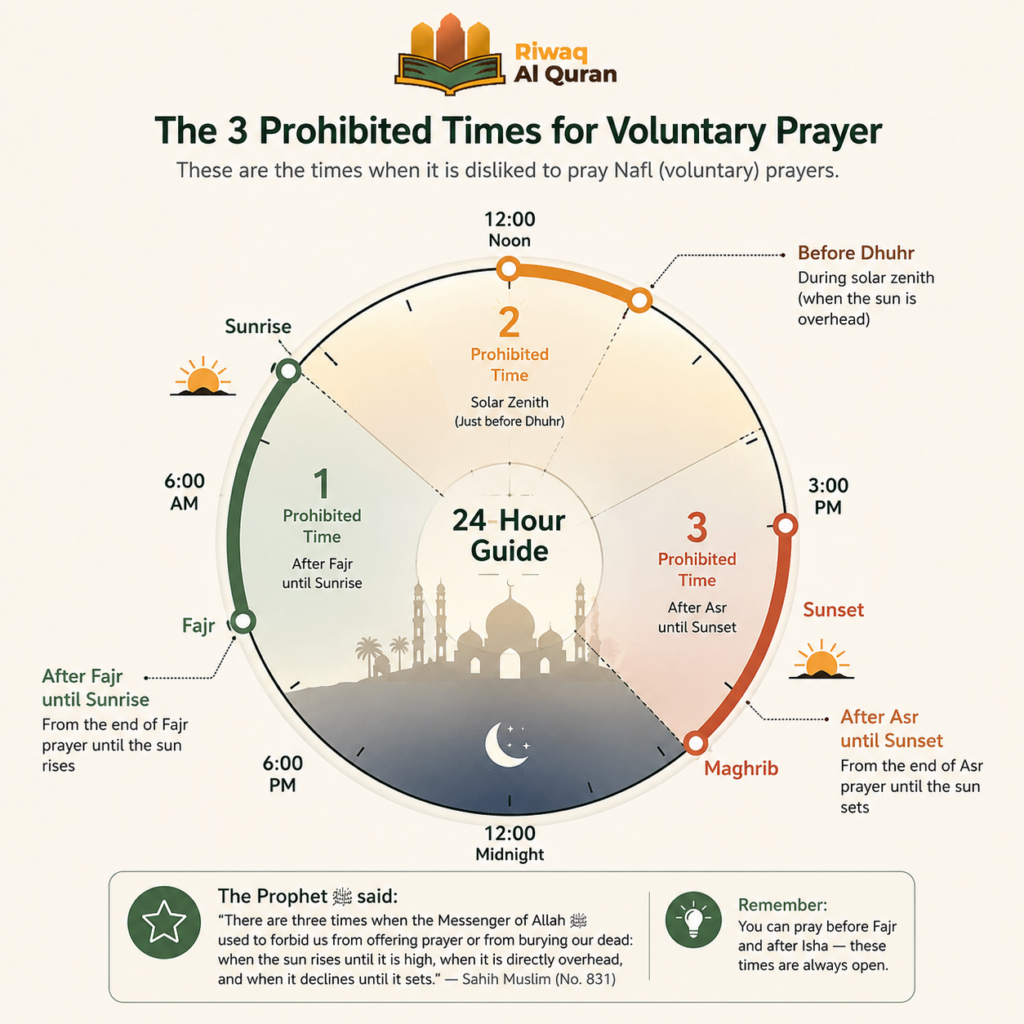
a. The Three Widely Cited Windows
Most general references summarize the prohibited times as three broad windows:
- From after Fajr until sunrise.
- Around the sun’s zenith, just before Dhuhr.
- From after Asr until sunset.
This is the version most beginners learn first, and it’s accurate as a working rule.
b. The More Detailed Five-Part Breakdown
Scholars who describe the rule more precisely split two of those three windows in half, based on whether the sun is actually rising or setting versus simply low in the sky:
- After Fajr until sunrise.
- The moments the sun is actually rising.
- The zenith before Dhuhr.
- After Asr until sunset.
- The moments the sun is actually setting.
Both descriptions point to the same underlying restriction — the three-window version groups two phases together for simplicity, while the five-part version separates them for precision. Neither contradicts the other; they’re different levels of detail on the same ruling.
This kind of nuance is exactly why fiqh is easier to get right with a teacher than from a single article — Riwaq Al Quran‘s Islamic Studies course covers rulings like this with room to ask questions about your specific situation.
c. The Maliki School’s Distinction Between Prohibition and Dislike
The Maliki school adds a further layer: it distinguishes between times of strict prohibition (Tahreem) — such as during the actual sunrise or sunset, during the Friday sermon, or during the Iqamah for an obligatory prayer — and times of mere dislike (Karahah), such as the general period after Fajr or after Asr. This distinction affects how strongly a scholar advises against praying in each window, without changing which windows are restricted.
d. Exceptions to the Rule Including Prayers With a Specific Cause
Prayers tied to a specific cause are exempt from the restriction above, since the prohibition applies specifically to absolute, purely voluntary Nafl prayers:
- Tahiyyat al-Masjid (greeting the mosque).
- Salat al-Janazah (the funeral prayer).
- A missed obligatory prayer that must be made up — this should be prayed immediately regardless of the time.
Summary Table of Nafl and Sunnah Prayers at a Glance
Use the table below as a quick reference once you’ve read the details above — it lists all 13 prayers side by side with their category, timing, and rak’ah count.
| Prayer | Category | Time | Rak’ahs |
|---|---|---|---|
| Before Fajr | Sunnah Mu’akkadah | Before Fajr | 2 |
| Before Dhuhr | Sunnah Mu’akkadah | Before Dhuhr | 4 |
| After Dhuhr | Sunnah Mu’akkadah | After Dhuhr | 2 |
| After Maghrib | Sunnah Mu’akkadah | After Maghrib | 2 |
| After Isha | Sunnah Mu’akkadah | After Isha | 2 |
| Before Asr | Sunnah Ghair Mu’akkadah | Before Asr | 4 |
| Before Maghrib | Sunnah Ghair Mu’akkadah | Before Maghrib | 2 |
| Before Isha | Sunnah Ghair Mu’akkadah | Before Isha | 2 |
| Tahajjud | Absolute Nafl | Last third of the night | 2+ |
| Duha | Absolute Nafl | After sunrise, before Dhuhr | 2–8 |
| Witr | Absolute Nafl | After Isha, before Fajr | Odd number |
| Istikhara | Absolute Nafl | Any permitted time | 2 |
| Tasbih | Absolute Nafl | Any permitted time | 4 |
Build a Real Prayer Routine With Riwaq Al Quran
Knowing the list is one step — praying each of these correctly, with the right recitation and at the right time, is what actually builds the habit.
Riwaq Al Quran is a comprehensive online platform that offers personalized Quran, Arabic and Islamic Studies online classes for individuals of all ages and backgrounds.
Their experienced instructors use a structured curriculum to cover Tajweed, Tafsir, and Memorization, providing easy and effective access to learning the Quran. The advanced online classes allow for seamless communication and interaction between students and teachers. Join Riwaq Al Quran for a deeper connection with the Quran.

We offer several courses such as:
- Online courses for kids.
- Online Quran classes for kids and adults.
- Online Arabic courses.
- Online Ijazah courses.
- Online Islamic Studies courses.
Here are a sample of our set of Quran Courses that will be helpful for you:


- Online Tafseer Course: Delve into Quranic meanings with our insightful online Tafseer course.
- Noorani Qaida Online: Learn Quranic basics efficiently through our Noorani Qaida online program.
- Online Quran Recitation Course: Enhance Quranic recitation skills through our expert-led online course.
- Online Tajweed Classes: Master Tajweed rules for beautiful Quranic recitation in online classes.
- Quran Memorization Online Course: Memorize the Quran effectively with our specialized online memorization course.
- Online Qirat Course: Explore diverse Qirat styles with our comprehensive online Qirat course.
- Online Quran Classes for Kids: Nurture a love for the Quran in kids through interactive online classes.

Conclusion
Allah describes what prayer accomplishes directly: إِنَّ الصَّلَاةَ تَنْهَىٰ عَنِ الْفَحْشَاءِ وَالْمُنكَرِ (Surah Al-Ankabut, 29:45) — “Indeed, prayer prohibits immorality and wrongdoing.” Understanding which prayers are confirmed, which are optional, and when Nafl prayer is restricted gives you a complete, accurate framework for building these voluntary prayers into your daily routine.
The list of Nafl and Sunnah prayers in Islam covers 13 distinct prayers across three tiers: five confirmed Sunnah Mu’akkadah totaling 12 daily rak’ahs, three non-confirmed Sunnah Ghair Mu’akkadah, and five special Nafl prayers each with its own timing and virtue.
Beyond simply cataloging them, the value in this list is functional — as the hadith on the Day of Judgment makes clear, these voluntary prayers exist specifically to repair any deficiency in the five obligatory prayers, not just to add extra reward on top of them.
If you’re starting from scratch, don’t try to adopt all 13 at once. Anchor the habit first with the two rak’ahs before Fajr and Witr after Isha, then build the remaining Sunnah al-Rawatib around Dhuhr, Maghrib, and Isha once those two are consistent. And when it comes to the prohibited times, remember the three-window and five-window descriptions aren’t in conflict — they’re simply different levels of precision on the same underlying rule.
Whether you’re praying two rak’ahs before Fajr or working Tahajjud into your last third of the night, each of these Nafl and Sunnah prayers is a concrete, actionable step — not an abstract ideal — toward a stronger daily connection with Allah.
FAQs
The questions below cover the details this article’s sections don’t fully spell out on their own — daily totals, the prohibited-time count, and how Nafl relates to Sunnah.
What Is the Difference Between Nafl and Sunnah Prayers?
Fard is a prayer Allah has made obligatory — the five daily prayers. Nafl (also called voluntary or supererogatory prayer) is anything prayed beyond that obligation, and Sunnah specifically refers to Nafl prayers the Prophet ﷺ himself performed, which carry more weight than Nafl prayers with no direct prophetic precedent.
Scholars split these voluntary prayers into three tiers based on how consistently the Prophet ﷺ performed them:
- Sunnah Mu’akkadah (Confirmed Sunnah) — prayers the Prophet ﷺ performed consistently and rarely, if ever, missed, tied directly to the five daily prayers.
- Sunnah Ghair Mu’akkadah (Non-Confirmed Sunnah) — prayers the Prophet ﷺ performed sometimes and encouraged, but without the same consistency.
- Absolute Nafl — voluntary prayers not tied to a specific daily prayer slot, each with its own occasion, such as Tahajjud, Duha, Istikhara, and Tasbih.
Let’s discuss first the Sunnah Mu’akkadah (Confirmed Sunnah Prayers)
These are the voluntary prayers that the Prophet Muhammad (ﷺ) regularly performed and encouraged his followers to perform. They are associated with the five daily obligatory prayers.
How many Nafl rak’ahs can you pray daily?
The confirmed Sunnah al-Rawatib total 12 rak’ahs a day, split as 2 before Fajr, 4 before and 2 after Dhuhr, 2 after Maghrib, and 2 after Isha. Beyond these 12, a Muslim may pray unlimited additional Nafl prayers in pairs of two rak’ahs, outside the prohibited times.
How many prohibited times are there for Nafl prayer?
Most sources describe three broad windows — after Fajr until sunrise, around the sun’s zenith before Dhuhr, and after Asr until sunset. Scholars who describe the rule more precisely split this into five phases by separating the moments of actual sunrise and sunset, though both descriptions refer to the same underlying restriction.
Can you pray Nafl prayers during the prohibited times?
Generally no for absolute, purely voluntary Nafl prayers, but prayers with a specific cause — such as greeting the mosque (Tahiyyat al-Masjid) or the funeral prayer (Salat al-Janazah) — are permitted during these times according to many scholars, since the restriction applies specifically to optional prayer with no other reason behind it.
What is the difference between Nafl and Sunnah prayer?
Nafl is the general term for any voluntary prayer beyond the obligatory five, while Sunnah specifically means a Nafl prayer the Prophet ﷺ performed himself, which carries more weight than a Nafl prayer with no direct prophetic example behind it.
Is Witr prayer obligatory or voluntary?
Witr is voluntary but strongly recommended — the Prophet ﷺ described it as a prayer Allah has prescribed, which is why many scholars treat it as close to obligatory in practice, even though it does not carry the same ruling as the five daily Fard prayers.