You’ve finished your night prayers and you’re in bed, phone in hand, wanting to recite a few ayat before sleep. Then the doubt creeps in: is this actually allowed? Can you read the Quran while lying down, or does that cross a line of disrespect?
The short answer is yes — reading the Quran while lying down is permissible. But the full ruling is more useful than a simple yes. It depends on what you’re reading from, whether you have wudu, and whether your position reflects ease or indifference. This article gives you the complete picture, grounded in Quranic text, authentic hadith, and the positions of all four major madhabs.ran on one’s lap. Additionally, it highlights the offerings of Riwaq Al Quran’s online classes, covering Tajweed, Tafsir, and Memorization.
What You’ll Learn in This Article
- Whether reading the Quran while lying down is halal or makruh — and what the difference is.
- The Quranic verse and authentic hadith that directly address recitation posture.
- How the Hanafi, Maliki, Shafi’i, and Hanbali schools view this question.
- Why the ruling for reading from a phone is less strict than for a physical mushaf.
- A practical framework for choosing the right posture in different situations.
Table of Contents
Is Reading the Quran While Lying Down Permissible?
Reading the Quran while lying down is permissible (mubah) in Islam, according to the scholarly consensus of all four major madhabs. The validity of recitation depends not on physical posture but on the inner state of khushu’ — reverence and attentiveness — toward Allah’s words.
The foundational principle is that Quranic recitation is a form of dhikr (remembrance of Allah), and dhikr has no mandatory body position. Scholars consistently identify three conditions that determine whether any recitation posture is valid:
- The position does not reflect deliberate contempt toward the sacred text.
- The reciter maintains focus and attentiveness (khushu’) throughout.
- The act is performed with sincere intention of worship or learning.
Etiquette extends beyond posture — scholars also address related questions of appropriate dress and the manners of reading the Quran more broadly. Each of these conditions is strongly encouraged but does not individually invalidate sincere recitation.
What the Quran Says About Reciting in All Positions
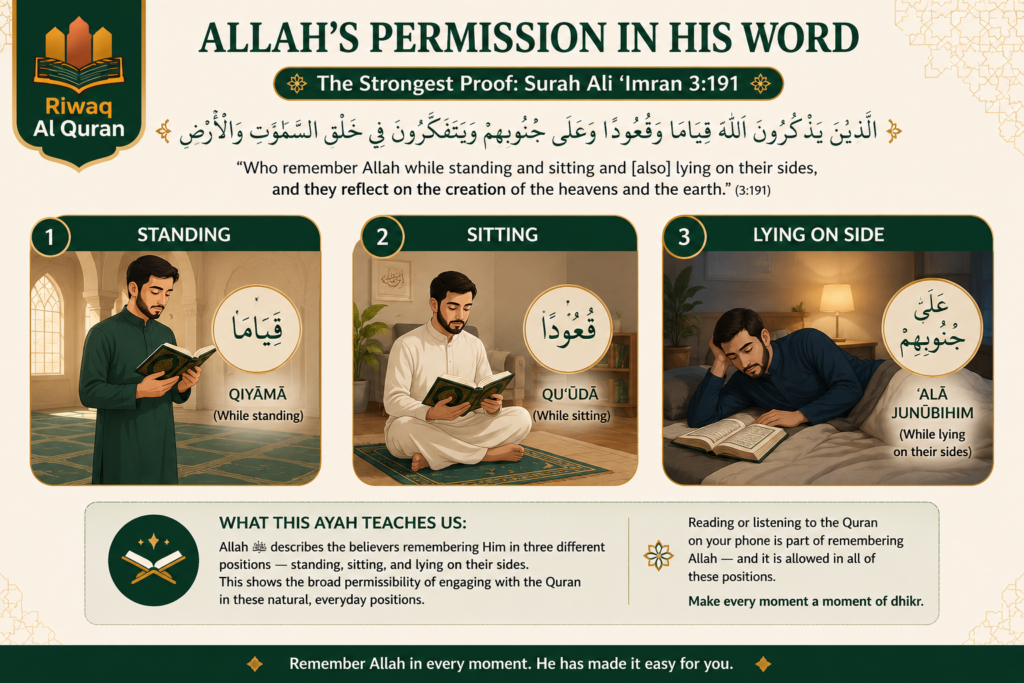
Allah ﷻ describes the believers as those who remember Him in every physical state. The clearest textual proof is in Surah Ali ‘Imran:
(الَّذِينَ يَذْكُرُونَ اللَّهَ قِيَامًا وَقُعُودًا وَعَلَىٰ جُنُوبِهِمْ وَيَتَفَكَّرُونَ فِي خَلْقِ السَّمَاوَاتِ وَالْأَرْضِ رَبَّنَا مَا خَلَقْتَ هَٰذَا بَاطِلًا سُبْحَانَكَ فَقِنَا عَذَابَ النَّارِ)
“Those who remember Allah while standing, sitting, and [lying] on their sides, and who reflect upon the creation of the heavens and the earth, [saying]: Our Lord, You did not create this without purpose; exalted are You above such a thing — so protect us from the punishment of the Fire.”— Surah Ali ‘Imran 3:191
This ayah is the primary textual proof for the permissibility of dhikr — and by scholarly extension, Quranic recitation — in all three physical positions: standing (قِيَامًا), sitting (قُعُودًا), and lying on one’s side (عَلَى جُنُوبِهِمْ). The sequence in the verse moves from most upright to most reclined, covering the full range of human posture.
Scholars of tafsir, including Ibn Kathir, note that the verse does not attach a condition of physical uprightness to the act of remembrance — the condition attached is reflection and sincerity of heart (يَتَفَكَّرُونَ). The lying position is not an emergency exception; it is explicitly named alongside standing and sitting as a valid state of worship.
What the Hadith Says About Reciting While Reclining
Beyond the Quranic principle, two authentic hadiths from Sahih Al-Bukhari confirm this ruling directly from the Prophet’s ﷺ own practice — and a third establishes the ease principle that covers those who cannot sit upright at all.
1. The Aisha Narration — Direct Prophetic Proof
The Prophet Muhammad ﷺ himself recited the Quran while reclining. Aisha (may Allah be pleased with her) narrated:
(كَانَ النَّبِيُّ ﷺ يَتَّكِئُ فِي حَجْرِي وَأَنَا حَائِضٌ، ثُمَّ يَقْرَأُ الْقُرْآنَ)
“The Prophet ﷺ would recline in my lap while I was menstruating and then recite the Quran.”— Sahih Al-Bukhari, Hadith 297
This narration carries two simultaneous rulings. First, the Prophet ﷺ recited the Quran while physically reclining — confirming that lying-down recitation is valid from the Prophet’s own practice (sunnah fi’liyyah), not merely permitted by scholarly inference. Second, he did so in close physical proximity to a state of ritual impurity (Aisha’s menstrual period).
The scholars use this narration to establish that verbal recitation is not invalidated by proximity to ritual impurity — a ruling directly relevant to anyone who wonders whether reciting in bed, near a state of sleep or physical fatigue, affects the validity of their recitation. It does not.
2. The Bedtime Sunnah — Lying Down Recitation as Active Worship
The Prophet ﷺ had a consistent nightly practice of reciting while lying in bed. Aisha (may Allah be pleased with her) narrated:
(كَانَ النَّبِيُّ ﷺ إِذَا أَوَى إِلَى فِرَاشِهِ كُلَّ لَيْلَةٍ جَمَعَ كَفَّيْهِ ثُمَّ نَفَثَ فِيهِمَا، فَقَرَأَ فِيهِمَا: ﴿قُلْ هُوَ اللَّهُ أَحَدٌ﴾ وَ﴿قُلْ أَعُوذُ بِرَبِّ الْفَلَقِ﴾ وَ﴿قُلْ أَعُوذُ بِرَبِّ النَّاسِ﴾، ثُمَّ يَمْسَحُ بِهِمَا مَا اسْتَطَاعَ مِنْ جَسَدِهِ)
“Every night when the Prophet ﷺ went to his bed, he would cup his palms together, blow into them, and recite into them: Surah Al-Ikhlas, Surah Al-Falaq, and Surah An-Nas — then wipe with his hands whatever he could reach of his body.” — Sahih Al-Bukhari, Hadith 6319
This narration elevates the discussion beyond mere permissibility. The Prophet ﷺ did not simply tolerate lying-down recitation — he made it a nightly sunnah performed in bed, after retiring for sleep. This means that for the pre-sleep bedtime recitation specifically, the lying-down position is not a concession or a lesser option: it is the position the sunnah was performed in.
A Muslim who abandons the bedtime recitation of the three Quls out of concern that lying down is disrespectful is, by this hadith, missing an established act of worship the Prophet ﷺ never abandoned. The scholars of hadith grade this narration as sahih and recorded in the most authoritative hadith collection in Islam.

3. The Ease Principle — The Quranic Guarantee for Those Who Cannot Sit
For those who cannot sit upright due to illness, disability, or physical fatigue, the ruling carries an additional Quranic foundation:
(لَا يُكَلِّفُ اللَّهُ نَفْسًا إِلَّا وُسْعَهَا)
“Allah does not burden a soul beyond what it can bear.”— (Surah Al-Baqarah 2:286)
This ayah represents one of the foundational principles of Islamic jurisprudence known as raf’ al-haraj — the removal of hardship. Scholars across all four madhabs apply it consistently to questions of worship posture: if sitting upright causes genuine physical difficulty, the obligation to do so is lifted without any reduction in the spiritual validity of the recitation.
This is not a loophole — it is a built-in mercy in the religion. Imam Al-Nawawi applies this principle explicitly when discussing Quran recitation: ease of posture is accommodated so that worship continues rather than being abandoned due to physical constraint.
Scholar Opinions on Reading the Quran While Lying Down
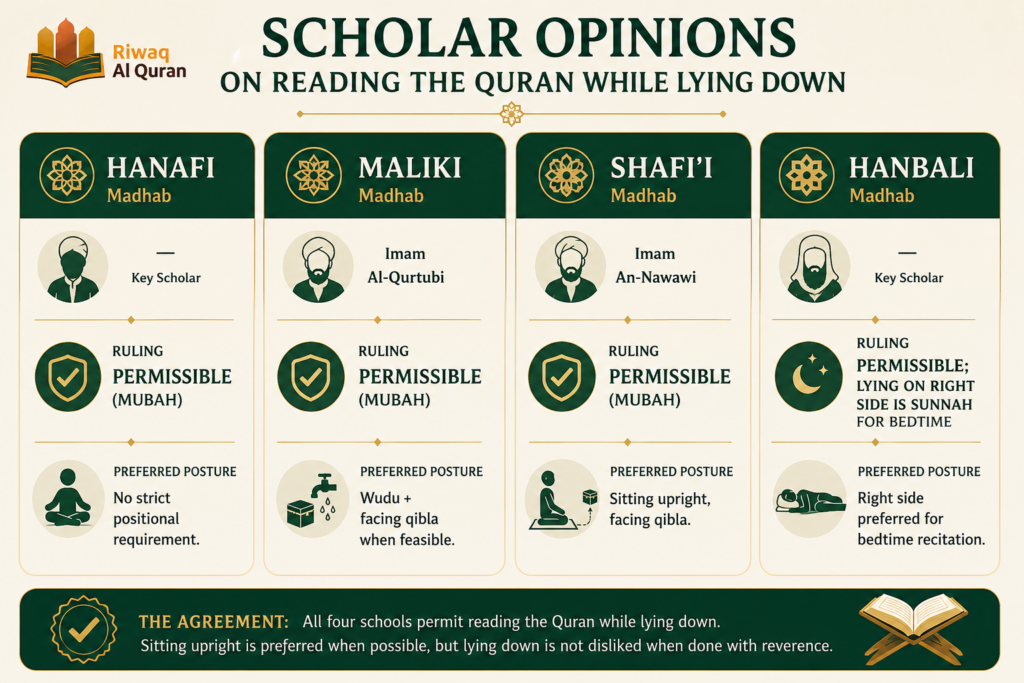
The four major madhabs — Hanafi, Maliki, Shafi’i, and Hanbali — all hold that reciting the Quran while lying down is permissible. Where they differ is in how they grade the recommended posture: all prefer sitting upright when possible, but none declare lying-down recitation makruh (disliked) when done with reverence. Understanding this distinction — permitted vs. preferred — gives a Muslim room to make a conscious, informed choice rather than defaulting to either excessive restriction or carelessness.
The table below summarizes each school’s position before the detailed opinions that follow.
| Madhab | Key Scholar | Ruling on Lying-Down Recitation | Preferred Posture |
|---|---|---|---|
| Shafi’i | Imam An-Nawawi | Permissible (mubah) | Sitting upright, facing qibla |
| Maliki | Imam Al-Qurtubi | Permissible (mubah) | Wudu + facing qibla when feasible |
| Hanafi | — | Permissible (mubah) | No strict positional requirement |
| Hanbali | — | Permissible; lying on right side is sunnah for bedtime | Right side preferred for bedtime recitation |
1. The Shafi’i Position – Imam An-Nawawi
Imam An-Nawawi, in Al-Majmu’ Sharh Al-Muhadhdhab (Vol. 2), explicitly states that reciting the Quran while sitting, lying down, or reclining is permissible. He grades sitting upright — ideally with crossed legs, facing the qibla — as afḍal (preferable) because it reflects greater attentiveness and humility before Allah’s words, while making clear that lying down does not render the recitation invalid or blameworthy.
The Shafi’i school identifies one practical concern: if a lying position leads to drowsiness and genuinely absent-minded recitation — words leaving the tongue with no awareness — that inattentiveness is the problem, not the posture. A person who recites attentively while reclining is in a stronger position than one who sits upright while mentally elsewhere.
2. The Maliki Position – Imam Al-Qurtubi
Imam Al-Qurtubi, in Al-Jami’ li-Ahkam Al-Quran, clarifies that turning away from Allah’s remembrance refers to abandoning recitation and practice entirely — not to choosing a relaxed physical position. His commentary emphasizes that the act of remembrance matters more than its form.
The Maliki school holds lying-down recitation as valid while recommending wudu and orientation toward the qibla when feasible — a position consistent with the broader Maliki principle that external conditions of worship are strongly encouraged but do not individually invalidate valid recitation when absent.
3. The Hanafi and Hanbali Positions
Both schools reach the same ruling through the same textual evidence: the Aisha narration (Bukhari 297) and the bedtime recitation sunnah (Bukhari 6319) are decisive proofs that the Prophet ﷺ did not restrict Quranic recitation to any single body position. T
he Hanbali school additionally notes that lying on the right side — as the Prophet ﷺ did when going to sleep — is itself a preferred position for the bedtime recitation sunnah. All four schools converge on the same principle: reverence is the condition, not uprightness.
Can You Read the Quran on Your Phone While Lying Down?
Reading the Quran on a phone while lying down is permissible, and on one point the ruling is actually less strict than for a physical mushaf: you are not required to be in a state of wudu to touch a phone displaying Quranic text.
The traditional requirement to have wudu before touching the Quran applies specifically to the physical mushaf — the bound scripture — based on the scholarly interpretation of the following ayah:
(لَّا يَمَسُّهُ إِلَّا الْمُطَهَّرُونَ)
“None shall touch it except the purified.”— (Surah Al-Waqi’ah 56:79)


Scholars of fiqh have debated the referent of “it” (هُ) in this ayah — whether it refers to the physical mushaf, the Preserved Tablet (Al-Lawh Al-Mahfuz), or the Quran in a broader sense. The majority position of the four madhabs applies the wudu requirement to the physical mushaf specifically, as a matter of ta’dhim (honoring the sacred object).
A phone or tablet is a device that displays text among many other functions; it is not a mushaf. Scholars from all four madhabs agree this ruling does not transfer to digital screens.
Key points for phone recitation while lying down:
- Wudu is not required to open a Quran app and recite — though it remains strongly recommended for the depth of connection it enables
- The permissibility is established by the same Prophetic evidence (Bukhari 297, 6319) that covers any recitation while lying down
- The main practical caution is distraction — notifications and app-switching work against khushu’
- Using airplane mode or a dedicated Quran app in full-screen view eliminates this risk and keeps the session purposeful
For a detailed breakdown of the wudu rules and when they apply, see Reading the Quran Without Wudu. For the full scholarly discussion on phone-based recitation, see Does Reading the Quran on a Phone Count?
If you want every ayah you recite — lying down before sleep or seated during Fajr — to carry the correct pronunciation and rhythm, Riwaq Al Quran’s online Tajweed courses give you that foundation: live, one-on-one sessions with certified instructors, available for all ages and scheduled around your day.
Watch how Riwaq Al Quran’s Telawa course trains students to recite with the precision and attentiveness that proper Quranic recitation deserves — whether sitting at a desk or finishing your bedtime sunnah.
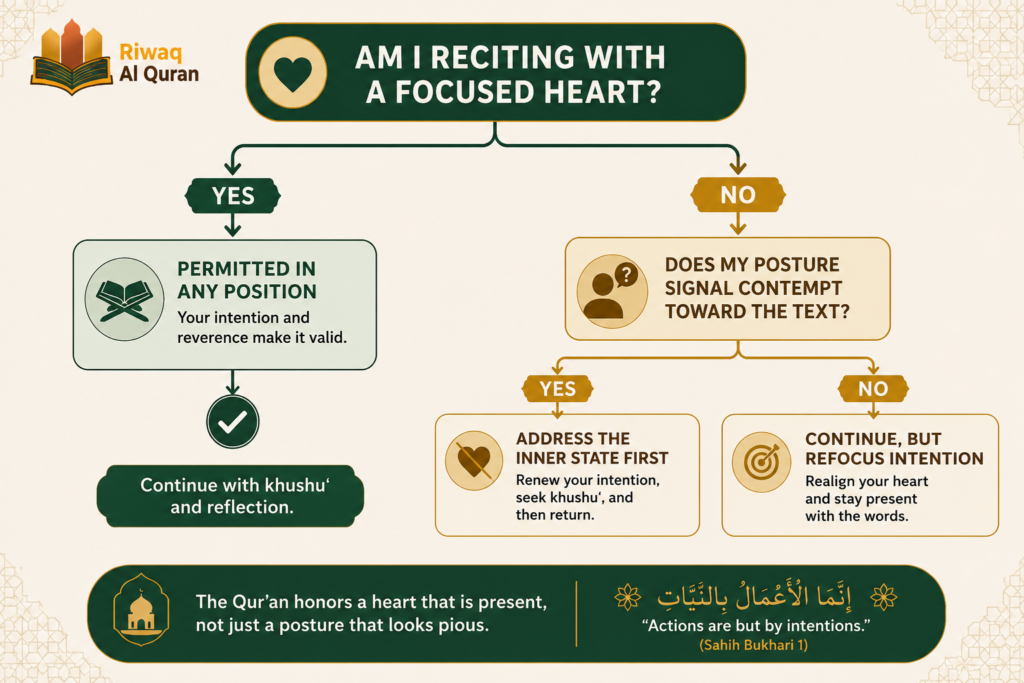
Choosing Your Recitation Posture – The Reverence Tes
The deciding factor between permissible and impermissible is not the angle of your spine — it is whether your position reflects ease or indifference. Scholars consistently distinguish between these two states. Apply this test: if you are comfortable and reciting with a focused heart, that is ease — it is permitted.
If you are positioned in a way that signals you regard the Quran as background noise, that is indifference — and that is the concern regardless of whether you are sitting or lying.
a. When Lying Down Is the Right Choice
There are three situations in which lying down is not just acceptable but specifically appropriate:
- Before sleep. Reciting the three Quls (Al-Ikhlas, Al-Falaq, An-Nas) while lying in bed is an established Prophetic sunnah documented in Sahih Al-Bukhari 6319. In this context, lying down is not the fallback option — it is the correct position.
- During illness or physical limitation. A person who cannot sit upright without pain recites lying down without any scholarly reservation whatsoever. As established in Surah Al-Baqarah 2:286, Allah ﷻ does not burden a soul beyond its capacity. Reciting lying down during illness is not a concession to weakness — it is worship correctly suited to circumstances.
- During rest or travel fatigue. When sitting is genuinely uncomfortable or impractical, lying-down recitation keeps the habit of dhikr and recitation active rather than abandoning it entirely.
b. When Sitting Upright Is the Better Choice
Sitting upright is the preferred (afḍal) position, and three situations call for it specifically:
- When studying Tafsir or engaging with meaning deeply. Sitting aids cognitive focus and signals to your own mind that this is a deliberate session of learning. The posture reinforces the intention.
- When reciting aloud in a group or teaching setting. Uprightness communicates respect to others present and models reverence for the text.
- When beginning a deliberate reading session and you are physically comfortable. Choosing to sit when you easily could is an act of conscious reverence — what scholars call ta’dhim — and it carries its own spiritual value. Scholars additionally recommend facing the qibla while reading or reciting as a further sign of devotion.
c. The Common Mistake to Avoid
Many Muslims abandon the pre-sleep bedtime sunnah entirely, and stop reciting dhikr during illness, out of excessive caution about lying-down recitation. The scholars’ position — grounded in Bukhari 297 and 6319 — is unambiguous: that avoidance is unwarranted and results in missed worship that the Prophet ﷺ himself observed in the same position.
Understanding not just what to recite but how to recite it — with correct Tajweed, proper makhraj, and the right intention — is what separates recitation from fluent Arabic reading. Riwaq Al Quran’s courses in Tajweed, Quran Memorization, and Tafsir build exactly that, online and at your pace.
Start Learning the Quran the Right Way — Book Your Free Trial at Riwaq Al Quran
Knowing the ruling on recitation posture is a start. Reciting with correct Tajweed, understanding the meaning through Tafsir, and building a consistent memorization habit are what deepen your relationship with the Quran over time — whether you’re reciting before sleep lying down or finishing a full juz’ at your desk.
Riwaq Al Quran is a comprehensive online platform that offers personalized Quran, Arabic, and Islamic Studies classes for individuals of all ages and backgrounds. Experienced instructors use a structured curriculum covering Tajweed, Tafsir, and Memorization, and advanced online tools allow seamless communication and interaction between students and teachers.
Riwaq Al Quran brings certified Quran instruction to wherever you are — at your desk, on your commute, or in bed before sleep.
Browse by Category
| Category | Best For |
|---|---|
| Online Quran Classes — Kids & Adults | All levels, ages 5 and up |
| Online Arabic Courses | Beginners through advanced |
| Online Ijazah Courses | Students seeking certification |
| Online Courses for Kids | Ages 5–15, interactive format |
| Online Islamic Studies | Aqeedah, Seerah, Fiqh, and more |
Featured Quran Courses
- Online Tafseer Course — Delve into Quranic meanings with expert-led Tafseer instruction, ideal for anyone who wants to move beyond recitation into real understanding.
- Noorani Qaida Online — The foundational program for learners starting from scratch, covering Arabic letters and Quranic pronunciation step by step.
- Online Quran Recitation Course — Structured fluency training with a certified instructor, focused on accuracy, rhythm, and confidence.
- Online Tajweed Classes — Master the rules of Tajweed for beautiful, correct Quranic recitation — from basic rules to advanced application.
- Quran Memorization Online Course — A structured hifz program with memorization techniques, revision schedules, and instructor accountability.
- Online Qirat Course — Explore the ten established Qirat recitation styles with an expert guide.
- Online Quran Classes for Kids — Interactive, age-appropriate sessions designed to nurture a love for the Quran from an early age.
Your first lesson is free — no commitment required.

Conclusion
Reading the Quran while lying down is permissible in Islam — confirmed by Surah Ali ‘Imran 3:191, by the Aisha narration in Sahih Al-Bukhari 297, by the ease principle of Surah Al-Baqarah 2:286, and by the scholarly consensus of the Hanafi, Maliki, Shafi’i, and Hanbali schools.
The condition is inner reverence (khushu’), not physical uprightness. Reading from a phone while lying down carries an even less restrictive ruling, since the wudu requirement attached to touching a physical mushaf — established through Surah Al-Waqi’ah 56:79 — does not extend to digital devices.
The Prophetic sunnah of reciting the three Quls before sleep — performed lying in bed, recorded in Sahih Al-Bukhari 6319 — is itself the clearest proof that lying-down recitation is not merely tolerated but actively practiced by the best example. Sit when you comfortably can; that is the preferred position. Recite lying down when ease, illness, or the bedtime sunnah calls for it — and do so with a focused heart and a clean conscience.
Frequently Asked Questions
The questions below address the most common doubts about recitation posture — from the basic ruling to the specific conditions around wudu, menstruation, and what the Prophet ﷺ himself practiced.
Is it haram to read the Quran while lying down?
No. Reading the Quran while lying down is not haram. It is permissible according to the scholarly consensus of all four major madhabs — Hanafi, Maliki, Shafi’i, and Hanbali. The condition is that your position reflect ease, not contempt toward the text.
Do I need wudu to read the Quran while lying down?
If you are reciting from memory or from a phone, wudu is recommended but not required. If you are reading from a physical mushaf, the majority scholarly position — based on Surah Al-Waqi’ah 56:79 — requires wudu before touching it, regardless of whether you are sitting or lying down.
Is reciting the Quran in bed before sleep a sunnah?
Yes. Reciting Surah Al-Ikhlas, Surah Al-Falaq, and Surah An-Nas while lying in bed before sleep is an established sunnah of the Prophet ﷺ, recorded in Sahih Al-Bukhari 6319. This is one of the strongest proofs that lying-down recitation is not only permitted but actively practiced.
Can menstruating women read the Quran while lying down?
Yes. The majority scholarly position allows women during menstruation to recite the Quran from memory while lying down. The Aisha narration (Bukhari 297) itself involves the Prophet ﷺ reciting while resting his head in Aisha’s lap during her menstrual period. The separate question of whether menstruating women may read from a physical mushaf carries different scholarly positions and is a more detailed discussion.
Is reading the Quran lying down disrespectful?
No. Scholars distinguish between physical ease — permitted — and deliberate contempt toward the Quran, which is not. Reciting attentively while comfortable or ill reflects ease, not disregard.
What is the best position for reading the Quran?
The preferred position, according to the majority of scholars, is sitting upright with crossed legs, facing the qibla, in a state of wudu. This maximizes focus and expresses the highest degree of reverence. Lying down is valid and sometimes specifically appropriate — as in pre-sleep recitation — but sitting remains the recommended default when physically able.
Sources
- Sahih Al-Bukhari, Hadith 297 — Aisha narration on reclining recitation
- Sahih Al-Bukhari, Hadith 6319 — Bedtime sunnah recitation
- Surah Ali ‘Imran 3:191 — Dhikr in standing, sitting, and lying positions
- Surah Al-Baqarah 2:286 — The ease principle
- Surah Al-Waqi’ah 56:79 — Basis for the wudu-and-mushaf ruling
- Imam An-Nawawi, Al-Majmu’ Sharh Al-Muhadhdhab, Vol. 2 — Shafi’i ruling on recitation posture
- Imam Al-Qurtubi, Al-Jami’ li-Ahkam Al-Quran — Maliki commentary on dhikr and posture