Every year, thousands of Muslims and new learners begin reading the Quran — and nearly all carry the same handful of errors that quietly undermine their recitation. The rules of reading the Quran are not arbitrary formalities. They are a structured system built from Quranic commands, Prophetic practice, and centuries of scholarly consensus — designed to protect both the accuracy of the text and the depth of the reader’s connection to it.
Whether you are a complete beginner taking your first steps or someone looking to refine a long-standing practice, understanding these rules transforms recitation from routine into worship.
This guide covers every essential rule, explains the religious evidence behind each one, and addresses three areas that most guides overlook entirely: the three scholarly paces of recitation, the modern Islamic ruling on reading from a phone or tablet, and the specific mistakes that qualified Quran teachers correct most often.
What You’ll Learn in This Article
- The mandatory rules of reading the Quran with their Quranic and Prophetic evidence.
- Authentic hadiths on the rewards Allah has prepared for Quran reciters.
- The recommended etiquettes that transform recitation from habit into worship.
- A pre-session checklist you can apply before every sitting.
- The Islamic ruling on reading the Quran from digital devices.
- The most common recitation mistakes — and exactly how to fix them.
Table of Contents
Why Were the Rules of Reading the Quran Legislated?
Before examining the rules themselves, understanding why they exist makes every rule easier to observe consistently.
The Quran is unique among all books in human history in one precise way: it is not only a text but an oral transmission. From the moment of revelation to the Prophet Muhammad ﷺ through Jibreel (Gabriel), it was recited — not just written. The chain of oral transmission — teacher to student, letter by letter, generation after generation — is what has preserved the Quran exactly as revealed for over fourteen centuries without alteration.
The rules of recitation exist to protect that chain. Every Tajweed rule, every Waqf symbol, every etiquette of handling the Mushaf serves one purpose: ensuring that the Quran reaches the next reader — and the next generation — exactly as it left the mouth of the Prophet ﷺ.
What Are the Rules of Reading the Quran?
The rules of reading the Quran divide into two categories: obligatory rules (Wajibat) — which must be observed for recitation to be correct — and recommended etiquettes (Adab) — which deepen the spiritual quality of the act. Understanding the distinction tells you where to focus first.
Allah commands in the Quran:
﴿وَرَتِّلِ الْقُرْآنَ تَرْتِيلًا﴾
“And recite the Quran with measured recitation.” (Al-Muzammil, 73:4)
The Arabic word tarteel (تَرْتِيلًا) comes from the root r-t-l, meaning to arrange and order with precision. Classical lexicographers defined tarteel as “making each letter clear and giving each its right without haste.”
This single verse is the origin of the entire science of Tajweed — it is a divine command, not a scholarly recommendation.
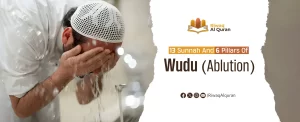
1. Performing Wudu (Ablution) Before Touching the Quran
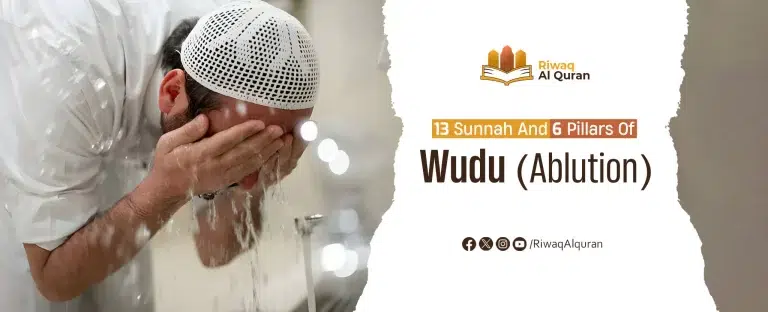
Performing wudu before touching the physical Mushaf is obligatory. The Quranic basis is:
﴿لَّا يَمَسُّهُ إِلَّا الْمُطَهَّرُونَ﴾
“None shall touch it except the purified.” (Al-Waqi’ah, 56:79)
The pronoun hu (هُ) in “none shall touch it” refers, in the primary scholarly opinion, to the earthly Mushaf. The majority of the four Sunni legal schools (Hanafi, Maliki, Shafi’i, and Hanbali) hold that wudu is required before touching the Mushaf, based on this verse along with a letter written by the Prophet ﷺ to Amr ibn Hazm stating: “No one should touch the Quran except in a state of purity.”
Two important distinctions every reader should know:
- Wudu is required for touching the physical Mushaf — this is the binding ruling across the four schools.
- Reciting from memory without physical contact is permitted without wudu according to many scholarly opinions, though maintaining purity is always preferred.
- When in doubt, performing wudu is always the safer and more spiritually correct approach.
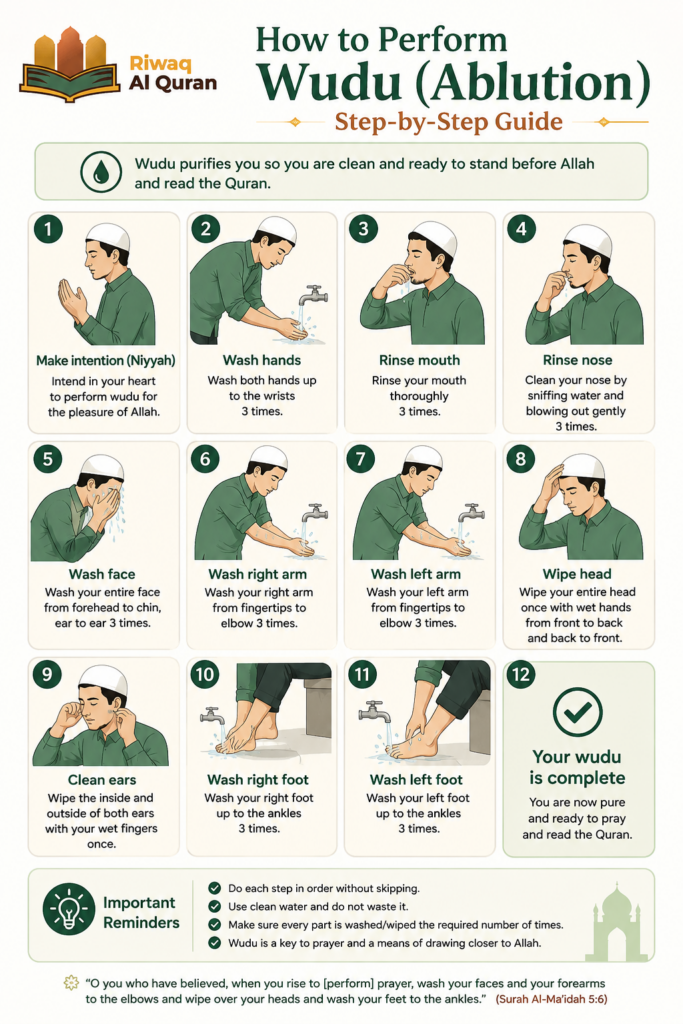
2. Reciting Istiaazah and Basmalah Before You Begin
Before beginning any recitation — whether starting fresh or resuming mid-surah — the reader recites Istiaazah followed by Basmalah. Allah commands this directly:
﴿فَإِذَا قَرَأْتَ الْقُرْآنَ فَاسْتَعِذْ بِاللَّهِ مِنَ الشَّيْطَانِ الرَّجِيمِ﴾
“So when you recite the Quran, seek refuge in Allah from Satan, the expelled.” (An-Nahl, 16:98)
The command “when you recite” comes before the act — meaning Istiaazah is a gate the reader passes through before entering the Quran, not a reaction to something that has already happened. Beginning without it leaves a spiritual opening that scholars explicitly warn against.
What to recite before starting:
- Istiaazah: أَعُوذُ بِاللَّهِ مِنَ الشَّيْطَانِ الرَّجِيمِ — “I seek refuge with Allah from Satan, the accursed.”
- Basmalah: بِسْمِ اللَّهِ الرَّحْمَٰنِ الرَّحِيمِ — “In the name of Allah, the Most Gracious, the Most Merciful.”
3. Applying Tajweed to Every Letter of the Quran
Tajweed is the set of phonetic and articulation rules that govern how every Arabic letter must be pronounced during recitation. Scholars classify following Tajweed as obligatory (Fard Ayn) — because mispronouncing letters can alter the meaning of a verse entirely.
The Prophet ﷺ commanded beautiful, correct recitation:
«زَيِّنُوا الْقُرْآنَ بِأَصْوَاتِكُمْ»
“Beautify the Quran with your voices.” Sunan Abi Dawud, Hadith 1468
Scholars clarify that this does not mean raising the voice or adding melody for its own sake. It means reciting with correct articulation, proper rules, and a sincere heart — because when Tajweed rules are observed, the natural beauty of Arabic phonology emerges on its own. Forced ornamentation that distorts letter pronunciation is, by contrast, disliked in Islamic tradition.
The four core areas of Tajweed every reader must master:
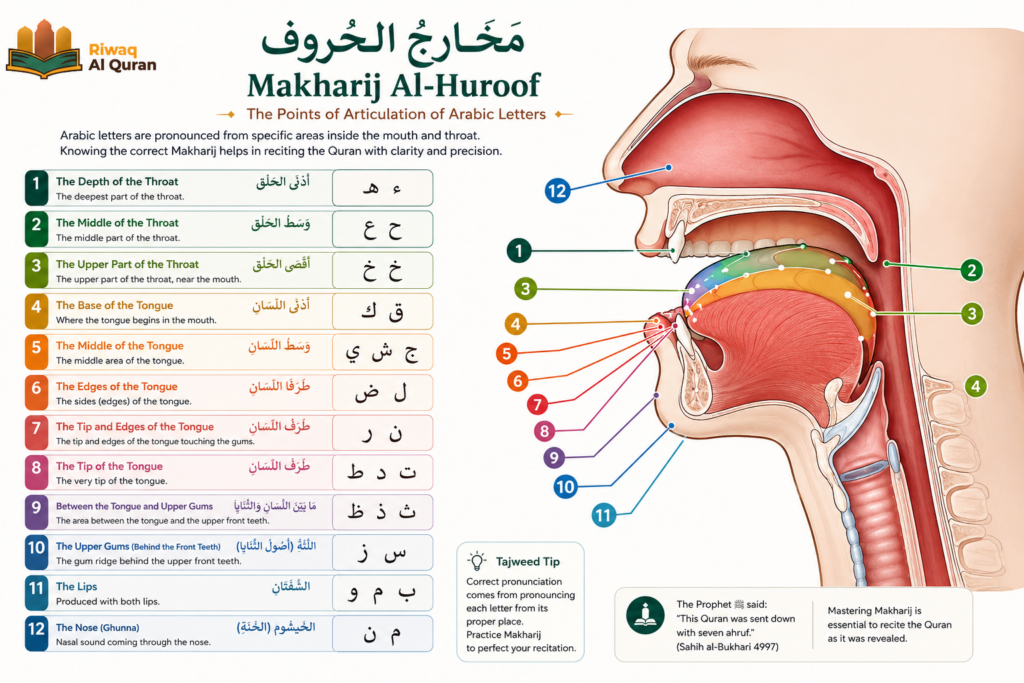
- Makharij (Points of Articulation): Every Arabic letter originates from a specific anatomical point in the mouth or throat. The letter ع (Ain) comes from deep in the throat — beginners frequently replace it with ا (Alif), producing a completely different sound and meaning. The letter ق (Qaf) is produced at the back of the tongue against the soft palate, not from the throat — a distinction that separates correct Arabic from approximate pronunciation. If you are struggling with these sounds, learning Quranic Arabic alongside your recitation practice will sharpen your ear significantly.
- Madd (Elongation): Vowel sounds must be stretched for precisely 2, 4, or 6 counts depending on surrounding letters and grammatical conditions. Shortening an obligatory Madd, or elongating one that should be short, are both Tajweed errors.
- Ghunna (Nasalisation): The letters Noon (ن) and Meem (م) carry a nasal resonance of 2 counts in specific conditions — Idgham, Ikhfa’, and Iqlab. Dropping the Ghunna is among the most common errors in self-taught recitation.
- Tafkheem and Tarqeeq (Heavy and Light Letters): Seven letters are always heavy (ص، ض، ط، ظ، غ، خ، ق); all others are generally light. The letter ر (Ra) and the word Allah (اللَّه) shift between heavy and light depending on the preceding vowel — a nuance that requires teacher correction to hear and internalise.
To master these rules in a structured environment, the Online Tajweed Classes at Riwaq Al Quran cover each of these areas progressively with certified tutors who correct errors in live sessions.
4. Understanding the Three Paces of Recitation
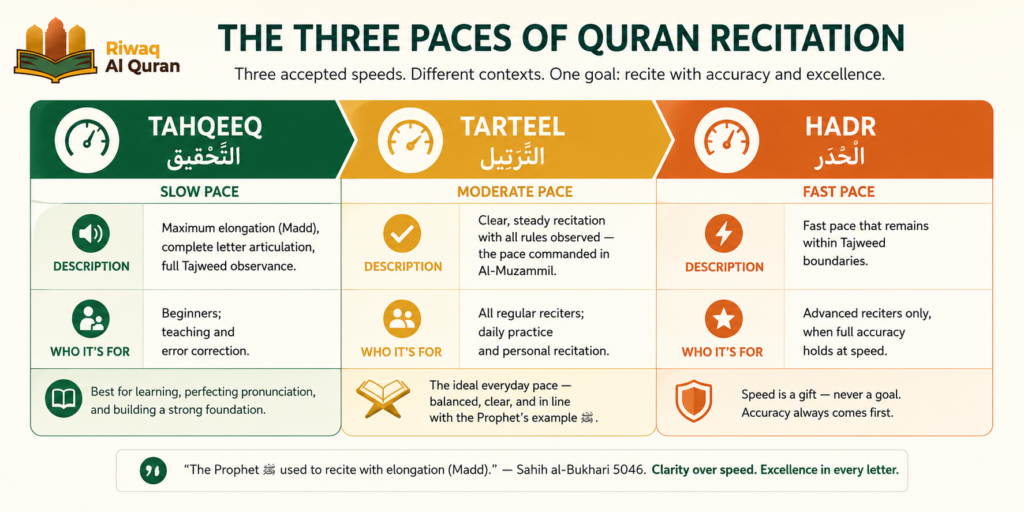
Most guides on Quran recitation advise a “moderate pace” without specifying what that means in practice. Islamic scholars classify Quranic recitation into three accepted speeds, each appropriate for a different context and level of proficiency.
The Prophet ﷺ himself modelled clarity and measured pace over speed. Anas ibn Malik (RA) was asked how the Prophet ﷺ recited and replied:
«كَانَ يَمُدُّ مَدًّا»
“He used to recite with elongation (Madd).”Narrated by Anas ibn Malik (RA) — Sahih al-Bukhari, Hadith 5046
Anas then demonstrated by reciting Bismillah — elongating the name Allah, elongating ar-Rahman, elongating ar-Raheem — showing that Madd was a defining feature of Prophetic recitation, not a stylistic choice. With this in mind, the three scholarly paces are:
| Pace | Arabic Name | Description | Who It’s For |
|---|---|---|---|
| Slow | الـتَّحقيق (Tahqeeq) | Maximum elongation, complete letter articulation, full Tajweed observance | Beginners; teaching and error correction |
| Moderate | التَّرتيل (Tarteel) | Clear, steady recitation with all rules observed — the pace commanded in Al-Muzammil | All regular reciters; daily practice |
| Fast | الـحَدر (Hadr) | Fast pace that remains within Tajweed boundaries | Advanced reciters only, when full accuracy holds at speed |
The most damaging mistake learners make is jumping to Hadr before Tahqeeq is solid. Speed without accuracy does not demonstrate fluency — it embeds errors that are significantly harder to correct later than errors made slowly.
5. Observing Waqf Signs for Proper Pauses
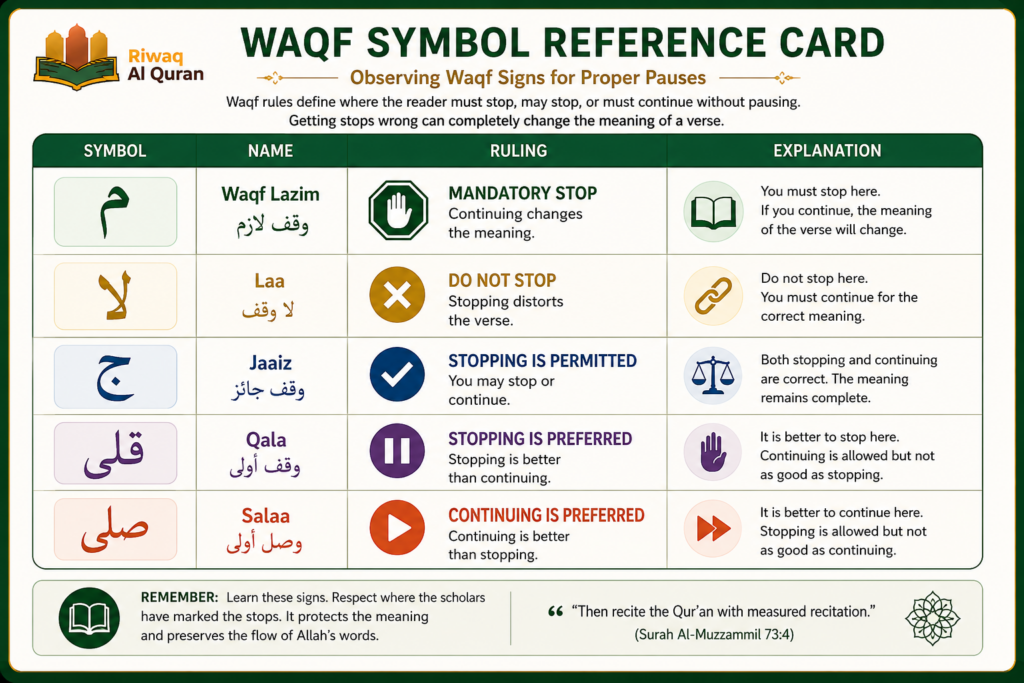
Waqf rules define where the reader must stop, may stop, or must continue without pausing. Getting stops wrong does not just break the flow — it can completely reverse the meaning of a verse. Most printed Mushafs include Waqf symbols printed above the text; the table below covers the ones every reader must recognise:
| Symbol | Name | Ruling |
|---|---|---|
| م | Waqf Lazim | Mandatory stop — continuing changes the meaning |
| لا | Laa | Do not stop — stopping distorts the verse |
| ج | Jaaiz | Stopping is permitted |
| قلى | Qala | Stopping is preferred over continuing |
| صلى | Salaa | Continuing is preferred over stopping |
A practical example of why this matters: stopping incorrectly in certain verses of Surah Al-Baqarah can turn a statement about the believers into a statement about the disbelievers. Waqf is not punctuation — it is meaning protection.
For a full study of the rules of stopping when reading the Quran, the dedicated guide covers every symbol and case in detail.
What Rewards Does Allah Promise Quran Reciters?
Understanding the rewards of recitation is not motivational padding — it is what makes consistent practice sustainable across a lifetime. The following are among the most authenticated hadiths on the subject, and knowing them changes how a reader approaches every single session.
A. Ten Good Deeds for Every Letter Recited
The Prophet ﷺ did not leave the reward for reciting the Quran vague or open to interpretation — he specified it with extraordinary precision, and the number is greater than most people expect.
«مَنْ قَرَأَ حَرْفًا مِنْ كِتَابِ اللَّهِ فَلَهُ بِهِ حَسَنَةٌ، وَالْحَسَنَةُ بِعَشْرِ أَمْثَالِهَا، لَا أَقُولُ الم حَرْفٌ، وَلَكِنْ أَلِفٌ حَرْفٌ، وَلَامٌ حَرْفٌ، وَمِيمٌ حَرْفٌ»
“Whoever recites a letter from Allah’s Book receives one good deed for it, and that good deed is multiplied by ten. I do not say that Alif-Lam-Mim is one letter — Alif is a letter, Lam is a letter, and Mim is a letter.”Narrated by Abdullah ibn Masud (RA) — Jami at-Tirmidhi, Hadith 2910
The Prophet ﷺ went out of his way to clarify the counting method: each individual letter carries ten rewards — not each word, not each verse. A beginner reading Surah Al-Fatiha (approximately 140 letters) accumulates 1,400 good deeds in a single recitation.
The implication for consistent daily practice — even a brief five-minute session — is profound.
B. The Skilled Reciter and the Double Reward for Those Who Struggle
One of the most common reasons people delay engaging with the Quran is the belief that they must first reach a certain level of proficiency before their recitation counts. The Prophet ﷺ addressed this concern directly — and his answer removes every excuse to wait.
«الْمَاهِرُ بِالْقُرْآنِ مَعَ السَّفَرَةِ الْكِرَامِ الْبَرَرَةِ، وَالَّذِي يَقْرَأُ الْقُرْآنَ وَيَتَتَعْتَعُ فِيهِ، وَهُوَ عَلَيْهِ شَاقٌّ، لَهُ أَجْرَانِ»
“The one who is proficient in the recitation of the Quran will be with the honourable, obedient scribes (angels). And the one who recites the Quran and struggles with it, finding it difficult, will have a double reward.”Narrated by Aisha (RA) — Sahih Muslim, Hadith 798
This hadith resolves the anxiety most new readers carry — the feeling that imperfect, halting recitation is not good enough. The Prophet ﷺ addresses that directly: struggle is not a reason to delay; it is itself a source of doubled reward.
The person who finds it easy and the person who finds it hard are both honoured — in entirely different ways. If you are currently finding it difficult, that difficulty is worth something in the sight of Allah. Begin now, and let the reward accumulate.
C. The Best Muslims Are Those Who Learn and Teach the Quran
Among all the qualities by which a person could be called “the best,” the Prophet ﷺ singled out one above the rest — not scholarship, not lineage, not acts of worship in isolation, but a living, continuous relationship with the Quran: learning it and passing it on.
«خَيْرُكُمْ مَنْ تَعَلَّمَ الْقُرْآنَ وَعَلَّمَهُ»
““The best among you is the one who learns the Quran and teaches it.”Narrated by Uthman ibn Affan (RA) — Sahih al-Bukhari, Hadith 5027
Excellence here is defined not by birth, wealth, or status — but entirely by relationship with the Quran. Importantly, the statement pairs learning with teaching: one who learns and keeps the knowledge to themselves is not fulfilling the complete form of this virtue.
This is one of the classical scholarly justifications for the unbroken chain of Quran transmission (Isnad) that continues to this day — each generation transmitting to the next, exactly as it was received.
Manners and Etiquettes of Reciting the Quran
The etiquettes of reading the Quran are not required for the recitation to be valid — but they determine whether recitation becomes a mechanical habit or an act of worship. Allah addresses the spirit of these etiquettes directly:
﴿وَإِذَا قُرِئَ الْقُرْآنُ فَاسْتَمِعُوا لَهُ وَأَنصِتُوا لَعَلَّكُمْ تُرْحَمُونَ﴾
“And when the Quran is recited, listen to it and pay attention that you may receive mercy.”(Al-A’raf, 7:204)
The verse links attentiveness directly to mercy (تُرْحَمُونَ). The condition for receiving that mercy is not simply being present while the Quran plays — it is active listening (اسْتَمِعُوا) and focused silence (أَنصِتُوا). This is the Quranic basis for eliminating all distractions before and during recitation.

1. Choosing the Right Place and Sitting Position
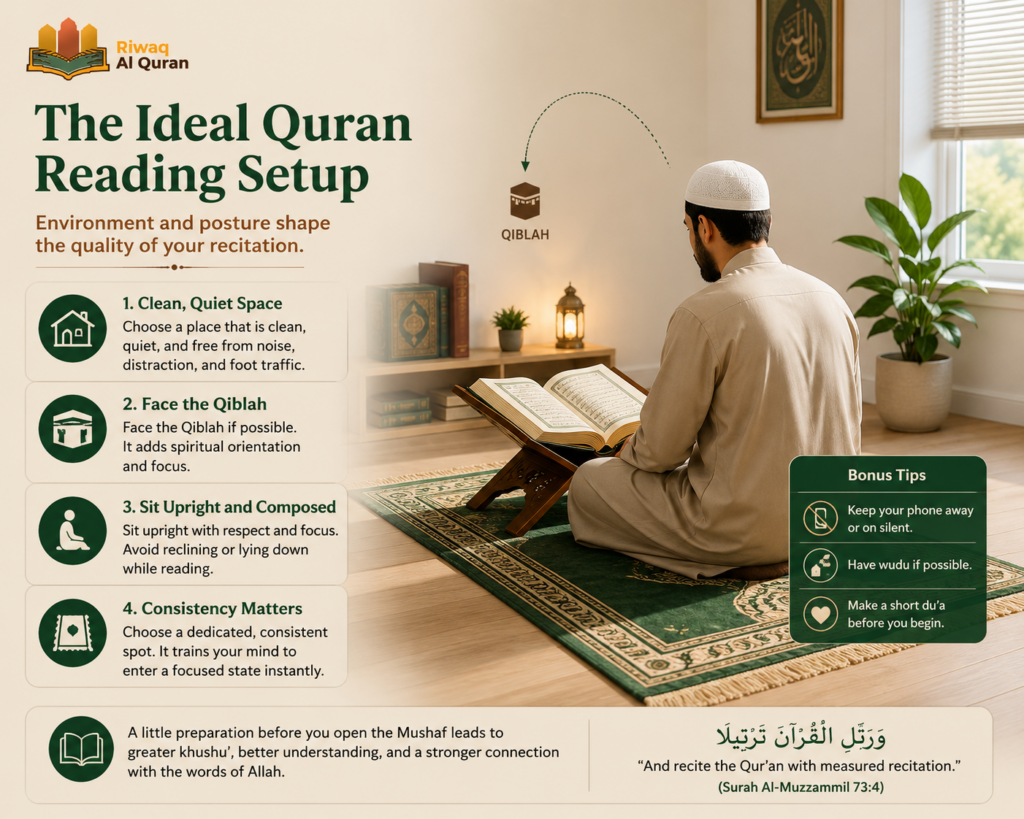
The environment and posture you choose before opening the Mushaf directly shape the quality of your recitation session. Scholars describe the following as best practice:
- Sit in a clean, quiet space — free from noise, foot traffic, and visual distraction.
- Face the Qiblah if possible — it adds spiritual orientation and focus, even though it is not obligatory.
- Sit upright and composed — not reclining or lying down, which scholars generally consider disrespectful for deliberate recitation. For a detailed discussion on the correct way to sit while reading the Quran, the dedicated guide covers the scholarly positions.
- Choose a dedicated, consistent spot — a specific space trains the mind to shift into a focused state immediately upon sitting, the same way a study corner conditions concentration.
2. Holding and Placing the Quran with Respect
How the Mushaf is handled communicates the reverence the reader holds for it. The following practices are recommended by scholars:
- Hold the Mushaf in the right hand, or supported in both hands — following the Prophetic practice of using the right hand for honourable acts.
- When resting the Mushaf, place it on an elevated surface — a Quran stand (Rihal), a clean cushion, or any clean raised position.
- Never place the Quran on the floor.
- Never stack other books or objects on top of the Quran.
These are not superstitions — they are expressions of the Quran’s status as the highest-ranked text in existence. Treating it accordingly is itself an act of worship.
3. Reflecting on the Meaning of Each Verse (Tadabbur)
Tadabbur — reciting with reflection on the meaning — is the highest level of engagement with the Quran. Allah makes this an expectation, not an optional pursuit:
﴿أَفَلَا يَتَدَبَّرُونَ الْقُرْآنَ وَلَوْ كَانَ مِنْ عِندِ غَيْرِ اللَّهِ لَوَجَدُوا فِيهِ اخْتِلَافًا كَثِيرًا﴾
Then do they not reflect upon the Quran? If it had been from other than Allah, they would have found within it much contradiction.”(An-Nisa, 4:82)
The verse is phrased as a mild rebuke — “do they not reflect?” — implying that failing to engage with the meaning is a shortcoming worth questioning. Tadabbur does not require advanced Arabic. Even a reader still learning can practise it through these simple responses:
- Upon reaching a verse of mercy — pause and ask Allah for that mercy.
- Upon reaching a verse of punishment — seek refuge with Allah.
- Upon reaching a verse of command — renew your intention to act on it.
“عن عبدالله بن مسعود رضي الله عنه قال: قال لي النبيُّ ﷺ: «اقرأ عليَّ». قلتُ: يا رسولَ اللهِ، أقرأُ عليكَ وعليكَ أُنزل؟! قال: «نعم». فقرأتُ سورةَ النساءِ حتى أتيتُ إلى هذه الآيةِ: ﴿فَكَيْفَ إِذَا جِئْنَا مِن كُلِّ أُمَّةٍ بِشَهِيدٍ وَجِئْنَا بِكَ عَلَىٰ هَٰؤُلَاءِ شَهِيدًا﴾، قال: «حسبُكَ الآن». فالتفتُّ إليه فإذا عيناه تذرفانِ””﴿فَكَيْفَ إِذَا جِئْنَا مِن كُلِّ أُمَّةٍ بِشَهِيدٍ وَجِئْنَا بِكَ عَلَىٰ هَٰؤُلَاءِ شَهِيدًا﴾
“The Prophet ﷺ himself modelled this depth of engagement. When he asked Ibn Masud (RA) to recite and Ibn Masud reached the verse “So how will it be when We bring from every nation a witness and bring you against these as a witness?” (An-Nisa, 4:41) — the Prophet ﷺ said: “Enough.” Ibn Masud looked up and saw that his eyes were overflowing with tears. (Sahih al-Bukhari, Hadith 5055 )
The Quran is not information to be processed. It is a living address from Allah to every reader in every generation.
4. Performing Sajdah Al-Tilawah When Required
Fourteen positions in the Quran carry a Sajdah (prostration) mark. When the reader recites or hears one of these verses, the following sequence applies:
- Pause recitation immediately.
- Face the Qiblah and ensure you are in a state of purity.
- Perform a brief prostration saying: سُبْحَانَ رَبِّيَ الْأَعْلَى (Subhana Rabbiya Al-A’la)
- Rise and continue recitation from where you paused.
Scholars recommend performing Sajdah Al-Tilawah immediately rather than delaying — forgetting it later is common, and delaying it unnecessarily is contrary to the recommended practice.
5. Closing the Session with Gratitude and Supplication
A recitation session should end as deliberately as it begins. The following closing practice is recommended by scholars:
- Praise Allah for granting you access to His Book.
- Recite: صَدَقَ اللَّهُ الْعَظِيمُ — Sadaqa Allah Al-Azeem — “Allah the Magnificent has spoken the truth.”
- Close with personal Dua drawn from what you just recited — if you read about mercy, ask for it; if about forgiveness, request it.
Closing this way transforms a recitation session into a complete act of worship — from the opening Istiaazah to the closing Dua.
Pre-Reading Checklist – What to Do Before Reading the Quran
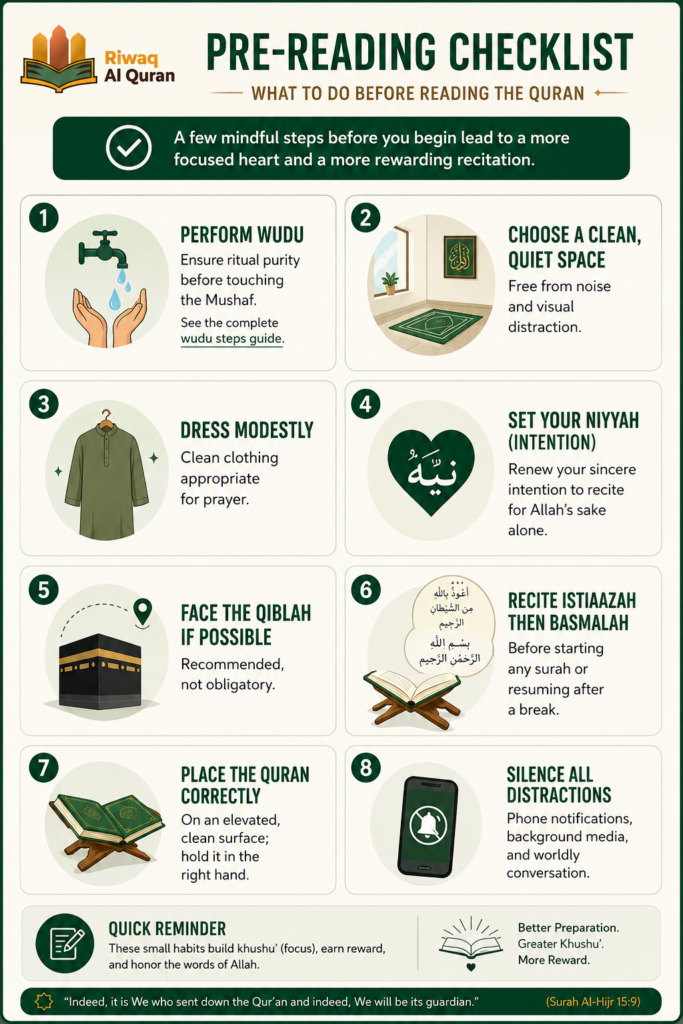
Running through this checklist takes less than two minutes and ensures every session begins in the correct state — spiritually, physically, and mentally. Apply it before every sitting, whether reading for five minutes or an hour:
- Perform Wudu — ensure ritual purity before touching the Mushaf. See the complete wudu steps guide if you need a refresher.
- Choose a clean, quiet space — free from noise and visual distraction.
- Dress modestly — clean clothing appropriate for prayer.
- Set your Niyyah (intention) — renew your sincere intention to recite for Allah’s sake alone.
- Face the Qiblah if possible — recommended, not obligatory.
- Recite Istiaazah then Basmalah — before starting any surah or resuming after a break.
- Place the Quran correctly — on an elevated, clean surface; hold it in the right hand.
- Silence all distractions — phone notifications, background media, and worldly conversation.
Can You Read the Quran on a Phone Without Wudu?
Digital Quran apps are now among the most common tools for daily recitation — yet most etiquette guides were written before smartphones existed. The scholarly consensus on this is well-established, and every digital reader should know it.
The ruling: The majority of contemporary scholars — including the Islamic Fiqh Academy and leading scholars across all four Sunni schools — hold that wudu is not obligatory to touch a phone or tablet displaying the Quran.
The device is not the Mushaf itself; it is an electronic screen that also runs other applications, carrying Quran text temporarily rather than as its dedicated permanent function. Wudu is, however, strongly recommended as a mark of respect and focused intention.
What remains fully required when reading the Quran on a device:
- Reciting Istiaazah and Basmalah before starting — this does not change based on the medium.
- Following all Tajweed rules — the screen does not change the rules of articulation or pronunciation.
- Avoiding disrespectful environments — the ruling on not reading the Quran in the bathroom applies to digital reading as it does to the physical Mushaf.
- Giving the session full attention — silence other notifications and approach the digital session with the same focus you would give the physical Mushaf.
One practical note for digital readers: scrolling past open Quran verses in the background does not constitute recitation. Once you begin reading intentionally, all etiquettes apply — regardless of the device.
Common Mistakes When Reading the Quran and How to Fix Them
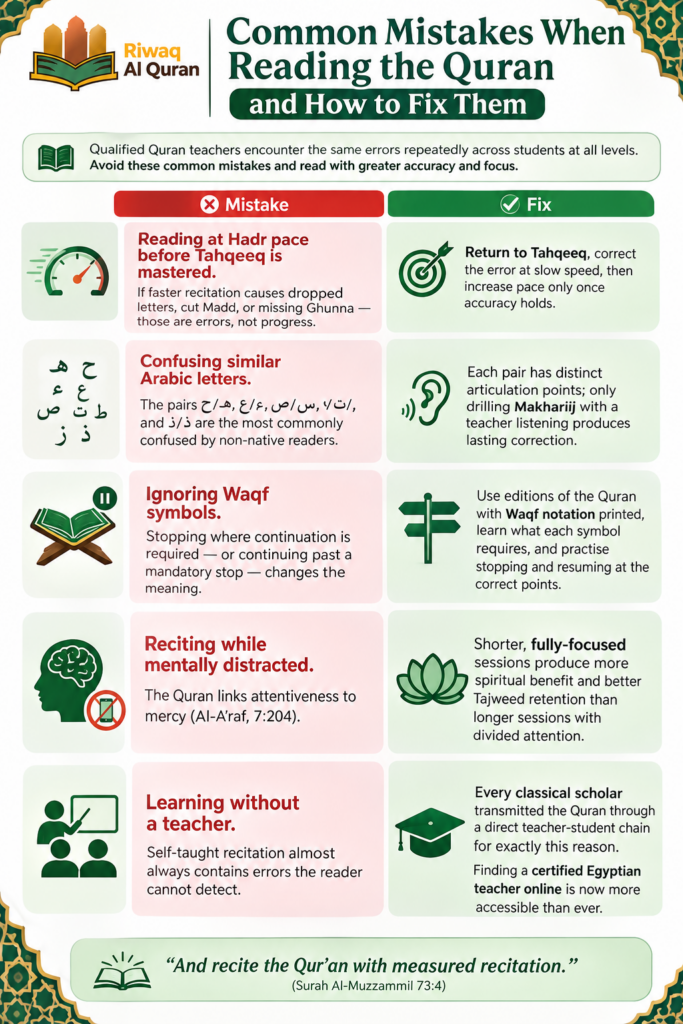
Qualified Quran teachers encounter the same errors repeatedly across students at all levels. For a foundational overview of how to read the Quran from scratch, the full guide covers the starting approach. The mistakes below are what prevent most readers from advancing:
- Reading at Hadr pace before Tahqeeq is mastered. If faster recitation causes dropped letters, cut Madd, or missing Ghunna — those are errors, not progress. The fix: return to Tahqeeq, correct the error at slow speed, then increase pace only once accuracy holds.
- Confusing similar Arabic letters. The pairs ح/هـ, ع/ء, س/ص, ط/ت, and ذ/ز are the most commonly confused by non-native readers. Each pair has distinct articulation points; only drilling Makharij with a teacher listening produces lasting correction.
- Ignoring Waqf symbols. Stopping where continuation is required — or continuing past a mandatory stop — changes the meaning. Use editions of the Quran with Waqf notation printed, learn what each symbol requires, and practise stopping and resuming at the correct points.
- Reciting while mentally distracted. The Quran links attentiveness to mercy (Al-A’raf, 7:204). Shorter, fully-focused sessions produce more spiritual benefit and better Tajweed retention than longer sessions with divided attention.
- Learning without a teacher. Self-taught recitation almost always contains errors the reader cannot detect — because they have no accurate reference point for what correct sounds like. Every classical scholar transmitted the Quran through a direct teacher-student chain for exactly this reason. Finding a certified Egyptian teacher online is now more accessible than ever.
What the Quran Promises Those Who Recite It Consistently
The Quran does not leave the dedicated reciter without a direct promise. For those who commit to regular, respectful recitation, Allah states:
﴿إِنَّ الَّذِينَ يَتْلُونَ كِتَابَ اللَّهِ وَأَقَامُوا الصَّلَاةَ وَأَنفَقُوا مِمَّا رَزَقْنَاهُمْ سِرًّا وَعَلَانِيَةً يَرْجُونَ تِجَارَةً لَّن تَبُورَ﴾
“Indeed, those who recite the Book of Allah and establish prayer and spend from what We have provided them, secretly and publicly, expect a transaction that will never perish.”(Fatir, 35:29)
Classical commentators identified a deliberate sequence within Fatir 35:29 that modern readers often pass over. The verse names three actions together: reciting the Book, establishing prayer, and spending from what has been provided. Ibn Kathir notes that these three are not listed arbitrarily — they represent the three primary relationships a believer maintains: with the Word of God, with God directly through prayer, and with creation through charity.
What is significant for the purpose of recitation is that tilawah (recitation) is listed first. In classical Arabic rhetorical convention, the opening position in a sequence signals primacy. Scholars of Quranic sciences (uloom al-Quran) have noted this as an indication that sustained engagement with the Quran forms the foundation upon which the other acts of worship are built and sustained.
Al-Sa’di, in his widely referenced Tayseer al-Kareem al-Rahman, adds that the phrase yatloona kitaab Allah implies the reciter has internalized the Quran as a reference point for life — not merely completing it as a ritual exercise. The “transaction that will never perish” (tijaarah lan taboor), in his reading, is precisely this integration: the Quran becomes a permanent asset in the reciter’s character, knowledge, and standing before God.
For those looking to learn the Quran quickly and effectively, consistency is the single most important variable — quality of attention over quantity of time.
Start Reciting the Quran Correctly — With a Certified Tutor
Reading rules in a guide and reading the Quran correctly are two different things. Accurate recitation requires real-time feedback from someone qualified to hear the difference between a correct and an incorrect letter.
Riwaq Al Quran is a comprehensive online platform offering personalised Quran, Arabic, and Islamic Studies classes for individuals of all ages and backgrounds. Certified Egyptian tutors use a structured curriculum covering Tajweed, Tafsir, and Memorisation — with live one-on-one sessions that allow seamless correction and interaction at every level.
Hear directly from our students about how Riwaq Al Quran Academy has transformed their connection with the Book of Allah:
Whatever your starting point, the following courses are available:
- Online Quran Recitation Course — structured recitation training for all levels, with Tajweed correction in every session.
- Online Tajweed Classes — master the rules of Tajweed for accurate, beautiful recitation with a certified instructor.
- Online Tafseer Course — explore the depths of Quranic meaning through expert-guided Tafseer study.
- Noorani Qaida Online — the foundational programme for learning Quranic letter pronunciation from zero.
- Quran Memorisation Online Course — structured memorisation with daily revision accountability and teacher guidance.
- Online Qirat Course — explore the ten accepted styles of Quranic recitation with an experienced specialist.
- Online Quran Classes for Kids — interactive, age-appropriate sessions that build a love for the Quran from an early age.
Your first class is free. No commitment required.

Conclusion
The rules of reading the Quran form a complete system, grounded in direct Quranic commands and authenticated Prophetic hadiths. The mandatory rules — wudu, Tajweed, Waqf, Istiaazah, Basmalah — protect the accuracy and sanctity of the text. The recommended etiquettes — posture, Tadabbur, Sajdah Al-Tilawah, and closing with gratitude — determine whether each session is a mechanical act or genuine worship.
The rewards attached to consistent, correct recitation are specific and significant: ten good deeds per letter, the company of honourable angels for the proficient reciter, and doubled reward for those who struggle sincerely. Allah promises a return that will never perish for those who make recitation a consistent practice.
The most impactful change most readers can make is to slow down — master Tahqeeq before Tarteel, and leave Hadr until accuracy is genuinely solid. Pair that with a qualified teacher who can hear what you cannot, and consistent improvement follows faster than most learners expect. Whether you are taking your first steps as a beginner or working toward memorising the Quran without forgetting, the foundation is always the same: correct rules, sincere heart, consistent practice.
Frequently Asked Questions
The questions below address the most common concerns readers have when learning the rules and etiquettes of Quran recitation — from the obligatory to the practical, including modern rulings on digital reading that most traditional guides have not yet caught up with.
What are the rules of reading the Quran?
The rules of reading the Quran include performing wudu before touching the Mushaf, reciting Istiaazah and Basmalah before starting, following Tajweed rules for accurate pronunciation, and observing Waqf signs to preserve the meaning of each verse. These are obligatory. Etiquettes such as sitting respectfully, practising Tadabbur, and dressing modestly are strongly recommended.
Is wudu required to read the Quran from a phone or tablet?
No — the scholarly majority holds that wudu is not obligatory to touch a phone or tablet displaying the Quran, since the device is not the Mushaf itself. However, wudu is strongly recommended as a sign of respect, and all recitation rules — Tajweed, Istiaazah, Basmalah, and choosing a respectful environment — apply fully when reading digitally.
What should I recite before reading the Quran?
Before reading the Quran, recite Istiaazah — أَعُوذُ بِاللَّهِ مِنَ الشَّيْطَانِ الرَّجِيمِ — followed by Basmalah — بِسْمِ اللَّهِ الرَّحْمَٰنِ الرَّحِيمِ. Allah commands this directly in An-Nahl (16:98): “So when you recite the Quran, seek refuge in Allah from Satan, the expelled.”
What is the difference between Tarteel and Hadr in Quran recitation?
Tarteel is a moderate, measured pace — commanded in Al-Muzammil (73:4) — with clear letter articulation and full Tajweed observance. Hadr is a faster pace valid only for advanced reciters who can maintain complete accuracy at that speed. All learners should begin with Tahqeeq (slowest, most detailed) before progressing to Tarteel. Listening to famous Quran reciters — such as Abdul Rahman Al-Sudais and Mishary Rashid Al-Afasy — gives you an accurate reference point for what correct Tarteel sounds like.
Does a struggling reciter still receive reward for reading the Quran?
Yes — and doubled reward. The Prophet ﷺ said: “The one who recites the Quran and struggles with it, finding it difficult, will have a double reward.” (Sahih Muslim, Hadith 798). Struggle with sincerity and correct effort is honoured in Islam — it is not a reason to delay starting.
How long does it take to learn to read the Quran correctly?
A complete beginner who studies three times a week with a qualified tutor typically reaches independent reading ability within 6 to 12 months. The most important variable is not age — it is the consistency of practice and the presence of a teacher who actively corrects errors before they become habits. Children progress quickly due to phonetic flexibility, but adults who practise consistently close the gap faster than most expect.