The best Quran reciters in the world combine three things at once: technical mastery of Tajweed, a voice that holds emotional weight, and a legacy that outlasts their own recitation career. Some names on this list stopped reciting decades ago and are still the reference point millions of students learn from today; others are actively building that same kind of reach right now.
This guide covers ten of the most significant reciters across generations — three classical figures whose recordings remain a teaching standard, and seven contemporary voices reaching global audiences through streaming and social platforms. Allah instructs believers directly on how to receive recitation:
(وَإِذَا قُرِئَ ٱلْقُرْءَانُ فَٱسْتَمِعُوا۟ لَهُۥ وَأَنصِتُوا۟ لَعَلَّكُمْ تُرْحَمُونَ)
“When the Quran is recited, listen to it and be silent, so that you may receive mercy.” (Surah Al-A’raf, 7:204)
A skilled reciter’s role is to make that listening experience as clear and moving as possible — which is exactly the standard used to judge the ten reciters below.
A Qari earns lasting recognition through a specific combination of qualities, not one skill alone: technically accurate Tajweed applied consistently rather than only in showcase moments, a distinctive voice listeners recognize instantly, recordings that continue to be used by students long after the reciter’s own career ends, and a style suited to at least one clear purpose — memorization, reflection, or public broadcast.
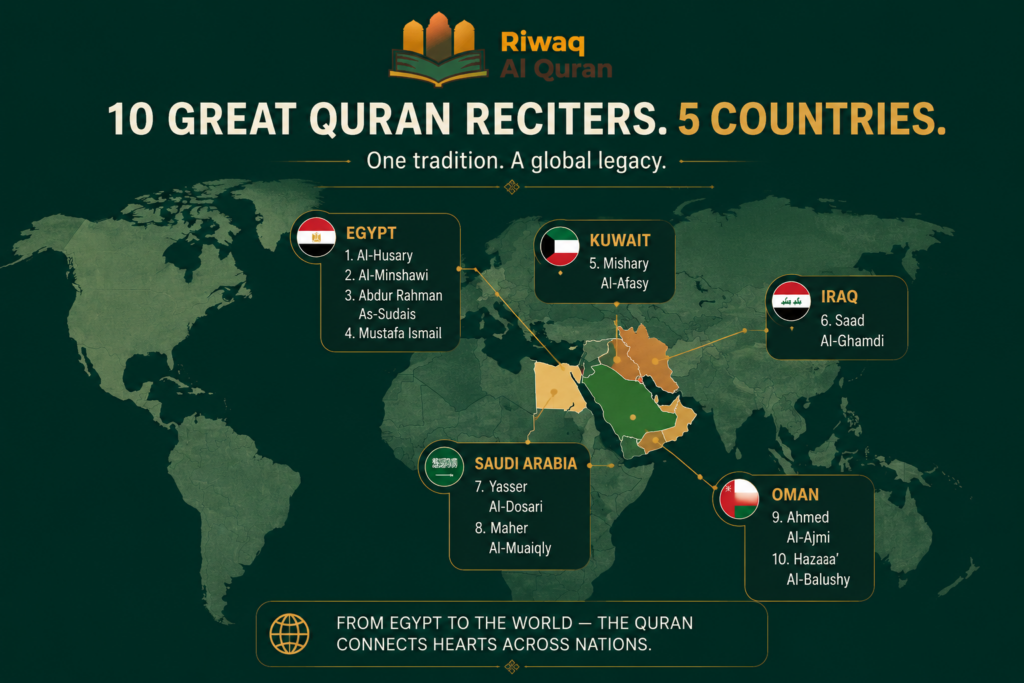
Table of Contents
Classical Reciters Whose Recordings Remain a Reference Standard
These three Egyptian reciters, all active in the mid-twentieth century, are still the names most commonly recommended to students learning Tajweed today, decades after their passing.
Their recordings, made well before the era of digital streaming, remain in constant circulation precisely because later generations haven’t produced anything that replaces them as a teaching reference.
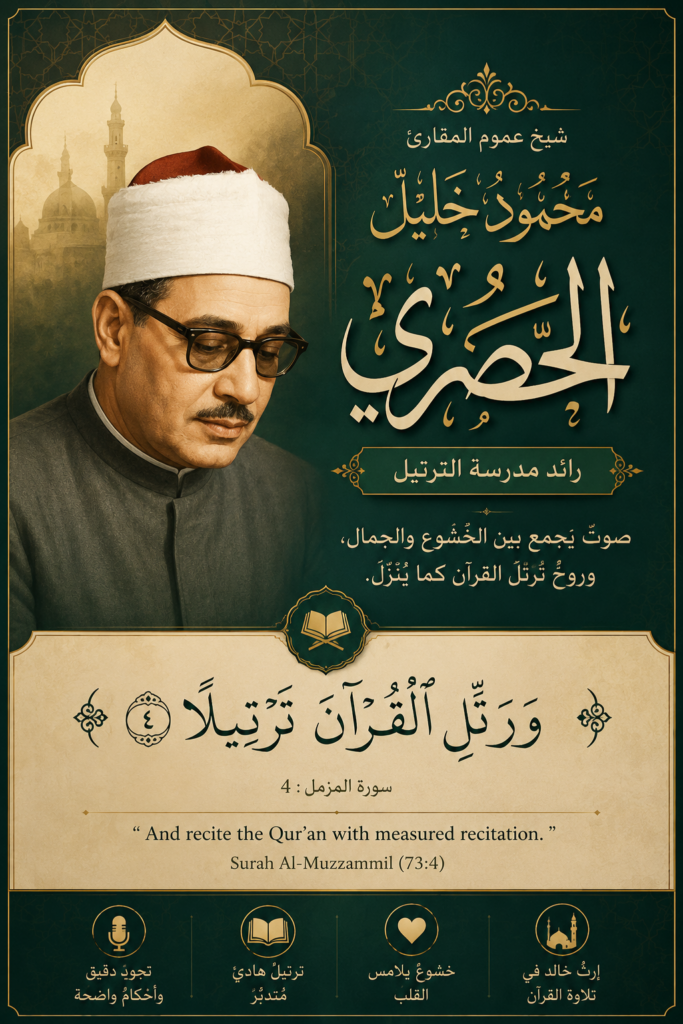
1. Sheikh Mahmoud Khalil Al-Husary (1917–1980)
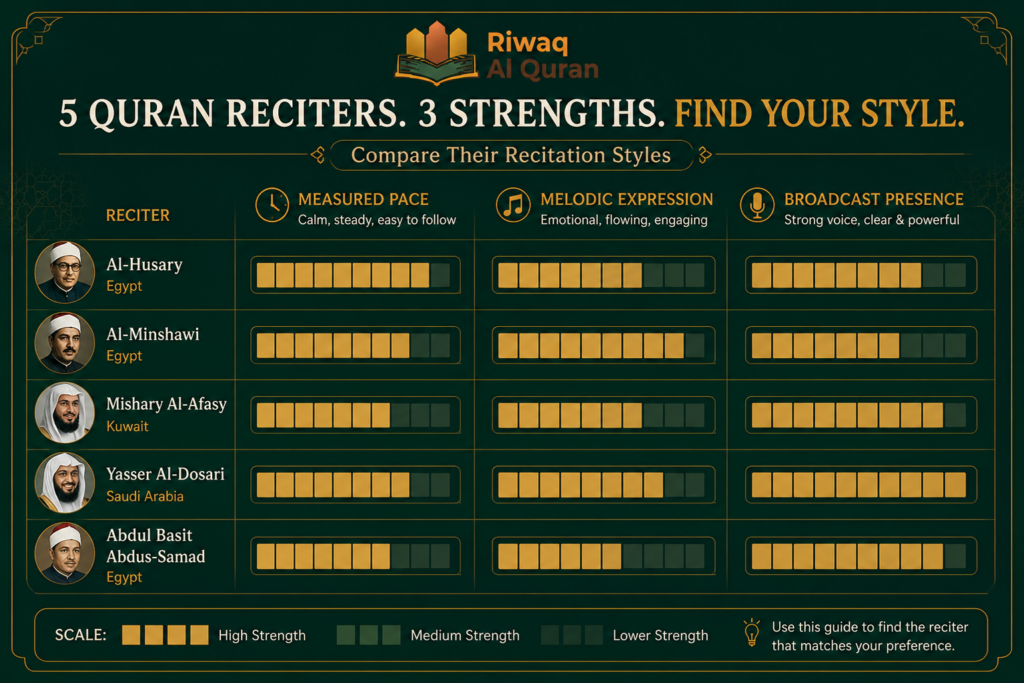
Al-Husary’s recitation is built around precision rather than ornamentation, prioritizing tarteel — a measured, textually faithful style — over musical embellishment.
This is exactly why his recordings remain the most widely used reference for Quran memorization worldwide, since a slower, clearer delivery makes individual letters and Tajweed rules far easier to isolate and study.
- Al-Azhar formally recognized this precision, awarding him the title Sheikh al-Maqāri’ (شـيخ المقارِئ, “Scholar of the Reciting Schools”) in 1957.
- He was elected President of the Islamic World League of Quran Reciters in 1967.
- He recited before international audiences, including at the United Nations and Buckingham Palace, carrying the Egyptian recitation tradition to a global stage.
- You can listen to his recitations on his official YouTube channel or at this website.
If Al-Husary’s precision is the standard you want to build toward, the Online Tajweed Classes are built specifically around mastering that same letter-by-letter accuracy.
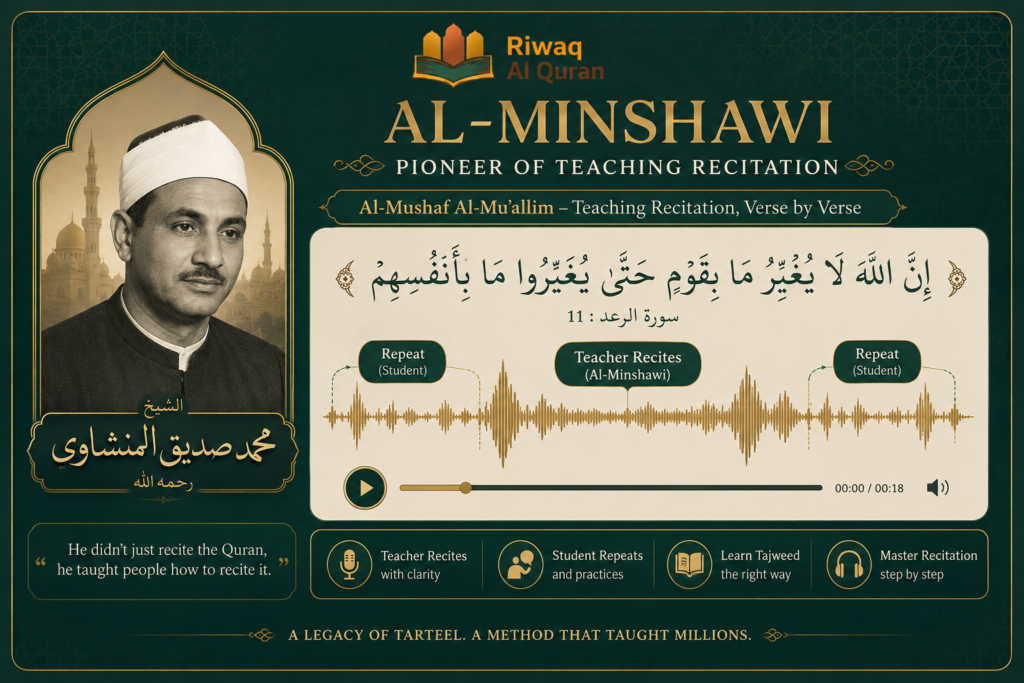
2. Sheikh Muhammad Siddiq Al-Minshawi (1920–1969)
Al-Minshawi’s style leans more expressive and animated than Al-Husary’s, which makes his recordings a common choice for students who want to hear how correct Tajweed and emotional delivery can work together rather than in tension with each other.
- He came from a family of huffaz (Quran memorizers), calligraphers, and Qaris, giving him a recitation grounding from an early age.
- He recorded Al-Mushaf Al-Mu’allim (المصحف المعلم), a teaching recitation with children repeating each verse after him — a resource still used directly in Quran memorization classes today.
- Despite dying at only 49, his recordings remain among the most referenced in the Muslim world.
- His full collection of recordings, including Al-Mushaf Al-Mu’allim, is available at this website.
3. Sheikh Abdul Basit Abdus-Samad (1927–1988)
Abdul Basit’s recitation is often described as blending elements of both Al-Husary’s precision and Al-Minshawi’s expressiveness, which is part of why he’s remembered as one of the most technically complete reciters of his generation.
- His breath control and vocal range earned him the titles “Voice of Heaven” (كروان الجنة) and “Golden Throat” (صاحب الحنجرة الذهبية).
- He came from a family of Quran reciters, giving him early, sustained exposure to Tajweed training.
- His consistency across recordings makes his recitation a common reference point for students checking their own memorization against a fixed rendition.
- His mujawwad-style recitations are available at this website.
Learning from reciters like these is a strong first step, but understanding why a specific Tajweed rule is applied the way it is takes direct instruction.
Contemporary Reciters Reaching a Global Audience
Alongside the classical Egyptian tradition, a newer generation of reciters — mostly from the Arabian Peninsula — has built global audiences through streaming platforms and social media, reaching listeners who may never have encountered a physical cassette recording.
Each brings a distinct regional style shaped by where they trained and where they now lead prayer.
4. Sheikh Mishary Rashid Alafasy (Born 1976)
Alafasy, a Kuwaiti reciter, blends classical Tajweed discipline with a clear, contemporary vocal style that has made him one of the most widely streamed reciters among younger listeners, both Muslim and non-Muslim.
His full archive of recitations is hosted on his official website, and he also posts regularly on his YouTube channel, often introducing new listeners to Quran recitation for the first time.
5. Sheikh Saad Al-Ghamdi (Born 1967)
Al-Ghamdi, a Saudi reciter, is known specifically for a calm, unhurried delivery, which makes his recordings a common choice for listeners seeking a soothing rather than highly melodic recitation.
His recitations can be found on his YouTube channel and at this website, often used for late-night or reflective listening rather than public broadcast.
6. Sheikh Yasser Al-Dosari (Born 1980)
Al-Dosari, also Saudi, has built a large following through an expressive recitation style that pairs clarity with emotional depth, making him a frequent presence in Ramadan Taraweeh broadcasts from Saudi Arabia.
His recitations are available on YouTube and at this website, and he’s a reciter many associate specifically with the Ramadan night-prayer experience.
7. Sheikh Ahmed Al-Ajmi (Born 1968)
Al-Ajmi, a Kuwaiti reciter, is recognized for combining emotional delivery with consistent clarity.
His recordings circulate widely across his YouTube channel, this website, and Islamic radio streams, giving him reach across both younger, app-based listeners and older, radio-based audiences.
8. Sheikh Maher Al-Mu’aiqly (Born 1969)
Al-Mu’aiqly, a Saudi reciter and Imam, is known for a rhythmic, heartfelt delivery that many listeners describe as particularly effective for reflection during longer recitation sessions.
His recitations are available on YouTube and on Islamic radio, a style shaped in part by his role leading extended prayers in an official capacity.
9. Sheikh Ra’ad Muhammad Al-Kurdy (Born 1991)
Al-Kurdy, an Imam and Qari from Kurdistan, Iraq, has built a substantial following particularly among younger audiences and new Muslims, largely through his YouTube channel and this website, reflecting how the newest generation of reciters is reaching listeners differently than their predecessors.
10. Sheikh Hazaa’ Al-Balushy (Born 1995)
Al-Balushy, a reciter from Oman, represents the youngest generation on this list, known for a passionate delivery style that has grown his audience quickly on his YouTube channel and at this website in recent years — a sign that the tradition’s center of gravity is expanding well beyond its historical Egyptian and Saudi hubs.
If one of these contemporary styles is the one that keeps you focused during recitation, that’s worth building on directly.
Why These Reciters Are Considered the Best?
A Qari (Quran reciter) earns lasting recognition through a specific combination of qualities, not one skill alone:
- Technically accurate Tajweed, applied consistently rather than only in showcase moments.
- A distinctive, emotionally resonant voice that listeners recognize instantly.
- Recordings that continue to be used by students long after the reciter’s own career ends.
- A recitation pace and style suited to at least one clear purpose — memorization, reflection, or public broadcast.
All ten reciters on this list meet this bar in different ways, from strict adherence to tarteel (measured, unembellished recitation) to more melodically expressive approaches.
Strengthen Your Own Recitation With Riwaq Al Quran
Listening to these reciters is a starting point — building the same clarity and confidence in your own recitation takes a tutor who can correct you directly, in real time, rather than leaving you to compare your voice against a recording on your own.
Riwaq Al Quran pairs you with qualified, native-speaking instructors across a full curriculum built around exactly what these reciters demonstrate: precision, memorization, and meaning.

Depending on where you want to start, you can move directly into the course that fits your goal:
- Online Tajweed Classes — master the pronunciation rules that separate a technically correct reciter from one who’s just fast
- Online Quran Recitation Course — build your own recitation skill and confidence with expert-led, one-on-one sessions
- Quran Memorization Online Course — commit the Quran to memory with a structured, sustainable pace
- Online Qirat Course — explore the different Qirat styles the reciters above draw from
- Online Tafseer Course — go beyond the sound of the words into what they actually mean
- Online Quran Classes for Kids — start children on the same foundation early, with instructors trained specifically for younger learners
Every course is taught live, one-on-one or in small groups, by native-speaking instructors — with a free trial lesson before you commit to anything.
Conclusion
The best Quran reciters in the world span two different eras and two different strengths: the classical Egyptian tradition of Al-Husary, Al-Minshawi, and Abdul Basit, whose recordings remain a teaching reference decades later, and a newer generation of Saudi, Kuwaiti, Iraqi, and Omani reciters reaching global audiences through streaming and video.
What connects all ten is the same underlying standard — accurate Tajweed paired with a voice capable of holding a listener’s attention through the meaning of the words, not just their sound.
Listening across both generations is also the fastest way to discover your own preference before committing to a learning path:
- If you’re drawn to Al-Husary’s measured tarteel, you’re usually chasing precision — a slower, rule-focused foundation is the right starting point.
- If you gravitate toward Al-Dosari’s or Alafasy’s more expressive delivery, you’re often looking for an emotional entry point into the Quran first, with technical mastery following after.
- Neither path is wrong — they’re simply two different starting points toward the same goal.
Whichever style resonates with you, the reciters on this list are a reference point, not a replacement for guided practice.
FAQs
The questions below cover what people most often search after reading a list like this — from who holds the largest audience today, to how to actually pick a starting point for your own learning.
Who is the most listened-to Quran reciter in the world?
Sheikh Abdul Rahman Al-Sudais, imam of the Grand Mosque in Mecca, is widely regarded as one of the most listened-to Quran reciters globally, alongside contemporary reciters like Mishary Rashid Alafasy and Maher Al-Mu’aiqly, largely due to broadcast reach from the Grand Mosque and wide distribution on streaming platforms.
Who has the most beautiful voice for Quran recitation?
This is subjective, but Egypt’s Sheikh Muhammad Siddiq Al-Minshawi and Abdul Basit Abdus-Samad are consistently cited among classical reciters for emotional depth, while contemporary reciters like Mishary Rashid Alafasy and Yasser Al-Dosari are frequently praised for their expressive delivery.
Why is Egypt so famous for Quran recitation?
Egypt’s reputation stems from Al-Azhar University’s long-standing role in training reciters in Tajweed, combined with Egypt’s dedicated Quran radio station, launched in 1964, which broadcast reciters like Sheikh Al-Husary across the Arab world and established an influential school of recitation still referenced today.
How do I choose the right Quran reciter to learn from?
If your goal is mastering Tajweed precisely, a reciter known for measured, unembellished delivery like Sheikh Al-Husary is a strong starting point; if you’re looking for emotional connection while listening, more expressive reciters like Alafasy or Al-Dosari may resonate more. Listening to a few different reciters and noticing which one keeps you most focused is the most reliable way to decide.
Is it necessary to study with a teacher instead of just listening to reciters?
Yes, if your goal is a formal certification like an Ijazah, listening to recordings alone isn’t sufficient — structured study with a certified Tajweed teacher who can correct your recitation directly is necessary to reach that level.