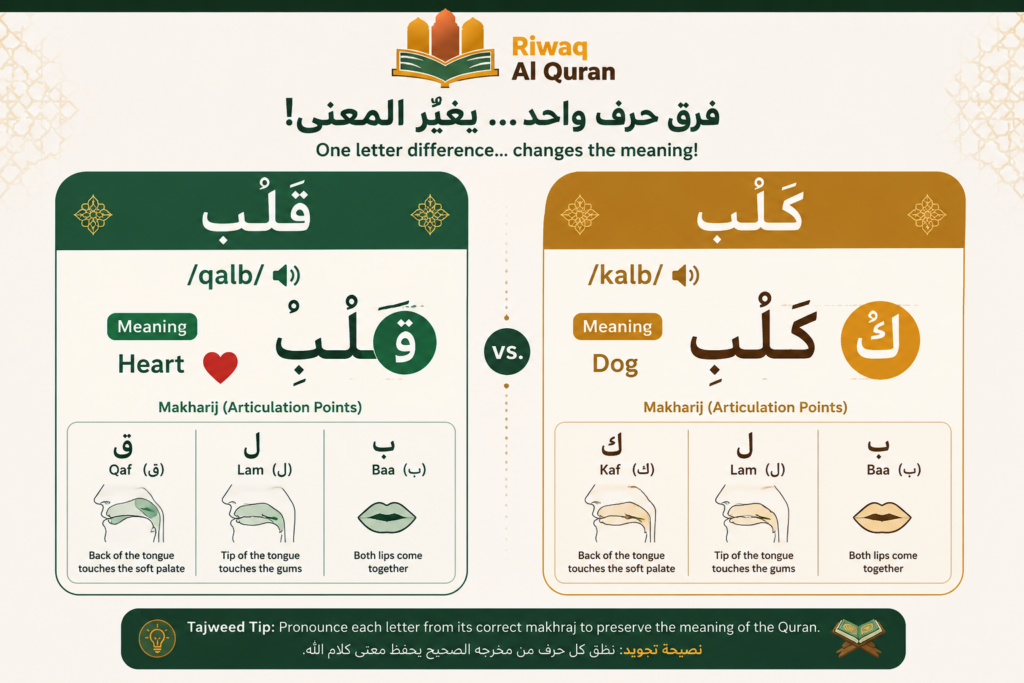
What you recite when you open the Quran is the literal word of Allah. The importance and benefits of Tajweed become concrete the moment you understand that a single mispronounced letter can turn “qalb” (قَلْب, heart) into “kalb” (كَلْب, dog) — not a subtle accent difference, but a complete change of meaning in a sacred text. This is the core reason Tajweed exists.
Tajweed (تَجْوِيد) is the science of phonetic rules governing correct Quranic recitation — covering each letter’s precise point of articulation (makhraj), its phonetic characteristics (sifat), and rules for elongation (madd), nasalization (ghunnah), and merging (idgham). It is a defined, learnable discipline with a fixed syllabus and clear endpoints.
This article explains the Quranic and scholarly basis for Tajweed, its specific spiritual and practical benefits, and what the learning process actually involves.
What You’ll Learn in This Article
- The direct Quranic command to recite with precision, and how scholars rule on its obligation.
- Three Quranic verses that together establish why careless recitation is impermissible.
- A concrete example of how a single mispronounced letter changes meaning in Allah’s words.
- The hadith that promises double reward to the struggling reciter.
- The specific spiritual and practical benefits of correct recitation, grounded in Quran and hadith.
- A realistic timeline for learning Tajweed from scratch.
Before diving into the textual evidence, watch this short clip for a quick, visual sense of why Tajweed matters from the very first letter:
Table of Contents
Why the Importance of Tajweed Is Established in the Quran Itself
Most people understand Tajweed as a skill — something admirable in a polished reciter. What is less commonly taught is that the obligation to recite correctly is grounded directly in the Quran and confirmed by scholarly consensus. Understanding this changes how you approach the decision to learn.
Three separate Quranic verses establish this obligation, each from a different angle.
1. The First Command – Recite with Measured Precision (Al-Muzzammil 73:4)
The foundational command for Tajweed is found in Surah Al-Muzzammil:
“وَرَتِّلِ الْقُرْآنَ تَرْتِيلًا”
“And recite the Quran with measured recitation.” — (Surah Al-Muzzammil, 73:4)
The Arabic term tarteel (تَرْتِيل) refers specifically to enunciating each letter from its correct point of articulation, clearly and without rushing — which is precisely what Tajweed rules govern. Imam Ali ibn Abi Talib (رضي الله عنه), one of the earliest authorities on Quranic recitation, defined tarteel as “making the letters distinct and observing the proper stopping points.”
The command is direct, in the imperative form (rattil), addressed to the Prophet ﷺ — and by extension, to every believer who opens the Mushaf. It is not a suggestion about recitation style; it is a command about correctness. This single verse is the primary textual basis for the entire science of Tajweed.
2. The Second Command – Recite at a Deliberate Pace (Al-Isra 17:106)
A second verse reinforces the same instruction from a different angle:
“وَقُرْآنًا فَرَّقْنَاهُ لِتَقْرَأَهُ عَلَى النَّاسِ عَلَىٰ مُكْثٍ وَنَزَّلْنَاهُ تَنزِيلًا”
“And [it is] a Quran which We have separated [by intervals] that you might recite it to the people over a prolonged period. And We have sent it down progressively.” — (Surah Al-Isra, 17:106)
The phrase عَلَىٰ مُكْثٍ (ala mukthin) means at a measured, unhurried pace — not quickly, not carelessly, but with deliberate attention. Allah did not reveal the Quran all at once precisely so it would be recited and absorbed carefully, both by the reciter and the listener.
This verse directly supports the measured, rule-governed approach that Tajweed demands — and it frames that approach as part of the divine wisdom behind the Quran’s gradual revelation.
3. The Third Comman – Do Not Rush the Recitation (Al-Qiyamah 75:16–18)
When the Prophet ﷺ first began receiving revelation, he would rush his tongue for fear of forgetting. Allah addressed this directly:
“لَا تُحَرِّكْ بِهِ لِسَانَكَ لِتَعْجَلَ بِهِ إِنَّ عَلَيْنَا جَمْعَهُ وَقُرْآنَهُ فَإِذَا قَرَأْنَاهُ فَاتَّبِعْ قُرْآنَهُ”
“Do not move your tongue with it to hasten with it. Indeed, upon Us is its collection and its recitation. So when We have recited it [through Gabriel], then follow its recitation carefully.” — (Surah Al-Qiyamah, 75:16–18)
These verses establish something rarely discussed: precise, unhurried recitation is not a scholarly tradition that developed after the Prophet ﷺ — it is a divine instruction, modeled by the method through which the Quran was transmitted to him in the first place.
Speed and carelessness in recitation have no precedent in the revelation process itself.
4. The Scholarly Ruling – Who Is Obligated to Learn Tajweed
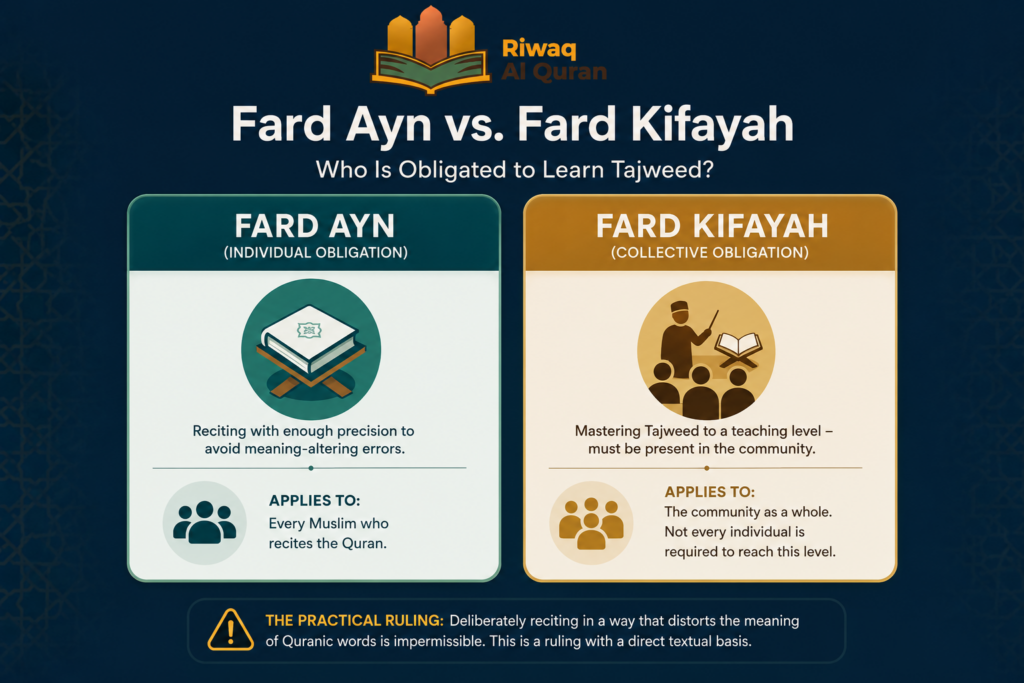
Scholars of Islamic jurisprudence draw a clear line between two levels of Tajweed obligation, each applying to a different group:
- Fard ayn (individual obligation): Reciting with enough precision to avoid meaning-altering errors — required of every Muslim who recites the Quran.
- Fard kifayah (collective obligation): Mastering Tajweed to a teaching level — must be present in the community, but does not require every individual to reach this standard.
The practical ruling: deliberately reciting in a way that distorts the meaning of Quranic words is impermissible. This is not a matter of cultural tradition or stylistic preference — it is a ruling with a direct textual basis in the three verses above.
How One Letter Error Changes the Meaning of Allah’s Words
The abstract claim that mispronunciation changes Quranic meaning becomes concrete when you examine a specific pair of letters — one articulation shift that produces a completely different word in the middle of Allah’s speech.
The letters ق (qaf) and ك (kaf) are articulated from different points in the throat. A reciter who mispronounces ق as ك turns قَلْب (qalb = heart) into كَلْب (kalb = dog). In a verse referring to the heart’s state before Allah, this is not an imprecise accent — it changes the actual word being recited.
A second, subtler example involves the Madd rules, which govern vowel elongation:
- Shortening a Madd where it is required shifts the grammatical function of a word and with it the meaning.
- Adding a Madd where it is not required introduces a sound that does not exist in the revealed text.
- Arabic is a language where vowel length is phonemically significant — meaning-bearing, not merely stylistic.
Tajweed exists because this precision is not optional in the Quran.
The Spiritual and Practical Benefits of Tajweed
The benefits of Tajweed are not vague spiritual goods. They are specific, documentable outcomes tied to the act of correct recitation — grounded in hadith, observed in practice, and felt in every salah. Here is what you actually gain:
1. Reward for Every Letter — Doubled for the Struggling Reciter
The Prophet Muhammad ﷺ said:
“الْمَاهِرُ بِالْقُرْآنِ مَعَ السَّفَرَةِ الْكِرَامِ الْبَرَرَةِ، وَالَّذِي يَقْرَأُ الْقُرْآنَ وَيَتَتَعْتَعُ فِيهِ وَهُوَ عَلَيْهِ شَاقٌّ لَهُ أَجْرَانِ”
“The one who is proficient in the Quran will be with the noble, righteous scribes [the angels]. And the one who reads the Quran and stutters, finding it difficult, will have a double reward.” — (Sahih Muslim, 798)
This hadith carries a specific message for every beginner: the struggle itself is rewarded, not penalized. Each of the following earns reward on top of the recitation itself:
- Tripping over a makhraj while working to correct it.
- Sustaining a ghunnah at the right duration.
- Repeating a verse until the idgham sounds right.
The narration of Ibn Masud (رضي الله عنه) adds a further dimension:
“مَنْ قَرَأَ حَرْفًا مِنْ كِتَابِ اللَّهِ فَلَهُ بِهِ حَسَنَةٌ، وَالْحَسَنَةُ بِعَشْرِ أَمْثَالِهَا، لَا أَقُولُ الم حَرْفٌ، وَلَكِنْ أَلِفٌ حَرْفٌ وَلَامٌ حَرْفٌ وَمِيمٌ حَرْفٌ”
“Whoever recites a letter from the Book of Allah will receive a good deed, and each good deed is multiplied by ten. I do not say that Alif-Lam-Mim is one letter, but Alif is a letter, Lam is a letter, and Mim is a letter.” — (Sunan al-Tirmidhi, 2910)
Tajweed ensures those letters are correctly formed — so the ten-fold reward applies to each letter of what Allah actually revealed, not to an approximated version of it.
2. Deeper Presence with Allah’s Words in Every Recitation
Allah describes the standard for those who truly honor His book:
“الَّذِينَ آتَيْنَاهُمُ الْكِتَابَ يَتْلُونَهُ حَقَّ تِلَاوَتِهِ”
“Those to whom We gave the Scripture recite it with its true recital.” — (Surah Al-Baqarah, 2:121)
حَقَّ تِلَاوَتِهِ (haqqa tilawatih) — “its true recital” — means reciting it exactly as it deserves. Scholars of tafsir explain this encompasses three things:
- Correct pronunciation.
- Reflection on its meaning.
- Acting upon its rulings.
Tajweed is the foundation of the first — and without it, the other two cannot be fully realized, because a reciter uncertain about what they are pronouncing cannot be fully present with what they are saying. Applying Tajweed rules requires full attention on each letter as it arrives. That attention transforms recitation from a rote exercise into a conscious act of worship. The heart settles when the tongue is deliberate.
If you want to develop this quality with structured, live guidance, Riwaq Al Quran’s one-on-one Tajweed sessions are built exactly around this — one rule at a time, with a certified teacher correcting your recitation in real time.
3. Intercession on the Day of Resurrection
The Prophet ﷺ said:
“اقْرَءُوا الْقُرْآنَ فَإِنَّهُ يَأْتِي يَوْمَ الْقِيَامَةِ شَفِيعًا لِأَصْحَابِهِ”
“Read the Quran, for it will come as an intercessor for its reciters on the Day of Resurrection.” — (Sahih Muslim, 804)
The word أَصْحَابِهِ — “its companions” — implies a relationship of closeness and commitment, not casual occasional reading. The reciter who takes Tajweed seriously is precisely this kind of companion: one who approaches the Quran with care, regularity, and the respect demanded by its status as the direct speech of Allah. The promise of intercession is tied to the quality of that relationship.
4. Joining the Bes = Learning and Teaching the Quran
The Prophet ﷺ said, as narrated by Uthman ibn Affan (رضي الله عنه):
“خَيْرُكُمْ مَنْ تَعَلَّمَ الْقُرْآنَ وَعَلَّمَهُ”
“The best among you are those who learn the Quran and teach it.” — (Sahih al-Bukhari, 5027)
This hadith closes a circle that begins with the individual decision to learn Tajweed. Every Quran teacher was once a student who struggled with makharij and madd rules. When you master Tajweed, you become capable of transmitting it correctly — and the reward described in this hadith applies to both acts.
Those who learn and teach the Quran are not just earning personal reward; they are continuing a chain of transmission that has preserved the Quran’s exact pronunciation since the time of the Prophet ﷺ. For anyone who eventually wants to reach this level, teaching the Quran online begins with the same foundation: a solidly corrected recitation.
5. Stronger Memorization with Fewer Corrections Over Time
Tajweed and Hifz (Quran memorization) are practically inseparable for a technical reason: the brain stores not just words but their phonetic shape. When you memorize a verse with correct Tajweed from the start, each letter’s makhraj becomes an acoustic anchor — making it significantly harder to misremember or distort the verse over years.
Quran teachers who work with adult learners observe this consistently:
- Students who solidify their Tajweed before beginning Hifz require far fewer correction sessions during memorization.
- They retain their recitation more accurately years later.
- Students who memorize without Tajweed must later unlearn embedded mispronunciations — and breaking a habitual mispronunciation is harder than learning the correct form from the beginning.
If you’re planning to memorize, the Quran Memorization Course at Riwaq Al Quran integrates Tajweed correction throughout the Hifz process — so accurate memory is built from day one.
6. Confident, Valid Recitation in Salah and Public Settings
Uncertainty about recitation correctness is a quiet anxiety for many Muslims, particularly when leading others in prayer. Tajweed removes this uncertainty. When you know you are applying the rules, there is nothing to second-guess mid-surah. The specific rules that eliminate this uncertainty include:
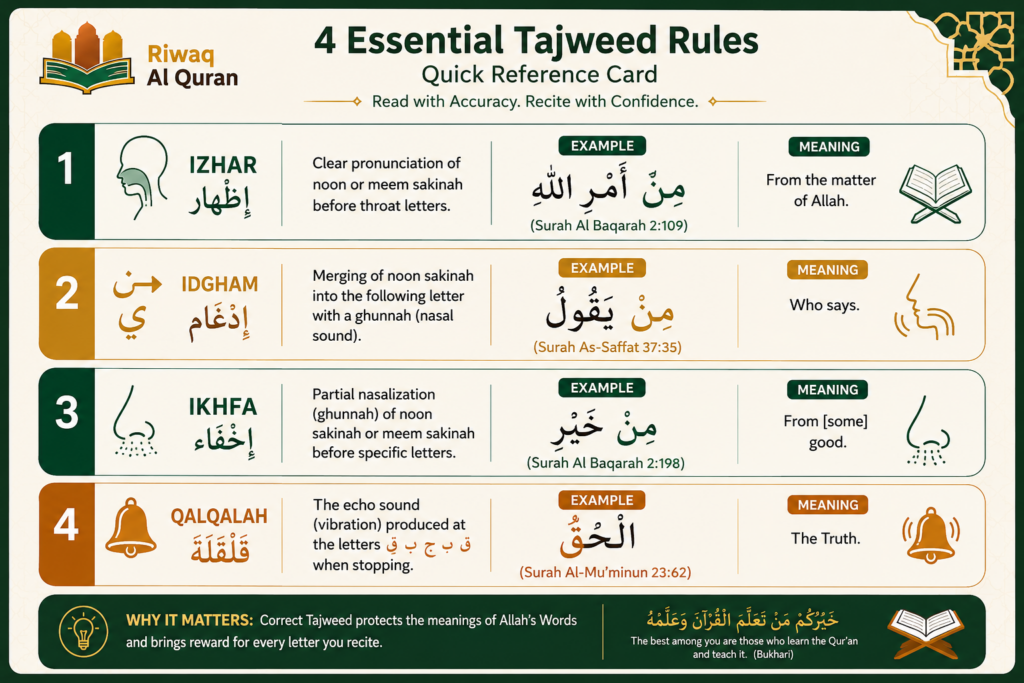
- Izhar: clear pronunciation of noon or meem sakinah before throat letters.
- Idgham: merging of noon sakinah into the following letter.
- Ikhfa: partial nasalization before specific letters.
- Qalqalah: the echo sound produced at the letters ق ط ب ج د when stopping.
In tarawih, in Quran circles, in family settings where children are listening, the clarity of a well-applied Tajweed recitation is immediately perceptible. It reflects the care the reciter brings to Allah’s words — and it sets a standard for those around you. This is not aesthetic; it is the practical outcome of fulfilling a clearly established obligation.
What Learning Tajweed Actually Involves
One reason people delay starting is uncertainty about what the process looks like and how long it takes. Both have concrete answers.
Knowing the rules is one thing — recognizing where beginners most commonly go wrong is another. This short video highlights the mistakes to watch for as you start:
1. The Rule Categories You Will Work Through
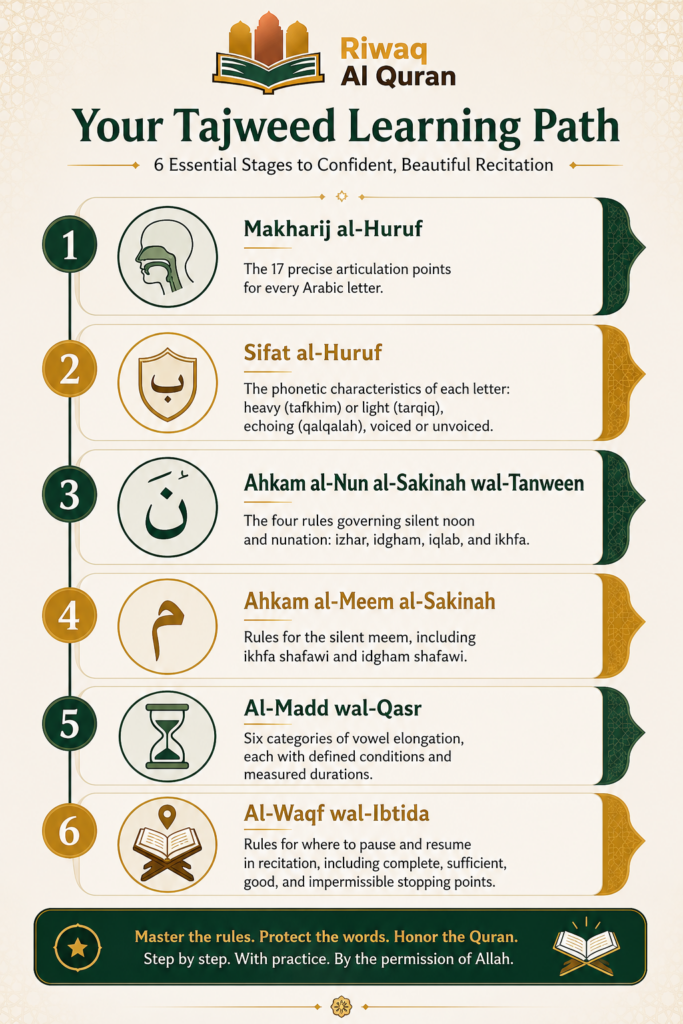
Tajweed is a defined discipline — not an open-ended study with no finish line. The core categories every student covers, in sequence:
- Makharij al-huruf — the 17 precise articulation points for every Arabic letter, located across the mouth, throat, and nasal cavity.
- Sifat al-huruf — the phonetic characteristics of each letter: heavy (tafkhim) or light (tarqiq), echoing (qalqalah), voiced or unvoiced.
- Ahkam al-nun al-sakinah wal-tanween — the four rules governing silent noon and nunation: izhar, idgham, iqlab, and ikhfa.
- Ahkam al-meem al-sakinah — rules for the silent meem, including ikhfa shafawi and idgham shafawi.
- Al-madd wal-qasr — six categories of vowel elongation, each with defined conditions and measured durations.
- Al-waqf wal-ibtida — rules for where to pause and resume in recitation, including complete, sufficient, good, and impermissible stopping points.
Each category has a fixed rule set with clear applications. Mastering Tajweed means completing a defined syllabus — not chasing a moving target.
For a step-by-step breakdown of how to approach each category, see this guide on how to learn Tajweed of Quran. You can also explore top Tajweed resources to support your study.
2. Realistic Learning Timelin – From Beginner to Fluent Reciter
[image: three-phase learning diagram — understanding the rules / conscious application / automatic fluency]
For an adult learner studying with a qualified teacher two to three sessions per week, the process follows three clear phases:
- Months 1–6: Foundational rules understood and applied consciously.
- Months 6–18: Rules become more automatic through consistent recitation practice.
- Year 1–2: Tajweed applied without deliberate effort across most recitation contexts.
These timelines assume live correction — which is why Tajweed cannot be learned to a reliable standard through audio recordings alone. The ear cannot self-correct articulation errors without an external reference. Errors practiced unchecked for months become harder to fix than errors caught in the first week.
Riwaq Al Quran’s online Tajweed program pairs each student with a certified teacher in live, one-on-one sessions — the same method used in traditional Quran institutions, delivered from wherever you are.
Start Learning Tajweed with Riwaq Al Quran Today
Riwaq Al Quran connects you with certified Tajweed teachers for live, personalized sessions — fully online, structured for all levels from complete beginner to those refining an existing recitation. Every student starts with a free trial class. No prior level required.
Whatever stage you’re at, there’s a course built for you:
- Start from the very beginning with Noorani Qaida Online — Learn Quranic letter recognition and basic pronunciation before moving into full recitation. The right first step for complete beginners.
- Build your recitation with proper Tajweed Through The Online Quran Recitation Course — Expert-led sessions covering correct letter pronunciation and all core Tajweed rules, with live correction at every stage.
- Go deeper into meaning By Our Online Quran Tafseer Course — Understand every verse as it was intended. Pairs naturally with a strong recitation foundation.
- Commit to memorization With The Quran Memorization Course — Hifz with integrated Tajweed correction from day one. Build phonetically accurate memory that lasts.
- Explore advanced recitation styles Through The Online Qirat Course — Study the diverse styles of Quranic recitation for a deeper command of the text beyond standard Hafs.
- For young learners join Our Online Quran Classes for Kids — Interactive, age-appropriate sessions designed to build love and familiarity with the Quran from an early age.

Conclusion
The importance and benefits of Tajweed are not two separate topics — they are two sides of the same established obligation. Allah commands measured recitation directly in the Quran, in Surah Al-Muzzammil (73:4), Surah Al-Isra (17:106), and Surah Al-Qiyamah (75:16–18). Scholars rule that meaning-altering mispronunciation is impermissible. And the Prophet Muhammad ﷺ promises a double reward to every reciter who finds it difficult and continues anyway.
What Tajweed gives you is specific:
- Accurate meaning preserved in every verse you recite.
- Valid, confident recitation in salah and public settings.
- A more stable phonetic foundation for Quran memorization.
- The intercession of the Quran on the Day of Resurrection.
- A quality of presence with Allah’s words that careless recitation does not produce.
The rules are finite. The obligation is established. The reward for the struggling reciter is explicitly doubled.
Start wherever you are.
Frequently Asked Questions About the Importance and Benefits of Tajweed
The questions below address the most common points of confusion for learners at every level — from those discovering Tajweed for the first time to those deciding whether to formalize their study.
Is Tajweed obligatory for every Muslim?
Tajweed is obligatory at two levels. Avoiding mispronunciations that change Quranic meaning is fard ayn — an individual obligation on every Muslim who recites the Quran. Mastering Tajweed to a teaching level is fard kifayah — a collective obligation on the Muslim community. The majority of classical and contemporary scholars hold this position based on the direct command in Surah Al-Muzzammil (73:4).
What happens if I recite the Quran without Tajweed?
Reciting in a way that introduces meaning-altering errors is impermissible according to scholarly consensus. Minor pronunciation imperfections that do not change meaning — particularly for non-native Arabic speakers who are actively learning — are excused. As the hadith in Sahih Muslim (798) confirms, the struggling reciter earns a double reward, so the obligation is to try and to learn, not to already be perfect.
Can Tajweed be learned online effectively?
Yes — provided the learning includes live, one-on-one correction from a qualified teacher. Tajweed cannot be reliably self-taught through audio recordings because articulation errors cannot be self-detected without an external reference. Live sessions with a certified teacher replicate the traditional learning method and are recognized as valid by scholars of Quranic sciences.
How is Tajweed different from simply reading Arabic?
Reading Arabic correctly means recognizing letters and vowels. Tajweed goes further — it requires each letter to be articulated from its precise makhraj, with its correct sifat applied, and elongation or nasalization rules observed where required. A person can read Arabic fluently and still recite the Quran with Tajweed errors that change meaning — the two skills are not equivalent.
Which Quranic verse directly commands Tajweed?
Surah Al-Muzzammil (73:4) contains the primary command: وَرَتِّلِ الْقُرْآنَ تَرْتِيلًا — “And recite the Quran with measured recitation.” Supporting verses include Al-Isra (17:106), which commands reciting at a measured pace, and Al-Qiyamah (75:16–18), in which Allah instructs the Prophet ﷺ himself not to rush the recitation.
Does learning Tajweed help with Quran memorization?
Yes, significantly. Memorizing with correct Tajweed from the start creates a stable, accurate phonetic imprint for each verse. Quran teachers consistently observe that students who establish their Tajweed before beginning Hifz require fewer corrections during memorization and retain their recitation more accurately over years, compared to those who memorize without it.
Why does the Quran specifically reward the struggling reciter?
The hadith in Sahih Muslim (798) explicitly promises a double reward to the one who recites with difficulty and effort. This confirms that Tajweed is not reserved for those with a natural aptitude for Arabic pronunciation — the struggle itself carries reward. It also signals that the effort to recite correctly is valued by Allah independent of the level of proficiency reached.