When a parent dies, many Muslims immediately reach for a Mushaf and begin reading the Quran for deceased, hoping the reward reaches them. It is one of the most asked questions in grief-related fiqh, and yet the Prophet ﷺ and his companions left no record of doing it themselves.
That absence is exactly why scholars disagree. This article lays out both positions in detail, explains why some scholars classify the practice as bid’ah, examines the popular claims around Surah Al-Mulk, Yaseen, and Al-Fatiha, and gives you the authentic Quranic duas and hadiths every scholar agrees on — each sourced and linked so you can verify it yourself.
What You’ll Learn in This Article
- The two scholarly positions on reading Quran for the dead, and which scholars hold each one.
- Whether the practice counts as bid’ah (religious innovation).
- Whether Surah Al-Mulk, Yaseen, or Al-Fatiha have any authentic basis for the deceased.
- The verified sahih hadiths that actually apply to death, dua, and visiting graves.
- Quranic duas, in Arabic with full tashkeel, you can say for deceased parents.
Table of Contents
Reading the Quran for Deceased – The Two Scholarly Positions
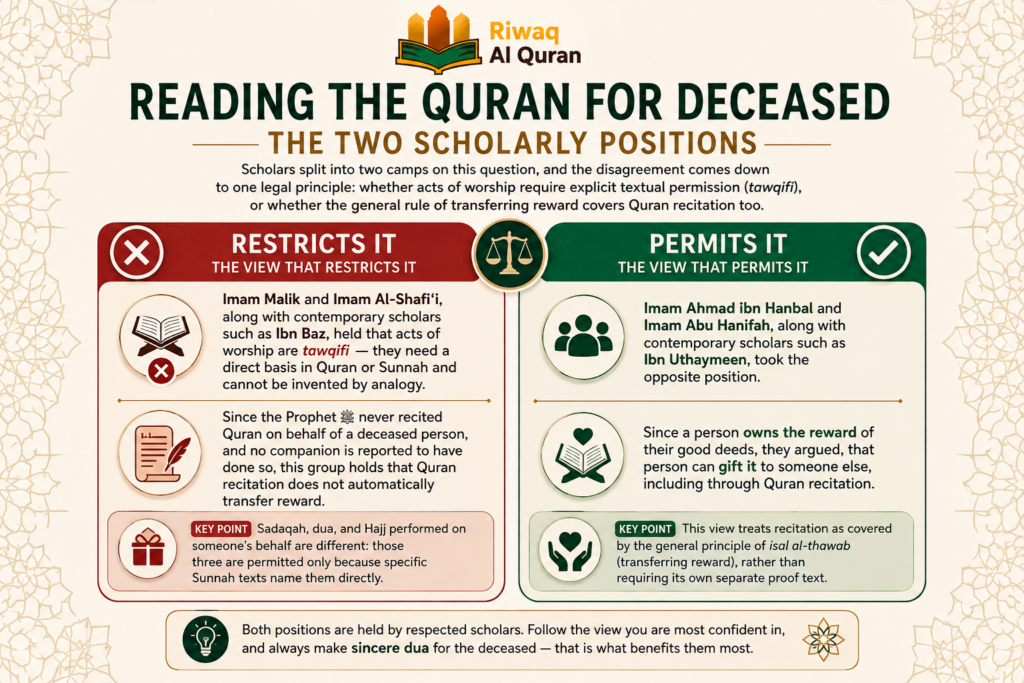
Scholars split into two camps on this question, and the disagreement comes down to one legal principle: whether acts of worship require explicit textual permission (tawqifi), or whether the general rule of transferring reward covers Quran recitation too.
1. The View That Restricts It
Imam Malik and Imam Al-Shafi’i, along with contemporary scholars such as Ibn Baz, held that acts of worship are tawqifi — they need a direct basis in Quran or Sunnah and cannot be invented by analogy.
- Since the Prophet ﷺ never recited Quran on behalf of a deceased person, and no companion is reported to have done so, this group holds that Quran recitation does not automatically transfer reward.
- Sadaqah, dua, and Hajj performed on someone’s behalf are different: those three are permitted only because specific Sunnah texts name them directly.
2. The View That Permits It
Imam Ahmad ibn Hanbal and Imam Abu Hanifah, along with contemporary scholars such as Ibn Uthaymeen, took the opposite position.
- Since a person owns the reward of their good deeds, they argued, that person can gift it to someone else, including through Quran recitation.
- This view treats recitation as covered by the general principle of isal al-thawab (transferring reward), rather than requiring its own separate proof text.
3. What the Permission Actually Covers
Even scholars who permit the practice are specific about what they are permitting: general, occasional recitation with the intention of gifting the reward.
- They do not endorse assigning it a fixed day, such as the day of death.
- They do not endorse selecting a specific surah for the purpose.
- They do not endorse turning it into a habitual, repeated ritual.
All three of those additions are cautioned against, even by the scholars most open to the underlying idea. If you want to build lasting religious knowledge in your family instead of relying on disputed practices, structured learning is the more reliable route — closing exactly this gap is what Riwaq Al Quran’s live Quran and Islamic Studies classes are built for, for parents and children alike.
Is Reading Quran for the DeceasedConsidered Bid’ah?
Because the practice has no precedent from the Prophet ﷺ or his companions, many scholars label it bid’ah — an addition introduced into worship without basis.
1. Why Some Scholars Call It Bid’ah
Scholars who take this view apply the same tawqifi principle covered above: worship without textual support, and without precedent from the earliest generations, counts as an innovation regardless of the good intention behind it.
2. Why the Disagreement Continues
Other scholars, including some who caution against the practice, stop short of calling it bid’ah outright. That is because the underlying question — whether isal al-thawab covers Quran recitation — is itself disputed among the earliest legal schools, not settled.
A minority position inside a legitimate area of scholarly disagreement is treated differently from a practice with no scholarly basis at all.
Which Surah Should Be Recited for the Dead?
This is the most searched part of the topic, and it deserves a direct answer: no authentic hadith names any specific surah for the dead. Each claim below has spread widely, but the underlying reports do not say what popular practice assumes they say — and where an authentic hadith does exist nearby, it says something different from what people think.
1. Surah Al-Mulk (Chapter 67)
The only report connecting Surah Al-Mulk to the grave comes from Al-Hakim’s Al-Mustadrak ‘ala al-Sahihain, a classical hadith collection separate from the six major books.
- Some scholars accept its chain as valid, but it is the statement of the companion Ibn Mas’ud, not the Prophet ﷺ.
- It describes reciting the surah while alive as protection from punishment in the grave — not reciting it on behalf of someone who has already died.
- Because it is a companion’s statement rather than a Prophetic hadith with a widely indexed reference, it does not carry the same verifiable weight as the hadiths cited later in this article.
Treating it as a ritual for the deceased goes beyond what the report itself says. For the broader (non-funeral) virtues of this surah, see our guide on the benefits of Surah Al-Mulk.
2. Surah Yaseen (Chapter 36)
The hadith directly connecting Surah Yaseen to a dying person is weak. But there is an authentic hadith about what to actually do at that moment, and it doesn’t mention Yaseen at all.
“لَقِّنُوا مَوْتَاكُمْ لاَ إِلَهَ إِلاَّ اللَّهُ”
“Prompt your dying ones to say: There is no god but Allah.” Sahih Muslim 916a, narrated by Abu Sa’id al-Khudri.
This is the authentic practice behind the popular Yaseen custom — reminding a dying person of the shahadah, not reciting a specific surah to them. If you’re at the bedside of someone dying, say the shahadah gently so they can hear and repeat it, without insisting if it distresses them.
You can also explore the general (non-funeral) merits of this surah in our guide on the benefits of reading Surah Yaseen after Fajr.
3. Surah Al-Fatiha (Chapter 1)
There is no authentic hadith connecting Surah Al-Fatiha to the dead at all. Its widespread use at funerals and gravesites across many Muslim cultures is a cultural practice, not one with textual support.
4. The “41 Times” Claim
Reciting Surah Al-Mulk 41 times for a deceased person has no source in Quran, hadith, or classical fiqh literature — it does not appear in any book of tafsir, hadith commentary, or fatwa. Claims like this typically spread through oral repetition and, more recently, social media, gaining credibility from repetition rather than from any traceable text.
It is a clear example of emotional attachment to a loved one leading to an invented ritual that feels meaningful but has no grounding.
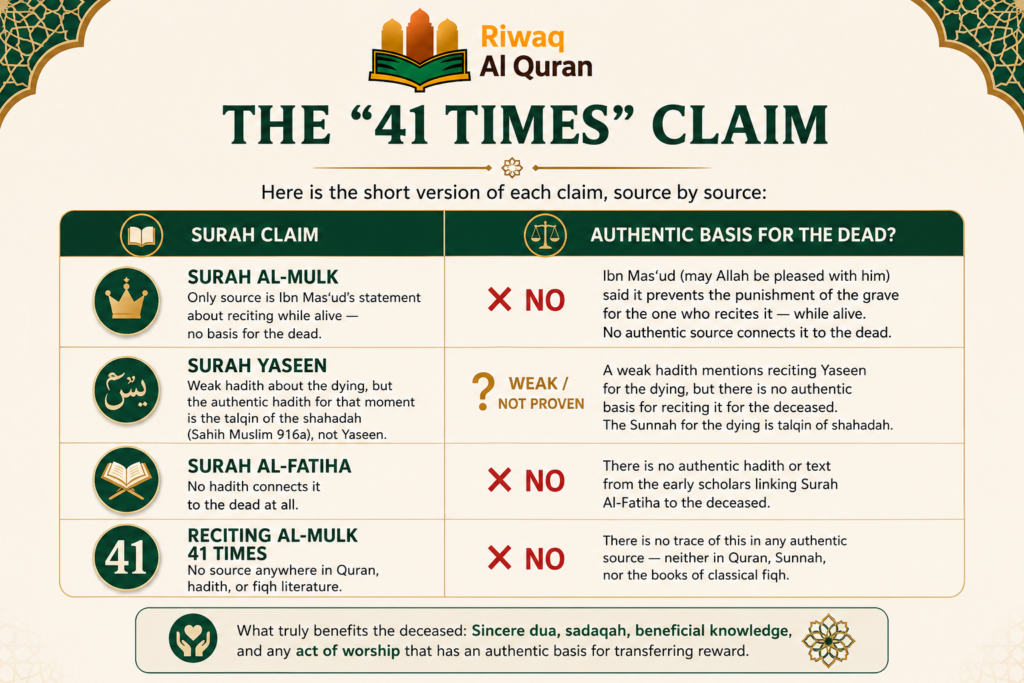
Here is the short version of each claim, source by source:
- Surah Al-Mulk: only source is Ibn Mas’ud’s statement about reciting while alive — no basis for the dead.
- Surah Yaseen: weak hadith about the dying, but the authentic hadith for that moment is the talqin of the shahadah (Sahih Muslim 916a), not Yaseen.
- Surah Al-Fatiha: no hadith connects it to the dead at all.
- Reciting Al-Mulk 41 times: no source anywhere in Quran, hadith, or fiqh literature.
What Does the Sunnah Actually Recommend for the Dead?
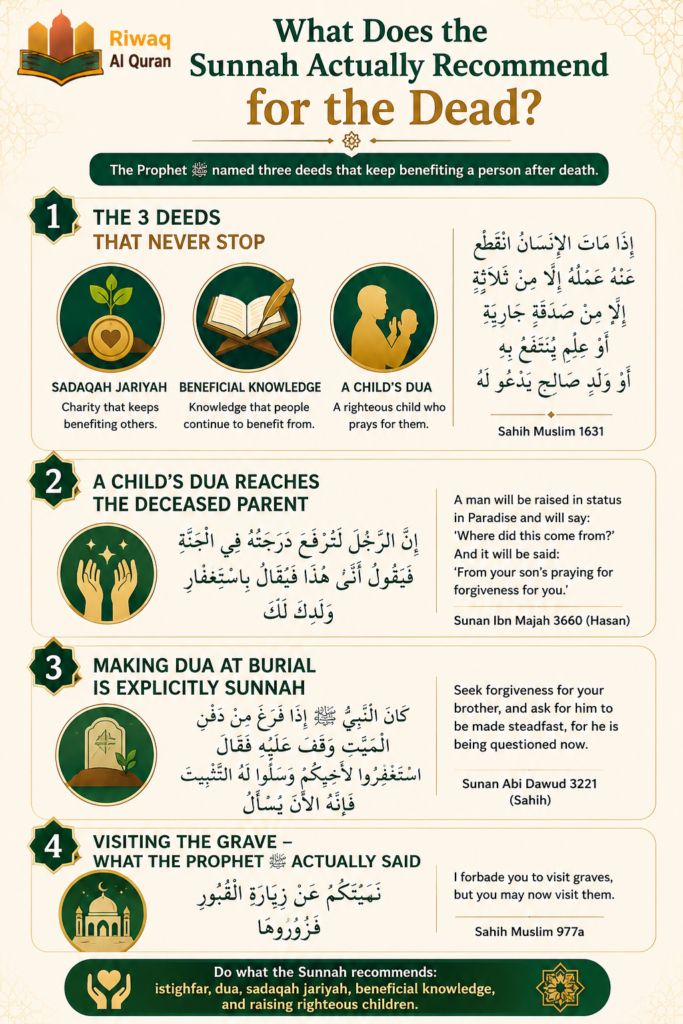
Instead of specific surahs or rituals, the Prophet ﷺ named three concrete actions that keep benefiting a person after death, and he specified exactly what to do at burial and afterward — all backed by authentic hadith, not popular custom.
1. The Three Deeds That Continue After Death
The Prophet ﷺ drew a clear and specific line between deeds that end at death and the three that don’t — and this hadith is the foundation every scholar on this topic returns to:
“إِذَا مَاتَ الإِنْسَانُ انْقَطَعَ عَنْهُ عَمَلُهُ إِلاَّ مِنْ ثَلاَثَةٍ إِلاَّ مِنْ صَدَقَةٍ جَارِيَةٍ أَوْ عِلْمٍ يُنْتَفَعُ بِهِ أَوْ وَلَدٍ صَالِحٍ يَدْعُو لَهُ”
“When a man dies, his deeds come to an end except for three: ongoing charity, knowledge that people benefit from, or a righteous child who prays for him.”Sahih Muslim 1631, narrated by Abu Huraira.
This hadith is the single most important piece of evidence in this entire topic — it is undisputed, authentic, and names exactly what benefits the dead, with no mention of Quran recitation among the three.
What this looks like in practice:
- Sadaqah jariyah is charity that keeps producing benefit rather than being consumed once: funding a well, contributing to a Quran-printing project, or endowing a scholarship for Quran students fit the same principle as building a mosque or planting a tree.
- Beneficial knowledge covers anything that keeps spreading Islamic benefit after the person who shared it has died: writing a book, helping distribute a Mushaf, recording a lecture, or teaching a child who goes on to teach others.
- In the original Arabic, the term used for “child” (ولد) applies equally to sons and daughters, despite common English translations rendering it as “son.”
2. Does a Child’s Dua Really Reach a Deceased Parent?
Rather than leaving the question to scholarly inference, the Prophet ﷺ answered it with a scene from Paradise itself — describing exactly what happens when a child makes istighfar for a deceased parent:
“إِنَّ الرَّجُلَ لَتُرْفَعُ دَرَجَتُهُ فِي الْجَنَّةِ فَيَقُولُ أَنَّى هَذَا فَيُقَالُ بِاسْتِغْفَارِ وَلَدِكَ لَكَ”
“A man will be raised in status in Paradise and will say: ‘Where did this come from?’ And it will be said: ‘From your son’s praying for forgiveness for you.'” Sunan Ibn Majah 3660, graded Hasan by Darussalam.
This is direct textual confirmation that a child’s istighfar for a deceased parent is not just permitted but actively raises the parent’s rank — a stronger and more specific guarantee than anything claimed about a particular surah.
3. Making Dua at Burial Is Explicitly Sunnah
This wasn’t a general recommendation the Prophet ﷺ gave in a lecture — it was something he did himself, every single time, and he told those standing with him exactly why it mattered at that specific moment:
“كَانَ النَّبِيُّ صلى الله عليه وسلم إِذَا فَرَغَ مِنْ دَفْنِ الْمَيِّتِ وَقَفَ عَلَيْهِ فَقَالَ اسْتَغْفِرُوا لأَخِيكُمْ وَسَلُوا لَهُ التَّثْبِيتَ فَإِنَّهُ الآنَ يُسْأَلُ ”
“Whenever the Prophet ﷺ finished burying the dead, he would stay at the grave and say: ‘Seek forgiveness for your brother, and ask for him to be made steadfast, for he is being questioned now.'”Sunan Abi Dawud 3221, narrated by Uthman ibn Affan, graded Sahih by Al-Albani.
This hadith describes exactly what the Prophet ﷺ did immediately after burial — standing at the grave and asking those present to make istighfar and dua for steadfastness, since the deceased is being questioned by the angels at that moment. This is the practice every school of fiqh agrees on, with a specific, sahih basis, not a general custom.
4. Visiting the Grave – What the Prophet ﷺ Actually Said
The ruling on grave visits changed during the Prophet’s ﷺ own lifetime, and he made that shift explicit — which is why understanding this hadith correctly matters before drawing conclusions about what visiting a grave does or doesn’t do:
“نَهَيْتُكُمْ عَنْ زِيَارَةِ الْقُبُورِ فَزُورُوهَا “
“I forbade you to visit graves, but you may now visit them.”Sahih Muslim 977a, narrated by Buraida ibn al-Husayb.
Visiting graves was initially discouraged in early Islam, out of concern it could lead to practices resembling grave-worship, then explicitly permitted once that concern passed.
Scholars read this hadith as a reminder of death and the afterlife for the visitor, not as a ritual that benefits the deceased through the act of visiting itself. If you’re wondering specifically about the rulings for women, see can women visit graveyards.
Quranic Duas You Can Say for Deceased Parents
The Quran itself contains several duas Muslims are taught to recite for their parents and for believers in general. These carry the same reward as any other dhikr and are agreed upon by every school of thought, unlike specific-surah rituals. If you’d like to understand these duas word for word rather than only by transliteration, learn Arabic here.
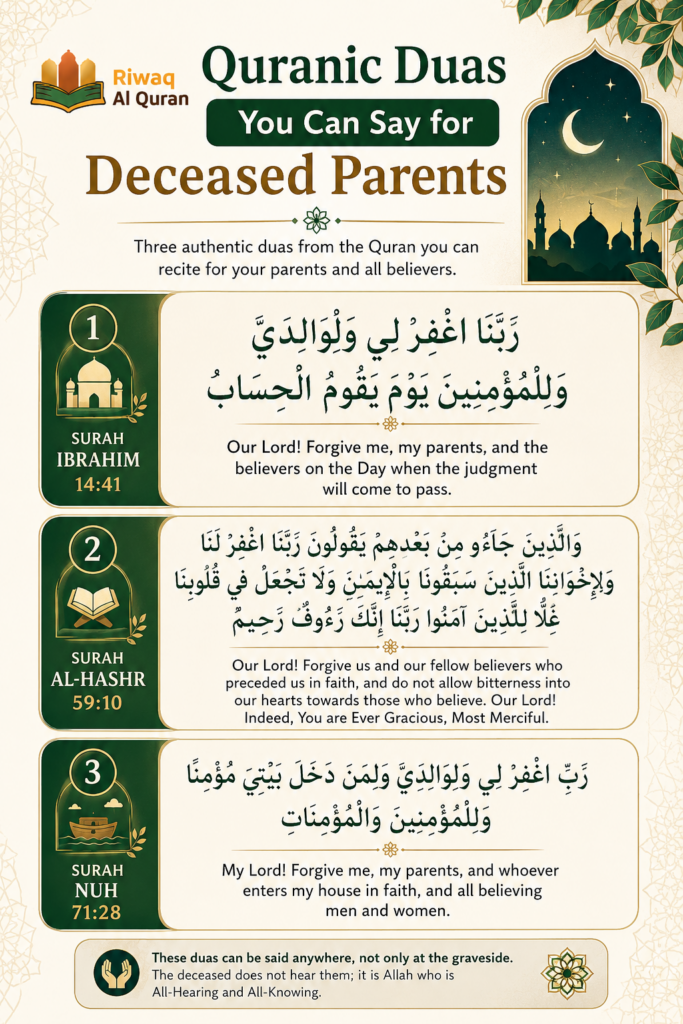
1. Surah Ibrahim
The Prophet ﷺ drew a clear and specific line between deeds that end at death and the three that don’t — and this hadith is the foundation every scholar on this topic returns to:
“رَبَّنَا ٱغۡفِرۡ لِي وَلِوَٰلِدَيَّ وَلِلۡمُؤۡمِنِينَ يَوۡمَ يَقُومُ ٱلۡحِسَابُ”
“Our Lord! Forgive me, my parents, and the believers on the Day when the judgment will come to pass.” Surah Ibrahim, 14:41
This is Prophet Ibrahim’s own dua for his parents, made explicitly in the context of the Day of Judgment rather than at a grave. Reciting it asks Allah for your parents’ forgiveness using the exact wording a prophet used for his own.
2. Surah Al-Hashr
This verse doesn’t just teach Muslims to pray for deceased parents — it frames that prayer as a defining characteristic of every generation of believers that comes after, widening the dua to the entire Ummah:
“وَٱلَّذِينَ جَآءُو مِنۢ بَعۡدِهِمۡ يَقُولُونَ رَبَّنَا ٱغۡفِرۡ لَنَا وَلِإِخۡوَٰنِنَا ٱلَّذِينَ سَبَقُونَا بِٱلۡإِيمَٰنِ وَلَا تَجۡعَلۡ فِي قُلُوبِنَا غِلّٗا لِّلَّذِينَ ءَامَنُواْ رَبَّنَآ إِنَّكَ رَءُوفٞ رَّحِيمٌ”
“And those who come after them will pray, ‘Our Lord! Forgive us and our fellow believers who preceded us in faith, and do not allow bitterness into our hearts towards those who believe. Our Lord! Indeed, You are Ever Gracious, Most Merciful.'”Source: Surah Al-Hashr, 59:10
This verse describes how later generations of believers are taught to pray for those who died before them in faith, deceased parents included. It widens the dua to the entire Ummah, which is part of why scholars note that Muslim dua for the dead is communal, not limited to one’s own relatives.
3. Surah Nuh
Prophet Nuh made this dua after generations of calling his people to faith — and like Ibrahim’s dua, it pairs forgiveness for his own parents with a broader prayer for the entire community of believers:
“رَّبِّ ٱغۡفِرۡ لِي وَلِوَٰلِدَيَّ وَلِمَن دَخَلَ بَيۡتِيَ مُؤۡمِنٗا وَلِلۡمُؤۡمِنِينَ وَٱلۡمُؤۡمِنَٰتِ”
“My Lord! Forgive me, my parents, and whoever enters my house in faith, and all believing men and women.” Surah Nuh, 71:28
Prophet Nuh made this dua after generations of calling his people to faith. Like Ibrahim’s dua above, it pairs forgiveness for one’s own parents with forgiveness for the wider community of believers.
These duas can be said anywhere, not only at the graveside — the deceased does not hear them either way, as covered in the FAQs below; it is Allah who is All-Hearing and All-Knowing.
Common Mistakes People Make With This Topic
A few mistakes come up repeatedly around Deceased, and avoiding them keeps your practice within what is actually agreed upon and authentically sourced.
1. Treating a Weak or Unlinked Report as a Green Light
The Yaseen-before-death hadith and the Mulk-in-the-grave report are frequently cited as if they were strong, authentic evidence for reciting after death. Neither is.
Checking whether a hadith is graded sahih, hasan, or weak — and reading it on a source like sunnah.com before acting on it — is the difference between following Sunnah and following a rumor about Sunnah.
2. Turning a Permission Into a Ritual
Even scholars who allow gifting Quran recitation are clear that fixing a specific day, surah, or repetition count turns a general permission into an invented ritual. That is the part they actually object to, not the underlying idea of reward-sharing itself.
3. Skipping the Deeds That Are Actually Guaranteed
Because the surah debate gets so much attention, the three agreed-upon deeds — sadaqah jariyah, beneficial knowledge, and a child’s dua — often get less effort than a disputed practice, even though the hadith backing them (Sahih Muslim 1631 and Sunan Ibn Majah 3660) is stronger and more specific than anything cited for a particular surah.
Start Learning Quran and Islamic Studies the Right Way — With Riwaq Al Quran
Riwaq Al Quran is a comprehensive online platform that offers personalized Quran, Arabic, and Islamic Studies classes for individuals of all ages and backgrounds. Their experienced instructors use a structured curriculum to cover Tajweed, Tafsir, and memorization, providing easy and effective access to learning the Quran.
The advanced online classes allow for seamless communication and interaction between students and teachers. Join Riwaq Al Quran for a deeper connection with the Quran.
Hear directly from our students about how Riwaq Al Quran Academy has transformed their connection with the Book of Allah:
We offer several courses such as:
- Online courses for kids
- Online Quran classes for kids and adults
- Online Arabic courses
- Online Ijazah courses
- Online Islamic Studies courses
Book your free trial with Riwaq Al Quran today, and build the kind of Quran knowledge you can pass on to your own children — the “beneficial knowledge” that keeps benefiting a person long after they are gone.

Conclusion
Reading Quran for the dead remains genuinely disputed. One group of scholars restricts it because acts of worship require direct textual basis, while another permits general reward-transfer — but neither camp endorses fixed surahs, set timings, or ritual repetition counts like the Surah Al-Mulk “41 times” claim, none of which trace back to any authentic, sourced text.
What every school agrees on, backed by sahih hadith, is simpler: sincere dua and istighfar for your parents, sadaqah jariyah, and passing on beneficial knowledge. If you want a practice that sidesteps the disagreement entirely, reading from a Mushaf your parent gave you, or one you have dedicated in their memory, is often suggested as counting toward the “beneficial knowledge” they left behind — giving you a share in the reward without stepping into disputed territory.
Frequently Asked Questions
Here are direct, source-backed answers to the specific questions people search most about this topic.
1. Should you read Quran when someone dies?
There is no Sunnah instructing this, and scholars who permit it call it allowed, not recommended. What is Sunnah, confirmed in sahih hadith, is making istighfar and dua for the person at burial (Sunan Abi Dawud 3221) and afterward.
2. Is there an authentic hadith about reciting Quran for the dead?
No. There is no authentic hadith, from Quran or Sunnah, that mentions reciting Quran on behalf of someone who has died. The reports connected to Surah Al-Mulk and Yaseen are either a companion’s statement or a weak hadith, and both describe a different situation — reciting while a person is alive or dying.
3. Can dead people hear the Quran or dua recited for them?
Scholars generally hold that the dead cannot hear the living. One hadith confirms a parent’s status rises in Paradise because of their child’s istighfar (Sunan Ibn Majah 3660), but it does not say whether this happens in the grave or on the Day of Judgment, or whether the deceased is aware of who is praying for them.
4. What tasbeeh or dua should I say when someone dies?
Istighfar for the deceased is the most recommended, following the Prophet’s ﷺ own instruction at burial (Sunan Abi Dawud 3221), along with general duas asking for ease in the grave, entry into Paradise, and protection from the Fire. These can be said anywhere; you do not need to be at the grave.
5. Is visiting a deceased parent’s grave allowed in Islam?
Yes. The Prophet ﷺ explicitly said visiting graves, once discouraged, became permitted: “I forbade you to visit graves, but you may now visit them” (Sahih Muslim 977a). It is recommended as a reminder of death, not as a ritual that transfers benefit to the deceased.
6. Which madhhab permits reading Quran for the dead?
The Hanafi and Hanbali schools generally permit it, based on positions held by Imam Abu Hanifah and Imam Ahmad ibn Hanbal, supported by contemporary scholars such as Ibn Uthaymeen. The Maliki and Shafi’i schools generally restrict it, following Imam Malik and Imam Al-Shafi’i, a position also held by Ibn Baz.
Sources
Every ayah and hadith cited in this article draws from the following primary sources:
- Sahih Muslim 1631 — the three deeds that continue after death
- Sunan Ibn Majah 3660 — a child’s istighfar raising a parent’s status (graded Hasan)
- Sunan Abi Dawud 3221 — dua for the deceased at burial (graded Sahih by Al-Albani)
- Sahih Muslim 916a — prompting the dying to say the shahadah
- Sahih Muslim 977a — permission to visit graves
- Al-Hakim, Al-Mustadrak ‘ala al-Sahihain — the companion report on Surah Al-Mulk (Ibn Mas’ud), authenticity disputed
- Surah Ibrahim, 14:41; Surah Al-Hashr, 59:10; Surah Nuh, 71:28