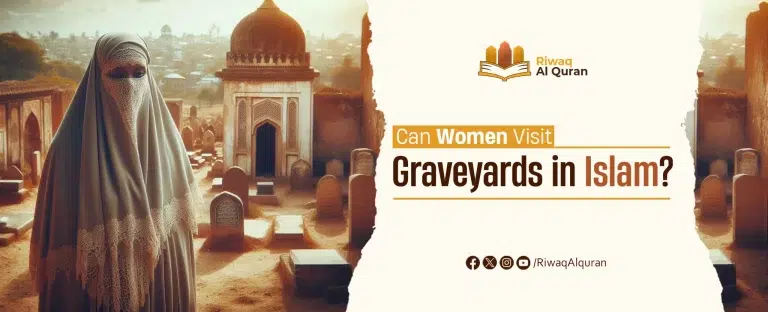
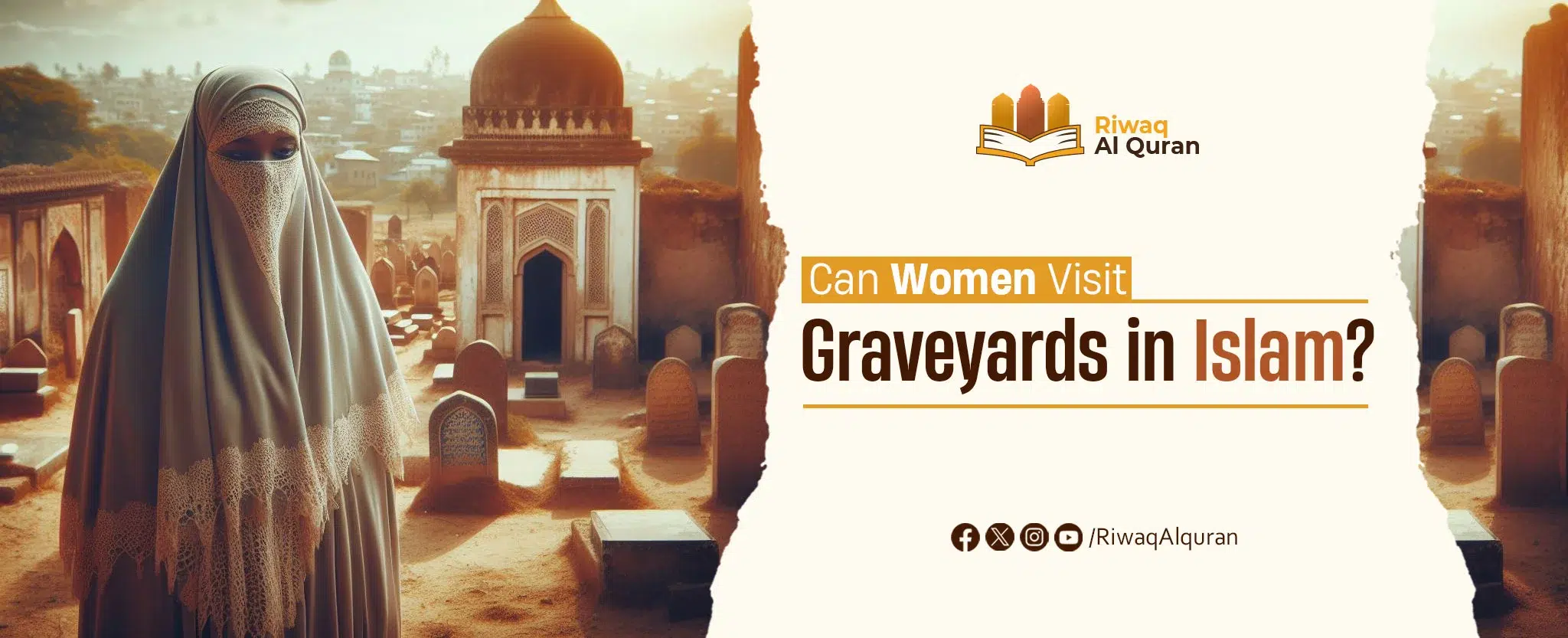
A Muslim woman stands at the entrance of a graveyard, unsure whether to step inside. She wants to visit her father’s grave and recite a prayer over him — but she has heard conflicting opinions and does not know which ruling applies to her situation. This uncertainty is common, and it stems from a genuine difference of opinion among the classical scholars of Islam.
Can women visit graveyards in Islam? The short answer is yes, with conditions. But the complete answer requires examining what the Quran establishes about death and remembrance, what five key prophetic hadiths actually say when read together, and how all four major schools of Islamic law applied that evidence to reach their conclusions.
This guide covers all of that — including the specific questions about wives visiting husbands’ graves, daughters visiting fathers’ graves, the Iddah period ruling, and a practical four-question framework for knowing whether a planned visit meets the scholarly standard. If you want to understand rulings like these from their juristic roots, Riwaq Al Quran‘s Online Fiqh Course is designed exactly for that purpose.
What You Will Learn in This Article
- The Quranic foundation for visiting graves and why remembrance of death is central to Islamic spirituality.
- The five core hadiths that define the ruling — including the curse hadith correctly understood.
- What all four madhabs actually say, including the two most articles omit: Maliki and Hanbali.
- The Iddah-period ruling and why it is a separate legal question from the general permission.
- A practical four-question framework for assessing whether a planned visit meets the scholarly standard.
Table of Contents
Can Women Visit Graveyards in Islam?
The majority scholarly opinion: Yes, it is permissible, though scholars differ on the details. The Prophet Muhammad ﷺ initially prohibited all Muslims from visiting graves, then later permitted it, saying: “I had forbidden you from visiting graves, but now visit them.” (Muslim)
Where Scholars Differ:
- Majority view (Maliki, Shafi’i, Hanbali): Women may visit graves, as the permission is general and applies to both men and women. The Prophet ﷺ also did not rebuke Aisha (RA) when she visited her brother’s grave.
- Some Hanafi scholars: Consider it makruh (discouraged) for women, citing a hadith that the Prophet ﷺ cursed women who visit graves frequently (zuwwarat al-qubur). However, many scholars clarify this refers to excessive visitation, not a general ban.
- Ibn Taymiyyah & some scholars: Permitted for older women, discouraged for younger women due to fitnah concerns.
What is Agreed Upon:
- Visiting to make du’a and reflect on death is the permitted/encouraged reason
- Wailing, loud crying, and tearing clothes at graves is prohibited for everyone
- Visiting out of grief and remembrance is fine
Bottom Line: Visiting graveyards is permissible for women according to the strongest scholarly opinion, with the condition of maintaining proper Islamic conduct and avoiding excessive lamentation.
1. The Quranic Foundation for Visiting Graves
Islam teaches that awareness of death is not morbid — it is clarifying. The Quran returns repeatedly to mortality as a spiritual anchor, a reminder that this life is a passage and that the soul’s ultimate accountability lies ahead.
Visiting a grave materialises this abstract truth into something a person can stand before and feel. That is the Quranic basis for the entire practice — and it is addressed to all of humanity, without a gender distinction.
1. Surah Al-Anbiya (The Prophets)
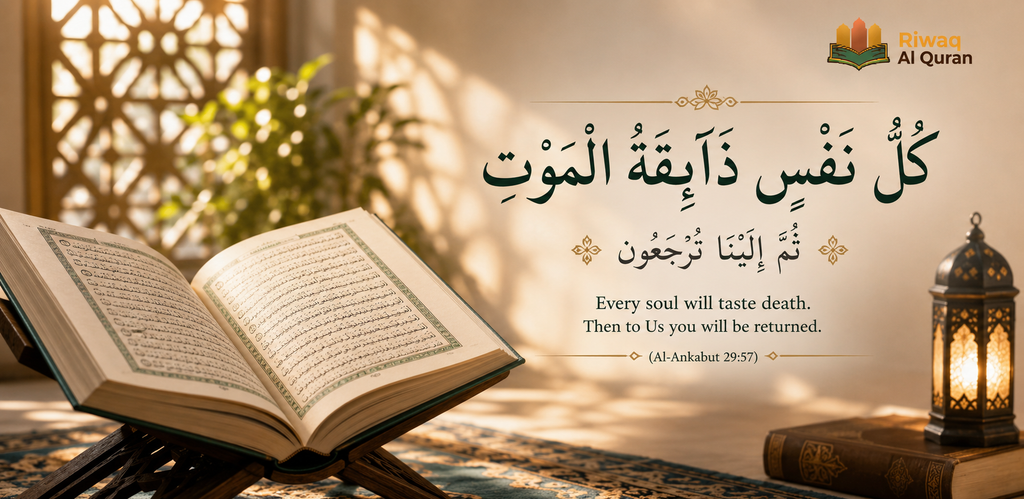
This verse lays the Quranic foundation for visiting graves. It addresses every human soul without distinction between man and woman, reminding all that death is a shared reality and that returning to Allah is the destiny of everyone.
“كُلُّ نَفْسٍ ذَائِقَةُ الْمَوْتِ ۗ وَنَبْلُوكُمْ بِالشَّرِّ وَالْخَيْرِ فِتْنَةً ۖ وَإِلَيْنَا تُرْجَعُونَ”
“Every soul will taste death. And We test you with evil and with good as trial; and to Us you will be returned.” Surah Al-Anbiya (The Prophets) — 21:35
This verse establishes the universal, inescapable nature of death — addressed equally to men and women. Scholars who permit women’s grave visits cite it as the Quranic basis: if the reminder of death benefits the soul, and the grave is its most direct embodiment, there is no textual ground for restricting that benefit to men alone.
Al-Qurtubi notes in his Tafsir that the entire practice of grave visits is built on activating the spiritual awareness this verse describes.
2. Surah Al-Imran (The Family of Imran)
This verse connects the remembrance of death to the highest spiritual goal: escaping the Fire and entering Paradise. That purpose is universal — which is why scholars who permit women’s grave visits argue there is no textual ground for restricting that benefit to men alone.
“كُلُّ نَفْسٍ ذَائِقَةُ الْمَوْتِ ۗ وَإِنَّمَا تُوَفَّوْنَ أُجُورَكُمْ يَوْمَ الْقِيَامَةِ ۖ فَمَن زُحْزِحَ عَنِ النَّارِ وَأُدْخِلَ الْجَنَّةَ فَقَدْ فَازَ ۗ وَمَا الْحَيَاةُ الدُّنْيَا إِلَّا مَتَاعُ الْغُرُورِ”
“Every soul will taste death, and you will only be given your full compensation on the Day of Resurrection. So he who is drawn away from the Fire and admitted to Paradise has attained his desire. And what is the life of this world except the enjoyment of delusion.” Surah Al-Imran (The Family of Imran) — 3:185
This verse connects the remembrance of death directly to the ultimate spiritual goal: escaping the Fire and entering Paradise. Al-Nawawi in Al-Majmu’ Sharh Al-Muhadhdhab uses precisely this principle to argue that the mild dislike (karaha) some schools attach to women’s visits must be weighed against the significant spiritual benefit — and where the benefit is genuine and the prohibited behaviors are absent, the balance tips firmly toward permissibility.


3. Surah Al-Baqarah (The Cow)
These two verses establish the correct Islamic model for grief: acknowledgment of loss, patience, and surrender to Allah. This is precisely the emotional state a woman should carry to a grave — not wailing or outward displays, but quiet composure and sincere supplication.
وَلَنَبْلُوَنَّكُمْ بِشَيْءٍ مِّنَ الْخَوْفِ وَالْجُوعِ وَنَقْصٍ مِّنَ الْأَمْوَالِ وَالْأَنفُسِ وَالثَّمَرَاتِ ۗ وَبَشِّرِ الصَّابِرِينَ ﴿١٥٥﴾ الَّذِينَ إِذَا أَصَابَتْهُمْ مُّصِيبَةٌ قَالُوا إِنَّا لِلَّهِ وَإِنَّا إِلَيْهِ رَاجِعُونَ ﴿١٥٦﴾
“And We will surely test you with something of fear and hunger and a loss of wealth and lives and fruits, but give good tidings to the patient — who, when disaster strikes them, say: ‘Indeed we belong to Allah, and indeed to Him we will return.'” Surah Al-Baqarah (The Cow) — 2:155–156
These verses establish the Islamic model for grief: acknowledgment of loss, patience, and verbal affirmation of Allah’s ownership over all things and all souls. This is exactly the emotional register that visiting a grave should activate — not performative wailing, but composed, sincere grief channeled into surrender and supplication.
Al-Khatib al-Shirbini drew on this Quranic model to explain why the scholars’ concern was specifically about emotional excess, not grief itself. Quiet tears at a grave align with the Quranic ideal. Wailing does not.
4. Surah Az-Zumar (The Groups)
Though addressed to the Prophet ﷺ in its immediate context, scholars across all four schools cited this verse in discussions of death because of its universal message: the living and the dead are separated only by time. Standing at a grave is standing at a mirror.
“إِنَّكَ مَيِّتٌ وَإِنَّهُمْ مَّيِّتُونَ”
“Indeed, you will die and indeed, they will die.” Surah Az-Zumar (The Groups) — 39:30
Though addressed to the Prophet Muhammad ﷺ in its immediate context, scholars across all four schools cited this verse in discussions of death and its remembrance because of its universal message: the living and the dead are separated only by time.
Standing at a grave is standing at a mirror. This is why even the schools that attach a mild dislike to women’s visits never describe the practice as inherently wrong — the act is spiritually sound; only the conduct around it requires regulation.
5. The Five Core Hadiths That Establish the Ruling
Five hadiths collectively establish the Sharia ruling on women visiting graves. Read in isolation, some appear to conflict. Read together — as the classical scholars did — they form a coherent legal picture.
a. The Original Prohibition and Its Lifting
Early in Islam, the Prophet ﷺ had prohibited grave visits due to the proximity of the pre-Islamic era and its practices. Once monotheism was firmly established, he lifted the prohibition and permitted visits for the spiritual benefit they carry. Crucially, his command came in the plural with no gender qualifier.
The Prophet ﷺ said:
عن بريدة بن الحصيب رضي الله عنه قال: قال رسولُ اللهِ ﷺ: «كنتُ نهيتُكم عن زيارةِ القبورِ فزوروها، فإنها تُذكِّرُكم الآخرةَ»
“I had forbidden you to visit graves, but now visit them — for they soften the heart, cause the eyes to weep, and remind you of the Hereafter.” Sahih Muslim 977a, Book 11, Hadith 106.
This is the foundational hadith for the permissibility of grave visits for all Muslims. The Prophet ﷺ explicitly reversed an earlier prohibition and gave a clear rationale: softening the heart, tears of reflection, and preparation for the Hereafter.
Scholars of all four schools note that the permission is stated in the plural imperative (zuru — “visit them”) with no gender qualifier, establishing the baseline permission for both men and women. Any subsequent restriction for women is a qualification on this general permission, not a contradiction of it.
b. Aisha’s Question – The Most Direct Evidence for Women’s Visits
Aisha, the Mother of the Believers and one of the foremost scholarly authorities among the Companions, asked the Prophet ﷺ what she should say when visiting graves. He responded with specific instructions — not a prohibition. A Prophet who had forbidden women’s grave visits would not have replied this way.
عن عائشة أم المؤمنين رضي الله عنها قالت: قلتُ: كيف أقولُ يا رسولَ الله؟ قال: «قولي: السَّلَامُ عَلَيكُم أهلَ الديارِ من المؤمنينَ والمسلمينَ، ويرحمُ اللهُ المستقدِمينَ منَّا والمستأخِرينَ، وإنَّا إن شاء اللهُ بكم لَاحقونَ»
“Say: Peace be upon the inhabitants of these dwellings from among the believers and Muslims. May Allah have mercy on those who have gone ahead of us and those who will follow. And we will, Allah willing, join you.”Sahih Muslim 974, Book 11, Hadith 104.
Aisha — the Mother of the Believers and one of the foremost scholarly authorities among the Companions — asked the Prophet ﷺ about the etiquette of her own grave visits, and he responded with specific instructions, not a prohibition.
Al-Nawawi treats this hadith as conclusive evidence that the practice is at minimum permissible for women. A Prophet who had forbidden women’s grave visits would not have replied this way. The full Arabic supplication he taught her:
“Peace be upon you, O inhabitants of these dwellings, from among the believers and Muslims. May Allah have mercy on those who preceded us and those who will follow. And we will, Allah willing, join you.”
c. The Prophet ﷺ at the Weeping Woman’s Grave – Silence as Approval
The Prophet ﷺ passed by a woman weeping at a grave and did not tell her to leave. He corrected her grief but not her presence. Scholars call this taqrir — the Prophet’s ﷺ silence on an act while present and capable of correction constitutes implicit approval.
عن أنس بن مالك رضي الله عنه قال: مرَّ النبيُّ ﷺ بامرأةٍ تبكي عند قبرٍ، فقال: «اتَّقي اللهَ واصبري». قالت: إليكَ عني، فإنكَ لم تُصَبْ بمصيبتي، ولم تعرفْه، فقيل لها: إنه النبيُّ ﷺ، فأتتْ بابَ النبيِّ ﷺ فلم تجدْ عنده بوَّابين، فقالت: لم أعرفْك، فقال: «إنما الصبرُ عند الصدمةِ الأولى»
“Fear Allah and be patient.”Sahih al-Bukhari 1283, Book 23, Hadith 36.
Scholars apply a well-established principle of Islamic jurisprudence here: the Prophet’s ﷺ silence on an act, while present and capable of correction, constitutes implicit approval (taqrir). He corrected her grief but not her location.
Ibn Hajar al-Asqalani in Fath al-Bari notes that the instruction to “fear Allah and be patient” was directed at the manner of her mourning — not at her presence at the grave. This is among the strongest proofs that women’s presence at graves is permitted.
d.The Prophet ﷺ Weeping at His Mother’s Grave – Grief Is Not the Problem
The Prophet ﷺ visited his mother’s grave, wept, and caused those around him to weep. He then immediately urged the general permission to visit graves for the reminder they carry. His quiet grief demonstrated that composed sorrow at a grave is a natural response that does not contradict Islamic values.
عن أبي هريرة رضي الله عنه قال: زار النبيُّ ﷺ قبرَ أمِّه، فبكى وأبكى مَن حولَه، فقال: «استأذنتُ ربي في أن أستغفرَ لها، فلم يُؤذَنْ لي، واستأذنتُه في أن أزورَ قبرَها، فأذِنَ لي، فزوروا القبورَ فإنها تُذكِّرُ الموتَ»
“I sought permission from my Lord to seek forgiveness for her, but He did not give it to me. I sought permission to visit her grave, and He gave it. So visit graves — for they remind you of death.” Sahih Muslim 976, Book 11, Hadith 107.
Two lessons emerge from this hadith. First, the Prophet ﷺ himself wept at a grave — demonstrating that quiet grief is a natural human response that does not contradict Islamic values.
Second, his instruction immediately afterward to “visit graves for they remind you of death” ties the act directly to the spiritual purpose described in the Quranic verses above. The purpose is universal; the regulations around it are behavioral.
e. The Curse Hadith – Correctly Read
This is the hadith most often cited against women visiting graves — and the most frequently misread. The Arabic word zuwwārāt is an intensive verbal form indicating habitual excess, not ordinary visits. Al-Qurtubi stated explicitly: “The curse applies only to those who visit frequently, as the grammatical form indicates exaggeration.”
عن ابن عباس رضي الله عنهما قال: «لعن رسولُ اللهِ ﷺ زائراتِ القبورِ، والمتخِذينَ عليها المساجدَ والسُّرُجَ»
” The Prophet ﷺ cursed women who visit graves habitually (zuwwarat al-qubur), as well as those who build mosques over them and place lamps upon them.Sunan Ibn Majah 1575, Book 7, Hadith 28.
عن أبي هريرة رضي الله عنه: «أنَّ رسولَ اللهِ ﷺ لعَنَ زوَّاراتِ القبورِ»
“The Prophet ﷺ cursed women who habitually visit graves.” Jami’ al-Tirmidhi 1056, Book 10, Hadith 92.
This is the hadith most frequently cited against women’s visits — and the most frequently misread. The Arabic word zuwwarat is the feminine plural of an intensive verbal noun (fa”ala pattern), which carries the meaning of habitual or excessive repetition, not ordinary visits. Al-Qurtubi stated explicitly: “The curse mentioned applies only to those who visit frequently, as the grammatical form indicates exaggeration.”
Most scholars further hold that this hadith predates the general permission in Hadith 1 and was effectively qualified by it. The prohibited behavior — excessive, wailing-accompanied visits — remains prohibited. The ordinary visit conducted with proper etiquette does not fall under this curse.
What the Four Madhabs Say About Women Visiting Graves
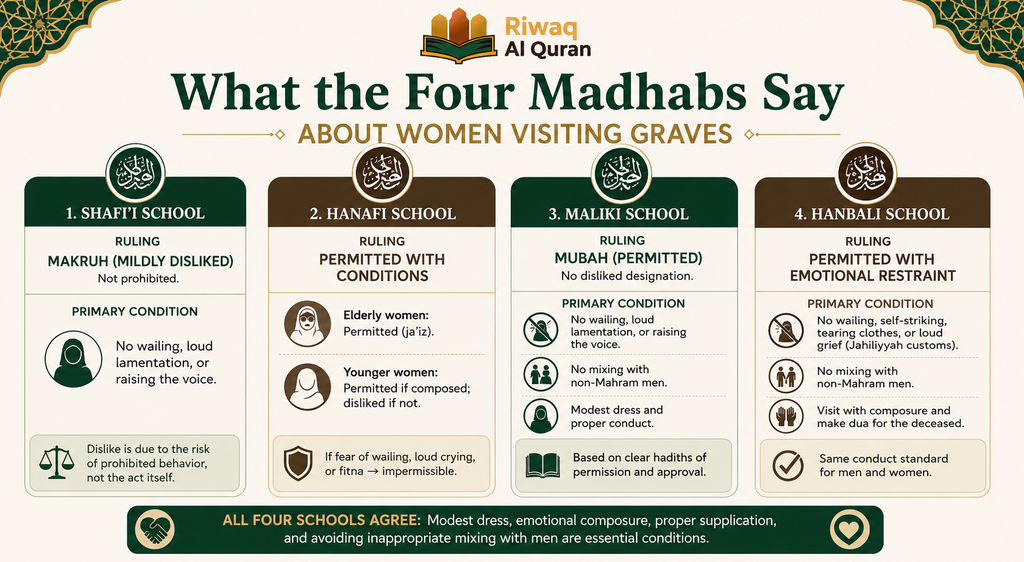
All four major Sunni schools accepted the same set of hadiths. Their different conclusions reflect different weightings of that evidence and different applications of the juristic principle of preventing harm (sadd al-dhara’i). Understanding this methodology explains why the schools differ — and why, despite those differences, they all converge on the core permissibility of the act.
a. Shafi’i School – Mildly Disliked, Not Prohibited
The Shafi’i school holds that it is disliked (makruh) for women to visit graves in general, based primarily on the curse hadith (Hadith 5 above). Al-Nawawi — the school’s foremost authority — qualified this position significantly in Al-Majmu’ Sharh Al-Muhadhdhab:
- The dislike is mild (tanzih), not severe, when the prohibited behaviors are absent.
- If a woman visits without wailing, excessive lamentation, or raising her voice, the ruling approaches permissibility.
- For elderly women specifically, the ruling moves closer to full permission.
- Women must not intermingle with non-Mahram men when visiting graves — this is a separate and firm condition.
- The dislike is attached to the risk of prohibited behavior, not to the act of visiting itself.
b. Hanafi School – Permitted with Behavioral Conditions
The Hanafi school makes a structured distinction between older and younger women based on their capacity for emotional restraint. Ibn Abidin in Radd al-Muhtar ‘ala al-Durr al-Mukhtar explains the school’s position as follows:
- For elderly women: visiting graves is straightforwardly permissible (ja’iz) — they are considered less susceptible to the emotional outbursts the scholars were concerned about.
- For younger women: permissible but mildly disliked if conducted with full restraint and composure.
- If there is genuine fear of wailing, loud crying, or fitna — the ruling shifts to impermissibility.
- The operative criterion is behavioral ability, not simply age — a younger woman who can maintain composure meets the condition.
c. Maliki School – Fully Permitted Without a Disliked Designation
The Maliki school takes the most permissive position of the four. It holds that women’s grave visits are fully permissible (mubah) — without the disliked designation attached by other schools — provided the following:
- No wailing, loud lamentation, or raising the voice in grief.
- No inappropriate mixing with non-Mahram men.
- Visit conducted with modest dress and proper conduct.
Maliki scholars ground this position directly in Hadith 2 (Aisha’s question about grave-visiting etiquette) and Hadith 3 (the Prophet’s ﷺ implicit approval at the weeping woman’s grave). They treat the evidence as conclusive: the general permission of Hadith 1 was not withdrawn for women.
d. Hanbali School – Permitted with Emotional Restraint Required
The Hanbali school holds that women’s grave visits are permitted when free from the behaviors the Prophet ﷺ explicitly condemned. Ibn Qudama in Al-Mughni explains:
- Wailing, self-striking, and tearing of garments are prohibited — identified as remnants of pre-Islamic (jahiliyyah) mourning customs abolished by the Prophet ﷺ.
- These are behavioral prohibitions applying to all Muslims — the Hanbali school does not treat women as a special case requiring additional restriction.
- A woman who visits with composure and supplicates for the deceased performs an act that is permissible and spiritually beneficial.
- The conduct standard is the same for men and women.
Where all four schools converge: No madhab holds that women are categorically prohibited from visiting graves. The conditions they all agree on are: modest dress, emotional composure, the appropriate supplication, and avoidance of any inappropriate mixing with men.
Can a Wife Visit Her Husband’s Grave in Islam?
Yes, a wife can visit her husband’s grave in Islam. This is supported by the general permissibility established across all four madhabs and by Aisha’s direct engagement with the Prophet ﷺ on grave-visiting etiquette, which she herself practiced.
Key considerations for a wife visiting her husband’s grave:
- Losing a husband is among the most significant losses a woman can experience, and Islam does not require her to suppress that grief — it channels it.
- Visiting the grave to recite Al-Fatiha, make dua for the husband’s forgiveness and mercy, and connect with the reality of the Hereafter is a spiritually meaningful and legally supported act.
- This aligns directly with the purpose the Prophet ﷺ described in Hadith 1: softening the heart, tears of reflection, and remembrance of the Hereafter.
- One legal distinction applies during the iddah period — this is addressed in full detail in the dedicated section below.
Can a Daughter Visit Her Father’s Grave in Islam?
Yes, and there is broad scholarly agreement that this falls clearly within the general permissibility. Islamic teaching is explicit that parental rights (haqq al-walidayn) extend beyond death. The Prophet ﷺ said:
“عن أبي هريرة رضي الله عنه أن رسول الله ﷺ قال: «إذا ماتَ ابنُ آدمَ انقطع عملُه إلا من ثلاثٍ: صدقةٍ جاريةٍ، أو علمٍ يُنتفَعُ به، أو ولدٍ صالحٍ يدعو له»
“When a man dies, his deeds come to an end except for three things: continuous charity, knowledge from which others benefit, and a righteous child who prays for him.”Sahih Muslim 1631, Book 25, Hadith 14
What this means for a daughter visiting her father’s grave:
- Her supplication for his forgiveness and mercy is an act of ongoing benefit that reaches him — confirmed by the hadith above.
- Her presence at the grave is an active extension of filial duty (birr al-walidayn) — not a passive act of grief.
- No scholar singles out a daughter’s visit to her father’s grave as problematic in any of the four schools.
- The standard guidelines of modest dress, composed conduct, and appropriate supplication apply, as they do for all grave visits.
The Iddah Period and Grave Visits – A Ruling Most Articles Fail to Explain
The Iddah period introduces a separate legal question that is frequently mentioned in articles on this topic but almost never properly explained.
The iddah of a widow is the waiting period of four months and ten days she observes following her husband’s death. Allah says in:
“وَالَّذِينَ يُتَوَفَّوْنَ مِنكُمْ وَيَذَرُونَ أَزْوَاجًا يَتَرَبَّصْنَ بِأَنفُسِهِنَّ أَرْبَعَةَ أَشْهُرٍ وَعَشْرًا ۖ فَإِذَا بَلَغْنَ أَجَلَهُنَّ فَلَا جُنَاحَ عَلَيْكُمْ فِيمَا فَعَلْنَ فِي أَنفُسِهِنَّ بِالْمَعْرُوفِ ۗ وَاللَّهُ بِمَا تَعْمَلُونَ خَبِيرٌ”
“And those who are taken in death among you and leave wives behind — they, the wives, shall wait four months and ten days. And when they have fulfilled their term, then there is no blame upon you for what they do with themselves in an acceptable manner. And Allah is acquainted with what you do.” Surah Al-Baqarah — 2:234
During iddah, the dominant position in both the Hanafi and Shafi’i schools is that the widow remains at home except for genuine legal necessity (darurah). What this means practically:
- Visiting any grave — including her husband’s — is not classified as a legal necessity in the classical sense.
- Most scholars advise deferring such visits until the iddah period concludes.
- The iddah restriction is about her legal status as a widow in a waiting period — not a judgment on the propriety of women’s grave visits generally.
- A woman in iddah who wishes to pray for her deceased husband should do so from home — her sincere dua reaches him regardless of her physical location.
- Once iddah ends, the standard ruling for all other women applies to her fully.
A Practical Decision Framework – Four Questions Before Visiting a Grave
One thing missing from almost every article on this topic is a concrete decision tool — a set of criteria a woman can apply to her own planned visit rather than relying on general statements. Based on the conditions agreed upon across all four schools, the following four questions cover the scholarly standard:
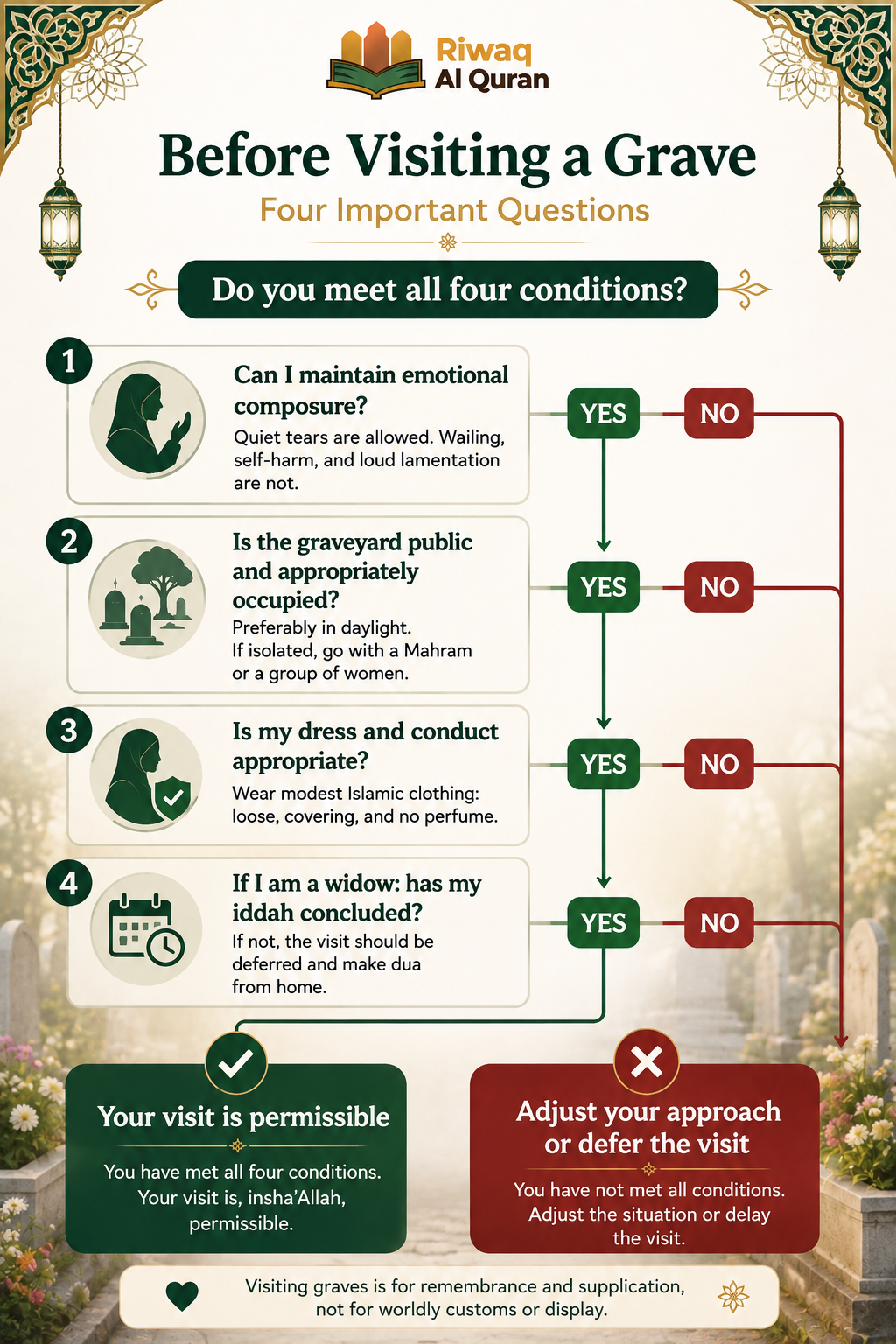
- Can I conduct myself with emotional composure? Quiet tears are permitted. Wailing, striking oneself, raising the voice in grief — these are not. If a woman knows she is likely to lose composure in the prohibited sense, she should defer the visit until she is more settled. This is applying the scholarly condition honestly to one’s own situation, not a sign of weakness.
- Is the graveyard public and appropriately occupied, or isolated and deserted? A busy public graveyard during daylight hours presents no safety or fitna concern. A deserted graveyard at night or in an isolated location is a different situation — scholars recommend a Mahram companion. The question is whether specific circumstances warrant accompaniment, not whether it is legally required in every scenario.
- Is my dress and conduct appropriate? Full Islamic modest dress is required — loose-fitting, covering appropriately, and without perfume. Scholars specifically note that women should not wear fragrance when visiting graveyards, for the same reason they are advised against it in mosques where non-Mahram men are present.
- If I am a widow: has my iddah concluded? If not, the visit should be deferred and supplications made from home.
If all four conditions are satisfactorily met, the visit falls within the standard agreed upon across all four schools and is — at minimum — permissible.
Practical Guidelines for Women Visiting Graves in Islam
Knowing that a visit is permitted is only the starting point. How a woman conducts that visit determines whether it is spiritually sound and legally correct. The following guidelines draw directly from the scholarly conditions established by all four schools.
1. Dress, Timing, and Companionship
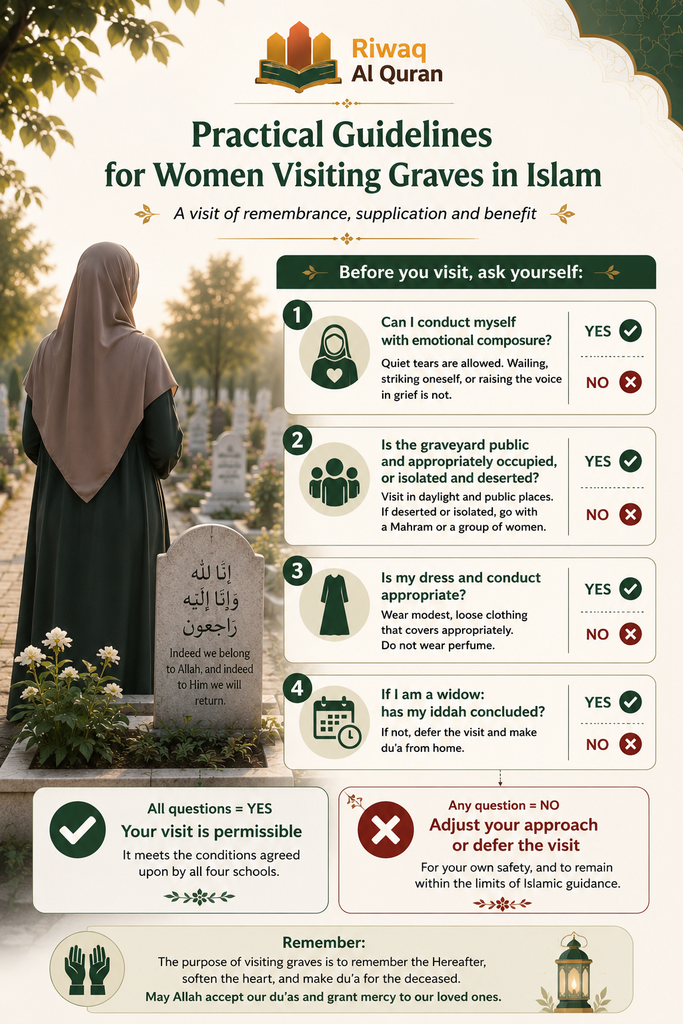
Before arriving at the graveyard, a woman should ensure the following:
- Wear full Islamic modest dress — loose-fitting and covering appropriately.
- Do not wear perfume. This is a specific scholarly condition, absent from most articles on this topic. The same reasoning that applies to mosques applies here: avoiding any cause of attraction in shared religious spaces where non-Mahram men may be present.
- Visit during daylight hours at a graveyard that is publicly accessible and not isolated.
- If reaching a specific grave requires walking among unfamiliar men in a crowded space, bring a Mahram companion or visit with a group of women.
2. The Supplication to Recite at the Grave
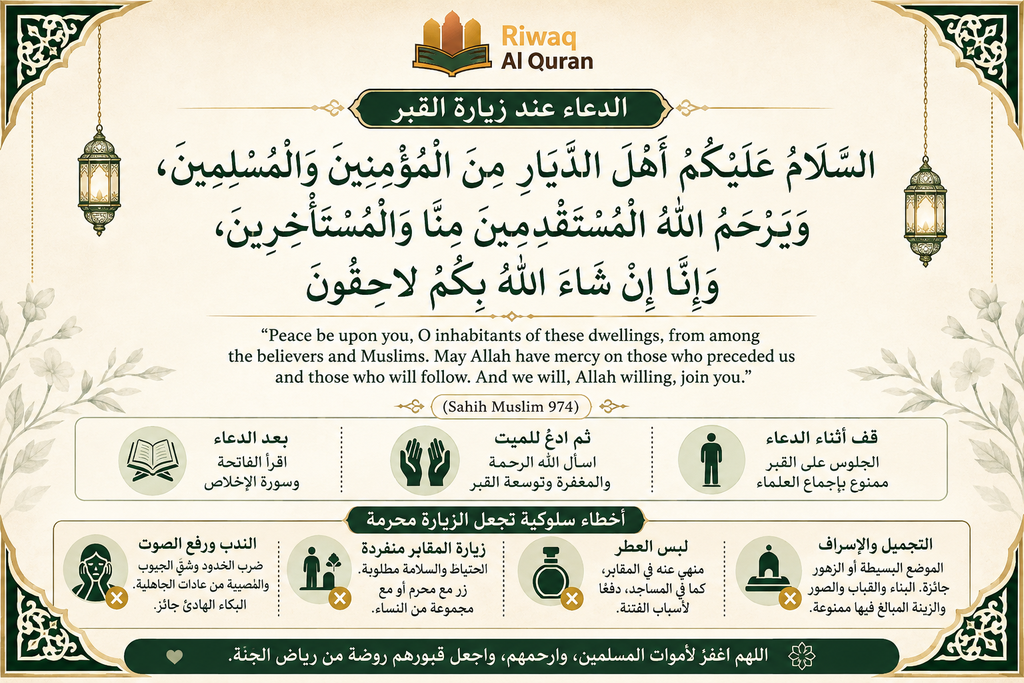
Upon arriving at the grave, recite the supplication the Prophet ﷺ taught Aisha:
“السَّلَامُ عَلَيْكُمْ أَهْلَ الدِّيَارِ مِنَ الْمُؤْمِنِينَ وَالْمُسْلِمِينَ، وَيَرْحَمُ اللَّهُ الْمُسْتَقْدِمِينَ مِنَّا وَالْمُسْتَأْخِرِينَ، وَإِنَّا إِنْ شَاءَ اللَّهُ بِكُمْ لَاحِقُونَ”
“Peace be upon you, O inhabitants of these dwellings, from among the believers and Muslims. May Allah have mercy on those who preceded us and those who will follow. And we will, Allah willing, join you.” (Sahih Muslim 974)
After this supplication:
- Recite Surah Al-Fatiha and Surah Al-Ikhlas.
- Make personal dua for the deceased — asking for Allah’s mercy, forgiveness, and the widening of the grave.
- Stand during supplication — sitting directly on the grave itself is prohibited by scholarly consensus across all four schools.
3. Behavioral Mistakes That Can Make a Permissible Visit Prohibited
These are the specific errors that shift a permissible visit into a prohibited one — a distinction most articles on this topic never draw clearly:
- Wailing and loud lamentation. The Prophet ﷺ condemned striking the cheeks, tearing garments, and raising the voice in grief as remnants of pre-Islamic mourning customs. Quiet weeping is permitted and prophetically established. It is the manner of grief that is regulated, not grief itself.
- Visiting a deserted graveyard alone. The concern is safety and the harm-prevention principle (sadd al-dhara’i). Visiting with a Mahram companion or a group of women removes the concern entirely.
- Wearing perfume. This is the detail most articles miss. Scholars specifically advise against fragrance at graveyards — for the same reason as in mosques — to avoid any cause of attraction in shared religious spaces.
- Extravagant decoration of the grave. A simple marker or flowers is permissible. Building raised structures over graves, placing photographs, or elaborate adornment are acts explicitly prohibited by the Prophet ﷺ. The visit should be an act of remembrance and supplication — not display.
Deepen Your Understanding of Islamic Jurisprudence with Riwaq Al Quran
The ruling on women visiting graves illustrates something important about fiqh: even a seemingly simple question is grounded in Quranic principles, authenticated hadiths, and centuries of careful scholarly reasoning applied to specific human realities.
Understanding why scholars ruled the way they did — and how to apply those rulings to contemporary situations — requires studying the principles of Islamic jurisprudence at their root.
Riwaq Al Quran is a comprehensive online platform offering personalised Quran, Arabic, and Islamic Studies courses for individuals of all ages and backgrounds. Their experienced instructors use a structured curriculum covering Tajweed, Tafsir, Memorisation, and Fiqh — providing easy and effective access to grounded Islamic learning.
Their Online Fiqh Course covers the foundational principles of Islamic jurisprudence, the methodology of all four schools, and applied rulings on everyday questions exactly like the one this article addresses.
Watch real moments from our live sessions at Riwaq Al Quran and see how we bring learning to life:
Start Learning with Riwaq Al Quran Today
If you want to understand Islamic rulings at this depth — not just the what, but the why and the how — Riwaq Al Quran‘s curriculum gives you the tools to build that understanding from the ground up.
Among their most sought-after offerings:
- Online Tafseer Course — Delve into Quranic meanings with insightful, expert-led study.
- Online Fiqh of Worship Course — Master the principles of Islamic jurisprudence with structured guidance.
- Online Quran Recitation Course — Enhance your Quranic recitation with expert instruction.
- Online Tajweed Classes — Master Tajweed rules for beautiful Quranic recitation.
- Online Qirat Course — Explore the diverse Qirat styles of the Quran.
- Online Quran Classes for Kids — Nurture a love for the Quran in your children through interactive, age-appropriate classes.
Riwaq Al Quran has helped thousands of students across the world build genuine, grounded knowledge of Islam — from complete beginners to those deepening years of existing study.
Book your free trial session now — no commitment required.

Conclusion
Women can visit graveyards in Islam — and the evidence for this is grounded in the Quran, authenticated hadiths, and the juristic reasoning of all four major Sunni schools. Allah reminds us in Surah Al-Anbiya and Surah Al-Imran that every soul will taste death and return to Him.
The grave visit is Islam’s practical expression of that reminder — an act of spiritual reckoning that the Prophet ﷺ encouraged for all believers and taught Aisha, the Mother of the Believers, to perform with the proper supplication.
The madhabs differ on degree — from mildly disliked in the Shafi’i school to fully permitted without qualification in the Maliki school — but none prohibits the practice. The conditions they all attach are behavioral, not gender-based:
- No wailing or loud lamentation.
- Full Islamic modest dress, without perfume.
- Appropriate conduct and solemnity at all times.
- No mixing with non-Mahram men.
The Iddah period stands as a separate legal matter that defers but does not deny. And a daughter praying at her father’s grave, a wife reciting Al-Fatiha at her husband’s resting place — both are performing acts that Islam’s scholarly tradition broadly endorses and its spiritual framework actively encourages.
Frequently Asked Questions
The following questions address the most common points of confusion that Muslims encounter on this topic — from the general ruling across all four schools, to specific family situations, to the conduct required during the visit itself.
Is it haram for women to visit graveyards in Islam?
No. None of the four major Sunni schools — Shafi’i, Hanafi, Maliki, or Hanbali — classifies women’s grave visits as haram. The ruling ranges from mildly disliked to fully permitted depending on the school and the conditions present. The curse hadith (Ibn Majah 1575) refers specifically to habitual, wailing-accompanied visits — not ordinary visits conducted with proper conduct and sincere intention.
What should a woman recite when visiting a grave?
She should recite the dua the Prophet ﷺ taught Aisha (Sahih Muslim 974): “Peace be upon you, O inhabitants of these dwellings, from among the believers and Muslims. May Allah have mercy on those who preceded us and those who will follow. And we will, Allah willing, join you.” She may also recite Surah Al-Fatiha, Surah Al-Ikhlas, and make personal dua for the deceased. Sitting directly on the grave is prohibited.
Can a woman visit a graveyard without a Mahram?
She may visit without a Mahram if the graveyard is public and appropriately occupied during daylight hours. In deserted or isolated graveyards, scholars recommend a Mahram companion or visiting with a group of women. The concern is safety and the prevention of fitna — not a categorical legal requirement for male accompaniment in every scenario.
Can a widow visit her husband’s grave during iddah?
The dominant position in the Hanafi and Shafi’i schools is that a widow in iddah remains at home except for genuine legal necessity. A grave visit does not meet the threshold of necessity in the classical sense, so most scholars advise deferring the visit until the iddah of four months and ten days concludes. Her sincere dua for her husband made from home is equally valid and reaches him regardless of her physical location.
Does the Maliki school treat women’s grave visits differently from other madhabs?
Yes. The Maliki school is the most permissive of the four, holding women’s visits to be fully permissible without a makruh designation — provided there is no wailing, loud lamentation, or inappropriate mixing with non-Mahram men. This position draws directly on Aisha’s hadith (Muslim 974) and the Prophet’s ﷺ implicit approval at the weeping woman’s grave (Bukhari 1283), which Maliki scholars treat as conclusive evidence that the general permission was not withdrawn for women.
Is crying permitted when visiting a grave?
Yes. Quiet weeping from genuine grief is permitted — the Prophet ﷺ himself wept at his mother’s grave (Muslim 976). What is prohibited is wailing, raising the voice in lamentation, striking oneself, or tearing garments. The distinction is between natural, composed grief and the performative mourning practices that the Prophet ﷺ explicitly condemned.
Sources
The following table lists all Quranic verses and authenticated hadiths cited in this article, with direct links to verified references on Quran.com and Sunnah.com.
| Reference | Description | Link |
| Surah Al-Anbiya — 21:35 | Every soul will taste death | quran.com/21/35 |
| Surah Al-Imran — 3:185 | Every soul tastes death; life is delusion | quran.com/3/185 |
| Surah Al-Baqarah — 2:155–156 | Patience in grief and calamity | quran.com/2/155 |
| Surah Az-Zumar — 39:30 | You will die and they will die | quran.com/39/30 |
| Surah Al-Baqarah — 2:234 | The Iddah period verse | quran.com/2/234 |
| Sahih Muslim 977a | Prohibition on grave visits lifted | sunnah.com/muslim:977a |
| Sahih Muslim 974 | Aisha’s dua at the grave | sunnah.com/muslim:974 |
| Sahih al-Bukhari 1283 | Prophet at weeping woman’s grave | sunnah.com/bukhari:1283 |
| Sahih Muslim 976 | Prophet weeping at his mother’s grave | sunnah.com/muslim:976 |
| Sahih Muslim 1631 | Righteous child praying for deceased parent | sunnah.com/muslim:1631 |
| Sunan Ibn Majah 1575 | Curse hadith | sunnah.com/ibnmajah:1575 |
| Jami’ al-Tirmidhi 1056 | Curse hadith (extended version) | sunnah.com/tirmidhi:1056 |