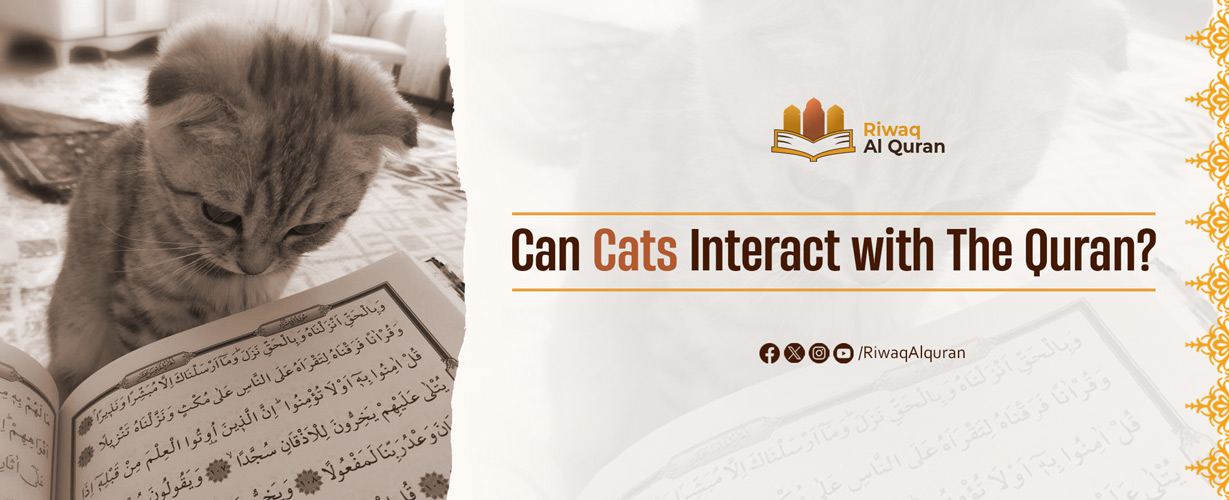
Have you ever watched your cat stroll across your prayer mat and wondered what Islam actually says about that? Every Muslim household with a cat eventually faces the same questions: are cats mentioned in the Quran? Are they ritually pure? And can they touch the holy book without that meaning something?
Cats in Islam are not a grey area. Between the Quran’s broader framework for treating all living creatures, the Prophet Muhammad’s (PBUH) documented personal affection for cats, and clear fiqh rulings on their ritual purity, there is a consistent, well-grounded tradition to draw on. This article covers all of it — the Quranic verses, the key hadith with sources and translations, the scholarly ruling on cats and the Quran, and practical steps every Muslim pet owner should follow.
What You’ll Learn in This Article
- Whether cats are mentioned in the Quran and which verses apply to them.
- The story of Muezza, the Prophet’s cat, and its significance for Muslims today.
- The fiqh ruling on cats’ ritual purity (tahara) — with the exact hadith text and chain
- The scholarly position on whether a cat can touch a mushaf
- Actionable steps for keeping the Quran safe and honored in a home with pets
Table of Contents
Are Cats Mentioned in the Quran?
Cats are not mentioned by name anywhere in the Quran. What the Quran does establish — and this matters — is a broad framework of mercy and stewardship that directly governs a Muslim’s relationship with all animals, including cats.
1. The Quranic Framework for Animals
The Quran addresses animals directly in three key passages, each adding a distinct dimension to how a Muslim should understand their relationship with them.
a. Surah Al-An’am 6:38 and Animals as Communities
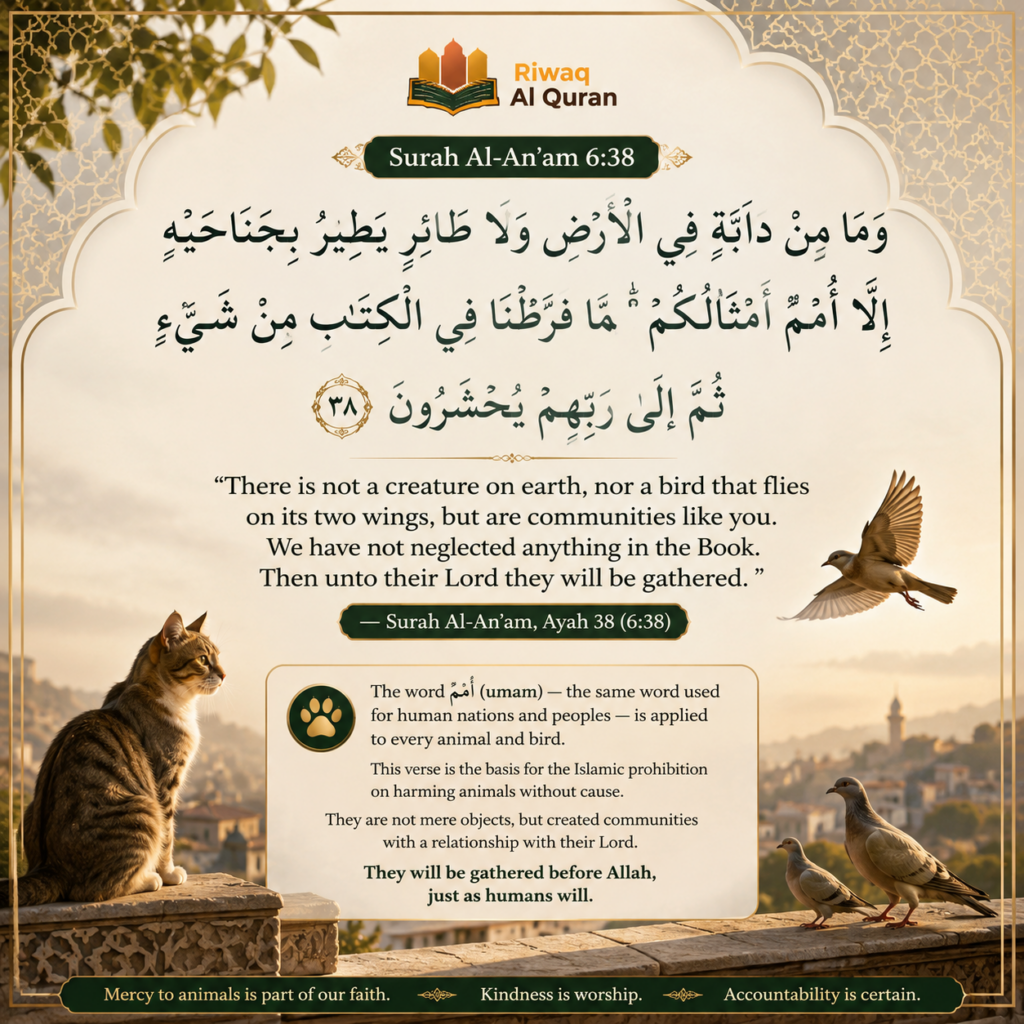
“وَمَا مِن دَابَّةٍ فِي الْأَرْضِ وَلَا طَائِرٍ يَطِيرُ بِجَنَاحَيْهِ إِلَّا أُمَمٌ أَمْثَالُكُم ۚ مَّا فَرَّطْنَا فِي الْكِتَابِ مِن شَيْءٍ ۚ ثُمَّ إِلَىٰ رَبِّهِمْ يُحْشَرُونَ”
“There is not a creature on earth, nor a bird that flies on its two wings, but are communities like you. We have not neglected anything in the Book. Then unto their Lord they will be gathered.”(Surah Al-An’am, Ayah 38 (6:38)
The Arabic word أُمَمٌ (umam) — the same word used for human nations and peoples — is applied here to every animal and bird on earth. This is not incidental word choice. Imam al-Qurtubi, commenting in Al-Jami’ li-Ahkam al-Quran, notes that this verse is the basis for the Islamic prohibition on harming animals without cause — they are not mere objects but created communities with a relationship with their Lord.
The verse closes by stating that animals will be gathered before Allah, just as humans will. For Muslim cat owners, this verse is the theological foundation for their duty of care toward their pets.
b. Surah Al-Hajj 22:18 and Animals in Continuous Prostration
“وَلِلَّهِ يَسْجُدُ مَا فِي السَّمَاوَاتِ وَمَا فِي الْأَرْضِ مِن دَابَّةٍ وَالْمَلَائِكَةُ وَهُمْ لَا يَسْتَكْبِرُونَ”
“And to Allah prostrates whatever is in the heavens and whatever is on the earth of moving creatures, and the angels, and they are not arrogant.”(Surah An-Nahl, Ayah 49 (16:49))
The word دَابَّةٍ (dabba) — creatures that move on the earth — encompasses cats explicitly. This verse appears in a passage distinguishing believers from those who do not, naming the animals among those who humble themselves before Allah.
In Islamic understanding, the cat in a Muslim home is itself in a state of continuous worship — a concept that aligned directly with how the Prophet (PBUH) treated animals in his own household.
c. Surah Al-Anbiya 21:107 and the Prophet’s Mercy Extending to All Creation
“وَمَا أَرْسَلْنَاكَ إِلَّا رَحْمَةً لِّلْعَالَمِينَ”
“And We have not sent you except as a mercy to the worlds.”(Surah Al-Anbiya, Ayah 107 (21:107))
The Arabic الْعَالَمِينَ (al-‘alamin) encompasses everything that exists — humans, animals, jinn, and all of creation. Imam Ibn Kathir (Tafsir Ibn Kathir, commentary on 21:107) explains that the mercy of the Prophet extended to all of creation, including animals and even the disbelievers.
His well-documented affection for cats was a direct expression of this prophetic quality — a behavioral model for every Muslim, not a personal preference.
2. How Cats Are Treated in the Hadith
The Hadith literature is where cats receive their specific, detailed treatment in Islamic tradition. Three narrations form the foundation.
a . The Ruling on Ritual Purity (Sunan Abu Dawud, 75)
Kabsha bint Ka’b ibn Malik, who was married to a son of Abu Qatada al-Ansari (may Allah be pleased with him), reported that Abu Qatada came to visit her and she poured water for him to perform ablution.
A cat came and drank from the water. Abu Qatada tilted the vessel for it until it drank. Kabsha said: He saw me looking at him. He said: “Are you surprised, O daughter of my brother?” I said: “Yes.” He then said that the Messenger of Allah (PBUH) said:
“إِنَّهَا لَيْسَتْ بِنَجَسٍ، إِنَّهَا مِنَ الطَّوَّافِينَ عَلَيْكُمْ أَوِ الطَّوَّافَاتِ”
“It (the cat) is not impure; it is one of those that go around among you.”— Sunan Abu Dawud, 75 | Also: Sunan al-Tirmidhi, 92 | Authenticated by Imam al-Nawawi in Al-Majmu’)
The ruling was not delivered as an abstract lecture but confirmed in a real domestic situation — telling us it was known and practiced among the Companions. The phrase الطَّوَّافِينَ عَلَيْكُمْ (al-tawwafin ‘alaykum — “those that go around among you”) shares the same Arabic root as the tawaf at the Kaaba — connecting the cat’s natural movement through the house with a concept of dignity and closeness, not impurity.
This hadith is cited as the decisive text by Imam al-Nawawi in Al-Majmu’ (Shafi’i), Ibn Qudama in Al-Mughni (Hanbali), and Ibn ‘Abidin in Radd al-Muhtar (Hanafi).
b. The Consequence of Cruelty (Sahih al-Bukhari, 3318 | Sahih Muslim, 2242)
“عُذِّبَتِ امْرَأَةٌ فِي هِرَّةٍ سَجَنَتْهَا حَتَّى مَاتَتْ، فَدَخَلَتْ فِيهَا النَّارَ، لاَ هِيَ أَطْعَمَتْهَا وَسَقَتْهَا إِذْ هِيَ حَبَسَتْهَا، وَلاَ هِيَ أَرْسَلَتْهَا تَأْكُلُ مِنْ خَشَاشِ الأَرْضِ”
“A woman was punished because of a cat she confined until it died. She entered Hellfire because of it. She did not feed it or give it water while she confined it, nor did she free it to eat from the creatures of the earth.”(Sahih al-Bukhari, Hadith 3318)(Muslim, Hadith 2242)
The woman was not punished for a violent act but for confinement and neglect — removing the animal’s autonomy and then failing the responsibility that came with it.
The hadith notes the alternative she did not take: “nor did she free it to eat from the creatures of the earth.” Islam’s default position for animals is freedom; confinement is permitted only when the owner fully assumes the duties of care. Any Muslim who keeps a cat indoors is, by this hadith, bound to provide food, water, shelter, and medical attention as required.
c. The General Principle of Reward for Serving Any Living Being from Sahih al-Bukhari 2363
“فِي كُلِّ كَبِدٍ رَطْبَةٍ أَجْرٌ“
“There is a reward for serving any living being.”(Sahih al-Bukhari, Hadith 2363, Sahih Muslim, Hadith 2244)
This ruling extends to all living creatures — not only the dog in the original context of the narration. Imam Ibn Hajar al-Asqalani (Fath al-Bari, commentary on Sahih al-Bukhari) explains that this hadith establishes an active reward — hasanat — for acts of care toward animals, not merely the avoidance of sin.
Feeding your cat, giving it water, and meeting its needs is, in Islamic understanding, an act of worship that carries reward.
The Islamic Status of Cats – Pure Protected and Favored
Understanding these views encourages Muslims to treat cats with kindness and respect, reflecting the compassionate teachings of Islam.
1. The Story of Muezza and the Prophet’s Cat
The most famous account of the Prophet’s relationship with cats involves his cat Muezza. Islamic historical literature records that the Prophet Muhammad (PBUH) once found Muezza sleeping on the sleeve of his robe when the adhan (call to prayer) was given. Rather than disturb her, he cut the sleeve from his robe so he could leave without waking the cat.
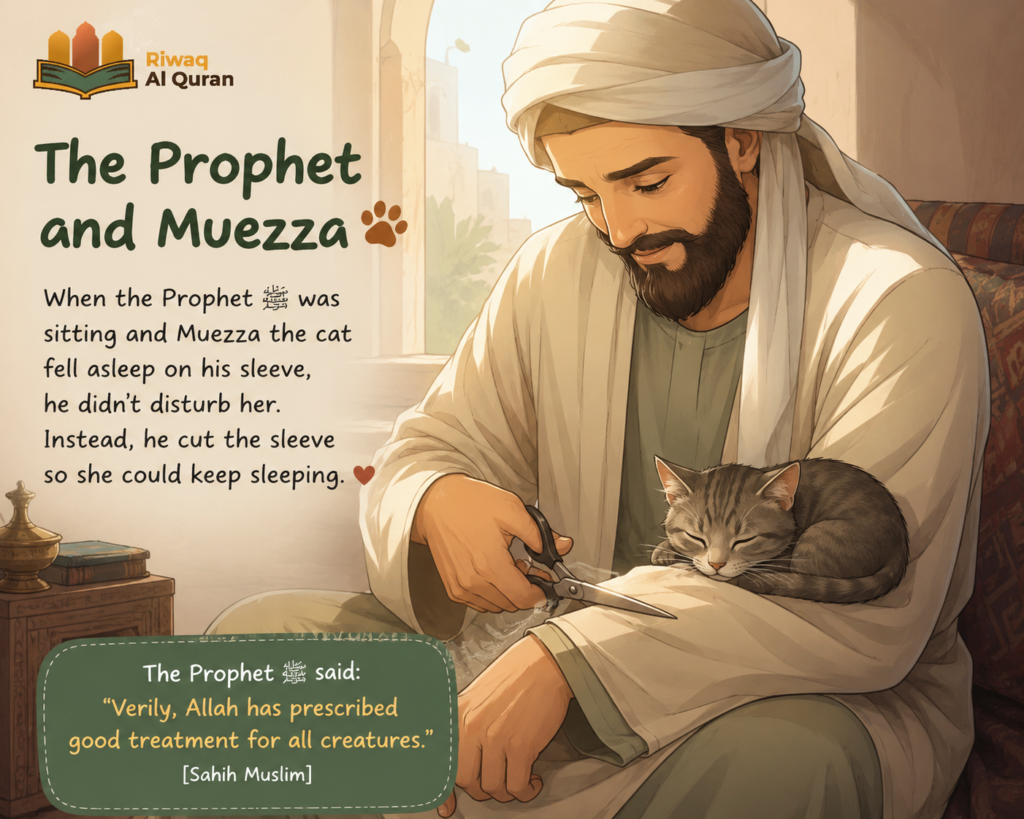
This account is referenced in classical Islamic literature on the Prophet’s character and manners (shama’il), including works by Islamic scholars on prophetic conduct.
While hadith scholars classify its chain of transmission as weak (da’if) when examined as a standalone narration, the account is accepted and transmitted in the broader literature of Islamic history and prophetic biography as an expression of a documented pattern of behavior — namely, the Prophet’s consistent, extraordinary consideration for animals, established through multiple authenticated hadith.
Its significance for Muslims is not as a legal proof-text, but as a concrete illustration of prophetic character: a man sent as a mercy to all worlds chose personal inconvenience rather than disturb a sleeping cat at the moment of prayer. That behavioral model is grounded in authenticated narrations establishing the same ethic across multiple incidents.
The Prophet’s (PBUH) extraordinary consideration for cats was one expression of a character documented across his entire life. Explore his full biography through Riwaq Al Quran’s Seerah course:
2. The Fiqh Ruling on Whether Cats Are Ritually Pure Tahir
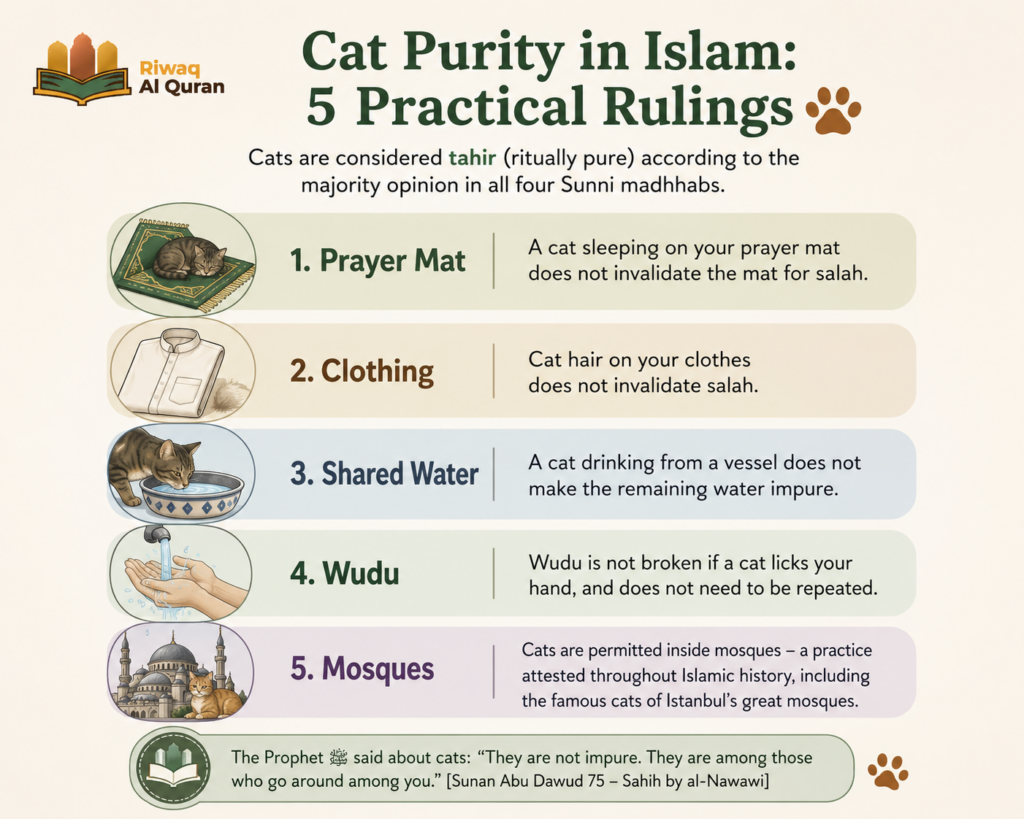
Cats are classified as tahir (ritually pure) under the majority scholarly opinion across all four major madhabs — Hanafi, Maliki, Shafi’i, and Hanbali — based on the hadith of Abu Qatada in Sunan Abu Dawud 75, authenticated by Imam al-Nawawi.
In practical terms, this ruling means:
- Prayer mat: A cat sleeping on your prayer mat does not invalidate the mat for salah.
- Clothing: Cat hair on your clothes does not invalidate salah.
- Shared water: A cat drinking from a vessel does not make the remaining water impure.
- Wudu: Wudu is not broken if a cat licks your hand, and does not need to be repeated.
- Mosques: Cats are permitted inside mosques — a practice attested throughout Islamic history, including the famous cats of Istanbul’s great mosques.
One narrow exception applies: a cat that has just eaten something najis (ritually impure) carries impure saliva until it has eaten and drunk enough clean food and water to cleanse its mouth. This is the exception, not the default ruling — and it applies only in the immediate aftermath of contact with impurity.
3. What the Shariah Says About Keeping Cats at Home
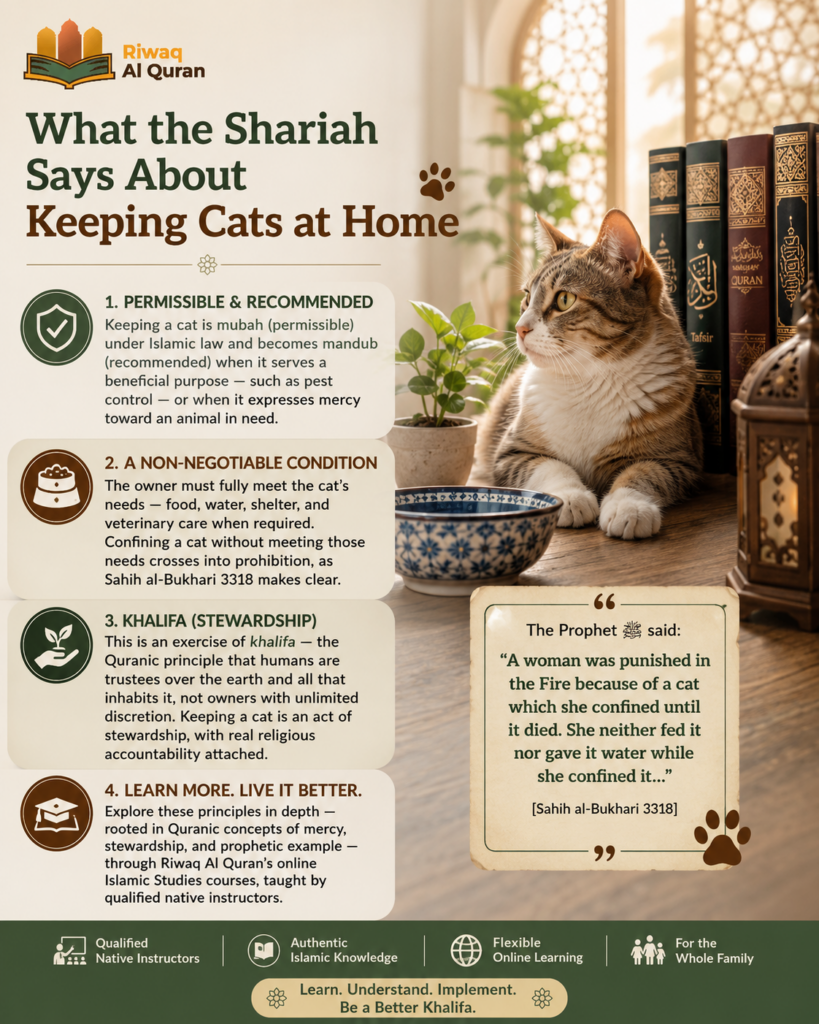
Keeping a cat is mubah (permissible) under Islamic law and becomes mandub (recommended) when it serves a beneficial purpose — such as pest control — or when it expresses mercy toward an animal in need.
The attached condition is non-negotiable: the owner must fully meet the cat’s needs — food, water, shelter, and veterinary care when required. Confining a cat without meeting those needs crosses into prohibition, as Sahih al-Bukhari 3318 makes clear.
The concept at work here is khalifa (stewardship) — the Quranic principle that humans are trustees over the earth and all that inhabits it, not owners with unlimited discretion. Keeping a cat is an exercise of that stewardship, with real religious accountability attached.
Muslim families who want to explore these principles in depth — rooted in Quranic concepts of mercy, stewardship, and prophetic example — can do so through Riwaq Al Quran’s online Islamic Studies courses, taught by qualified native instructors.
Can Cats Touch the Quran?
This is the question Muslim cat owners search most often, and it deserves a precise answer.
a. The Quranic Verse on Touching the Mushaf (56:79)
“لَّا يَمَسُّهُ إِلَّا الْمُطَهَّرُونَ”
“None shall touch it except the purified.” — (Surah Al-Waqi’ah, 56:79)
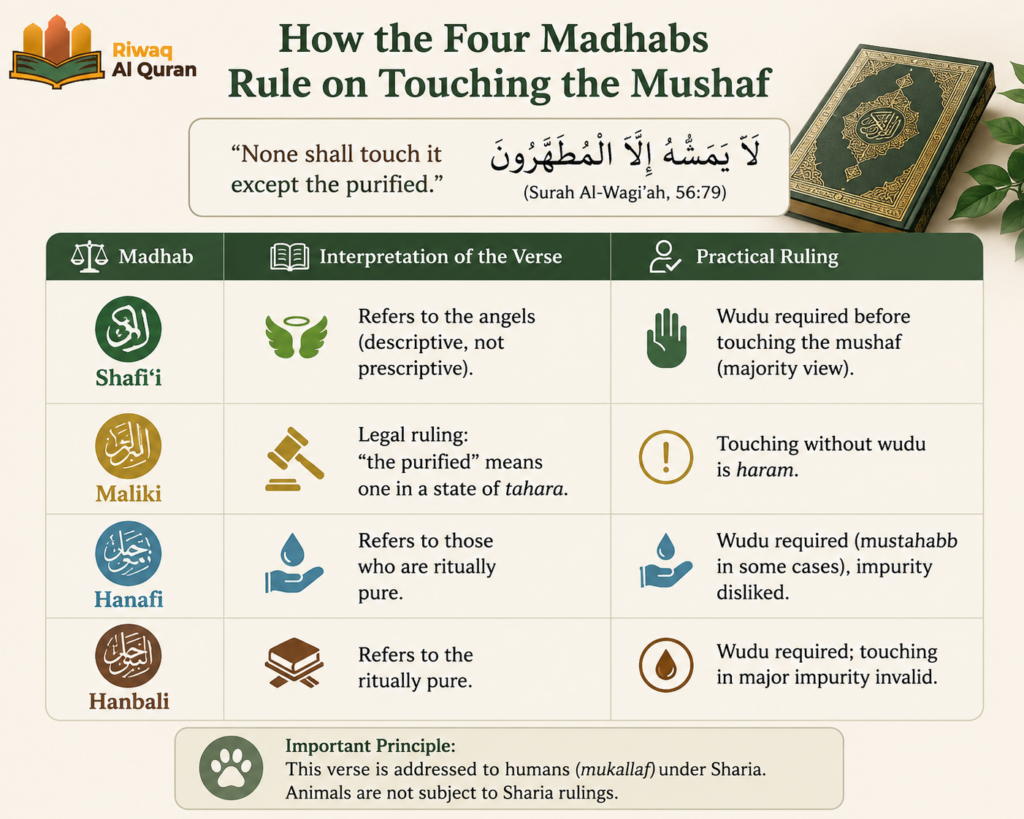
This verse sits within a passage describing the Quran’s elevated, protected status with Allah. Scholars hold differing opinions on the precise meaning of الْمُطَهَّرُونَ (al-mutahharun — “the purified”):
- Imam al-Shafi’i and Ibn Hazm hold that it refers to the angels who carry the Preserved Tablet, and that the verse is descriptive, not prescriptive.
- The majority of Maliki and Shafi’i scholars — and the ruling relied on in practice — interpret it as a legal ruling requiring tahara (wudu) before a Muslim touches a physical mushaf.
- The Maliki school goes furthest, classifying touching a mushaf without wudu as haram.
- The Hanafi and Hanbali schools are slightly less strict in certain cases but agree on the general principle.
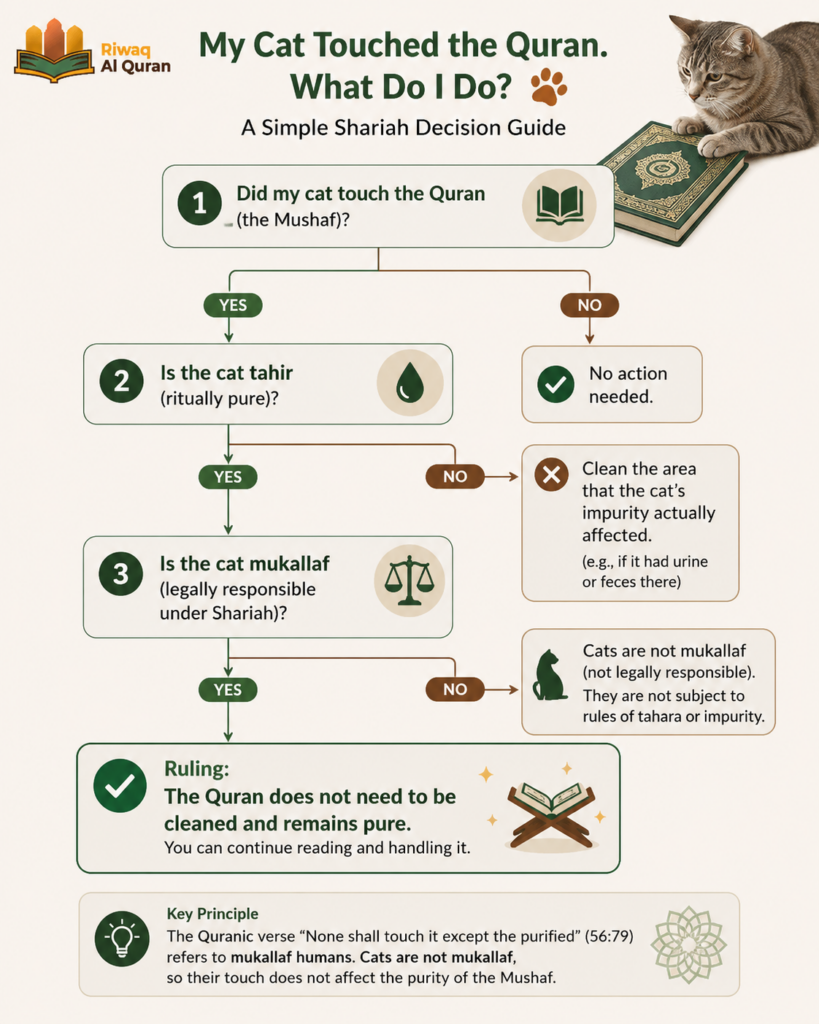
Critically: the verse is addressed to humans under Sharia obligation (mukallaf). Animals are not subject to Sharia rulings and cannot be in a state of wudu or ritual impurity in the legally operative sense. This is the foundation of the scholarly position on cats and the Quran.
b. The Scholarly Position on Cats and the Quran
The practical ruling — drawn from the interplay between Surah Al-Waqi’ah 56:79 and the cat purity ruling in Sunan Abu Dawud 75 — rests on two connected points:
- A cat physically contacting a mushaf does not violate the verse, because cats are both tahir (ritually pure) and outside the scope of the Sharia obligation the verse imposes — they cannot violate a rule that does not address them.
- However, scholars across all four madhabs hold that the Quran deserves the highest possible reverence (ta’dhim), and allowing an animal to walk across it or rest on it is makruh (discouraged), even if not haram.
The distinction is important: the cat does not “desecrate” the Quran. The Muslim who failed to prevent it is not honoring the Quran as it is owed to be honored. The religious failing belongs to the person, not the animal.
c. How to Keep the Quran Safe in a Home with Cats
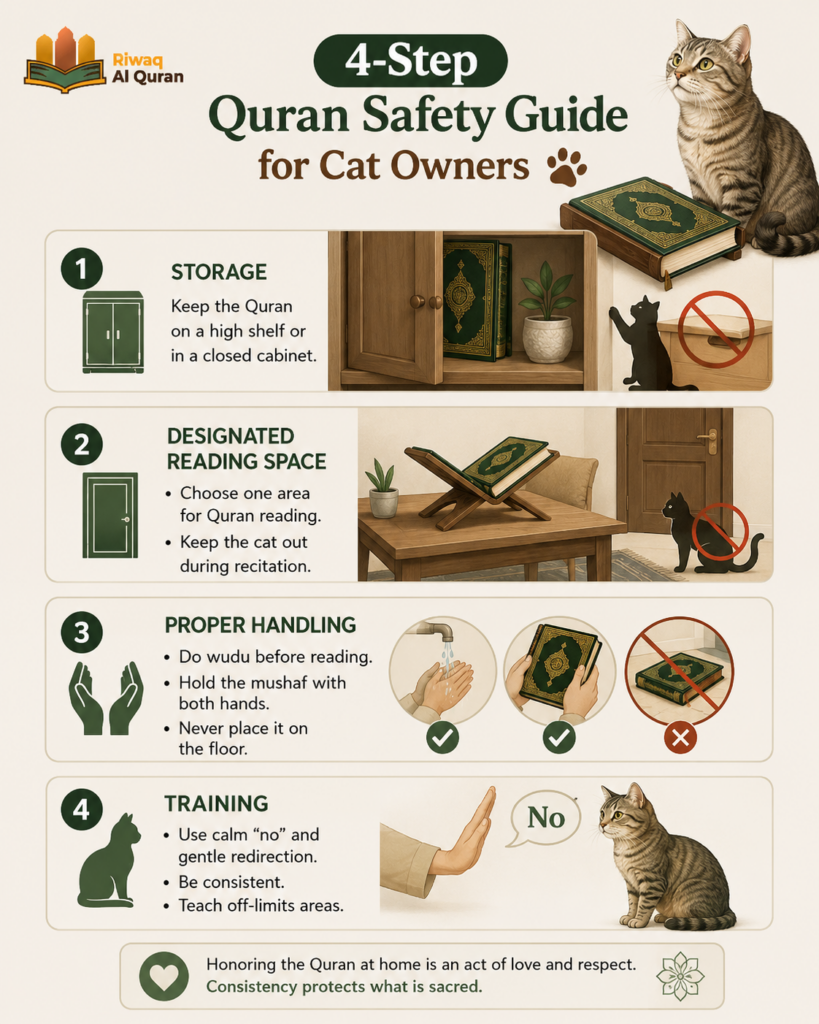
The most common mistake in Muslim households with cats is placing the Quran on a low shelf and assuming the cat will stay away. Cats reliably will not. A more effective approach:
- Storage — Keep the Quran on a high, dedicated shelf or inside a closed cabinet. Cats can reach most open flat surfaces; a cabinet door or a shelf above comfortable jumping height is far more reliable than an open lower shelf.
- Designated reading space — Establish one area for Quran reading — a room with a door you can close, or a reading stand on a table the cat does not climb — where the cat does not enter during recitation. Creating this consistent boundary is itself an act of honoring the Quran.
- Proper handling — Perform wudu before reading. Handle the mushaf with both hands. Never place it on the floor, even temporarily — cats are drawn to investigate anything placed at their level.
- Training — Most cats can be trained to avoid specific areas with consistent, patient redirection. A calm “no” and gentle removal, repeated consistently, teaches a cat which spaces are off-limits.
If you want to go beyond the basics — learning proper Quran handling, the tajweed rules, and the meanings behind the verses — Riwaq Al Quran offers one-on-one live sessions with qualified instructors, available online for all ages and levels, including complete beginners. Start by exploring learning the Quran online with guidance tailored to where you are today.
Start Learning the Quran Online — Book a Free Trial Today
Understanding Islamic teachings is richer when you learn directly from scholars, not just search results. Riwaq Al Quran is a comprehensive online platform offering personalized Quran, Arabic, and Islamic Studies classes for individuals of all ages and backgrounds.
Experienced instructors use a structured curriculum covering Tajweed, Tafsir, and Memorization, with live sessions that allow seamless communication and interaction between students and teachers.
See how Riwaq Al Quran delivers live, qualified instruction to students anywhere in the world:
Browse the full Quran courses catalog or explore by what matters most to you:
Quran Foundations
- Noorani Qaida Online — Start here: master the essentials of Quranic reading before anything else.
- Online Quran Recitation Course — Build fluency and correct pronunciation under expert guidance.
- Online Tajweed Classes — Learn the rules that govern beautiful, precise Quranic recitation.
Language & Islamic Knowledge
- Online Arabic Courses — Classical Arabic with a focus on Quranic comprehension.
- Online Islamic Studies Courses — Foundations of Islamic belief, worship, history, and ethics.
- Online Ijazah Courses — Obtain your formal certification in Quranic recitation.


Flexible scheduling. Proven curriculum. A free trial lesson to experience the quality yourself.
Conclusion
Cats in Islam are not merely tolerated — they are favored, legally protected, and a direct test of a Muslim’s commitment to mercy. The Quran establishes in Surah Al-An’am (6:38) that all animals are communities deserving respect, and in Surah Al-Hajj (22:18) that they glorify Allah alongside the angels.
The Prophet Muhammad (PBUH), described in Surah Al-Anbiya (21:107) as a mercy to all worlds, modeled extraordinary personal kindness toward cats in multiple authenticated accounts. Islamic jurisprudence across all four major madhabs classifies cats as ritually pure based on the hadith in Sunan Abu Dawud (75), with concrete implications for prayer and daily life.
And on the question of cats and the Quran, the ruling falls on the human: the Quran deserves the highest reverence, and it is the Muslim’s obligation — not the cat’s — to ensure conditions that honor it. Keep the Quran elevated. Handle it with purity. Treat the cat with kindness. Both are acts of worship.
Frequently Asked Questions
Every Muslim household with a cat has questions that go beyond the basics — from what the Quran actually says to the specific fiqh rulings that govern daily life. The answers below draw directly from Quranic verses, authenticated hadith, and the positions of the four major madhabs.
Are cats mentioned by name in the Quran?
No. Cats are not mentioned by name in the Quran. The Quran establishes a framework of mercy toward all animals in Surah Al-An’am (6:38), classifying them as communities (umam) like human peoples, and cats receive specific, favorable treatment in authenticated hadith — including the Prophet’s (PBUH) explicit statement that they are ritually pure (Sunan Abu Dawud, 75).
Are cats ritually pure (tahir) in Islam?
Yes. The majority scholarly position across all four madhabs classifies cats as tahir (ritually pure). A cat’s contact with your clothing, prayer mat, or a shared water vessel does not render them impure for prayer. The ruling is based directly on the hadith narrated by Abu Qatada, authenticated in Sunan Abu Dawud (75) and confirmed by Imam al-Nawawi in Al-Majmu’.
Can a cat touch the Quran?
A cat physically touching a mushaf does not violate Surah Al-Waqi’ah (56:79), which scholars interpret as a ruling addressed to legally responsible humans — not animals. However, allowing it is considered makruh (discouraged), because the Quran deserves the highest reverence. The responsibility to prevent it belongs to the Muslim, not the cat. Store the Quran on a high shelf or in a closed cabinet.
Is it haram to keep a cat indoors?
No. Keeping a cat indoors is permissible (mubah) and becomes recommended (mandub) when done with proper care. It becomes prohibited only if the cat is confined without adequate food, water, and care — established by the hadith in Sahih al-Bukhari (3318) and Sahih Muslim (2242), which records that a woman was punished in the Hereafter specifically for this act of neglect.
What did the Prophet Muhammad (PBUH) say about cats?
The Prophet (PBUH) explicitly stated that cats are not impure (Sunan Abu Dawud, 75) and demonstrated personal care for them throughout his life. He also gave a serious warning against cruelty to cats (Sahih al-Bukhari, 3318; Sahih Muslim, 2242), indicating that their welfare is a matter of direct religious accountability before Allah. Read more about the Prophet Muhammad’s teachings in the Quran.
Does cat hair on my clothes invalidate my prayer?
No. Because cats are classified as tahir (ritually pure) under the majority scholarly opinion, cat hair on clothing does not affect the validity of salah. You may pray with cat hair on your clothes without any issue. This applies equally to a cat that has rested on your prayer mat — the mat remains valid for prayer.
.