Free Quran learning online is entirely possible today. You can learn the Arabic letters, master Tajweed rules, and build fluent recitation using free apps, color-coded mushafs, reciter audio, and structured video lessons — then a free trial with a qualified teacher to correct what self-study alone can’t catch. Everything you need to start is below.
Most “free Quran learning” guides just hand you a long list of tools and leave you to guess the order. The result is a familiar one: you download five apps, watch a dozen videos, and three weeks later you’ve stalled with no clear next step. What beginners actually need is a path — what to learn first, what you can teach yourself for free, and the one thing free tools can never give you.
This guide gives you that path. Whether you’re starting from the Arabic alphabet or want to learn how to read the Quran properly, you’ll learn Quran online for free in a sequence that actually works.
What you’ll learn in this guide?
- A clear four-stage path to learn Quran online for free, from letters to fluent recitation.
- Which parts of Quran learning you can self-teach for free — and which need a teacher’s ear.
- How to learn Tajweed for free without locking in bad habits.
- How to learn for free as a child or a non-Arabic speaker.
- The common free-learning mistakes that quietly stall beginners.
Table of Contents
What Does Free Quran Learning Online Include?
Free Quran learning online means using no-cost digital resources — apps, websites, reciter audio, and video lessons — to learn to read, recite, and understand the Quran without paying for a course. It covers four core skills:
- The Arabic letters — recognizing and pronouncing each letter.
- Tajweed — the rules of correct pronunciation.
- Fluent recitation — reading smoothly and accurately.
- Memorization (Hifz) — retaining and reviewing what you learn.
Allah describes the Quran as made deliberately accessible to every sincere learner:
(وَلَقَدْ يَسَّرْنَا ٱلْقُرْءَانَ لِلذِّكْرِ فَهَلْ مِن مُّدَّكِرٍ)
“And We have certainly made the Quran easy to remember. So is there anyone who will be mindful?” — Surah Al-Qamar (54:17)
That ease is the foundation of every free method that follows. The tools are only a means; the Quran itself was made learnable — your job is to work through it in the right order.
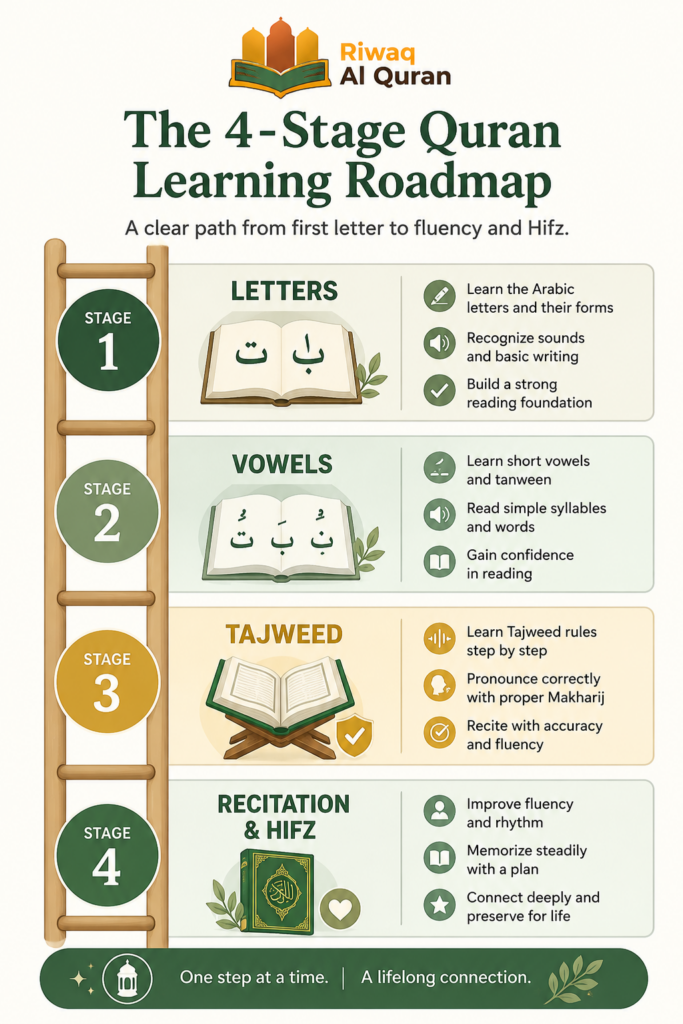
The Four-Stage Path To Learn Quran Online For Free
The fastest way to learn Quran online for free is to move through four stages in sequence, never skipping ahead. Most beginners fail not from lack of resources but from jumping straight to reciting full surahs before they can pronounce the letters. Follow the stages in order.
Here is the path, stage by stage.
Stage 1 — Learn the Arabic letters and their sounds
Start with the Arabic alphabet using a free Noorani Qaida program, which teaches each letter’s shape and sound before you ever touch a verse. This is the single most important stage, because every later skill depends on pronouncing the letters from their correct points of articulation (makharij).
Spend your first weeks here even if it feels slow. A learner who rushes past the letters carries those errors into everything else.
Stage 2 — Connect letters with the short and long vowels
Once you know the letters, learn the harakat — fatha, kasra, damma — and how letters join into syllables and words. Free color-coded mushaf apps help here by showing you exactly how each mark changes a sound.
At this stage you are reading simple words, not yet full verses. Read slowly and aloud; silent reading hides the pronunciation mistakes you most need to hear.
Stage 3 — Apply the Tajweed rules
Now layer in Tajweed: the rules of elongation (madd), nasalization (ghunnah), merging (idgham), and the points of articulation. Free video series and color-coded Qurans teach the rules clearly, and you can practice them on short surahs like Al-Fatihah and Al-Ikhlas.
This is exactly the stage where self-teaching starts to hit its limit — more on that next.
Stage 4 — Build fluent recitation and begin memorization
Finally, recite along with expert reciters to build rhythm and flow, then start memorizing short surahs. Free reciter audio libraries let you listen, repeat, and self-correct, while a repetition-based memorization app tracks your progress.
Start memorizing with the shortest surahs to build confidence before longer ones. Consistency here matters more than speed.
How to learn Tajweed for free — and where free hits its limit?
You can learn the theory of Tajweed for free, but you cannot hear your own mistakes — which is the one thing correct recitation depends on. This is the honest boundary of free self-study, and understanding it saves you months of wasted effort.
Allah commands recitation with precision, not just speed:
(وَرَتِّلِ ٱلْقُرْءَانَ تَرْتِيلًا)
“And recite the Quran with measured recitation.” — Surah Al-Muzzammil (73:4)
Tartil — measured, correct recitation — is a skill of the ear as much as the mouth. A video can show you the rule for idgham, but it cannot tell you that your noon is coming out wrong. Self-taught pronunciation errors tend to fossilize: the longer you repeat them uncorrected, the harder they are to fix later.
This is where a live teacher changes everything, and it’s why Riwaq Al Quran offers a genuinely free trial — so a qualified tutor can listen to your recitation and correct what no app can catch, before any bad habit sets in.
These are the exact errors free study tends to miss — watch a few common beginner Tajweed mistakes and how they’re corrected:
Free Self-Study vs Learning With a Teacher and Which One You Need
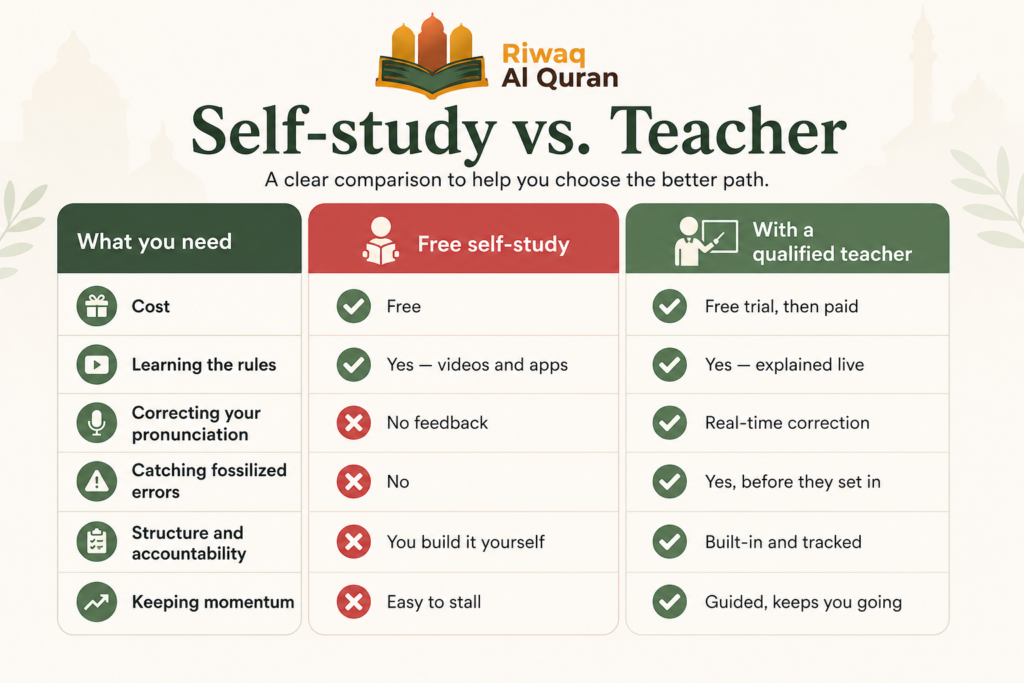
Free self-study and teacher-led learning are not rivals — they cover different needs, and the smartest learners combine them. Free tools teach you the rules; a teacher corrects how you apply them. The table below shows exactly where each one wins.
| What you need | Free self-study | With a qualified teacher |
|---|---|---|
| Cost | Free | Free trial, then paid |
| Learning the rules | Yes — videos and apps | Yes — explained live |
| Correcting your pronunciation | No feedback | Real-time correction |
| Catching fossilized errors | No | Yes, before they set in |
| Structure and accountability | You build it yourself | Built-in and tracked |
| Keeping momentum | Easy to stall | Guided, keeps you going |
The practical rule: use free tools for everything on the left, and bring in a teacher for the two rows only a human can do — hearing your recitation and correcting it. That single feedback loop is what separates learners who finish from those who plateau.
Free Quran learning for children and non-Arabic speakers
Children and non-Arabic speakers can learn Quran online for free, but each needs a slightly different approach to avoid the traps that stall them most. The core path is the same; the pacing and pitfalls differ.
- For children — Keep sessions short (fifteen to twenty minutes) and use gamified Noorani Qaida apps that reward progress. Kids absorb pronunciation quickly, so early correction matters — an uncorrected habit at age seven is far harder to fix at seventeen. Online lessons also let parents watch sessions and track progress.
- For non-Arabic speakers — Treat transliteration (Quran written in English letters) as a temporary crutch, not a method. Relying on it long-term is a common, costly mistake, because English letters cannot represent Arabic sounds accurately and lock in wrong pronunciation. Learn the actual Arabic script from Stage 1 and study Quranic Arabic alongside it, using translation apps only to understand meaning, not to recite from.
Understand What You Recite, not Just How
Reading the Quran correctly is the first goal; understanding it is the next, and free Tafsir and translation resources make that reachable. Recitation without reflection is only half the purpose — the Quran itself calls readers to ponder its meaning.
(أَفَلَا يَتَدَبَّرُونَ ٱلْقُرْءَانَ أَمْ عَلَىٰ قُلُوبٍ أَقْفَالُهَآ)
“Then do they not reflect upon the Quran, or are there locks upon their hearts?” — Surah Muhammad (47:24)
The verse frames reflection (tadabbur) as the point of recitation, not an optional extra. A simple free habit builds it: after you recite a short surah, read a two-line translation and one line of Tafsir for it — free downloadable Islamic studies books are a good place to start. Ten minutes a day connects the sounds you’re learning to the meaning behind them.
Free Tools That Genuinely Help Your Quran Learning
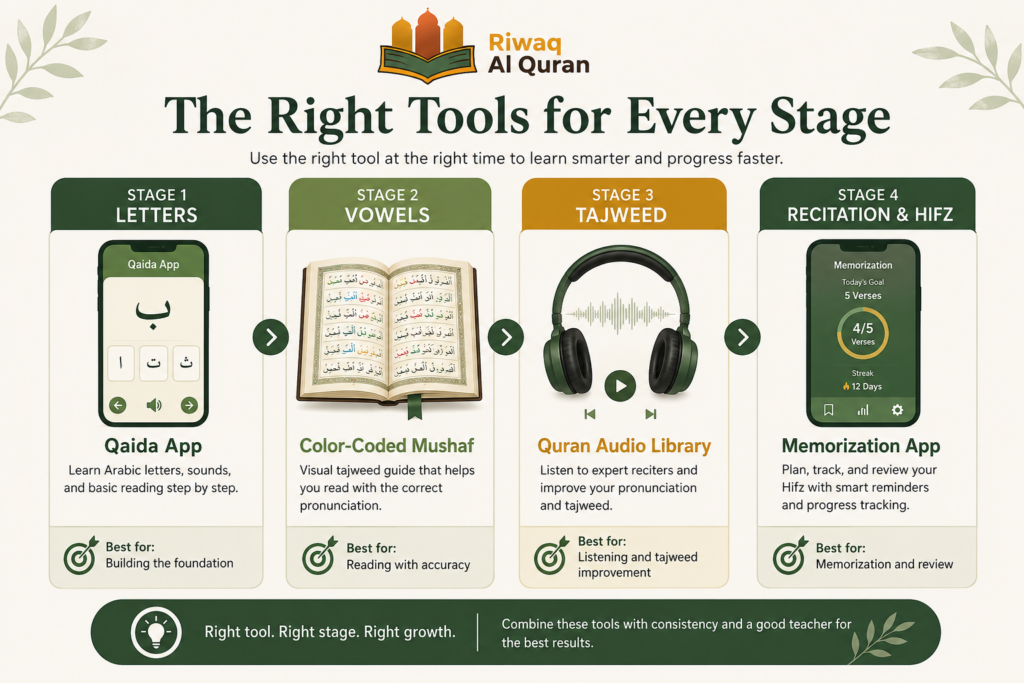
The free tools worth using fall into four types, and knowing what each one is for keeps you from drowning in apps. Choose one from each category rather than collecting a dozen.
Use these four categories:
- A Noorani Qaida program — for Stage 1, learning the letters and their articulation points.
- A color-coded mushaf app — for Stages 2 and 3, seeing Tajweed rules marked directly in the text.
- A reciter audio library — for Stage 4, listening to expert Qaris and reciting along.
- A repetition-based memorization app — for tracking Hifz with spaced review.
You can also learn from free video lessons, including Riwaq Al Quran’s own YouTube channel and Facebook page, which post free Tajweed and recitation tips.
When you evaluate any free resource, apply one test: does it give you feedback, or only content? Content-only tools (videos, audio, text) are perfect for learning rules and building exposure. But none of them hear you back — and that missing feedback loop is why most free-only learners plateau at Stage 3.
Common Mistakes When Learning Quran Online For Free
The mistakes that stall free-online learners are predictable, and each one is avoidable once you know it. These are the patterns that separate beginners who progress from those who quietly give up.
Watch for these four:
- Skipping the letters to reach the verses — Rushing to recite surahs before mastering makharij bakes pronunciation errors into everything after. Finish Stage 1 first.
- Collecting tools instead of following a path — Ten apps with no sequence create motion without progress. Pick one tool per stage and move through them in order.
- Practicing silently — Reading in your head hides the exact errors you need to hear. Always recite aloud.
- Never getting corrected — Months of confident but incorrect recitation is the costliest mistake, because fossilized errors take far longer to undo than to prevent. Get a teacher’s ear early.
How Long Does It Take To Learn To Read The Quran?
Most adult beginners learn to read the Quran with basic Tajweed in about six to twelve months of consistent daily practice, though the range depends on your starting point and how often you practice. The letters and vowels (Stages 1–2) typically take one to three months; applying Tajweed and building fluency (Stages 3–4) takes the rest.
The single biggest variable is not talent — it’s consistency. The Prophet ﷺ pointed to exactly this principle:
(أَحَبُّ الْأَعْمَالِ إِلَى اللَّهِ أَدْوَمُهَا وَإِنْ قَلَّ)
“The most beloved deeds to Allah are those done consistently, even if they are few.” — Sahih al-Bukhari 6464; Sahih Muslim 782
Applied to the Quran, this is decisive: fifteen focused minutes every day outperforms two hours once a week, because reading the Quran is a motor skill built through repetition. Set a small daily minimum you can keep, and protect it.
Why Online Quran Learning Works For Learners Of All Ages?
Online Quran learning suits children, teenagers, and adults because it removes the barriers that stop most people — time, location, and access to a qualified teacher. You study from home, on a schedule you set, with a tutor you’d never reach locally, giving everyone access to quality Quranic education.
The core advantages are concrete:
- Flexible timing — Fit lessons around work, school, or family instead of a fixed class.
- One-to-one attention — A tutor focused on your recitation, not a crowded room.
- Access to qualified tutors — Learn from specialists in Tajweed, Hifz, and Tafsir regardless of where you live.
- Progress you can see — Structured lessons and tracked milestones keep you moving.
Learning and teaching the Quran carries its own reward, as the Prophet ﷺ said:
(خَيْرُكُمْ مَنْ تَعَلَّمَ ٱلْقُرْآنَ وَعَلَّمَهُ)
“The best of you are those who learn the Quran and teach it.” — Sahih al-Bukhari 5027
The Reward Of Learning The Quran — Even One Letter At A Time
Every step of learning the Quran is rewarded, which is why even slow, effortful reading is never wasted. This is the encouragement beginners most need when the letters feel difficult.
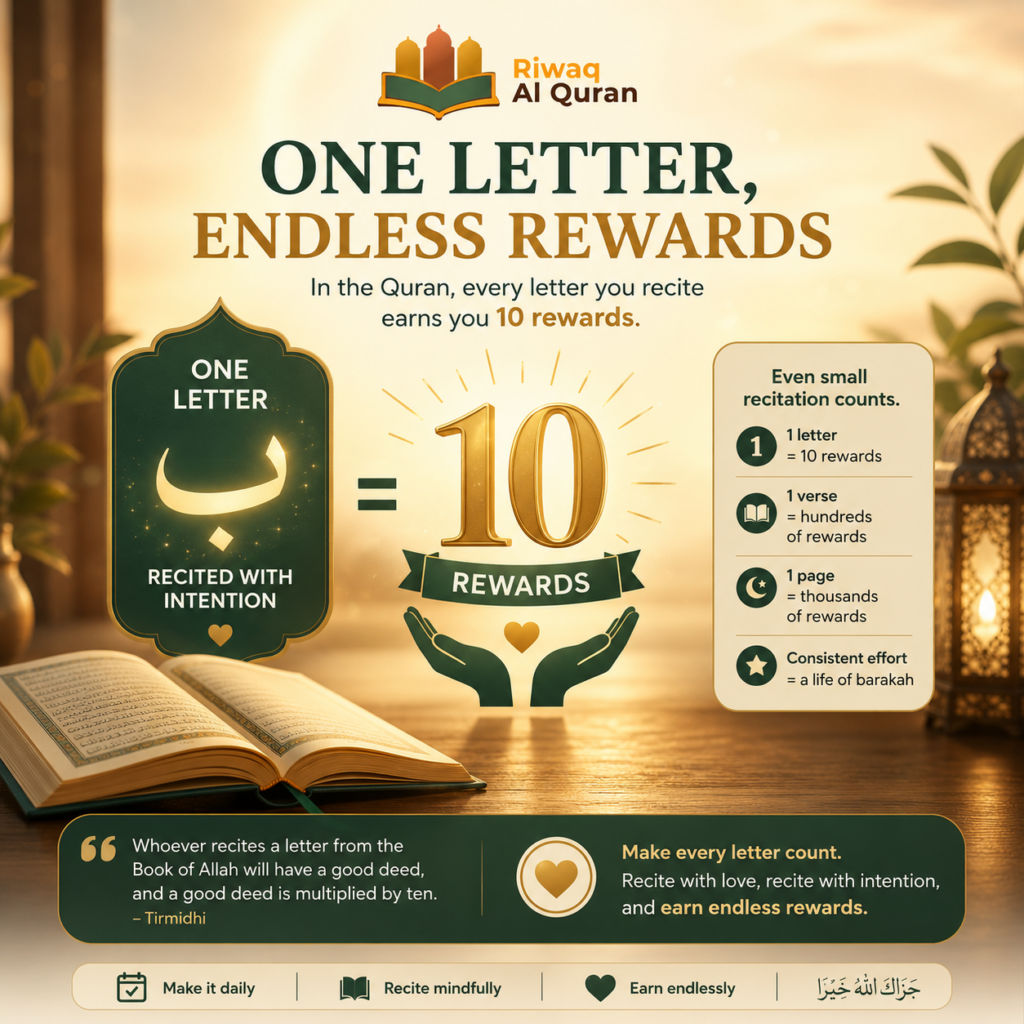
The Prophet ﷺ gave a specific measure for reading:
(مَنْ قَرَأَ حَرْفًا مِنْ كِتَابِ اللَّهِ فَلَهُ بِهِ حَسَنَةٌ، وَالْحَسَنَةُ بِعَشْرِ أَمْثَالِهَا)
“Whoever reads a letter from the Book of Allah earns one good deed, and each good deed is multiplied tenfold.” — Jami’ at-Tirmidhi 2910
He also honored the very struggle a beginner feels:
(الْمَاهِرُ بِالْقُرْآنِ مَعَ السَّفَرَةِ الْكِرَامِ الْبَرَرَةِ، وَالَّذِي يَقْرَأُ الْقُرْآنَ وَيَتَتَعْتَعُ فِيهِ وَهُوَ عَلَيْهِ شَاقٌّ لَهُ أَجْرَانِ)
“The one skilled in the Quran is with the noble, obedient angels, and the one who recites the Quran haltingly, finding it difficult, has two rewards.” — Sahih Muslim 798
Read that hadith carefully if you are just starting: the very difficulty you feel sounding out the letters earns you a double reward. Your stumbling recitation is not a sign you’re behind — it is itself an act Allah rewards twice over.
Turn free practice into correct recitation — start with a free lesson
You’ve done the hard part: you followed the path, used the free tools, and put in the daily minutes. So why does your recitation still feel uncertain? Because free content can teach you every rule and still never tell you the one thing that matters — whether you are applying them correctly. Left unchecked, small errors harden into habits that take months to undo.
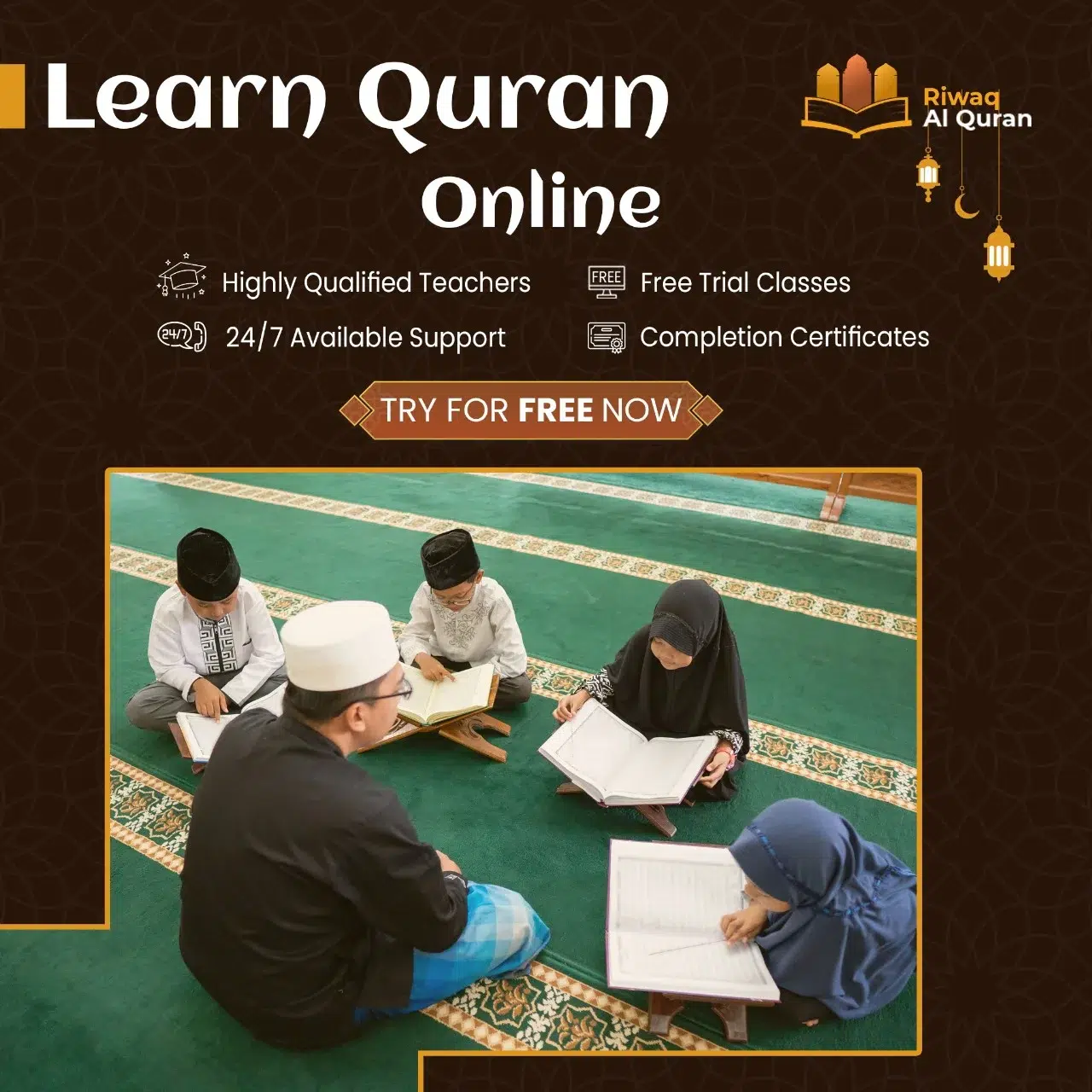
One free lesson closes that gap. A qualified Riwaq Al Quran tutor listens to your recitation, catches what no app can hear, and shows you your next step — before any mistake sets in.
No cost. No card. No commitment — just your recitation and a teacher’s ear.
See what learning to recite with a Riwaq Al Quran teacher actually looks like before you book your free lesson:
Find the Riwaq Al Quran Course That Matches Your Goal
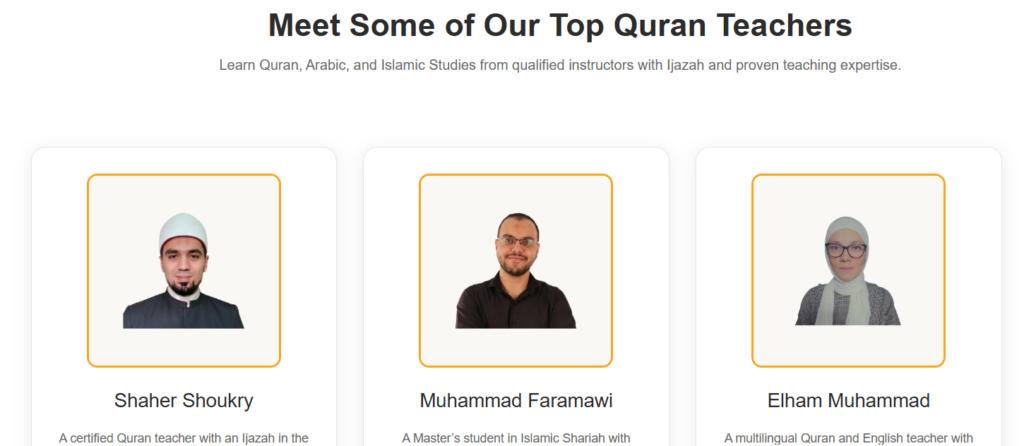
Wherever you are on the four-stage path, there’s a structured course built to take you further — taught one-to-one by native-speaking instructors through Riwaq Al Quran, with a curriculum spanning Tajweed, Tafsir, and memorization for every age and level.
Not sure where you fit? Start with the category closest to you:
- Just starting out or teaching your kids → Online courses for kids or Quran classes for kids and adults
- Want the meaning, not just the sounds → Online Arabic courses and Islamic Studies courses
- Ready for certification → Online Ijazah courses
And here’s what each of our most popular Quran courses helps you achieve:
| If your goal is to… | Start with |
|---|---|
| Read the letters correctly from scratch | Noorani Qaida Online |
| Recite fluently with confidence | Online Quran Recitation Course |
| Master the rules of beautiful recitation | Online Tajweed Classes |
| Memorize the Quran with a real plan | Quran Memorization Online Course |
| Understand the meaning of the verses | Online Tafseer Course |
| Explore the ten styles of recitation | Online Qirat Course |
| Nurture your child’s love for the Quran | Online Quran Classes for Kids |
Conclusion
Free Quran learning online genuinely works when you follow a path instead of a pile of tools: learn the letters, connect the vowels, apply Tajweed, then build recitation and memorization — one stage at a time. Free apps, color-coded mushafs, and reciter audio can carry you a long way, and the Quran itself was made easy to learn.
The one thing free content cannot provide is feedback — a teacher’s ear to catch the errors you can’t hear. That is the gap a free trial closes. Combine free self-study with early correction from a qualified tutor, and you’ll learn Quran online for free without the plateau that stops most beginners.
Start with the letters, keep a small daily habit, and ask Allah for help along the way:
(رَّبِّ زِدْنِى عِلْمًا)
“My Lord, increase me in knowledge.” — Surah Ta-Ha (20:114)
Frequently asked questions about free Quran learning online
Below are the most common questions about learning Quran online for free, answered directly.
Can you really learn Quran online for free?
Yes, you can learn Quran online for free using no-cost apps, color-coded mushafs, reciter audio, and video lessons. Free tools cover the letters, Tajweed rules, and memorization — though a teacher’s feedback is still needed to correct pronunciation you can’t hear yourself.
Is it possible to learn Tajweed for free?
You can learn the rules of Tajweed for free through videos and color-coded Qurans, and practice them on short surahs. However, correct Tajweed depends on someone hearing your recitation, so pair free lessons with a teacher’s correction to avoid fossilizing mistakes.
What is the best free way to learn Quran for beginners?
The best free way for beginners is to start with a Noorani Qaida program to learn the Arabic letters, then move through vowels, Tajweed, and recitation in order. A free trial with a qualified tutor adds the correction that self-study can’t.
Can my child learn Quran online for free?
Yes, children can learn Quran online for free using gamified Noorani Qaida apps and short daily sessions. Because kids pick up pronunciation fast, early correction from a teacher is especially valuable so habits form correctly from the start.
How long does it take to learn to read the Quran?
Most adult beginners learn to read the Quran with basic Tajweed in six to twelve months of consistent daily practice. The letters and vowels take one to three months; applying Tajweed and building fluency takes the rest. Consistency matters more than talent.
Do free apps teach Tajweed correctly?
Free apps teach Tajweed rules and pronunciation examples accurately, but they cannot hear your recitation or correct your specific errors. Use them to learn the rules, then have a qualified teacher check your recitation so mistakes don’t become permanent.