The very first word revealed to Prophet Muhammad ﷺ was not a command to pray, fast, or give charity — it was iqra’: “Read.” That single word, spoken by the Angel Jibreel in a cave on Mount Hira in 610 CE, permanently resolved any ambiguity about where education stands in Islam. The word ‘ilm (knowledge) and its derivatives appear over 700 times in the Quran — more than any concept other than the names and attributes of Allah Himself.
Understanding what the Quran says about education is not an abstract theological exercise. It is a question with direct consequences for every Muslim parent, student, professional, and community leader. The Quran’s answer runs across literacy, inquiry, accountability, intention, and transmission — covering not just the obligation to learn, but how to learn, what to learn, and why it matters beyond this life.
This article examines the complete picture: the Quranic verses on education with full Arabic text and commentary, five authenticated prophetic hadith with sources and grading, a three-stage learning framework embedded in the Quran’s own verse progression, the classical Islamic distinction between two types of obligatory knowledge, and the etiquette of learning that scholars considered inseparable from knowledge itself.
What You’ll Learn in This Article
- The Quranic verses on education with Arabic text, source links, and commentary.
- Five authenticated hadith on seeking knowledge — graded, sourced, and explained.
- The three-stage Quranic educational framework: Acquire → Reflect → Elevate.
- The difference between Fard ‘Ayn and Fard Kifaya in Islamic education.
- The etiquette of knowledge-seeking that makes learning spiritually valid.
- What the Quran says about women and education, and why it is a religious obligation.
- How Quranic educational principles shaped one of history’s greatest intellectual civilizations.
Table of Contents
What Does the Quran Say About Education?
The Quran frames education not as a personal option but as the first obligation placed on the Prophet ﷺ and, through him, on every believer. This makes Islamic learning structurally unique: seeking knowledge is ‘ibadah (worship), carrying the same spiritual foundation as prayer and fasting.
1. The First Revelation – A Command to Read
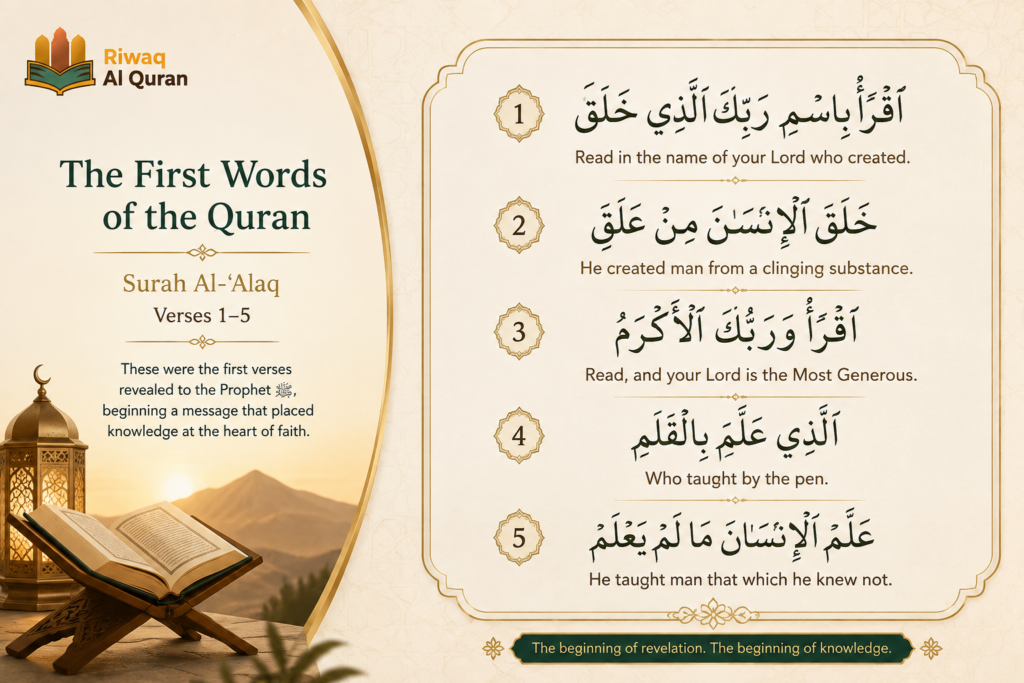
The opening verses of Surah Al-‘Alaq are the Quran’s most direct statement on education. They do not begin with theology, legal rulings, or ritual instructions — they begin with a verb directed at the intellect.
“اقْرَأْ بِاسْمِ رَبِّكَ الَّذِي خَلَقَ ﴿١﴾ خَلَقَ الْإِنسَانَ مِنْ عَلَقٍ ﴿٢﴾ اقْرَأْ وَرَبُّكَ الْأَكْرَمُ ﴿٣﴾ الَّذِي عَلَّمَ بِالْقَلَمِ ﴿٤﴾ عَلَّمَ الْإِنسَانَ مَا لَمْ يَعْلَمْ ﴿٥﴾
“Read in the name of your Lord who created — created man from a clinging substance. Read, and your Lord is the most Generous — Who taught by the pen — taught man that which he knew not.” — Surah Al-‘Alaq (96:1–5)
Three structural details in this passage carry specific educational weight:
- The command is repeated. Iqra’ appears twice — in Quranic rhetoric, repetition signals paramount importance, not stylistic habit.
- The pen is named as Allah’s teaching instrument. This places written and recorded knowledge within divine action itself, sanctifying literacy and scholarship from Islam’s first moment.
- Man was taught what he did not know. Knowledge is not innate; it must be pursued, received, and internalized. The verse makes clear that human beings begin in a state of unknowing — and knowledge is always a gift received, never a possession owned by right.
The sequence of the passage models the educational process: you read, you receive from a generous source, and you arrive at knowledge you did not previously hold.
2. Quranic Education Is Not Limited to Religious Study
A persistent misunderstanding is that Islamic education means only Quranic memorization and religious jurisprudence. The Quran corrects this directly by commanding believers to study the natural world, the cosmos, and the patterns of history — each described as ayaat (signs) of Allah that reward serious investigation.
“إِنَّ فِي خَلْقِ السَّمَاوَاتِ وَالْأَرْضِ وَاخْتِلَافِ اللَّيْلِ وَالنَّهَارِ لَآيَاتٍ لِّأُولِي الْأَلْبَابِ ﴿١٩٠﴾ الَّذِينَ يَذْكُرُونَ اللَّهَ قِيَامًا وَقُعُودًا وَعَلَىٰ جُنُوبِهِمْ وَيَتَفَكَّرُونَ فِي خَلْقِ السَّمَاوَاتِ وَالْأَرْضِ رَبَّنَا مَا خَلَقْتَ هَٰذَا بَاطِلًا سُبْحَانَكَ فَقِنَا عَذَابَ النَّارِ ﴿١٩١﴾”
“Indeed, in the creation of the heavens and the earth and the alternation of the night and the day are signs for those of understanding — those who remember Allah while standing, sitting, and lying on their sides, and give thought to the creation of the heavens and the earth, saying: ‘Our Lord, You did not create this aimlessly; exalted are You — so protect us from the punishment of the Fire.'” — Surah Al-Imran (3:190–191) — quran.com
The key word is yatafakkarun — “they give thought,” from the root tafakkur (active, directed reflection). What these verses establish:
- Studying the heavens, the earth, and natural cycles is itself an act of dhikr (remembrance of Allah) — not a distraction from it.
- The term ulul albab (“people of understanding”) is the Quran’s designation for those who combine knowledge with spiritual awareness — not two separate categories of Muslim.
- The sciences — astronomy, biology, physics, geography — fall within this Quranic command when pursued with the intention of understanding Allah’s creation.
3. A Quranic Warning Against Knowledge Without Action
The Quran does not only encourage learning — it warns specifically against acquiring knowledge and not acting on it. This warning is addressed to those who carry religious knowledge while ignoring its obligations.
“مَثَلُ الَّذِينَ حُمِّلُوا التَّوْرَاةَ ثُمَّ لَمْ يَحْمِلُوهَا كَمَثَلِ الْحِمَارِ يَحْمِلُ أَسْفَارًا ۚ بِئْسَ مَثَلُ الْقَوْمِ الَّذِينَ كَذَّبُوا بِآيَاتِ اللَّهِ ۚ وَاللَّهُ لَا يَهْدِي الْقَوْمَ الظَّالِمِينَ”
“The example of those who were entrusted with the Torah and then did not uphold it is like that of a donkey who carries volumes of books. Wretched is the example of the people who deny the signs of Allah.” — Surah Al-Jumu’ah (62:5)
The Quran uses one of its sharpest images — a donkey carrying books — to describe someone who holds knowledge without implementing it. The practical implications:
- Knowledge accumulated for status or public recognition does not accumulate as spiritual reward.
- The test of genuine Islamic education is not what you memorized but what changed in your character and decisions because of it.
- For any Muslim student, the question is not only “what have I learned?” but “what am I doing differently because I learned it?”
What Does the Quran Say About Knowledge (‘Ilm)?
Knowledge (‘ilm) in the Quran is both a divine attribute and a human obligation. Allah describes Himself as Al-‘Alim (the All-Knowing) — knowledge is an attribute of Allah, and pursuing it is among the closest ways a human being reflects a divine quality in their own character.
A. The Learned and the Ignorant Are Not Equal
Allah opens this comparison with a direct rhetorical question that leaves no room for ambiguity:
“قُلْ هَلْ يَسْتَوِي الَّذِينَ يَعْلَمُونَ وَالَّذِينَ لَا يَعْلَمُونَ ۗ إِنَّمَا يَتَذَكَّرُ أُولُو الْأَلْبَابِ”
“Say, ‘Are those who know equal to those who do not know?’ Only people of understanding will take heed.” — Surah Az-Zumar (39:9)
The rhetorical question expects one answer: no, they are not equal. The Quran’s purpose here is motivational, not elitist:
- The gap between the knowledgeable and the ignorant is not fixed — it is a challenge issued to every Muslim who hears the verse.
- Ulul albab (“people of understanding”) is the Quran’s recurring designation for those who hold both knowledge and the wisdom to apply it.
- Failing to seek knowledge is a choice — and one with spiritual consequence that each Muslim answers for individually.
B. Allah Elevates Those Given Knowledge
The Quran ties this elevation directly to two conditions held together, as the following verse makes clear:
“يَرْفَعِ اللَّهُ الَّذِينَ آمَنُوا مِنكُمْ وَالَّذِينَ أُوتُوا الْعِلْمَ دَرَجَاتٍ ۚ وَاللَّهُ بِمَا تَعْلَمُونَ خَبِيرٌ”
“Allah will raise those who have believed among you and those who were given knowledge by degrees. And Allah is Acquainted with what you do.” — Surah Al-Mujadila (58:11)
Key points from this verse:
- Darajaat means “degrees” — plural. Elevation through knowledge is incremental and ongoing, not a single credential obtained once.
- Two simultaneous conditions are named: faith (iman) and knowledge (‘ilm). Sincere faith without knowledge may be misdirected. Knowledge without faith loses its anchor.
- The closing phrase — “Allah is Acquainted with what you do” — grounds the elevation in action, not merely in the possession of information.
C. You Are Accountable for What You Know
Before granting knowledge any weight, the Quran first demands honesty about its source — a principle this verse establishes explicitly:
“وَلَا تَقْفُ مَا لَيْسَ لَكَ بِهِ عِلْمٌ ۚ إِنَّ السَّمْعَ وَالْبَصَرَ وَالْفُؤَادَ كُلُّ أُولَٰئِكَ كَانَ عَنْهُ مَسْئُولًا”
“And do not pursue that of which you have no knowledge. Indeed, the hearing, the sight, and the heart — about all those one will be questioned.” — Surah Al-Isra (17:36)
This verse makes intellectual honesty an Islamic obligation. The three faculties named — hearing, sight, and heart — are precisely the faculties of learning and judgment:
- Source verification — Do not act on or spread information you have not confirmed.
- Intellectual honesty — Acknowledge what you do not know rather than filling gaps with conjecture.
- Epistemic accountability — Every piece of information received through these faculties will be accounted for on the Day of Judgment for what was done with it.
Verifying sources before sharing, acknowledging uncertainty, and refusing to speak on what you do not know are Quranic commands — not modern academic conventions.
D. Knowledge Is a Lifelong Pursuit
Even the most knowledgeable human being was commanded to keep asking for more, as this verse shows:
“وَقُل رَّبِّ زِدْنِي عِلْمًا”
“And say, ‘My Lord, increase me in knowledge.'” — Surah Taha (20:114)
Allah instructs the Prophet ﷺ himself — the most knowledgeable of human beings — to ask for more knowledge. The implications are clear:
- No Muslim is exempt from the need to keep learning.
- The correct posture of a Muslim learner is perpetual humility before the vastness of what remains unknown.
- Education in Islam does not end with a certificate or a memorized text — it ends when life ends, and even then its rewards continue for knowledge that benefited others.
For a deeper examination of these foundations, see the benefits of seeking knowledge as mentioned in the Quran.
Prophetic Teachings on Education – Five Authenticated Hadith
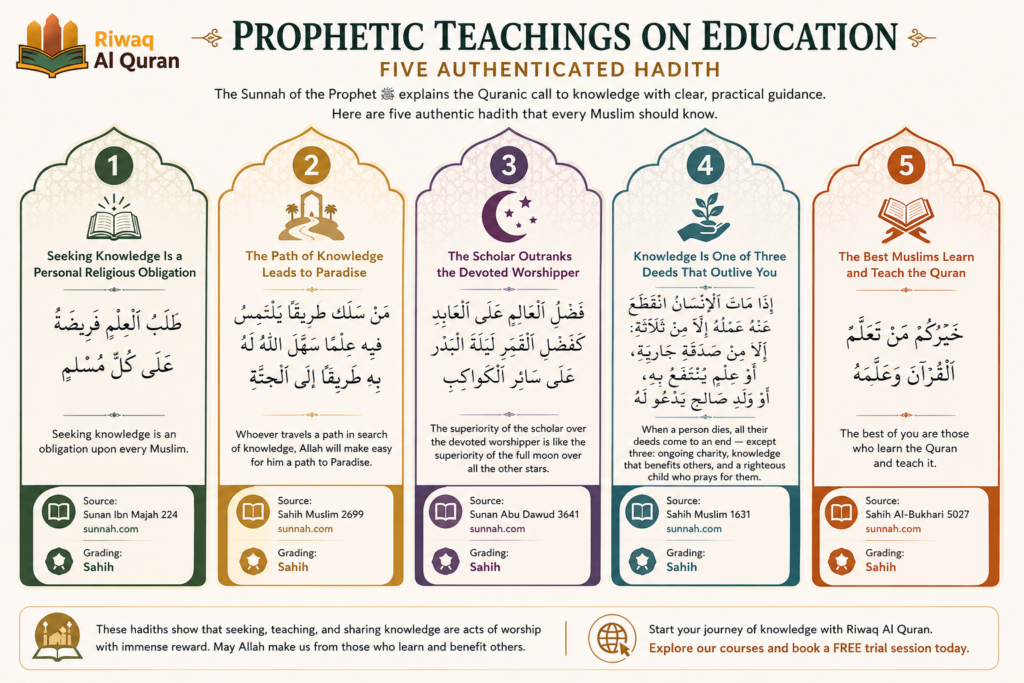
The Quran’s educational framework is elaborated in detail by the Sunnah of the Prophet Muhammad ﷺ. These hadith are not additions to the Quranic message — they are its practical extension, translating divine commands into specific, actionable guidance followed across fourteen centuries.
The following table provides a quick reference for the five authenticated hadith examined in this section, with links to the full Arabic text and chain of transmission on sunnah.com:
| # | Core Message | Source | Grading |
| 1 | Seeking knowledge is an obligation on every Muslim | Sunan Ibn Majah 224 | Sahih |
| 2 | Whoever travels seeking knowledge, Allah eases a path to Paradise | Sahih Muslim 2699 | Sahih |
| 3 | The scholar’s rank over the devoted worshipper is like the full moon over stars | Sunan Abu Dawud 3641 | Sahih |
| 4 | Three deeds that continue after death — one is knowledge that benefits others | Sahih Muslim 1631 | Sahih |
| 5 | The best of you are those who learn and teach the Quran | Sahih Al-Bukhari 5027 | Sahih |
1. Seeking Knowledge Is a Personal Religious Obligation
The Prophet ﷺ stated this obligation in terms that leave no ambiguity about who it applies to:
“طَلَبُ الْعِلْمِ فَرِيضَةٌ عَلَى كُلِّ مُسْلِمٍ”
“Seeking knowledge is an obligation upon every Muslim.” — Sunan Ibn Majah 224 — sunnah.com | Graded Sahih by Al-Albani
The word farida — obligation — places education in the same legal category as prayer and fasting. Key points:
- The obligation applies to every Muslim — no gender restriction, no age limit, no wealth threshold.
- A 60-year-old who discovers a gap in their knowledge of obligatory practice is bound to fill it, just as a child beginning school is.
- The type of knowledge that is obligatory is defined by the classical distinction between Fard ‘Ayn and Fard Kifaya, detailed in the next section.
2. The Path of Knowledge Leads to Paradise
The reward for pursuing knowledge is described through a vivid image of two paths, laid out directly in this hadith:
“مَنْ سَلَكَ طَرِيقًا يَلْتَمِسُ فِيهِ عِلْمًا سَهَّلَ اللَّهُ لَهُ بِهِ طَرِيقًا إِلَى الْجَنَّةِ”
“Whoever travels a path in search of knowledge, Allah will make easy for him a path to Paradise.” — Sahih Muslim 2699 — sunnah.com | Graded Sahih
The hadith uses salaka — to travel, to walk a road — capturing the active, effortful nature of learning:
- The effort of studying — the hours spent, the discomfort of uncertainty, the discipline of sitting with a teacher — is itself an act of worship.
- The reward is direct and unconditional: Allah eases a path to Jannah proportional to the effort invested in the path of knowledge.
- The symmetry is exact: you walk a path seeking knowledge; Allah opens a path to Paradise.
3. The Scholar Outranks the Devoted Worshipper
The Prophet ﷺ used a striking celestial image to rank the scholar’s impact above solitary worship:
“فَضْلُ الْعَالِمِ عَلَى الْعَابِدِ كَفَضْلِ الْقَمَرِ لَيْلَةَ الْبَدْرِ عَلَى سَائِرِ الْكَوَاكِبِ”
“The superiority of the scholar over the devoted worshipper is like the superiority of the full moon over all the other stars.” — Sunan Abu Dawud 3641| Graded Sahih by Al-Albani
This hadith requires careful reading:
- The Prophet ﷺ is not diminishing worship — he is elevating the communal impact of knowledge over solitary devotion.
- A worshipper who prays in sincerity benefits primarily themselves. A scholar whose knowledge reaches others extends light across the entire community — as the full moon illuminates a whole landscape while individual stars barely light a patch of sky.
- This hadith is the classical Islamic argument for why producing knowledgeable Muslims is a community priority, not merely an individual virtue.
4. Knowledge Is One of Three Deeds That Outlive You
Among everything a person leaves behind, the Prophet ﷺ named only three deeds that continue to count after death:
“إِذَا مَاتَ الْإِنْسَانُ انْقَطَعَ عَنْهُ عَمَلُهُ إِلَّا مِنْ ثَلَاثَةٍ: إِلَّا مِنْ صَدَقَةٍ جَارِيَةٍ، أَوْ عِلْمٍ يُنْتَفَعُ بِهِ، أَوْ وَلَدٍ صَالِحٍ يَدْعُو لَهُ”
“When a person dies, all their deeds come to an end — except three: ongoing charity, knowledge that continues to benefit others, and a righteous child who prays for them.” — Sahih Muslim 1631 | Graded Sahih
This hadith reframes education from a personal benefit to a permanent legacy:
- Of the three categories that outlive a person, knowledge depends entirely on transmission — it must be learned and passed on to count.
- The chain of transmission in Islamic scholarship (isnad) — tracing knowledge from teacher to student across generations — is a living embodiment of this hadith.
- Every Muslim who learns and then teaches becomes a link in an unbroken stream of reward stretching back to whoever first taught them.
5. The Best Muslims Learn and Teach the Quran
The Prophet ﷺ defined excellence in this field through a two-part standard, captured in this hadith:
“خَيْرُكُمْ مَنْ تَعَلَّمَ الْقُرْآنَ وَعَلَّمَهُ”
“The best of you are those who learn the Quran and teach it.” — Sahih Al-Bukhari 5027
The structure of this hadith carries a principle that extends beyond memorization:
- Ta’allama (learned) and ‘allama (taught) are both required — learning alone fulfills only half the criterion.
- The person who acquires knowledge and keeps it — who does not transmit it — fails the hadith’s standard of excellence.
- Teaching Quran is the highest form of this principle, but the cycle of learning and transmitting applies across all categories of Islamic knowledge.
Riwaq Al Quran structures every course with this hadith in mind — building not just recitation skills, but the understanding that eventually enables students to teach. To take the first step, explore how to learn the Quran online and book a free trial session.
The Quran’s Three-Stage Educational Framework
One of the most overlooked dimensions of Quranic teaching on education is the developmental progression embedded across its verses. When the Quranic commands on learning are read in sequence — rather than as isolated instructions — they do not simply endorse the idea of education.
They map a structured, three-stage model of how genuine understanding is built, tested, and made permanent. Classical Islamic scholars recognized this progression intuitively in how they designed curricula and described the journey of the student of knowledge. Understanding this sequence changes how any Muslim approaches their own learning at any stage of life.
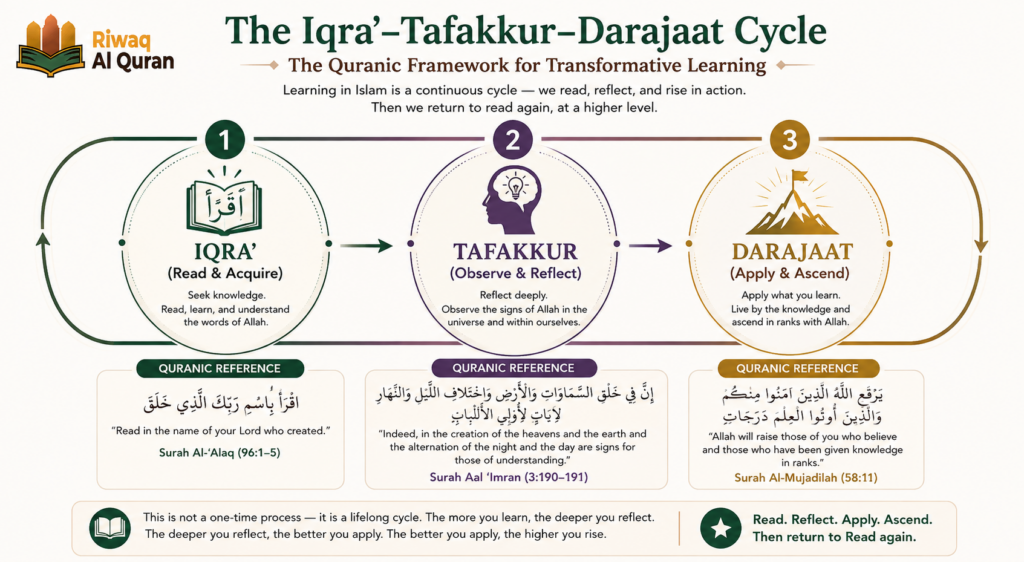
The three stages are: Iqra’ (Acquire) → Tafakkur (Reflect) → ‘Amal (Apply and Elevate). Each stage has its own Quranic foundation, its own classical scholarly commentary, and its own failure mode when disconnected from the others.
Stage One – Iqra’ — Acquire
The first stage is acquisition: the disciplined receiving of knowledge through reading, listening, memorization, and transmission from qualified sources. Surah Al-‘Alaq (96:1–5) establishes this as the non-negotiable entry point into all learning. The command is not merely “learn” in a vague sense — it is iqra’, a specific verb meaning to read aloud, to recite, to engage with a written or transmitted text actively and with the whole of one’s attention.
“اقْرَأْ بِاسْمِ رَبِّكَ الَّذِي خَلَقَ”
“Read in the name of your Lord who created.” — Surah Al-‘Alaq (96:1)
Three structural details in this verse define what the acquisition stage means in practice.
- First: the command is bi-ismi Rabbik — in the name of your Lord, not in your own name. This grammatical construction sets the entire act of reading and learning within the frame of conscious God-awareness. Acquisition that is disconnected from divine consciousness — learning for personal gain, status, or rivalry — fails the first stage before it has truly begun. Ibn al-Qayyim al-Jawziyyah noted in Miftah Dar al-Sa’adah that the scholar who studies without awareness of whose knowledge he is receiving is like a person drinking from a spring while believing the water came from himself.
- Second: the pen is named as Allah’s teaching instrument: “Who taught by the pen” (96:4). This places the act of writing — and therefore recorded, transmittable knowledge — within divine action itself. The pen is not incidental to learning; it is the mechanism through which Allah described His own act of teaching. Imam Al-Nawawi wrote in Al-Majmu’ that the obligation to write and preserve knowledge is derived from this verse, making the preservation of scholarship through documentation a religious act, not merely an academic habit.
- Third: “Taught man that which he knew not” (96:5). Man begins in ignorance. Knowledge is not innate, not self-generated, and not a natural possession. It is always received — from a teacher, from a text, from revelation. This means the student who approaches learning with arrogance — as if the exercise merely confirms what they already suspect — has misunderstood the Quranic model of acquisition from its first verse.
What the acquisition stage requires:
Receiving knowledge through a qualified teacher with a traceable chain — the Islamic tradition’s insistence on isnad (chains of transmission) is a direct embodiment of this stage’s logic. Al-Imam al-Shafi’i said: “Whoever learns without a teacher is like a person who builds without a foundation — their building will not stand.”
Memorizing foundational texts before seeking to analyze them — the classical sequence of hifz (memorization) before fahm (understanding) is not arbitrary. A student cannot reflect on what they do not yet firmly hold. Al-Zarnuji in Ta’lim al-Muta’allim described memorization as the vessel — the understanding poured in afterward fills it, but without the vessel, there is nothing to hold.
Developing literacy in both the language of revelation and, where applicable, the language of one’s field of study. The Quranic command to read is a command to become a person capable of reading — not merely to perform the mechanical act once.
The failure mode of Stage One is acquisition without consciousness of its source. A student who memorizes texts, accumulates information, and builds technical competence while treating learning as a personal achievement rather than a received trust has completed the motions of Stage One without fulfilling its spirit. The Quran’s warning in Surah Al-Jumu’ah (62:5) — the image of a donkey carrying books — describes precisely this: the form of knowledge without its transforming substance.
Stage Two – Tafakkur — Reflect
The second stage is active, directed inquiry — moving from what was received in Stage One to investigating the world as a site of ayaat (signs) from Allah. This is where acquisition becomes understanding, and where information becomes knowledge in the fullest Islamic sense of the word.
The Quran uses a remarkable cluster of interrogative commands across more than forty verses to call believers into this stage. These are not rhetorical questions in the conversational sense — they are divine imperatives directed at the faculty of reason:
“أَفَلَا تَتَفَكَّرُون
“Do you not reflect?” (Al-An’am, 6:50)
“أَفَلَا تَعْقِلُونَ
“Do you not reason?” (Al-Baqarah, 2:44, and repeatedly across the Quran)
أَفَلَا يُبْصِرُونَ“
“Do you not observe?” (Ya-Sin, 36:68)
أَفَلَمْ يَسِيرُوا فِي الْأَرْضِ
“Have they not traveled through the earth?” (Al-Hajj, 22:46)
The repetition is purposeful and structurally significant. In Quranic rhetoric, a command that appears once is an instruction. A command that appears forty times across different contexts, directed at different audiences, addressing different subjects, is a framework — a recurring call to a mode of being that the Quran expects to characterize every believer’s relationship with knowledge.
“إِنَّ فِي خَلْقِ السَّمَاوَاتِ وَالْأَرْضِ وَاخْتِلَافِ اللَّيْلِ وَالنَّهَارِ لَآيَاتٍ لِّأُولِي الْأَلْبَابِ ﴿١٩٠﴾ الَّذِينَ يَذْكُرُونَ اللَّهَ قِيَامًا وَقُعُودًا وَعَلَىٰ جُنُوبِهِمْ وَيَتَفَكَّرُونَ فِي خَلْقِ السَّمَاوَاتِ وَالْأَرْضِ”
“Indeed, in the creation of the heavens and the earth and the alternation of the night and the day are signs for those of understanding — those who remember Allah while standing, sitting, and lying on their sides, and give thought to the creation of the heavens and the earth.” — Surah Al-Imran (3:190–191)
The word yatafakkarun — they give thought — comes from the root fakara, meaning deliberate, sustained, directed mental engagement. Classical Arabic linguists distinguished tafakkur from simple fikr (thought) by the sustained and purposeful nature of the former. This is not casual observation. It is methodical investigation of the created world as a text to be read — a second scripture written in matter, in light, in living organisms, in historical cycles.
Imam Al-Ghazali developed this understanding extensively in Ihya’ Ulum al-Din, arguing that tafakkur — reflection — was so central to Islamic spiritual and intellectual life that an hour of genuine, directed reflection on creation was worth more in proximity to Allah than a year of supererogatory worship without it. He wrote: “The heart’s reflection on the wonders of Allah’s creation is the foundation of the knowledge of Allah Himself — for the outward world is a mirror of the inner reality, and the person who does not investigate the mirror cannot know what it reflects.”
The supplication in Surah Taha identifies the defining posture of Stage Two precisely:
“وَقُل رَّبِّ زِدْنِي عِلْمًا”
“And say: My Lord, increase me in knowledge.” — Surah Taha (20:114)
What makes this supplication Stage Two’s signature is its occasion. It was revealed immediately after Allah commanded the Prophet ﷺ not to hasten in reciting revelation before it was fully conveyed — meaning: do not rush to conclusions before the complete picture is received.
The supplication that follows is directed outward and upward. It is not the student saying “I understand enough” — it is the student who has acquired and begun to reflect, and who now recognizes with clarity exactly how much remains beyond what they have grasped. The discovery of the vastness of what is unknown is itself a Stage Two insight, and the Quran teaches that the correct response is not discouragement but prayer directed precisely at the gap.
Ibn Kathir commented on this verse: “This supplication is proof that the scholars are the most aware of the vastness of knowledge — for the one who knows nothing does not know what they are missing, while the one who has learned enough to reflect understands the ocean they have barely entered.”
What Stage Two demands
Moving from passive reception to active investigation — taking what was received in Stage One and testing it against observable reality. The classical Islamic scholars did not treat the natural sciences as distractions from religious learning; they treated them as Stage Two obligations, because the Quran commands reflection on the heavens, the earth, the human body, and historical patterns as a religious duty.
Developing the capacity for nazar — systematic, rigorous inquiry — alongside tafakkur. Ibn Rushd (Averroes) wrote in his Fasl al-Maqal that the Quran’s repeated calls to investigate the natural world make systematic philosophical and scientific inquiry not merely permissible but obligatory for those with the capacity to conduct it.
Sustaining intellectual humility — the scholar who arrives at Stage Two and believes they have now understood is in greater danger than the beginner who has not yet begun. The supplication “Rabbi zidni ‘ilman” is Quranic instruction to make this humility permanent and prayerful rather than performative.
The failure mode of Stage Two is reflection that circles inward rather than ascending. The person who acquires knowledge in Stage One and then uses Stage Two’s reflective capacity to generate private insight — without anchoring that reflection in revealed guidance, without testing conclusions against the scholarly tradition, and without any intention to share what reflection reveals — has used a Quranic faculty for a self-contained purpose. Al-Ghazali described this as the scholar who turns the lamp inward and sees only their own face, while the lamp was given to illuminate a room.
Stage Three – ‘Amal — Apply and Ascend
The third stage is the culmination of the first two and their proof of completion: acting on what was acquired and reflected upon, and transmitting it so the chain of benefit continues beyond the individual.
“يَرْفَعِ اللَّهُ الَّذِينَ آمَنُوا مِنكُمْ وَالَّذِينَ أُوتُوا الْعِلْمَ دَرَجَاتٍ”
“Allah will raise those who have believed among you and those who were given knowledge by degrees.” — Surah Al-Mujadila (58:11)
The word darajaat — degrees, in the plural — is Stage Three’s defining Quranic term. Elevation through knowledge in Islam is not a single credential obtained once and held permanently. It is incremental, ongoing, and conditioned on two simultaneous factors that the verse names together: faith (iman) and knowledge (‘ilm).
The verse does not say “believers” and “knowledgeable people” as separate categories receiving elevation for separate reasons. It names a person who is both — and who is raised precisely because the two are held together.
Ibn Hajar al-Asqalani, commenting on this verse in Fath al-Bari, noted that the scholars mentioned here are not elevated by virtue of their accumulated information but by virtue of what that knowledge produced in them — character, action, and transmission to others. Knowledge that has not changed the person who holds it has not fulfilled the verse’s conditions for elevation, regardless of how much was memorized.
The prophetic tradition makes Stage Three’s obligations explicit:
“خَيْرُكُمْ مَنْ تَعَلَّمَ الْقُرْآنَ وَعَلَّمَهُ”
“The best of you are those who learn the Quran and teach it.” — Sahih Al-Bukhari 5027
The structure of this hadith is as important as its content. Ta’allama (learned) and ‘allama (taught) are both required — learning alone fulfills only half of the condition for excellence. The complete Quranic learner in Islamic understanding is not one who acquires and reflects for personal benefit alone.
They are one who closes the circuit by transmission — making their knowledge a contribution to the community’s collective understanding rather than a private possession.
This is reinforced by one of the most consequential hadith on knowledge in the entire prophetic tradition:
“إِذَا مَاتَ الْإِنسَانُ انْقَطَعَ عَنْهُ عَمَلُهُ إِلَّا مِنْ ثَلَاثَةٍ: إِلَّا مِنْ صَدَقَةٍ جَارِيَةٍ، أَوْ عِلْمٍ يُنْتَفَعُ بِهِ، أَوْ وَلَدٍ صَالِحٍ يَدْعُو لَهُ”
“When a person dies, all their deeds come to an end except three: ongoing charity, knowledge that continues to benefit others, and a righteous child who prays for them.” — Sahih Muslim 1631
Of the three categories that outlive a person, knowledge is uniquely dependent on Stage Three having been completed. Ongoing charity requires wealth given while alive. A righteous child requires years of upbringing. But ‘ilm yuntafa’ bihi — knowledge that benefits others — only outlives its original possessor if it was transmitted. Knowledge that was acquired, reflected upon, and then held without transmission dies with the person who held it. The hadith’s extraordinary promise — reward that continues after death — is conditional on Stage Three having occurred.
What Stage Three demands
Implementation — applying what was learned to daily decisions, professional conduct, character, and moral choices. Al-Ghazali wrote in Ihya’: “The sign that knowledge has truly entered the heart is that it changes the person’s state — their fear of Allah increases, their attachment to the world decreases, and their conduct toward people improves. If none of these are visible, the person has collected words, not knowledge.”
Transmission — teaching others, formally or informally. The Islamic tradition’s chain of transmission (isnad) from teacher to student across fourteen centuries is a living institutional embodiment of Stage Three’s requirement. Every link in that chain represents a person who did not allow knowledge to stop with them.
Return to Stage One at a higher level — because genuine application always reveals new gaps. The scholar who has implemented and transmitted what they know discovers through that process how much they do not yet understand. Stage Three is therefore not an endpoint but a spiral return to Stage One at greater depth. This is why classical Islamic scholars described knowledge as “an ocean with no shore” — not to discourage the learner, but to describe what Stage Three reveals to anyone who genuinely reaches it.
The failure mode of Stage Three is application without transmission. The person who implements everything they have learned — who is personally transformed by their knowledge, whose character reflects their study — but who teaches no one, writes nothing, and transmits nothing, has fulfilled two-thirds of the Quranic model. They will not be judged for their silence the way the person who acquired without acting will be judged. But they will have ended a chain of benefit that could have continued far beyond their own lifetime, and the hadith of Sahih Muslim 1631 makes clear what that continuity is worth in the permanent accounting.
Why the Three Stages Must Be Held Together
The failure of any single stage corrupts the whole:
- Acquisition without reflection produces what Surah Al-Jumu’ah describes — the scholar as beast of burden, carrying volumes without understanding their weight. Information accumulated without being tested against reality or revelation remains inert. It can be recited but not applied, quoted but not understood.
- Reflection without prior acquisition is the error of the person who reasons from premises they have not verified — who investigates a question they do not have the foundational knowledge to frame correctly. Islamic scholarship’s insistence that systematic inquiry follow proper grounding in foundational texts is the institutional expression of this warning.
- Application without the prior two stages is activity without foundation — action taken on the basis of misunderstanding, generating harm while intending benefit. This is perhaps the most dangerous failure mode, because it is the most energetic and confident.
This interdependence is why classical Islamic scholars described the path of knowledge as having no retirement age. A person who has completed Stage Three does not graduate — they return to Stage One with the questions that Stage Three’s application has opened, now with greater capacity and greater need.
The scholar of fifty years’ experience is not done learning; they are simply cycling through the three stages at a depth unavailable to the beginner. The Quran makes this permanent: “And say: My Lord, increase me in knowledge” — a supplication commanded without qualification of age, credential, or prior accomplishment.
Two Categories of Islamic Knowledge Every Muslim Must Understand
Classical Islamic scholars made a foundational distinction in the obligation to seek knowledge — one that guides how every Muslim should practically prioritize their learning. Misunderstanding this distinction leads to two opposite errors: either treating all learning as equally obligatory regardless of circumstance, or dismissing secular and professional knowledge as outside the scope of Islamic responsibility.
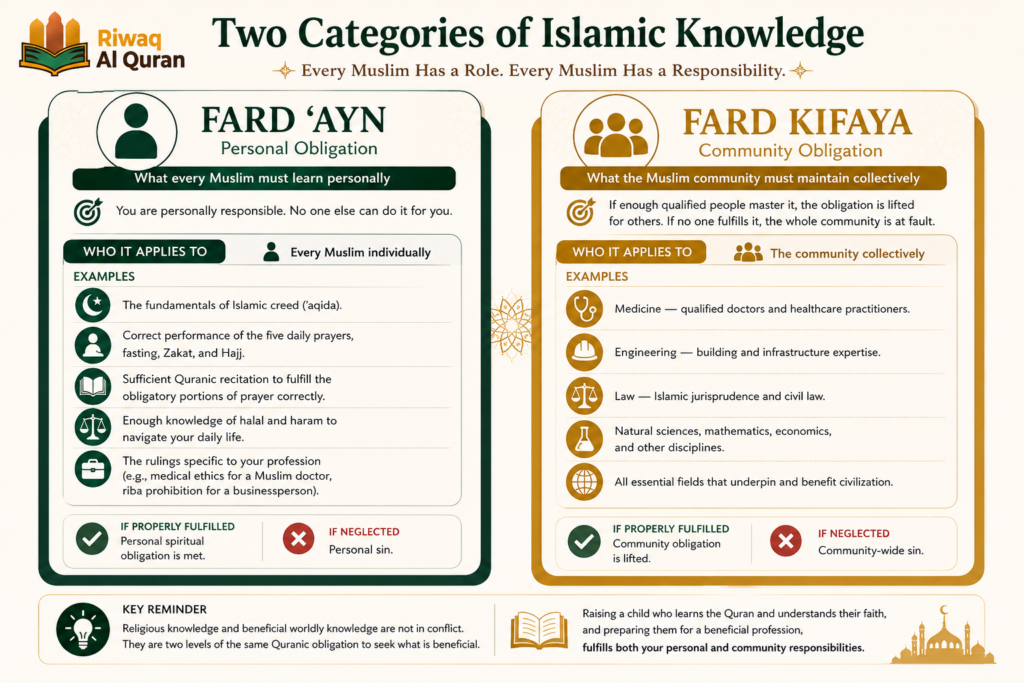
The following table summarizes the key differences between the two categories before examining each in detail:
| Feature | Fard ‘Ayn | Fard Kifaya |
| Arabic term | فَرْضُ عَيْن | فَرْضُ كِفَايَة |
| Who it applies to | Every Muslim individually | The community collectively |
| Scope | Basic creed, worship obligations, personal halal/haram | Medicine, law, engineering, natural sciences |
| Can others fulfill it for you? | No — non-transferable | Yes — if enough community members master it |
| If properly fulfilled | Personal spiritual obligation met | Community obligation lifted |
| If neglected | Personal sin | Community-wide sin |
A. Fard ‘Ayn – What Every Muslim Must Learn Personally
Fard ‘Ayn is knowledge that is personally obligatory on every Muslim without exception — no one else’s learning can substitute for your own. It scales with your life and circumstances:
- The fundamentals of Islamic creed (‘aqida).
- Correct performance of the five daily prayers, fasting, Zakat, and Hajj.
- Sufficient Quranic recitation to fulfill the obligatory portions of prayer correctly.
- Enough knowledge of halal and haram to navigate your specific daily life.
- The rulings specific to your profession — a Muslim doctor must know Islamic medical ethics; a Muslim businessperson must understand the prohibition on riba (interest).
The minimum shifts with each person’s role. What is Fard ‘Ayn for a doctor is not Fard ‘Ayn for a child. The obligation does not change — the scope of what it covers does.
B. Fard Kifaya – What the Community Must Maintain Collectively
Fard Kifaya is knowledge that the Muslim community as a whole must possess. If enough qualified people master it, the obligation lifts for others. If no one fulfills it, the community bears collective responsibility. This includes:
- Medicine — every Muslim community needs qualified doctors and healthcare practitioners.
- Engineering — the built environment requires Muslim expertise for communities to function.
- Law — both Islamic jurisprudence and civil law require trained specialists.
- Natural sciences, mathematics, economics, and other disciplines that underpin civilization.
This framework is the classical Islamic justification for why scholars of the Golden Age — Al-Khwarizmi in mathematics, Ibn Sina in medicine, Al-Biruni in astronomy — pursued their fields with the same religious seriousness as Quran and hadith. They understood it as answering a fard kifaya that their community could not afford to leave unfulfilled.
The division between “religious knowledge” and “worldly knowledge” is a modern import; it does not appear in the classical Islamic understanding of the obligation to learn.
The practical implication for Muslim families: ensuring your child learns to recite the Quran correctly, understands the foundations of their faith, and is prepared for a beneficial profession are not competing goals — they are two levels of a single Quranic obligation.
The Etiquette of Seeking Knowledge in Islam (Adab Al-‘Ilm)
The Quran and Sunnah do not only command Muslims to seek knowledge — they specify how to seek it. The classical scholars compiled what they called adab al-‘ilm (the etiquette of knowledge-seeking), a set of principles without which knowledge can harm its possessor rather than benefit them.
This dimension of Islamic education is among the most practically important and the most consistently overlooked in modern discussions.
1. Begin with Sincere Intention (Ikhlas)
The Prophet ﷺ issued a specific warning against learning for the wrong reasons:
“مَنْ طَلَبَ الْعِلْمَ لِيُجَارِيَ بِهِ الْعُلَمَاءَ، أَوْ لِيُمَارِيَ بِهِ السُّفَهَاءَ، أَوْ يَصْرِفَ بِهِ وُجُوهَ النَّاسِ إِلَيْهِ، أَدْخَلَهُ اللَّهُ النَّارَ”
“Whoever seeks knowledge to compete with scholars, to argue with fools, or to draw people’s attention to himself — Allah will admit him to the Fire.” — Sunan Ibn Majah 253 | Graded Sahih by Al-Albani
Three wrong intentions explicitly condemned in this hadith:
- Competing with other scholars — using knowledge as a tool of rivalry rather than service
- Arguing with the less knowledgeable — using knowledge to win rather than to teach
- Seeking public attention — using knowledge as a vehicle for status or recognition
The correct intentions — to draw closer to Allah, to fulfill obligations more accurately, and to benefit others — are the ones that transform study into worship. A student who memorizes the Quran with this intention is doing the same act as a student who studies medicine with it: both are seeking knowledge li-Llah (for Allah’s sake).
2. Act on What You Learn, Then Teach Others
The Quran makes the connection between knowing and doing explicit, and makes the failure to act an offense described with strong divine displeasure:
“يَا أَيُّهَا الَّذِينَ آمَنُوا لِمَ تَقُولُونَ مَا لَا تَفْعَلُونَ ﴿٢﴾ كَبُرَ مَقْتًا عِندَ اللَّهِ أَن تَقُولُونَ مَا لَا تَفْعَلُونَ ﴿٣﴾”
“O you who have believed, why do you say what you do not do? It is greatly hateful in the sight of Allah that you say what you do not do.” — Surah As-Saf (61:2–3)
The phrase kabura maqtan — “greatly hateful” — is among the strongest expressions of divine displeasure in the Quran. For the Muslim learner:
- Completing a course or memorizing a text is the beginning of education, not the end.
- The obligation completes when the knowledge is implemented — in character, in daily decisions, and in transmission to others.
- After acting, the next obligation is teaching — closing the cycle established in Sahih Al-Bukhari 5027 and making your knowledge one of the three deeds that outlive you (Sahih Muslim 1631).
3. Honor Your Teacher and the Learning Process
The transmission of Islamic knowledge has always been personal — from teacher to student, with a chain of names (isnad) extending back to the Prophet ﷺ. This chain is not merely a method of source verification; it is a living transmission of trust and responsibility from generation to generation. In practice, honoring your teacher means:
- Treating the learning relationship as a trust, not a transaction.
- Arriving prepared — having reviewed previous material, with questions ready.
- Listening to understand, not simply to record information.
- Acknowledging the weight of what is being transmitted.
Imam Al-Shafi’i said: “I would turn pages quietly when sitting with Malik, out of respect for him, so that he would not hear the sound.” This is not cultural formality. It is the recognition that the teacher is a link connecting you to prophetic knowledge — and that disrespecting that link weakens your relationship with its source.
What Does the Quran Say About Women and Education in Islam?
The Quran makes no gender distinction in the obligation to seek knowledge. The hadith of Sunan Ibn Majah (224) — “Seeking knowledge is an obligation upon every Muslim” — uses Muslim in its complete, unrestricted sense. When classical scholars intended a ruling to apply to men only, they specified it explicitly; this hadith carries no such specification.
The early Muslim community demonstrated this in practice. Key historical examples:
- Aisha bint Abi Bakr (RA) transmitted approximately 2,210 authenticated hadith — making her one of the most prolific hadith transmitters in Islamic history. Male scholars of the succeeding generation, including Urwa ibn al-Zubayr and Ibn Shihab al-Zuhri, traveled specifically to her to learn. Her authority was recognized, relied upon, and cited across the major hadith collections.
- Fatima bint Muhammad (RA) was a transmitter of hadith and a model of Islamic learning for her generation.
- Female narrators appear in the isnad chains of the major hadith collections at every generation — their testimony accepted and built upon by the scholars who constructed Islamic jurisprudence.
For Muslim families today, the implications are direct:
- Educating daughters is the fulfillment of the same religious obligation that applies to sons — not an accommodation to modern norms.
- An educated Muslim woman understands the Quran and Sunnah firsthand, transmits that understanding to her children, and participates in preserving Islamic knowledge — each of these is an act of worship with permanent reward (Sahih Muslim 1631).
- The role of parents in establishing this foundation for both daughters and sons is among the most significant educational obligations in Islam.
For a comprehensive examination of female education in Islam from Quranic and scholarly perspectives, the dedicated article on this topic covers the subject in full depth.
How Quranic Principles on Education Built a Civilization
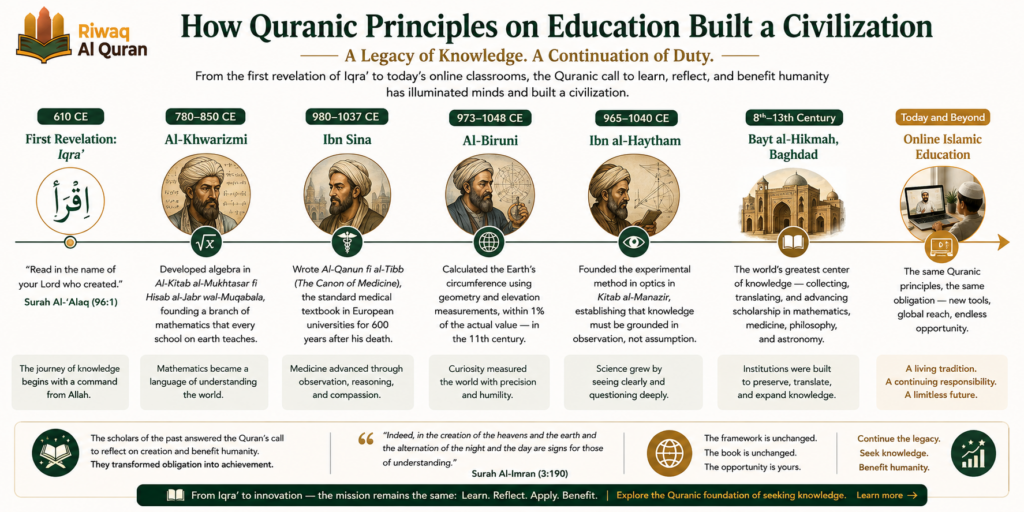
The Quran’s educational ethic was not theoretical — it produced one of the most significant intellectual achievements in recorded human history. Muslim scholars who took the Quranic command to observe and reflect seriously did not separate that inquiry from their faith. They understood their scientific work as fulfilling a religious obligation. The results were concrete:
- Al-Khwarizmi (780–850 CE) — developed algebra in Al-Kitab al-Mukhtasar fi Hisab al-Jabr wal-Muqabala, founding a branch of mathematics that every school on earth now teaches.
- Ibn Sina (980–1037 CE) — wrote Al-Qanun fi al-Tibb (The Canon of Medicine), which served as the primary medical textbook in European universities for six centuries after his death.
- Al-Biruni (973–1048 CE) — calculated the Earth’s circumference using geometry and elevation measurements, arriving within 1% of the actual value — in the 11th century.
- Ibn al-Haytham (965–1040 CE) — founded the experimental method in optics in Kitab al-Manazir, establishing that knowledge of the physical world must be grounded in observation, not inherited assumption.
- The Bayt al-Hikmah, Baghdad — the largest organized repository of knowledge the world had seen, collecting, translating, and advancing scholarship in mathematics, medicine, philosophy, and astronomy.
None of these scholars divided their work into “religious” and “secular” categories. They opened their treatises with Bismillah. They understood studying creation as answering the direct command of Surah Al-Imran (3:190–191).
The secular/religious division that some modern Muslims treat as fundamental did not exist for these scholars — because the Quran does not draw that line.
The Quranic educational framework is not a historical artifact. The civilization it produced was real, its achievements are still in use, and the framework that produced it is still in the same book every Muslim holds. For more on the Quranic foundations of knowledge-seeking, see what the Quran says about seeking knowledge.
Start Your Quranic Education with Riwaq Al Quran
The Quran commands you to read, to seek knowledge, and to never stop asking Allah to increase you in it. The Prophet ﷺ confirmed that this path leads directly to Paradise. Acting on that command is now straightforward — qualified teachers, structured curricula, and flexible scheduling are available to you from any device, from anywhere in the world.
Riwaq Al Quran is a comprehensive online platform offering personalized Quran, Arabic, and Islamic Studies classes for students of all ages and backgrounds. Experienced instructors follow a structured curriculum covering Tajweed, Tafsir, and Memorization — providing effective, accessible learning with seamless interaction between teachers and students in every session.
Take a closer look at authentic excerpts from our live classes:
Choose the path that matches where you are right now:
| Your Learning Goal | Recommended Course |
| Learn to read the Quran from scratch | Noorani Qaida Online |
| Perfect your recitation and pronunciation | Online Quran Recitation Course |
| Master Tajweed rules for beautiful recitation | Online Tajweed Classes |
| Memorize the Quran with a qualified instructor | Quran Memorization Online Course |
| Understand the meaning and context of the Quran | Online Tafseer Course |
| Explore the diverse styles of Quranic recitation | Online Qirat Course |
| Build your child’s connection with the Quran early | Online Quran Classes for Kids |
Browse the full range of programs across Online Quran Classes, Arabic Language Courses, Islamic Studies, Ijazah Programs, and Kids’ Courses.
Your first class is completely free. No commitment, no pressure.
Conclusion
The Quran’s answer to the question of education is consistent, specific, and demanding across its verses: read, pursue knowledge of the natural world and of revealed guidance, hold yourself accountable to what you learn, act on it, never stop, and understand the entire process as an act of worship directed toward Allah. From the first word of revelation through over 700 references to ‘ilm, what the Quran says about education establishes learning as a defining obligation of Islamic life — one that applies equally to men and women, to religious and worldly knowledge, and to every stage of life.
The prophetic hadith elaborates this framework into specific duties: seeking knowledge is farida (obligatory), the path of knowledge leads to Jannah, knowledge that benefits others outlives its source, and the best Muslims are those who learn and then teach. None of these are recommendations — they are terms of a religious duty with specific spiritual consequences.
What the Quran says about education, read completely — with its verses on literacy, inquiry, accountability, intention, and action all understood together — is not a simple endorsement of learning. It is a structured framework: acquire knowledge sincerely, reflect on what you find, act on what reflection reveals, and transmit to others so the chain continues. That framework built one of history’s greatest civilizations. For any Muslim who takes it seriously today, it remains exactly as live and exactly as demanding as it was the moment iqra’ was first spoken.
Frequently Asked Questions
The questions below address the most common points readers raise about what the Quran and the Prophet ﷺ say on education — covering the scope of the obligation, the position of women, the types of knowledge Islam sanctions, and guidance for Muslim students and families.
Does the Quran specifically command Muslims to seek education?
Yes. The Quran’s very first revelation opens with the command to read (Surah Al-‘Alaq, 96:1–5), and the Prophet ﷺ confirmed in a hadith graded Sahih that seeking knowledge is an obligation on every Muslim (Sunan Ibn Majah 224). Education in Islam is a religious duty, not a personal preference.
What is the most important Quranic verse about knowledge?
Surah Al-Mujadila (58:11) is frequently cited: “Allah will raise those who have believed among you and those who were given knowledge by degrees.” It directly links faith, knowledge, and divine elevation. Surah Al-‘Alaq (96:1–5) is equally foundational as the first revelation — explicitly grounding reading and scholarship within divine action from the Quran’s opening words.
Does Islam allow women to seek education?
Yes, without qualification. The Prophet ﷺ said “every Muslim” — the hadith carries no gender restriction. Aisha (RA) transmitted over 2,200 authenticated hadith and was consulted as a primary religious authority by the male scholars of her era. Female education is not a concession to modernity; it is the original Islamic position established by the Quran and Sunnah.
Does the Quran support studying science and non-religious subjects?
Yes. Surah Al-Imran (3:190–191) commands believers to observe and reflect on the natural world as signs of Allah — explicitly making natural science an act of worship. The Fard Kifaya obligation means that if Muslim communities produce no doctors, engineers, or scientists, they bear collective religious responsibility for that gap.
What is the difference between Fard ‘Ayn and Fard Kifaya in Islamic education?
Fard ‘Ayn is individually obligatory — every Muslim must personally learn the basics of creed, worship, and the halal/haram rulings of their daily life and profession. Fard Kifaya is collectively obligatory — medicine, engineering, law, and natural sciences must be represented in Muslim communities. If enough qualified Muslims master these fields, the obligation lifts for others; if no one does, the entire community shares the sin of neglect.
Is Quranic memorization the highest form of Islamic education?
Quranic memorization (hifz) is the most distinctive form, and the Prophet ﷺ described those who learn and teach the Quran as the best of the believers (Sahih Bukhari 5027). The classical tradition always paired memorization with Tajweed (correct recitation) and Tafsir (interpretation and understanding). Memorization without comprehension fulfills part of the obligation; the full Quranic educational model — Acquire, Reflect, Elevate — requires all three stages to be genuinely complete.