One mispronounced vowel mark in the Quran can reverse the meaning of an entire verse. When Allah describes who truly fears Him among His servants, the word “اللَّهَ” must carry a Fatha to be the object of fear. Replace that Fatha with a Damma and the sentence states — God forbid — that Allah fears His servants. That single diacritic mark is called a Haraka.
Arabic Harakat (حَرَكَات) are the short vowel diacritics placed above or below letters to indicate how each letter is vocalized. They are the difference between reading Arabic correctly and producing a completely different word, meaning, or — in the Quran — a theologically invalid sentence. For anyone learning Arabic or studying Tajweed, Harakat are not a detail to revisit later. They are the foundation of accurate reading from day one.
This article covers what Harakat are in Arabic grammar and in Tajweed, the complete system of Arabic diacritics including Tanwin and Shaddah (which most guides skip entirely), how Harakat govern meaning at both word and verse level, the core rules that structure every Arabic word, the most common pronunciation errors with exact physical corrections, and a practical four-step method to master them.
What You’ll Learn in This Article:
- The precise definition of Haraka and how it differs from Tashkeel.
- All six Arabic diacritics — not just the three main ones.
- How the wrong Haraka changes the meaning of a Quranic verse.
- The rule that governs the first and last letter of every Arabic word.
- Eight specific pronunciation mistakes and their physical corrections.
- A step-by-step method to build correct Harakat habits.
Table of Contents
The Quranic and Prophetic Imperative for Mastering Harakat
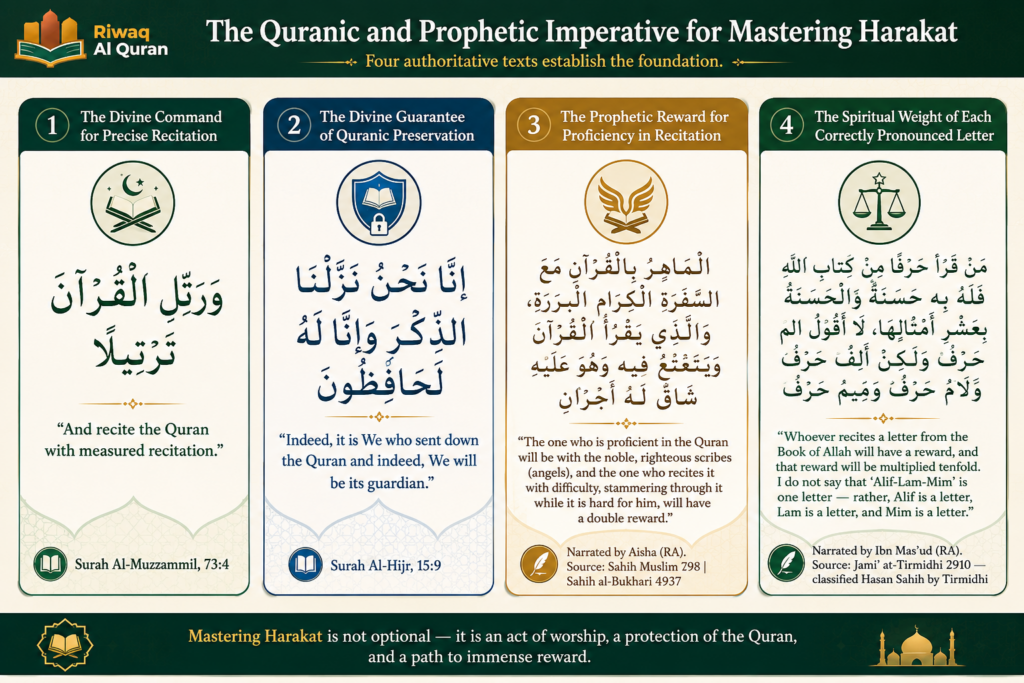
Before examining the technical dimensions of Harakat, it is worth establishing why mastering them is not merely an academic exercise — it is a religious obligation rooted in explicit Quranic commands and Prophetic tradition. Four authoritative texts establish this foundation.
1. The Divine Command for Precise Recitation
“وَرَتِّلِ الْقُرْآنَ تَرْتِيلًا”
“And recite the Quran with measured recitation.”— Surah Al-Muzzammil, 73:4
The word Tarteel (تَرْتِيل) in classical Arabic lexicography means to arrange and pronounce letters distinctly, giving each its full and correct measure. Ibn Kathir, in his Tafsir, explains it as reciting with precision and clarity — unhurried, with each letter articulated correctly at its Makhraj and with its exact Haraka.
This verse is the primary Quranic basis for Tajweed as an obligatory discipline. You cannot achieve Tarteel without Harakat mastery; they are the same requirement expressed two different ways.
2. The Divine Guarantee of Quranic Preservation
“إِنَّا نَحْنُ نَزَّلْنَا الذِّكْرَ وَإِنَّا لَهُ لَحَافِظُونَ”
“Indeed, it is We who sent down the Quran and indeed, We will be its guardian.”— Surah Al-Hijr, 15:9
Islamic scholars have historically interpreted this preservation as encompassing both the written text and the recited tradition — including Harakat and Tashkeel. The Tashkeel system was formally introduced to Arabic script precisely to guard against the drift in pronunciation that threatened the Quran’s integrity as the language spread to non-Arab populations.
The preservation Allah promises here is active, not passive — it demands that each generation transmit the Quran with its exact vowels intact.
3. The Prophetic Reward for Proficiency in Recitation
“الْمَاهِرُ بِالْقُرْآنِ مَعَ السَّفَرَةِ الْكِرَامِ الْبَرَرَةِ، وَالَّذِي يَقْرَأُ الْقُرْآنَ وَيَتَتَعْتَعُ فِيهِ وَهُوَ عَلَيْهِ شَاقٌّ لَهُ أَجْرَانِ”
“The one who is proficient in the Quran will be with the noble, righteous scribes (angels), and the one who recites it with difficulty, stammering through it while it is hard for him, will have a double reward.”— Narrated by Aisha (RA). Source: Sahih Muslim 798 | Sahih al-Bukhari 4937
Proficiency (مَهَارَة) in this hadith is not limited to memorization — it includes precision of pronunciation. A reciter who knows the Quran by heart but consistently reads Fatha as Kasra, or collapses Dammas at word endings, is not demonstrating the Mahara that earns the rank described here.
Equally, the encouragement for those who struggle is theologically significant: difficulty in achieving correct Harakat is recognized and rewarded — but as an incentive to persist, not an excuse to accept inaccuracy.
4. The Spiritual Weight of Each Correctly Pronounced Letter
“مَنْ قَرَأَ حَرْفًا مِنْ كِتَابِ اللَّهِ فَلَهُ بِهِ حَسَنَةٌ وَالْحَسَنَةُ بِعَشْرِ أَمْثَالِهَا، لاَ أَقُولُ الم حَرْفٌ وَلَكِنْ أَلِفٌ حَرْفٌ وَلاَمٌ حَرْفٌ وَمِيمٌ حَرْفٌ”
“Whoever recites a letter from the Book of Allah will have a reward, and that reward will be multiplied tenfold. I do not say that ‘Alif-Lam-Mim’ is one letter — rather, Alif is a letter, Lam is a letter, and Mim is a letter.”— Narrated by Ibn Mas’ud (RA). Source: Jami’ at-Tirmidhi 2910 — classified Hasan Sahih by Tirmidhi
The Prophet ﷺ specifically individuates letters — each carries its own full weight of reward. A letter with its correct Haraka is a fully realized letter: it has its Makhraj, its vowel quality, and its timing. A letter whose Haraka is swallowed or confused with another is an incomplete letter — it has not been recited as the Book of Allah contains it.
This hadith is an implicit motivation for Harakat precision: every correctly formed vowel is a whole letter, and a whole letter carries a reward multiplied tenfold.
See why Tajweed scholars consider correct recitation a matter of obligation, not preference — and what that means practically for every Muslim learning to read the Quran.
What Are Harakat in Arabic?
Harakat are the diacritical marks placed above or below Arabic letters to show how each letter is vocalized. The word Haraka (حَرَكَة) literally means “movement” in Arabic — a reference to the physical movement of the jaw, lips, and tongue that each vowel mark requires. Without Harakat, Arabic script records only consonants, leaving vowels to be inferred from context. For a fluent native speaker reading everyday prose this is manageable; for a learner reading the Quran, it is not.
Based on whether they carry a Haraka or not, every Arabic letter falls into one of two states:
1. Mutahrik (مُتَحَرِّك) — A Letter with a Vowel
A Mutahrik letter carries one of the three vowel marks and requires the mouth to move when pronounced. In the verse:
“قُلْ هُوَ ٱللَّهُ أَحَدٌ”
“Say: He is Allah, [who is] One.”— Surah Al-Ikhlas, 112:1
The letter قُ carries a Damma — it is Mutahrik, requiring full lip rounding before the sound is voiced.
2. Sakin (سَاكِن) — A Letter Without a Vowel
A Sakin letter carries no vowel mark and is produced as a bare consonant with no following vowel sound. In the same word (“قُلْ”), the letter لْ carries a Sukun — it is Sakin. The mouth closes on the consonant with no vowel following. Both states appear in the same word, and the distinction between them shapes the entire rhythm of the recitation.
Surah Al-Ikhlas is among the most recited surahs in daily prayer. Yet even in this brief verse, the Mutahrik-Sakin distinction is in full effect. Getting this right from the very first lesson — from the very first surah a student memorizes — is not perfectionism. It is the correct starting point.
The Complete System of Arabic Harakat and Diacritics
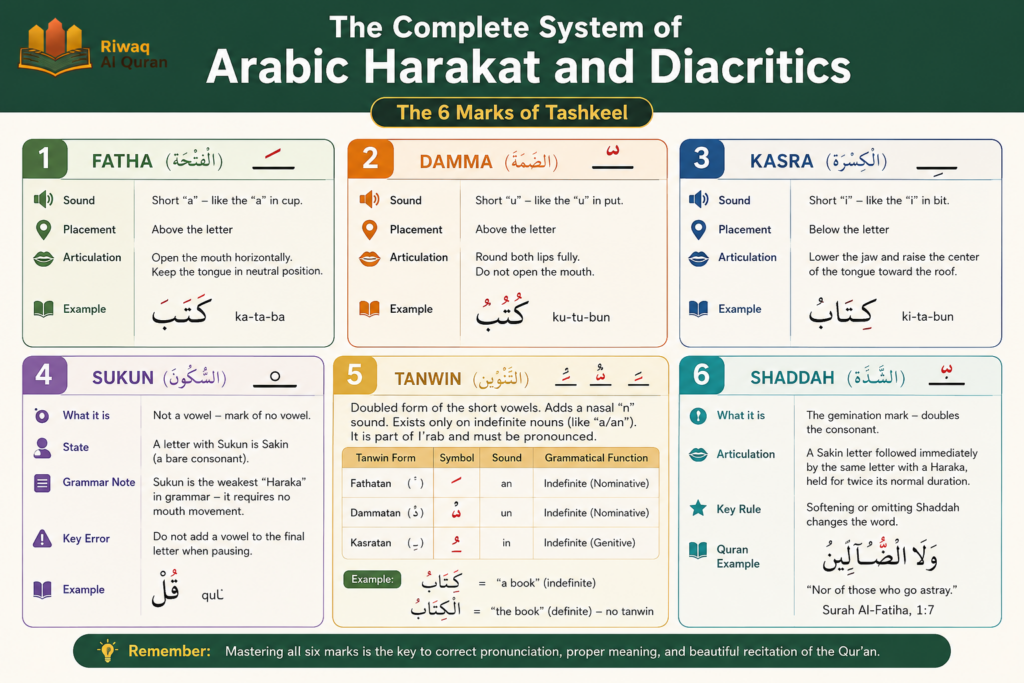
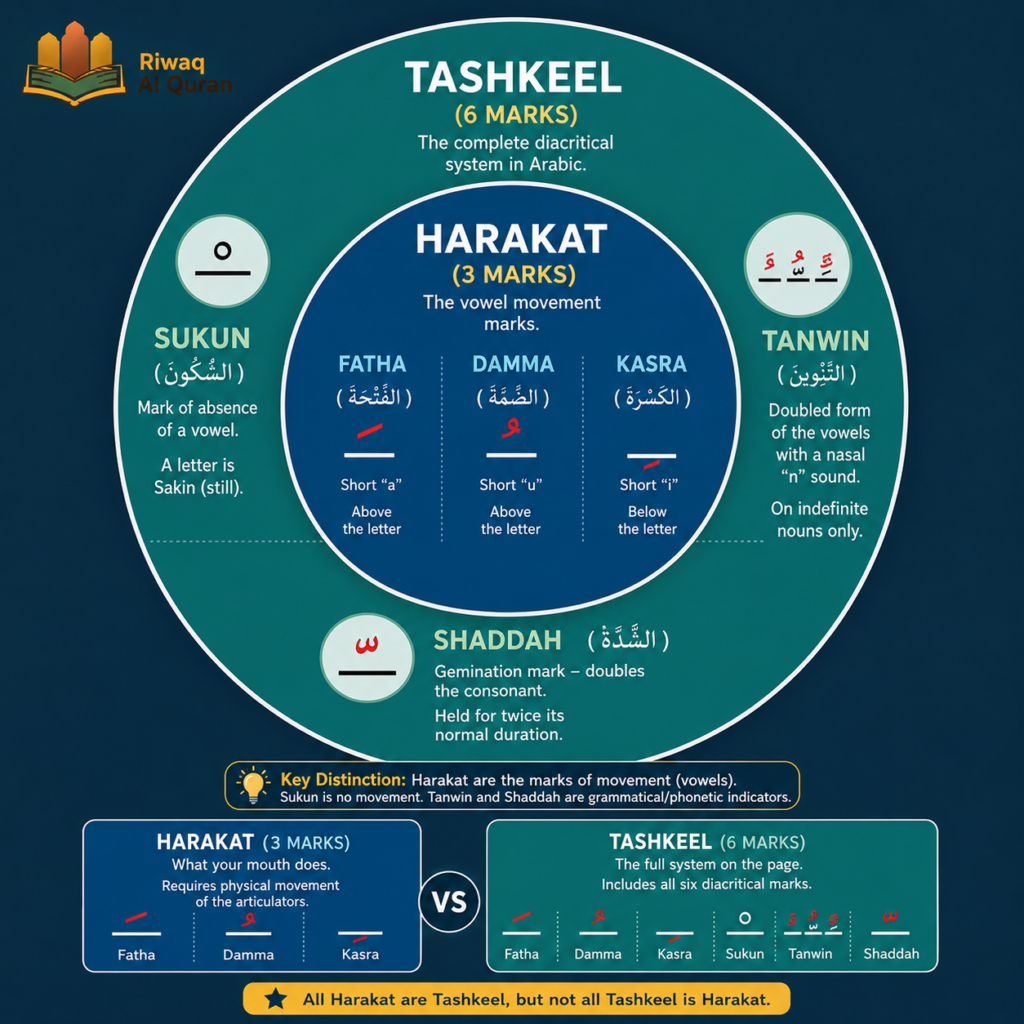
Most guides list three Harakat and stop. The full Arabic diacritical system — called Tashkeel — has six marks. Knowing all six is what separates a learner who can read a voweled text from one who genuinely understands Arabic pronunciation. The six marks divide into two groups: the three short vowels (the core Harakat) and three secondary marks that extend them, double a consonant, or mark the absence of a vowel.
1. Fatha (الفَتْحَة) — ـَ
- Sound: The short “a” vowel — resembles the short “a” in the English word “cup.”
- Placement: Written above the letter.
- Articulation: Open the mouth horizontally and keep the tongue in the neutral resting position. Raising the tongue even slightly tilts the sound toward Kasra — a mistake called Imala (إمالة), common among non-Arab learners.
- Example: “كَتَبَ” — each letter carries a Fatha, pronounced “ka-ta-ba.”
2. Damma (الضَّمَّة) — ـُ
- Sound: The short “u” vowel — resembles the short “u” in the English word “put.”
- Placement: Written above the letter.
- Articulation: Both lips must be fully rounded — not just slightly pursed. Opening the mouth instead of rounding the lips is the most common Damma error; it produces a sound that drifts toward Fatha.
- Example: “كُتُبٌ” — pronounced “ku-tu-bun.”
3. Kasra (الكَسْرَة) — ـِ
- Sound: The short “i” vowel — resembles the short “i” in the English word “bit.”
- Placement: Written below the letter.
- Articulation: Lower the jaw and simultaneously raise the center of the tongue toward the roof of the mouth. Both movements must happen together — lowering the jaw alone without raising the tongue produces a weak, under-formed Kasra.
- Example: “كِتَابٌ” — pronounced “ki-ta-bun.”
4. Sukun (السُّكُون) — ـْ
- What it is: Not a vowel — the mark of complete absence of a vowel, written as a small circle above the letter.
- State: A letter with Sukun is Sakin — pronounced as a bare consonant.
- Grammar note: In classical Arabic grammar, Sukun is technically the weakest “Haraka” because it requires no mouth movement whatsoever.
- Key practitioner error: The most frequent mistake is incorrectly adding a vowel to the final letter of a word when pausing — that final letter must be Sakin at a stop.
- Example: “قُلْ” — the لْ carries Sukun. No vowel follows it.
5. Tanwin (التَّنْوِين) — ً ٌ ٍ
Tanwin is the doubled form of each of the three short vowels: Fathatan (ً), Dammatan (ٌ), and Kasratan (ٍ). It adds a nasal “n” sound after the vowel and appears exclusively on indefinite Arabic nouns — functioning similarly to the indefinite article “a/an” in English. Tanwin is part of I’rab and must be fully pronounced; it is not silent. The three forms each carry distinct grammatical meaning, as illustrated below:
“كِتَابٌ” (with Dammatan ٌ) = “a book” (indefinite) | “ٱلْكِتَابُ” (no Tanwin) = “the book” (definite). The Dammatan signals indefiniteness and is a pronunciation requirement, not optional ornamentation.
[image: table comparing the three Tanwin forms — Fathatan / Dammatan / Kasratan — with their sounds and grammatical functions]
6. Shaddah (الشَّدَّة) — ـّ
- What it is: The gemination mark — a small “w” shape above a letter indicating the consonant is doubled.
- Articulation: A letter with Shaddah consists of a Sakin letter followed immediately by the same letter with a Haraka, compressed into one held sound, pronounced for twice its normal duration.
- Key rule: Softening or omitting a Shaddah changes the word entirely.
- Example from the Quran:
“وَلَا ٱلضَّآلِّينَ”“
Nor of those who go astray.”— Surah Al-Fatiha, 1:7
The Lam (لّ) in ٱلضَّآلِّينَ carries a Shaddah and must be held double. A Shaddah combined with a Kasra below it — the “Kasra with Shaddah” (كسرة مع شدة) — is one of the most frequently under-pronounced combinations in non-Arab recitation. This verse is recited in every unit of every prayer — a minimum of 17 times daily.
The two Shaddahs in ٱلضَّآلِّينَ, combined with the extended Madd of 6 Harakat on the same word, make it one of the most phonetically demanding phrases a beginning reciter encounters. Each repetition either reinforces correct articulation or deepens an incorrect habit. There is no neutral ground in a phrase this frequently recited.
What Is the Difference Between Harakat and Tashkeel?
Tashkeel and Harakat are related but not the same thing, and conflating them leads to conceptual errors in understanding Arabic grammar. The distinction is as follows:
- Tashkeel (التَّشْكِيل) is the complete written diacritical system in Arabic — it includes all six marks (Fatha, Damma, Kasra, Sukun, Tanwin, and Shaddah). It is the system on the page.
- Harakat (حَرَكَات), in the strict linguistic sense, refers specifically to the three vowel-movement marks (Fatha, Damma, Kasra) — the ones that require active physical movement of the articulators. It is what your mouth does when you read.
The key distinction: Sukun belongs to Tashkeel but is technically not a Haraka, because the mouth makes no movement when producing it — which is precisely why Arabic grammar defines a letter as either “Mutahrik (moving)” or “Sakin (still).” Sakin is the absence of Haraka, not a type of it. In summary: all Harakat are Tashkeel, but not all Tashkeel is Harakat.
What Are Harakat in Tajweed?
In Tajweed, “Haraka” carries an additional meaning beyond its role as a vowel mark. A Haraka in Tajweed is also a unit of pronunciation time — roughly equivalent to one finger-tap or one beat. This timing dimension governs the Madd (extension) rules and determines whether a recitation is correct or contains an error. There are two key applications of this timing principle:
1. Haraka as a Unit of Time: Natural Madd (المَدُّ الطَّبِيعِي)
A regular consonant with a short vowel takes one Haraka of time to pronounce. The three Madd letters — Alif (ا), Waw (و), and Ya (ي) — each naturally extend to two Harakat. This is the Natural Madd, and it is the baseline every reciter must maintain:
- Shortening it to one Haraka is a Tajweed error.
- Lengthening it beyond two without a qualifying rule is also incorrect.
“وَٱلتِّينِ وَٱلزَّيْتُونِ ١ وَطُورِ سِينِينَ ٢ وَهَـٰذَا ٱلْبَلَدِ ٱلْأَمِينِ ٣ لَقَدْ خَلَقْنَا ٱلْإِنسَـٰنَ فِىٓ أَحْسَنِ تَقْوِيمٍۢ ٤”
“By the fig and the olive, and by Mount Sinai, and by this secure city [Makkah] — We have certainly created man in the best of stature.”— Surah At-Tin, 95:1–4
Every Waw (و) and Ya (ي) in these verses carries the Natural Madd of exactly two Harakat. The rhythm of the opening oath “وَٱلتِّينِ وَٱلزَّيْتُونِ” is built entirely on correctly held two-Haraka extensions. Compressing them to one beat flattens the recitation and breaks the rhythmic pattern that distinguishes this surah in traditional recitation.
The aesthetic experience of listening to the Quran and its technical requirements are not separate — the beauty listeners perceive is the direct product of precise Madd timing.
2. Extended Madd – When 4–6 Harakat Are Required
Specific Tajweed conditions trigger Madd extensions beyond two Harakat:
- Madd Al-Muttasil / Madd Al-Munfasil: typically 4–5 Harakat.
- Madd Al-Lazim: a mandatory 6 Harakat — no shortening is permissible.
“وَلَا ٱلضَّآلِّينَ” — Surah Al-Fatiha, 1:7
In this phrase, the “آ” in ٱلضَّآلِّينَ requires 4 Harakat; the “يـ” at the end of the same word requires 6 Harakat under Madd Al-Lazim. These are not stylistic choices — their lengths are prescribed, and an incorrect count constitutes a recitation error. Calibrating Madd counts by ear alone is genuinely difficult.
Working with a Tajweed-qualified teacher who can count and correct in real time — as available through Riwaq Al Quran’s Tajweed courses — closes this gap far faster than self-study. You can also explore the different voices and styles of renowned Quran reciters to develop your ear for correct Madd timing.
How Harakat Change the Meaning of Arabic Words and Quran Verses
Harakat are not decorative. They carry full semantic and grammatical information. Changing a single mark can produce a completely different word or, in the Quran, reverse the meaning of a verse entirely. This section examines both dimensions: the word level and the verse level.
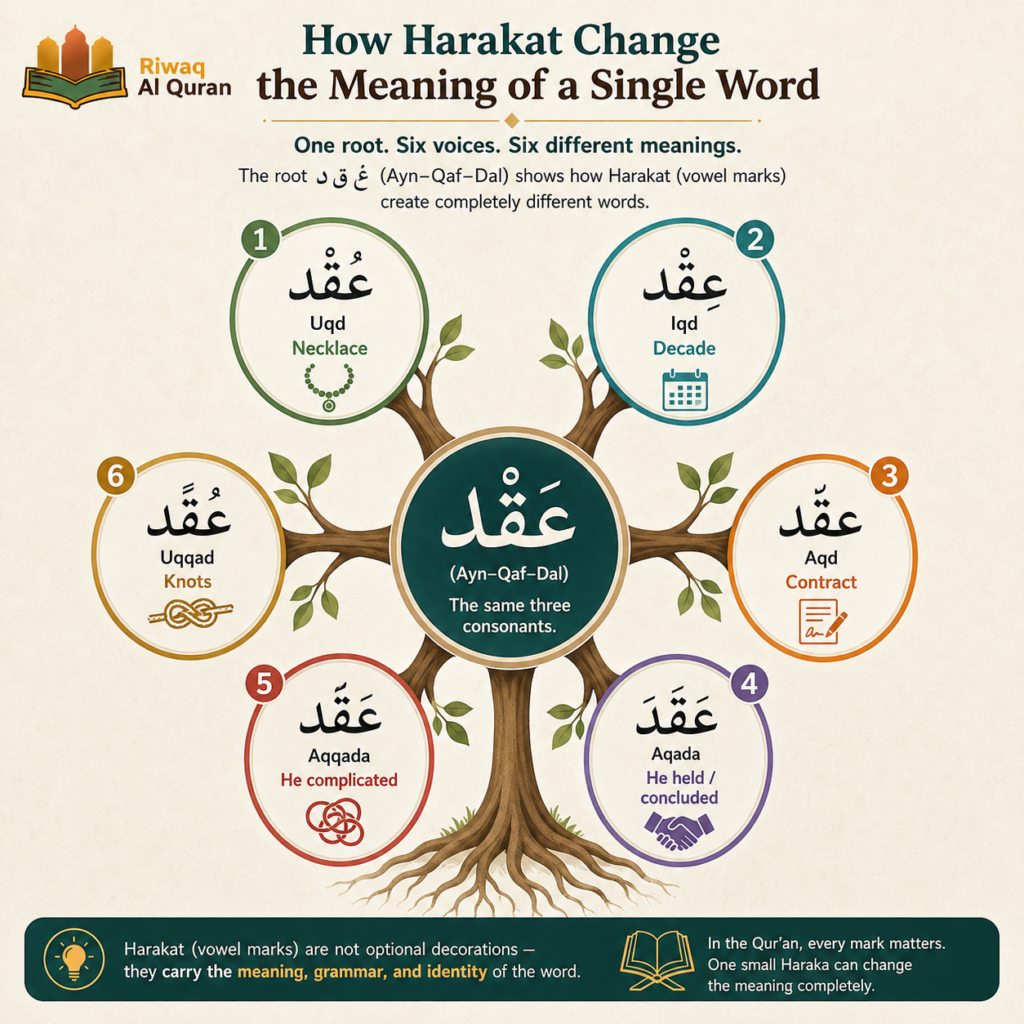
1. How Harakat Change the Meaning of a Single Word
The same root consonants can carry entirely different meanings depending solely on which Harakat are applied. The Arabic root عقد (Ayn-Qaf-Dal) illustrates this perfectly — the same three consonants yield six entirely different words:
| Vocalized Form | Pronunciation | Meaning |
|---|---|---|
| عُقْد | Uqd | Necklace |
| عِقْد | Iqd | Decade |
| عَقْد | Aqd | Contract |
| عَقَدَ | Aqada | He held / concluded |
| عَقَّدَ | Aqqada | He complicated |
| عُقَّد | Uqqad | Knots |
This is not an edge case. Arabic root-based morphology means Harakat carry the entire lexical and grammatical identity of a word. For Quran recitation, where the text is fully voweled, there is no ambiguity — and no justification for reading the wrong mark.
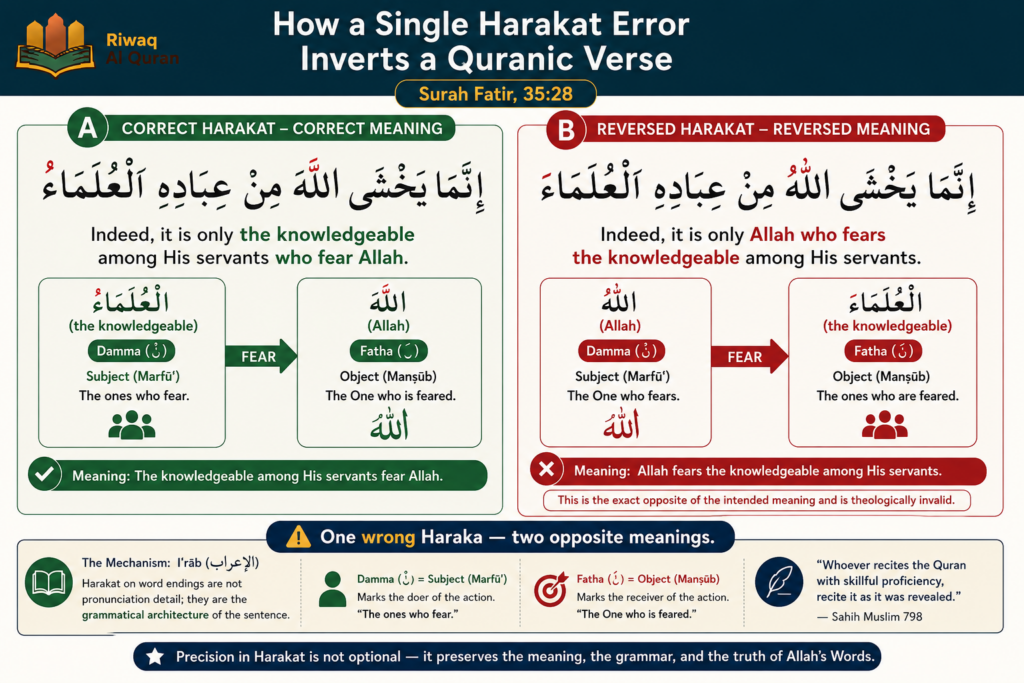
2. How a Single Harakat Error Inverts a Quranic Verse
Allah says:
“إِنَّمَا يَخْشَى ٱللَّهَ مِنْ عِبَادِهِ ٱلْعُلَمَاءُ”
“Indeed, it is only the knowledgeable among His servants who fear Allah.”— Surah Fatir, 35:28
In this sentence:
- “ٱلْعُلَمَاءُ” (the knowledgeable) is the grammatical subject → carries Damma (ُ) → the ones who fear.
- “ٱللَّهَ” is the grammatical object → carries Fatha (َ) → the one who is feared.
If a reciter reverses the Harakat — reading “اللهُ” with Damma and “الْعُلَمَاءَ” with Fatha — the grammatical roles swap entirely: “Allah fears the knowledgeable among His servants.” This is the exact opposite of the intended meaning and a theologically invalid statement.
This verse is among the most theologically significant examples of Harakat precision in the entire Quran. Scholars of Aqeedah cite it precisely because it demonstrates that a single wrong Haraka can produce theological error in recitation. The 13th-century grammarian Ibn Hisham, in his Mughni Al-Labib, uses I’rab examples of this type to show that Arabic case endings are not optional refinements — they are the grammatical spine of meaning.
This is why the Prophet ﷺ’s call to Mahara in Sahih Muslim 798 is not merely an encouragement to memorize more; it is a call to recite with precision.
The mechanism is I’rab (الإعراب) — the Arabic case system:
- Damma marks the subject (Marfu’) → the doer of the action.
- Fatha marks the object (Mansub) → the receiver of the action.
Harakat on word endings are not pronunciation detail; they are the grammatical architecture of the sentence.
Core Arabic Harakat Rules
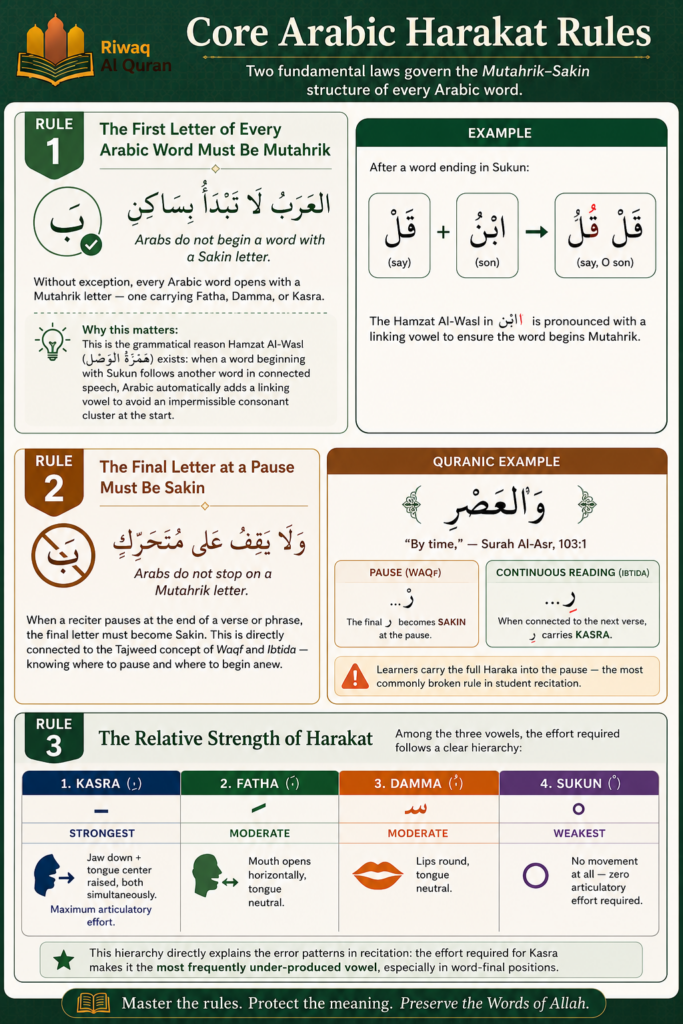
Two fundamental rules govern the Mutahrik-Sakin structure of every Arabic word. These are not stylistic preferences — they describe how Arabic phonology is built, and both have direct consequences for Quranic recitation.
Rule 1: The First Letter of Every Arabic Word Must Be Mutahrik
“العَرَبُ لَا تَبْدَأُ بِسَاكِنٍ” — Arabs do not begin a word with a Sakin letter. Without exception, every Arabic word opens with a Mutahrik letter — one carrying Fatha, Damma, or Kasra.
This is the grammatical reason Hamzat Al-Wasl (هَمْزَةُ الوَصْلِ) exists: when a word beginning with Sukun follows another word in connected speech, Arabic automatically adds a linking vowel to avoid an impermissible consonant cluster at the start.
Rule 2: The Final Letter at a Pause Must Be Sakin
“وَلَا يَقِفُ عَلَى مُتَحَرِّكٍ” — Arabs do not stop on a Mutahrik letter. When a reciter pauses at the end of a verse or phrase, the final letter must become Sakin. This is directly connected to the Tajweed concept of Waqf and Ibtida — knowing where to pause and where to begin anew.
“وَٱلْعَصْرِ”
“By time,”— Surah Al-Asr, 103:1
When pausing at this verse, the final رِ shifts from carrying a Kasra (when read continuously into the next verse) to being Sakin at the pause. Learners habituate the full Haraka of a word as a fixed property and carry it unchanged into the pause — this is the single most commonly broken rule in student recitation.
The Quran’s verse boundaries are major pause positions, and mastering Sakin-at-pause is a prerequisite for correct recitation, not a refinement for advanced students.
Rule 3: The Relative Strength of Harakat
Among the three vowels, the effort required follows a clear hierarchy:
- Kasra — strongest: Jaw down + tongue center raised, both simultaneously. Maximum articulatory effort.
- Fatha — moderate: Mouth opens horizontally, tongue neutral.
- Damma — moderate: Lips round, tongue neutral.
- Sukun — weakest: No movement at all — zero articulatory effort required.
This hierarchy directly explains the error patterns in the next section: the effort required for Kasra makes it the most frequently under-produced vowel, especially in word-final positions where physical attention tends to relax.
8 Common Harakat Mistakes and How to Fix Them
Every Harakat error is a physical error before it is a knowledge error. The three articulatory components — jaw height, lip shape, and tongue position — each have a correct and incorrect state for each vowel. The eight mistakes below are organized by the vowel they affect, and each is mapped to its physical cause and its specific correction.
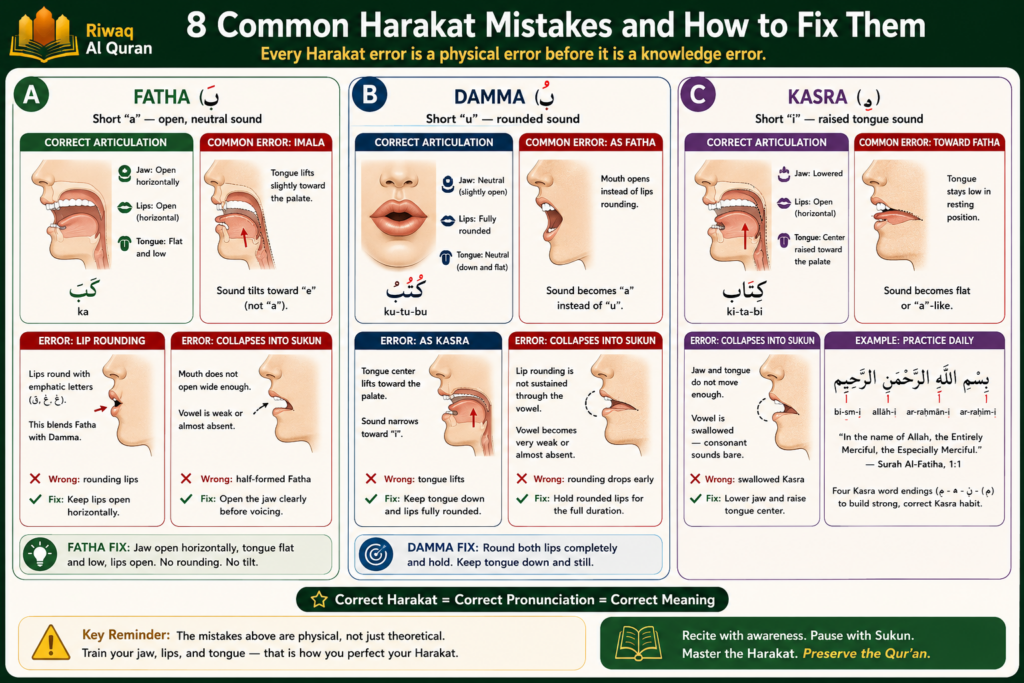
A. Fatha Mistakes
The three most common Fatha errors all stem from the jaw, tongue, or lips departing from the correct neutral-open position.
A1. Imala — Fatha Tilted Toward Kasra
- What happens: The tongue rises slightly, narrowing the vowel space until Fatha sounds like “e.”
- Cause: The speaker lifts their tongue to a higher position while opening the mouth horizontally.
- Fix: Keep the tongue completely flat and neutral; open the mouth horizontally, not forward or upward. Any tongue movement toward the palate converts Fatha into Imala.
A2. Rounding the Lips with Emphatic Letters
- What happens: Emphatic consonants like ق, خ, and غ trigger lip rounding, blending Fatha with Damma.
- Cause: The speaker mistakenly believes rounding the lips produces the emphatic (Tafkhim) effect.
- Fix: Emphasis comes from the back of the tongue and throat — the lips open horizontally and never round during Fatha, even on emphatic letters. Example: “خَتَمَ” — both خ and ت carry Fatha with zero lip rounding.
A3. Fatha Collapses into Sukun
- What happens: The vowel is half-formed and sounds truncated, almost as if no vowel is present.
- Cause: The speaker does not open the mouth wide enough when pronouncing the Fatha.
- Fix: Consciously open the jaw to a clear, deliberate horizontal position before voicing the letter. The opening must precede the sound, not accompany it.
B. Damma Mistakes
The three Damma errors all trace back to failure to maintain or achieve full, sustained lip rounding.
B1. Damma Pronounced as Fatha
- What happens: The sound drifts toward “a,” losing its “u” quality.
- Cause: The speaker opens the mouth instead of rounding the lips.
- Fix: Form a complete rounded circle with both lips before voicing any letter with Damma. If the lips are not round before the sound begins, the Damma is already wrong.
B2. Damma Pronounced as Kasra
- What happens: The sound narrows toward “i,” especially common in non-Arab learners.
- Cause: The tongue center rises during the vowel, pulling the sound toward Kasra.
- Fix: Concentrate entirely on lip rounding and actively prevent the tongue from lifting.
B3. Damma Collapses into Sukun
- What happens: The vowel is under-pronounced, producing a near-consonant sound.
- Cause: The speaker does not sustain lip rounding through the full duration of the vowel.
- Example:
“إِيَّاكَ نَعْبُدُ وَإِيَّاكَ نَسْتَعِينُ”
“You alone we worship, and You alone we ask for help.”— Surah Al-Fatiha, 1:5
Both the بُ and the دُ must sustain full lip rounding through their complete duration — once for بُ and once for دُ.
- Fix: Hold the rounded lip position from the moment you voice the letter until the vowel is fully complete.
C. Kasra Mistakes
The two Kasra errors both result from incomplete or absent jaw-and-tongue coordination.
C1. Kasra Pulled Toward Fatha
- What happens: The vowel sounds flat or neutral instead of the bright “i” quality.
- Cause: The tongue remains in the resting position instead of lifting toward the palate.
- Fix: Lower the jaw and simultaneously raise the tongue center — both movements together, neither alone. If only the jaw lowers without the tongue lifting, the result is a Fatha-like sound.
C2. Kasra Collapses into Sukun
- What happens: The vowel is swallowed — the consonant sounds bare with no vowel following.
- Cause: Jaw and tongue do not move to the required position, especially at word endings where physical attention relaxes.
- Example:
“بِسْمِ ٱللَّهِ ٱلرَّحْمَـٰنِ ٱلرَّحِيمِ”
“In the name of Allah, the Entirely Merciful, the Especially Merciful.”— Surah Al-Fatiha, 1:1
The Kasra on the final letters of each word (مِ – هِ – نِ – مِ) must be fully articulated, not swallowed. The Basmala is the ideal daily drill for this: four Kasra word endings, recited dozens of times daily, that build the muscle memory for every Kasra in the Quran. A reciter who fully forms every Kasra in the Basmala has already built the habit that carries into the rest of the text.
- Fix: Actively lower the jaw and raise the tongue center at every Kasra, with specific, conscious attention to word endings.
(Kasra: tongue flat = error). This is the most practically useful visual in the article and directly supports the physical-correction framework of this section.
Before going through each mistake in detail, watch this quick breakdown of the most common Tajweed errors beginners make — many of them trace directly back to incorrect Harakat habits.
How to Learn Arabic Harakat – A Practical Four-Step Method
The Prophet ﷺ set a clear standard for this pursuit. In two related narrations, he said:
“مَا أَذِنَ اللَّهُ لِشَيْءٍ مَا أَذِنَ لِنَبِيٍّ حَسَنِ الصَّوْتِ يَتَغَنَّى بِالْقُرْآنِ يَجْهَرُ بِهِ”
“Allah has not given permission to anything as He gives permission to a Prophet with a beautiful voice, reciting the Quran aloud melodiously.”— Narrated by Abu Hurairah (RA). Sahih al-Bukhari 5024
“لَيْسَ مِنَّا مَنْ لَمْ يَتَغَنَّ بِالْقُرْآنِ”
“He is not one of us who does not recite the Quran melodiously.”— Narrated by Abu Hurairah (RA). Sahih al-Bukhari 7527
Both hadith point to the same reality: melodious recitation is not a gift reserved for the naturally talented — it is an aspiration the Prophet ﷺ placed before every Muslim. The most direct path to it is not musicality; it is correct Harakat.
When every vowel is properly formed and every Madd correctly timed, the melody of the recitation emerges naturally from the language itself. These hadith are not calling for aesthetic performance; they are calling for phonetic precision pursued with the intention of worship.
Step 1: Learn the Mouth Positions Before the Rules
Most learners start with rules and then try to apply them to pronunciation. The effective sequence is the reverse:
- First, master the physical position for each Haraka in isolation — Fatha (neutral tongue, horizontal open jaw), Damma (fully rounded lips), Kasra (lowered jaw + raised tongue center).
- Then associate each rule with that physical sensation.
- Practice each position without Arabic text until it feels automatic.
Rules without physical habit produce reading-speed errors under pressure. This is especially true when reciting from memory — the mouth defaults to what it has practiced physically, not what the mind knows intellectually.
Step 2: Listen to Precision Reciters with a Specific Focus
Passive listening does not build Harakat accuracy. Active, focused listening does:
- Choose reciters recognized for precision in the Hafs ‘an ‘Asim narration — Shaikh Al-Husary and Shaikh Al-Minshawi are the standard references used in Tajweed instruction worldwide.
- Listen to a single verse repeatedly, focusing on one feature at a time: whether each vowel is fully formed, or whether word endings shift correctly at pauses.
- Avoid monitoring everything simultaneously — isolate one feature per listening session.
For a broader introduction to precision reciters, see this guide to voices and recitation styles.
Step 3: Record Yourself and Apply the Three-Harakat Diagnostic
- Record your recitation of a short surah.
- Play it back and categorize every error by its physical cause:
- Jaw problem → Fatha or Kasra error
- Lip problem → Damma error
- Tongue problem → Kasra or Imala error
- Most learners have one dominant error pattern — typically either collapsing Dammas (lip-rounding failure) or flattening Kasras (tongue-lift failure).
- Identifying your personal pattern allows you to target practice where it generates the most improvement, rather than drilling everything equally.
Step 4: Work with a Qualified Teacher for Live Correction
Self-diagnosis catches obvious errors. Subtle errors in Madd timing, Tanwin nasalization, and Shaddah doubling require a trained ear to catch in real time:
- A qualified teacher hears whether your Madd Al-Lazim runs to five Harakat instead of six — a distinction inaudible on playback to the untrained ear.
- Seeking an Egyptian Quran teacher is particularly recommended, as Egypt’s tradition of Quran education is among the most rigorous and widely respected globally.
- At Riwaq Al Quran, qualified Tajweed instructors work one-on-one in live sessions, identifying each student’s specific error pattern and building a targeted correction plan from the first lesson.
You can also supplement with structured Arabic grammar study, which deepens your understanding of why Harakat function as they do in the sentence — bridging pronunciation practice with grammatical comprehension.
Learn Quran, Arabic, and Islamic Studies Online — Book Your Free Trial
Correct Harakat are not a refinement for advanced students. They are the grammatical structure of Arabic and the foundation of every Quranic recitation — getting them wrong changes meaning, and in the Quran, that matters.
Allah commands Tarteel (73:4); the Prophet ﷺ rewards proficiency (Sahih Muslim 798); and every correctly pronounced letter carries a reward multiplied tenfold (Tirmidhi 2910).
Riwaq Al Quran is a comprehensive online platform offering personalized Quran, Arabic, and Islamic Studies classes for all ages and backgrounds. Experienced instructors follow a structured curriculum covering Tajweed, Tafsir, and Memorization through advanced live online classes — providing seamless, real-time interaction between students and teachers.
Browse by learning area:
Quran Courses · Arabic Language · Kids’ Courses · Ijazah Certification · Islamic Studies
Courses most relevant to Harakat and Tajweed mastery:
| Course | What You Will Develop |
|---|---|
| Online Tajweed Classes | Correct pronunciation rules, Madd timing, and Harakat precision |
| Online Quran Recitation Course | Fluent, accurate recitation with proper vowel articulation |
| Noorani Qaida Online | Foundational Arabic reading with correct Harakat from day one |
| Quran Memorization with Tajweed | Memorizing with correct vowel habits locked in from the start |
| Online Qirat Course | The ten Quranic recitation styles and their distinct Harakat rules |
| Online Tafseer Course | Understanding the meaning that correct recitation preserves |
| Online Quran Classes for Kids | Building correct Harakat foundations for young learners from the start |
Looking for structured Arabic language study alongside Quran? Explore the Arabic courses for kids or the online Arabic grammar course to build the grammatical understanding that makes Harakat rules intuitive rather than memorized.
Riwaq Al Quran instructors are available for one-on-one live sessions, with qualified female mentors available for students who prefer a same-gender learning environment.
Conclusion
Harakat in Arabic are the short vowel marks — Fatha, Damma, and Kasra — that determine how every Arabic letter is pronounced. Together with Sukun, Tanwin, and Shaddah, they form the Tashkeel system that makes Arabic text fully readable. In Tajweed, the word Haraka additionally means a unit of pronunciation time, governing how long Madd letters are held during Quran recitation and determining whether a recitation is valid or contains an error.
The grammatical stakes are direct: Harakat on word endings signal I’rab — grammatical case — which determines subject and object. In Surah Fatir 35:28, a single reversed Haraka transforms a verse about scholars fearing Allah into the theologically opposite statement. This is not an edge case; it is the reason Islamic scholarship treats Tajweed rules as obligatory for Quranic recitation.
Allah commands Tarteel (73:4), guarantees the Quran’s preservation (15:9), and through His Prophet ﷺ rewards those who master its recitation with the company of the noble scribes (Sahih Muslim 798).
The most actionable takeaway: almost all Harakat errors trace back to one of three physical causes — wrong jaw height, wrong lip shape, or wrong tongue position. Diagnosing your personal error pattern and targeting it with corrected, teacher-supervised practice is the fastest path to accurate recitation.
Frequently Asked Questions
The questions below address the most common points readers ask about Arabic Harakat — from basic definitions and types, to their role in Quranic grammar and why learning them carries religious weight.
What are Harakat in Arabic?
Harakat in Arabic are the short vowel diacritical marks — Fatha (ـَ), Damma (ـُ), and Kasra (ـِ) — placed above or below Arabic letters to indicate their vowel sounds. They tell the reader how to pronounce each letter and are essential for accurately reading the Quran and any fully voweled Arabic text.
How many Harakat are there in Arabic?
There are three core Harakat: Fatha, Damma, and Kasra. The complete diacritical system (Tashkeel) includes three additional marks: Sukun (absence of vowel), Tanwin (the three doubled-vowel nunation forms), and Shaddah (consonant gemination). Together these six marks cover every pronunciation marking found in a fully voweled Arabic text.
What is the difference between Harakat and Tashkeel?
Harakat refers specifically to the three short vowel marks that require active mouth movement. Tashkeel is the broader written diacritical system that includes Harakat plus Sukun, Tanwin, and Shaddah. All Harakat are part of Tashkeel, but not every Tashkeel mark is a Haraka — Sukun marks the absence of vowel movement and is technically not a Haraka.
What does Haraka mean in Tajweed?
In Tajweed, a Haraka is a unit of pronunciation time — roughly one beat. Regular consonants take one Haraka; the three Madd letters (Alif, Waw, Ya) extend naturally to two Harakat. Longer Madd rules (4, 5, or 6 Harakat) are triggered by specific Tajweed conditions. Getting the Haraka count wrong in any Madd is a recitation error, not a stylistic variation.
Can the wrong Haraka change the meaning of a Quranic verse?
Yes — the wrong Haraka can reverse the meaning of a verse entirely. In “إِنَّمَا يَخْشَى ٱللَّهَ مِنْ عِبَادِهِ ٱلْعُلَمَاءُ” (Surah Fatir, 35:28), “اللَّهَ” carries Fatha as the grammatical object (the one feared). Pronouncing it with Damma makes it the subject, producing the opposite and theologically invalid meaning. The mechanism is I’rab — Harakat on word endings mark grammatical role.
What is Tanwin and why does it matter?
Tanwin (التَّنْوِين) is the doubled form of the three short vowels — Fathatan (ً), Dammatan (ٌ), and Kasratan (ٍ) — added to indefinite Arabic nouns to produce a nasal “n” sound. “كِتَابٌ” means “a book” (indefinite); “ٱلْكِتَابُ” means “the book” (definite, no Tanwin). Tanwin is a core part of Arabic I’rab and must be pronounced in recitation — it is not silent.
What is Shaddah in Arabic?
Shaddah (الشَّدَّة) is the gemination mark that doubles a consonant and holds it for twice its normal duration. Softening or omitting a Shaddah changes the word, and in Quranic recitation it constitutes a pronunciation error with consequences for both meaning and I’rab.
Is learning Harakat obligatory for Muslims?
Islamic scholars consider reciting the Quran with correct Harakat obligatory — based on the Quranic command for Tarteel (Surah Al-Muzzammil, 73:4) and the consensus of classical scholarship. Errors that change meaning (Lahn Jali) are universally considered impermissible in recitation. The Prophet ﷺ’s hadith in Sahih Muslim 798 identifies Mahara (proficiency) as the standard to strive for, while the additional reward for those who struggle confirms that effort toward correct Harakat is itself a form of worship.
Sources
- Quranic verses: Quran.com
- Sahih Muslim 798 — Hadith of Aisha (RA) on Quranic proficiency
- Sahih al-Bukhari 4937 — Parallel narration of the same hadith
- Sahih al-Bukhari 5024 — Hadith of Abu Hurairah (RA) on melodious recitation
- Sahih al-Bukhari 7527 — Hadith of Abu Hurairah (RA) on reciting melodiously
- Jami’ at-Tirmidhi 2910 — Hadith of Ibn Mas’ud (RA) on the reward for each letter (classified Hasan Sahih)