A student mid-lesson once stopped his recitation right after “إِنَّ ٱللَّهَ لَا يَسْتَحْيِي” and left the sentence there — making it sound as though Allah possesses a deficiency. No bad intention; he was simply out of breath and picked the wrong moment to stop. That single pause is why Waqf and Ibtida in the Quran sit at the center of every serious Tajweed curriculum.
Waqf (الوقف) and Ibtida (الابتداء) are the paired disciplines governing when to pause and where to resume during Quranic recitation. The Companion Ali Ibn Abi Talib (may Allah be pleased with him) described these two sciences together as half of Tarteel — the other half being correct pronunciation of individual letters. Ibn Al-Anbari (ابن الأنباري), the tenth-century Arabic linguist, stated it plainly: “An essential part of learning the Quran is to learn Waqf and Ibtida.”
That weight traces directly to a divine command. In Surah Al-Muzzammil, Allah says:
“أَوْ زِدْ عَلَيْهِ وَرَتِّلِ ٱلْقُرْءَانَ تَرْتِيلًا”
“Or add to it, and recite the Quran with measured recitation.”Surah Al-Muzzammil, Ayah 4 (73:4)
This is not a recommendation — it is a command with the emphatic cognate accusative (تَرْتِيلًا), which in Arabic grammar signals unconditional obligation. Ali Ibn Abi Talib’s own definition of Tarteel requires: “Tajweed of the letters and knowledge of the stopping points.” The stopping points are Waqf. The divine command therefore directly encompasses everything this article teaches.
What you’ll learn in this article:
- The exact meaning of Waqf and Ibtida in Arabic scholarship.
- All 7 Tajweed stop signs — symbols, rulings, and Quranic examples.
- Every type of Ibtida — permissible and impermissible — with examples.
- How many Waqf marks are in the Quran and why scholars give different counts.
- Three common mistakes students make and a practical rule to avoid each one.
Table of Contents
What Waqf and Ibtida Mean in Quranic Recitation
Before defining the two terms, consider what it means to recite the Quran as it deserves to be recited. In Surah Al-Baqarah, Allah describes the true believers’ relationship with His Book:
“ٱلَّذِينَ ءَاتَيْنَـٰهُمُ ٱلْكِتَـٰبَ يَتْلُونَهُۥ حَقَّ تِلَاوَتِهِۦٓ أُو۟لَـٰٓئِكَ يُؤْمِنُونَ بِهِۦ”
“Those to whom We have given the Book recite it with its true recital. It is they who truly believe in it.”Surah Al-Baqarah, Ayah 121 (2:121)
Classical commentators — including Ibn Kathir and Al-Tabari — define “حَقَّ تِلَاوَتِهِ” (its true recital) as reciting with proper pronunciation, observing the prescribed Waqf positions, and reflecting on the meaning. This verse places Waqf and Ibtida inside the very definition of a believer who is faithful to the Book. Reciting without attending to these rules is, by this framing, falling short of the standard Allah set.
Waqf and Ibtida are two important terms that possess high value and significance as far as reciting and perfecting the Quran are concerned. A prominent Muslim linguist [Ibn Al-Anbari – ابن الأنباري] once said:
“من تمام معرفة القرآن: معرفة الوقف والابتداء فيه”.
[An essential part of learning the Quran is to learn Waqf and Ibtida.]
1. What Waqf Means in Tajweed
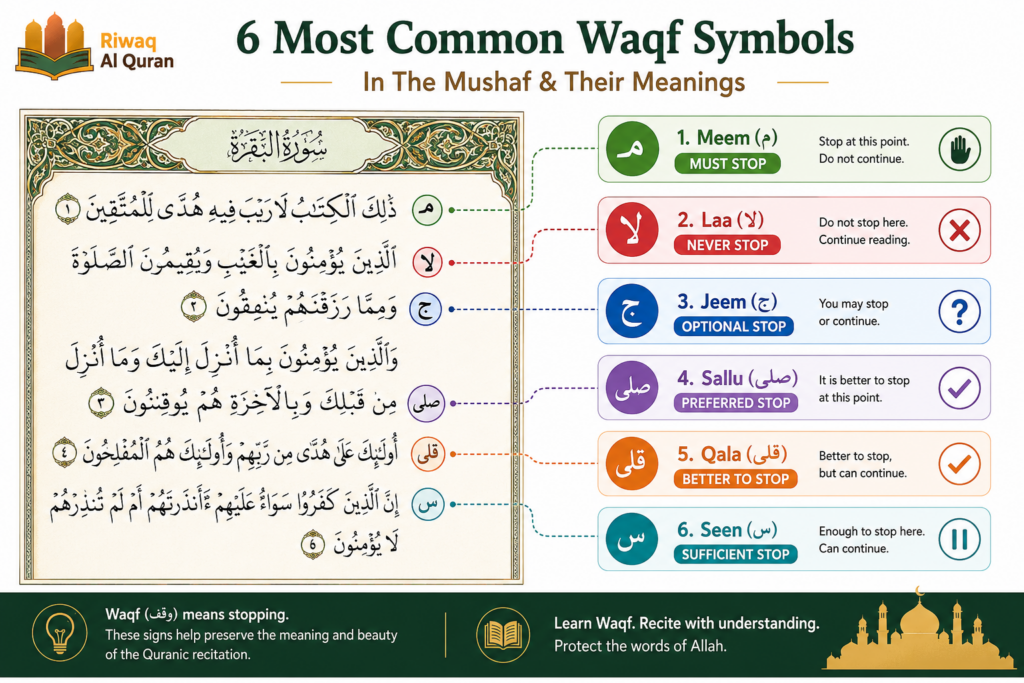
Waqf (وَقْف) means “to stop.” In Tajweed, it is a deliberate pause at a designated point during which the Quran reciter takes a breath before continuing. The stop is not arbitrary — each Waqf position carries a ruling: mandatory, prohibited, preferred, or permissible. Seven distinct types exist, each marked with its own symbol in the Mushaf.
A critical distinction many students miss:
- Waqf is not a breathing opportunity — it is a linguistic event.
- Breath management must be arranged around Waqf positions, not the other way around.
- Stopping wherever air runs out is the single most common source of prohibited pauses.
2. What Ibtida Means in Tajweed
Ibtida (ابْتِداء) means to begin anew — specifically, to start recitation again after a Waqf or a full stop (Qat’). Unlike Waqf, which is often prescribed, Ibtida is almost always a decision.
“الشروع في القراءة بعد وقف أو قطع، بما يلي الكلمة التي وُقِف عندها أو بما قبلها أو بها هي نفسها”.
After any stop, the reciter may begin again at:
- The word that had the Waqf itself.
- The word before it.
- The word after it.
— provided the resulting phrase carries complete and accurate meaning.
A practical rule from classical scholarship:
After any unplanned stop, return to the beginning of the nearest complete grammatical and semantic unit (جملة مفيدة), even if that means repeating a few already-recited words. Starting mid-phrase risks producing a statement that is broken or misleading.
For example, in Surah Al-Bayyinah (98:5):
“وَمَآ أُمِرُوٓا۟ إِلَّا لِيَعْبُدُوا۟ ٱللَّهَ مُخْلِصِينَ لَهُ ٱلدِّينَ حُنَفَآءَ وَيُقِيمُوا۟ ٱلصَّلَوٰةَ وَيُؤْتُوا۟ ٱلزَّكَوٰةَ ۚ وَذَٰلِكَ دِينُ ٱلْقَيِّمَةِ”
“Even though they were only commanded to worship Allah alone with sincere devotion to Him in all uprightness, establish prayer, and pay alms-tax. That is the upright Way.”
A reciter may stop at “حُنَفَآءَ” if out of breath, but a sound Ibtida would go back to “مُخْلِصِينَ لَهُ ٱلدِّينَ” to resume with a complete phrase.

Why Waqf and Ibtida Matter and the Consequences of a Wrong Pause
The stakes of a wrong Waqf are not abstract. A widely cited example among Tajweed scholars involves Surah Al-Baqarah (2:26):
“إِنَّ ٱللَّهَ لَا يَسْتَحْيِۦٓ أَن يَضْرِبَ مَثَلًا مَّا بَعُوضَةً فَمَا فَوْقَهَا”
“Indeed, Allah does not shy away from using the parable of a mosquito or something even smaller.”
If a reciter stops after “لَا يَسْتَحْيِي” — even accidentally — the truncated phrase reads: “Indeed, Allah does not have modesty.” One wrong pause inverts the verse’s meaning entirely. This is what a ninth-century scholar meant when he wrote:
“بَابُ الْوَقْفِ عَظِيمُ الْقَدْرِ، جَلِيلُ الْخَطَرِ”
“The chapter of Waqf is of great importance and grave consequence.”
Al-Sha’bi (الشعبي), an early Islamic scholar, gave a parallel instruction regarding Surah Ar-Rahman (55:26–27):
“(كُلُّ مَنْ عَلَيْهَا فَانٍ ﴿
(وَيَبْقَىٰ وَجْهُ رَبِّكَ ذُو ٱلْجَلَـٰلِ وَٱلْإِكْرَامِ)
“Every being on earth is bound to perish ˹26˺, while your Lord’s Face will remain forever, full of Majesty and Honour ˹27˺.”
Al-Sha’bi said: “If you recite verse 26, do not stop until you have recited verse 27.” Although pausing at verse endings is generally Sunnah, here the comparison between Allah who is Ever-Living and creation which perishes must be read as one unit for its meaning to land correctly. This is a non-obvious ruling that even experienced reciters overlook.
Mastering these rulings is what the Prophet Muhammad (ﷺ) described as proficiency. In a well-known hadith narrated by Aisha (may Allah be pleased with her):
“الْمَاهِرُ بِالْقُرْآنِ مَعَ السَّفَرَةِ الْكِرَامِ الْبَرَرَةِ، وَالَّذِي يَقْرَأُ الْقُرْآنَ وَيَتَتَعْتَعُ فِيهِ وَهُوَ عَلَيْهِ شَاقٌّ لَهُ أَجْرَانِ”
“The one who is proficient in the Quran will be with the noble and righteous scribes (angels), and the one who recites the Quran and stutters in it, finding it difficult, will have a double reward.”Sahih Al-Bukhari 4937 · Sahih Muslim 798
The distinction the Prophet drew between الماهر (the proficient) and the one who struggles is not about vocal beauty — it is about mastery of recitation rules. Crucially, the hadith is also a mercy: the struggling student earns a double reward — one for the recitation, one for the effort. Learning Waqf is hard; the Prophet acknowledged that and attached reward to the struggle itself.
For more on the signs and symbols used in the Mushaf, read: What Do The Signs ط – لا – ج – م Mean In The Quran?
Before diving into the rulings that govern each pause, this short video puts into perspective why getting Tajweed — and Waqf in particular — right is not merely a technical concern:
The 7 Types of Waqf in Tajweed with Quranic Examples
Seven categories of Waqf are identified in Tajweed scholarship, each marked by a distinct symbol in the Mushaf. The table below gives a quick reference before the full rulings and examples that follow.
| Symbol | Name | Ruling in One Word |
|---|---|---|
| مـ | Waqf Lazim — Mandatory | Must stop |
| لا | Waqf Mamnu’ — Prohibited | Never stop |
| ج | Waqf Ja’iz — Permissible | Optional |
| صلى | Waqf Mujawwaz | Prefer to continue |
| قلى | Waqf Mujawwaz lil-Waqf | Prefer to stop |
| ۛ ۛ | Mu’anaqah — Paired Signs | Stop at one only |
| س | Sakt — Silent Pause | Brief silence, no breath |
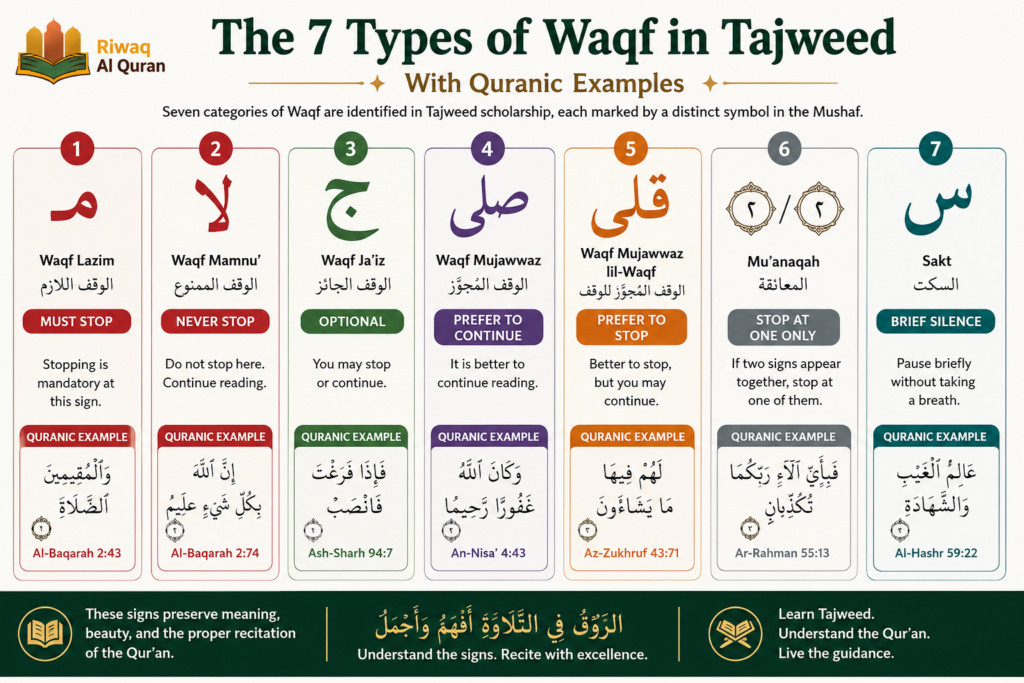
The seven Waqf types vary significantly in their rulings — some are obligatory, some forbidden, and some are a matter of reciter judgment. Understanding each one protects both the meaning and the flow of recitation.
1. Mandatory Waqf — مـ (Waqf Lazim)
Mandatory Waqf requires the reciter to stop. Continuing without pausing distorts the verse’s meaning. The symbol مـ (from لازم, “obligatory”) appears above the word where the stop must occur.
Key points:
- Stopping here is required, not optional.
- Continuing past this point causes a meaning error.
- After stopping, the reciter makes Ibtida from the very next word.
Quranic Example — Surah Al-An’am (6:36):
“إِنَّمَا يَسْتَجِيبُ ٱلَّذِينَ يَسْمَعُونَ ۘ وَٱلْمَوْتَىٰ يَبْعَثُهُمُ ٱللَّهُ ثُمَّ إِلَيْهِ يُرْجَعُونَ”
“Only those who listen will respond to you. As for the dead, Allah will raise them up, then to Him they will all be returned.”
The reciter must stop after “يَسْمَعُونَ” and begin again with “وَٱلْمَوْتَىٰ”. Without this stop, the sentence reads as though the dead also respond — contradicting the intended meaning.
2. Prohibited Waqf — لا (Waqf Mamnu’)
Prohibited Waqf means stopping here is not allowed because the verse’s meaning is incomplete, and a pause would either mislead or create an incorrect statement. The symbol لا appears above the restricted position.
Key points:
- Stopping here is forbidden.
- If the reciter stops accidentally, they must go back and resume from a valid point.
- The لا sign often appears where a descriptive phrase is still in progress.
Quranic Example — Surah An-Nahl (16:32):
“ٱلَّذِينَ تَتَوَفَّىٰهُمُ ٱلْمَلَـٰٓئِكَةُ طَيِّبِينَ ۙ يَقُولُونَ سَلَـٰمٌ عَلَيْكُمُ ٱدْخُلُوا۟ ٱلْجَنَّةَ بِمَا كُنتُمْ تَعْمَلُونَ”
“Those whose souls the angels take while they are virtuous, saying, ‘Peace be upon you! Enter Paradise for what you used to do.'”
Stopping after “طَيِّبِينَ” severs the description mid-sentence. The reciter must continue to the verse’s end.
3. Permissible Waqf — ج (Waqf Ja’iz)
Permissible Waqf means both stopping and continuing are valid. The symbol ج (from جائز) marks positions where meaning is sufficiently complete that either choice is acceptable.
Key points:
- The reciter has a genuine choice — stop or continue.
- Neither option affects the verse’s meaning negatively.
- This is the most flexible of all Waqf types.
Quranic Example — Surah An-Nasr (110:3):
“فَسَبِّحْ بِحَمْدِ رَبِّكَ وَٱسْتَغْفِرْهُ ۚ إِنَّهُۥ كَانَ تَوَّابًا”
“Celebrate the praises of your Lord and seek His forgiveness, for He is truly the Accepter of Repentance.”
After “وَٱسْتَغْفِرْهُ”, the reciter may pause or continue — both options preserve the meaning.
4. Better to Continue — صلى (Waqf Mujawwaz)
Continuing is preferred here, though pausing is not a serious error. صلى is an acronym for الوصل أولى — “continuing is better.”
Key points:
- Stopping is allowed, but continuing delivers stronger rhetorical flow.
- The preferred choice reinforces the connected meaning of the verse.
Quranic Example — Surah Al-Humazah (104:4):
“كَلَّا ۖ لَيُنبَذَنَّ فِى ٱلْحُطَمَةِ”
“But no! They will certainly be thrown into the Crusher.”
After “كَلَّا”, continuing into the warning delivers stronger rhetorical force.
5. Better to Stop — قلى (Waqf Mujawwaz lil-Waqf)
Stopping is preferred here, though continuing is not forbidden. قلى comes from الوقف أولى — “stopping is better.”
Key points:
- The preferred choice is to stop.
- Continuing does not create an error, but the meaning is cleaner with a pause.
Quranic Example — Surah Al-Kahf (18:22):
“قُل رَّبِّىٓ أَعْلَمُ بِعِدَّتِهِم مَّا يَعْلَمُهُمْ إِلَّا قَلِيلٌ ۗ فَلَا تُمَارِ فِيهِمْ إِلَّا مِرَآءً ظَـٰهِرًا”
“Say, ‘My Lord knows best their exact number.’ Only a few have knowledge of them. So do not argue about them except with clear evidence.”
After “قَلِيلٌ”, the sentence has reached a natural close; pausing here is preferred.
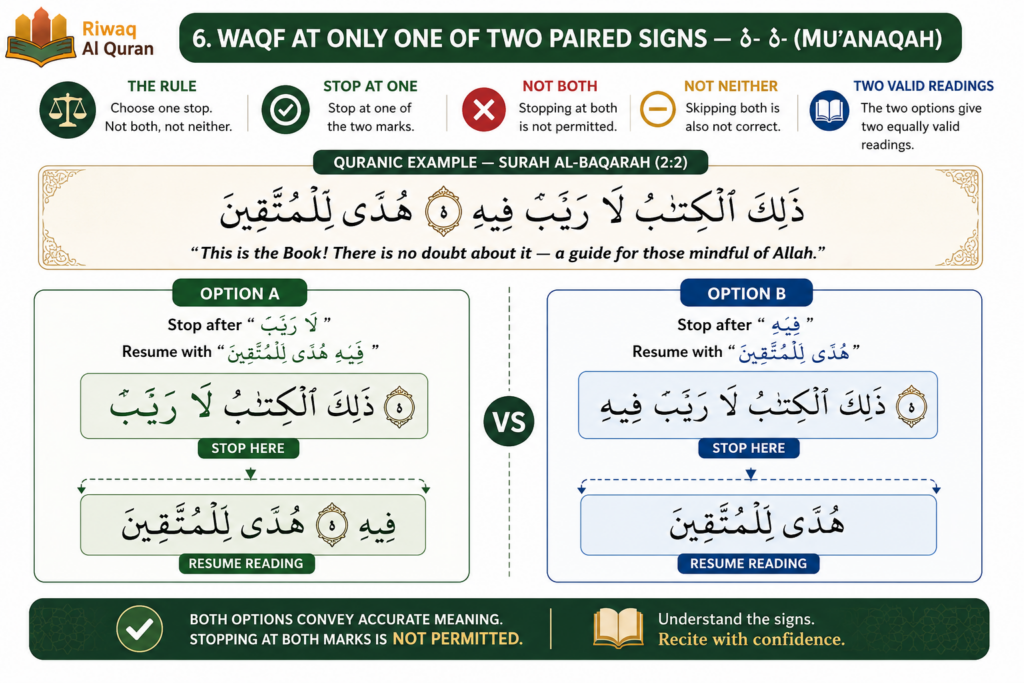
6. Waqf at Only One of Two Paired Signs — ۛ ۛ (Mu’anaqah)
These paired marks indicate the reciter must choose exactly one stopping point — not both, not neither. Stopping at both fragments the verse incorrectly.
Key points:
- The reciter must stop at one of the two marks.
- Stopping at both is not permitted.
- Skipping both is also not correct.
- The two options typically produce two equally valid readings of the verse.
Quranic Example — Surah Al-Baqarah (2:2):
“ذَٰلِكَ ٱلْكِتَـٰبُ لَا رَيْبَ ۛ فِيهِ ۛ هُدًى لِّلْمُتَّقِينَ”
“This is the Book! There is no doubt about it — a guide for those mindful of Allah.”
- Option A: Stop after “لَا رَيْبَ” → resume with “فِيهِ هُدًى لِلْمُتَّقِينَ”
- Option B: Stop after “فِيهِ” → resume with “هُدًى لِلْمُتَّقِينَ”
Both convey accurate meaning. Stopping at both marks is not permitted.
7. Sakt — س (Brief Silence Without Breath)
Sakt is a very short silence during which the reciter does not take a breath. It is shorter than a full Waqf — the voice suspends briefly, no air is inhaled, then recitation resumes immediately. It is marked with a small “س” and occurs at only four specific locations in the Quran in the narration of Hafs ‘an ‘Asim — the most widely used narration today.
Key points:
- No breath is taken during Sakt.
- The pause is very brief — just enough to separate the two adjacent words.
- Sakt exists specifically to prevent words from merging into an incorrect Arabic term.
- There are only 4 Sakt positions in the Hafs narration — all four must be known before reciting the relevant Surahs.
Quranic Example — Surah Al-Qiyamah (75:27):
“وَقِيلَ مَنۜ رَاقٍ”
“And it will be said, ‘Who can save him now?'”
The reciter makes a silent pause after “مَنْ” without breathing, then continues with “رَاقٍ”. Without this Sakt, the two words blend into “مَرَّاقٍ” — a real Arabic word meaning “one who abandons religion” — producing an entirely different and incorrect statement.
For a deeper look at Tajweed recitation rules, read: What Is Harakat In Tajweed And Arabic? Meaning, Types, Examples, And Common Mistakes
If you’re working through these rulings with a qualified teacher who can hear and correct your Waqf positions in real time, Riwaq Al Quran’s Online Tajweed Classes pair students with native Arab certified instructors in live one-on-one sessions — fully online, on your schedule. Your first class is free.
Types of Ibtida in the Quran with Examples
Ibtida divides into two broad categories: Permissible (جائز) and Impermissible (غير جائز). The permissible type has three levels based on how connected the new section is to what preceded it. Understanding these categories prevents the most common resumption errors in structured recitation.
A. Permissible Ibtida (الابتداء الجائز)
Permissible Ibtida means the reciter can safely start anew from a given point without distorting the meaning. It divides into three levels based on how strongly the resumed phrase connects to what came before it.
A-1. Complete Ibtida (تام)
Complete Ibtida is made when the new section has no connection — in meaning or in words — to what came before it. This is the strongest and safest form of Ibtida.
Quranic Example — Surah Al-Kahf (18:107):
“إِنَّ ٱلَّذِينَ ءَامَنُوا۟ وَعَمِلُوا۟ ٱلصَّـٰلِحَـٰتِ كَانَتْ لَهُمْ جَنَّـٰتُ ٱلْفِرْدَوْسِ نُزُلًا”
“Indeed, those who believe and do good will have the Gardens of Paradise as an accommodation.”
The previous verse — 18:106 — addressed disbelievers and their punishment: “That is their reward: Hell, for their disbelief and mockery of My signs and messengers.” The topic shifts entirely, making starting with verse 107 a Complete Ibtida.
A-2. Sufficient Ibtida (كاف)
Sufficient Ibtida applies when the new section connects to the previous one in meaning but not in grammatical structure. The resumed phrase carries independent meaning and stands on its own.
Quranic Example — Surah Al-Baqarah (2:7):
“خَتَمَ ٱللَّهُ عَلَىٰ قُلُوبِهِمْ وَعَلَىٰ سَمْعِهِمْ ۖ وَعَلَىٰٓ أَبْصَـٰرِهِمْ غِشَـٰوَةٌ ۖ وَلَهُمْ عَذَابٌ عَظِيمٌ”
“Allah has sealed their hearts and their hearing, and their sight is covered. They will suffer a tremendous punishment.”
After stopping at “غِشَـٰوَةٌ”, beginning with “وَلَهُمْ عَذَابٌ عَظِيمٌ” is Sufficient Ibtida — the phrase stands on its own, even though it continues the same theme.
A-3. Acceptable Ibtida (حسن)
Acceptable Ibtida occurs when the new section connects to what came before both in meaning and in grammar. It is permitted because the resumed phrase is intelligible, even if it belongs to a larger whole.
Quranic Example — Surah Al-Baqarah (2:8–9):
“وَمِنَ ٱلنَّاسِ مَن يَقُولُ ءَامَنَّا بِٱللَّهِ وَبِٱلْيَوْمِ ٱلْـَٔاخِرِ وَمَا هُم بِمُؤْمِنِينَ ﴿
“And there are some who say, ‘We believe in Allah and the Last Day,’ yet they are not true believers
“يُخَـٰدِعُونَ ٱللَّهَ وَٱلَّذِينَ ءَامَنُوا۟ وَمَا يَخْدَعُونَ إِلَّآ أَنفُسَهُمْ وَمَا يَشْعُرُون”
“They seek to deceive Allah and the believers, yet they only deceive themselves, but they fail to perceive it”
Starting verse 9 (“يُخَـٰدِعُونَ”) after a stop at the end of verse 8 is Acceptable Ibtida — grammatically linked to verse 8, yet the resumed phrase carries clear standalone meaning.
B. Impermissible Ibtida (الابتداء الممنوع)
Impermissible Ibtida occurs when resuming from a given point creates a wrong, incomplete, or ambiguous meaning. Two cases exist:
B-1. Ibtida Leading to Wrong Meaning
This occurs when resuming from a mid-sentence point creates a statement opposite or dangerously different from what was intended.
Quranic Example — Surah Al-Ma’idah (5:72):
“لَقَدْ كَفَرَ ٱلَّذِينَ قَالُوٓا۟ إِنَّ ٱللَّهَ هُوَ ٱلْمَسِيحُ ٱبْنُ مَرْيَمَ”
“Those who say, ‘Allah is the Messiah, son of Mary,’ have certainly fallen into disbelief.”
Stopping after “قَالُوٓا۟” and resuming with “إِنَّ ٱللَّهَ هُوَ ٱلْمَسِيحُ ٱبْنُ مَرْيَمَ” turns the verse into an affirmation — “Indeed, Allah is the Messiah, son of Mary” — the exact statement the verse was labeling as disbelief.
B-2. Ibtida Leading to Incomplete or Ambiguous Meaning
This occurs when the resumed phrase cannot stand alone, leaving the listener with a broken or unclear statement.
Quranic Example — Surah Al-Masad (111:1):
“تَبَّتْ يَدَآ أَبِى لَهَبٍ وَتَبَّ”
“May the hands of Abu Lahab perish, and he ˹himself˺ perish!”
Stopping after “تَبَّتْ يَدَآ” and starting with “أَبِى لَهَبٍ وَتَبَّ” strips out the grammatical subject of the curse. The resumed phrase is broken and incomprehensible.
How Many Waqf Are There in the Quran?
The answer depends entirely on which category is being counted:
- Mandatory marks (مـ): Few — a small number of positions in the entire Quran under the Hafs narration.
- Prohibited marks (لا): Dozens of occurrences throughout the Quran.
- All categories combined (Medina Mushaf / King Fahd Complex edition): Several hundred Waqf signs.
- Every grammatically permissible stopping point, marked or unmarked: Scholars note the figure runs into the thousands.
Ibn al-Jazari, the fourteenth-century authority on Quranic recitation and author of Al-Jazariyyah — the foundational Tajweed text used in curricula worldwide — did not fix a single total.
He classified Waqf by ruling and function, and that classification remains the framework every Tajweed student encounters today. In his poem Al-Jazariyyah, he wrote:
“وَالْأَخْذُ بِالتَّجْوِيدِ حَتْمٌ لَازِمُ — مَنْ لَمْ يُجَوِّدِ الْقُرْآنَ آثِمُ”
“Learning Tajweed is an obligatory duty — whoever does not apply it to the Quran is sinful.”
This position applies equally to Waqf as a branch of Tajweed.
For a student, the more useful question is: which positions are mandatory or prohibited? Those are the ones that directly alter meaning if ignored. The optional and preferred categories matter too, but they do not carry the same immediate risk.
3 Common Mistakes Students Make with Waqf and Ibtida
Most errors in Waqf and Ibtida fall into one of three patterns, regardless of the student’s level. Knowing the mistake is the first step to correcting it permanently.
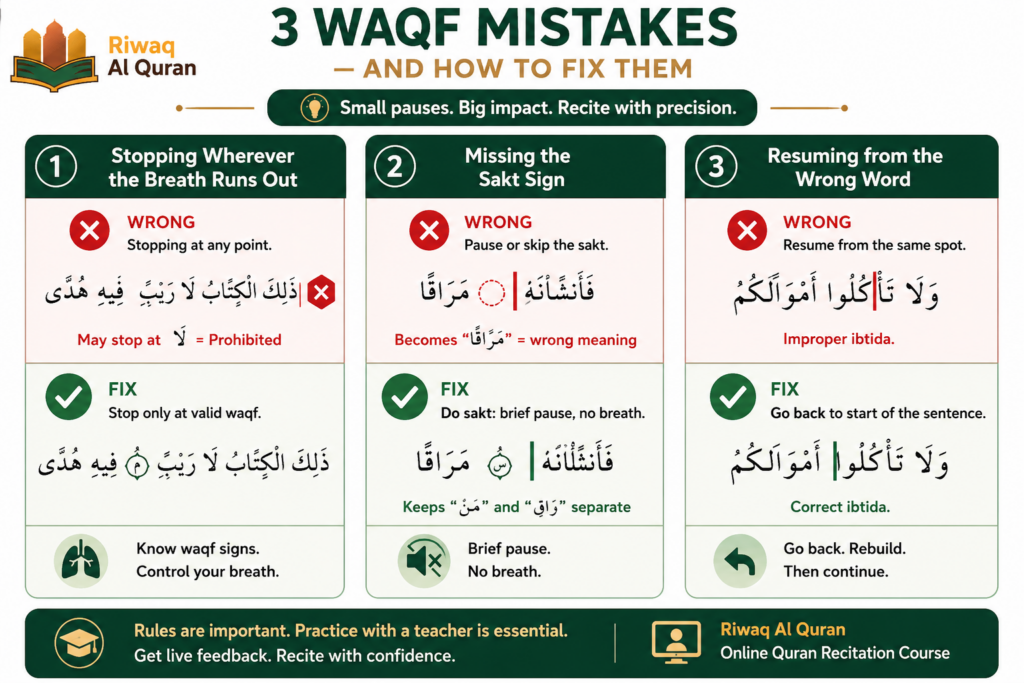
1. Stopping Wherever the Breath Runs Out
Treating Waqf as a breathing opportunity is the most common error. A student runs low on air and stops — regardless of whether the word carries مـ, لا, or no symbol at all. The result is often an accidental prohibited Waqf.
Ibn al-Jazari’s classical definition in Al-Nashr fi al-Qira’at al-‘Ashr — the foundational reference text of Tajweed scholarship — makes the correct relationship explicit:
“قَطْعُ الصَّوْتِ عَلَى الكَلِمَةِ زَمَناً يُتَنَفَّسُ فِيهِ عَادَةً بِنِيَّةِ اسْتِئْنَافِ القِرَاءَةِ”
“Cutting the voice on a word for the customary period in which breath is taken, with the intention of resuming recitation.”
Notice the structure: the Waqf position is determined first — then breath is taken within that stop. Breathing is a consequence of Waqf, never its cause. The stop governs where breath happens; breath does not govern where the stop happens.
The Prophet ﷺ modeled this directly. Umm Salamah (may Allah be pleased with her) described his recitation:
“كَانَ يَقْطَعُ قِرَاءَتَهُ آيَةً آيَةً”
“He would pause his recitation verse by verse.” (Narrated by Umm Salamah — Sunan Abi Dawud and Sunan Al-Tirmidhi)
His pauses were at ordained positions — not wherever air ran out.
The correction:
- Map the mandatory and prohibited Waqf positions in your assigned Surahs before you recite them.
- Build breath management around those specific points — not the other way around.
- If breath runs short before a valid Waqf, lengthen the intake at the previous permissible pause.
2. Missing the Sakt Sign Entirely
Students who have not been explicitly taught Sakt either treat it as a full Waqf (taking a breath) or skip it and blend adjacent words. As shown in Surah Al-Qiyamah (75:27), blending “مَنْ” and “رَاقٍ” produces “مَرَّاقٍ” — a completely different Arabic word with a theologically problematic meaning.
The stakes of protecting individual words are higher than many students realize. The Prophet (ﷺ) said:
“مَنْ قَرَأَ حَرْفًا مِنْ كِتَابِ اللَّهِ فَلَهُ بِهِ حَسَنَةٌ، وَالحَسَنَةُ بِعَشْرِ أَمْثَالِهَا، لاَ أَقُولُ الم حَرْفٌ، وَلَكِنْ أَلِفٌ حَرْفٌ وَلاَمٌ حَرْفٌ وَمِيمٌ حَرْفٌ”
“Whoever recites a letter from Allah’s Book will receive a good deed, and the good deed is multiplied by ten. I do not say that Alif Lam Mim is one letter — rather, Alif is a letter, Lam is a letter, and Mim is a letter.”
Sunan Al-Tirmidhi 2910 — graded Hasan Sahih
The Prophet counted reward by the letter. The Sakt at Surah Al-Qiyamah (75:27) exists precisely to keep “مَنْ” and “رَاقٍ” as two distinct words — two distinct identities, each carrying its own meaning and its own weight. Merging them through blended recitation does not just distort the meaning; it annihilates the individual identity of those words.
The correction:
- A qualified teacher should mark all four Sakt positions in the Hafs narration explicitly before a student recites the relevant Surahs.
- Practice Sakt as a conscious micro-pause: mouth closed, no air inhaled, then continue.
- Sakt is distinct from Waqf — the voice suspends briefly, then resumes without a breath.
3. Resuming from the Wrong Word After an Unplanned Stop
When a student stops mid-verse unexpectedly — due to coughing, distraction, or depleted breath — and resumes from exactly where they stopped, the result is often an impermissible Ibtida. Classical Tajweed instruction addresses this with a clear procedure.
The correction:
- After any unplanned stop, return to the beginning of the nearest complete sentence (جملة مفيدة).
- Even if that means repeating a few already-recited words, this “back-up and rebuild” approach is the correct procedure — not a shortcut.
- This is standard practice in structured recitation lessons and prevents the errors illustrated above in Surah Al-Ma’idah and Surah Al-Masad.
Applying these rulings correctly requires a trained ear hearing your recitation live — not just reading about the rules. Riwaq Al Quran’s Online Quran Recitation Course is built exactly for this: native Arab certified instructors review Waqf positions and correct mistakes in real time, one-on-one, fully online.
Start Learning Waqf and Ibtida with Riwaq Al Quran — Book Your Free Class
Waqf and Ibtida cannot be fully absorbed through reading alone. They require a qualified teacher who can hear where you pause, catch a missed Sakt, and correct an impermissible Ibtida before it becomes a habit.
Riwaq Al Quran is a comprehensive online platform offering personalized Quran, Arabic, and Islamic Studies classes for individuals of all ages and backgrounds. Experienced native Arab instructors use a structured curriculum covering Tajweed, Tafsir, and Memorization — with advanced online classes designed for seamless, real-time interaction between student and teacher.
This is what a live Riwaq Al Quran recitation session looks like — real students, real correction, in real time:
Choose your learning path:
- Starting from the foundations?
Begin with the Noorani Qaida Online program to master Quranic basics before tackling Waqf rules — or enroll your child in Online Quran Classes for Kids for age-appropriate, interactive learning.
- Ready to perfect your recitation?
The Online Quran Recitation Course covers live Waqf correction with expert instruction, while Online Tajweed Classes take you through the complete ruleset — from letter pronunciation to advanced stopping points.
- Going deeper into the Quran’s meaning and memorization?
Explore the Online Tafseer Course to understand what you recite, or join the Quran Memorization Online Course for structured Hifz with Tajweed integrated throughout. Advanced students can also explore the Online Qirat Course to study the ten narrations and how Waqf rulings differ across them.
We also offer full programs in Islamic Studies and Ijazah certification — all online, all with qualified instructors. View the complete Quran courses catalog to find the right fit.
Your first class is free. No commitment required.
Conclusion
Waqf and Ibtida in the Quran are not stylistic refinements — they are the mechanism by which meaning is protected during recitation. Allah commanded measured recitation (Quran 73:4), described the true believer as one who recites “with its true recital” (Quran 2:121), and His Prophet (ﷺ) attached the company of angels to the reciter who masters these rules (Bukhari 4937 / Muslim 798). A wrong stop can turn a verse about divine transcendence into an impermissible statement about Allah. A wrong resumption can leave a sacred phrase grammatically broken.
The seven Waqf types carry distinct rulings — from mandatory (مـ) to prohibited (لا) to the precisely defined Sakt (س). The three levels of permissible Ibtida — Complete, Sufficient, and Acceptable — give the reciter a clear framework for resuming after any pause. And the three dominant student mistakes — breath-driven stops, missed Sakt signs, and mid-phrase resumption — account for the majority of real errors in structured recitation.
The goal of learning Waqf and Ibtida is not to memorize symbols. It is to understand why each ruling exists — so that every pause and every resumption serves the meaning of the Quran, never distorts it. For a broader look at what the Quran teaches the believer, read: What Does The Quran Teach?
Frequently Asked Questions about Waqf and Ibtida
The questions below address the most common points of confusion students encounter — from basic definitions to the rulings that even experienced reciters misapply.
What is the difference between Waqf and Ibtida?
Waqf is the act of pausing at a specific point during Quranic recitation; Ibtida is the decision of where to begin again after that pause. Waqf positions are often prescribed in the Mushaf with symbols such as مـ, لا, and ج. Ibtida is always the reciter’s choice, governed by one rule: the resumed phrase must carry complete and accurate meaning.
What are the 7 types of Waqf in Tajweed?
The seven Waqf types are: Mandatory (مـ), Prohibited (لا), Permissible (ج), Better to Continue (صلى), Better to Stop (قلى), One of Two Paired Signs (ۛ), and Sakt (س). Each has a distinct symbol in the Mushaf and a specific ruling about whether stopping is required, forbidden, or optional.
What does the symbol لا mean in the Quran?
The symbol لا marks a Prohibited Waqf (Waqf Mamnu’). It means the reciter must not stop at this point because the verse’s meaning is incomplete, and pausing would produce an incorrect or misleading statement. The reciter must continue until the next valid stopping point.
What is Sakt in Tajweed and how is it different from Waqf?
Sakt (سَكْت) is a brief silence during which no breath is taken — unlike a full Waqf, where the reciter stops and breathes before continuing. In the Hafs narration, Sakt occurs at only four specific locations in the Quran. Its purpose is to prevent adjacent words from blending into a different Arabic word that would carry an incorrect meaning. It is marked with a small “س” above the relevant word.
Is Ibtida always the reciter’s choice?
Yes — Ibtida is always a decision, unlike Waqf which has mandatory and prohibited categories. The reciter chooses where to start again, subject to one constraint: the resumed phrase must carry complete and sound meaning. Beginning mid-phrase that produces an incorrect or ambiguous statement makes the Ibtida impermissible.
How many Waqf marks are in the Quran?
The count depends on which category is measured. Mandatory marks (مـ) are few; prohibited marks (لا) appear dozens of times. The Medina Mushaf marks several hundred Waqf signs across all categories. If counting every grammatically permissible stopping point — marked or not — the figure runs into the thousands. For students, the priority is knowing which positions are mandatory or prohibited, since those directly affect the verse’s meaning.
Why is Waqf considered half of Tarteel?
Ali Ibn Abi Talib (may Allah be pleased with him) defined Tarteel as two components: Tajweed of individual letters, and knowledge of the stopping points (Waqf). Since Waqf and Ibtida make up one of those two components entirely, they constitute half of Tarteel. This is also why Allah’s command in Quran 73:4 — وَرَتِّلِ ٱلْقُرْءَانَ تَرْتِيلًا — makes learning Waqf a religious obligation, not merely a recitation technique.