Every Muslim parent asks the same quiet question at some point: how do I raise a child who stays faithful, kind, and steady once they’re old enough to choose their own path? A dua for a righteous child is one of the most direct answers Islam gives to that question — a supplication that combines sincere prayer with the daily effort of good upbringing.
This guide collects the core Quranic duas for a righteous child, cites each verse’s original Arabic with full tashkeel, its exact Quranic reference, and a direct link to the verse on Quran.com so you can verify it yourself. It also covers the two authentic hadiths most relevant to raising children, sourced and linked to Sunnah.com, and is honest about the one popular supplication that is neither Quranic nor traceable to an authentic hadith chain.
What you’ll learn in this article
- The full text, transliteration, meaning, and verified source link for seven Quranic duas for a righteous child.
- Two authentic hadiths on children — one on protection, one on why a righteous child benefits a parent after death — each linked to its primary source.
- Why one commonly shared “dua for children” is not actually from the Quran or an authenticated hadith, and how to treat it accordingly.
- A simple daily routine for reciting these duas with your children.
- Common mistakes parents make when teaching dua, and how to avoid them.
- A full breakdown of Riwaq Al Quran’s course categories and a sample of its specific Quran courses.
Table of Contents
What Is The Dua For A Righteous Child?
A dua for a righteous child is a supplication addressed to Allah asking for guidance, protection, and good character for one’s children. The strongest versions of it are not improvised — they are the exact words the Quran records prophets using for their own children, plus a small number of authentic hadiths where the Prophet Muhammad ﷺ prayed over his own grandchildren.
That distinction matters more than most articles on this topic explain. A Quranic ayah, an authentic hadith, and a popular but unsourced supplication do not carry the same weight, and a parent teaching these words to a child should know which is which.
1. Why These Specific Words Matter
Reciting a prophet’s own dua carries a particular weight in Islamic practice: it means asking Allah in language He Himself recorded and preserved in the Quran, or in words the Prophet ﷺ used and that were preserved through a verified chain of narration (isnad).
That’s the reason scholars encourage memorizing the sourced versions below rather than only reading translations or reciting whatever wording circulates on social media.
2. When To Recite These Duas
There’s no single mandated time. Most families recite them during the five daily prayers, after finishing a portion of Quran recitation, or during a private moment of dua such as before sleep or during travel.
Consistency matters more than timing — a dua said daily in thirty seconds outweighs one said once a year at length.
7 Quranic Duas For A Righteous Child
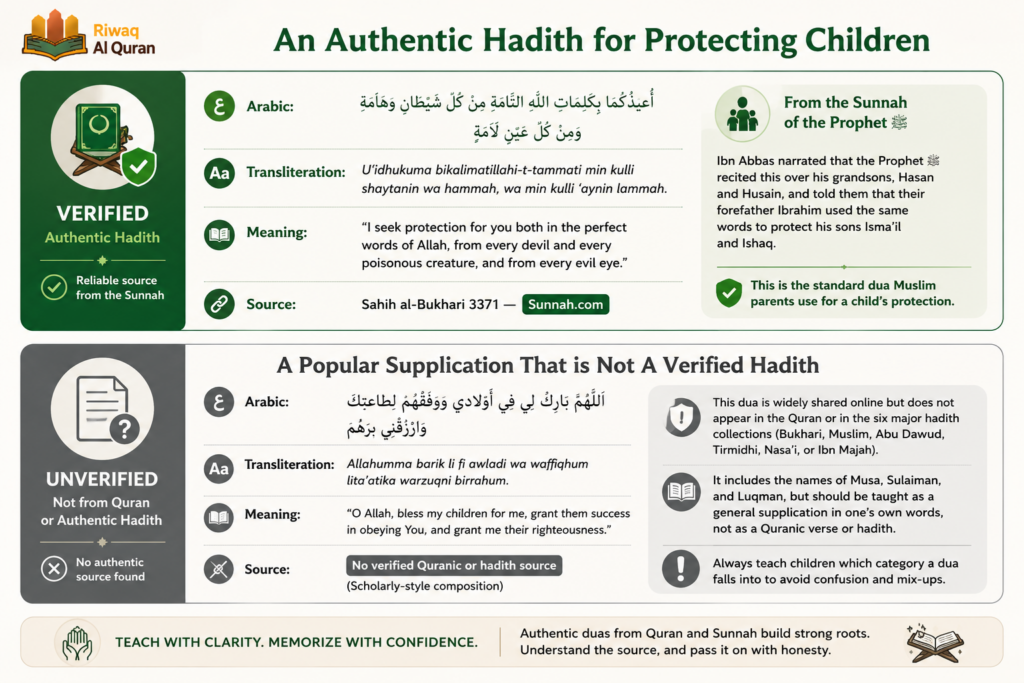
TheThe seven duas below are all direct ayahs from the Quran, each said by a specific prophet at a specific moment in his story — that context is part of why the wording is what it is, not incidental detail. Before going through each one in full, the table below gives you a fast reference: who said it, where it appears, and what it’s actually asking for, with each reference linked straight to the verse on Quran.com so you can read it in its surrounding context.
| # | Dua | Who Recited It | Surah & Ayah | What It Asks For |
|---|---|---|---|---|
| 1 | Dua for Righteous Offspring | Prophet Ibrahim (peace be upon him) | As-Saffat 37:100 | A child from among the righteous |
| 2 | Dua for Gratitude and Righteous Children | A believer reflecting at forty years of age | Al-Ahqaf 46:15 | Gratitude for one’s parents, paired with righteous offspring |
| 3 | Dua of Ibrahim and Ismail for Righteous Descendants | Prophets Ibrahim and Ismail (peace be upon them) | Al-Baqarah 2:128 | A submitting, righteous nation among one’s descendants |
| 4 | Dua of Zakariya for Righteous Offspring | Prophet Zakariya (peace be upon him) | Aal-i-Imran 3:38 | A good, pure offspring after years of asking |
| 5 | Dua for Steadfastness in Prayer | Prophet Ibrahim (peace be upon him) | Ibrahim 14:40 | Descendants who keep up the five daily prayers |
| 6 | Dua to Protect Children From Bad Habits | Prophet Ibrahim (peace be upon him) | Ibrahim 14:35 | Protection from idolatry and harmful attachments |
| 7 | Dua for Family Comfort and Righteousness | The “servants of the Most Merciful” (Al-Furqan 25:63-74) | Al-Furqan 25:74 | A righteous spouse, righteous offspring, and comfort in them |
Use the table to decide which dua fits your situation right now — whether you’re asking for a child, raising one, or hoping to see them keep up their prayers as adults — then read the full entry below for the context that makes each one worth memorizing rather than just reciting.
1. Dua for Righteous Offspring
Before Ibrahim (peace be upon him) was given the news of a forbearing son, the Quran records him asking Allah for exactly one thing, in the fewest possible words. It appears in Surah As-Saffat at the turning point of his story, right before the announcement of Isma’il’s birth — which is part of why this dua is so closely associated with asking for a child in the first place, not only with raising one who’s already born.
“رَبِّ هَبْ لِي مِنَ الصَّالِحِينَ”
“Rabbi hab li minas-salihin.””My Lord, grant me [a child] from among the righteous.”(Surah As-Saffat 37:100)
Its brevity is exactly why it’s usually the first dua taught to a child: five words, one request, no clauses to memorize out of order — a natural starting point before moving on to the longer duas on this list.
2. Dua for Gratitude and Righteous Children
This dua doesn’t appear in isolation — the verse immediately before it in Surah Al-Ahqaf describes a person reaching the age of forty and reflecting on the years his parents spent raising him.
The dua that follows is his response to that reflection, which is why it opens with gratitude rather than a request, and only asks for righteous offspring afterward.
“رَبِّ أَوْزِعْنِي أَنْ أَشْكُرَ نِعْمَتَكَ الَّتِي أَنْعَمْتَ عَلَيَّ وَعَلَىٰ وَالِدَيَّ وَأَنْ أَعْمَلَ صَالِحًا تَرْضَاهُ وَأَصْلِحْ لِي فِي ذُرِّيَّتِي ۖ إِنِّي تُبْتُ إِلَيْكَ وَإِنِّي مِنَ الْمُسْلِمِينَ”
“Rabbi awzi’ni an ashkura ni’mataka-llati an’amta ‘alayya wa ‘ala walidayya wa an a’mala salihan tardahu wa aslih li fi dhurriyyati, inni tubtu ilayka wa inni minal-muslimin.” “My Lord, enable me to be grateful for Your favor which You bestowed upon me and upon my parents, and to work righteousness of which You approve, and make righteous for me my offspring. Indeed I have repented to You, and I am of the Muslims.”(Surah Al-Ahqaf 46:15)
That ordering is worth teaching alongside the words themselves: the Quran links being a grateful child yourself to raising a righteous one, treating the two as the same habit applied at different points in life rather than as unrelated goals.
3. Dua of Ibrahim and Ismail for Righteous Descendants
This is the only dua on this list spoken by a father and son together, in the middle of physical labor. Ibrahim and Ismail (peace be upon them) said it while raising the foundations of the Kaaba, asking not just for their own righteousness but for an entire future nation descended from them to remain submitted to Allah.
“رَبَّنَا وَاجْعَلْنَا مُسْلِمَيْنِ لَكَ وَمِنْ ذُرِّيَّتِنَا أُمَّةً مُسْلِمَةً لَكَ وَأَرِنَا مَنَاسِكَنَا وَتُبْ عَلَيْنَا ۖ إِنَّكَ أَنْتَ التَّوَّابُ الرَّحِيمُ”
“Rabbana waj’alna muslimayni laka wa min dhurriyyatina ummatan muslimatan laka wa arina manasikana wa tub ‘alayna, innaka anta-t-tawwabu-r-rahim.””Our Lord, make us both submit to You, and from our descendants a nation submitting to You. Show us our rites and turn to us in mercy. Indeed, You are the Accepting of Repentance, the Merciful.”(Surah Al-Baqarah 2:128)
Because it was recited by a parent and child reciting the same words at the same time, many families use this one specifically as a dua to say together rather than one parent teaching it to a child afterward.
4. Dua of Zakariya for Righteous Offspring
Zakariya (peace be upon him) said this dua as an old man, after asking Allah for a child for years without one — the Quran presents his story specifically as an example of a dua answered only after long patience, not a quick request granted right away.
“رَبِّ هَبْ لِي مِنْ لَدُنْكَ ذُرِّيَّةً طَيِّبَةً ۖ إِنَّكَ سَمِيعُ الدُّعَاءِ”
“Rabbi hab li min ladunka dhurriyyatan tayyibatan innaka sami’u-d-du’a.””My Lord, grant me from Yourself a good offspring. Indeed, You are the Hearer of supplication.”( Surah Aal-i-Imran 3:38 )
That backstory is why this specific dua is usually recommended to parents who have been asking for a child for a long time, rather than to parents already raising one and looking for a character-focused dua instead.
5. Dua for Steadfastness in Prayer
Ibrahim (peace be upon him) recited this as part of a longer supplication after settling his family near the Kaaba, and it targets one outcome specifically: descendants who keep up the five daily prayers as adults, not just as children following a household routine.
“رَبِّ اجْعَلْنِي مُقِيمَ الصَّلَاةِ وَمِنْ ذُرِّيَّتِي”
“Rabbi-j’alni muqima-s-salati wa min dhurriyyati.””My Lord, make me an establisher of prayer, and [many] from my descendants.”(Surah Ibrahim 14:40)
The ayah continues with “Our Lord, and accept my supplication” — Ibrahim asks for himself first and his descendants second, which is worth pairing with the practical habit of a parent praying visibly and on time, since the dua and the daily example reinforce each other rather than replacing one another.
6. Dua to Protect Children From Bad Habits
This line comes from the middle of Ibrahim’s (peace be upon him) longer dua asking Allah to make Makkah a secure city — protection for the city and protection for his children from idolatry are asked for in the same breath, not as separate concerns.
“وَاجْنُبْنِي وَبَنِيَّ أَنْ نَعْبُدَ الْأَصْنَامَ”
“Wajnubni wa baniyya an na’buda-l-asnam.””And keep me and my children away from worshipping idols.”( Surah Ibrahim 14:35)
Classical commentary already reads “idols” broadly, as anything that competes with sincere worship of Allah — which is why modern use of this dua for protection from harmful habits and unhealthy influences is an extension of the verse’s own scope, not a reinterpretation of it.
7. Dua for Family Comfort and Righteousness
This dua closes a passage in Surah Al-Furqan that lists the qualities of “the servants of the Most Merciful” — meaning it isn’t presented as a stand-alone parenting dua, but as one trait among several (patience, humility, avoiding excess) that the Quran uses to define a righteous believer.
“رَبَّنَا هَبْ لَنَا مِنْ أَزْوَاجِنَا وَذُرِّيَّاتِنَا قُرَّةَ أَعْيُنٍ وَاجْعَلْنَا لِلْمُتَّقِينَ إِمَامًا”
“Rabbana hab lana min azwajina wa dhurriyyatina qurrata a’yunin waj’alna lil-muttaqina imama.””Our Lord, grant us from our spouses and offspring comfort to our eyes, and make us leaders for the righteous.”(Surah Al-Furqan 25:74)
It closes with a request most parents don’t think to make — not just a good family, but to become the kind of household other righteous families look to as an example, which is why some scholars read it as the most ambitious dua on this list rather than the simplest.
This is a good point to note something Riwaq Al Quran’s teachers see often in live classes — children pick up a dua’s meaning far faster when they can hear it recited correctly and repeat it back, rather than only reading a transliteration off a page.
An authentic Hadith For Protecting Children
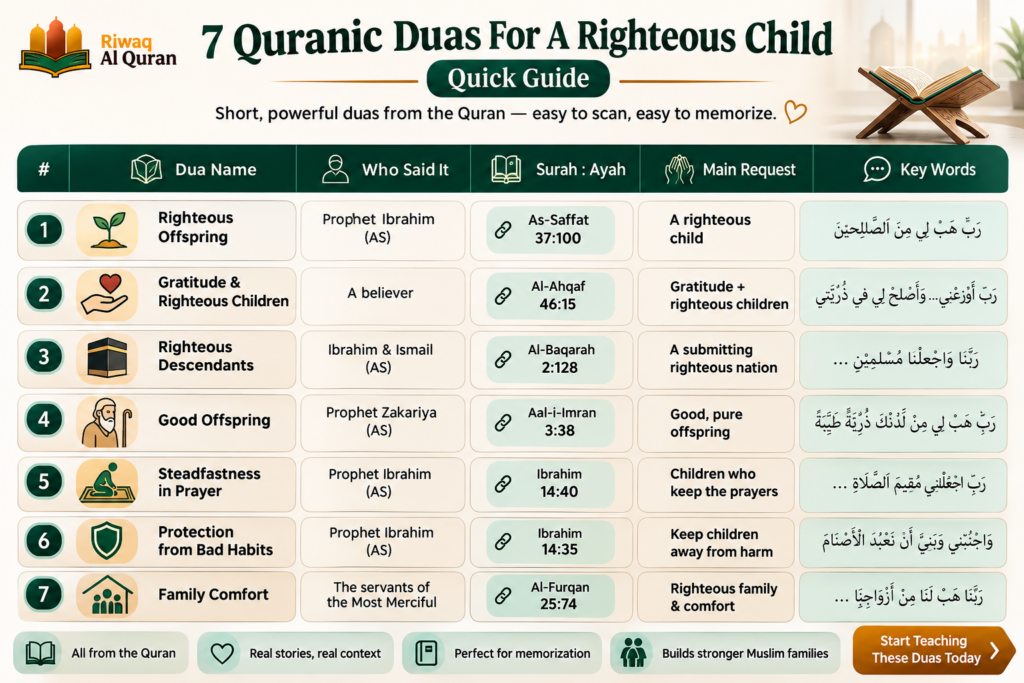
Unlike the seven duas above, this one is not from the Quran — it comes from an authentic hadith.
“أُعِيذُكُمَا بِكَلِمَاتِ اللَّهِ التَّامَّةِ مِنْ كُلِّ شَيْطَانٍ وَهَامَّةٍ وَمِنْ كُلِّ عَيْنٍ لَامَّةٍ”
“U’idhukuma bikalimatillahi-t-tammati min kulli shaytanin wa hammah, wa min kulli ‘aynin lammah.” “I seek protection for you both in the perfect words of Allah, from every devil and every poisonous creature, and from every evil eye.” Sahih al-Bukhari 3371 — Sunnah.com
Ibn Abbas narrated that the Prophet Muhammad ﷺ recited this over his own grandsons, Hasan and Husain, and told them that their forefather Ibrahim used the very same words to protect his sons Isma’il and Ishaq.
That detail — that this exact supplication was already a family practice going back to Ibrahim — is part of why it’s the standard dua Muslim parents use specifically for a child’s protection, distinct from the Quranic duas above focused on character and guidance.
A popular Supplication That is Not A Verified Hadith
The following dua circulates widely among Muslim parents online, but it does not appear in the Quran and is not traceable to an authentic hadith chain in the recognized collections (Bukhari, Muslim, Abu Dawud, Tirmidhi, Nasa’i, or Ibn Majah).
“للَّهُمَّ بَارِكْ لِي فِي أَوْلَادِي وَوَفِّقْهُمْ لِطَاعَتِكَ وَارْزُقْنِي بِرَّهُمْ”
“O Allah, bless my children for me, grant them success in obeying You, and grant me their righteousness.”(Source: no verified Quranic or hadith source — this is a scholarly-style composition, not a citation)
There is no authentic source to link here, and that absence is itself the point. The wording weaves in the names of Musa, Sulaiman, and Luqman, but it should be taught to children as a general supplication in one’s own words, not recited as if it were a Quranic verse or a hadith of the Prophet ﷺ.
Conflating the two is a common and avoidable mistake, and it’s worth telling a child directly which category a dua falls into as they memorize it.
Why Raising A Righteous Child Matters in Islam
Islam gives a child’s righteousness weight for two distinct reasons: what it does for the parent after death, and what it requires from the parent while raising the child.
1. The hadith on a child’s ongoing reward for parents
“إِذَا مَاتَ الإِنْسَانُ انْقَطَعَ عَنْهُ عَمَلُهُ إِلاَّ مِنْ ثَلاَثَةٍ إِلاَّ مِنْ صَدَقَةٍ جَارِيَةٍ أَوْ عِلْمٍ يُنْتَفَعُ بِهِ أَوْ وَلَدٍ صَالِحٍ يَدْعُو لَهُ”
“Idha mata al-insanu inqata’a ‘anhu ‘amaluhu illa min thalathatin: illa min sadaqatin jariyatin, aw ‘ilmin yuntafa’u bihi, aw waladin salihin yad’u lahu.(Sahih Muslim 1631)
Abu Hurairah reported that the Prophet Muhammad ﷺ said that when a person dies, their deeds come to an end except for three:
- Ongoing charity (sadaqah jariyah)
- Knowledge that others continue to benefit from
- A righteous child who prays for them
- That third category is the only one of the three that keeps generating reward without the parent doing anything further after death — the charity and the knowledge both depend on something the parent already set up during their lifetime, while the child’s prayer continues independently, for as long as the child themselves keeps practicing. That’s why Islamic scholarship treats a child’s upbringing as a long-term investment, not only a present-day parenting task.
2. What righteousness means beyond dua
Dua is the request; the child’s actual environment is the mechanism. A child who hears these duas but never sees the following modeled at home is far less likely to absorb them:
- Prayer
- Honesty
- Patience
A child who sees the dua matched by daily practice in these three areas absorbs it far more reliably. This is the basis of the Islamic concept of tarbiyah, or intentional upbringing, which pairs supplication with consistent example-setting.
How To Put These Duas into Practice
Reciting the right words matters less than building a habit around them — here’s how to do that without it quietly disappearing after a few weeks.
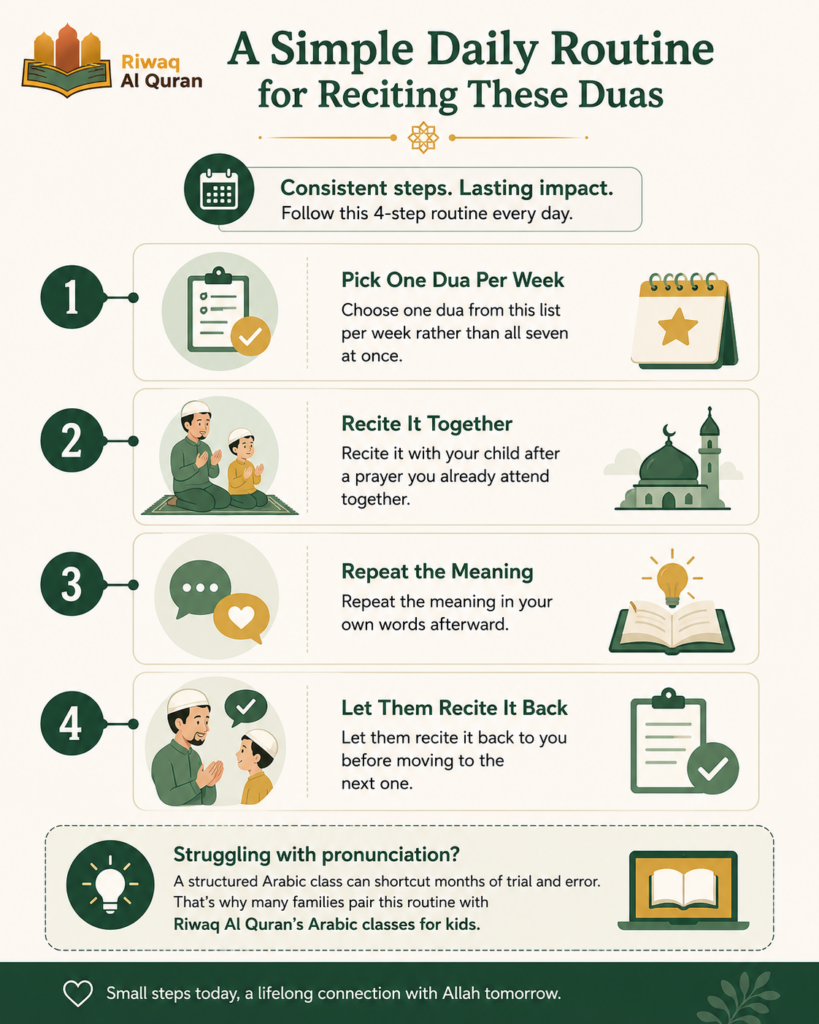
1. A simple daily routine for reciting these duas
- Pick one dua from this list per week rather than all seven at once.
- Recite it with your child after a prayer you already attend together.
- Repeat the meaning in your own words afterward.
- Let them recite it back to you before moving to the next one.
If pronunciation is the sticking point, a structured Arabic class can shortcut months of trial and error — which is one reason families pair this routine with lessons like Riwaq Al Quran’s Arabic classes for kids.
2. Common mistakes parents make when teaching dua
- Reciting only in Arabic without ever explaining the meaning, which turns the dua into memorized sound rather than understood prayer.
- Only bringing these duas out during a crisis — an exam, an illness, a fight between siblings — instead of during ordinary weeks, which teaches a child that dua is an emergency tool rather than a daily habit.
- Treating every popular “dua for children” text as equally authoritative, without checking whether it’s actually Quranic, an authentic hadith, or an unsourced composition, as the section above shows.
This is exactly the gap Riwaq Al Quran’s Islamic Studies classes for kids are built to close — children work through the meaning and the sourcing of Quranic duas and hadith, not just their pronunciation, alongside a tutor who can answer the “why” and “is this authentic” questions a parent doesn’t always have time to research.
How Riwaq Al Quran supports your child’s Islamic learning
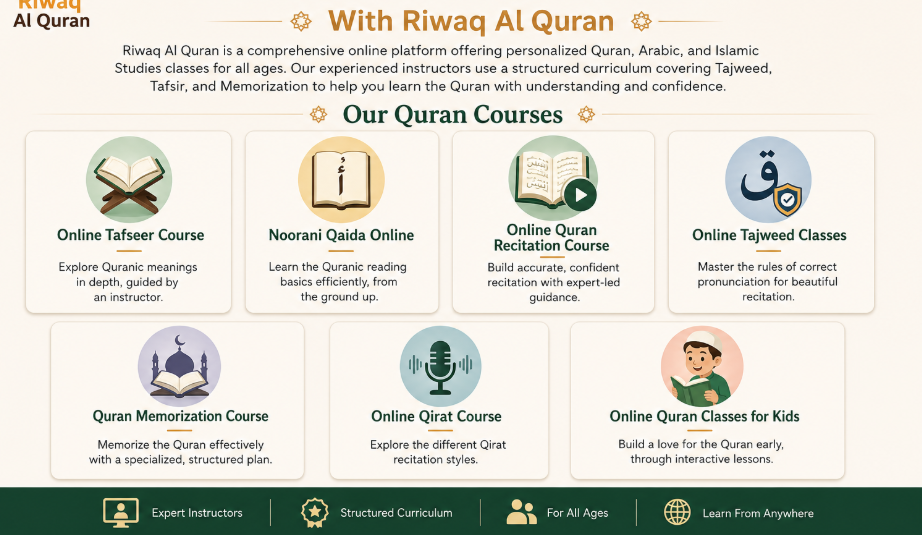
Riwaq Al Quran is a comprehensive online platform offering personalized Quran, Arabic, and Islamic Studies classes for all ages, with a structured curriculum and experienced instructors delivering seamless, interactive live sessions. Everything below connects directly to the duas and hadith covered in this guide.
1. Quran classes for kids
Structured Tajweed and memorization sessions, so a child doesn’t just recite dua correctly but learns to read the surahs these duas come from in their original context.
2. Islamic Studies for kids
Covers the Quran, Hadith, Seerah, and Islamic history — including the stories behind Ibrahim’s, Zakariya’s, and Musa’s duas referenced above, so children understand who first said these words, why, and how scholars verify a hadith’s authenticity.
Here’s what that looks like in practice — Ayaan Khan, a Riwaq Al Quran student, placing 3rd in our Islamic Studies competition:
3. Arabic classes for kids
Builds the reading and listening skills that make memorizing dua with correct tashkeel and pronunciation possible, rather than relying on transliteration alone.
[image: child reciting Quran during an online Riwaq Al Quran class]
4. Course categories at Riwaq Al Quran
Beyond the three core skills above, Riwaq organizes its full catalog into five broad categories:
- Online courses for kids
- Online Quran classes for kids and adults
- Online Arabic courses
- Online Ijazah courses
- Online Islamic Studies courses
5. A sample of Riwaq’s Quran courses
Within the Quran-focused categories above, here is a sample of the specific courses currently offered:
| Course | What it covers |
|---|---|
| Online Tafseer Course | Explores Quranic meanings and interpretation in depth. |
| Noorani Qaida Online | Teaches the Quranic reading basics — letters and sounds — efficiently, for beginners. |
| Online Quran Recitation Course | Builds accurate, expert-led recitation skills. |
| Online Tajweed Classes | Covers the rules of Tajweed for correct, beautiful recitation. |
| Quran Memorization Online Course | A specialized, structured program for effective Hifz. |
| Online Qirat Course | Introduces the different recognized Qirat (recitation) styles. |
| Online Quran Classes for Kids | Interactive sessions designed to build a love for the Quran in children specifically. |
Course names above are bolded as placeholders — link each one to its live course page once you have the confirmed URLs; I don’t have access to the actual Riwaq course-page links and couldn’t verify them independently, so I’ve left them unlinked rather than guess.
Book your child’s free trial class today
If you want your child learning these duas with proper Tajweed and real understanding of their meaning and sourcing, a live class with a tutor gets there faster than a page or an app. Riwaq Al Quran offers a free trial session so you can see the teaching style before committing to anything.
Here’s a short look at what that live teaching style actually feels like for a child:
Conclusion
A dua for a righteous child is only as strong as its source, and that’s the thread running through everything above. The seven duas in this guide are the Quran’s own words — spoken by Ibrahim, Zakariya, and Ismail at specific, verifiable moments in their stories, each one linked back to Quran.com so you can read it in context rather than take it on faith. The protection dua sits in a different category entirely: it’s not Quranic, but it is an authentic hadith, traced through Ibn Abbas and confirmed on Sunnah.com. And the “bless my children” dua that circulates most widely online belongs to a third category altogether — sincere, but unsourced, and worth teaching to a child as exactly that.
That three-way distinction is the actual takeaway, more than any single dua on this list. Reciting the right words matters, but reciting them without knowing whether they’re Quran, hadith, or tradition teaches a child to treat all religious text as interchangeable — which is a habit worth breaking early, not passing down.
Words alone don’t raise a righteous child, though. The Quran pairs every one of these duas with a life lived alongside them — Ibrahim didn’t just ask for a righteous son, he modeled worship in front of him first. That’s the practical order worth keeping: pick one dua for a righteous child from this list, learn where it comes from, recite it consistently, and let your own example carry the rest of the work the dua is asking Allah to do.
Frequently asked questions
The five questions below cover what parents most often ask about reciting dua for a righteous child, sourced the same way as the rest of this guide.
What is the dua for a righteous child?
The primary dua is “Rabbi hab li minas-salihin” (“My Lord, grant me [a child] from among the righteous”), from Surah As-Saffat 37:100 — it’s Ibrahim’s own request in the Quran and the most commonly memorized version among the duas in this article.
Can I recite these duas in English instead of Arabic?
You can understand and reflect on the meaning in English, but the recitation itself should be in the original Arabic, since these are the exact words the Quran records — an English paraphrase carries the meaning but not the same status as the preserved Arabic text.
How often should I recite dua for my child’s righteousness?
There’s no fixed number, but reciting a short dua daily, ideally after a prayer you already perform, builds a more lasting habit than reciting a longer set only occasionally.
What is the hadith about children praying for their parents?
The Prophet Muhammad ﷺ said a person’s deeds stop after death except for three things, one of which is a righteous child who prays for them — recorded in Sahih Muslim 1631.
Are there specific duas for protecting my child from harm?
Yes — the dua “U’idhukuma bikalimatillahi-t-tammati…” is what the Prophet ﷺ recited over his own grandsons for protection, recorded in Sahih al-Bukhari 3371, and is distinct from the Quranic duas focused on character or righteousness.
Is the “O Allah, bless my children” dua (mentioning Musa, Sulaiman, and Luqman) authentic?
No — it is not found in the Quran and has no verified chain in the recognized hadith collections. It can still be recited as a general, sincere supplication in one’s own words, but it should not be taught to a child as a Quranic verse or an authentic hadith.