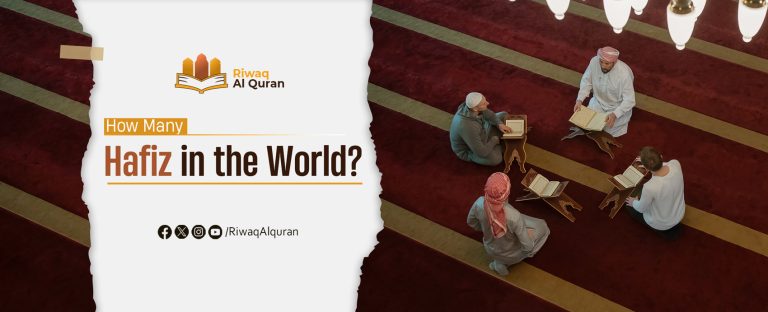
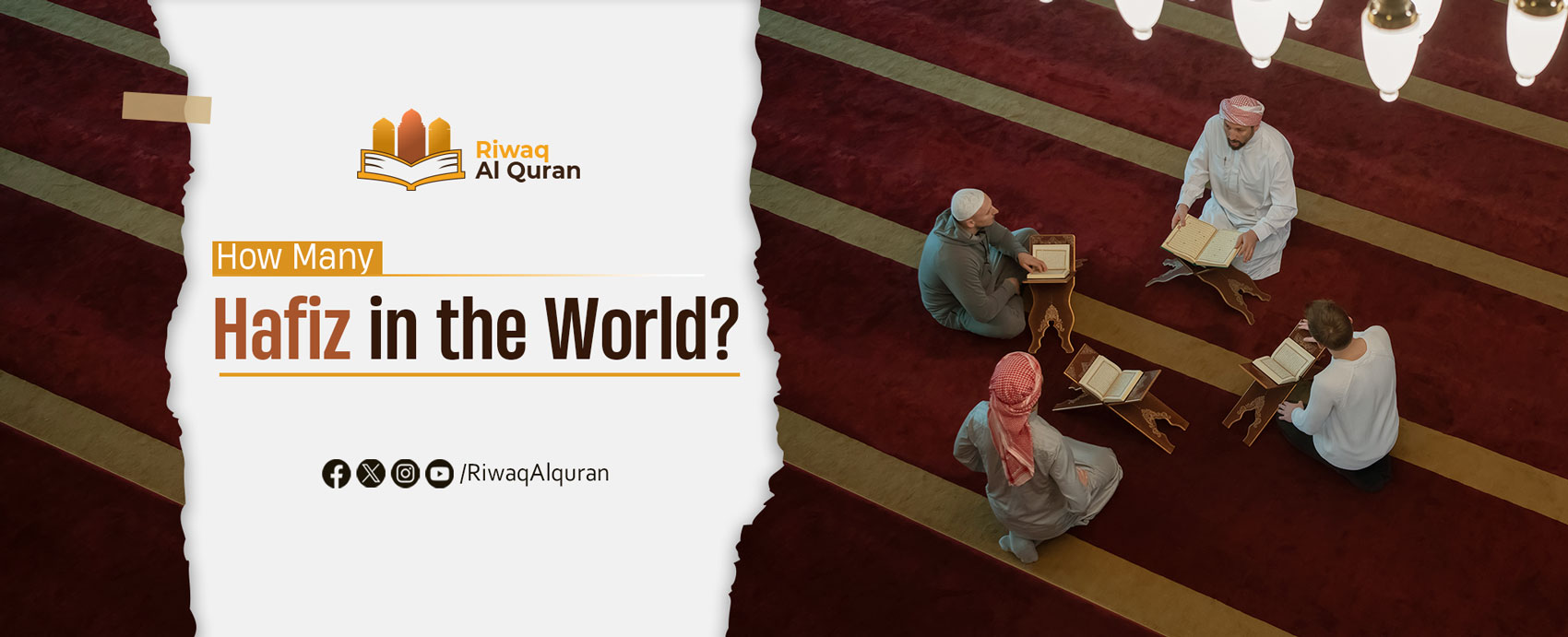
Every year, tens of thousands of people — children and adults alike — commit one of the most ambitious acts of human memory: they memorize every word of the Quran. All 114 Surahs. All 6,236 verses. All 77,430 words. Word for word, with precise pronunciation, in a language many of them did not grow up speaking.
The Quran is the only book of its length and complexity memorized by millions across every continent, every generation, and every walk of life. This did not happen by accident, and it did not slow down with the invention of printing or the internet. If anything, the global community of Huffaz is growing.
But how many Hafiz are in the world today? Why do estimates range from 10 million to 200 million? Which countries produce the most, and what does Islam say about why this tradition exists and what it means? This guide answers all of it — with the Quran, the Sunnah, and verifiable data.
What You’ll Learn in This Article
- The honest range of global Hafiz estimates and why the gap is so large.
- What the Quran and authentic Hadith say about memorizers and their spiritual status.
- A country-by-country breakdown of where Huffaz are concentrated.
- What a Hafiz is, how Ijazah certification works, and why it matters.
- The spiritual rewards tied to Hifz — for the memorizer and their parents.
- What separates lifetime retention from forgetting within two years.
- Whether adults can realistically complete Hifz and how long it takes.
Table of Contents
How Many Hafiz Are in the World?
The global Hafiz count is one of the most cited — and least verified — statistics in discussions about Islam. Understanding why the numbers diverge so dramatically is as important as knowing the numbers themselves.
1. Why Estimates Range from 10 Million to 200 Million
The lower estimates — typically 7 to 15 million — represent individuals who have completed memorization of all 30 Juz and received a formal Ijazah. These figures come from scholars and researchers applying a strict, certification-based definition.
Pakistan’s Wafaq-ul-Madaris Al-Arabia alone accounts for over one million verified graduates, making the global certified total of 10 to 15 million a credible and defensible lower bound.
The higher estimates — sometimes reaching 200 million — are broader in definition and include:
- Partial memorizers who have completed several Juz but not all 30.
- Informal learners who completed Hifz through family settings without institutional certification.
- Communities where the term “Hafiz” applies to anyone memorizing several Juz, not necessarily the full Quran.
- Female Huffaz whose memorization went unrecorded in official institutional data.
The most honest answer: verified, certified complete Huffaz number approximately 10 to 15 million globally, with partial and informal memorizers adding many millions more. The 200 million figure circulates online without traceable institutional sourcing, and stating it without this context undermines the credibility of any publication that uses it.
2. What Makes the Quran Uniquely Memorizable
No other book of comparable length — religious or otherwise — is memorized in full by millions across different languages and cultures. Linguists and cognitive scientists who have studied Quranic structure consistently note features that support phonological retention:
- Rhythmic verse endings that create auditory anchors.
- Internal rhyme schemes that connect consecutive ayat.
- Sound-meaning links that reinforce recall through association.
- Repetition of key phrases at structurally significant intervals throughout the text.
This memorability is not incidental. Allah ﷻ attests to it directly and emphatically:
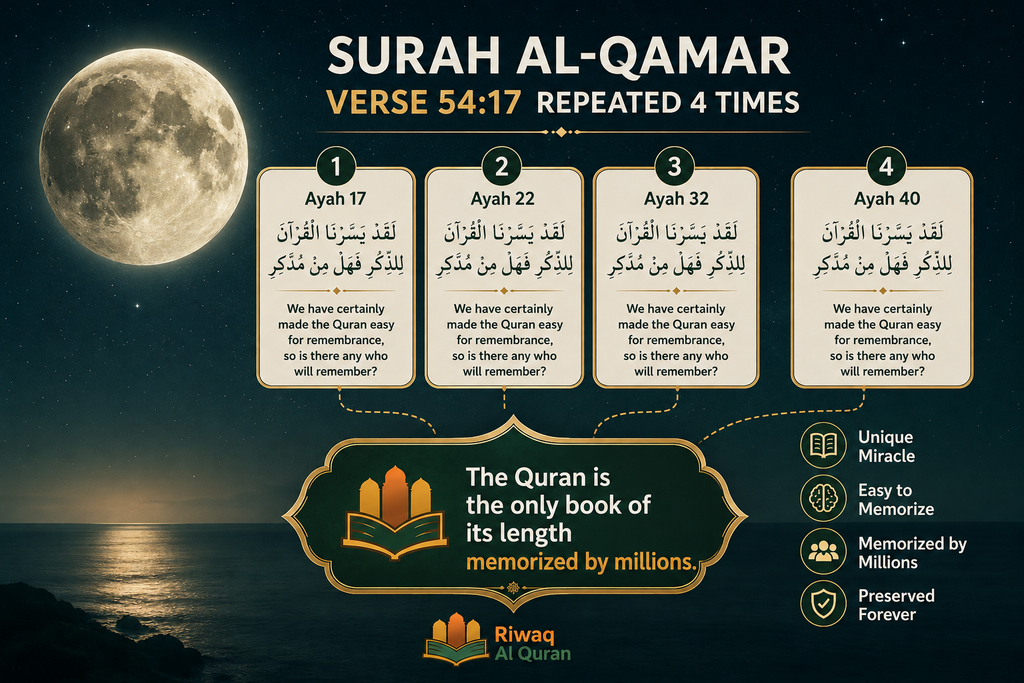
﴿وَلَقَدْ يَسَّرْنَا الْقُرْآنَ لِلذِّكْرِ فَهَلْ مِن مُّدَّكِرٍ﴾
“And We have certainly made the Qur’an easy for remembrance, so is there any who will remember?”— (Surah Al-Qamar, 54:17)
This verse is not a one-time statement. It appears four times in Surah Al-Qamar — at verses 17, 22, 32, and 40. The repetition itself functions as a Quranic demonstration of the principle: the structure that makes something easy to remember is consistent repetition. The divine invitation to memorize comes with the divine architecture to support it.
What the Quran and Sunnah Say About Huffaz
Before counting Hafiz, it is worth understanding why the tradition has sustained itself for 1,400 years. The answer lies not in cultural habit alone, but in explicit divine instruction and direct prophetic confirmation that memorization is among the most honored acts in Islam.
1. Quranic Verses on Preservation and Remembrance
The preservation of the Quran is a divine commitment, not a human achievement. Huffaz are the living human dimension of that commitment:
﴿إِنَّا نَحْنُ نَزَّلْنَا الذِّكْرَ وَإِنَّا لَهُ لَحَافِظُونَ﴾
“Indeed, it is We who sent down the Reminder, and indeed, We will be its guardian.”— (Surah Al-Hijr, 15:9)
This verse carries a layer most readers pass over quickly: the word لَحَافِظُونَ shares the exact root as الحَافِظ — the Hafiz. Allah ﷻ used the word for “guardian and preserver” to describe His own action toward the Quran.
Human Huffaz carry this title as people who participate — through discipline and devotion — in a preservation that is ultimately divine in origin and guarantee.
The Quran also identifies a specific category of people in whom its signs are particularly embedded:
﴿بَلْ هُوَ آيَاتٌ بَيِّنَاتٌ فِي صُدُورِ الَّذِينَ أُوتُوا الْعِلْمَ﴾
“Rather, it is distinct signs [preserved] within the breasts of those who have been given knowledge.”— (Surah Al-Ankabut, 29:49)
This verse was revealed in Makkah, before the Quran was widely written. The “breasts” here refer to human memory — the primary vessel of Quranic preservation at the time of revelation, and still the most indestructible one. A library can be burned. A chest cannot.
On the obligation of reciting with precision and measured care:
﴿وَرَتِّلِ الْقُرْآنَ تَرْتِيلًا﴾
“And recite the Qur’an with measured, careful recitation.”— (Surah Al-Muzzammil, 73:4)
This is a direct command to the Prophet ﷺ — and by extension to every Muslim who recites. Tarteel (تَرْتِيل) means deliberate, accurate, unhurried recitation.
Every Quran memorization program that prioritizes Tajweed over speed is following this instruction directly — not as a pedagogical preference, but as a Quranic command.
2. Authentic Hadiths on the Status of Quran Memorizers
The Prophet Muhammad ﷺ spoke about Quran memorizers with consistency that makes their elevated status unambiguous in Islamic scholarship. The following are all established, authenticated narrations.
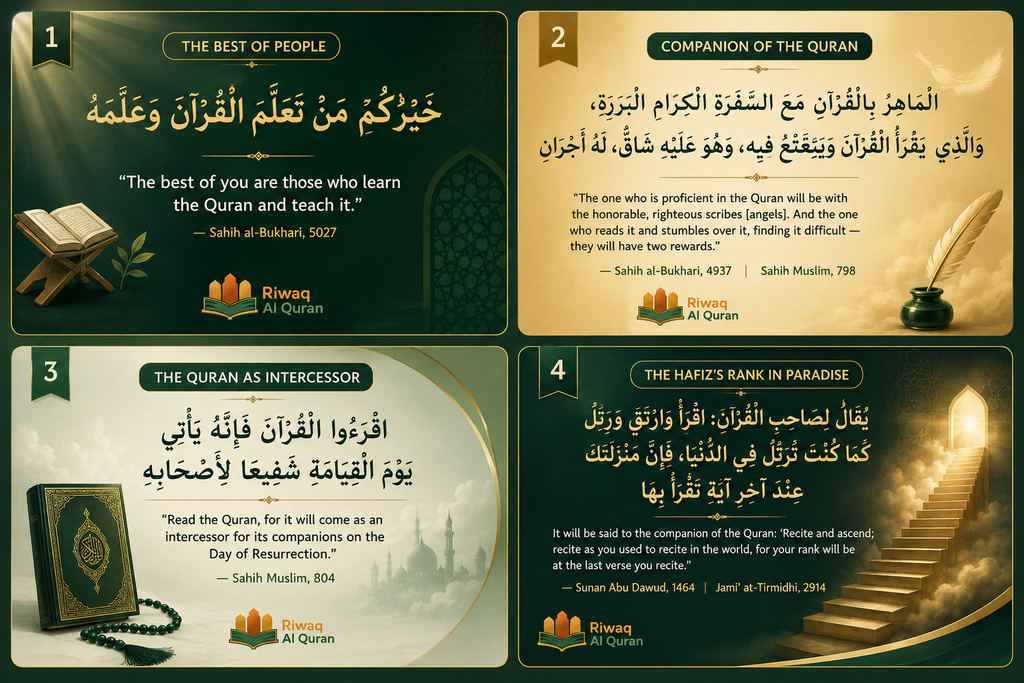
a. The Best of People
Among the most cited narrations in the entire hadith literature on this subject is one that sets the ceiling for human excellence in a single, unambiguous line. The Prophet ﷺ defined the apex of virtue not by lineage, wealth, or position, but by one’s relationship with the Quran:
«خَيْرُكُمْ مَنْ تَعَلَّمَ الْقُرْآنَ وَعَلَّمَهُ»
“The best of you are those who learn the Quran and teach it.”— Sahih al-Bukhari, 5027
“The best of you” (خَيْرُكُمْ) is a comparative superlative. It does not say Quran learners are “good people.” It says they occupy the highest position among believers in terms of benefit to themselves and others.
A Hafiz who memorizes and goes on to teach — as Riwaq Al Quran’s certified instructors do — combines both dimensions of this narration into one life and career.
b. The Companion of the Quran Among the Angels
The Prophet ﷺ did not leave the question of the memorizer’s spiritual station to inference. In a narration recorded in both Bukhari and Muslim — the two most authoritative hadith collections in Sunni Islam — he placed the proficient reciter in specific, named company:
«الْمَاهِرُ بِالْقُرْآنِ مَعَ السَّفَرَةِ الْكِرَامِ الْبَرَرَةِ، وَالَّذِي يَقْرَأُ الْقُرْآنَ وَيَتَتَعْتَعُ فِيهِ، وَهُوَ عَلَيْهِ شَاقٌّ، لَهُ أَجْرَانِ»
“The one who is proficient in the Quran will be with the honorable, righteous scribes [angels]. And the one who reads it and stumbles over it, finding it difficult — they will have two rewards.”— Sahih al-Bukhari, 4937 | Sahih Muslim, 798
This hadith carries two messages that work together. The skilled, fluent memorizer is ranked alongside the noble recording angels — السَّفَرَة الْكِرَامِ الْبَرَرَة — a level of company that signals where Hifz takes a person spiritually.
But the Prophet ﷺ immediately follows with reassurance for the struggling student: effort against difficulty earns double reward. No level of struggle is a reason to stop. It is, if anything, a reason for more reward.
c. The Quran as Intercessor on the Day of Judgment
Of all the descriptions the Prophet ﷺ gave of the Quran’s role in the hereafter, none is more frequently quoted — or more sobering in its implication — than this one, recorded in Sahih Muslim:
«اقْرَءُوا الْقُرْآنَ فَإِنَّهُ يَأْتِي يَوْمَ الْقِيَامَةِ شَفِيعًا لِأَصْحَابِهِ»
“Read the Quran, for it will come as an intercessor for its companions on the Day of Resurrection.”— Sahih Muslim, 804
The word أَصْحَابِهِ — companions — is deliberate. Companionship implies sustained relationship: daily reading, revision, reflection, and return. The Quran intercedes for people who made it their constant companion — and the Hafiz, by definition, carries the Quran wherever they go.
d. The Hafiz’s Rank in Paradise
Perhaps no hadith captures the stakes of Hifz more precisely than this narration, which connects the number of verses a person retains — not merely memorizes — to their literal elevation in Jannah:
«يُقَالُ لِصَاحِبِ الْقُرْآنِ: اقْرَأْ وَارْتَقِ وَرَتِّلْ كَمَا كُنْتَ تُرَتِّلُ فِي الدُّنْيَا، فَإِنَّ مَنْزِلَتَكَ عِنْدَ آخِرِ آيَةٍ تَقْرَأُ بِهَا»
“It will be said to the companion of the Quran: ‘Recite and ascend; recite as you used to recite in the world, for your rank will be at the last verse you recite.'”— Sunan Abu Dawud, 1464 | Jami’ at-Tirmidhi, 2914
This hadith carries a practical implication rarely discussed: the number of verses memorized and retained directly corresponds to one’s rank in Jannah. Rank is not awarded at the moment of completing Hifz — it is earned through the verses you still carry accurately on the Day you stand before Allah.
This is the strongest possible argument for the revision systems described later in this article. What you forget is, in this framework, rank left behind.
Which Country Has the Most Hafiz?
No single country holds a monopoly on Hifz, but several nations have built the institutional infrastructure, cultural expectations, and family traditions that produce exceptional numbers of memorizers year after year. The countries below are consistently cited across Islamic scholarship and institutional data.
1. Pakistan — Global Leader in Annual Hafiz Graduates
Pakistan is widely regarded as the country that produces the largest number of new Hafiz annually by a significant margin. According to the Wafaq-ul-Madaris Al-Arabia — Pakistan’s largest madrasa certification board — the figures tell a clear story:
- Over one million students have formally graduated as Hafiz from the Wafaq-ul-Madaris network.
- Approximately 70,000 to 80,000 new graduates are added every year.
- Tens of thousands of institutions — from small mosque-attached Hifz circles to large residential academies — form the structural backbone of this output.
A distinguishing feature of the Pakistani system is that many institutions require the student to recite the complete Quran before a panel of examiners without any prompting. This makes Pakistani certification one of the more rigorously verified systems globally — not simply a certificate of attendance.
2. Morocco — Highest Per-Capita Density and Dual Tradition
Morocco’s Hifz culture is woven directly into its national education identity. Quranic schools known as Msids have operated continuously for centuries, and official data points to:
- Over one million certified Huffaz in a country of approximately 37 million people — one of the highest per-capita ratios globally.
- A national curriculum that integrates Quranic memorization into formal schooling from early childhood.
- The dominant use of Riwayat Warsh ‘an Nafi’, a recitation style distinct from the Hafs recitation used across most of the world — giving Moroccan Huffaz a separate and ancient chain of transmission.
3. Nigeria — The Sub-Saharan Powerhouse
Nigeria’s northern states — particularly Kano, Katsina, and Sokoto — have some of the highest Hafiz density rates in sub-Saharan Africa. Key distinguishing features of the Nigerian tradition include:
- The active use of the Luh (لَوْح) system, where students memorize from wooden boards without printed Qurans, forcing memorization entirely through hearing and writing from memory.
- Conservative estimates placing Nigeria’s certified Huffaz in the hundreds of thousands, with rapid growth through expanding institutional programs.
- Significant contribution from organizations like the Izala movement, which has expanded formal Hifz programs substantially since the 1990s.
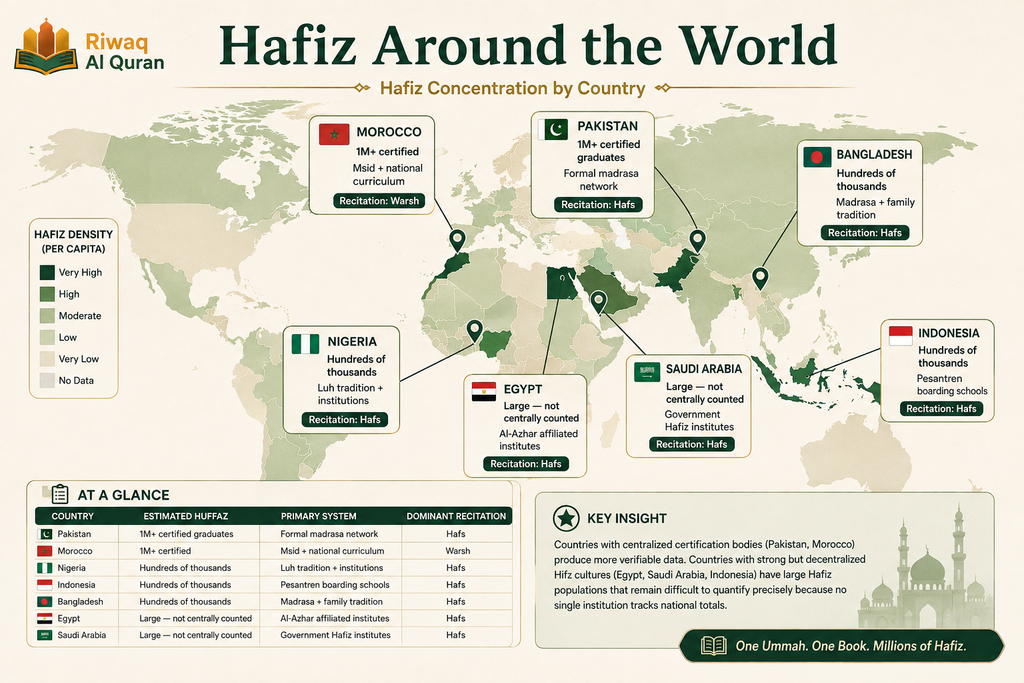
Country Comparison at a Glance
The following table summarizes the key data points across countries with the highest Hafiz concentrations, giving a clear side-by-side view of system types, scale, and recitation traditions.
| Country | Estimated Huffaz | Primary System | Dominant Recitation |
| Pakistan | 1M+ certified graduates | Formal madrasa network | Hafs |
| Morocco | 1M+ certified | Msid + national curriculum | Warsh |
| Nigeria | Hundreds of thousands | Luh tradition + institutions | Hafs |
| Indonesia | Hundreds of thousands | Pesantren boarding schools | Hafs |
| Bangladesh | Hundreds of thousands | Madrasa + family tradition | Hafs |
| Egypt | Large — not centrally counted | Al-Azhar affiliated institutes | Hafs |
| Saudi Arabia | Large — not centrally counted | Government Hafiz institutes | Hafs |
One consistent pattern: countries with centralized certification bodies (Pakistan, Morocco) produce more verifiable data. Countries with strong but decentralized Hifz cultures (Egypt, Saudi Arabia, Indonesia) have large Hafiz populations that remain difficult to quantify precisely because no single institution tracks national totals.
What Is a Hafiz in Islam?
The word “Hafiz” is used loosely across Muslim communities worldwide, but its scholarly and legal definition is precise — and the distinction matters when interpreting global estimates.
1. Definition, Linguistic Origin, and Gender Inclusivity
The word Hafiz (حَافِظ) derives from the Arabic root ح-ف-ظ, meaning to preserve, protect, and guard. In classical Islamic scholarship, the term carries a precise technical meaning:
- It refers exclusively to someone who has memorized the complete Quran — all 30 Juz — and can recite it accurately from memory.
- A person who has memorized five or ten Juz is not technically a Hafiz in the scholarly sense, though cultural usage of the term varies
- The plural is Huffaz (حُفَّاظ).
- A female memorizer holds the title Hafizah (حَافِظَة) — with equal honor in Islamic tradition.
Women Huffaz are systematically undercounted in global statistics because their memorization has historically taken place in private family settings rather than certified institutions that generate records. The real global count of complete female Huffaz is almost certainly higher than any published figure reflects.
2. Hafiz vs. Alim — Two Separate Achievements
A Hafiz is not automatically an Islamic scholar, and a scholar is not automatically a Hafiz. The distinction is important:
- An Alim (عَالِم) has studied the Quran, Hadith, Fiqh, Usul, and related Islamic sciences in depth — but may or may not have memorized the complete Quran.
- A Hafiz has mastered the text of the Quran from memory — but may or may not have pursued broader scholarly study.
- Many great Islamic scholars in history held both titles — Al-Imam Al-Shafi’i and Imam Ahmad ibn Hanbal both memorized the Quran before the age of ten — but the two achievements represent separate disciplines and should not be conflated.
3. The Historical Role of Huffaz in Preserving the Quran
The importance of Huffaz became dramatically clear in the early years of Islam. At the Battle of Yamama in 633 CE, the stakes of Hifz as a preservation method became undeniable:
- Approximately 70 Huffaz were killed in a single battle.
- The scale of this loss prompted Abu Bakr Al-Siddiq (رضي الله عنه) to commission the first formal written compilation of the Quran.
- The fact that losing 70 memorizers was considered a civilizational crisis reveals precisely how central human memory was to Quranic preservation from the beginning.
That chain has never broken. The Quran exists today in its original form not only because of written manuscripts, but because it has been recited, memorized, and transmitted by living people in every generation since the time of the Prophet ﷺ.
What Are the Rewards for Becoming a Hafiz?
The Islamic tradition is unusually specific about the rewards for Quran memorizers — not in vague terms of “spiritual benefit,” but in detailed descriptions of status in the Hereafter and the honor reflected onto their families. For a deeper look at what awaits those who memorize the Quran, see Riwaq Al Quran’s dedicated piece on the reward for becoming a Hafiz.
1. The Hafiz’s Status in the Hereafter
As established by Hadith 4 above — narrated in both Abu Dawud and Tirmidhi — the Hafiz’s rank in Jannah corresponds directly to the number of verses they carry and can still recite on the Day of Judgment.
The command “recite and ascend” places the entire journey of memorization in a different frame: it is not an achievement that ends at completion, but a standing that is measured at a single future moment.
The practical implication most students miss:
- Completing memorization is the beginning, not the end.
- The revision you maintain for the rest of your life determines the rank you arrive with.
- A Hafiz who stops revising after completing the Quran risks losing both the memory and the rank.
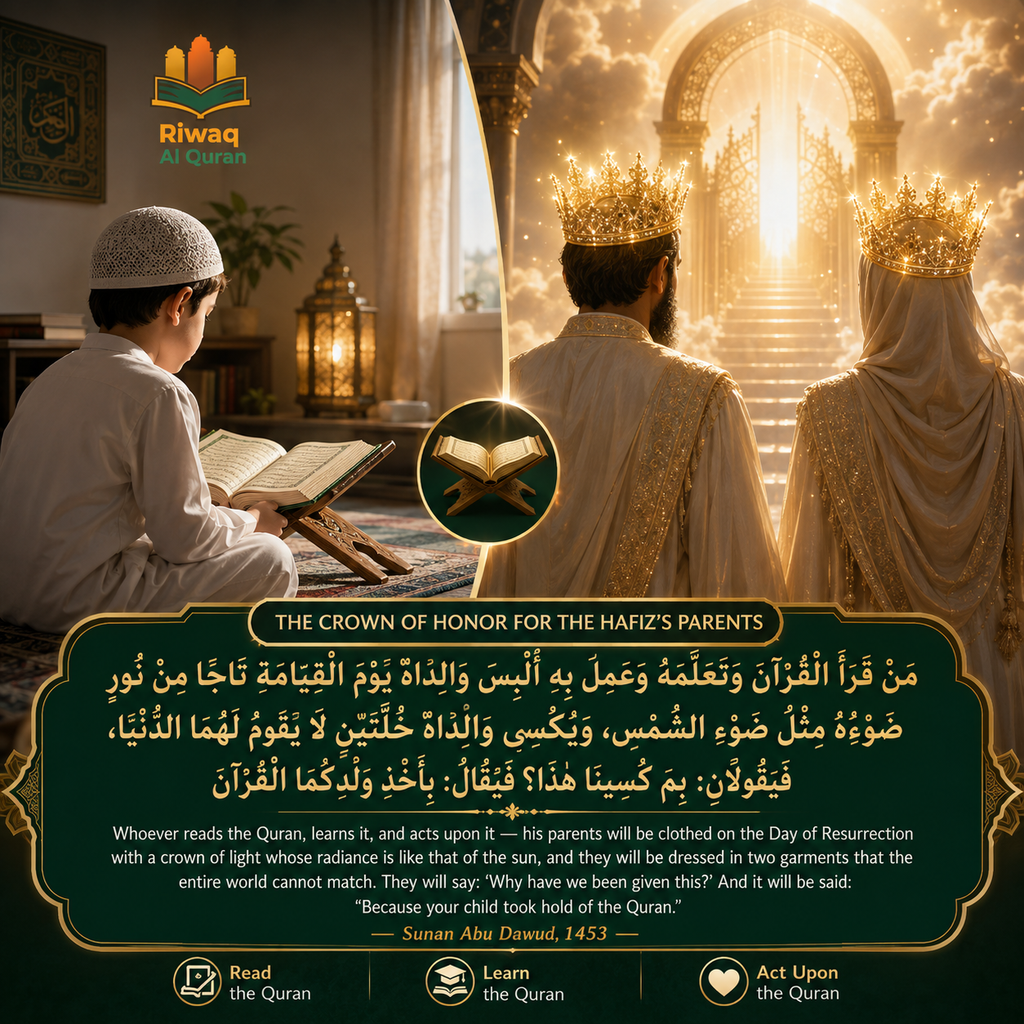
2. The Crown of Honor for the Hafiz’s Parents
One of the most emotionally powerful hadiths in the tradition concerns not the Hafiz themselves, but their parents:
«مَنْ قَرَأَ الْقُرْآنَ وَتَعَلَّمَهُ وَعَمِلَ بِهِ أُلْبِسَ وَالِدَاهُ يَوْمَ الْقِيَامَةِ تَاجًا مِنْ نُورٍ ضَوْءُهُ مِثْلُ ضَوْءِ الشَّمْسِ، وَيُكْسَى وَالِدَاهُ حُلَّتَيْنِ لَا يَقُومُ لَهُمَا الدُّنْيَا، فَيَقُولَانِ: بِمَ كُسِينَا هَذَا؟ فَيُقَالُ: بِأَخْذِ وَلَدِكُمَا الْقُرْآنَ»
“Whoever reads the Quran, learns it, and acts upon it — his parents will be clothed on the Day of Resurrection with a crown of light whose radiance is like that of the sun, and they will be dressed in two garments that the entire world cannot match. They will say: ‘Why have we been given this?’ And it will be said: ‘Because your child took hold of the Quran.'”— Sunan Abu Dawud, 1453
Three conditions are embedded in this hadith: reading, learning, and acting upon the Quran. The crown is not given for memorization alone — it is given when the Quran shapes the child’s life and conduct. This is why the strongest Hifz traditions do not separate memorization from understanding and application — they are one integrated practice.
For parents supporting a child through Hifz: every hour invested in their child’s Quran memorization journey is building something that transcends this world entirely.
How Is a Hafiz Certified? The Ijazah Chain
Most articles about the global Hafiz count discuss memorization but skip the certification question entirely. This section explains why the method of transmission matters as much as the act of memorizing — and why not all memorization is equal.
1. What an Ijazah Is and How Certification Works
An Ijazah (إِجَازَة) is a formal authorization granted by a qualified Quran teacher to a student who has recited the complete Quran from memory, without error, in the teacher’s verified presence. It is not simply a graduation certificate. Key features of what an Ijazah represents:
- A documented position in an unbroken chain of oral transmission going back to the Prophet Muhammad ﷺ.
- A full list of every teacher in the chain — named, in sequence — connecting the student to that original source.
- Verification not just of memory, but of recitation accuracy, pronunciation, and Tajweed — all confirmed by a qualified listener.
- For students pursuing Ijazah certification online, the requirement is identical: live, real-time recitation before a chain-holding teacher, not a recorded submission.
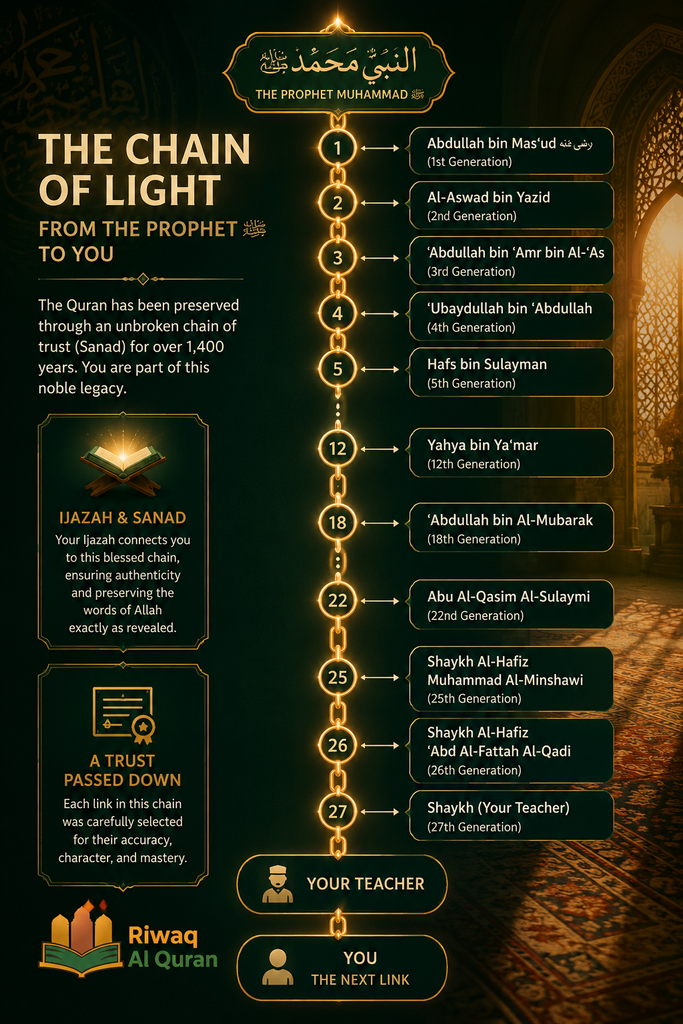
A student certified this way has not merely memorized a text. They have received it, verified, from a teacher who received it from a teacher — across a named lineage covering more than 1,400 years.
2. The Sanad — An Unbroken Chain Across 1,400 Years
The concept of Sanad (سَنَد) — the documented chain of transmission — is what distinguishes Quranic memorization from any other religious or academic tradition in the world:
- A student receiving an Ijazah in Riwayat Hafs ‘an ‘Asim is connected through approximately 25 to 27 named, documented transmission links directly to the Prophet ﷺ.
- Each link in the chain is a person — named, historically traceable — who received the Quran from the person before them.
- When a certified Hafiz recites, what is heard is not an approximation of the Quran as revealed — it is a verified, transmitted recitation.
This is what broad global estimates often miss: they count memory, but the Ijazah system counts verified, transmitted memory. That distinction is the most important thing this article adds that most competing content does not address.
For a memorization that enters this chain from the very first lesson — not after years of additional qualification — the teacher you learn from matters as much as the effort you invest. Riwaq Al Quran’s Ijazah-certified instructors hold verified chains, meaning your memorization connects to the Sanad from day one.
Who Are the Youngest Hafiz on Record?
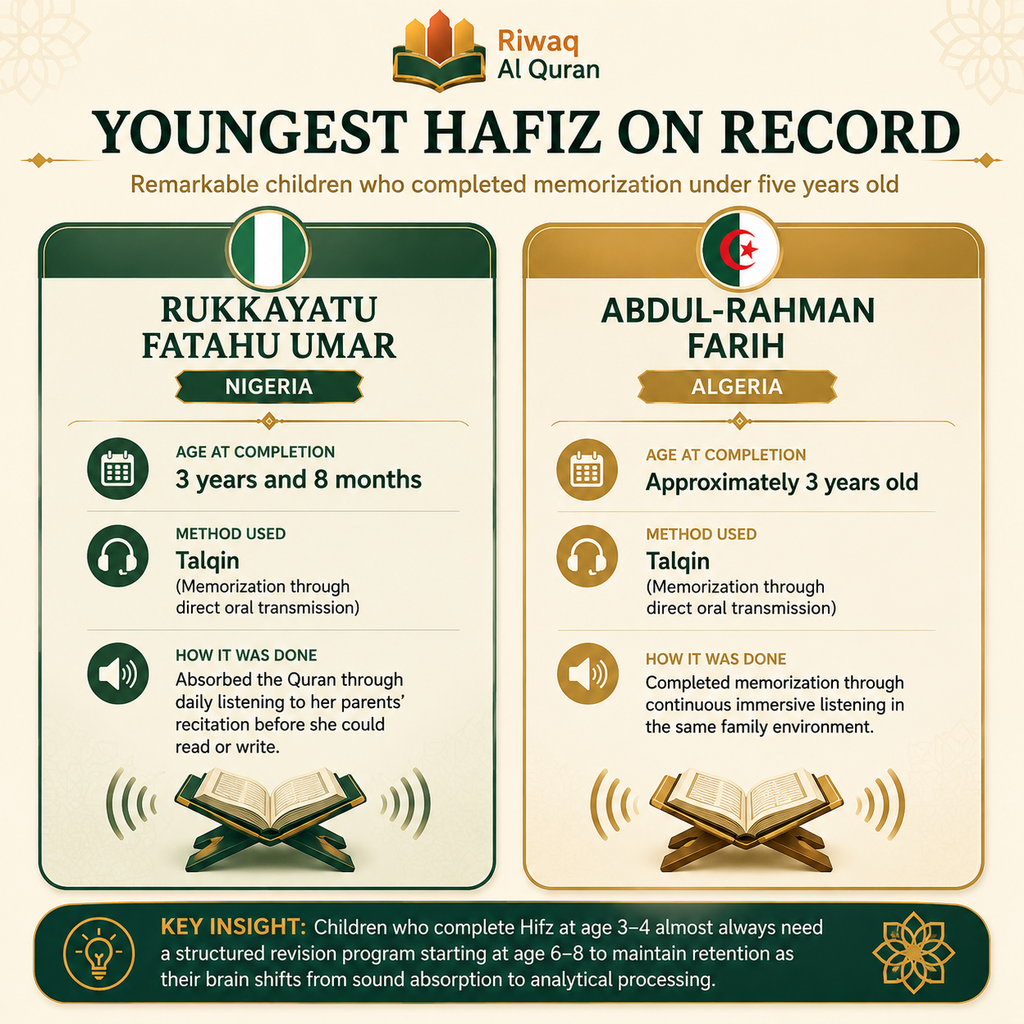
The youngest documented cases of complete Quran memorization cluster around ages 3 to 4. Every verified case involves the same foundational method: intensive auditory exposure, not formal textual study.
Documented cases under five years old:
- Rukkayatu Fatahu Umar (Nigeria) — completed Hifz at 3 years and 8 months, absorbing the Quran through daily listening to her parents’ recitation before she could read or write.
- Abdul-Rahman Farih (Algeria) — reportedly completed memorization at approximately 3 years old through continuous immersive listening in the same family environment.
These cases reflect a principle that cognitive developmental research supports: children under five are in the peak window for phonological acquisition — the brain’s sound-pattern absorption capacity is at maximum elasticity during this developmental stage. The Talqin method (تَلْقِين — memorization through direct oral transmission, listening then repeating) is specifically designed to work with this window, not against it.
One practitioner observation that most accounts miss entirely: children who complete Hifz at age 3 or 4 almost universally require a structured revision program beginning at age 6 to 8, or retention drops significantly as the brain’s developmental mode shifts from sound absorption to analytical processing.
Completing early memorization and sustaining it through adolescence are two different challenges requiring two different strategies — and the Quran memorization program a family chooses should account for both.
For younger children beginning their Quran journey, Riwaq Al Quran’s Online Quran Classes for Kids use age-appropriate methods that build this early foundation systematically.
Can Adults Become Hafiz? What the Evidence Shows
One of the most common questions from people encountering Hifz for the first time as adults is whether the opportunity has passed. The consistent answer from instructors who work with adult learners: it has not passed — but the method must adapt.
Adult memorization differs from children’s learning in three fundamental ways:
- Method: Children memorize primarily through auditory repetition without needing to understand the meaning. Adults retain more durably when they connect verses to their themes, understand the context of what they are memorizing, and visualize page structure. An adult who studies the meaning of a passage before memorizing it will typically retain it more durably than through repetition alone.
- Time investment: Adult learners who commit 45 minutes to one hour per day of focused memorization, with daily new input and structured revision, typically complete the Quran in 4 to 7 years. Adults who treat memorization as occasional rather than daily rarely complete — not because of cognitive limitation, but because insufficient daily density does not build the automatic recall the Quran requires. For a realistic Quran memorization schedule that works for adults, consistency is the single most important variable.
- Accountability: Adult learners working with a teacher who checks recitation weekly significantly outperform self-directed learners. Adults do not hear their own errors the way a qualified external listener does — and errors that go uncorrected for months become habits that take years to fix.
Wondering how hard it is to memorize the Quran as an adult? The answer depends almost entirely on whether the student has daily consistency and qualified accountability behind them — not on age alone.
What Supports Long-Term Hifz Retention?
Completing Hifz is one achievement. Keeping it for a lifetime is a separate discipline — and conflating the two is the most common error students make after finishing memorization. The brain requires systematic maintenance for long-term retention at this scale — and that maintenance has a clear, teachable structure.
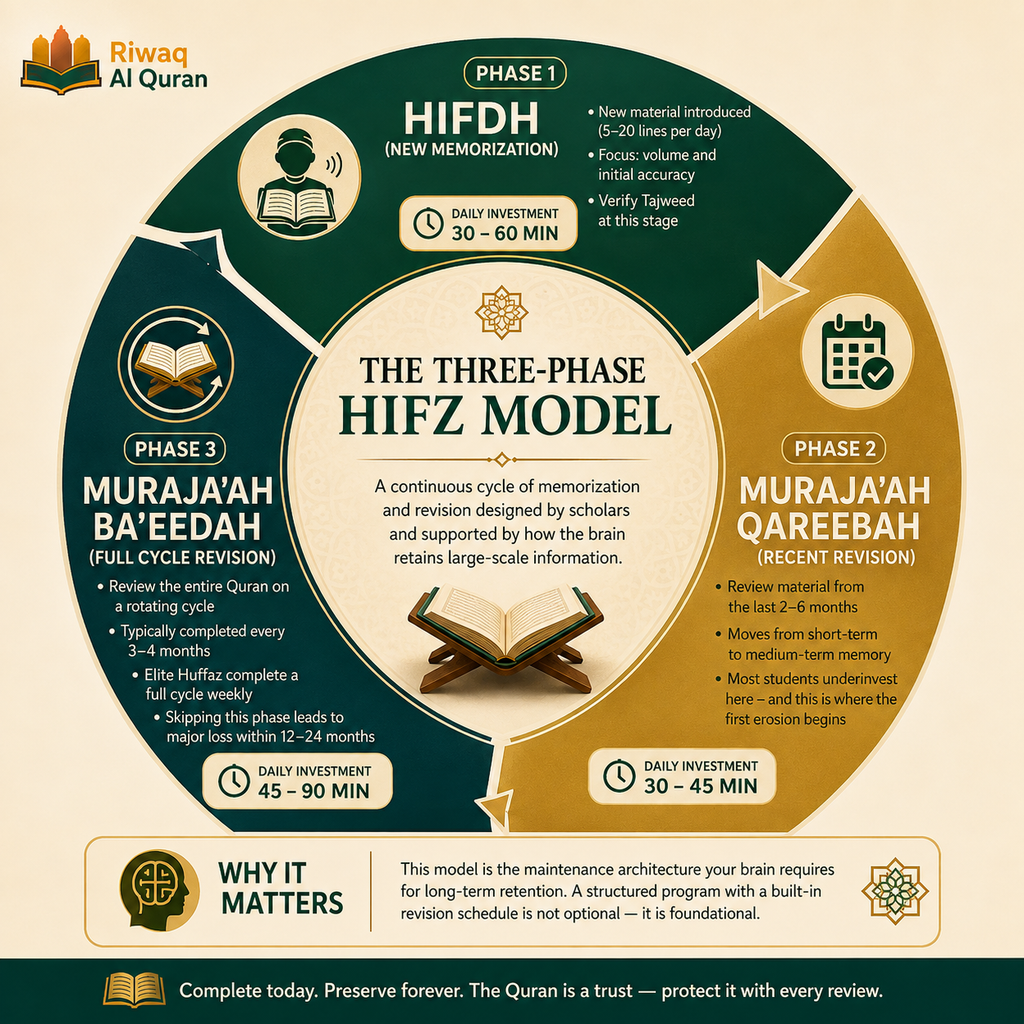
1. The Three-Phase Hifz Model
Experienced Hifz teachers and traditional Islamic scholars describe memorization in three distinct phases, each requiring different techniques and different daily time allocations.
Understanding what each phase demands — and why skipping one quietly undermines the others — is the first step toward building a maintenance routine that actually holds.
1. Hifdh (New Memorization)
This is the entry phase, where the goal is simply to get material into memory accurately and at a sustainable pace.
- New material is introduced, typically 5 to 20 lines per day depending on age and capacity.
- Focus: volume and initial accuracy.
- Common mistake: moving too fast, skipping Tajweed verification at this stage.
2. Muraja’ah Qareebah (Recent Revision)
Once a portion is newly memorized, it’s still fragile — this phase is what carries it from a fresh, easily-lost impression into something the memory can actually rely on.
- Material memorized in the last two to six months is reviewed daily.
- Purpose: move content from short-term to medium-term memory.
- This is where most students underinvest — and where the first quiet erosion of Hifz begins.
3. Muraja’ah Ba’eedah (Full Cycle Revision)
This final phase is what protects everything memorized over the years, not just what was learned recently — and it’s the phase most often abandoned once the pressure of finishing Hifz is gone.
- The complete Quran is reviewed on a rotating cycle, typically completed every three to four months.
- Elite Huffaz complete a full review cycle weekly.
- A student who skips this phase will find that within 12 to 24 months of finishing Hifz, only the Juz they recite regularly in Salah remain solid.
The Three-Phase Model is not a learning style preference. It is the maintenance architecture the brain requires for long-term declarative memory of this scale — and it is why a structured program with a built-in revision schedule is not optional, it is foundational.
2. The Three Most Common Hifz Mistakes
Based on patterns that qualified Hifz instructors observe consistently across students of all ages and backgrounds:
- Memorizing without structural anchors: Students who memorize verses in isolation — without understanding how each ayah connects thematically to what precedes and follows it — have no fallback when distraction strikes mid-recitation. Students with thematic context recover; students without it go blank.
- Prioritizing speed over Tajweed accuracy: Mispronunciation habits embedded through years of repetition are among the most difficult errors to correct in Quranic recitation. The command in Al-Muzzammil (73:4) to recite with Tarteel is not supplementary guidance — it is the foundational specification. Accuracy must be built in from the first lesson, not corrected at painful cost later. Riwaq Al Quran’s Online Tajweed Classes integrate this from lesson one.
- No external accountability: Memorizing without a teacher who checks recitation weekly means errors accumulate silently. Students frequently cannot hear their own mistakes. Only a qualified external listener with both the memorization and the Tajweed mastery to identify the gap prevents this from becoming permanent — and this is not a function that self-assessment fulfills.
Start Your Hifz Journey with Riwaq Al Quran
You now know how many Hafiz are in the world. The more important question is whether you will be among the next — and whether you will have the right support behind you not just to finish, but to stay there.
Riwaq Al Quran is a comprehensive online platform offering personalized Quran, Arabic, and Islamic Studies classes for individuals of all ages and backgrounds. Every instructor is Azhari-certified and holds a verified Ijazah — meaning your memorization enters the unbroken chain of transmission going back 1,400 years from the very first lesson.
Watch real moments from our live sessions at Riwaq Al Quran and see how we bring learning to life:.
What you get when you enroll
- 1-on-1 live sessions — full attention, your pace, zero distraction.
- Ijazah-certified teachers — chain-verified, not just qualified; meet all instructors.
- Tajweed integrated from lesson one — accuracy built in, never retrofitted.
- Three-phase revision system — a plan that protects your Hifz for life, not just until graduation.
- 2 free trial classes — experience the method before any financial commitment.
- 100% money-back guarantee — if it is not right for you, you owe nothing.
Courses available at Riwaq Al Quran:
- Quran Memorization Online Course — structured, systematic Hifz for all levels
- Online Tajweed Classes — master recitation rules for beautiful, accurate Quran recitation
- Ijazah Program — earn your certified, chain-documented Ijazah online
- Online Quran Classes for Kids — age-appropriate methods that build a lifelong foundation
- Arabic Language Classes — understand the Quran in its original language
- Islamic Studies Courses — deepen your knowledge beyond memorization

Conclusion
The global community of Huffaz — conservatively 10 to 15 million verified, certified memorizers, with millions more in partial and informal traditions — is the longest continuous oral preservation project in recorded human history. It is also, according to the Quran and the Sunnah, one of the most spiritually significant things a Muslim can undertake in this world.
Pakistan leads in annual graduates through its madrasa network. Morocco sustains one of the highest per-capita Hafiz ratios globally. Nigeria, Indonesia, and Bangladesh each contribute hundreds of thousands through distinct institutional and traditional frameworks. Women Huffaz remain systematically undercounted in every national record, meaning the real total is higher than any published figure captures.
Underlying all of it is the Ijazah chain — the certification that does not simply record that someone memorized the Quran, but documents that memorization as a verified link in a 1,400-year transmission going back to the Prophet ﷺ. And above all of it is the divine promise in Surah Al-Hijr: this preservation will never end.
Whether you are here out of curiosity or because you are considering Hifz yourself, the path is more structured, more supported, and more achievable than it appears from the outside. Ten to fifteen million people — children, adults, men, and women — have already proven that. The question is not whether it is possible. It is whether you have the right system around you.
Frequently Asked Questions
The questions below address the most common points readers search for after reading this guide — from global statistics to personal Hifz decisions. Each answer is written to be complete on its own, so you can jump directly to what matters most to you.
1. How Many Hafiz Are in the World Today?
Conservative scholarly estimates place verified, complete Huffaz at approximately 10 to 15 million worldwide. Pakistan’s Wafaq-ul-Madaris alone records over one million certified graduates. Broader estimates including partial memorizers and those certified informally can reach significantly higher, though no institutional source verifies figures as high as 200 million for complete Hafiz specifically.
2. Which Country Produces the Most Hafiz?
Pakistan produces the largest number of new Hafiz annually — approximately 70,000 to 80,000 certified graduates per year according to Wafaq-ul-Madaris records. Morocco holds the highest per-capita density, with over one million certified Huffaz in a population of 37 million. Nigeria leads sub-Saharan Africa through its Luh-based traditional system.
3. What Is the Difference Between a Hafiz and an Alim?
A Hafiz has memorized the complete Quran — all 30 Juz — from cover to cover. An Alim has studied the Quran, Hadith, Fiqh, and Islamic sciences in depth but may or may not have memorized the full Quran. The titles reflect separate achievements. Many great Islamic scholars in history were both, but the two should not be used interchangeably when counting or discussing Huffaz globally.
4. How Long Does It Take to Become a Hafiz?
Children who begin between ages 5 and 10 typically complete Hifz in 2 to 4 years with consistent daily study. Adults typically take 4 to 7 years.
The most significant variable is not the memorization pace but the daily revision investment — students who revise consistently every day finish faster and retain far more durably than those who only memorize new material without reviewing the old.
5. Can Adults Realistically Become Hafiz?
Yes — adult memorizers complete Hifz regularly through structured programs. The method differs from children’s learning: adults benefit from understanding thematic context before memorizing, visualizing page structure, and working with a teacher who provides weekly recitation checks.
Daily consistency matters more for adults than for children, because adult retention without regular revision degrades faster.
6. What Is an Ijazah, and Is It Necessary?
An Ijazah is a formal certification granted by a qualified teacher after verifying complete, accurate recitation from memory. It is necessary if you want your memorization to be part of the verified Sanad — the chain of transmission connecting back to the Prophet ﷺ.
A Hafiz without an Ijazah has memorized the Quran; a Hafiz with an Ijazah has received it as a documented link in a 1,400-year chain. For many students, earning this certification is a core goal of their Ijazah program.
7. Who Are the Youngest Hafiz on Record?
The youngest documented cases cluster around age 3 to 4. Rukkayatu Fatahu Umar of Nigeria completed Hifz at 3 years and 8 months through the Talqin listening method.
Abdul-Rahman Farih of Algeria reportedly completed at approximately 3 years old. Both demonstrate the phonological absorption capacity of the early childhood brain when exposed to consistent, immersive Quranic recitation from infancy.
Sources
- Wafaq-ul-Madaris Al-Arabia Pakistan — official graduation and enrollment records
- Surah Al-Qamar, 54:17 — quran.com/54/17
- Surah Al-Hijr, 15:9 — quran.com/15/9
- Surah Al-Ankabut, 29:49 — quran.com/29/49
- Surah Al-Muzzammil, 73:4 — quran.com/73/4
- Sahih al-Bukhari, 5027 — sunnah.com/bukhari:5027
- Sahih al-Bukhari, 4937 / Sahih Muslim, 798 — sunnah.com/bukhari:4937
- Sahih Muslim, 804 — sunnah.com/muslim:804
- Sunan Abu Dawud, 1464 / Jami’ at-Tirmidhi, 2914 — sunnah.com/abudawud:1464
- Sunan Abu Dawud, 1453 — sunnah.com/abudawud:1453