Quran games for kids turn memorization drills into something a child actually looks forward to instead of a task they resist. Reciting the same ayah five times in a row loses a five-year-old’s attention fast; turning that same ayah into a bingo card, a treasure hunt clue, or a story cube doesn’t.
Riwaq Al Quran builds games into its live kids’ curriculum for exactly this reason: children retain what they enjoy repeating. As Ali ibn Abi Talib put it, “Speak to people only according to their level of knowledge” — with children, that means teaching through play, not just recitation.
The Prophet ﷺ built the same principle into how he taught adults, and it applies just as directly to children:
(يَسِّرُوا وَلَا تُعَسِّرُوا، وَسَكِّنُوا وَلَا تُنَفِّرُوا)
“Make things easy for the people, and do not make it difficult for them, and make them calm [with glad tidings] and do not repulse them.” — Prophet Muhammad ﷺ, narrated by Anas ibn Malik, Sahih al-Bukhari 6125 (Sahih)
Applied to teaching a child the Quran, this hadith is the whole argument for games: a fifteen-minute bingo round that ends in laughter teaches more than forty minutes of drilling that ends in tears.
This article covers 12 Quran games for kids, grouped by learning style, with a real ayah or hadith alongside several of them so you can start today without extra prep.
Table of Contents
Quran Learning Games and How to Choose the Right One
Quran learning games are structured activities — not free play — built around a specific verse, story, or Surah, with a clear goal a child can reach by the end.
Not every child learns the same way, so the fastest way to pick a game is to match it to how your child absorbs information. This article uses a simple three-way split:
- See games are visual — Pictionary, coloring sheets, story cubes, puzzles — for children who remember what they’ve looked at more than what they’ve heard.
- Do games are kinesthetic — treasure hunts, charades, relay races — for children who need to move to concentrate.
- Say games are auditory — bingo calling, recitation relays, Jeopardy-style Q&A — for children who pick up rhythm and repetition by ear.
Most children respond to a mix of all three, so the 12 games below are grouped by category, and each one notes which of the three it leans on.
Memory and Matching Games for the Quran
Memory and matching games work because they force active recall instead of passive listening — the child has to produce the answer, not just hear it repeated. A common mistake here is starting with too many cards: for children aged 5–7, cap the deck at 6–8 pairs, or the game turns into guessing rather than memory work. Adjust the difficulty based on the age group and participants’ familiarity with the Quranic content.
That effort carries weight beyond the kitchen table. The Prophet ﷺ said:
(خَيْرُكُمْ مَنْ تَعَلَّمَ الْقُرْآنَ وَعَلَّمَهُ)
“The best among you are those who learn the Qur’an and teach it.” — narrated by Uthman ibn Affan, Sahih al-Bukhari 5027 (Sahih)
A parent running a memory-match round after dinner is doing exactly what this hadith describes — learning and teaching a verse in the same breath.
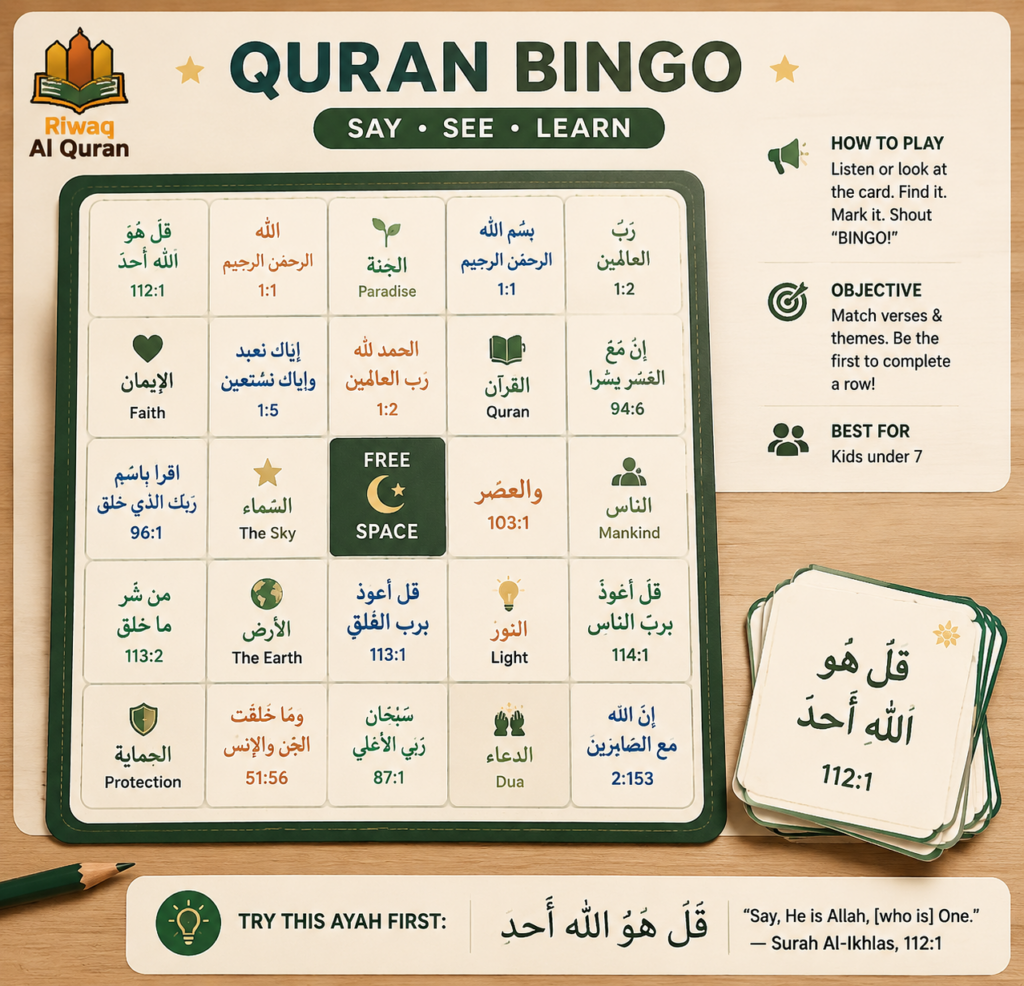
1. Quran Bingo
Bingo works as a first game precisely because it needs no explanation — every child already knows the format, so all the learning effort goes into the verses, not the rules.
Learning style: Say / See.
Objective: Quran Bingo helps children become familiar with Quranic verses or themes by ear and by sight at the same time. Children mark off squares as verses or themes are called out, aiming to complete a row.
Setup:
- Make bingo cards with a grid of squares, each filled with a verse reference, theme, or image.
- Prepare matching calling cards.
Gameplay:
- Call out a verse or show its calling card.
- Children mark the matching square.
- First to complete a row calls “Bingo.”
Try this ayah:
(قُلْ هُوَ اللَّهُ أَحَدٌ)
“Say, He is Allah, [who is] One.” — Surah Al-Ikhlas, 112:1
This is the shortest, clearest statement of Tawhid (Allah’s oneness) in the Quran — a good first ayah for any child, since almost everything else they’ll learn about Islam builds on this single idea.
Short, three-word ayat like this one also work best as calling cards for children under 7 — anything longer than one line slows the game down.
2. Memory Match
Memory Match asks for a second, quieter skill bingo doesn’t: holding a verse’s meaning in mind while you search for its match, not just recognizing the sound of it.
Learning style: Say / See.
Objective: Memory Match pairs a verse card with its meaning card, and children flip two at a time to find matches.
Setup:
- Create pairs — one card with a verse, one with its meaning.
- Shuffle and lay face down in a grid.
Gameplay:
- Players flip two cards per turn.
- A match means another turn; no match means the cards flip back and play passes on.
- Most pairs at the end wins.
Try this ayah:
(إِنَّا أَعْطَيْنَاكَ الْكَوْثَرَ)
“Indeed, We have granted you al-Kawthar.” — Surah Al-Kawthar, 108:1
Kawthar is understood as a river in Paradise, and more broadly as abundant good — a gentle first lesson that Allah’s gifts are given generously, not sparingly.
Pair this card with a meaning card reading “Allah gave the Prophet ﷺ abundant good” rather than a literal word-for-word translation — young children match concepts faster than they match vocabulary.
3. Verse Word Order
This is the one game in the section that tests whether a child truly knows a verse, rather than just recognizes it — rebuilding it from scratch leaves nowhere to guess.
Learning style: Do / See.
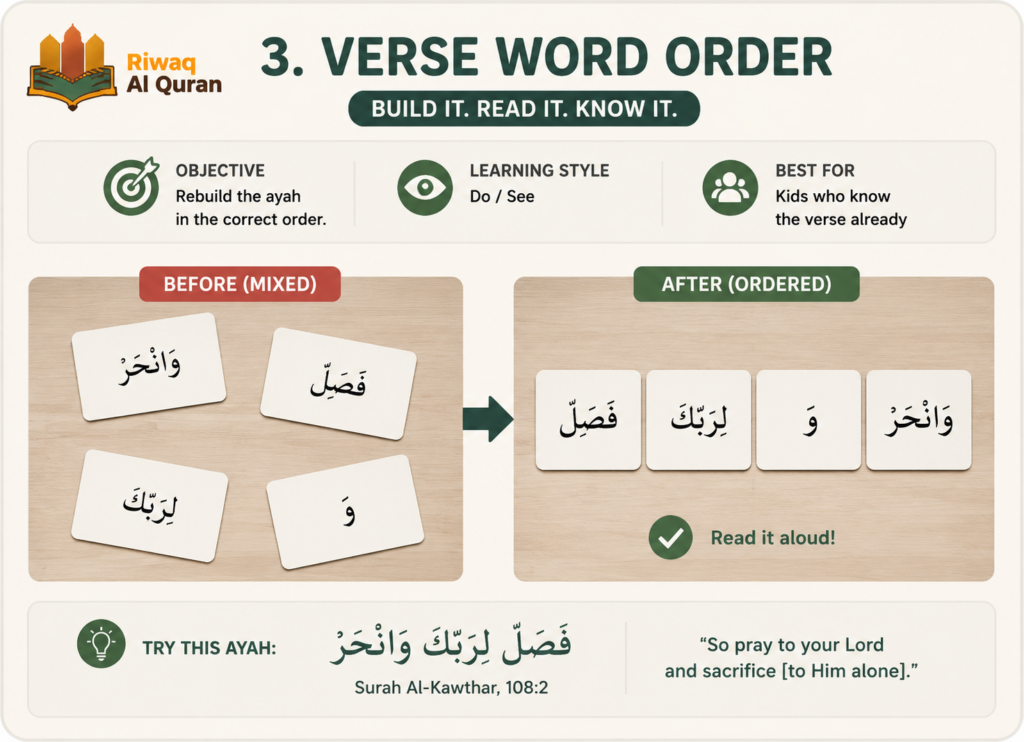
Objective: Verse Word Order builds sentence-level understanding by having children physically rebuild a short ayah, word by word, in the correct sequence.
Setup:
- Write each word of a short surah on a separate card or block.
- Mix them up.
Gameplay:
- The child arranges the cards in the correct order, then reads the completed ayah aloud.
- For a group, time it as a race between teams.
Try this ayah:
(فَصَلِّ لِرَبِّكَ وَانْحَرْ)
“So pray to your Lord and sacrifice [to Him alone].” — Surah Al-Kawthar, 108:2
Read together with 108:1, this ayah teaches the natural response to a gift: worship offered back to the One who gave it. This game only works with a surah the child has already heard several times — if the words are unfamiliar, they’re solving a puzzle with no reference point, and the Quranic learning goal gets lost.
Read: 13 Arabic Games for Kids.
If you’d rather have a tutor run these memory games as part of a structured weekly plan, Riwaq Al Quran’s kids’ classes build bingo and matching drills directly into live Hifz sessions, so the games reinforce what’s already being memorized instead of running separately from it.
Art and Creativity Quran Games
Through drawing, coloring, and acting, children reconstruct a Quranic story in their own words or images — a stronger sign they actually understood it than simple recall. These games offer a vibrant, hands-on approach to Quranic education for young learners. The mistake to avoid here: judging the artwork itself. Praise story accuracy over drawing skill, or the lesson turns into an art contest.
The Prophet ﷺ tied exactly this kind of gentleness to faith itself:
(مَنْ لَمْ يَرْحَمْ صَغِيرَنَا وَيَعْرِفْ حَقَّ كَبِيرِنَا فَلَيْسَ مِنَّا)
“Those who do not show mercy to our young ones and do not realize the right of our elders are not from us.” — Sunan Abi Dawud 4943 (Sahih)
In practice, that means the point of Quranic Pictionary isn’t a polished drawing — it’s a child who felt safe enough to attempt the story at all.
4. Quranic Pictionary
The time limit is what makes this one work — it forces the child to draw the one detail of the story that matters most, instead of stalling over a perfect picture.
Learning style: See / Do.
Objective: Children draw a Quranic story or lesson within a time limit while others guess it.
Setup:
- Prepare a list of stories or lessons on cards.
- Have drawing materials and a timer ready.
Gameplay:
- A player draws from a card and sketches the scene.
- The group guesses.
- Points go to correct guesses.
5. Colorful Surahs Quest
Coloring gives a naturally quiet activity somewhere to put the conversation — children listen better with their hands busy.
Learning style: See.
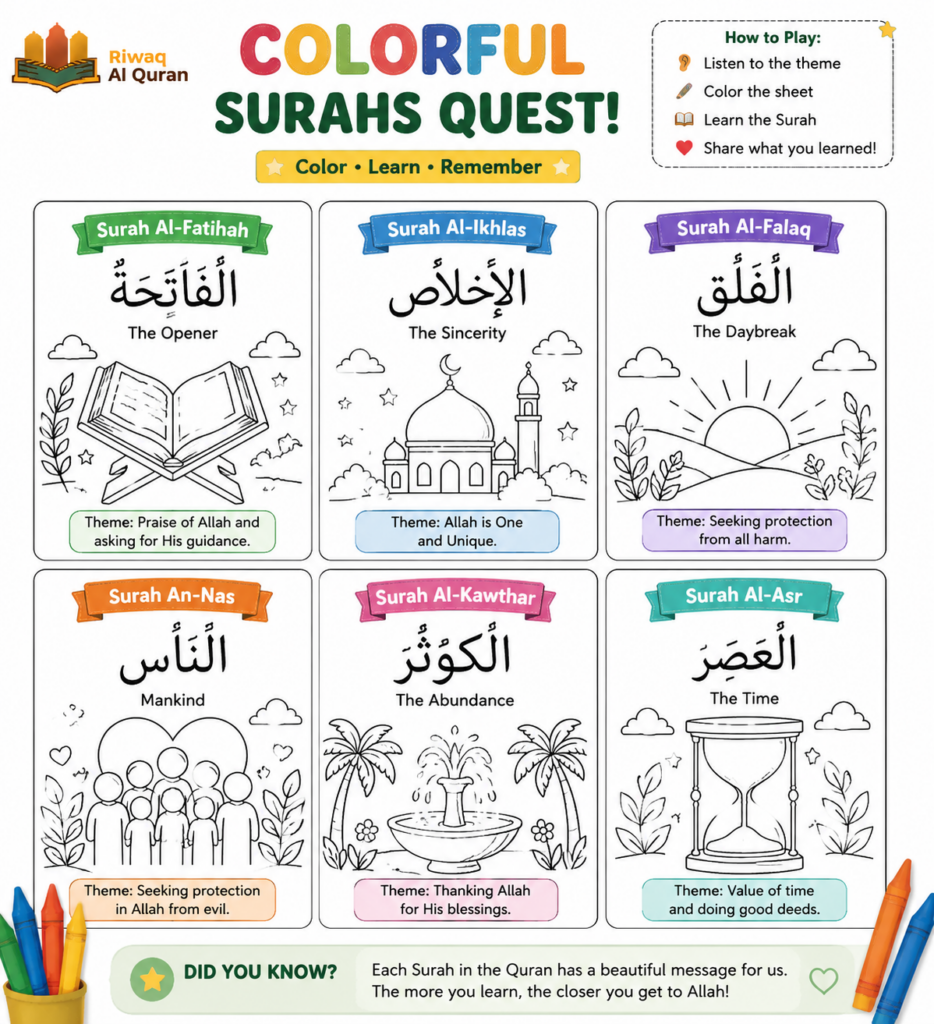
Objective: Children color illustrated Surah name sheets while discussing what each Surah is about, building name recognition alongside the importance of the gained Quranic knowledge.
Setup:
- Print sheets with Surah names and simple illustrations.
- Provide coloring materials.
Gameplay:
- Distribute sheets and explain the Surah briefly before coloring starts.
- Let children color while you talk through its theme.
- A light contest for the most creative sheet keeps energy up.
6. Quranic Charades
Silence is the whole point here — without words, the child has to lead with the part of the story they understood best.
Learning style: Do.
Objective: Children act out a Quranic story silently while their team guesses it.
Setup:
- Write stories or lessons on slips and place them in a container.
- Set a timer per round.
Gameplay:
- One player acts, the team guesses within the time limit.
- Points are tallied per correct guess.
7. Quranic Story Cubes
Because the images land in a different order every roll, this is the one game where no two rounds — or two children’s stories — ever come out the same.
Learning style: See / Do.
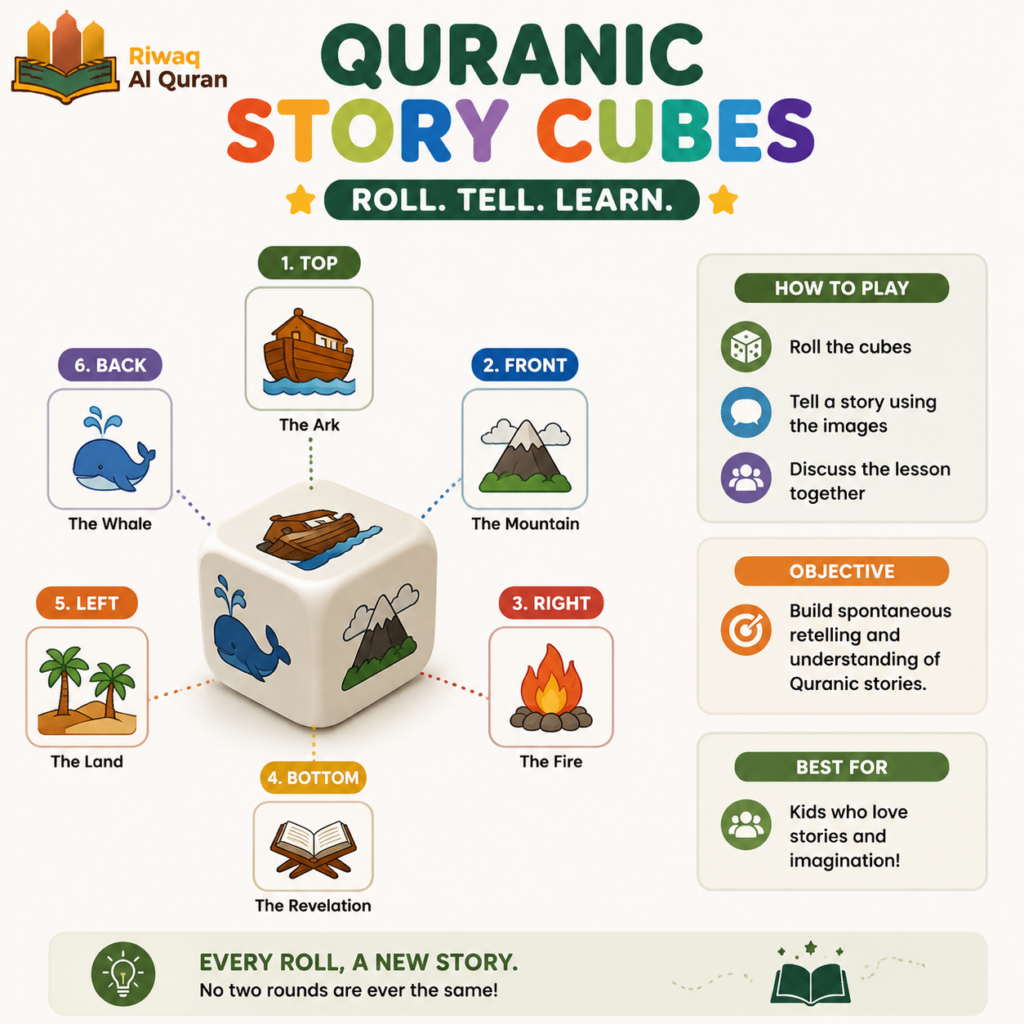
Objective: Children roll cubes printed with images from Quranic stories and build a spontaneous retelling from whatever combination appears.
Setup: Use story cubes with images tied to Quranic narratives — one image per face.
Gameplay:
- Roll the cubes and tell a story using the images shown.
- Discuss the lesson as a group afterward.
Story Cubes and Charades both work better with stories the child has heard at least once from a teacher first — cold-starting a child on an unfamiliar story usually produces a guessing game, not a retelling.
Quran Outdoor and Physical Activities
Outdoor games trade some of the precision of tabletop games for physical energy, which matters for children who lose focus sitting still. The mistake to avoid: hiding the cards without preparing the discussion questions in advance, which turns the activity into a chase with no Quranic content attached.
Physical play isn’t a modern accommodation bolted onto Quran study — it has precedent in the Prophet’s ﷺ own household. Aisha (may Allah be pleased with her) narrated:
(فَسَابَقْتُهُ فَسَبَقْتُهُ عَلَى رِجْلَيَّ، فَلَمَّا حَمَلْتُ اللَّحْمَ سَابَقْتُهُ فَسَبَقَنِي، فَقَالَ: هَذِهِ بِتِلْكَ السَّبْقَةِ)
“I had a race with him [the Prophet ﷺ] and I outstripped him on my feet. When I became heavier, I raced him again and he outstripped me. He said: This is for that [earlier] outstripping.” — Sunan Abi Dawud 2578 (Sahih)
If a footrace was part of the Prophet’s ﷺ own family life, a relay course built around a short surah fits comfortably in the same tradition.
8. Quranic Treasure Hunt
The search is what keeps children moving, but the real learning happens the moment they stop and open the card.
Learning style: Do.
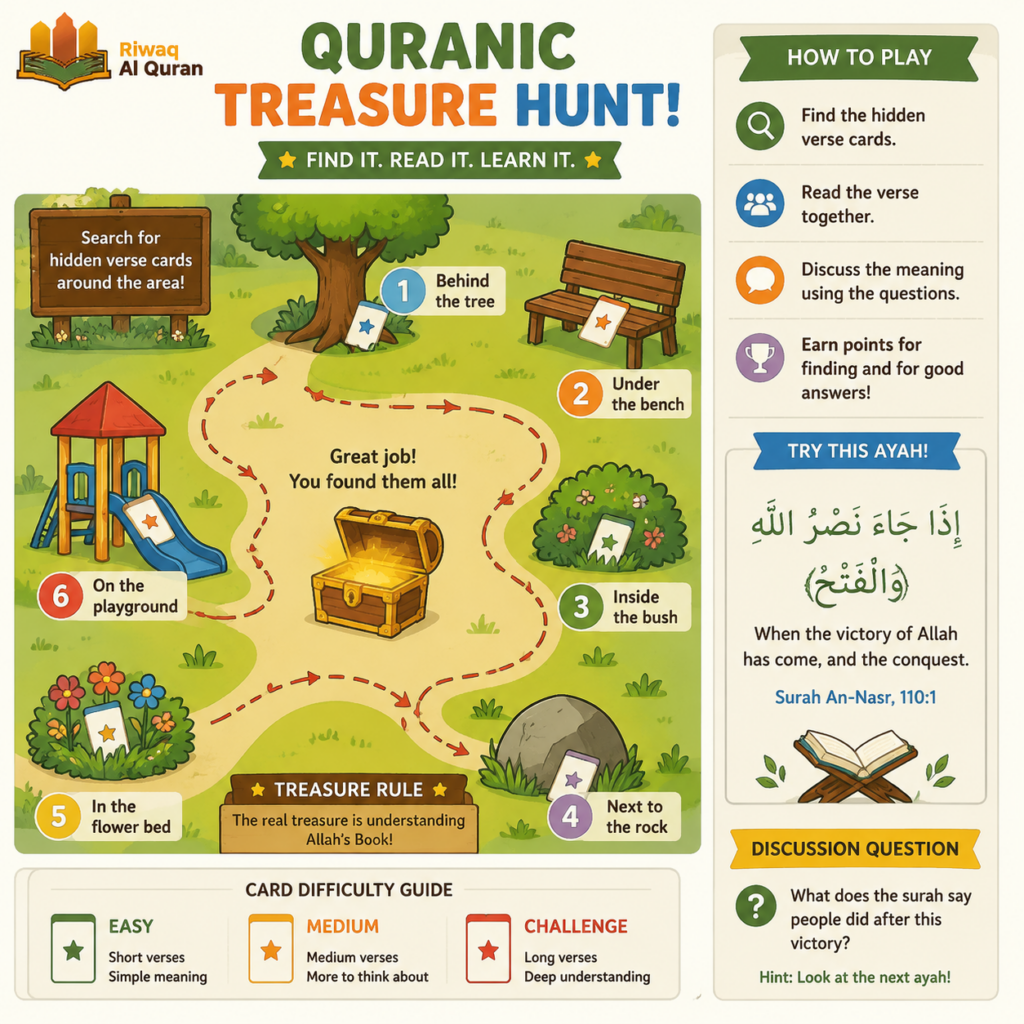
Objective: Children search for hidden verse cards, then discuss the meaning of each one they find — the discussion is the actual learning moment, not the search.
Setup:
- Hide verse cards around the play area, color-coded by difficulty.
- Prepare 1–2 discussion questions per card in advance.
Gameplay:
- Children or teams find cards, then gather to discuss meaning and context.
- Award points for finding cards and separate points for good discussion answers.
Try this ayah:
(إِذَا جَاءَ نَصْرُ اللَّهِ وَالْفَتْحُ)
“When the victory of Allah has come, and the conquest.” — Surah An-Nasr, 110:1
This surah was revealed near the end of the Prophet’s ﷺ life, marking the victory in Makkah — a good entry point for a child into the idea that patience in faith is eventually met with support.
A good discussion question for this card: “What does the surah say people did after this victory?” — it points the child to the next ayah instead of ending the conversation.
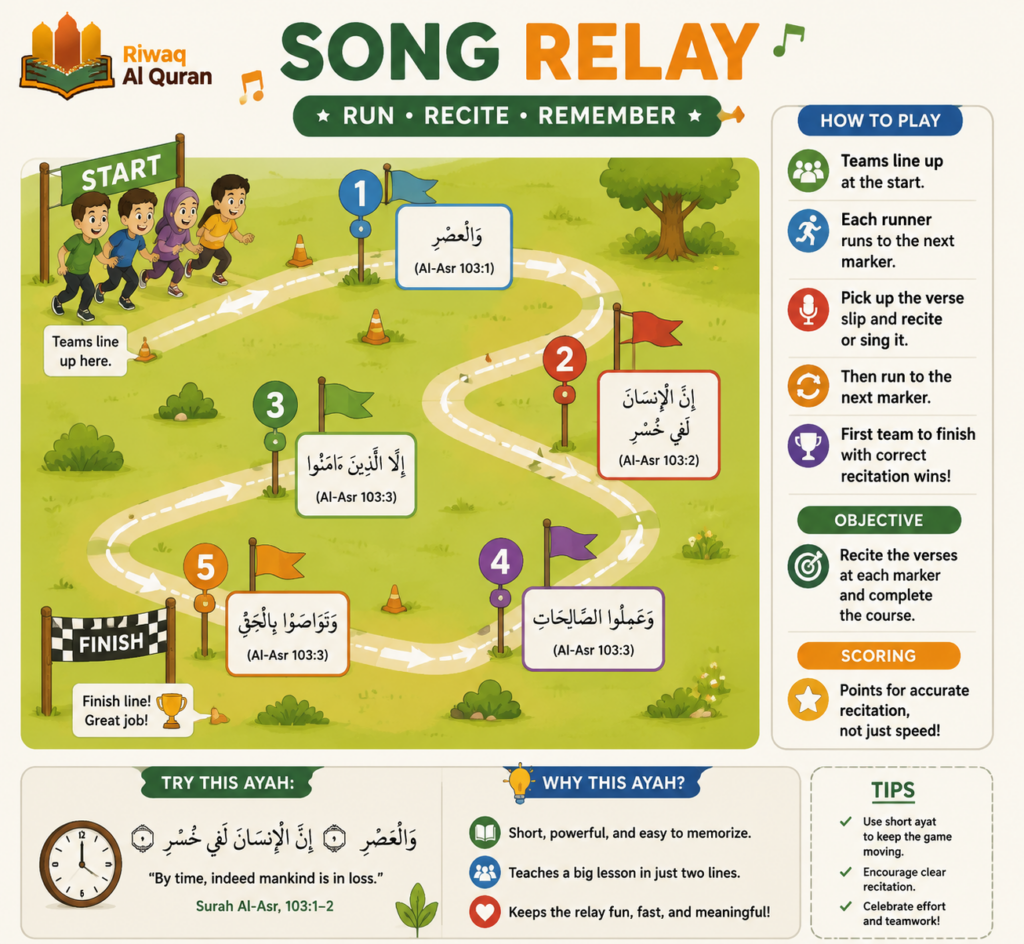
9. Song Relay Quran Games
Recitation under a bit of physical pressure — mid-run, slightly out of breath — sticks differently than recitation sitting still.
Learning style: Say / Do.
Objective: Children run a relay course, picking up a verse at each marker to recite or sing before continuing.
Setup:
- Write verses on slips and scatter them along a marked course.
- Split children into teams.
Gameplay:
- Each runner collects a slip, recites it at the marker, then continues.
- Time the relay and score for accurate recitation, not just speed.
Try this ayah:
(وَالْعَصْرِ إِنَّ الْإِنسَانَ لَفِي خُسْرٍ)
“By time, indeed mankind is in loss.” — Surah Al-Asr, 103:1–2
Surah Al-Asr is only three ayat long, but it’s widely cited — in a saying often attributed to Imam al-Shafi’i — as containing the essence of Islam’s message in miniature. Short two-line ayat like this keep the relay moving; longer verses slow the pace and shift the focus from recitation to reading comprehension mid-run.
Read Also: Islamic Stories For Kids.
Quran Trivia and Knowledge Games
Trivia and knowledge games work best as a check on understanding after the stories and verses have already been taught — they’re a review format, not a first introduction. The mistake to avoid: writing questions about obscure verse numbers instead of the story or lesson itself, which tests trivia recall rather than comprehension.
Whatever the scoreboard says at the end, the value of the recitation itself doesn’t change:
(مَنْ قَرَأَ حَرْفًا مِنْ كِتَابِ اللَّهِ فَلَهُ بِهِ حَسَنَةٌ وَالْحَسَنَةُ بِعَشْرِ أَمْثَالِهَا)
“Whoever recites a letter from the Book of Allah will have a reward, and that reward is multiplied by ten.” — narrated by Abdullah ibn Mas’ud, Jami’ at-Tirmidhi 2910 (Hasan)
That’s worth saying out loud during Quranic Jeopardy: even the answer a child gets wrong usually involved reciting or hearing a verse correctly first — the reward for that recitation stands regardless of the final score.
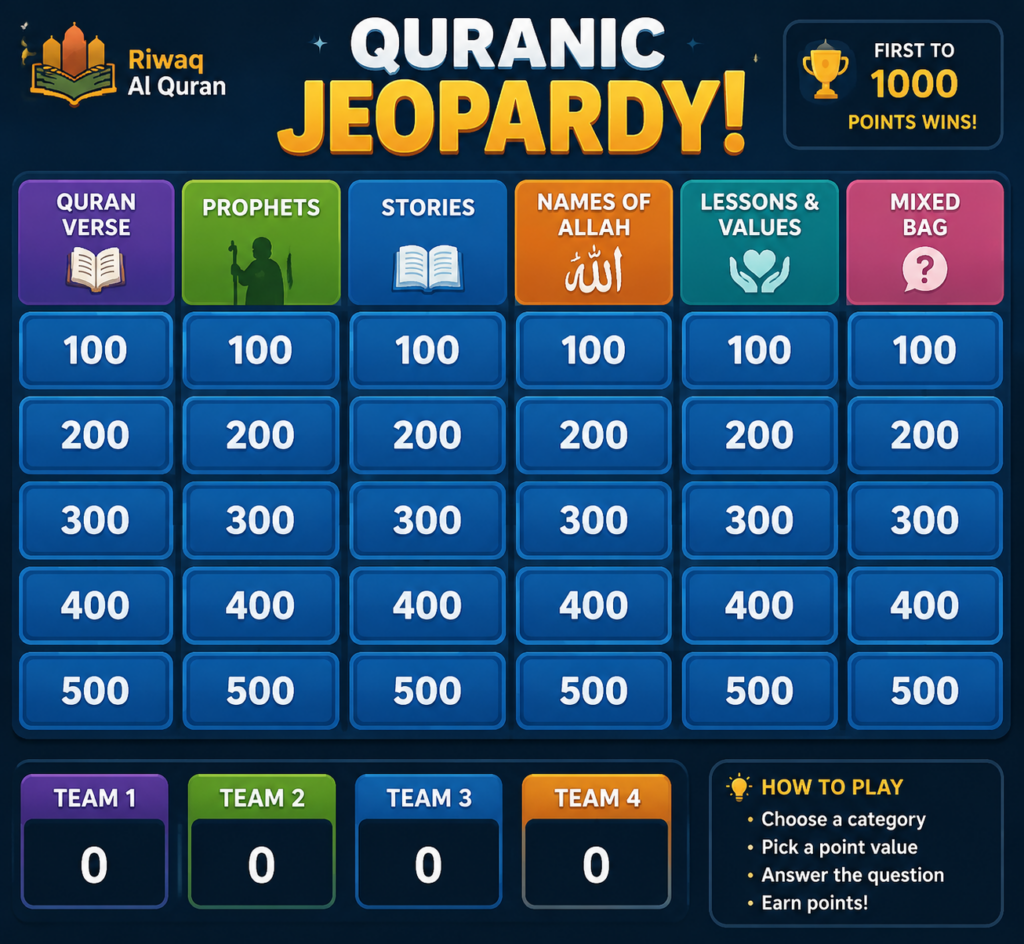
10. Quranic Jeopardy
The category board is what makes this playable at very different knowledge levels at once — a younger sibling can take the easy points while an older one goes for the harder categories.
Learning style: Say.
Objective: Children pick a category and point value, then answer a question to score points — deepening their knowledge of Prophets, stories, verses, and lessons.
Setup: Build a board (physical or digital) with categories and point values by difficulty.
Gameplay:
- A player chooses a category and value.
- They answer the question shown.
- Points are gained or lost based on accuracy.
A strong example question for the “Stories” category: “Which Surah tells the story of the army with the elephant, and what happened to them?” The answer — Surah Al-Fil — opens with a single memorable ayah:
(أَلَمْ تَرَ كَيْفَ فَعَلَ رَبُّكَ بِأَصْحَابِ الْفِيلِ)
“Have you not seen how your Lord dealt with the companions of the elephant?” — Surah Al-Fil, 105:1
The surah goes on to describe how the army was destroyed by flocks of birds — a story children tend to remember precisely because it’s vivid and short.
“See the story behind this exact trivia question — a quick recap of the Year of the Elephant:
11. Quranic Board Game
Landing on a space is what creates the suspense — the challenge only appears once the piece stops moving, which keeps younger players watching the whole turn, not just their own.
Learning style: See / Say.
Objective: Children move along a board, answering a Quranic question or challenge at each space they land on.
Setup: Design a path board with spaces tied to challenges or questions, plus tokens and a die or spinner.
Gameplay:
- Players advance by rolling.
- They answer the challenge on the space they land on.
- They either move ahead or face a setback based on accuracy.
12. Quran Games Puzzles
Because the picture only makes sense once every piece is in place, this is the quietest game in the list — and often the one that holds a child’s attention longest.
Learning style: See.
Objective: Children assemble jigsaw puzzles built from Quranic images or verses, reinforcing visual recognition through hands-on assembly.
Setup: Create or source puzzles at a difficulty matched to the child’s age.
Gameplay:
- Children assemble individually or in groups.
- Timing completion adds a light competitive element.
Read Also: Islamic Games for Kids.
If your child enjoys the trivia format specifically, that’s usually a sign they’d do well with structured Q&A-style review — which is exactly how Riwaq Al Quran tutors check retention at the end of each Hifz session, using the same story and verse categories as Quranic Jeopardy.
Book a Free Trial Quran Class for Your Child
Running these games consistently takes planning — verse selection, difficulty pacing, and knowing which ayah a specific child is ready for. A tutor who already knows your child’s memorization level can build these games into a session instead of you preparing them from scratch every week.
Take a look at real excerpts from our live sessions to see how we teach in an engaging and practical way:
Riwaq Al Quran is a comprehensive online platform offering personalized Quran, Arabic, and Islamic Studies classes for learners of every age and background.
Instructors work from a structured curriculum covering Tajweed, Tafsir, and memorization, with live video sessions that keep the back-and-forth between student and teacher close and responsive — the same direct, paced-to-the-child approach behind every game in this article. Our academy is dedicated to making the journey of teaching kids not just informative, but also enjoyable.
Courses are organized around where your child is starting from. If they’re brand new to Arabic letters, Online courses for kids and Noorani Qaida Online build the foundation first. Once they’re reading Arabic and ready to focus on the Quran itself, these move faster:
- Online Quran Classes for Kids — nurtures a love for the Quran in kids through interactive online classes.
- Quran Memorization Online Course — memorize the Quran effectively with a specialized online memorization program.
- Online Tajweed Classes — master Tajweed rules for beautiful Quranic recitation.
- Online Quran Recitation Course — enhance recitation skills through expert-led sessions.
- Online Tafseer Course — delve into Quranic meanings once recitation and memorization are underway.
- Online Qirat Course — explore diverse Qirat styles for older or more advanced students.
For the wider family, online Quran classes for kids and adults, Arabic courses, Ijazah courses, and Islamic Studies courses run on the same platform, so siblings or parents can study alongside the same child without switching programs.
Conclusion
Quran games for kids work because they turn memorization from a chore into something a child can touch, act out, or compete over — and that’s the real takeaway from everything above. A child marking off squares in Quran Bingo or flipping cards in Memory Match is still rehearsing verses; it just doesn’t feel like rehearsal to them.
The four categories here cover the main ways kids actually absorb material:
- Memory and matching games (Quran Bingo, Memory Match) build recall through repetition that doesn’t feel repetitive.
- Art and creativity games (Quranic Pictionary, Colorful Surahs Quest, Quranic Charades, Story Cubes) let children process Quranic stories by drawing, coloring, or acting them out rather than just hearing them.
- Outdoor and physical games (Quranic Treasure Hunt, Song Relay) suit kids who need to move while they learn.
- Trivia and knowledge games (Quranic Jeopardy, the Quranic Board Game, Quran Puzzles) reward kids who respond to competition and structure.
The games aren’t meant to be used one at a time and dropped. A simple weekly rotation — one memory game, one art activity, one outdoor or trivia session — shows you fairly quickly which style your child responds to, and that’s worth more than sticking rigidly to any single game.
If there’s one rule to apply, it’s this: match the game to the child, not the child to the game. A quieter, detail-focused child usually gets more out of Colorful Surahs Quest than a Treasure Hunt, while an energetic child will disengage from a board game faster than from a relay race.
Used this way, Quran games for kids stop being a one-off activity and become a consistent part of how a child builds their relationship with the Quran.
FAQs
Quick answers to the questions parents and teachers ask most before trying these games:
What are the best Quran games for kids?
The best Quran games for kids match the child’s learning style: Quran Bingo and Memory Match for auditory and visual learners, Charades and Treasure Hunts for kinesthetic learners, and Jeopardy-style trivia for children who enjoy structured review. Start with whichever format keeps your child’s attention longest, then rotate.
What age should a child start playing Quran games?
Most Quran games for kids work from around age 5, once a child can recognize a few short surahs by ear. Simplify format at younger ages — fewer bingo squares, shorter relay verses — rather than skipping the game entirely.
Do Quran games help with Hifz memorization?
Yes, Quran games support Hifz by turning repetition into active recall instead of passive listening, which improves retention of verses a child has already been taught. They work as reinforcement alongside memorization lessons, not as a replacement for them.
Is there a hadith that supports teaching children through play?
Yes. The Prophet ﷺ said, “Make things easy for the people, and do not make it difficult for them” (Sahih al-Bukhari 6125), and he raced with Aisha himself during a journey (Sunan Abi Dawud 2578). Both are cited by teachers as precedent for using ease, play, and physical activity in religious education, rather than relying on repetition alone.
Can Quran games replace a Quran teacher?
No. Quran games reinforce what a teacher has already introduced — correct pronunciation, tajweed rules, and verse meaning still need to come from a qualified tutor. Games without that foundation risk reinforcing mistakes a child hasn’t been corrected on yet.
How long should a Quran game session last?
Ten to fifteen minutes works well for children under 8, since attention drops off after that regardless of the game. Older children can sustain 20–25 minutes, especially with trivia or board-game formats that have a clear end point.