
The importance of the Quran in a Muslim’s life goes far beyond a book to be read during worship — it’s described in Islamic teaching as a complete guide for belief, conduct, and the purpose of life itself. Many Muslims know this in principle but still struggle to give the Quran real, consistent space in a busy daily routine.
This guide covers what the Quran itself says about its own role, how the Prophet Muhammad ﷺ embodied its teachings directly, the specific reward tied to reciting it, and why its importance intensifies further during Ramadan.
The Quran describes its own function directly across two verses, rather than leaving its purpose open to interpretation.
Table of Contents
1. The Quran Give you Guidance Tied to Mercy
Allah ties following the Quran directly to receiving His mercy, rather than presenting the two as separate outcomes. This is stated plainly in Surah Al-An’am:
(كِتَابٌ أَنزَلْنَاهُ مُبَارَكٌ فَاتَّبِعُوهُ وَاتَّقُوا لَعَلَّكُمْ تُرْحَمُونَ)
“This is a blessed Book We have revealed. So follow it and be mindful of Allah, so you may be shown mercy.” (Surah Al-An’am, 6:155)
The Significance of Following the Quran Before Taqwa
The instruction here is direct:
- Following the Quran is tied explicitly to receiving mercy, not just to religious observance for its own sake.
- The sequence is worth noting specifically — “follow it” comes before “be mindful of Allah.”
- Scholars read this as significant: mindfulness (taqwa) isn’t presented as a separate inner state achieved on its own, but as something that develops specifically through the practice of following the Quran’s guidance.
In other words, taqwa isn’t a precondition for benefiting from the Quran — it’s a result of engaging with it consistently.
2. The Quran Is A Light Guiding Toward the Straight Path
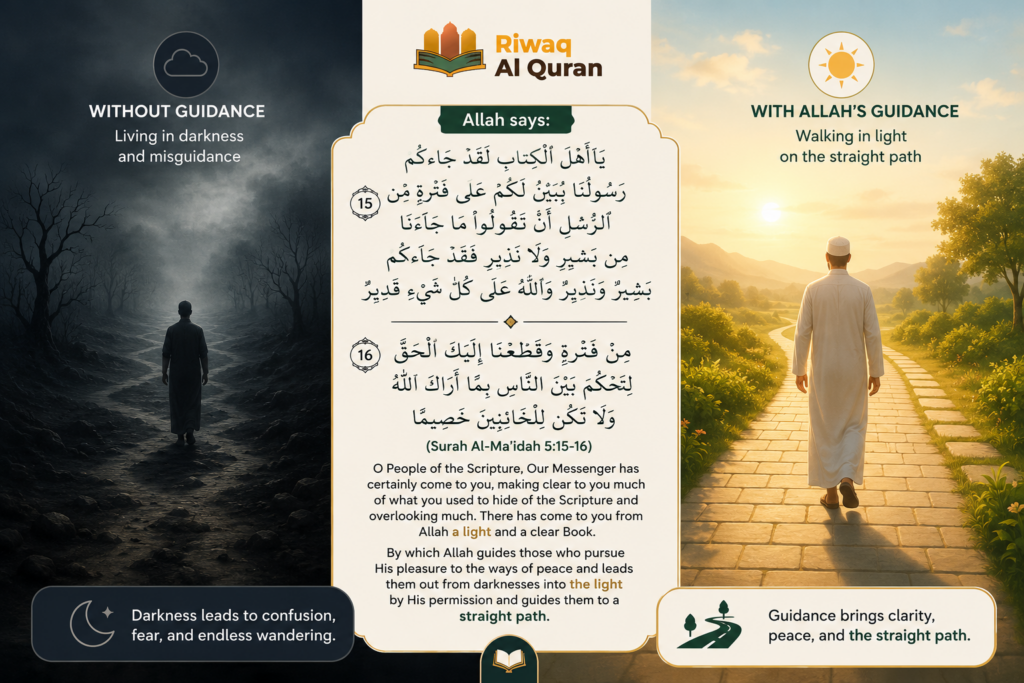
A second verse moves beyond describing the Quran as a set of instructions and frames it instead as active guidance — something that does the work of bringing a person from confusion into clarity:
(قَدْ جَاءَكُم مِّنَ اللَّهِ نُورٌ وَكِتَابٌ مُّبِينٌ يَهْدِي بِهِ اللَّهُ مَنِ اتَّبَعَ رِضْوَانَهُ سُبُلَ السَّلَامِ وَيُخْرِجُهُم مِّنَ الظُّلُمَاتِ إِلَى النُّورِ بِإِذْنِهِ وَيَهْدِيهِمْ إِلَىٰ صِرَاطٍ مُّسْتَقِيمٍ)
“There certainly has come to you from Allah a light and a clear Book through which Allah guides those who seek His pleasure to the ways of peace, brings them out of darkness and into light by His will, and guides them to the straight path.” (Surah Al-Ma’idah, 5:15–16)
The Metaphor of Light Isn’t Decorative
The metaphor of light guiding someone out of darkness is specific, not poetic filler: the Quran isn’t described as one resource among many, but as the primary source of clarity for a believer’s decisions.
This is also why “ways of peace” in the verse is plural, not singular — commentators note it signals multiple paths of guidance across different life situations, rather than one narrow track that only applies to a single kind of decision.
Quranic Guidance in Everyday Decisions
In practice, this guidance is meant to shape ordinary daily choices, not only major life decisions:
- How a person handles a disagreement with a family member or coworker.
- How honestly someone conducts a financial transaction or business deal.
- How patience is maintained during hardship, illness, or loss.
- How a parent chooses to discipline and guide their children.
- How a person treats someone weaker or more vulnerable than themselves.
The Quran’s guidance is built to be applied at this everyday level — not reserved only for moments of formal worship, and not treated as abstract principle disconnected from the actual decisions a person faces during a normal week.
3. Reaching The Great Reward for Reciting the Quran
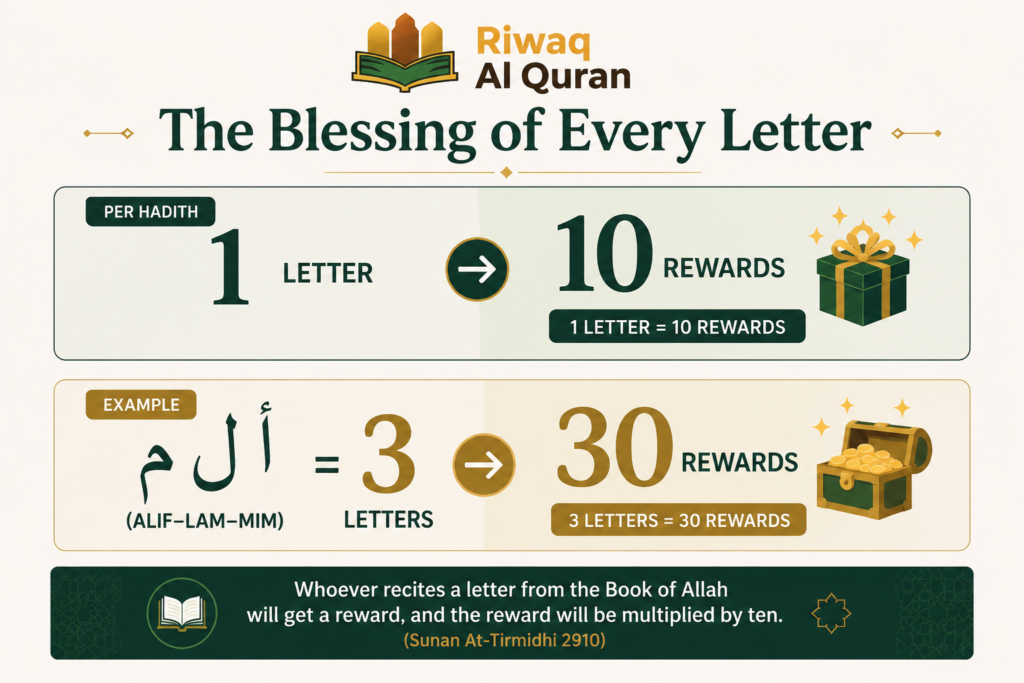
BBeyond guidance and example, the Quran carries a specific, documented reward tied to recitation itself — one that applies letter by letter, not just to completing whole passages. The Prophet ﷺ described this precisely:
(مَنْ قَرَأَ حَرْفًا مِنْ كِتَابِ اللَّهِ فَلَهُ بِهِ حَسَنَةٌ، وَالْحَسَنَةُ بِعَشْرِ أَمْثَالِهَا، لَا أَقُولُ الم حَرْفٌ، وَلَكِنْ أَلِفٌ حَرْفٌ، وَلَامٌ حَرْفٌ، وَمِيمٌ حَرْفٌ)
“Whoever recites a letter from the Book of Allah will be credited with a good deed, and a good deed is multiplied tenfold. I do not say that Alif-Lam-Mim is one letter, but Alif is a letter, Lam is a letter, and Mim is a letter.” (Jami’ at-Tirmidhi 2910, graded Sahih)
The Wisdom Behind Counting Each Quranic Letter Separately
This precision matters more than it might first appear:
- A single letter, such as Alif on its own, earns ten multiplied rewards.
- A three-letter combination like Alif-Lam-Mim is not treated as one letter — it earns thirty rewards, since each letter is counted individually.
- This means no part of the Quran, however small it looks on the page, is treated as too minor to carry weight.
For someone trying to build a consistent habit of recitation, this reward structure is worth keeping in mind on days when only a few minutes are available — a short, sincere recitation still carries real, multiplied reward, not a reduced or lesser one.
Accurate Pronunciation and Its Connection to Quranic Reward
Getting the pronunciation of each letter genuinely correct matters too, since the reward described in this hadith is tied to reciting the letters as they were revealed, not to an approximate or mispronounced version of the same word.
A letter altered by incorrect pronunciation isn’t simply “less polished” recitation — in some cases it changes the letter being recited entirely, which is part of why Tajweed is treated as inseparable from the reward itself, not a separate skill layered on top of it.
Getting the pronunciation of each letter genuinely correct matters too, since the reward is tied to reciting the letters as they were revealed — this is exactly what Online Tajweed Classes and the Online Quran Recitation Course are built to strengthen.
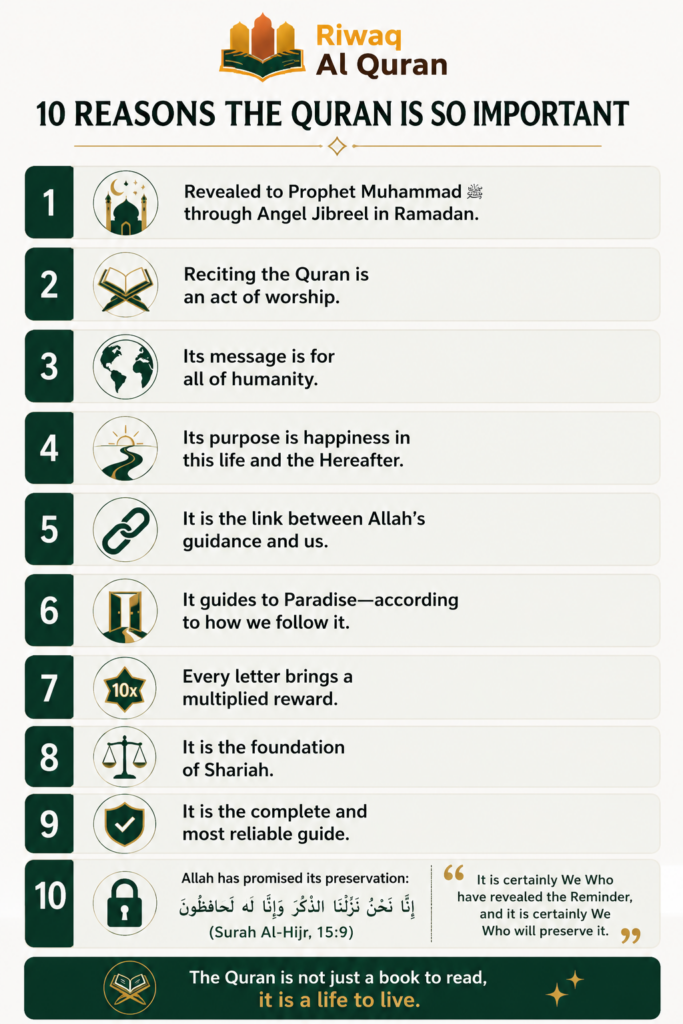
10 Reasons the Quran Holds Central Importance in Islam
Beyond the direct evidence covered above, ten distinct reasons explain why the Quran occupies the central place it does in Islamic life — each one grounded in a specific verse or hadith, not general sentiment.
1. It Was Revealed Through the Angel Jibreel During Ramadan
The Quran’s own revelation is tied to a specific, named month, not a vague point in history. Allah states directly:
(شَهْرُ رَمَضَانَ الَّذِي أُنزِلَ فِيهِ الْقُرْآنُ)
“The month of Ramadan is the one in which the Quran was revealed.” (Surah Al-Baqarah, 2:185)
This isn’t incidental detail — it’s the reason Ramadan carries the specific weight it does in Islamic practice. What this connection shapes in practice:
- The revelation unfolded gradually over roughly 23 years, with Ramadan marking the yearly anniversary of that first moment — a renewal of the relationship between a believer and the text, not just a calendar date.
- Taraweeh prayers are built around progressing through the entire Quran across the month’s nights.
- Completing a full reading (a Khatm) is deliberately timed to Ramadan specifically, echoing the month revelation itself began in.
2. Reciting the Quran Is Itself an Act of Worship
Unlike reading a book for information, reciting the Quran carries its own dedicated reward structure independent of prayer. The Prophet ﷺ made this explicit:
(مَنْ قَرَأَ حَرْفًا مِنْ كِتَابِ اللَّهِ فَلَهُ بِهِ حَسَنَةٌ وَالْحَسَنَةُ بِعَشْرِ أَمْثَالِهَا)
“Whoever recites a letter from the Book of Allah will be credited with a good deed, and a good deed is multiplied tenfold.” (Jami’ at-Tirmidhi 2910)
What this means in practice:
- It’s part of why memorization and recitation practice begins early, rather than waiting until full comprehension is possible.
- The reward attaches to reciting the Quran’s own Arabic wording specifically, not to absorbing its content through any means.
- Reading a translation to understand meaning is valuable and encouraged, but scholars note it doesn’t carry this same letter-based reward.
This is why recitation is treated as worship even without full comprehension in the moment — a child reciting Al-Fatihah, or an adult still learning Arabic, still earns this multiplied reward for every letter pronounced.
Here’s what that sustained relationship with recitation can build toward over time:
3. Its Message Is Addressed to All of Humanity
The Quran does not present itself as guidance for one nation or era. Allah describes its purpose in universal terms:
(تَبَارَكَ الَّذِي نَزَّلَ الْفُرْقَانَ عَلَىٰ عَبْدِهِ لِيَكُونَ لِلْعَالَمِينَ نَذِيرًا)
“Blessed is He who sent down the Criterion upon His Servant that he may be a warner to all the worlds.” (Surah Al-Furqan, 25:1)
“All the worlds” (al-‘alamin) is a deliberately broad term. This universality shows up structurally in the Quran itself:
- The Quran positions itself as the final chapter of that same continuous message, not an unrelated, separate revelation.
- It repeatedly addresses “O mankind” (يا أيها الناس), not only “O believers.”
- It references prophets sent to different nations across history — Musa to the Israelites, Nuh to his people, Hud to ‘Ad.
4. Its Stated Purpose Is Happiness in This Life and the Hereafter
The Quran ties following its guidance to a tangible outcome in this world, not only a reward deferred to the afterlife:
(مَنْ عَمِلَ صَالِحًا مِّن ذَكَرٍ أَوْ أُنثَىٰ وَهُوَ مُؤْمِنٌ فَلَنُحْيِيَنَّهُ حَيَاةً طَيِّبَةً)
“Whoever does righteousness, whether male or female, while being a believer, We will surely cause him to live a good life.” (Surah An-Nahl, 16:97)
Worth noting about this verse:
- This means a believer can experience this promised good life even through hardship, not only in comfortable conditions.
- It deliberately addresses both genders explicitly, removing ambiguity about whether the promise applies equally.
“A good life” (hayatan tayyibah) is generally read as contentment, inner peace, and barakah — not wealth or ease specifically.
5. It Serves as the Direct Link Between Allah’s Guidance and Human Understanding
The Quran describes itself, from its opening chapter, as guidance without ambiguity:
(ذَٰلِكَ الْكِتَابُ لَا رَيْبَ ۛ فِيهِ ۛ هُدًى لِّلْمُتَّقِينَ)
“This is the Book about which there is no doubt, a guidance for those conscious of Allah.” (Surah Al-Baqarah, 2:2)
Two details worth drawing out:
- The verse specifies who draws the fullest guidance from it: al-muttaqin, those mindful of Allah — a description of depth of benefit, not a restriction on who may read it.
- “No doubt” is stated about the text itself, not about how individuals interpret it — the certainty attaches to the Quran’s role as guidance.
6. It Functions as a Guide Toward Paradise, Tied to How Closely It’s Followed
The Quran describes its own guiding function in specific, active terms:
(إِنَّ هَٰذَا الْقُرْآنَ يَهْدِي لِلَّتِي هِيَ أَقْوَمُ وَيُبَشِّرُ الْمُؤْمِنِينَ الَّذِينَ يَعْمَلُونَ الصَّالِحَاتِ أَنَّ لَهُمْ أَجْرًا كَبِيرًا)
“Indeed, this Quran guides to that which is most suitable and gives good tidings to the believers who do righteous deeds that they will have a great reward.” (Surah Al-Isra, 17:9)
Key points from this verse:
- Classical scholars read this as an implicit invitation to compare Quranic guidance against alternatives, rather than accept it passively.
- The reward described is conditioned specifically on righteous deeds following the guidance, not on exposure to the text alone.
- “Guides to that which is most suitable” (allati hiya aqwam) is a comparative claim — not just a good path, but the most upright one among available options.
7. Every Letter Recited Carries a Documented, Multiplied Reward
This reason is established through the same hadith cited in reason 2 — the Prophet’s ﷺ insistence that a three-letter combination like Alif-Lam-Mim be counted as three separate letters, not one (Jami’ at-Tirmidhi 2910). What this means in practical terms:
Completing even a partial reading represents a substantial, quantifiable act of worship — a detail that gives structure to students working through a Khatm over weeks or months.
- No part of the Quran, however small on the page, is treated as too minor to carry weight.
- The Quran contains roughly 320,000 letters across its text, each carrying this tenfold reward when recited sincerely.
8. It Forms the Basis of Shariah, the Framework of Islamic Law and Ethical Conduct
The Quran describes the Prophet ﷺ as placed directly on a defined legal and ethical path:
(ثُمَّ جَعَلْنَاكَ عَلَىٰ شَرِيعَةٍ مِّنَ الْأَمْرِ فَاتَّبِعْهَا)
“Then We put you, [O Muhammad], on an ordained way concerning the matter of religion, so follow it.” (Surah Al-Jathiyah, 45:18)
Background worth knowing:
- That root meaning is why Islamic law is framed as a source of guidance and relief rather than restriction alone.
- The word shari’ah is the same term that gives Islamic law its name.
- It originally referred to a clear path leading to a water source — something followed with confidence to reach what sustains life.
9. It Is the Complete and Most Reliable Guide for Living in Accordance With Allah’s Pleasure
The Quran describes its own scope as comprehensive rather than partial:
(مَّا فَرَّطْنَا فِي الْكِتَابِ مِن شَيْءٍ)
“We have not neglected in the Register a thing.” (Surah Al-An’am, 6:38)
How scholars read this claim:
- Not as a claim that every specific ruling is spelled out explicitly.
- Rather, that the principles needed to derive guidance for any situation are present, directly or through the framework the Quran establishes.
- This is why Islamic legal scholarship (fiqh) remains an ongoing discipline — new questions (like digital contracts) are addressed by extending established Quranic principles, not by inventing guidance disconnected from the text.
10. Allah Has Promised Its Preservation Until the Day of Judgment
Unlike earlier scriptures, which Islamic teaching holds were altered over time, the Quran carries a direct divine guarantee of preservation:
(إِنَّا نَحْنُ نَزَّلْنَا الذِّكْرَ وَإِنَّا لَهُ لَحَافِظُونَ)
“It is certainly We Who have revealed the Reminder, and it is certainly We Who will preserve it.” (Surah Al-Hijr, 15:9)
What this preservation looks like in practice:
- The Quran’s text has remained unchanged since its compilation, distinct from claims about the preservation of earlier revealed books.
- Millions of Muslims today have memorized the Quran in full, forming a living, human chain of transmission alongside the written text — a practical expression of this promise passed down generation after generation.
- Preservation isn’t attributed only to the written text — it’s also carried by an unbroken oral tradition of memorization since the Prophet’s ﷺ lifetime.
Why Does the Quran Hold Special Importance During Ramadan?
Ramadan carries a specific, documented connection to the Quran that goes beyond it simply being the month of revelation — a connection built into the Quran’s own text, reinforced by the Prophet’s ﷺ documented practice in his final year, and still shaping how Muslims engage with the Quran during this month today.
Allah names this connection directly, rather than leaving it to tradition alone:
(شَهْرُ رَمَضَانَ الَّذِي أُنزِلَ فِيهِ الْقُرْآنُ هُدًى لِّلنَّاسِ وَبَيِّنَاتٍ مِّنَ الْهُدَىٰ وَالْفُرْقَانِ)
“The month of Ramadan is the one in which the Quran was revealed, as guidance for the people, and as clear proofs of that guidance, and as the criterion between right and wrong.” (Surah Al-Baqarah, 2:185)
1. The Month the Quran Was First Revealed
Ramadan’s significance begins with the Quran’s own revelation during this month, which is the foundation for why recitation, reflection, and study of the Quran intensify specifically during this time rather than year-round at the same pace.
2. The Prophet’s ﷺ Final Ramadan
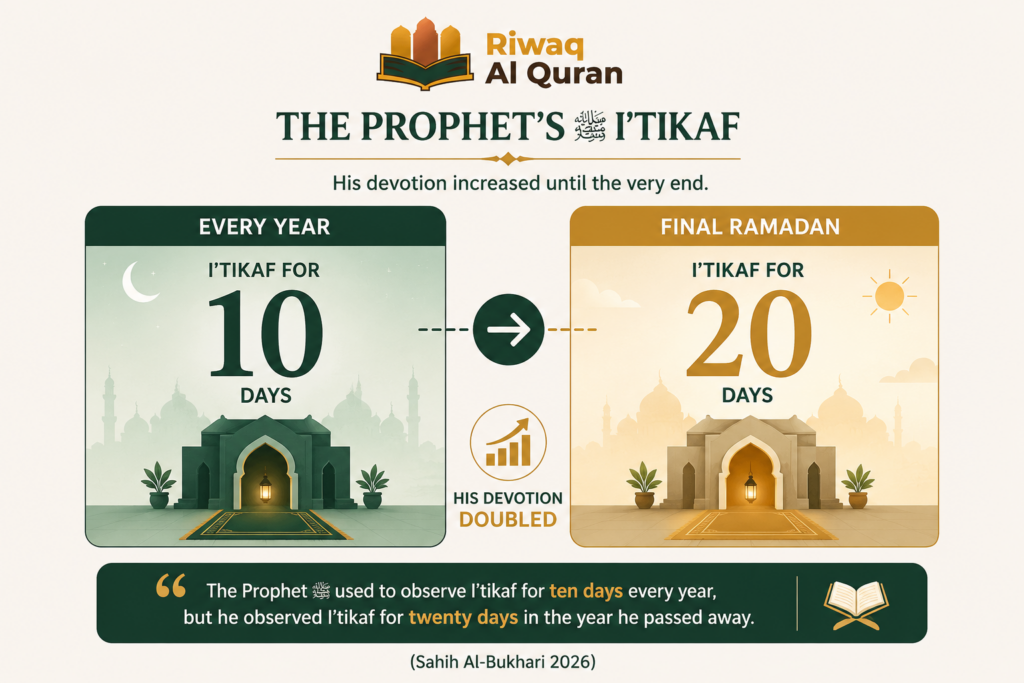
Abu Hurairah narrated: “Jibreel used to revise the Quran with the Prophet ﷺ once every year, but he revised it with him twice in the year he passed away. The Prophet ﷺ used to stay in I’tikaf for ten days every year in Ramadan, but in the year of his death, he stayed in I’tikaf for twenty days” (Sahih al-Bukhari).
Abu Hurairah narrated a detail from the Prophet’s ﷺ own final year that scholars treat as especially significant:
(كَانَ جِبْرِيلُ يَعْرِضُ عَلَى النَّبِيِّ صَلَّى اللَّهُ عَلَيْهِ وَسَلَّمَ الْقُرْآنَ مَرَّةً فِي كُلِّ عَامٍ، فَعَرَضَ عَلَيْهِ مَرَّتَيْنِ فِي الْعَامِ الَّذِي قُبِضَ فِيهِ، وَكَانَ يَعْتَكِفُ فِي كُلِّ عَامٍ عَشْرًا، فَاعْتَكَفَ فِي الْعَامِ الَّذِي قُبِضَ فِيهِ عِشْرِينَ)
“Jibreel used to revise the Quran with the Prophet ﷺ once every year, but he revised it with him twice in the year he passed away. The Prophet ﷺ used to stay in I’tikaf for ten days every year in Ramadan, but in the year of his death, he stayed in I’tikaf for twenty days.” (Sahih al-Bukhari 4998)
This detail — the Prophet ﷺ doubling both his Quran revision and his time in seclusion in his final year — is treated by scholars as a sign of how directly tied Ramadan is to deepening one’s relationship with the Quran specifically, not just increasing general worship.
This is also why many Muslims specifically aim to complete a full reading of the Quran (a Khatm) during Ramadan, and why Taraweeh prayers are structured around progressively reciting through the entire Quran across the month’s nights.
This deepened connection during Ramadan is exactly what our own annual competition is built around:
How the Prophet Muhammad ﷺ Embodied the Quran’s Teachings?
The clearest evidence of the Quran’s practical importance is that it was lived out completely by one person, in a way that’s directly documented rather than assumed.
a. Described Directly in the Quran
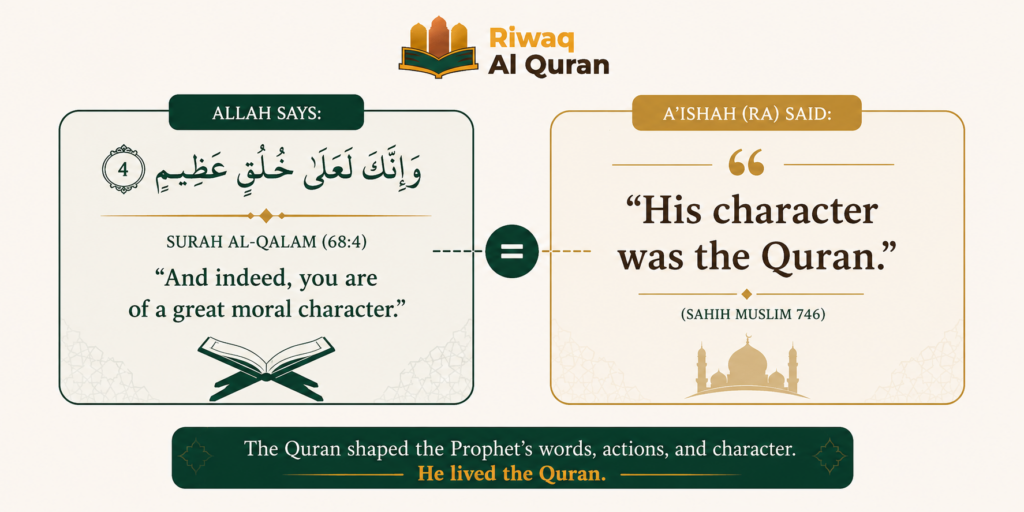
Allah describes the Prophet ﷺ directly: وَإِنَّكَ لَعَلَىٰ خُلُقٍ عَظِيمٍ (Surah Al-Qalam, 68:4) — “And indeed, you are of a great moral character.” This is not a general compliment; it’s Allah confirming, within the text itself, that the Prophet’s ﷺ conduct matched the standard the Quran sets.
b. Confirmed Directly by Aisha’s Testimony
When Aisha (may Allah be pleased with her) was asked to describe the Prophet’s ﷺ character, her answer was direct rather than descriptive: “His character was the Quran” (recorded in Al-Adab Al-Mufrad 308, and similarly in Sahih Muslim).
This is a significant claim — it means every teaching, value, and instruction in the Quran had a living, observable example in exactly how the Prophet ﷺ conducted himself.
This connection is easiest to see in specific, everyday traits the Quran itself commands and the Prophet ﷺ is reported to have visibly practiced:
- Honesty in speech and dealings, even when it was inconvenient.
- Patience with people who mistreated or insulted him.
- Mercy toward children, the poor, and the vulnerable.
- Fairness in judgment, regardless of a person’s social standing.
- Humility despite his status as the final Messenger.
If you’d like to explore how specific Quranic teachings connect to the Prophet’s ﷺ actual conduct in more depth, Online Tafseer Course traces these themes across the Quran verse by verse with a qualified instructor, rather than leaving verses to be read in isolation.
And since understanding meaning starts with reading the text itself correctly, Noorani Qaida Online builds that foundational reading skill for anyone still working on it.
Build a Real, Daily Connection to the Quran With Riwaq Al Quran
Knowing the Quran’s importance is one thing — building consistent time with it into a busy life is another. Riwaq Al Quran is a comprehensive online platform offering personalized Quran, Arabic, and Islamic Studies classes for individuals of all ages and backgrounds.
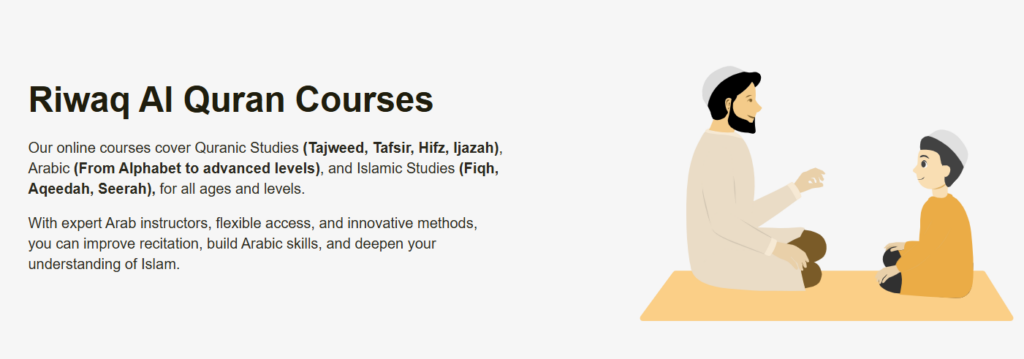
Experienced instructors follow a structured curriculum covering Tajweed, Tafsir, and Memorization, with advanced online classes that allow seamless, real-time interaction between students and teachers.
Whether you’re just starting to read Arabic or want to strengthen your family’s connection to the Quran together, there’s a course built for that stage:
- Online Tafseer Course — go deeper into Quranic meaning and context
- Noorani Qaida Online — build the foundational reading skills that come before fluent recitation
- Online Quran Recitation Course — enhance recitation skills with expert-led instruction
- Online Tajweed Classes — master the rules for correct, beautiful recitation
- Quran Memorization Online Course — memorize the Quran with a specialized, structured program
- Online Qirat Course — explore the diverse styles of Quranic recitation
- Online Quran Classes for Kids — build a love for the Quran early, through interactive lessons
Arabic Language, Ijazah, and Islamic Studies programs are also available for those looking to deepen their study beyond recitation alone.
Conclusion
The Quran’s importance isn’t a vague spiritual truth — it’s specific, and the specifics are what make it actionable.
- It describes its own purpose directly. Not as one resource among many, but as light guiding a person out of darkness: قَدْ جَاءَكُم مِّنَ اللَّهِ نُورٌ وَكِتَابٌ مُّبِينٌ (Surah Al-Ma’idah, 5:15)
- “There has come to you from Allah a light and a clear Book.”
- It was lived, not just recited. When Aisha was asked to describe the Prophet ﷺ, she didn’t reach for adjectives — she said his character was the Quran. That’s not a compliment; it’s a claim that every teaching in this book had a walking, breathing example.
- It rewards precision, not just effort. A single letter, multiplied tenfold — and the Prophet ﷺ insisted on counting Alif, Lam, and Mim as three separate letters rather than one, just to make sure nothing was undervalued.
- And it intensifies with the calendar. The Prophet ﷺ doubled his Quran revision and his seclusion in his final Ramadan — a detail scholars read as deliberate, not incidental.
None of this asks you to feel something vague about the Quran’s importance. It asks you to follow it, recite it, and let it guide decisions the way its own verses describe — mercy tied to following it, not just admiring it from a distance.
FAQs
These are the questions people most often ask once they understand the Quran’s central role and want to apply it more consistently in daily life.
What does the Quran say about its own importance?
The Quran describes itself as a blessed Book to be followed for mercy (Surah Al-An’am, 6:155) and as a light guiding believers out of darkness onto a straight path (Surah Al-Ma’idah, 5:15), framing itself as active guidance rather than a passive text.
What is the reward for reciting the Quran?
The Prophet ﷺ stated that reciting even a single letter from the Quran earns a good deed multiplied tenfold, specifying that a combination like Alif-Lam-Mim counts as three separate letters and rewards, not one (Jami’ at-Tirmidhi 2910).
How did the Prophet Muhammad embody the Quran’s teachings?
Aisha described the Prophet’s ﷺ character directly as “the Quran” itself (Al-Adab Al-Mufrad 308), meaning his conduct served as a living example of the Quran’s teachings rather than a separate interpretation of them.
Why is the Quran especially important during Ramadan?
Ramadan is the month the Quran was revealed, and the Prophet ﷺ is reported to have doubled both his Quran revision with the Angel Jibreel and his time in I’tikaf during the final Ramadan of his life (Sahih al-Bukhari), which scholars treat as a sign of the month’s specific tie to deepening one’s connection to the Quran.
Is reading the Quran considered an act of worship in Islam?
Yes, reciting the Quran is considered worship in itself, separate from prayer, which is why it carries its own specific reward structure tied to every letter recited.