
Reciting the Quran daily gives you guidance for life’s decisions, answers to its deepest questions, spiritual healing, and a reward system described in specific terms across the Quran and authentic Hadith. This isn’t a vague spiritual boost — each of these benefits ties back to a specific verse or hadith, not general sentiment.
This guide walks through nine distinct benefits of daily Quran recitation, then covers how much to read, which Surahs are worth prioritizing, and the manners that make the practice more meaningful.
Building a real relationship with the Quran requires a daily portion of it, not occasional reading. Each benefit below ties to a specific verse or hadith, starting with the most foundational.
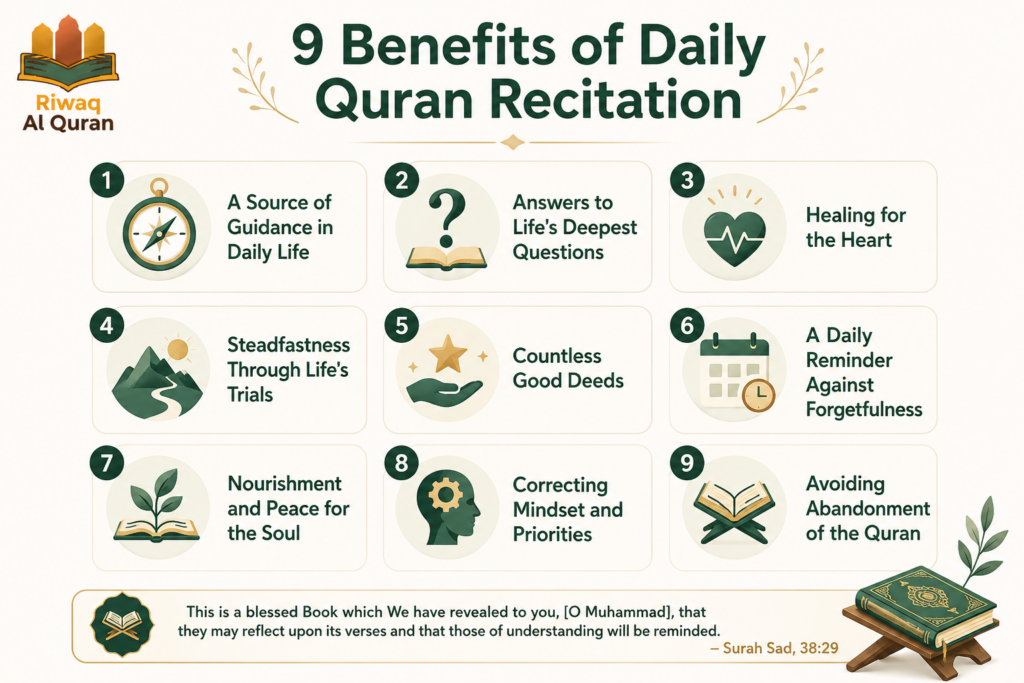
Table of Contents
1. Daily Quran Recitation Gives You a Source of Guidance in Daily Life
The Quran functions as practical guidance for avoiding harm and making sound decisions, not just abstract spiritual comfort. Allah describes this directly:
(لَقَدْ مَنَّ اللَّهُ عَلَى الْمُؤْمِنِينَ إِذْ بَعَثَ فِيهِمْ رَسُولًا مِّنْ أَنفُسِهِمْ يَتْلُو عَلَيْهِمْ آيَاتِهِ وَيُزَكِّيهِمْ وَيُعَلِّمُهُمُ الْكِتَابَ وَالْحِكْمَةَ)
“Allah conferred great favor upon the believers when He sent among them a Messenger reciting to them His verses, purifying them, and teaching them the Book and wisdom.” (Surah Aal-i-Imran, 3:164)
Notice the order in this verse: reciting comes before purifying and teaching, not after. That sequence is worth sitting with — the Quran presents recitation itself as the starting mechanism for moral change, not simply a delivery method for facts to be absorbed separately.
This is exactly why guidance from the Quran is generally taught alongside application, for readers of any age, rather than treated as information to file away.

2. Daily Recitation Answers Life’s Deepest Questions
Reflecting on the Quran gives direct answers to questions people carry throughout their lives — the purpose of existence, human identity, and what real happiness looks like. Allah states this purpose plainly:
(وَمَا خَلَقْتُ الْجِنَّ وَالْإِنسَ إِلَّا لِيَعْبُدُونِ)
“I did not create jinn and humans except to worship Me.” (Surah Adh-Dhariyat, 51:56)
This verse answers the “why am I here” question directly rather than leaving it as an open philosophical debate, which is part of why it’s one of the most frequently cited verses in discussions of purpose in Islamic thought.
Scholars note the verse doesn’t restrict worship to ritual acts alone — classical commentary generally extends “worship” (ʿibadah) to include any action done with sincere intention toward Allah, including honest work, caring for family, and seeking knowledge, which broadens this answer well beyond the five daily prayers alone.
This is exactly the question Surah Adh-Dhariyat answers directly — here’s a short reflection on it:
3. The Daily Recitation Brings Healing for the Heart
The Quran describes itself as a source of healing specifically for believers who approach it with sincerity. Allah says:
(وَنُنَزِّلُ مِنَ الْقُرْآنِ مَا هُوَ شِفَاءٌ وَرَحْمَةٌ لِّلْمُؤْمِنِينَ وَلَا يَزِيدُ الظَّالِمِينَ إِلَّا خَسَارًا)
“And We send down of the Quran that which is healing and mercy for the believers, but it does not increase the wrongdoers except in loss.” (Surah Al-Isra, 17:82)
The condition attached here matters: the healing effect is tied to sincere belief, not the act of reading alone. This is why the same verse pairs healing with loss for wrongdoers — the words themselves don’t change, only the disposition of the person reciting them.
This dual meaning of “healing” — spiritual and, in the view of many scholars, sometimes physical — is also the basis for Ruqyah, the practice of reciting specific verses for protection and relief, though that practice rests on its own separate set of conditions beyond daily recitation alone.
4. Recitation Daily Brings Healing for the Heart
Reciting the Quran with reflection builds resilience specifically because of how it was revealed — gradually, over 23 years, rather than all at once. Allah explains the reasoning directly, responding to an objection early disbelievers raised:
(وَقَالَ الَّذِينَ كَفَرُوا لَوْلَا نُزِّلَ عَلَيْهِ الْقُرْآنُ جُمْلَةً وَاحِدَةً كَذَٰلِكَ لِنُثَبِّتَ بِهِ فُؤَادَكَ وَرَتَّلْنَاهُ تَرْتِيلًا)
“And those who disbelieve say, ‘Why was the Quran not revealed to him all at once?’ Thus it is that We may strengthen thereby your heart, and We have spaced it distinctly.” (Surah Al-Furqan, 25:32)
This verse directly answers that objection with a mechanism, not just a defense: gradual revelation was designed specifically to build steadiness over time, responding to real events as they unfolded rather than delivering abstract instruction in one sitting.
Daily recitation mirrors that same gradual, cumulative structure — a small portion absorbed repeatedly builds resilience in a way a single large reading doesn’t, which is part of why scholars generally advise against treating a once-a-year Ramadan reading as a substitute for a daily habit.
5. Daily Recitation Builds Steadfastness Through Life’s Trials
Every letter recited earns a specific, multiplied reward. The Prophet ﷺ said:
(مَنْ قَرَأَ حَرْفًا مِنْ كِتَابِ اللَّهِ فَلَهُ بِهِ حَسَنَةٌ، وَالْحَسَنَةُ بِعَشْرِ أَمْثَالِهَا، لَا أَقُولُ الم حَرْفٌ، وَلَكِنْ أَلِفٌ حَرْفٌ، وَلَامٌ حَرْفٌ، وَمِيمٌ حَرْفٌ)
“Whoever reads a letter from the Book of Allah will be credited with a good deed, and a good deed gets a tenfold reward. I do not say that Alif-Lam-Meem is one letter — rather, Alif is a letter, Lam is a letter, and Meem is a letter.” (Jami’ at-Tirmidhi 2910, graded Sahih)
This reward isn’t limited to fluent reciters:
(مَثَلُ الَّذِي يَقْرَأُ الْقُرْآنَ وَهُوَ حَافِظٌ لَهُ مَعَ السَّفَرَةِ الْكِرَامِ الْبَرَرَةِ وَمَثَلُ الَّذِي يَقْرَأُ الْقُرْآنَ وَهُوَ يَتَعَاهَدُهُ وَهُوَ عَلَيْهِ شَدِيدٌ فَلَهُ أَجْرَانِ)
“The one proficient in reciting the Quran will be with the honorable, obedient angels, and the one who finds it difficult and still stammers through it will have a double reward.” (Sahih al-Bukhari 4937; Sahih Muslim 798)
Taken together, these two hadith cover the full range of ability: the beginner struggling through unfamiliar Arabic is not just tolerated but explicitly rewarded twice, while a fluent reciter is placed in the company of angels. There’s no version of daily recitation, at any skill level, that this reward structure excludes.
If building real recitation proficiency — rather than guessing at pronunciation alone — is something you want structured guidance on, Riwaq Al Quran‘s Online Tajweed Classes pair you with an instructor who corrects you letter by letter.
6. A Daily Reminder Against Forgetfulness
Human nature tends toward forgetting, and the Quran describes this as part of the human condition since Adam, whose story of forgetting the original command is narrated directly in a well-known hadith about a disagreement between Adam and Musa:
(قَالَ آدَمُ لِمُوسَى: أَنْتَ مُوسَى الَّذِي اصْطَفَاكَ اللَّهُ بِرِسَالَتِهِ وَبِكَلَامِهِ، ثُمَّ تَلُومُنِي عَلَى أَمْرٍ قَدَّرَهُ اللَّهُ عَلَيَّ قَبْلَ أَنْ يَخْلُقَنِي بِأَرْبَعِينَ عَامًا؟ فَحَجَّ آدَمُ مُوسَى)
“Adam said to Musa: You are the one Allah favored with His message and His speech, yet you blame me for a matter Allah decreed upon me forty years before He created me? So Adam prevailed over Musa in the argument.” (Sahih al-Bukhari 6614; Sahih Muslim 2652)
Allah addresses this same tendency toward forgetting directly, in a verse commentators often cite as a built-in corrective:
(وَاذْكُر رَّبَّكَ إِذَا نَسِيتَ)
“And remember your Lord when you forget.” (Surah Al-Kahf, 18:24)
This instruction assumes forgetfulness as a given, not a failure — the corrective isn’t self-blame, it’s returning to remembrance the moment lapse is noticed.
Daily recitation functions as exactly this kind of built-in return mechanism, rather than a one-time fix for a permanent human tendency.
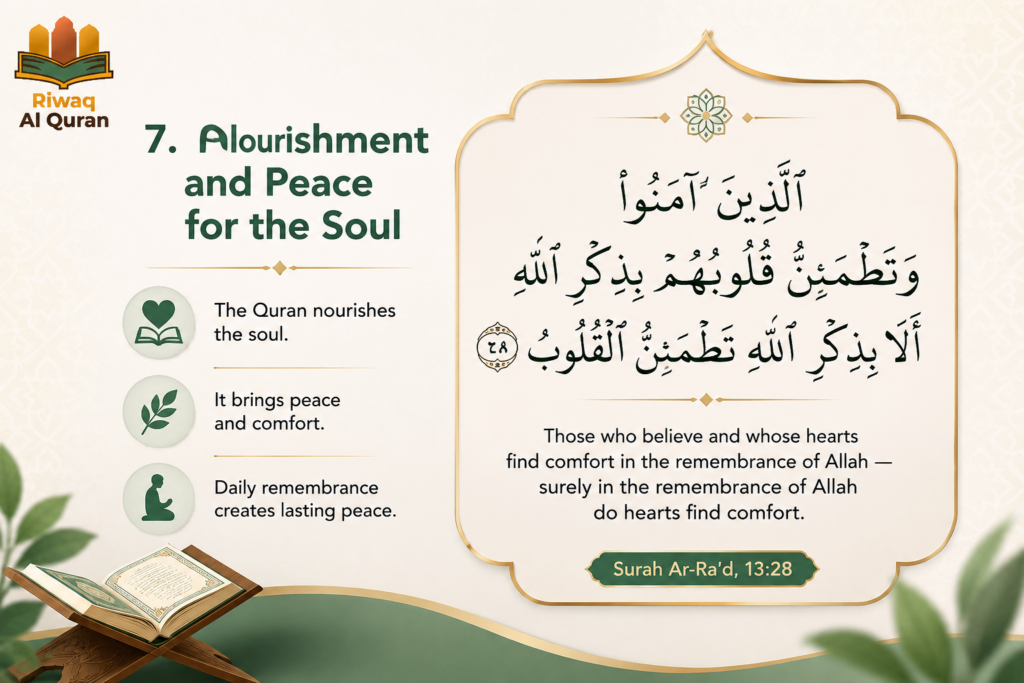
7. The Daily Recitation Brings Nourishment and Peace for the Soul
Just as the body needs food, the soul needs the Quran to stay grounded — and this isn’t a metaphor scholars invented, it’s the effect the Quran attributes to remembrance of Allah directly:
(الَّذِينَ آمَنُوا وَتَطْمَئِنُّ قُلُوبُهُم بِذِكْرِ اللَّهِ ۗ أَلَا بِذِكْرِ اللَّهِ تَطْمَئِنُّ الْقُلُوبُ)
“Those who believe and whose hearts find comfort in the remembrance of Allah — surely in the remembrance of Allah do hearts find comfort.” (Surah Ar-Ra’d, 13:28)
This same daily connection is what reduces the sense of unease that comes from a busy or stressful day, since the reassurance comes from returning to the same source consistently rather than occasionally — a single reading during a crisis doesn’t produce the same effect as verses already familiar from daily practice, since recognition itself is part of what settles the mind.
8. A Daily Recitation Corrects Mindset and Priorities
Regular recitation trains you to view difficulty with patience rather than panic, by repeatedly re-anchoring your priorities to what actually matters. Allah states, addressing Adam and Hawwa directly after their descent from Paradise:
(قَالَ اهْبِطَا مِنْهَا جَمِيعًا بَعْضُكُمْ لِبَعْضٍ عَدُوٌّ فَإِمَّا يَأْتِيَنَّكُم مِّنِّي هُدًى فَمَنِ اتَّبَعَ هُدَايَ فَلَا يَضِلُّ وَلَا يَشْقَىٰ)
“Whoever follows My guidance will neither go astray in this life nor suffer in the next.” (Surah Ta-Ha, 20:123)
This verse ties two distinct outcomes — not going astray in this life, and not suffering in the next — directly to the same single condition of following guidance, which is why scholars often cite it as evidence that worldly and spiritual well-being aren’t separate tracks requiring separate effort.
9. Recitation Daily Protects Against Abandoning the Quran
The Quran records the Prophet’s ﷺ own complaint about those who neglect it:
(وَقَالَ الرَّسُولُ يَا رَبِّ إِنَّ قَوْمِي اتَّخَذُوا هَٰذَا الْقُرْآنَ مَهْجُورًا)
“And the Messenger has said: ‘O my Lord, indeed my people have taken this Quran as a thing abandoned.'” (Surah Al-Furqan, 25:30)
Abandonment here isn’t a single, obvious act — the classical scholar Ibn al-Qayyim, in Al-Fawa’id, described several distinct forms it can take: not believing in the Quran at all, not reciting it, not reflecting on its meaning, not acting on its rulings, and not seeking healing and guidance from it specifically when facing hardship.
A person can avoid the first form entirely (genuine disbelief) while still falling into any of the other four — which is why “abandonment” is a broader risk than simply never opening the Mus-haf, and why daily recitation alone doesn’t fully guard against it unless paired with reflection and application.
This kind of reflection — connecting a verse’s context to how it applies practically — is exactly what Riwaq Al Quran‘s Online Tafseer Course is built around, rather than reading translation alone.
Recommended for you:14 Benefits and Rewards of Listening to the Holy Quran
How Much Quran Should You Read Each Day?
Islam doesn’t set one fixed daily portion — the right amount depends on your own capacity and schedule, but the Prophet’s ﷺ own guidance sets a useful range.
There’s No Fixed Minimum, But There Is a Maximum
The Prophet ﷺ taught his companions to complete the Quran at least once a month, meaning roughly one Juz’ (30th) daily.
When Abdullah ibn Amr pushed to complete it faster, the Prophet ﷺ progressively allowed down to seven days, but drew a firm line at three: “He who recites the Quran in less than three days does not understand it” (Sunan Abu Dawood, Hadith 1390).
The reasoning behind this ceiling is worth knowing, not just the rule itself — reading too fast to actually reflect on the meaning defeats part of the purpose of recitation, even though the reward for the letters recited still applies.
Read more: Why Is the Quran Important to Muslims?
Which Surahs Are Recommended for Daily Recitation?
Several Surahs carry specific, documented virtues tied to daily or nightly recitation, according to authentic Hadith:
- Surah Al-Mulk is described as protection from the punishment of the grave.
- Surah Al-Waqi’ah is associated with protection from poverty.
- The final two verses of Surah Al-Baqarah are described as sufficient protection for the night.
- Surah Al-Ikhlas, Al-Falaq, and An-Nas are recommended every morning, evening, and before sleep for comprehensive protection.
Manners of Reciting the Quran
When a Muslim recites the holy Quran, his recitation is recommended to be accompanied by different manners and etiquette of reading the book of Allah. How you recite shapes how much you get from it — a small set of manners, split between the heart and the body, make the difference.
Here are some of the manners that can make your heart more attached to the Creator:
1. Manners of the Heart
- Understanding the meaning and origin of the words, not just pronouncing them.
- Being fully present rather than reciting on autopilot.
- Reflecting on and personalizing each message as it applies to your own life.
2. Manners of the Body
- Reciting in a state of physical and spiritual purity, in a clean place.
- Seeking refuge from Shaytan and beginning with the Basmalah.
- Avoiding interrupting recitation to talk unnecessarily.
- Pausing at verses of warning to seek Allah’s protection.
Manners are half the practice — getting the recitation itself right is the other half, and here’s a quick look at why that specifically matters.
If you want to learn the manners and etiquette of reciting the Quran, this article will help you to Learn to Read the Quran Properly while knowing the etiquette of reciting it. You can also join our Tafseer classes and learn the Tafseer of the Quran effectively with us to help you reflect and ponder the meaning.
Herse’s context to how it applies practically — is exactly what Riwaq Al Quran‘s Online Tafseer Course is built around, rather than reading translation alone.
Start Your Recitation Journey With Riwaq Al Quran
Knowing these benefits is one step — reciting with correct Tajweed, real understanding, and consistency is what turns them from theory into practice.
Riwaq Al Quran is a comprehensive online platform that offers personalized Quran, Arabic, and Islamic Studies online classes for individuals of all ages and backgrounds. Their experienced instructors use a structured curriculum to cover Tajweed, Tafsir, and Memorization, providing easy and effective access to learning the Quran.


The advanced online classes allow for seamless communication and interaction between students and teachers. Join Riwaq Al Quran for a deeper connection with the Quran.
We offer several courses such as:
- Online courses for kids.
- Online Quran classes for kids and adults.
- Online Arabic courses.
- Online Ijazah courses.
- Online Islamic Studies courses.


Here are a sample of our set of Quran Courses that will be helpful for you:
- Online Tafseer Course: Delve into Quranic meanings with our insightful online Tafseer course.
- Noorani Qaida Online: Learn Quranic basics efficiently through our Noorani Qaida online program.
- Online Quran Recitation Course: Enhance Quranic recitation skills through our expert-led online course.
- Online Tajweed Classes: Master Tajweed rules for beautiful Quranic recitation in online classes.
- Quran Memorization Online Course: Memorize the Quran effectively with our specialized online memorization course.
- Online Qirat Course: Explore diverse Qirat styles with our comprehensive online Qirat course.
- Online Quran Classes for Kids: Nurture a love for the Quran in kids through interactive online classes.

Conclusion
Nine benefits, and not one of them is a feeling — each one is a specific verse or hadith, which is exactly why this list holds up under scrutiny instead of collapsing into vague sentiment.
Guidance for decisions you’re actually facing. Answers to the questions every person carries. Healing conditioned on sincerity, not just the act of reading. Steadfastness built the same way the Quran itself was revealed — gradually, so it could be absorbed rather than skimmed.
- A reward counted letter by letter, precise enough that the Prophet ﷺ refused to let three letters pass as one.
- A pull back from the same forgetfulness that reaches all the way back to Adam. Peace for the soul the same way food sustains the body.
- A correction to what you treat as urgent versus what actually matters.
- And a warning — spoken by the Prophet ﷺ himself — against letting this book become something abandoned rather than lived with.
Allah’s own reassurance ties directly to the habit itself, not the volume of it: أَلَا بِذِكْرِ اللَّهِ تَطْمَئِنُّ الْقُلُوبُ , (Surah Ar-Ra’d, 13:28),”Surely in the remembrance of Allah do hearts find comfort.”
There’s no fixed daily minimum, and there’s a real ceiling on speed — three days, no faster, because reflection has to keep pace with recitation. Between those two limits sits the entire benefit of this practice. Pick a pace inside them, and hold it daily. That’s the only step left that these nine verses can’t take for you.
FAQs
The questions below cover specifics about daily recitation that come up often but deserve a direct answer of their own.
Can you benefit from reciting the Quran if you don’t understand Arabic?
Yes — recitation is an act of worship in itself, and a Muslim is rewarded for every letter pronounced regardless of comprehension, though striving to also understand the meaning (tadabbur) is strongly encouraged alongside it.
Why is reading the Quran during Ramadan especially rewarding?
Ramadan is the month the Quran was first revealed, and the reward for righteous deeds is multiplied during it; the Prophet ﷺ reviewed the entire Quran with the angel Jibril every Ramadan, making frequent recitation a heavily emphasized practice specifically in this month.
Are the benefits different if you read the Quran in translation instead of Arabic?
Reading in translation fulfills the duty of reflection (tadabbur) and builds real comprehension of Allah’s commands and guidance, but scholars generally distinguish this from the specific letter-based, tenfold reward tied to reciting the Quran’s Arabic wording itself.
Does reciting the Quran too quickly reduce its benefit?
Reciting the whole Quran in less than three days is discouraged, based on the Prophet’s ﷺ statement that doing so means the reader hasn’t properly understood it, even though the reward for each letter recited still applies regardless of pace.