Most children learn wudu by copying a parent at the sink, one splash at a time. That works, but it also means they pick up half-finished habits — a rushed rinse here, a skipped step there — that can be hard to unlearn later.
Wudu for kids is the practice of teaching children the Islamic ritual of ablution: washing specific parts of the body in a set order before prayer. It combines a physical skill (the steps), a mental habit (repeating it correctly every time), and a spiritual concept (preparing to stand before Allah in a state of purity).
The instruction to perform wudu comes directly from the Quran:
(يَا أَيُّهَا الَّذِينَ آمَنُوا إِذَا قُمْتُمْ إِلَى الصَّلَاةِ فَاغْسِلُوا وُجُوهَكُمْ وَأَيْدِيَكُمْ إِلَى الْمَرَافِقِ وَامْسَحُوا بِرُءُوسِكُمْ وَأَرْجُلَكُمْ إِلَى الْكَعْبَيْنِ)
“O you who believe, when you rise to pray, wash your faces and your hands up to the elbows, wipe your heads, and wash your feet up to the ankles.”(Surah Al-Ma’idah, Ayah 6)
This verse is the reason wudu follows a fixed order — it isn’t a custom that developed over time, it’s a direct instruction, which is worth explaining to children so they understand wudu as an act of obedience, not just a hygiene habit.
Wudu isn’t a standalone ritual — it’s the gateway to one of Islam’s Five Pillars. This short video breaks down what those five pillars are and where prayer fits among them:
This guide breaks wudu down into steps a child can actually follow, grounds each part in the Quran and authentic hadith so you can explain the “why” with real sources, gives you a printable checklist to use at home, and covers the mistakes most children make so you can catch them early — not after they’ve become habits.
Table of Contents
Wudu Steps for Kids, in Order
Wudu follows one consistent rule that makes it easy for children to remember: wash most parts three times, wipe the head and ears once. Teaching kids this “wash three, wipe once” pattern up front gives them a mental shortcut before they even learn the individual steps.
Water use matters too, and it’s a point worth teaching alongside the steps themselves. The Prophet ﷺ once passed by a companion, Sa’d, who was using a large amount of water for wudu, and said:
(مَا هَذَا السَّرَفُ؟ … نَعَمْ، وَإِنْ كُنْتَ عَلَىٰ نَهَرٍ جَارٍ؟)
“What is this extravagance?” Sa’d asked, “Is there extravagance (israf) in wudu?” He replied: “Yes, even if you are at a flowing river.” (Sunan Ibn Majah, Hadith 425)
Teaching kids to use a cupped handful of water per wash — not a running tap the whole time — turns this into a practical habit rather than just a rule, and it’s a detail most wudu guides skip entirely.
1. Making the Intention (Niyyah)
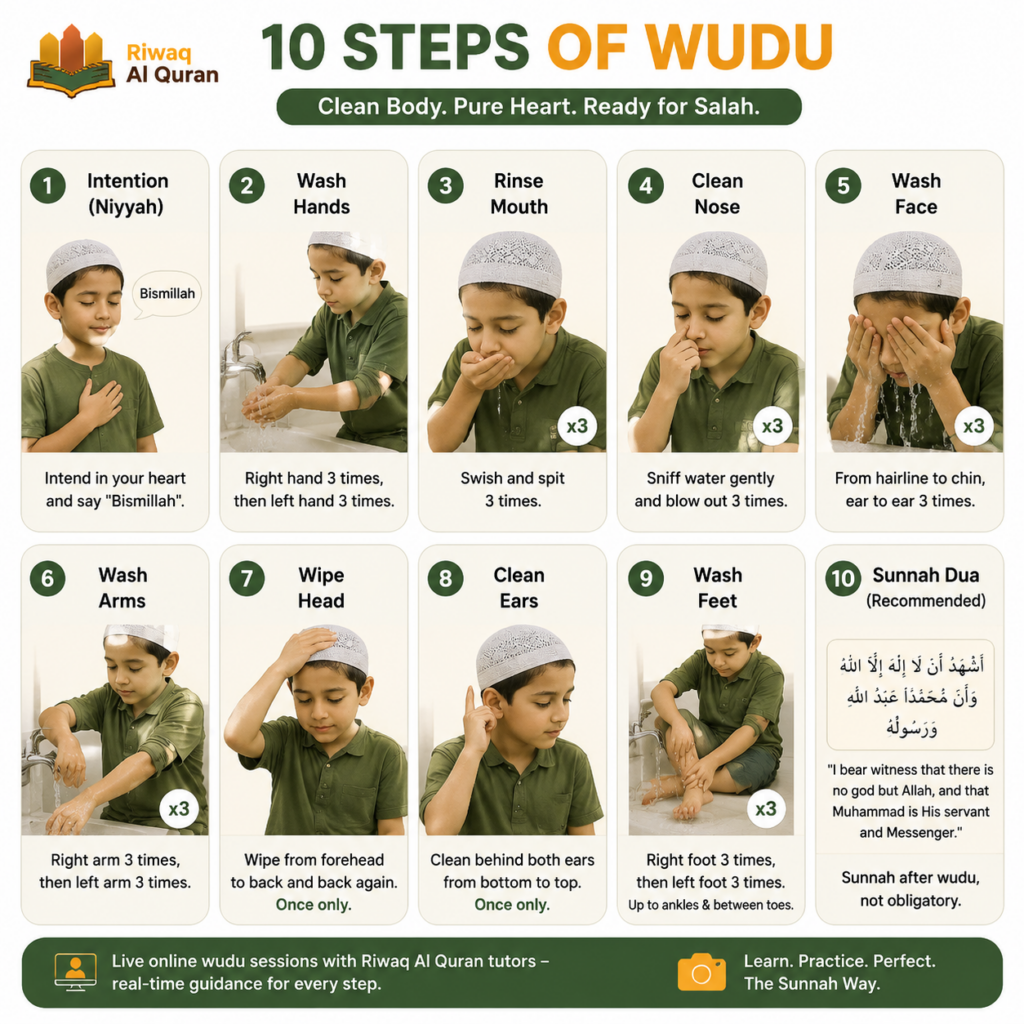
A child begins by silently intending in their heart to perform wudu for the sake of Allah, then says “Bismillah” out loud. The intention doesn’t need to be spoken in Arabic or memorized as a formula — a simple thought like “I’m doing wudu to pray” is enough.
These are two separate acts children often blend into one: the niyyah is the silent intention, and saying Bismillah is a spoken sunnah on top of it. If a child forgets to say Bismillah, the wudu is still valid — it’s a recommended addition, not a condition, which is worth explaining so kids don’t think they have to start over.
2. Washing the Hands
Using the left hand, wash the right hand three times, then use the right hand to wash the left hand three times. Water needs to reach between the fingers and up to the wrists — this is the step children most often rush, so it’s worth checking directly.
Rings and bracelets are the usual culprit when water doesn’t reach the skin underneath. Get children used to loosening or spinning a ring during this step, and keep nails trimmed — dirt or long polish trapped under a nail can block water from reaching the skin, which is a common question parents search for directly (“does nail polish break wudu”).
3. Rinsing the Mouth
Cup water in the right hand, bring it to the mouth, and swish it around the cheeks and teeth three times before spitting it out. This step doubles as a basic oral hygiene habit, which is a useful thing to point out to kids who ask “why.”
In cold weather, letting kids use lukewarm water for this step and the next one prevents the discomfort that makes children rush through both — a small adjustment that noticeably cuts down on shortcuts.
4. Cleaning the Nose
Cup a small amount of water in the right hand, sniff it gently into the nostrils, then blow it out gently. A light, controlled sniff is enough — there’s no need to inhale forcefully. Repeat three times. If a child struggles with inhaling water, wetting the fingers and wiping the lower part of the nostrils is an accepted alternative.
For children who are old enough to fast, this step needs one adjustment: avoid inhaling water deeply into the nose while fasting, since accidentally swallowing any of it can break the fast. A light rinse without deep inhalation is enough during fasting hours.
5. Washing the Face
Wash the face three times, from ear to ear and from the hairline to the chin, making sure water reaches the full width and length of the face each time.
Have kids close their eyes gently rather than squeezing them shut — a relaxed close lets water reach the eyelids and lashes without discomfort, which is usually what makes children flinch away from this step.
6. Washing the Arms
Wash the right arm from the wrist to the elbow three times using the left hand, then wash the left arm the same way using the right hand. No part of the forearm should stay dry.
The most commonly missed spot here isn’t the forearm — it’s the elbow joint itself. “Up to the elbows” means the elbow gets washed too, not just stopped at, and it’s worth pointing this out directly since kids naturally treat the elbow as a stopping line rather than a part to include.
7. Wiping the Head (Maseh)
Using wet hands, wipe the head once — from the forehead to the back of the head, then back again from the back of the head to the forehead. Unlike the earlier steps, this one is done a single time, not three.
For kids with thick or long hair, the goal is wetting the scalp near the hairline, not soaking every strand — maseh is a wipe, not a hair wash, and treating it as one just wastes water and time without adding anything required.
8. Cleaning the Ears
Using the thumbs, clean behind the ears once, moving from the bottom upward. This is usually done immediately after wiping the head, while the hands are still wet from that step.
The full technique uses both the thumb and index finger together: the index finger cleans inside the ear grooves while the thumb cleans behind the ear, in the same motion. Most guides only mention the thumb, which leaves out half the step.
9. Washing the Feet
Wash the right foot first, then the left, three times each, making sure water reaches up to the ankles and between every toe. Running the pinky finger between the toes is the easiest way to make sure no spot is missed — see why this specific spot matters so much in the mistakes section below.
One exception worth knowing for older kids: if socks were put on while already in a state of wudu, some scholars allow wiping over the socks (mash ‘ala al-khuffain) instead of washing the feet each time. This is a separate, more advanced ruling usually introduced after a child has the basic nine steps down, not during the first weeks of learning.
10. The Sunnah Dua After Wudu (Recommended, Not Obligatory)
Once the nine steps above are complete, wudu itself is already valid — this last part is a recommended addition, not a requirement. Teaching it to children anyway gives them a natural closing habit and a direct hadith to hold onto.
(أَشْهَدُ أَنْ لَا إِلَهَ إِلَّا اللَّهُ وَأَنَّ مُحَمَّدًا عَبْدُ اللَّهِ وَرَسُولُهُ)
“I bear witness that there is no god but Allah, and that Muhammad is His servant and Messenger.” — (Reported by ‘Umar ibn al-Khattab, Sahih Muslim 234a )
The same hadith states that saying this after completing wudu properly opens all eight gates of Paradise for the person to enter through whichever one they choose. It’s a short enough phrase that most children can memorize it within a few repetitions, and it gives the ritual a clear, memorable ending point.
Riwaq Al Quran’s tutors walk children through all ten of these steps live, on camera, correcting hand position, water coverage, and pronunciation of the closing dua in real time — a level of feedback that’s hard to replicate from a printed guide alone.
Read more: Salat for Kids: How to Teach a Child to Pray In Islam?
Free Printable Wudu Checklist for Kids
A checklist gives children something to follow with their eyes instead of relying purely on memory, which is especially useful in the first few weeks of learning. Here’s a copy-ready version you can print or turn into a wall chart:
☐ 1. Say Bismillah and make your intention
☐ 2. Wash hands – 3 times (right, then left)
☐ 3. Rinse mouth – 3 times
☐ 4. Clean nose – 3 times
☐ 5. Wash face – 3 times
☐ 6. Wash arms to elbows – 3 times (right, then left)
☐ 7. Wipe head – 1 time
☐ 8. Clean behind ears – 1 time
☐ 9. Wash feet to ankles – 3 times (right, then left)
☐ 10. Say the dua (Sunnah): "Ashhadu an la ilaha illallah..."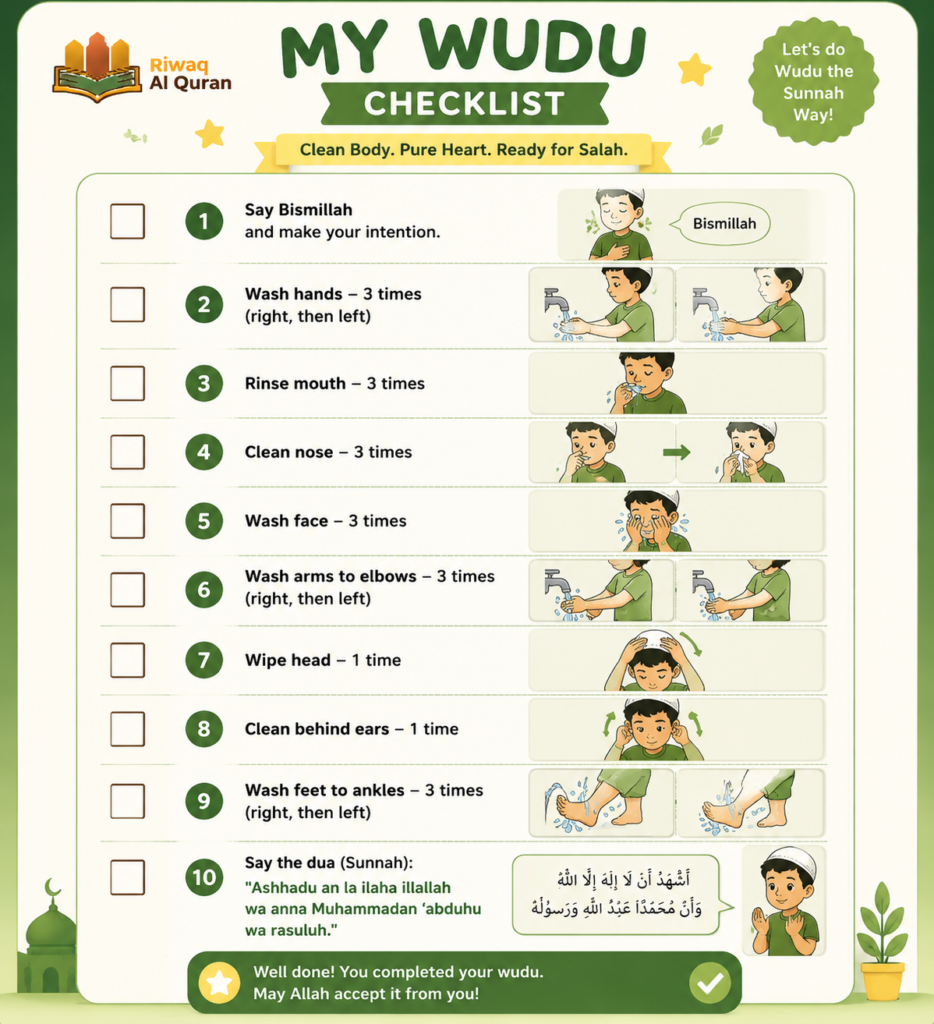
How to Use the Checklist at Home
Print it, laminate it, and stick it at child height near the sink used for wudu. For the first two to three weeks, have the child point to or tick each step as they go rather than relying on memory alone — this single change is usually what fixes inconsistent step order faster than verbal correction does.
Why Allah Loves Those Who Purify Themselves
A second verse gives children the emotional reason behind the ritual, not just the legal one.
(إِنَّ اللَّهَ يُحِبُّ التَّوَّابِينَ وَيُحِبُّ الْمُتَطَهِّرِينَ)
“Surely Allah loves those who always turn to Him in repentance and those who purify themselves.” (Surah Al-Baqarah, Ayah 222)
“Indeed, Allah loves those who repent and loves those who purify themselves.”
Framing wudu this way — as something Allah loves, not just something that’s required — tends to land better with young children than a purely procedural explanation.
What Wudu Teaches Beyond the Steps Themselves
Beyond the ritual itself, wudu is usually a child’s first repeated encounter with routine, self-discipline, and physical cleanliness tied to a spiritual purpose.
Performed five times a day, it becomes a natural anchor point that structures a child’s day around prayer, and it gives Muslim children a shared practice with peers at the mosque or Islamic school, which supports a sense of belonging early on.
Riwaq Al Quran’s live Islamic Studies for Kids classes build wudu into the same sessions where children learn the meaning behind prayer, so the ritual and its purpose are taught together rather than as two separate lessons.
Common Mistakes Kids Make During Wudu
Most errors fall into a small, predictable set of patterns, which makes them easy to watch for once you know what they look like.
1. Skipping or Rushing the Intention
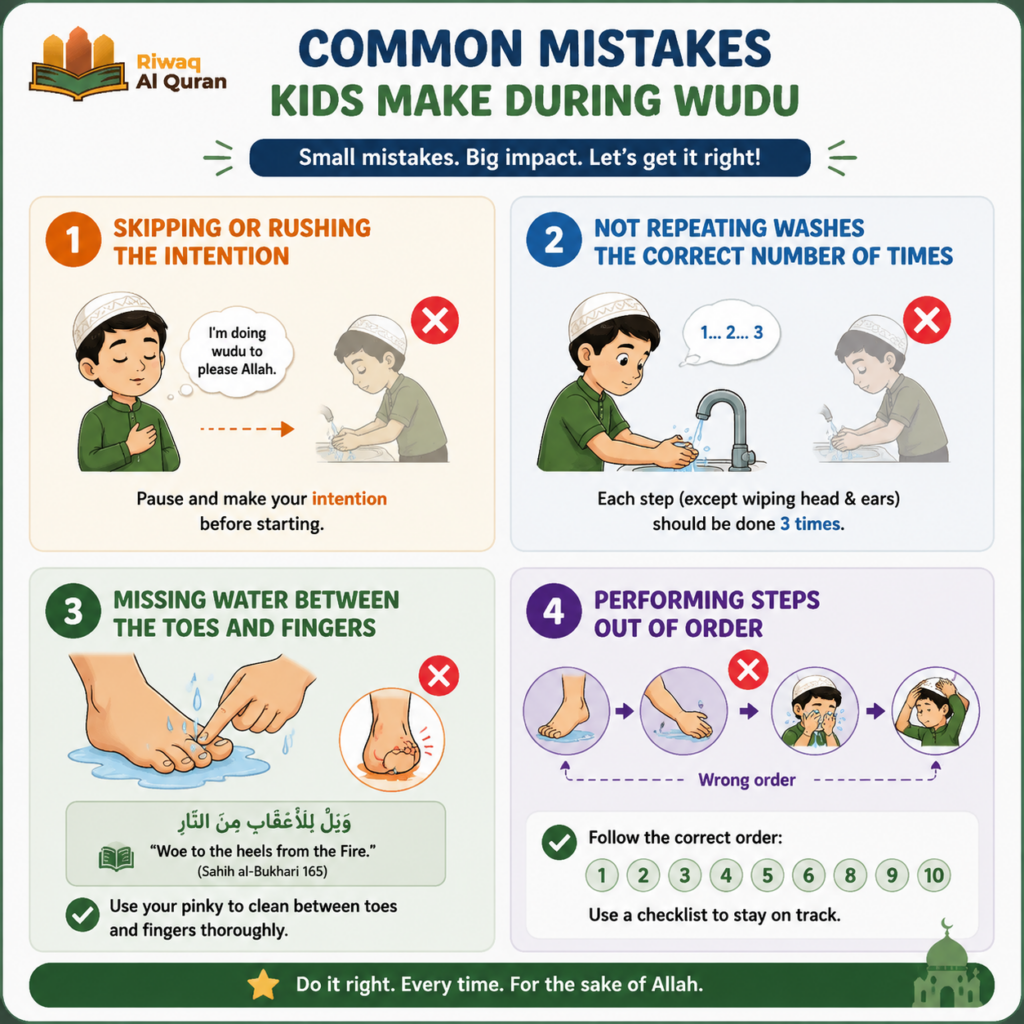
Children often jump straight to washing without pausing on the intention, treating it as a formality rather than the starting point of the ritual. A quick verbal reminder — “what are you about to do this for?” — before they start the water is usually enough to fix this.
2. Not Repeating Washes the Correct Number of Times
The three-times rule is the most commonly shortened step, especially when a child is in a hurry before prayer. Counting out loud together for the first few weeks builds the habit faster than correcting it after the fact.
3. Missing Water Between the Toes and Fingers
This is the mistake the Prophet ﷺ himself corrected in person. He once saw a group of men whose heels were still dry after wudu and said:
(وَيْلٌ لِلْأَعْقَابِ مِنَ النَّارِ)
“Woe to the heels from the Fire.” — (Reported by Abu Hurairah, Sahih al-Bukhari 165)
He then told the people nearby to perform their ablution completely and properly. Scholars cite this hadith as the reason dry patches on the feet — heels, between the toes, the sides — invalidate that part of the wash entirely, not partially. For kids, that makes it a useful line to repeat while teaching the “pinky finger sweep” for toes and a quick finger-interlace for hands.
4. Performing Steps Out of Order
Some children wash their feet before their arms, or wipe the head before finishing the face, particularly when they’re distracted. The printable checklist above is the most reliable fix here, since it removes the need to recall the order from memory under time pressure.
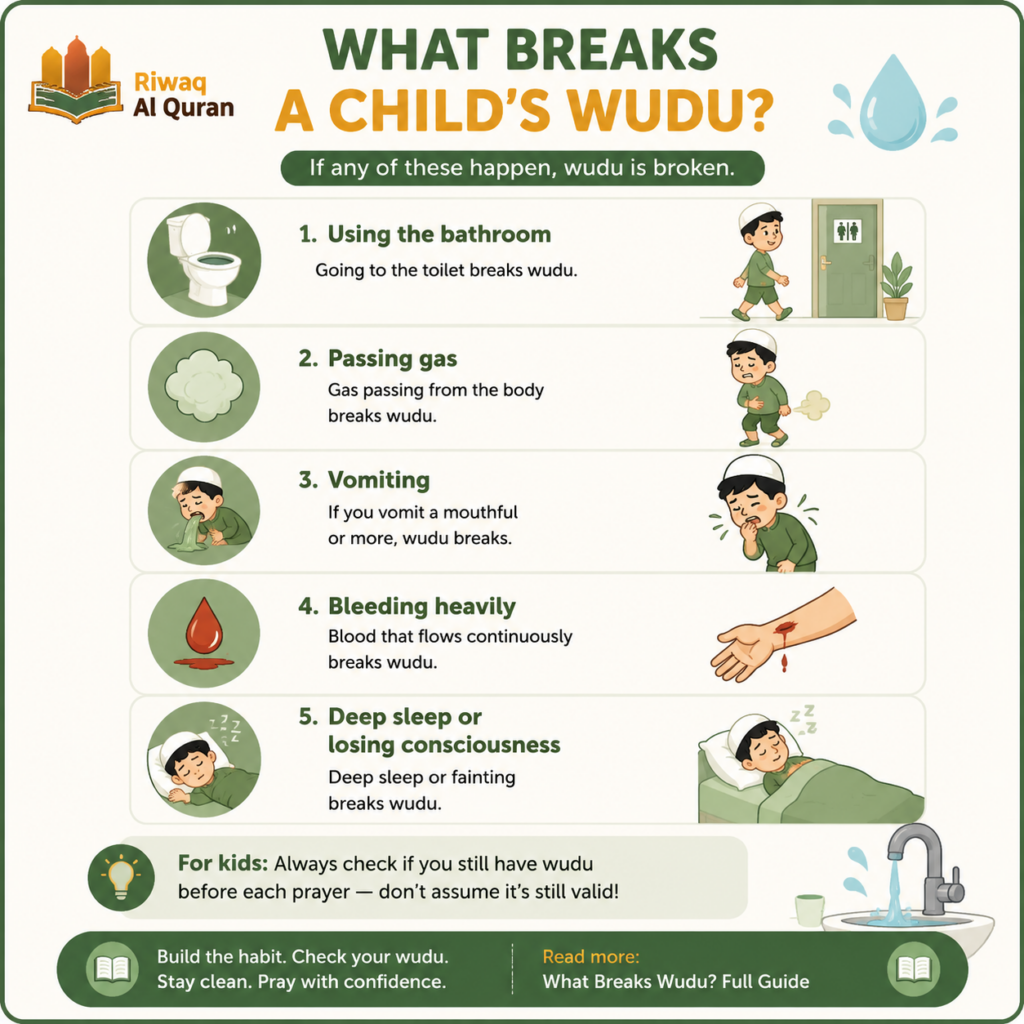
What Breaks a Child’s Wudu
Wudu isn’t a one-time achievement — it’s undone by specific, well-defined things, and children benefit from knowing the list explicitly rather than guessing. The main ones are:
- Using the bathroom
- Passing gas
- Vomiting
- Bleeding heavily
- Deep sleep or losing consciousness
For kids specifically, the two situations that come up constantly in daily life are a bathroom trip after playing outside and an afternoon nap — both quietly break wudu without the child necessarily realizing it.
Building a simple habit of “check if you still have wudu” before each prayer, rather than assuming it’s still valid from earlier in the day, avoids most of the confusion around this.
Read more: What Breaks Wudu? Full Guide
When and How to Start Teaching Wudu
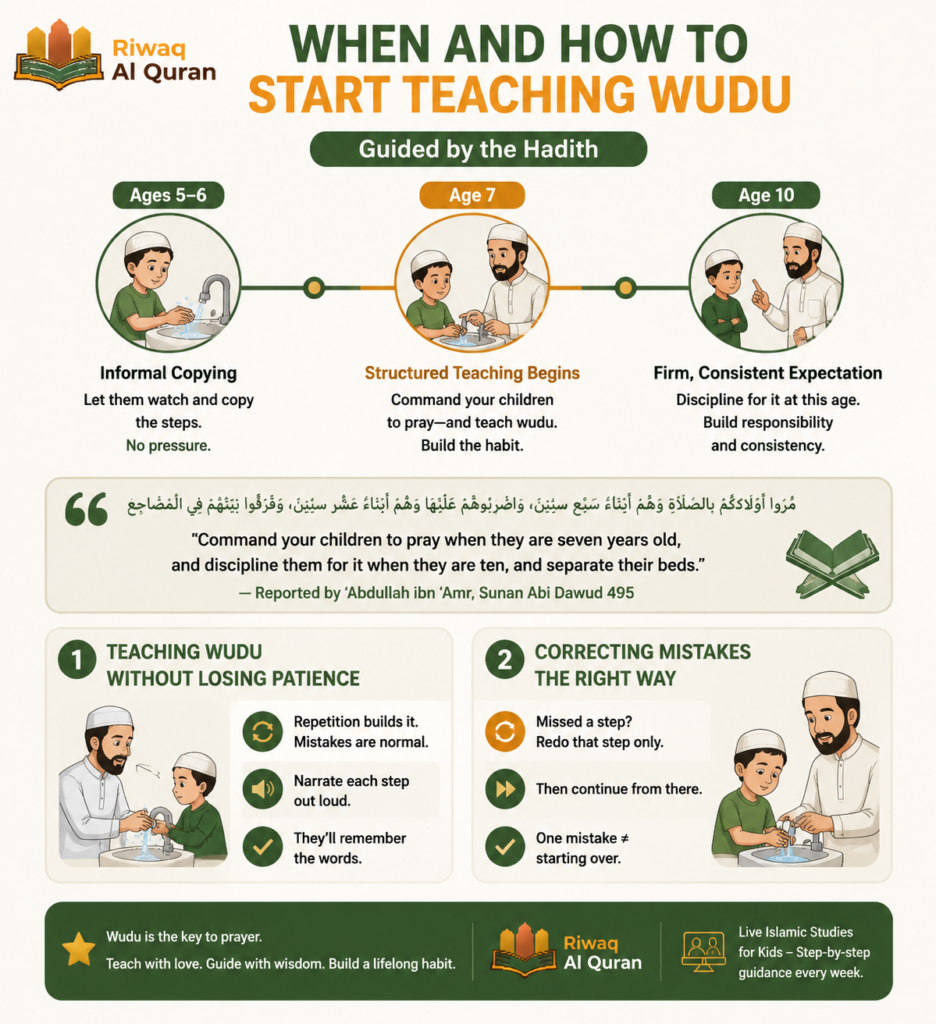
There’s no single fixed age at which wudu instruction must begin, but there is a specific, authentic hadith scholars use as the reference point for when prayer — and by extension, wudu — becomes something to actively teach rather than just model.
(مُرُوا أَوْلَادَكُمْ بِالصَّلَاةِ وَهُمْ أَبْنَاءُ سَبْعِ سِنِينَ، وَاضْرِبُوهُمْ عَلَيْهَا وَهُمْ أَبْنَاءُ عَشْرِ سِنِينَ، وَفَرِّقُوا بَيْنَهُمْ فِي الْمَضَاجِعِ)
“Command your children to pray when they are seven years old, and discipline them for it when they are ten, and separate their beds.” — (Reported by ‘Abdullah ibn ‘Amr, Sunan Abi Dawud 495 )
Since wudu is a prerequisite for prayer, most families use age seven as the point where wudu instruction becomes deliberate and structured, while letting younger children copy the motions informally in the two or three years before that.
The hadith’s own structure — command at seven, firmer follow-up at ten — is a useful model for wudu specifically: gentle correction in the early years, more consistent expectations as the child gets older, the same pattern that builds lasting discipline in a child’s wider routine.
1. Teaching Wudu Without Losing Patience
Children need several repetitions before the sequence sticks, and treating early mistakes as normal — rather than as something to get right immediately — keeps the process from becoming stressful for either side.
Narrating each step out loud while doing it yourself, rather than only demonstrating silently, gives children a verbal script they can repeat back to themselves later, which is often the difference between parents feeling frustrated and feeling like the lesson is actually landing.
2. Correcting Mistakes the Right Way
When a step is missed, the correction is simple: redo that step and continue from there, rather than starting the entire wudu over. Teaching this rule early prevents children from developing the mistaken idea that one missed spot invalidates everything they’ve already done.
Families enrolled in Riwaq Al Quran’s live Islamic Studies for Kids classes get this kind of step-by-step correction from a tutor each week, which tends to catch small errors — like a rushed rinse or an out-of-order step — well before they turn into habits.
Book a Free Trial Class and Get Wudu Taught Live
Reading the steps is a start, but most children learn wudu faster with someone watching and correcting them in real time. Riwaq Al Quran’s Islamic Studies for Kids course pairs your child with a live tutor who teaches wudu, prayer, and the Quranic and hadith basis behind them together, with direct feedback in every session.

Learn Quran, Arabic, and Islamic Studies Online With Riwaq Al Quran
Riwaq Al Quran is a comprehensive online platform that offers personalized Quran, Arabic, and Islamic Studies classes for individuals of all ages and backgrounds. Experienced instructors follow a structured curriculum covering Tajweed, Tafsir, and memorization, giving families straightforward, effective access to learning the Quran from home. The live classes are built for direct, two-way interaction between student and teacher rather than one-way video lessons.
Wudu is just one part of what a structured Islamic education looks like. Here’s a quick look at what your child can learn this summer with Riwaq Al Quran:
The platform is organized into five course categories: online courses for kids, online Quran classes for kids and adults, online Arabic courses, online Ijazah courses, and online Islamic Studies courses.


Here’s a closer look at some of the specific Quran courses on offer, and what each one actually covers:
| Course | What It Covers |
|---|---|
| Online Tafseer Course | Explains Quranic meanings in depth |
| Noorani Qaida Online | Builds Quranic reading basics from the ground up |
| Online Quran Recitation Course | Develops recitation skills with direct tutor feedback |
| Online Tajweed Classes | Covers the rules for correct, beautiful recitation |
| Quran Memorization Online Course | Structured, paced memorization with a dedicated tutor |
| Online Qirat Course | Introduces the recognized styles of Qirat |
| Online Quran Classes for Kids | Age-appropriate, interactive classes built to grow a child’s love of the Quran |
Conclusion
Wudu for kids comes down to three things: nine steps performed in a fixed order, one simple rule to anchor them by (wash three times, wipe once), and enough patient repetition for the sequence to become automatic.
The Quran sets out the ritual itself in Surah Al-Ma’idah, and the routine you build around it — checklist in hand, mistakes corrected calmly, steps practiced daily — is what actually turns wudu from something a child performs into something they understand.
The fastest way to lose that progress is to treat early mistakes as failures instead of the normal part of learning a new physical sequence. A child who rushes the three washes or wipes the head before finishing the face isn’t doing wudu wrong in any lasting sense — they’re doing it like every child does before the steps settle into muscle memory. Correct the specific step, not the whole attempt, and keep the checklist within reach until it isn’t needed anymore.
Start there: print the checklist, watch for the four mistakes covered above, and give your child room to get wudu wrong a few times before expecting them to get it right. That’s the difference between a child who memorizes wudu and one who actually keeps it as a lifelong habit.
FAQs
Here are direct answers to the questions parents ask most often when teaching wudu to their kids.
What age should a child start learning wudu?
Most families begin introducing wudu informally around age five or six, letting children copy the steps, with more consistent independent practice expected from age seven onward — the age referenced in the hadith on when children should be commanded to pray.
Do girls perform wudu differently from boys?
The steps of wudu are the same for boys and girls. The one difference some scholars note is for women during specific conditions related to menstruation, which affect prayer eligibility rather than the wudu steps themselves.
Can a child perform wudu with dirty or unclean water?
No, wudu must be performed with clean water. Water that is visibly dirty, discolored, or mixed with impurities does not fulfill the requirement, even if all the steps are followed correctly.
What should a child do if they make a mistake during wudu?
If a step is missed or done incorrectly, the child should simply redo that specific step and continue from there, rather than starting the entire wudu over from the beginning.
What if a child doesn’t have access to water?
If water is unavailable or unsafe to use, tayammum — a dry form of purification using clean soil or dust, mentioned in the same verse as wudu in Surah Al-Ma’idah — can be performed instead, following a simplified set of steps for the hands and face.
How often does a child need to perform wudu?
Wudu is performed before each of the five daily prayers, and needs to be redone after anything that breaks it, such as using the bathroom, passing gas, or deep sleep — see the full list above.