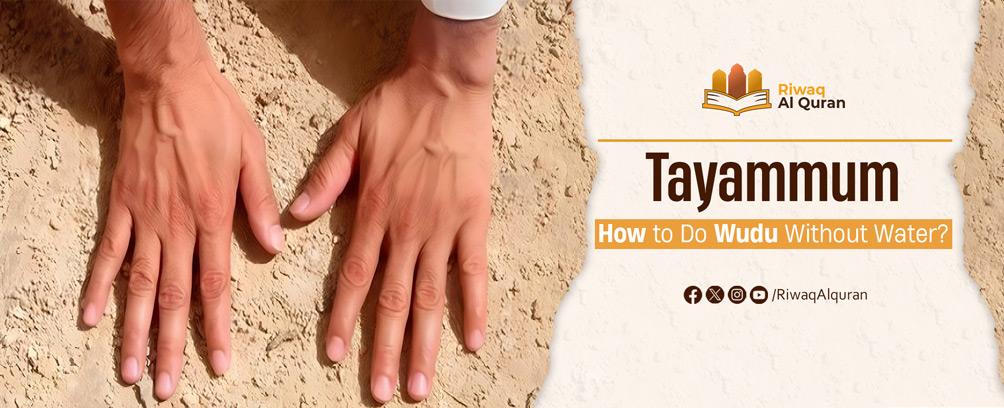
Tayammum is a form of Tahara and an essential part of Islamic worship, allowing Muslims to perform wudu without water when water is unavailable or using it could be harmful because of illness or other valid reasons. In such cases, Muslims perform Tayammum by using clean earth, dust, or other natural surfaces instead of water.
Tayammum involves striking a clean natural surface, such as earth, stones, or an unpainted wall, then wiping the face and hands to achieve ritual purity for prayer. As prescribed in the Quran, this concession reflects Allah’s mercy, ensuring that Muslims can maintain their worship and remain spiritually prepared even when water is out of reach.
In this article, you’ll learn what Tayammum is, when it is permissible, how to perform it correctly, the Quranic evidence for it, and the rulings for different situations such as travel, hospitals, cold weather, and other common questions about wudu without water.
What You’ll Learn in This Article
- What Tayammum is and its direct basis in the Quran.
- The exact conditions that make Tayammum valid.
- Which materials are actually valid to perform it with.
- The correct step-by-step method, with the hadith behind each step.
- How Tayammum applies in specific situations: travel, illness, cold water, and bed-bound patients.
Table of Contents
Understanding Tayammum
Tayammum is a dry method of ritual purification (Taharah) using clean earth, dust, or another natural surface in place of water, performed when water is unavailable, inaccessible, or would cause harm to use. It achieves the same ritual purity as wudu, allowing a Muslim to pray without ever compromising on Salah’s timing due to circumstances beyond their control.
Tayammum exists to protect one specific pillar from ever being missed — here’s a quick refresher on where prayer fits among the five:
The Quranic Basis for Tayammum
Tayammum isn’t a scholarly workaround — it’s directly legislated in the Quran, stated in two separate verses rather than one:
(فَلَمْ تَجِدُوا مَاءً فَتَيَمَّمُوا صَعِيدًا طَيِّبًا فَامْسَحُوا بِوُجُوهِكُمْ وَأَيْدِيكُم مِّنْهُ ۚ مَا يُرِيدُ اللَّهُ لِيَجْعَلَ عَلَيْكُم مِّنْ حَرَجٍ وَلَٰكِن يُرِيدُ لِيُطَهِّرَكُمْ وَلِيُتِمَّ نِعْمَتَهُ عَلَيْكُمْ لَعَلَّكُمْ تَشْكُرُونَ)
“…and you find no water, then perform Tayammum with clean earth and wipe your faces and hands with it. Allah does not want to place you in difficulty, but He wants to purify you and complete His favor upon you, so that you may be grateful.” (Surah Al-Ma’idah, 5:6)
The same core ruling is repeated in Surah An-Nisa, 4:43, which signals this concession isn’t a minor footnote but a rule the Quran states more than once. Notice the verse’s own framing: it explicitly says Allah doesn’t want to place believers in hardship — Tayammum exists to remove hardship, not to create a lesser, second-tier form of worship.
How to Perform Tayammum Correctly
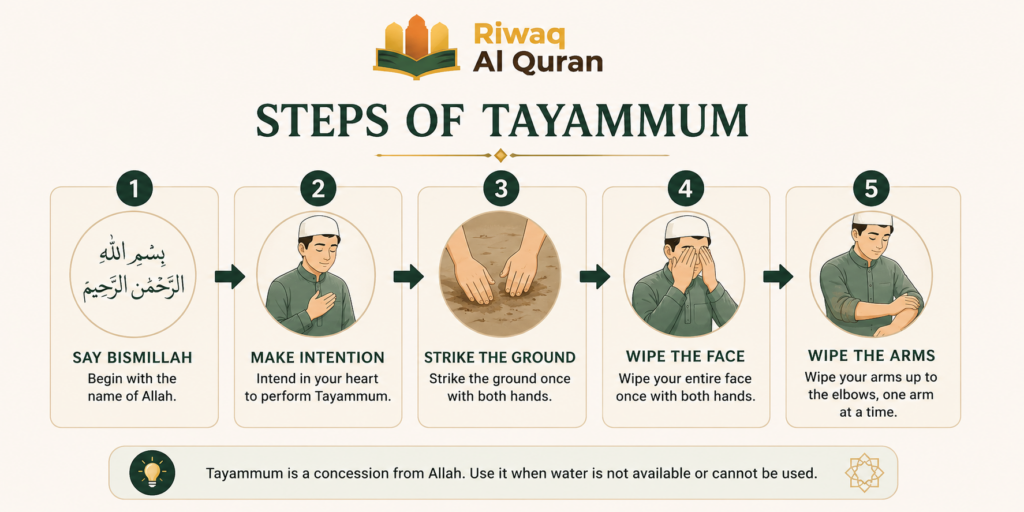
Once you’ve confirmed Tayammum applies to your situation, the method itself is short and follows a fixed sequence — one grounded directly in how the Prophet ﷺ described and demonstrated it, not a routine scholars pieced together afterward.
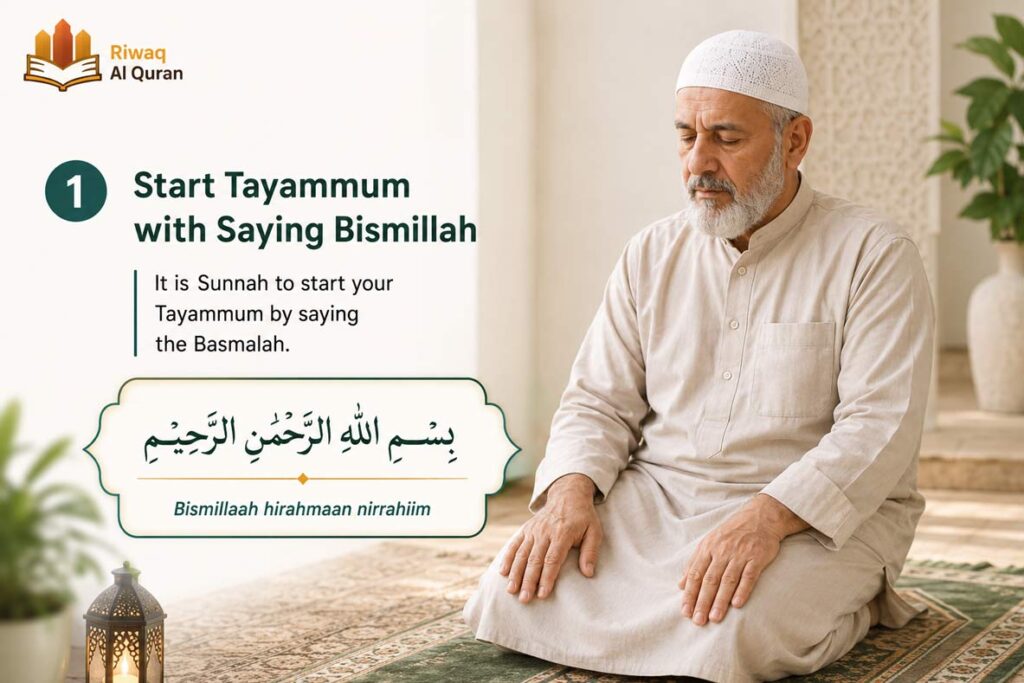
1. Begin by Saying “Bismillah”
Starting with Allah’s name is recommended the same way it is before wudu, marking the beginning of an act of worship rather than a purely mechanical routine. This mirrors the general Sunnah of beginning any significant act by mentioning Allah’s name first.
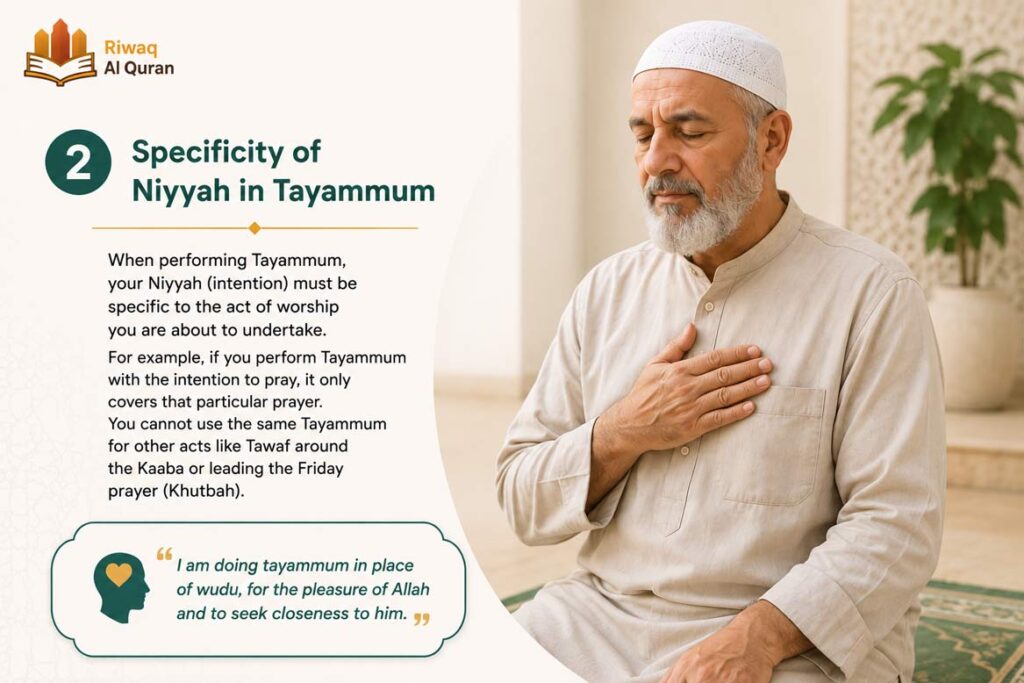
2. Make Your Intention (Niyyah) Specific to the Act Ahead
Your intention must match the exact act of worship you’re about to perform — a Tayammum made with the intention of praying covers only that prayer, not a separate act like Tawaf or leading Friday’s Khutbah. This condition traces back to the Prophet’s ﷺ own foundational statement on intention:
(إِنَّمَا الْأَعْمَالُ بِالنِّيَّاتِ)
“Actions are judged by intentions.” (Sahih al-Bukhari 1; Sahih Muslim 1907)
Since this hadith ties the validity and category of an action directly to what was intended, a Tayammum performed with a vague or unspecified intention doesn’t carry the same weight as one made with a clear, specific purpose in mind.
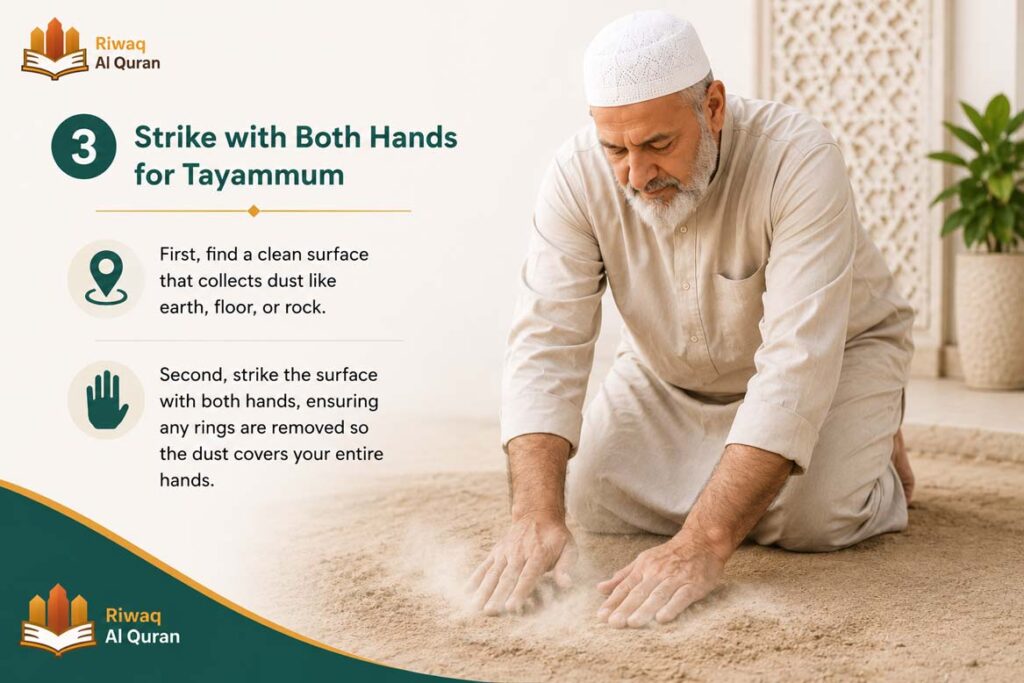
3. Strike a Clean, Dust-Bearing Surface With Both Hands
Remove any rings first so dust covers your entire palm. As the same verse quoted above specifies, the surface must be “clean earth” (sa’idan tayyiban) — a contaminated surface doesn’t fulfill this condition even if the physical motion is correct.
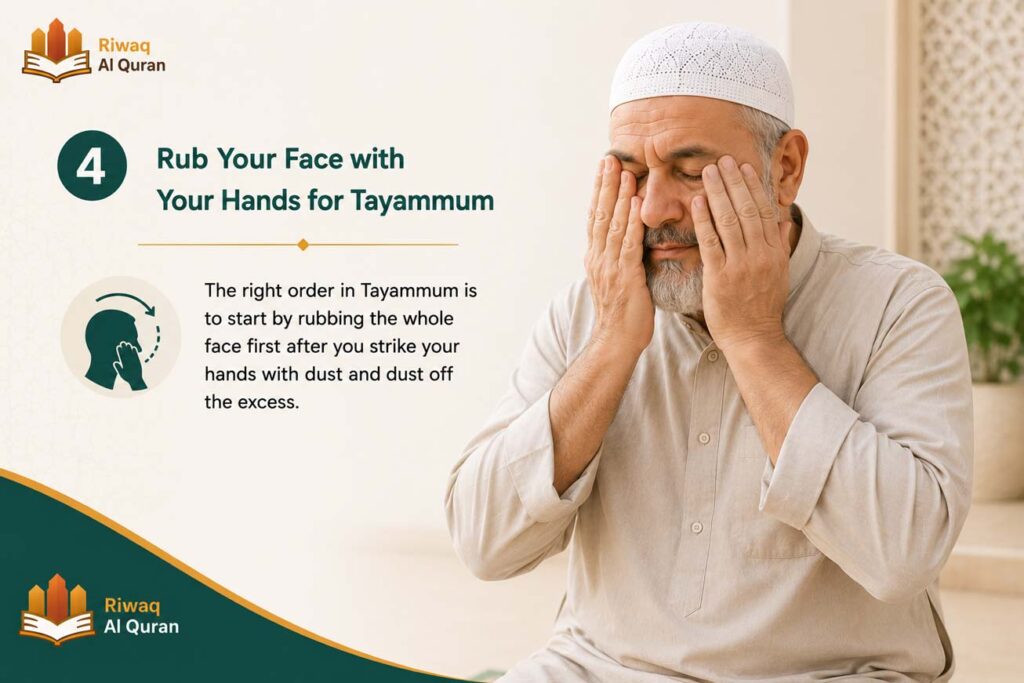
4. Wipe Your Entire Face With Both Hands, Then Dust Off the Excess
Using both palms together, wipe the whole face in one motion, then lightly dust off whatever excess remains rather than leaving a heavy visible layer. This detail comes directly from a hadith describing the Prophet’s ﷺ own demonstration:
(عَنْ عَمَّارِ بْنِ يَاسِرٍ قَالَ: ضَرَبَ رَسُولُ اللَّهِ ﷺ بِيَدَيْهِ الْأَرْضَ وَنَفَخَ فِيهِمَا ثُمَّ مَسَحَ بِهِمَا وَجْهَهُ وَكَفَّيْهِ)
“The Messenger of Allah ﷺ struck the earth with his hands, blew into them, then wiped his face and hands with them.” (Sahih al-Bukhari 338; Sahih Muslim 368)
The detail of blowing into the hands before wiping is specifically why dusting off the excess is part of the Sunnah method, not an optional addition — it keeps the amount of dust light rather than heavy or visibly caked on the skin.
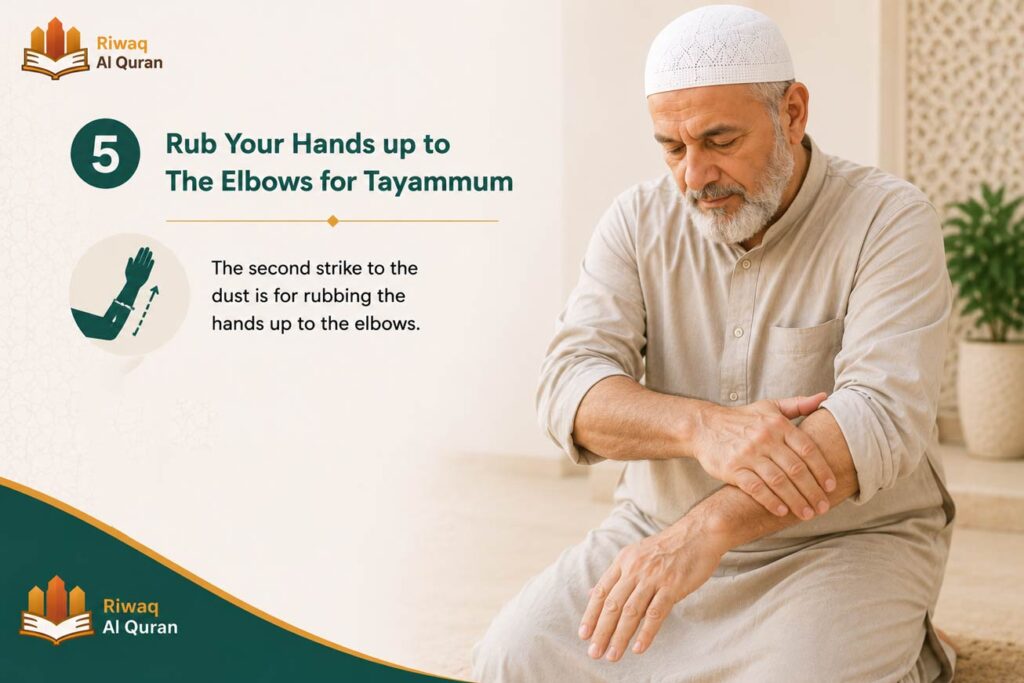
5. Wipe Your Hands Up to the Elbows
Using a second strike of the surface if needed, wipe both hands up to the elbows, completing the two areas the Quran names directly: face and hands. The companion Ibn Umar (may Allah be pleased with him) described the method concisely:
(التَّيَمُّمُ ضَرْبَتَانِ: ضَرْبَةٌ لِلْوَجْهِ وَضَرْبَةٌ لِلْيَدَيْنِ إِلَى الْمِرْفَقَيْنِ)
“Tayammum consists of two strikes: one strike for the face, and one strike for the hands up to the elbows.” (Sunan ad-Daraqutni; scholars, including Ad-Daraqutni himself, classify this as the authenticated practice of Ibn Umar rather than a direct saying of the Prophet)
This hadith is why the method is consistently taught as exactly two strikes rather than one combined motion or several repeated ones — a detail that distinguishes correct Tayammum from an approximate version of it.
A Recommended Closing Supplication
A short supplication is recommended after completing Tayammum, the same as after wudu — bearing witness to Allah’s oneness and asking to be among those who are purified, following the same closing dua recommended after wudu itself.
Since Tayammum achieves the same ritual purity as wudu, scholars generally extend the same recommended closing words to it rather than treating it as a separate, unrelated practice.
If the order or intention behind steps like these still feels uncertain in practice, Riwaq Al Quran’s Islamic Studies classes walk through Taharah fundamentals directly with an instructor rather than leaving you to self-check against a written guide.
The Conditions for Tayammum
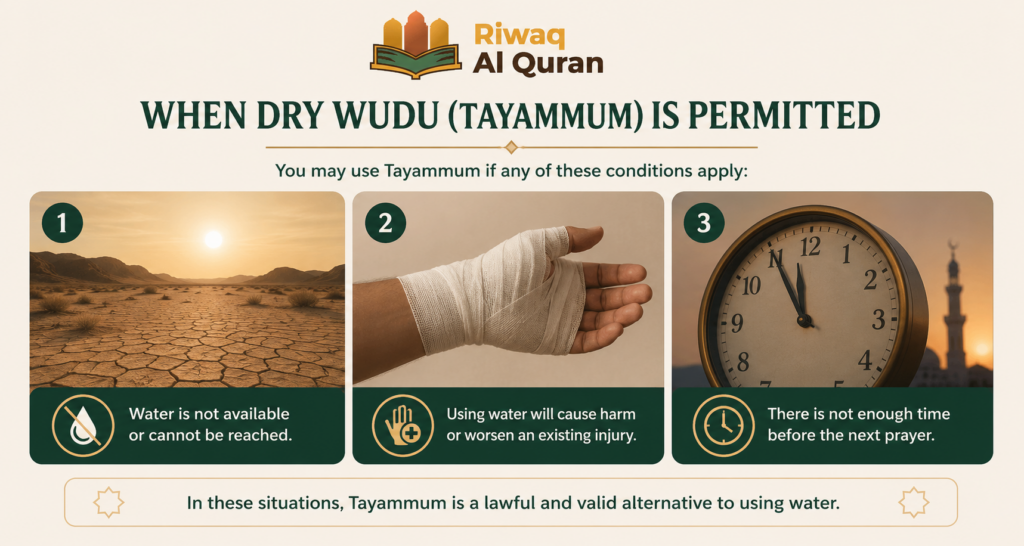
Wudu is the default; Tayammum is the exception, and it only becomes valid when a specific condition is actually met — not simply preferred or convenient.
The same verse above names illness, travel, and other ordinary circumstances directly, but every one of them is tied to the same closing condition: “and find no water.” This is why the three conditions below aren’t independent triggers on their own — each exists specifically to establish that genuine absence of water.
1. Water Is Genuinely Inaccessible
Tayammum is permitted only after a real, thorough search for water — checking the surrounding area and asking others nearby if water is available. It isn’t a shortcut for someone who simply didn’t look.
This condition is built directly into the verse’s own wording: “find no water” (falam tajidu ma’an) describes an actual outcome after genuine effort, not an assumption made without checking.
2. Using Water Would Cause Genuine Harm
Tayammum is allowed when using water would cause harm due to illness, wounds, or a medically confirmed condition — based on the guidance of a qualified medical professional, not personal assumption. This condition rests on a broader legal principle the Prophet ﷺ established directly:
(لَا ضَرَرَ وَلَا ضِرَارَ)
“There should be neither harming (of oneself) nor reciprocating harm.” (Sunan Ibn Majah 2340)
Since causing harm to oneself is prohibited as a general principle, insisting on wudu when water would genuinely worsen an illness or wound works directly against this rule — which is exactly why Tayammum becomes not just permitted but the appropriate choice in that situation.
3. There Isn’t Enough Time Left to Find Water Before Salah Ends
If someone knows they won’t find water before the current prayer’s time expires, delaying the prayer to search further is not permitted — scholarly consensus holds that Tayammum must be performed and the prayer completed on time rather than risking missing the prayer window entirely.
This is the exact situation the founding narration of Tayammum itself describes: when Aisha’s (RA) necklace went missing and dawn broke with no water found, the group didn’t delay Fajr indefinitely to keep searching — Allah revealed the ruling, they performed Tayammum, and prayed within the time still available (Sahih al-Bukhari 334).
The historical event that produced this ruling is itself the clearest illustration of the rule: search reasonably, but never let the search push the prayer past its window.
Materials You Can Use for Tayammum
Separate from the conditions above, a different question is what you can actually perform Tayammum with. The Prophet ﷺ described the earth’s role in worship directly:
(جُعِلَتْ لِيَ الْأَرْضُ مَسْجِدًا وَطَهُورًا)
“The earth has been made for me a place of prayer and a means of purification.” (Sahih al-Bukhari 335)
This hadith is the foundation for treating the earth itself — not just water — as a valid means of achieving Taharah, which is part of why Tayammum isn’t described in Islamic teaching as a diminished workaround, but as a genuine, prescribed form of purification in its own right.
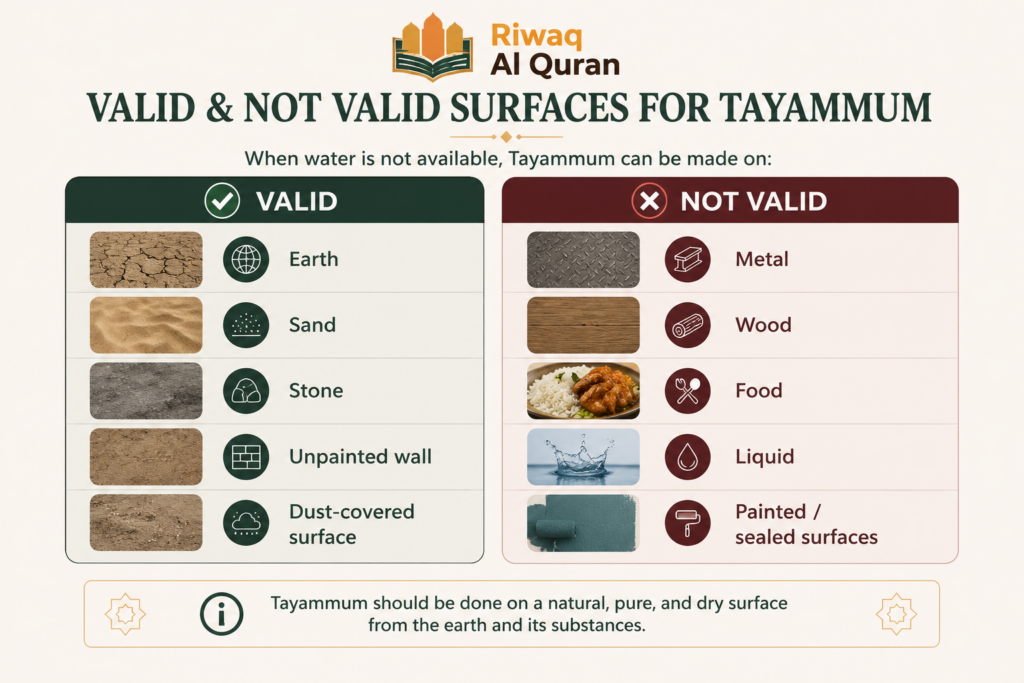
Based on this and further scholarly detail, the material used for Tayammum must meet specific conditions:
- The dust or surface must be pure and free of any mixture with liquids or contaminants.
- The same dust cannot be reused for a second Tayammum, the same way water used for wudu can’t be reused.
- Dust must genuinely adhere to the hands when struck — if it doesn’t stick at all, it isn’t suitable.
a. Performing Tayammum Without Soil
According to the Hanafi and Maliki schools, if soil is unavailable, you can use any natural, unmanufactured object for Tayammum, following the same steps described later in this guide. The item must not be manufactured, and it must not be food or a liquid — the key condition is that it’s a natural material, such as a rock or a clean wall.
b. Performing Tayammum With a Stone
Since stones are an earthly material, it’s permissible to use them for Tayammum as long as the stone is in its natural condition. All the same Tayammum steps apply to a stone. If the stone is small, you can flip it in your hands the way you would a bar of soap.
c. Performing Tayammum on a Wall
There are specific conditions for using a wall:
- The wall must be made of natural materials like stone or clay, not wood or metal.
- The wall should not be painted; if it is painted, it must still carry some genuine dust to be suitable.
- Tayammum cannot be performed using materials that can melt (like metal) or burn to ashes (like wood).
Understanding where scholars agree and where they differ on questions like material validity is exactly the kind of nuance Riwaq Al Quran’s Islamic Studies course is built to cover directly with a qualified instructor, rather than flattening into one blanket rule.
Specific Situations That Allow Tayammum
Beyond the general rule, several everyday situations raise their own specific questions worth answering directly — and several of them trace back to real, documented incidents from the Prophet’s ﷺ own companions, not just later scholarly reasoning.
a. Tayammum Is Permitted in a Car After a Genuine Search for Water
Using any dust found on surfaces inside the car is valid, but only after a genuine effort to find water first:
- Driving to a nearby water source if realistically possible before the prayer’s time runs out.
- Buying water along the way if that option is available.
- Checking for dust on any surface inside the car once water genuinely can’t be found in time.
This follows the same principle in the verse establishing Tayammum, which names travel explicitly as one of the situations this ruling addresses (“…or on a journey… and you find no water…” — Surah Al-Ma’idah, 5:6). Being in a car is a modern form of the same travel condition the verse describes, provided the genuine search for water still happens first.
b. Tayammum Is Permitted in a Hospital When a Doctor Confirms Water Would Cause Harm
If a doctor confirms water would be harmful and no dust is available in the room, a patient has a few options in order:
- Ask someone to bring dust from outside the room.
- Use dust already present on hospital walls or their own clothing.
- If neither option is available, pray without Tayammum in that specific situation.
A documented incident from the Prophet’s ﷺ own time shows exactly this kind of medical judgment being respected. A man was once injured and later had a wet dream requiring Ghusl; he was told to wash regardless of his injury, and the cold water worsened his condition until he died. When the Prophet ﷺ was told, he said:
(قَتَلُوهُ قَتَلَهُمُ اللَّهُ، أَلَا سَأَلُوا إِذْ لَمْ يَعْلَمُوا؟ فَإِنَّمَا شِفَاءُ الْعِيِّ السُّؤَالُ)
“They have killed him, may Allah kill them. Could they not ask if they did not know? The cure for ignorance is to ask.” (Sunan Abi Dawud 336)
This hadith is the direct textual basis for treating a doctor’s genuine medical judgment as sufficient grounds for Tayammum — the Prophet’s ﷺ reaction makes clear that insisting on water despite real medical risk isn’t caution, it’s a preventable harm.
c. Tayammum With Makeup On Is Permitted Only When Water Is Genuinely Inaccessible
Two conditions determine whether this applies:
- Tayammum is valid if water genuinely isn’t accessible to remove makeup, after first removing as much as possible using a towel or fabric.
- Tayammum is not valid as a way to skip wudu purely to preserve makeup when water is otherwise available.
This distinction matters because wudu requires water to reach the skin directly — the same command found in the verse quoted earlier, فَٱغْسِلُوا۟ وُجُوهَكُمْ, “wash your faces” (Surah Al-Ma’idah, 5:6).
A command to wash the face assumes water actually reaches the skin — a makeup layer that blocks this defeats the purpose of wudu itself, which is why removing what can reasonably be removed comes first, and Tayammum is reserved only for what genuinely can’t be addressed before the prayer’s time runs out.
d. Extreme Cold Justifies Tayammum, With a Specific Precedent From the Sunnah
Cold water alone isn’t a valid excuse, since the water still exists and can be used. The exception applies only when:
- The cold is severe enough to genuinely risk illness.
- There’s no way to warm the water or protect yourself afterward.
This exact scenario has a specific, named precedent in the Sunnah, not just a general principle applied by analogy. The companion Amr ibn al-‘As narrated it directly: during a cold night on a military expedition, he had a wet dream requiring Ghusl, but feared that washing in the extreme cold could kill him.
He performed Tayammum instead and led his companions in the Fajr prayer. When this reached the Prophet ﷺ, he asked Amr about it, and Amr explained his reasoning, citing the verse:
(وَلَا تَقْتُلُوٓا۟ أَنفُسَكُمْ ۚ إِنَّ ٱللَّهَ كَانَ بِكُمْ رَحِيمً)
“And do not kill yourselves. Indeed, Allah is ever Merciful to you.” (Surah An-Nisa, 4:29)
(عَمَّرُ، صَلَّيْتَ بِأَصْحَابِكَ وَأَنْتَ جُنُبٌ)
The Prophet ﷺ asked: “Amr, did you lead your companions in prayer while you were in a state of major impurity?” — but upon hearing Amr’s reasoning, he simply smiled and said nothing (Sunan Abi Dawud 334, classed authentic by Al-Albani).
This is a genuinely important detail most articles on this topic skip entirely: the Prophet’s ﷺ silence here is treated by scholars as tacit approval — he didn’t correct Amr’s decision or require him to repeat the prayer, which is why this specific hadith, not just the general “no harming oneself” principle, is the direct textual basis scholars cite for extreme cold justifying Tayammum.
Learn Fiqh, Worship, and Quran the Right Way With Riwaq Al Quran
After learning the terms of Tayammum, you may be curious to learn more about fiqh topics generally. Riwaq Al Quran is a comprehensive online platform that offers personalized Quran, Arabic, and Islamic Studies online classes for individuals of all ages and backgrounds.
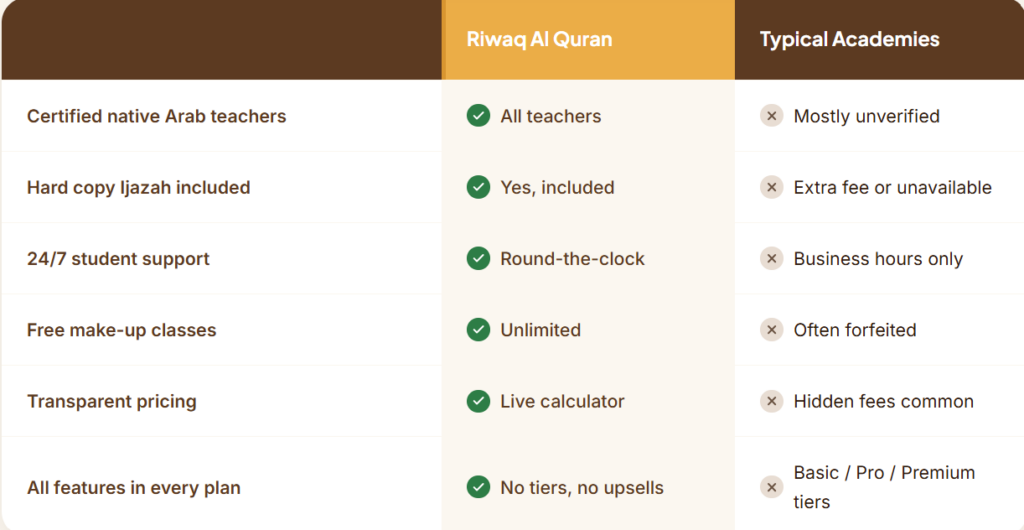
Their experienced instructors use a structured curriculum to cover Tajweed, Tafsir, and Memorization, providing easy and effective access to learning the Quran. The advanced online classes allow for seamless communication and interaction between students and teachers.
Our approach brings together skilled teachers and knowledgeable scholars, along with customized learning plans, to provide a personal and meaningful educational experience for every student — for both children and adults, at your own pace, with experienced native instructors guiding you.
This kind of foundational fiqh is worth building early — here’s what that structured learning looks like for younger students:
We offer several courses, including:
- Online courses for kids
- Online Quran classes for kids and adults
- Online Arabic courses
- Online Ijazah courses
- Online Islamic Studies courses
Here is a sample of our Quran courses that will be helpful for you:
- Online Tafseer Course: Delve into Quranic meanings with our insightful online Tafseer course.
- Noorani Qaida Online: Learn Quranic basics efficiently through our Noorani Qaida online program.
- Online Quran Recitation Course: Enhance your recitation skills through our expert-led online course.
- Online Tajweed Classes: Master Tajweed rules for beautiful Quranic recitation in online classes.
- Quran Memorization Online Course: Memorize the Quran effectively with our specialized online memorization course.
- Online Qirat Course: Explore diverse Qirat styles with our comprehensive online course.
- Online Quran Classes for Kids: Nurture a love for the Quran in kids through interactive online classes.


Conclusion
Tayammum comes down to two honest questions, answered in order — not a checklist of steps memorized without understanding why they exist.
- First: does your situation actually meet the condition? Water genuinely absent after a real search, water genuinely harmful on a doctor’s word, or time genuinely running out before the prayer window closes. Not convenience. Not assumption. The Quran ties every named circumstance — illness, travel, anything else — back to the same closing phrase: and you find no water.
- Second: does the material qualify? Clean, natural, unmanufactured — earth by default, another surface only when the Hanafi and Maliki view opens that door. Two separate questions, and skipping either one is where mistakes happen.
Answer both honestly, and the method itself asks nothing complicated: Bismillah, a specific intention, one strike for the face, one strike for the hands to the elbows. The Prophet ﷺ described it in a single sentence for a reason — this was never meant to be difficult to get right.
What’s worth carrying forward isn’t the sequence alone. It’s where this ruling came from: a broken necklace, a search that ran out of time, and a Prophet ﷺ who prayed anyway rather than let the moment pass. That’s the whole spirit of Tayammum — Allah removing a hardship, not adding a second set of hurdles in its place.
FAQs
These are the specific, situational questions that come up most often once the general rules of Tayammum are clear.
Can you perform Tayammum with makeup on?
If you cannot take off your makeup because water isn’t accessible, then yes, you can perform Tayammum — but first try to remove as much of the makeup as possible using a towel or fabric, then perform Tayammum. If you’re considering Tayammum instead of wudu purely to protect your makeup from water while water is otherwise available, that is not permissible.
Can you perform Tayammum if the water is cold?
No, cold water alone is not a valid excuse for Tayammum, since the water already exists and can be used. However, if the water is so cold that using it would certainly lead to illness, and there’s no way to warm it or protect yourself afterward, then Tayammum is allowed to avoid harm, based on the Prophet’s ﷺ principle that there should be neither harming oneself nor reciprocating harm.
Can you delay prayer until water becomes available?
No, according to scholarly consensus, it is not permissible to delay a prayer beyond its prescribed time simply because water is currently unavailable. If a traveler knows he won’t find water before the prayer time ends, it becomes obligatory for him to perform Tayammum and pray on time. He has no right to delay the prayer until he reaches water once the time remaining is too short to purify himself and pray before it expires.
Does one Tayammum cover more than one act of worship?
No, your intention must be specific to the exact act you’re about to perform. A Tayammum made with the intention to pray covers only that prayer — it doesn’t automatically extend to a separate act like Tawaf or delivering a Khutbah.
How long does a Tayammum remain valid?
A Tayammum remains valid until your state of purity is broken by the same actions that would invalidate wudu, or until water becomes available and you’re able to use it. It does not need to be repeated for every single prayer on its own, as long as purity hasn’t been broken in between.