Lam Shamsiya and Lam Qamariya are the two rules that decide how the Arabic definite article “ال” is actually pronounced — clearly, or silently merged into the next letter — depending on which of the 28 Arabic consonants follows it. Getting this rule wrong doesn’t just sound off; in Quran recitation, it can change the rhythm and accuracy of the verse itself.
Understanding this is also a foundational step in learning the Arabic language for beginners, since it’s one of the first rules that changes how written Arabic is actually spoken aloud, well before a learner reaches more advanced grammar.
However, sometimes ‘AL’ is pronounced as ‘A’. Words with ‘AL’ are Laam Qamariya (also known as the Moon letters) while the words with ‘A’ are Laam Shamsiya (also known as the Sun letters or Al Lam Al Shamsiya). In this article, we will walk you through the rules of Laam Shamsiya and Laam Qamariya to make the process of learning the Arabic language easier for you.
What You’ll Learn in This Article
- What separates Lam Shamsiya from Lam Qamariya, in one clear rule.
- The complete, correct list of all 14 Sun Letters and 14 Moon Letters.
- The specific articulation reason Sun Letters silence the Lam and Moon Letters don’t.
- Real Quranic examples of both rules in context.
- Why this rule matters for Tajweed, memorization, and teaching children.
Table of Contents
What Are Lam Shamsiya and Lam Qamariya?
The Arabic definite article “ال” (equivalent to “the” in English) is written the same way every time, but it’s pronounced two different ways depending on the letter that follows it.
- When “ال” precedes one of 14 specific letters — called Huruf Shamsiya, or Sun Letters — the Lam sound disappears entirely, and the following letter is pronounced with a doubling (Shaddah) instead.
- When “ال” precedes one of the other 14 letters — the Moon Letters, or Huruf Qamariya — the Lam is pronounced clearly, with no doubling on what follows.
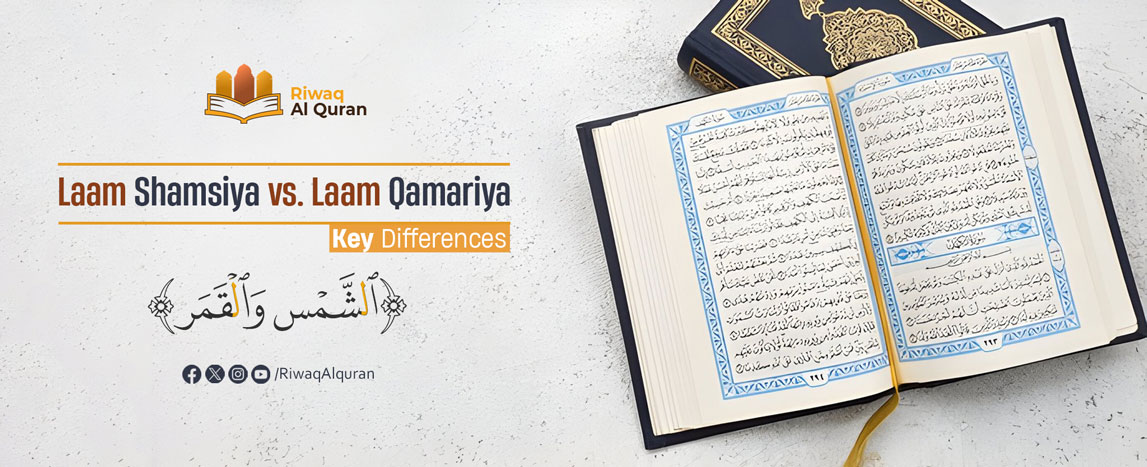
The names themselves are the easiest way to remember the rule: الشمس (the sun) is pronounced Ash-Shams, with no audible “L” — a Sun Letter word. القمر (the moon) is pronounced Al-Qamar, with a clearly audible “L” — a Moon Letter word. Every word in each category behaves the same way its own name-word does.
This distinction isn’t unique to these two examples — it’s a systematic rule covering all 28 Arabic consonants without exception, which is exactly why Tajweed scholars treat it as one of the earliest rules a reciter needs to internalize completely, rather than something to half-learn and revisit later. This naming logic is part of a broader set of Alif Lam rules worth understanding as a set, not in isolation.
The 14 Sun Letters and 14 Moon Letters
Both categories divide the 28 Arabic consonants exactly in half, and knowing both full lists by heart is what makes applying the rule automatic rather than something you calculate mid-sentence.
a. The Moon Letters (Lam Qamariya)
The Moon Letters are: أ ب ج ح خ ع غ ف ق ك م هـ و ي. When “ال” comes before any of these, the Lam is pronounced clearly and the following letter carries no Shaddah.
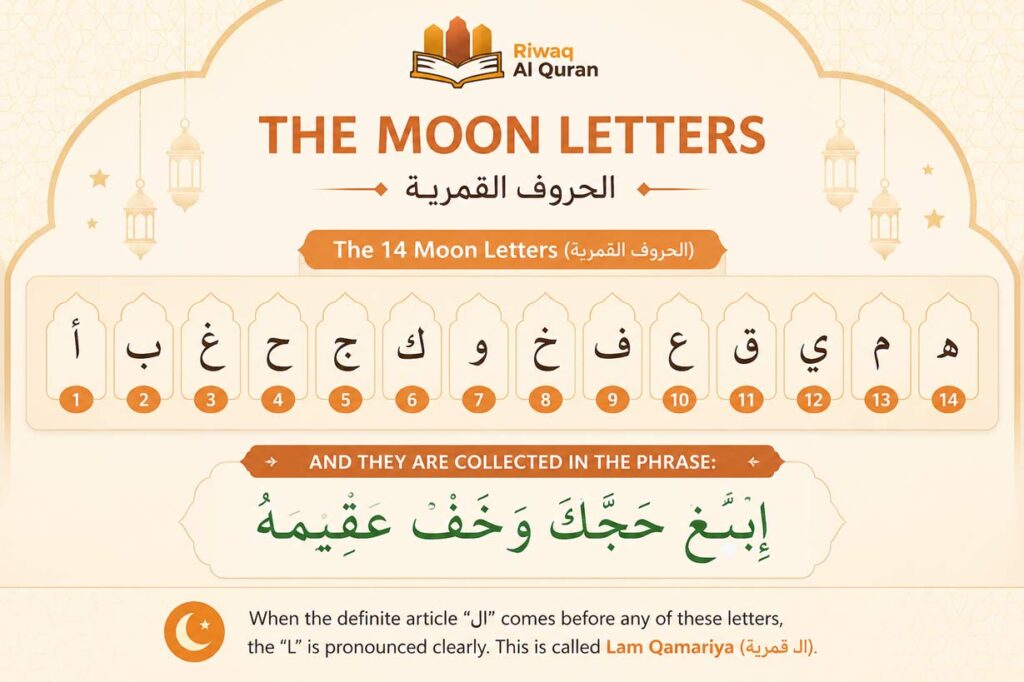
Examples of Lam Qamariya:
For example, in the word “القمر” (al-qamar), the “ال” is fully pronounced, and the word sounds like “al-qamar.”
In essence, the لام قمرية refers to the written form of “ال”, which is vocalized when followed by a lunar letter, in contrast to the لام شمسية, where the “ال” is omitted and the following letter is pronounced with emphasis.
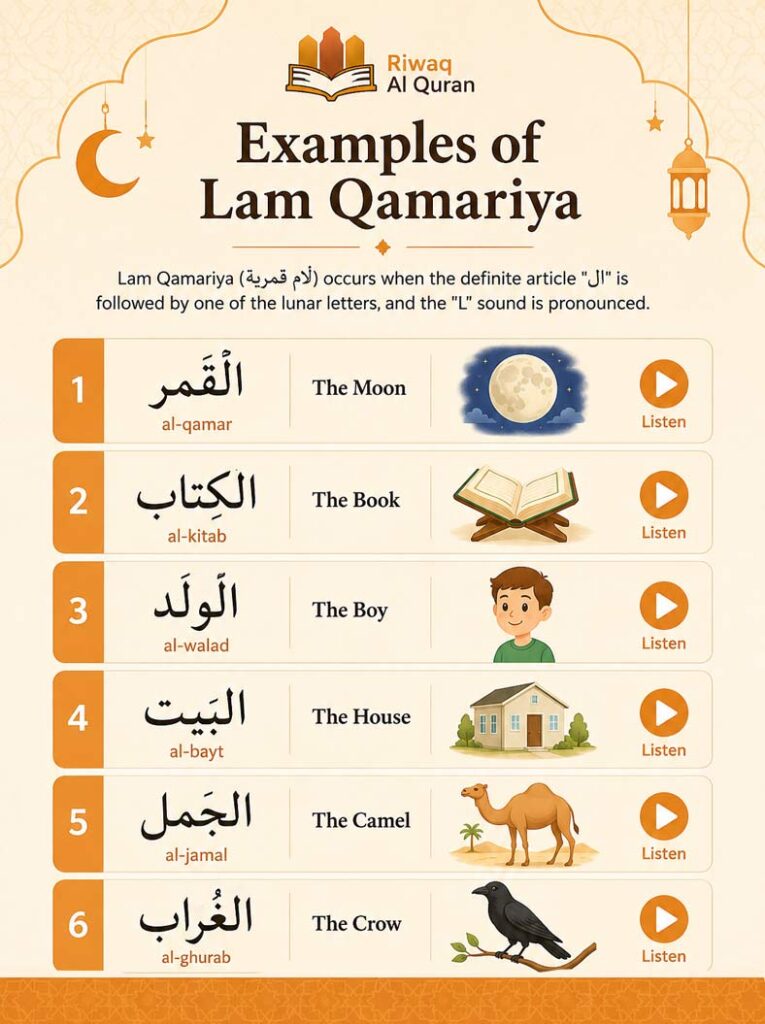
1- الْقَمَر (Al-Qamar) — “the moon”
2- الْكِتَاب (Al-Kitab) — “the book”
3- الْوَلَد (Al-Walad) — “the boy”
4- الْبَيْت (Al-Bayt) — “the house”
5- الْجَمَل (Al-Jamal) — “the camel”
6- الْغُرَاب (Al-Ghurab) — “the crow
The Moon Letters include أ (hamzah) specifically, which is why a word like أَحَد after “ال” (الْأَحَد, “the One”) keeps the Lam fully audible — a useful check if you’re ever unsure whether hamzah belongs to this group.
Read more about : How to Remember Arabic Sun and Moon Letters?
b. The Sun Letters (Lam Shamsiya)
The Sun Letters are: ت ث د ذ ر ز س ش ص ض ط ظ ل ن. When “ال” comes before any of these, the Lam is silent and the following letter takes a Shaddah.
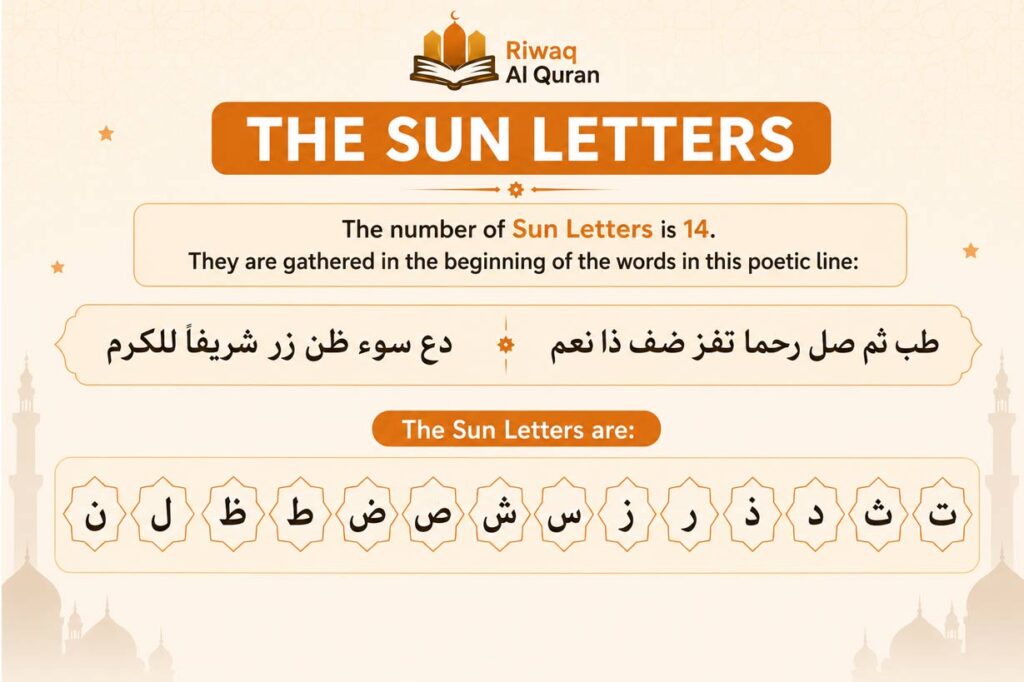
Examples of Lam Shamsiya:
For example, in the word “الشمس” (ash-shams), the “ال” is omitted, and the “ش” (shīn) is pronounced with a shaddah, resulting in “الشَّمس”.
In essence, the لام شمسية refers to the written form of “ال”, which is not vocalized when followed by a solar letter. Instead, the subsequent letter is pronounced with emphasis, unlike the لام قمرية (lunar “the”), where the “ال” is fully pronounced.
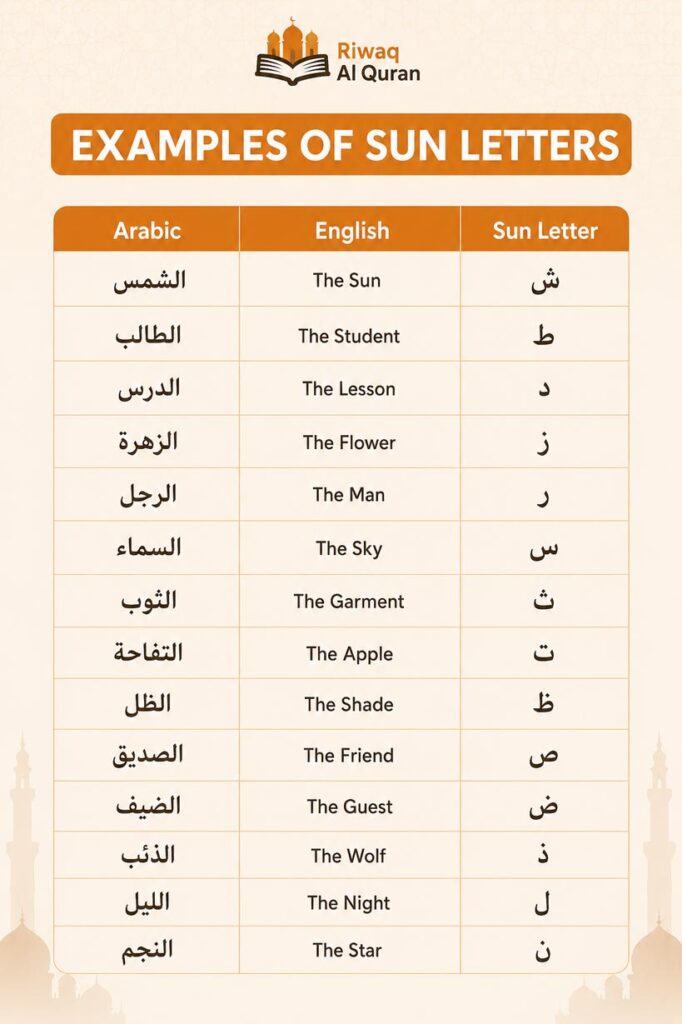
1- الشَّمْس (Ash-Shams) — “the sun”
2- الطَّالِب (At-Talib) — “the student”
3- الرَّجُل (Ar-Rajul) — “the man”
4- السَّمَاء (As-Sama’) — “the sky”
5- الصَّدِيق (As-Sadiq) — “the friend”
Read more about: The 5 Laam Sakinah Rules and How to Master Them
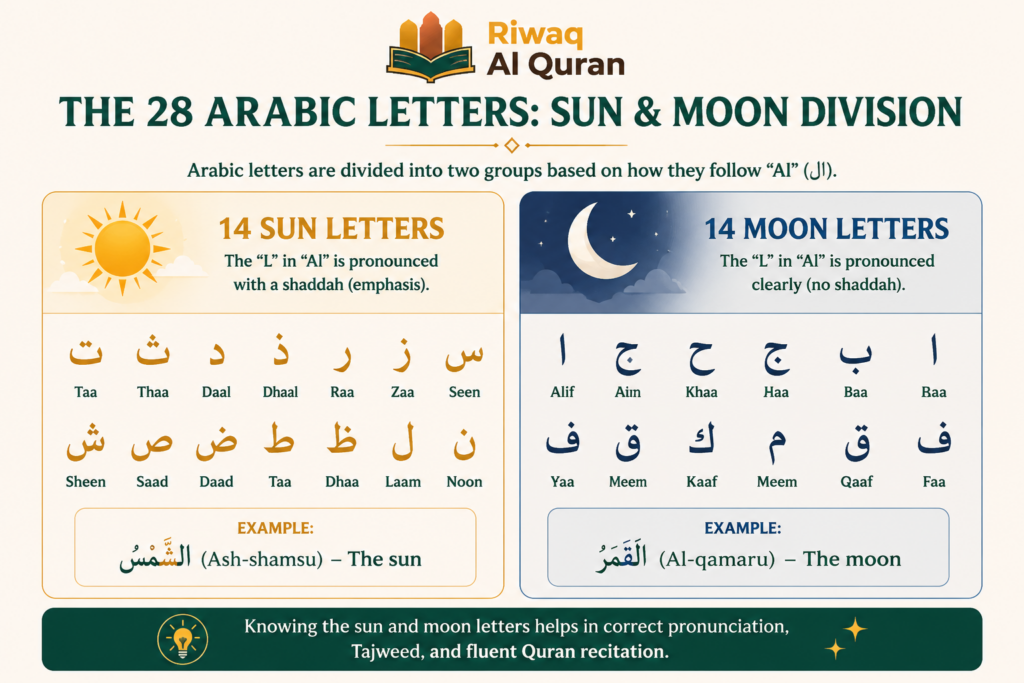
The Articulation of Sun Letters and Lam Assimilation
Sun Letters are pronounced from articulation points close to where the Lam itself is produced—primarily at the tip of the tongue against the gum ridge, the same general area used to pronounce Lam.
Because of this close proximity:
- The mouth barely changes position between the Lam and the following letter.
- The transition becomes naturally smooth.
- Instead of pronouncing two separate sounds, the Lam merges into the following letter, creating a doubled sound (Shaddah).
The Pronunciation of Lam with Moon Letters
Moon Letters are articulated from positions farther away from the Lam, including:
- Deep in the throat.
- The lips.
- The back of the tongue.
Since the mouth must move to a noticeably different articulation point:
- Merging the Lam would distort the pronunciation.
- The Lam remains fully pronounced as its own distinct sound before the following letter.
The Connection to Other Tajweed Rules
This articulation-based principle is not unique to Lam Shamsiya and Lam Qamariya. It belongs to the broader system of Tajweed rules that depend on a letter’s articulation point (Makhraj).
For example, the same principle appears in:
- Tafkheem (heavy pronunciation).
- Tarqeeq (light pronunciation).
In each case, a letter’s position in the mouth influences how it interacts with neighboring sounds, making Lam Shamsiya and Lam Qamariya part of a broader phonetic pattern rather than an isolated rule.
This articulation-point logic is part of the same broader family of rules covered under Tafkheem and Tarqeeq in Tajweed, where a letter’s position in the mouth consistently shapes how it interacts with neighboring sounds — this is one instance of a pattern that recurs across several other Tajweed rules, not a standalone exception.
The Written Form of Lam Shamsiya and Lam Qamariya
Although the pronunciation changes, the written form of ال never changes.
Instead, the diacritical marks indicate which rule applies:
- A Shaddah (ّ) on the following letter indicates Lam Shamsiya.
- A Sukoon (ْ) on the Lam itself indicates Lam Qamariya.
This is why reading the diacritics correctly is just as important as memorizing the Sun and Moon Letter lists. In a Mus-haf, these marks clearly guide pronunciation, whereas most non-Quranic Arabic texts omit many diacritics, requiring the reader to already know the rule.
Getting these marks right in practice is exactly where beginners tend to slip — here’s a quick look at the mistakes that show up most often.
Examples of Lam Shamsiya and Lam Qamariya from the Quran
Seeing both rules inside real verses makes the pattern easier to internalize than isolated vocabulary words, and it also connects directly to the pause and stop rules covered in a related guide on Quran stop signs when reading.
a. Sun Letter (Shamsiya) Examples From the Quran
1.
(الرَّحْمَـٰنِ الرَّحِيمِ)
“The Most Compassionate, Most Merciful.”— Surah Al-Fatihah, 1:3
Both الرَّحْمَـٰنِ and الرَّحِيمِ begin with ر, a Sun Letter, so the Lam merges into the doubled ر sound in each word — worth noting since these two names appear together at the very opening of the Quran, making this pairing one of the very first Sun Letter examples any student encounters.
2.
(هُوَ السَّمِيعُ الْبَصِيرُ)
“He is the All-Hearing, the All-Seeing.”— Surah Ash-Shura, 42:11
السَّمِيعُ begins with س, a Sun Letter, silencing the Lam entirely, while الْبَصِيرُ in the same verse begins with ب, a Moon Letter — meaning this single verse contains a clear example of both rules side by side, which makes it a genuinely useful practice verse on its own.
b. Moon Letter (Qamariya) Examples From the Quran
1.
(وَالْفَجْرِ)
“By the dawn.”— Surah Al-Fajr, 89:1
الْفَجْرِ begins with ف, a Moon Letter, so the Lam is pronounced clearly — notably, this is the opening verse of the Surah, and the Surah itself takes its name (Al-Fajr) directly from this Moon Letter word.
2.
(وَإِذَا الْجَنَّةُ أُزْلِفَتْ)
“And when Paradise is brought near.”— Surah At-Takwir, 81:13
الْجَنَّةُ begins with ج, another Moon Letter, keeping the Lam’s sound fully intact.
Key Differences Between Sun Letters and Moon Letters
Before jumping into the table, it helps to have both rules side by side in one place, since the two categories are easiest to tell apart when compared directly rather than read one after the other.
| Feature | Sun Letters (Shamsiya) | Moon Letters (Qamariya) |
|---|---|---|
| Number of letters | 14 | 14 |
| Lam pronunciation | Silent | Clearly pronounced |
| Following letter | Takes a Shaddah (doubled) | No Shaddah |
| Written mark | Sukoon-free, Shaddah on next letter | Sukoon over the Lam |
| Example | الشَّمْس (Ash-Shams) | الْقَمَر (Al-Qamar) |
| Articulation logic | Close to Lam’s own point | Further from Lam’s point |
How to Teach Kids Lam Shamsiya and Lam Qamariya
Younger learners generally grasp this rule faster through association and repetition than through the technical articulation explanation above.
a. Use a Fun Story or Analogy
Explain that Lam Shamsiya is “shy” and hides whenever it meets a Sun Letter, while Lam Qamariya is “confident” and always shows up clearly in front of a Moon Letter — a simple framing that makes the rule easy to recall on its own, especially for a child who hasn’t yet learned articulation points.
b. Introduce a Song or Chant
A short, repeated rhyme listing the Sun and Moon Letters, sung regularly during lessons, helps the list stick faster than reading it silently, since rhythm and repetition reinforce memory more effectively than a static written list for most young learners.
c. Use Visual Aids and Flashcards
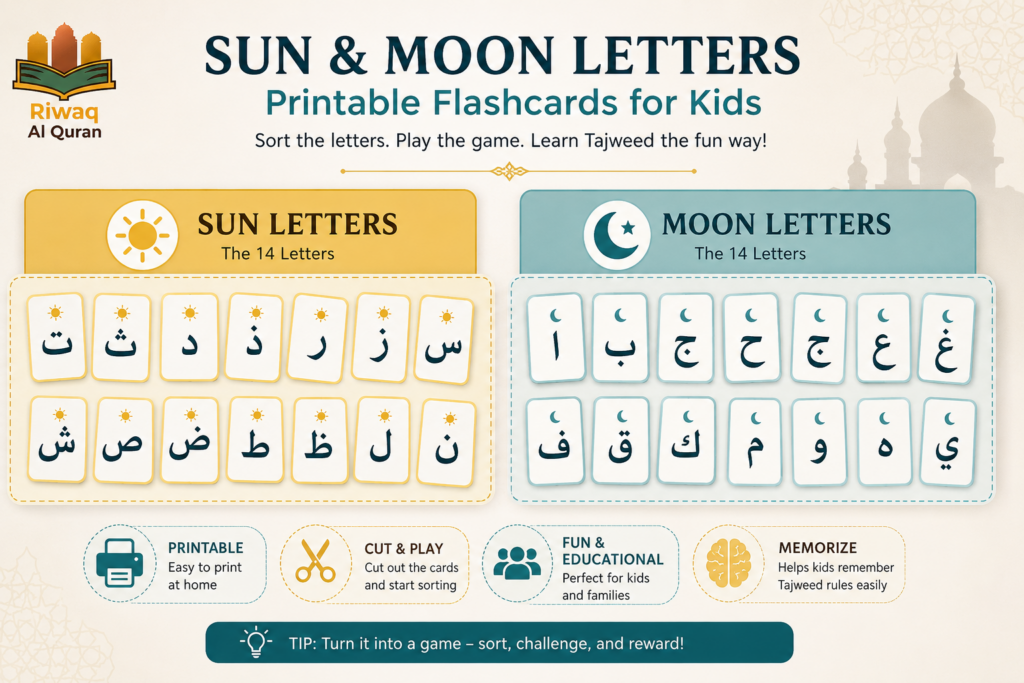
A chart split into two colored groups — a sun icon for Shamsiya, a moon icon for Qamariya — paired with matching games, turns memorization into an active task rather than passive reading.
d. Practice Directly From Quranic Verses
Choosing short, familiar verses containing clear examples and having a child identify which rule applies builds the skill inside real recitation, not just isolated vocabulary — a technique worth pairing with the broader Alif Lam guide once the basics feel solid.
e. Add a Game Element
A quick “Spot the Lam” listening game, where a child hears a word and calls out Shamsiya or Qamariya, keeps repetition from feeling like a chore, especially when paired with small rewards for correct answers.
The Importance of Mastering Lam Shamsiya and Lam Qamariya
Beyond correct pronunciation for its own sake, this rule affects several practical parts of learning and reciting the Quran, and each one builds directly on getting these two rules right early.
1. It Improves Tajweed and Recitation Accuracy
Understanding both rules lets a reciter pronounce words exactly as intended, in line with Tajweed’s core standards for precise, correct recitation. The Prophet ﷺ specifically instructed believers to give the Quran this kind of careful vocal attention:
(زَيِّنُوا الْقُرْآنَ بِأَصْوَاتِكُمْ)
“Beautify the Quran with your voices.”— Sunan Abi Dawud 1468, graded Sahih
This instruction isn’t just about a pleasant voice — accurate application of rules like Lam Shamsiya and Lam Qamariya is part of what “beautifying” recitation actually means in practice, since a recitation riddled with mispronounced Lams undercuts the clarity this hadith is calling for, regardless of how melodic the voice is.
2. It Enhances Arabic Reading Fluency
Knowing instantly whether a Lam is silent or pronounced removes hesitation from reading, letting a reader move through text smoothly instead of pausing to work out each definite article — a skill that compounds directly into faster, more confident reading over time rather than staying a one-off correction.
This fluency matters beyond the Quran itself. Since “ال” appears in a large share of everyday Arabic nouns, a reader who hesitates on Sun and Moon Letters in the Quran will hit the exact same hesitation reading a newspaper, a street sign, or a text message — this isn’t a Quran-specific skill quietly limited to recitation, it’s a general reading fluency skill that happens to be taught most rigorously through Quranic Tajweed first.
3. It Preserves Quranic Meaning
Mispronouncing the Lam in either direction can distort a word’s sound enough to affect how it’s understood, particularly important when reciting verses where precision carries real weight. Allah describes the Quran’s own precision directly:
(كِتَابٌ أُحْكِمَتْ آيَاتُهُ ثُمَّ فُصِّلَتْ مِن لَّدُنْ حَكِيمٍ خَبِيرٍ)
“A Book whose verses are perfected and then presented in detail from One who is Wise and Acquainted.”— Surah Hud, 11:1
A text described as deliberately “perfected” and “detailed” is one where small pronunciation shifts genuinely matter — this verse is part of why scholars have historically treated exact Tajweed rules, including this one, as inseparable from correct recitation rather than an optional refinement.
This connects to a specific practical risk worth naming directly: a mispronounced Sun Letter word can occasionally shift its Shaddah placement enough to blur it toward a different, unrelated word in casual listening — which is precisely the kind of subtle distortion Ibn al-Jazari, the classical scholar whose Tajweed treatise remains a foundational reference in this field, warned against when he insisted that correct application of the letters’ articulation points was a condition for sound recitation, not a stylistic preference layered on top of it.
4. It Builds a Strong Foundation for Arabic Grammar
For learners of Arabic, especially children and non-native speakers, recognizing this distinction early creates a solid base for more advanced grammar and phonetics later on — many later rules assume this one is already automatic, so treating it as optional early on creates gaps that surface again further into study.
This has a specific practical consequence worth naming: rules like Idgham (letter merging) and Ikhfa (partial concealment) later in Tajweed study rely on the same underlying skill of recognizing which letters naturally merge and which stay distinct — a student who never fully internalized Sun and Moon Letters is effectively relearning the same core concept from scratch when these later rules appear, rather than simply applying a skill they already have.
Teachers who work with beginners regularly report that hesitation on Alif Lam is one of the more reliable early signals that a student needs more foundational practice before progressing further, precisely because the rule is meant to become automatic this early.
5. It Deepens Appreciation for Arabic’s Structure
Understanding the logic behind these rules — not just memorizing them — builds a genuine appreciation for how deliberately structured the Arabic language is, and for its connection to the Quran itself as the text this structure was refined to carry.
Allah describes the Quran’s own language directly, tying its clarity to a specific linguistic choice:
(إِنَّا أَنزَلْنَاهُ قُرْآنًا عَرَبِيًّا لَّعَلَّكُمْ تَعْقِلُونَ)
“Indeed, We have sent it down as an Arabic Quran that you might understand.” (Surah Yusuf, 12:2)
The verse ties comprehension directly to the choice of Arabic as the revelation’s language — a claim that only holds up if the language’s own internal logic, down to details like why certain letters merge and others don’t, is treated as meaningful rather than arbitrary.
Sun and Moon Letters are a small, concrete example of exactly that kind of built-in logic: not a rule imposed on the language from outside, but a pattern that emerges naturally from how the letters are already articulated.
6. It Supports Accurate Quran Memorization
A student who has internalized Sun and Moon Letters correctly is far less likely to memorize a mispronounced version of a word — an error that becomes significantly harder to correct after weeks of repetition than before it sets in, since correcting an ingrained mistake takes noticeably longer than learning it right the first time.
This is closely tied to a principle scholars call Talqin — hearing a verse recited correctly before attempting to memorize it, rather than reading it silently and guessing at pronunciation.
A student applying Talqin who has already mastered Sun and Moon Letters will naturally recite Lam Shamsiya and Lam Qamariya words correctly the first time they hear them, since the rule becomes something the ear expects rather than something consciously checked verse by verse — which is precisely why teachers recommend covering this rule before beginning serious memorization, not alongside it.
7. It Builds Attention to Detail
Practicing this rule regularly develops a habit of noticing subtle pronunciation details, a skill that carries over into general Arabic reading and comprehension well beyond this one rule. This same attention to detail connects naturally to the related Laam Sakinah rules, which build on the same underlying logic.
The Prophet ﷺ described the effort behind careful recitation directly, distinguishing between a fluent reciter and one who has to work harder for the same result:
(الْمَاهِرُ بِالْقُرْآنِ مَعَ السَّفَرَةِ الْكِرَامِ الْبَرَرَةِ، وَالَّذِي يَقْرَأُ الْقُرْآنَ وَيَتَتَعْتَعُ فِيهِ وَهُوَ عَلَيْهِ شَاقٌّ لَهُ أَجْرَانِ)
“The one who is skilled in the Quran is with the noble, righteous scribes, and the one who recites the Quran and stumbles over it, finding it difficult, will have a double reward.” (Sahih al-Bukhari 4937; Sahih Muslim 798)
This hadith is worth reading specifically alongside attention to detail: the “stumbling” reciter isn’t penalized, but the entire hadith assumes the goal is to move from that stumbling stage toward genuine fluency — and rules like Sun and Moon Letters are exactly the kind of small, attainable detail that moves a learner from one category toward the other, one correctly internalized rule at a time.
Master Tajweed Rules Like This With Riwaq Al Quran
Riwaq Al Quran is a comprehensive online platform that offers personalized Quran, Arabic, and Islamic Studies online classes for individuals of all ages and backgrounds. Their experienced instructors use a structured curriculum to cover Tajweed, Tafsir, and Memorization, providing easy and effective access to learning the Quran.
The advanced online classes allow for seamless communication and interaction between students and teachers. Join Riwaq Al Quran for a deeper connection with the Quran.
Rules like Lam Shamsiya and Lam Qamariya are one part of a bigger picture — here’s a quick reminder of why Tajweed as a whole is worth this level of care.
We offer several courses, such as:
- Online courses for kids
- Online Quran classes for kids and adults
- Online Arabic courses
- Online Ijazah courses
- Online Islamic Studies courses


Here’s a sample of our set of Quran courses that will be helpful for you:
- Online Quran Classes for Kids: Nurture a love for the Quran in kids through interactive online classes.
- Online Tafseer Course: Delve into Quranic meanings with our insightful online Tafseer course.
- Noorani Qaida Online: Learn Quranic basics efficiently through our Noorani Qaida online program.
- Online Quran Recitation Course: Enhance Quranic recitation skills through our expert-led online course.
- Online Tajweed Classes: Master Tajweed rules for beautiful Quranic recitation in online classes.
- Quran Memorization Online Course: Memorize the Quran effectively with our specialized online memorization course.
- Online Qirat Course: Explore diverse Qirat styles with our comprehensive online Qirat course.

Conclusion
Seven reasons, and every one of them traces back to the same small rule: does the Lam merge, or does it stay?
- It shapes recitation itself, The Prophet ﷺ asked believers to beautify the Quran with their voices — and getting Sun and Moon Letters right is part of what that beauty actually requires, not a separate technical add-on.
- It builds fluency that outlasts the Quran, A reader who hesitates on “ال” in Surah recitation hesitates on it in a newspaper too — this rule quietly underwrites ordinary Arabic reading, not just Tajweed.
- It protects meaning, Allah describes His own Book as perfected, then detailed — a description that only holds if small pronunciation choices are treated as meaningful, not incidental.
- It’s the foundation every later rule assumes is already automating, Idgham, Ikhfa, and the rules that follow all lean on a student already knowing which letters merge — skip this one, and those later rules become harder, not simpler.
- It reveals a language built on logic, not convention, Sun and Moon Letters aren’t an arbitrary list to memorize — they’re what happens naturally when you already know where each letter sits in the mouth.
- It protects memorization from its most stubborn mistakes, A word memorized wrong here doesn’t just sound off — it becomes the version your memory defaults to, and undoing that takes far longer than getting it right the first time.
- And it trains the one habit every other Tajweed rule depends on: noticing what most readers skim past.
None of this asks for anything dramatic. It asks for two lists — 14 letters, 14 letters — learned well enough that the ear stops calculating and starts simply knowing.
FAQs
Here are direct answers to the questions that come up most once the core rule itself is clear.
What is the difference between Lam Shamsiya and Lam Qamariya?
Lam Shamsiya occurs when “ال” precedes one of 14 Sun Letters, silencing the Lam and doubling the following letter, while Lam Qamariya occurs before one of 14 Moon Letters, where the Lam is pronounced clearly with no doubling.
What are the 14 Sun Letters in Arabic?
The 14 Sun Letters are ت ث د ذ ر ز س ش ص ض ط ظ ل ن — any of these following “ال” silences the Lam and doubles the letter itself.
What are the 14 Moon Letters in Arabic?
The 14 Moon Letters are أ ب ج ح خ ع غ ف ق ك م هـ و ي — any of these following “ال” keeps the Lam fully pronounced with no doubling.
Why does the spelling of “ال” never change between the two rules?
Because the rule affects pronunciation, not the written definite article itself — a Shaddah on the following letter marks Lam Shamsiya, while a Sukoon on the Lam marks Lam Qamariya, but “ال” is written identically either way.
Why do Sun Letters silence the Lam while Moon Letters don’t?
Sun Letters are articulated from points in the mouth close to where the Lam itself is produced, allowing it to merge smoothly, while Moon Letters are articulated further away, which is why forcing a merge there would distort the sound instead of smoothing it.