You face a decision — a job offer, a marriage proposal, a major life change — and you want clarity. Not just a gut feeling, not just advice from friends, but genuine guidance from the One who knows what you don’t. That is exactly what Istikhara is for. It is one of the most practical gifts the Prophet Muhammad (ﷺ) gave his ummah: a structured, authenticated way to place your decision before Allah and invite His knowledge to direct your choice.
This guide gives you everything you need — the exact steps, the complete Istikhara dua with tashkeel and a phrase-by-phrase breakdown, the authentic hadiths with full citations, and the practical signs to watch for after the prayer. It also addresses the widespread misconceptions that cause people to perform Istikhara incorrectly for years without realizing it.
Istikhara (صَلَاةُ الِاسْتِخَارَة) is a voluntary prayer through which a Muslim asks Allah to guide them toward the better of two permissible choices. It is not an emergency practice reserved for life-altering decisions. The Prophet (ﷺ) taught it as a constant habit — for all matters — with the same care he used to teach verses of the Quran.
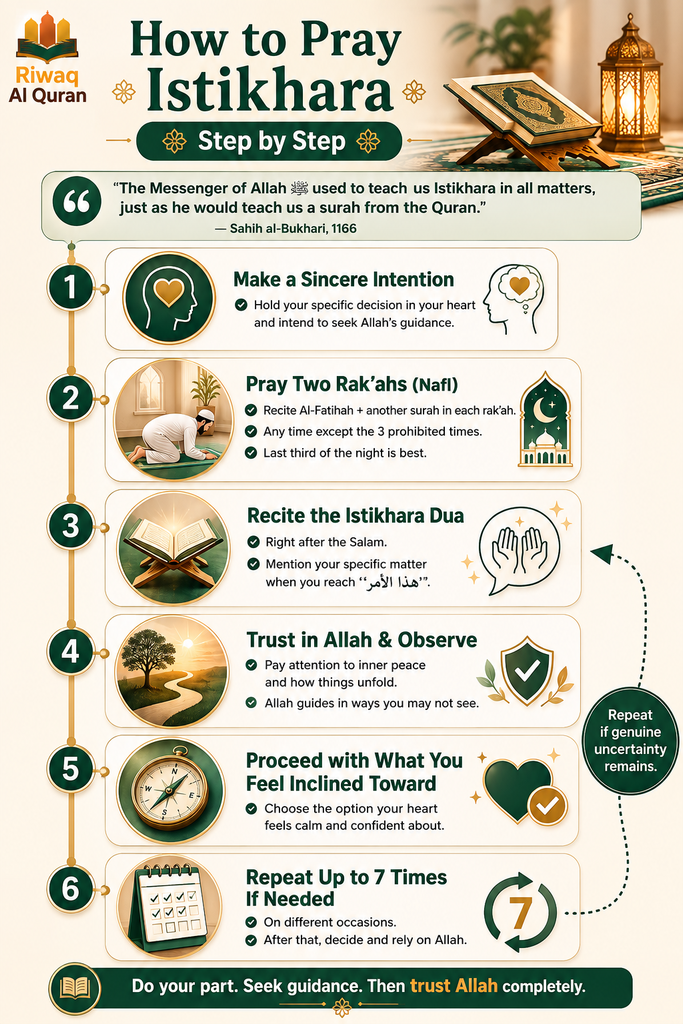
The foundational hadith that establishes Istikhara comes from Jabir ibn Abdullah (رضي الله عنه):
“عَنْ جَابِرِ بْنِ عَبْدِ اللَّهِ رضى الله عنهما قَالَ: كَانَ رَسُولُ اللَّهِ ﷺ يُعَلِّمُنَا الِاسْتِخَارَةَ فِي الْأُمُورِ كُلِّهَا، كَمَا يُعَلِّمُنَا السُّورَةَ مِنَ الْقُرْآنِ.“
“The Messenger of Allah (ﷺ) used to teach us Istikhara in all matters, just as he would teach us a surah from the Quran.”— Sahih al-Bukhari, Book 19, Hadith 1166
The phrase “in all matters” (فِي الْأُمُورِ كُلِّهَا) is the key detail most people miss. The Prophet (ﷺ) did not restrict Istikhara to marriage, emigration, or major life changes.
He normalized it for everyday decisions, making it a reflex of reliance on Allah rather than a last resort in crisis. The comparison to teaching Quranic surahs tells us how seriously he considered it — not a secondary sunnah, but a foundational life skill.
Table of Contents
1. Make a Sincere Intention (Niyyah)
Niyyah is the internal commitment to act for Allah’s sake. For Istikhara, hold your specific decision clearly in your mind before you begin — not a general feeling of needing guidance, but the precise matter you are choosing between.
- There is no required verbal formula; the intention is made in the heart.
- Mentally state: “I intend to pray two rak’ahs of Istikhara seeking guidance regarding [your specific matter]”.
- The sharper your intention, the more anchored your dua will be when you reach the supplication.
2. Perform Two Voluntary Rak’ahs
Perform two units of voluntary (nafl) prayer in exactly the same form as any other non-obligatory prayer. These may be offered at any time except the three prohibited times:
- Directly at sunrise.
- Directly at sunset.
- When the sun reaches its midday zenith.

Many scholars recommend performing Istikhara close to sleep at the last third of the night — and there is a powerful reason for this. The Prophet (ﷺ) described what happens during that time:
“يَنْزِلُ رَبُّنَا تَبَارَكَ وَتَعَالَى كُلَّ لَيْلَةٍ إِلَى السَّمَاءِ الدُّنْيَا حِينَ يَبْقَى ثُلُثُ اللَّيْلِ الآخِرُ يَقُولُ: مَنْ يَدْعُونِي فَأَسْتَجِيبَ لَهُ؟ مَنْ يَسْأَلُنِي فَأُعْطِيَهُ؟ مَنْ يَسْتَغْفِرُنِي فَأَغْفِرَ لَهُ؟”
“Our Lord descends every night to the lowest heaven when the last third of the night remains, and He says: ‘Who is calling upon Me, that I may answer him? Who is asking Me, that I may give him? Who is seeking forgiveness from Me, that I may forgive him?'”— Sahih al-Bukhari, Book 19, Hadith 1145
This hadith is not specific to Istikhara, but it is deeply relevant. If you want the best possible conditions for your dua to be answered, praying in the last third of the night places your Istikhara at precisely the moment Allah has described as most open to supplication. This is not a condition — it is a practical upgrade.
In the first rak’ah, recite Surah Al-Fatihah followed by another surah. Commonly chosen are Surah Al-Kafirun (Surah 109), which affirms complete reliance on Allah alone, or Surah Al-Ikhlas (Surah 112). In the second rak’ah, repeat the same structure. Complete the prayer with Tashahhud and end with Salam in both directions.
3. Recite the Istikhara Dua Immediately After the Salam
The moment you finish the Salam — before you stand, speak to anyone, or shift your attention — begin the Istikhara dua.
- When you reach “هَذَا الْأَمْرَ” (this matter), pause and name your specific decision, silently in your heart or quietly aloud.
- Naming it concretely anchors the supplication to your actual situation.
- Leaving it abstract reduces the dua to a general wish rather than a directed request to Allah.
The full dua, with Arabic text, English, transliteration, and a phrase-by-phrase explanation, is covered in the next section.
4. Trust in Allah and Observe What Unfolds
After the dua, active trust (tawakkul) begins. This does not mean passive waiting — it means continuing with your normal life while remaining attentive to the inner and outer signs Allah sends. The Quran establishes this directly:
“وَمَن يَتَوَكَّلْ عَلَى اللَّهِ فَهُوَ حَسْبُهُ ۚ إِنَّ اللَّهَ بَالِغُ أَمْرِهِ ۚ قَدْ جَعَلَ اللَّهُ لِكُلِّ شَيْءٍ قَدْرًا“
“And whoever relies upon Allah — then He is sufficient for him. Indeed, Allah will accomplish His purpose. Allah has already set for everything a decreed extent.”— At-Talaq, Surah 65:3
The verse does not say “He may be sufficient” — it states it as a fact. Tawakkul in the context of Istikhara is not hoping Allah will guide you; it is trusting that He has already begun to do so. Your role is to remain attentive and honest with yourself about what you feel and observe.
5. Proceed with What You Feel Inclined Toward
After Istikhara, move toward the option you feel genuinely and calmly pulled toward.
- This inclination — when it follows sincere prayer and honest preparation — is itself part of the guidance Allah places in the heart.
- The Prophet (ﷺ) did not instruct the companions to wait for a sign before deciding; He taught them to seek, then act.
- If one option produces settled, quiet confidence when you think about it, while the other produces unexplained hesitance or a tightening feeling, that difference is meaningful — it was not there before the prayer in the same way.
6. Repeat Up to Seven Times If Genuine Uncertainty Persists
If clarity does not emerge after the first Istikhara, there is no cause for anxiety.
- Repeat the prayer on separate occasions, up to seven times in total — not necessarily on consecutive nights.
- Each repetition is not a sign the first one failed; it is a deepening of reliance and a widening of your attention to what Allah is showing you.
- After seven sincere attempts, make your best decision, knowing you have done what the Sunnah prescribes, and trust Allah’s decree completely.


The Istikhara Dua — Arabic Text, Phrase-by-Phrase Meaning, and Transliteration
The Istikhara dua is not a generic supplication — its structure is theologically precise. Each phrase does specific work. Understanding what you are actually saying transforms the dua from recited words into a meaningful dialogue with Allah. The full dua is recorded in Sahih al-Bukhari:
اللَّهُمَّ إِنِّي أَسْتَخِيرُكَ بِعِلْمِكَ، وَأَسْتَقْدِرُكَ بِقُدْرَتِكَ، وَأَسْأَلُكَ مِنْ فَضْلِكَ الْعَظِيمِ، فَإِنَّكَ تَقْدِرُ وَلَا أَقْدِرُ، وَتَعْلَمُ وَلَا أَعْلَمُ، وَأَنْتَ عَلَّامُ الْغُيُوبِ. اللَّهُمَّ إِنْ كُنْتَ تَعْلَمُ أَنَّ هَذَا الْأَمْرَ — [اذْكُرِ الْأَمْرَ هُنَا] — خَيْرٌ لِي فِي دِينِي وَمَعَاشِي وَعَاقِبَةِ أَمْرِي، فَاقْدُرْهُ لِي وَيَسِّرْهُ لِي ثُمَّ بَارِكْ لِي فِيهِ. “وَإِنْ كُنْتَ تَعْلَمُ أَنَّ هَذَا الْأَمْرَ شَرٌّ لِي فِي دِينِي وَمَعَاشِي وَعَاقِبَةِ أَمْرِي، فَاصْرِفْهُ عَنِّي وَاصْرِفْنِي عَنْهُ، وَاقْدُرْ لِيَ الْخَيْرَ حَيْثُ كَانَ ثُمَّ أَرْضِنِي.“— Sahih al-Bukhari, Book 19, Hadith 1166
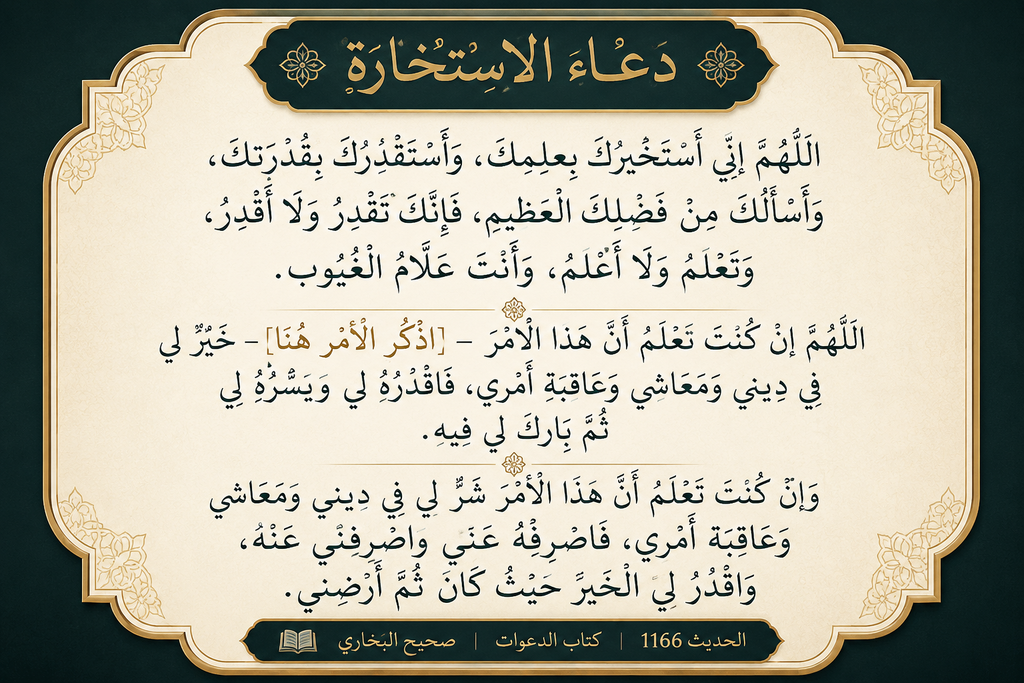
a. Istikhara Dua in Arabic (with Full Tashkeel)
The Arabic text above contains the complete dua with full tashkeel (vowel markings). Refer to it directly during recitation. For a detailed guide to pronouncing the dua correctly, visit the dedicated Istikhara Dua page.
b. What Each Phrase of the Dua Means
Most guides provide the translation. Few explain why each phrase is constructed the way it is — and that explanation is what changes how you feel while reciting it.
- “أَسْتَخِيرُكَ بِعِلْمِكَ” — I seek Your guidance through Your knowledge. You are explicitly asking Allah to use His knowledge — complete and perfect — to direct you. This phrase admits that your own analysis, however thorough, is limited by what you can see. Allah sees the outcome of every path you cannot.
- “وَأَسْتَقْدِرُكَ بِقُدْرَتِكَ” — I seek capability through Your power. This asks Allah not just for the right answer but for the ability to act on it. Guidance without the capacity to follow it is incomplete — so you ask for both at once.
- “وَأَسْأَلُكَ مِنْ فَضْلِكَ الْعَظِيمِ” — I ask from Your immense bounty. The word فَضْل (fadl) means generosity beyond what is deserved. You are not claiming a right to an answer — you are asking from generosity, with important humility built into the structure.
- “فَإِنَّكَ تَقْدِرُ وَلَا أَقْدِرُ، وَتَعْلَمُ وَلَا أَعْلَمُ” — For You have power and I do not; You know and I do not. This couplet is the theological core. The contrast is deliberate: not “You know more than I do” — but “You know, and I do not.” Complete dependence, not comparison.
- “وَأَنْتَ عَلَّامُ الْغُيُوبِ” — And You are the Knower of the unseen. The word عَلَّام is an intensified form — the profound, comprehensive Knower. The unseen includes the future consequences of your decision, the hidden character of the people involved, effects years from now that no human can access. You are asking the One who sees all of that to make your decision for you.
- “إِنْ كُنْتَ تَعْلَمُ أَنَّ هَذَا الْأَمْرَ خَيْرٌ لِي… فَاقْدُرْهُ لِي” — If You know this matter is good for me… then ordain it. The conditional structure (“if You know…”) is unique. You are not telling Allah what you want and asking Him to bless it. You are handing Him the decision completely — if He deems it good, bring it; if not, take it away.
- “ثُمَّ أَرْضِنِي” — And make me content. This is the most profound phrase and the one most people rush past. You are asking Allah not only for the right outcome but for satisfaction with it — even if it is not what you wanted. This phrase prepares your heart in advance for whatever decree comes.
c. Istikhara Dua in English
O Allah, I seek Your guidance by Your knowledge, and I seek strength through Your power, and I ask You from Your immense bounty. For You have power and I do not, and You know and I do not, and You are the Knower of the unseen.
O Allah, if You know that this matter — [name your decision] — is good for me in my religion, my livelihood, and my ultimate outcome, then ordain it for me, make it easy for me, and bless me in it.
And if You know that this matter is harmful to me in my religion, my livelihood, and my ultimate outcome, then turn it away from me and turn me away from it. Ordain for me the good wherever it may be, and make me content with it.
d. Istikhara Dua Transliteration
Allahumma inni astakhiruka bi’ilmika, wa astakdiruka biqudratika, wa as’aluka min fadlikal-‘azim. Fa’innaka taqdiru wa la aqdir, wa ta’lamu wa la a’lam, wa anta ‘allamul ghuyub.
Allahumma in kunta ta’lamu anna hadhal-amra — [name the matter] — khayrun li fi dini wa ma’ashi wa ‘aqibati amri, faqdurhu li wa yassirhu li thumma barik li fih.
Wa in kunta ta’lamu anna hadhal-amra sharrun li fi dini wa ma’ashi wa ‘aqibati amri, fasrifhu ‘anni wasrifni ‘anhu, waqdur li al-khayra haythu kana thumma ardini.
Why Allah Answers Sincere Du’a — The Theological Foundation
Before looking for signs of a response, it helps to understand what Allah has already promised about supplication. This matters practically: it prevents the anxiety of wondering whether your dua “reached” Allah. Allah says directly in the Quran:
“وَإِذَا سَأَلَكَ عِبَادِي عَنِّي فَإِنِّي قَرِيبٌ ۖ أُجِيبُ دَعْوَةَ الدَّاعِ إِذَا دَعَانِ ۖ فَلْيَسْتَجِيبُوا لِي وَلْيُؤْمِنُوا بِي لَعَلَّهُمْ يَرْشُدُونَ“
“And when My servants ask you concerning Me — indeed I am near. I respond to the invocation of the supplicant when he calls upon Me. So let them respond to Me and believe in Me that they may be guided.”— Al-Baqarah, Surah 2:186
The verse does not say “I respond sometimes” or “I respond to the most deserving.” It says “I respond to the invocation of the supplicant when he calls upon Me.”
The condition for response is the act of calling — which you fulfill when you perform Istikhara sincerely. The verse ends with “la’allahum yarshudun” — so that they may be guided — which is precisely what Istikhara asks for.
The Prophet (ﷺ) also established the status of du’a in Islam as a whole:
“عَنِ النُّعْمَانِ بْنِ بَشِيرٍ رضي الله عنه قَالَ: سَمِعْتُ النَّبِيَّ ﷺ يَقُولُ: “الدُّعَاءُ هُوَ الْعِبَادَةُ”
“Du’a is worship itself.”— Sunan al-Tirmidhi, Hadith 3372 (graded Sahih)
When the Prophet (ﷺ) says du’a is worship — not merely part of worship — he places supplication at the center of your relationship with Allah. Every time you perform Istikhara, you are not just asking for guidance; you are completing an act of worship.
This reframes the prayer: even if your decision is eventually shaped by external events, the act of Istikhara itself carries reward regardless of the outcome.
Developing a genuine understanding of du’a, its conditions, and its etiquette is part of a broader Islamic Studies foundation. Riwaq Al Quran’s Islamic studies curriculum covers these topics with qualified instructors in live, structured sessions.
Signs That Istikhara Has Been Answered
The Prophet’s (ﷺ) hadith on Istikhara does not prescribe a specific sign. Yet Muslims across generations have consistent experiences after the prayer. Here is what the classical scholars and sound Islamic reasoning tell us to actually look for.
For a full exploration of each type of response, see the dedicated guide on signs of Istikhara response.
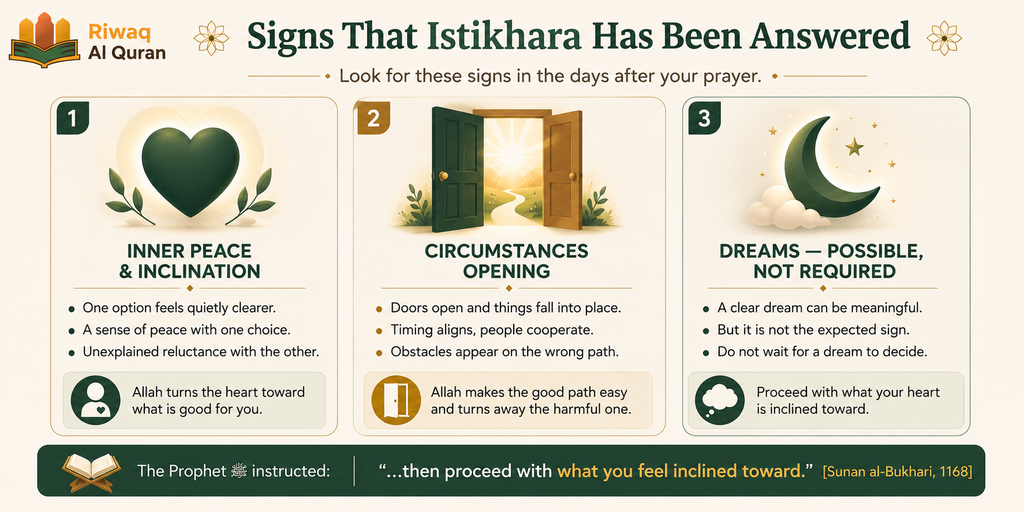
a. A Settled, Unexplained Inclination of the Heart
Before Istikhara, you were genuinely torn. After it, one option begins to feel naturally and quietly clearer — not because you gathered new information, but because something internally shifted.
- A sense of peace and confidence accompanies one choice
- A quiet tightening or unexplained reluctance follows the other
- This inner inclination is not wishful thinking — the dua explicitly asked Allah to “ordain it and make it easy” if it is good, and to “turn it away from me” if it is not. That turning is often felt before it is seen.
The Quran reminds us that ease follows difficulty — and that this pattern is a form of divine promise:
“فَإِنَّ مَعَ الْعُسْرِ يُسْرًا إِنَّ مَعَ الْعُسْرِ يُسْرًا“
“For indeed, with hardship will be ease. Indeed, with hardship will be ease.”— Al-Inshirah, Surah 94:5–6
The verse repeats twice intentionally. Classical scholars noted that the Arabic construction uses the definite article for “hardship” (الْعُسْر — the hardship) but not for ease, suggesting one hardship comes with multiple forms of ease.
When a path after Istikhara consistently feels hard despite honest effort, it may not be a sign to persist — it may be the answer itself.
b. Circumstances Opening or Closing Around One Path
Watch for the practical movement of events in the days following Istikhara.
- Arrangements for one option begin to fall into place with relative ease — doors open, timing aligns, people cooperate naturally.
- Meanwhile, a path that seemed open encounters repeated, unexplained obstacles.
- This is what the dua asks for: “make it easy” (يَسِّرْهُ لِي) versus “turn it away” (فَاصْرِفْهُ عَنِّي) — the ease and difficulty you observe are answers to those specific words.
c. Dreams — A Possible but Never Required Response
A clear dream in which one path appears favorable and the other difficult is sometimes experienced after Istikhara, and some scholars consider it meaningful when it occurs and is clear.
- However, the Prophet’s (ﷺ) instruction in the hadith contains no mention of dreams as the expected or required response.
- You are told to proceed with what you feel inclined toward — not to wait for sleep to tell you.
- Treating a dream as the only valid form of answer is a cultural overlay on the Sunnah, not part of it.
What to Do While Waiting for Clarity
Most guides end at “observe the signs.” But the days between Istikhara and a clear sense of direction can be uncomfortable, and knowing how to use them well matters. Allah ties patience and prayer together as the instruments of seeking help:
“وَاسْتَعِينُوا بِالصَّبْرِ وَالصَّلَاةِ ۚ وَإِنَّهَا لَكَبِيرَةٌ إِلَّا عَلَى الْخَاشِعِينَ“
“Seek help through patience and prayer. Indeed, it is difficult except for the humbly submissive to Allah.”— Al-Baqarah, Surah 2:45
The verse pairs صَبْر (patience) with صَلَاة (prayer) as two active instruments — not one passive state. During the waiting period after Istikhara, patience is not inaction; it is the deliberate holding of your decision in Allah’s hands while continuing to do what is needed. Here is how to use this period well:
- Continue making du’a. Istikhara is not a one-time switch. You may make du’a for guidance between your Istikhara repetitions without re-performing the full prayer each time.
- Seek consultation (istisharah) actively. Talk to people who know the situation, have relevant knowledge, and will give you honest advice rather than what you want to hear.
- Gather information you do not yet have. If there is research or investigation relevant to your decision that you have not yet completed, do it now. Istikhara is not a shortcut around preparation.
- Increase your general worship. Regular prayer, Quran recitation, and dhikr during this period keep the heart soft and sensitive to the subtle signs Allah sends. A heart occupied with distractions is less likely to notice a gentle inner shift.
- Watch without forcing. Avoid mentally fixating on a preferred outcome and interpreting every event as confirmation of it. Honest observation means noticing both ease and difficulty equally.
Three Common Mistakes That Undermine Istikhara
Most guides describe what to do. Fewer address what silently invalidates or misframes Istikhara. These three mistakes are widespread and worth knowing before you begin.
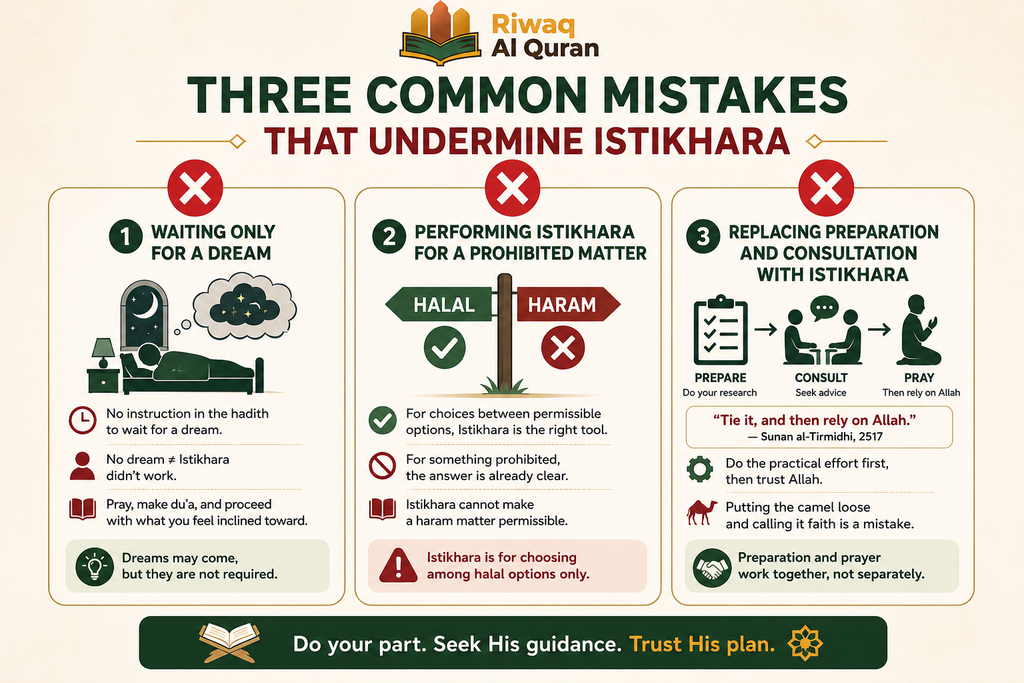
1. Waiting Only for a Dream
This is the most consequential misunderstanding of Istikhara — and the most common.
- Many Muslims freeze their entire decision-making process waiting for a specific dream as divine confirmation.
- When no dream comes, they feel spiritually inadequate or conclude that Istikhara “didn’t work”.
- The hadith contains no instruction to wait for a dream; it instructs the Muslim to perform the prayer, recite the dua, and proceed with what they feel inclined toward.
- Waiting for a dream before deciding is a cultural tradition attached to the Sunnah, not part of it.
2. Performing Istikhara for a Prohibited Matter
Istikhara is valid only for choices between permissible options.
- If both possibilities are halal and you are choosing between them, Istikhara is exactly the right tool.
- If one option involves something prohibited in Islam — a haram business arrangement, an unlawful relationship, a forbidden act — the Shariah has already answered that question.
- There is nothing left for Istikhara to resolve in that case, and performing it for a haram matter does not make the matter permissible.
3. Replacing Preparation and Consultation with Istikhara
The Prophet (ﷺ) was explicit about the relationship between relying on Allah and taking practical action:
عَنْ أَنَسِ بْنِ مَالِكٍ رضي الله عنه قَالَ: قَالَ رَجُلٌ: يَا رَسُولَ اللَّهِ، أَعْقِلُهَا وَأَتَوَكَّلُ، أَوْ أُطْلِقُهَا وَأَتَوَكَّلُ؟ قَالَ: “اعْقِلْهَا وَتَوَكَّلْ”
“A man asked: ‘O Messenger of Allah, shall I tie my camel and then rely on Allah, or shall I leave it untied and rely on Allah?’ He said: ‘Tie it, and then rely on Allah.'”— Sunan al-Tirmidhi, Hadith 2517
The Prophet’s answer was not “just trust Allah” — it was “do the practical thing first, then trust Allah.” Istikhara belongs on the same principle:
- Do your research, seek advice, and evaluate the decision honestly — then bring it to Allah in prayer.
- Performing Istikhara as a substitute for preparation is not tawakkul; it is what the scholars call putting the camel loose and calling it faith.
- The two are not alternatives — preparation and prayer are meant to work together.
When to Pray Istikhara
Istikhara is appropriate whenever you face a genuine choice between two or more permissible options and want Allah’s direction on which is better for you — in your deen, your livelihood, and your long-term outcome.
As the hadith establishes, the Prophet (ﷺ) encouraged it broadly for “all matters.” A dedicated guide to how to do Istikhara for major decisions covers the decision-making process in full. Common situations where Istikhara applies include:
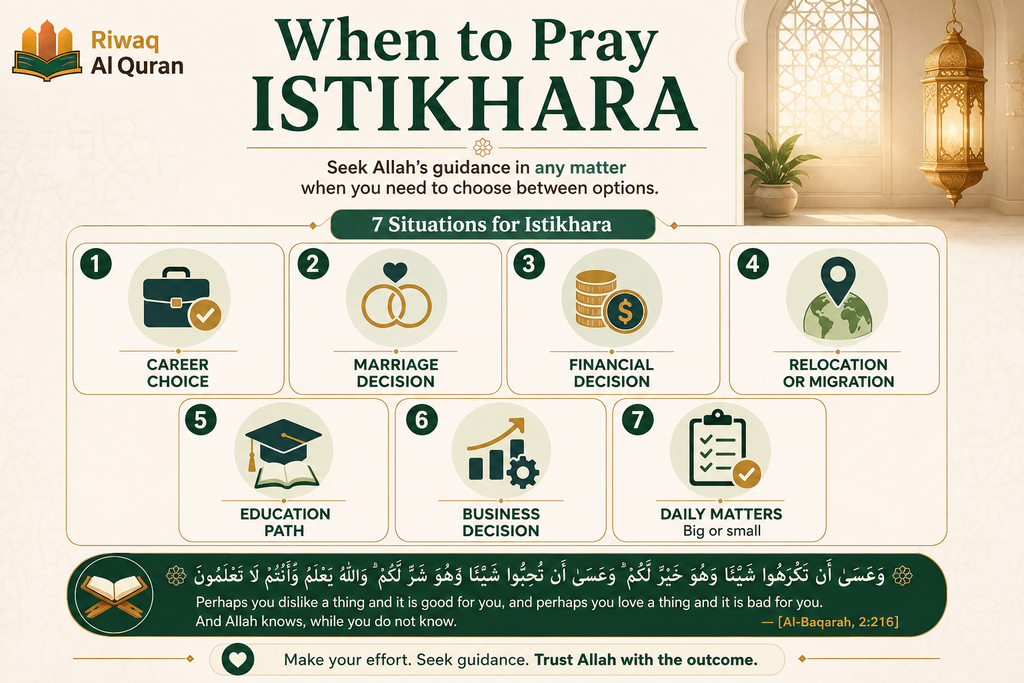
- Choosing between job offers or career paths.
- Deciding on a marriage partner.
- Committing to a significant financial decision or investment.
- Considering relocation or migration.
- Selecting a course of education or academic path.
- Navigating a significant personal or business dilemma.
- Everyday choices where guidance is genuinely sought.
The Quran articulates the exact reason why Istikhara is not only spiritually sound but intellectually rational:
“وَعَسَىٰ أَن تَكْرَهُوا شَيْئًا وَهُوَ خَيْرٌ لَّكُمْ ۖ وَعَسَىٰ أَن تُحِبُّوا شَيْئًا وَهُوَ شَرٌّ لَّكُمْ ۗ وَاللَّهُ يَعْلَمُ وَأَنتُمْ لَا تَعْلَمُونَ“
“Perhaps you dislike a thing and it is good for you, and perhaps you love a thing and it is bad for you. And Allah knows, while you do not know.”— Al-Baqarah, Surah 2:216
This verse is the intellectual justification for Istikhara in a single sentence. Human preference is not a reliable guide to human wellbeing — you can strongly want something that will harm you, and strongly resist something that would be the best thing that ever happened to you. Istikhara is the practice of acknowledging this gap and asking the One who has no such gap to guide you across it.
Istikhara is not for: matters already settled by the Quran and Sunnah, situations where no real choice exists, or options involving anything haram.
How to Pray Istikhara for Marriage
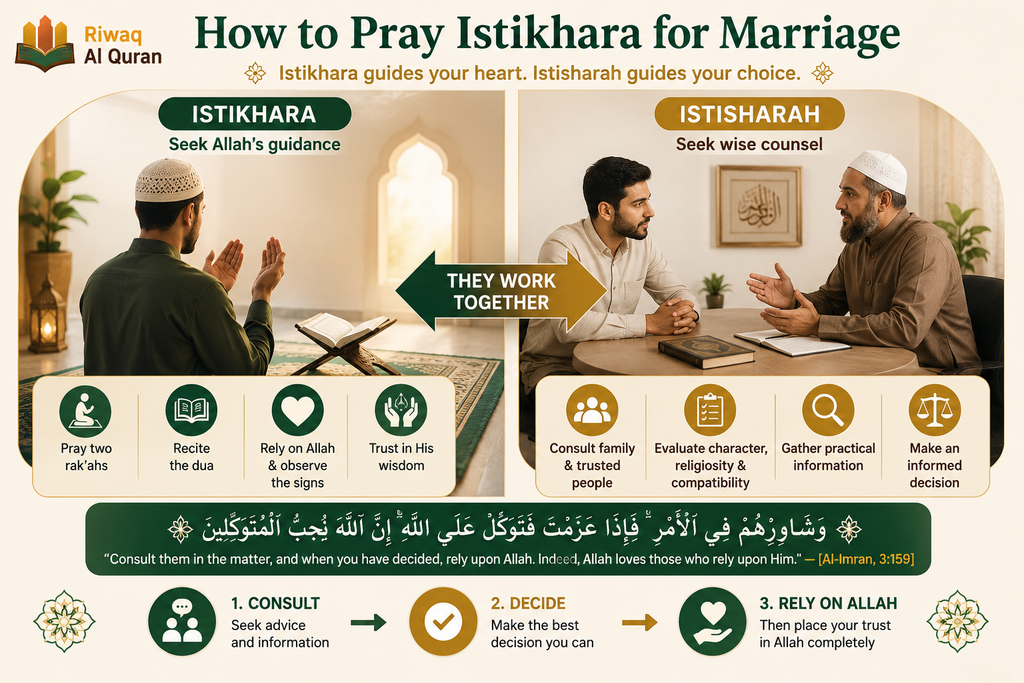
Istikhara for marriage follows the same six steps above with one specific addition: be precise about the person in question when you reach “هَذَا الْأَمْرَ” in the dua. The most important detail most marriage guides omit is that Istikhara and istisharah must work together, not separately.
This is not a recommendation left to the individual’s judgment — Allah addressed it as a direct command to the Prophet ﷺ himself, which means it carries the full weight of divine instruction for every believer who follows him. In Surah Al-Imran, Allah says:
“وَشَاوِرْهُمْ فِي الْأَمْرِ ۖ فَإِذَا عَزَمْتَ فَتَوَكَّلْ عَلَى اللَّهِ ۚ إِنَّ اللَّهَ يُحِبُّ الْمُتَوَكِّلِينَ“
“Consult them in the matter, and when you have decided, rely upon Allah. Indeed, Allah loves those who rely upon Him.”— Al-Imran, Surah 3:159
The sequence in this verse is instructive: consult first, then decide, then rely on Allah. Not: wish, rely on Allah, skip the consultation. Istikhara is not a bypass around due diligence — it is what you bring your considered decision to.
1. Prepare Spiritually
Before you stand in Istikhara, the internal state matters as much as the external form. Three things should be in place before you begin:
- Perform Wudu to ensure physical and spiritual cleanliness before the prayer.
- Make a sincere intention specifically about your marriage decision.
- Have the name or description of the person clearly in mind before you begin.
2. Perform Two Voluntary Rak’ahs
The prayer of Istikhara is a standard two-unit voluntary prayer — no special recitation is required beyond what every Muslim already knows:
- Follow the same structure described in the main steps section above.
- Recite Surah Al-Fatihah and another surah in each rak’ah.
- End with Tashahhud and Salam.
3. Recite the Dua with Your Specific Marriage Intention
This is the step that makes Istikhara for marriage different from a general supplication. The dua contains a deliberate opening — “هَذَا الْأَمْرَ” — that you fill with the specific person in mind. The complete intention sounds like this:
“O Allah, if You know that marrying [this person] is good for me in my deen, my livelihood, and my affairs, ordain it and make it easy. And if You know it is harmful, turn it away from me and turn me away from it.”
4. Trust in Allah and Observe the Signs
Once the prayer and dua are complete, the response does not usually arrive as a dream or sudden clarity. It unfolds through the movement of circumstances and the quiet state of the heart over the days that follow:
- Watch for the settled-heart inclination and the natural movement of circumstances (detailed in the signs section above).
- If the path opens with relative ease and your heart finds quiet confidence, that is meaningful.
- If repeated unexplained obstacles appear alongside persistent unease, treat that seriously as a signal — even if everything on paper looks right.
5. Combine with Istisharah — The Step Most Guides Skip
Istikhara is not a replacement for investigation — it is what you bring your considered findings to. Before relying on Istikhara alone, the following practical steps must come first:
- Evaluate the prospective spouse’s character, religiosity, and compatibility through proper channels.
- Consult family members and people who know both parties honestly.
- Gather the practical information you need before committing to a decision.
- Use Istikhara alongside this investigation, not as a replacement for it.
Understanding Islamic worship, the etiquette of du’a, and the foundations of marriage in Islam are topics covered in Riwaq Al Quran’s Online Islamic Studies courses — taught by qualified instructors through live, interactive sessions you can attend from anywhere.
Start Learning Quran and Islamic Knowledge the Right Way
Understanding prayers like Istikhara at their deepest level — the Arabic meaning of the dua, the fiqh of voluntary prayer, the balance between tawakkul and action — becomes far richer when you study directly with a qualified teacher who can answer your questions and guide your recitation in real time.
Riwaq Al Quran Academy offers comprehensive online Islamic education for individuals of all ages and backgrounds. Their certified instructors use a structured curriculum in live, interactive sessions that students can attend from anywhere in the world.
Watch real moments from our live sessions at Riwaq Al Quran and see how we bring learning to life:
Current courses include:
- Online Quran Recitation Course — strengthen the accuracy and beauty of your recitation
- Online Tajweed Classes — master Tajweed rules for proper Quranic recitation
- Quran Memorization Online Course — memorize the Quran with a structured, specialized method
- Online Tafseer Course — explore the meanings and context of Quranic verses
- Online Arabic Courses — build the language foundation to understand the Quran directly
- Online Islamic Studies Course — deepen your knowledge of worship, fiqh, and Islamic practice
- Noorani Qaida Online — the ideal starting point for beginners and children
- Online Qirat Course — explore the diverse recitation styles of the Quran
- Online Ijazah Course — receive an authenticated chain of transmission for Quran recitation
- Online Quran Classes for Kids — nurture a love for the Quran in children through interactive, age-appropriate learning
Your first class is free — no commitment required.
Conclusion
Istikhara is one of the most intellectually honest acts of worship in Islam. It is an admission that your knowledge has limits, that your preferences are unreliable guides, and that the One who sees all outcomes is the right one to consult before you commit to a path. The steps are straightforward: sincere intention, two voluntary rak’ahs, the dua recited with your specific matter named and understood phrase by phrase, then attentive observation of your inner inclination and the movement of circumstances around you.
The Quran states it plainly: “Allah knows, while you do not know” (Al-Baqarah 2:216). Istikhara is the practice of acting on that reality — not just believing it. Guard against the three mistakes that undermine it, combine it with the practical consultation the Sunnah recommends, and approach the signs with patience and honesty. Whether the answer comes as a settled feeling the morning after, or as circumstances that gradually close one door and open another, trust that Allah answered — because He said He would.
Frequently Asked Questions
The questions below cover the most common points of uncertainty about Istikhara — from what the prayer actually requires to what happens when clarity doesn’t come. Read through them before performing Istikhara for the first time, or return to them whenever a specific doubt arises.
What is Istikhara?
Istikhara is a two-rak’ah voluntary prayer in which a Muslim asks Allah to direct them toward the better of two permissible choices. Established in Sahih al-Bukhari (Hadith 1166) through the narration of Jabir ibn Abdullah (رضي الله عنه), it can be performed for any permissible matter involving a genuine choice, from major life decisions to everyday matters. View the source hadith.
Do I need a dream for Istikhara to work?
No. The Prophet’s (ﷺ) hadith on Istikhara mentions no dream as the expected or required response. You are instructed to proceed with the option you feel inclined toward after the prayer. The guidance most commonly appears as:
A settled inclination of the heart toward one option
A natural sense of ease or difficulty around one path
The quiet movement of circumstances in one direction
Waiting for a dream is a cultural tradition attached to the Sunnah, not part of it.
How many times can I repeat Istikhara?
Up to seven times in total, not necessarily on consecutive nights. If genuine uncertainty remains after seven sincere repetitions, proceed with the option you feel most naturally and calmly inclined toward, and entrust the outcome to Allah’s decree.
Can I perform Istikhara for small everyday decisions?
Yes. The hadith explicitly says the Prophet (ﷺ) taught Istikhara “in all matters” — there is no minimum importance threshold. Regularizing Istikhara for everyday choices builds a habit of turning to Allah rather than reserving it for emergencies only.
Can a woman in her menstrual period perform Istikhara?
Yes, with a modification. A woman who cannot pray due to menstruation may recite the Istikhara dua alone — without the two rak’ahs — and it holds its intended significance. The dua is a supplication (du’a), and there is no restriction on making du’a at any time.
What is the difference between Istikhara and Istisharah?
Istikhara is seeking guidance from Allah through prayer. Istisharah is seeking counsel from knowledgeable and trustworthy people. The Quran commands consultation in Al-Imran 3:159 (view source), and the Prophet (ﷺ) used both. They are complementary:
Istisharah gathers human knowledge, experience, and honest assessment
Istikhara brings the decision before the One whose knowledge is complete
Doing one without the other is an incomplete approach.
What if I still feel no clarity after seven Istikhara prayers?
Make your best decision based on the information and counsel you have gathered, and proceed with genuine tawakkul. Having sincerely sought Allah’s guidance seven times, you have fulfilled your responsibility under the Sunnah. The outcome is in Allah’s hands — and the last phrase of the dua — “وَاقْدُرْ لِيَ الْخَيْرَ حَيْثُ كَانَ ثُمَّ أَرْضِنِي” — already asked Him to make you content with whatever He decrees.