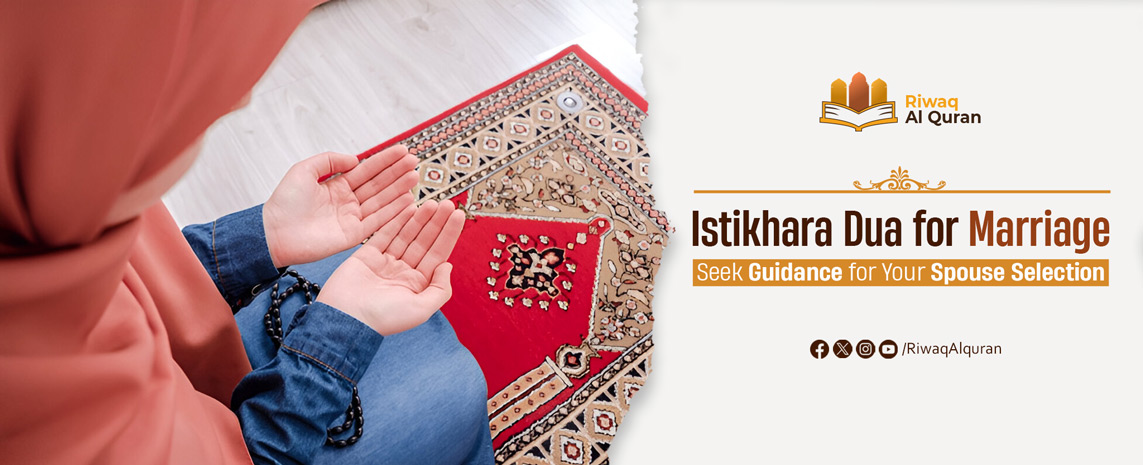
Choosing who to marry is one of the few decisions in life you can’t fully undo, which is exactly why so many Muslims turn to the Istikhara dua for marriage before saying yes or no. Istikhara means “seeking goodness,” and it’s the prayer the Prophet Muhammad ﷺ taught his companions for moments when a choice matters too much to make on instinct alone. For the broader meaning behind the practice beyond marriage specifically, see our Istikhara Meaning in Islam guide.
This guide walks through the authentic wording of the dua, exactly how to pray it step by step, when to pray it, the mistakes that quietly undo it, and how to read what happens afterward — without waiting for a dream that may never come.
What You’ll Learn in This Article
- The authentic Arabic text, transliteration, and translation of the Istikhara dua, sourced from Sahih al-Bukhari.
- What the Prophet ﷺ said about choosing a spouse in the first place.
- The exact steps to pray Istikhara for marriage, including where people go wrong.
- The best time to pray it, and how many times you’re allowed to repeat it.
- How to interpret what happens afterward — including when nothing seems to happen at all.
- Whether someone else can pray it on your behalf.
Table of Contents
What Is Istikhara Dua for Marriage — And Why It Matters
Istikhara dua for marriage is the supplication a Muslim recites after two rak’ahs of voluntary prayer to ask Allah for guidance on a specific marriage decision. It is not a request for a dream or a vision — it is a request to be guided toward whichever outcome is genuinely good for your religion and your life, even if that outcome isn’t the one you were hoping for.
The idea behind it rests on three things: what the Qur’an says about the limits of human judgment, why marriage specifically calls for this kind of guidance, and what the Prophet ﷺ said about what actually makes a spouse a good choice.
a) Why the Qur’an Emphasizes Trusting Allah’s Knowledge Over Your Own Judgment
Allah says in the Qur’an:
(وَعَسَىٰ أَنْ تَكْرَهُوا شَيْئًا وَهُوَ خَيْرٌ لَكُمْ ۖ وَعَسَىٰ أَنْ تُحِبُّوا شَيْئًا وَهُوَ شَرٌّ لَكُمْ ۗ وَاللَّهُ يَعْلَمُ وَأَنْتُمْ لَا تَعْلَمُونَ)
“But perhaps you hate a thing and it is good for you; and perhaps you love a thing and it is bad for you. And Allah knows, while you know not.” — Surah Al-Baqarah, 2:216
That’s the entire logic of Istikhara in one line. A proposal can look perfect on paper — good family, good character, good timing — and still carry something you can’t see. Istikhara hands that blind spot over to the One who doesn’t have one.
b) Why Istikhara Matters Specifically Before Marriage
Marriage affects your din (faith), your daily life, and — in Islamic teaching — the tranquility Allah placed inside the relationship itself:
(وَمِنْ آيَاتِهِ أَنْ خَلَقَ لَكُمْ مِنْ أَنْفُسِكُمْ أَزْوَاجًا لِتَسْكُنُوا إِلَيْهَا وَجَعَلَ بَيْنَكُمْ مَوَدَّةً وَرَحْمَةً ۚ إِنَّ فِي ذَٰلِكَ لَآيَاتٍ لِقَوْمٍ يَتَفَكَّرُونَ)
“And of His signs is that He created for you from yourselves mates that you may find tranquility in them; and He placed between you affection and mercy.” — Surah Ar-Rum, 30:21
Khadijah (RA), the Prophet’s ﷺ first wife, is one of the clearest examples in Islamic history of a marriage built on trust in Allah’s timing — her story is worth sitting with before you pray for guidance on your own:
That word “tranquility” (sakan) is exactly the feeling people describe after a positive Istikhara — the signs section further down leans on it directly. If you want to understand verses like this in their full context rather than a single translated line, that’s what a structured Tafseer course is built for — it’s one of the areas Riwaq Al Quran teaches specifically for non-Arabic speakers who want to read the Qur’an with real comprehension, not just recitation.
c) What the Prophet ﷺ Said About Choosing a Spouse
Istikhara asks Allah to guide your decision, but the Prophet ﷺ also gave direct guidance on what “good” tends to look like in practice. In an authentic hadith recorded in Sahih al-Bukhari (5090), narrated by Abu Hurairah, he said:
(تُنْكَحُ الْمَرْأَةُ لِأَرْبَعٍ: لِمَالِهَا، وَلِحَسَبِهَا، وَجَمَالِهَا، وَلِدِينِهَا، فَاظْفَرْ بِذَاتِ الدِّينِ تَرِبَتْ يَدَاكَ)
“A woman is married for four things: her wealth, her family status, her beauty, and her religion. So you should marry the religious woman, otherwise you will be a loser.” — Sahih al-Bukhari 5090
The four things people naturally weigh in a spouse, in the order the hadith names them:
- Her wealth
- Her family status (lineage)
- Her beauty
- Her religion — and this is the one the Prophet ﷺ tells you to prioritize
The hadith doesn’t dismiss the first three — it ranks them, placing religious commitment above the rest, because deen is the one factor that shapes how the other three get handled once you’re actually married. Scholars apply the same principle to a man being considered for marriage: character and commitment to faith outlast looks, money, and status, all of which shift over the years.
This is worth holding onto before you get to the dua itself. When you name “this matter” inside your Istikhara, you’re not only asking Allah to bless a feeling of attraction — you’re asking Him to weigh in on a decision you’ve already tried to evaluate honestly, deen included.
The Istikhara Dua for Marriage (Arabic, Transliteration, Translation)
The wording of this dua isn’t something scholars composed later — it comes directly from a hadith the Prophet ﷺ taught his companions, recorded in Sahih al-Bukhari (1166), narrated by Jabir ibn Abdullah.
That’s worth knowing, because the exact phrasing matters more here than in most everyday duas. It breaks down into four parts: the Arabic, the transliteration, the translation, and how to personalize it to your own decision.
a) Arabic Text of the Dua
(اللَّهُمَّ إِنِّي أَسْتَخِيرُكَ بِعِلْمِكَ، وَأَسْتَقْدِرُكَ بِقُدْرَتِكَ، وَأَسْأَلُكَ مِنْ فَضْلِكَ الْعَظِيمِ، فَإِنَّكَ تَقْدِرُ وَلَا أَقْدِرُ، وَتَعْلَمُ وَلَا أَعْلَمُ، وَأَنْتَ عَلَّامُ الْغُيُوبِ. اللَّهُمَّ إِنْ كُنْتَ تَعْلَمُ أَنَّ هَذَا الْأَمْرَ (وَاذْكُرِ الْحَاجَةَ) خَيْرٌ لِي فِي دِينِي وَمَعَاشِي وَعَاقِبَةِ أَمْرِي، أَوْ قَالَ: عَاجِلِ أَمْرِي وَآجِلِهِ، فَاقْدُرْهُ لِي وَيَسِّرْهُ لِي، ثُمَّ بَارِكْ لِي فِيهِ. وَإِنْ كُنْتَ تَعْلَمُ أَنَّ هَذَا الْأَمْرَ شَرٌّ لِي فِي دِينِي وَمَعَاشِي وَعَاقِبَةِ أَمْرِي، أَوْ قَالَ: فِي عَاجِلِ أَمْرِي وَآجِلِهِ، فَاصْرِفْهُ عَنِّي وَاصْرِفْنِي عَنْهُ، وَاقْدُرْ لِيَ الْخَيْرَ حَيْثُ كَانَ، ثُمَّ أَرْضِنِي بِهِ.)
b) Transliteration
Allahumma inni astakhiruka bi’ilmika, wa astaqdiruka biqudratika, wa as’aluka min fadlika al-azim. Fa innaka taqdiru wa la aqdir, wa ta’lamu wa la a’lam, wa anta ‘allamul-ghuyub.
Allahumma in kunta ta’lamu anna hadha al-amra (mention the matter) khayrun li fi dini wa ma’ashi wa ‘aqibati amri — aw qala: ‘ajili amri wa ajilihi — faqdurhu li wa yassirhu li, thumma barik li fih.
Wa in kunta ta’lamu anna hadha al-amra sharrun li fi dini wa ma’ashi wa ‘aqibati amri — aw qala: fi ‘ajili amri wa ajilihi — fasrifhu ‘anni wasrifni ‘anhu, waqdur li al-khayra haythu kana, thumma ardini bih.
c) English Translation
“O Allah, I seek Your guidance through Your knowledge, and I seek ability through Your power, and I ask You of Your great bounty. You are able, and I am not. You know, and I do not know. You are the Knower of the unseen.
O Allah, if You know that this matter is good for me in my religion, my livelihood, and the outcome of my affairs, then decree it for me, make it easy for me, and bless it for me.
But if You know that this matter is bad for me in my religion, my livelihood, and the outcome of my affairs, then turn it away from me and turn me away from it, and decree what is good for me wherever it may be, and make me content with it.” — Sahih al-Bukhari 1166
d) What to Say in Place of “This Matter”
At the point where the dua says “this matter,” you replace it with something specific — not a vague thought in your head, but a spoken or clearly held intention such as “marrying [name]” or “this proposal from [family/person].”
A common error is reciting the dua in general terms without pinning it to the actual decision in front of you, which makes the guidance harder to read afterward because you never asked a specific question.
How to Pray Istikhara for Marriage Step by Step
Praying Istikhara correctly is less about getting every word right and more about following the sequence the Prophet ﷺ taught: purification, intention, prayer, then the dua itself. For a longer walkthrough with additional detail on any of these steps, see our complete guide to praying Istikhara.
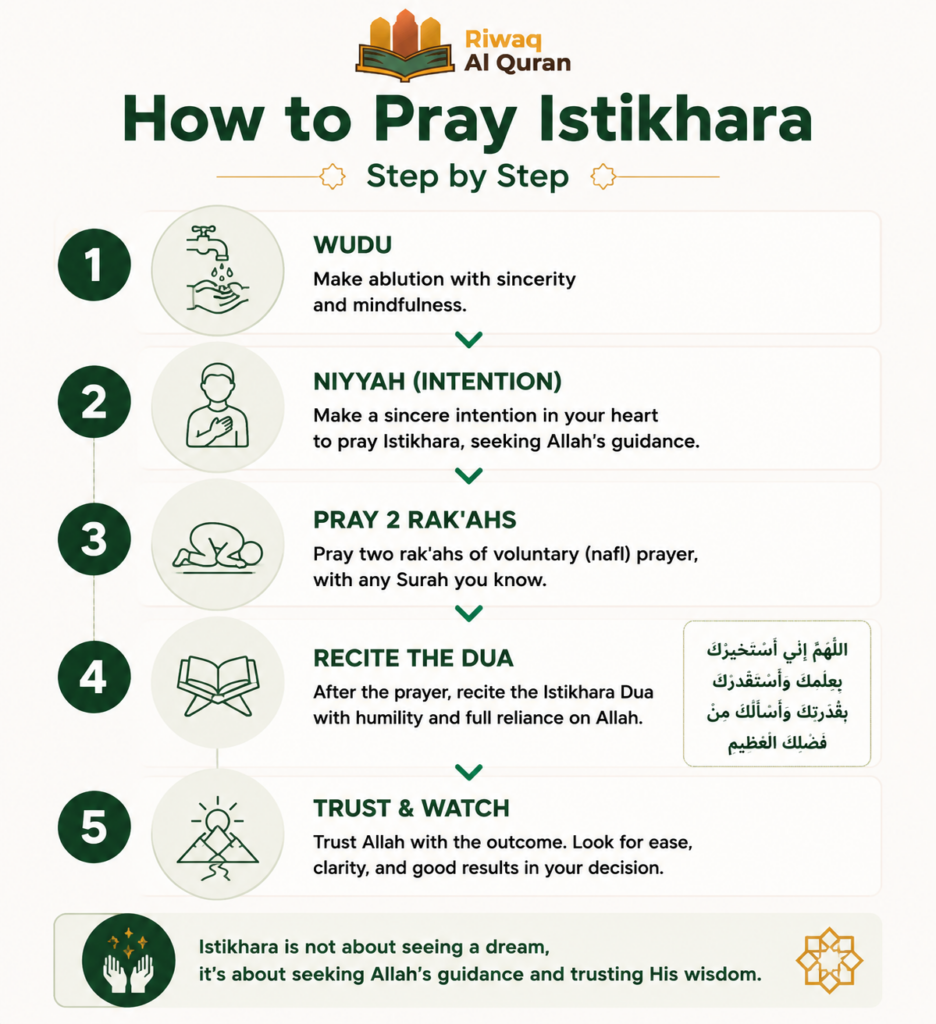
Step 1 – Perform Wudu
Start with wudu (ablution), the same physical purification required for any prayer — hands, mouth, nose, face, arms to the elbows, head, ears, and feet. This isn’t a formality; it’s the state of readiness Islamic teaching asks for before standing in front of Allah with a request this personal.
If you’re already in a state of wudu from earlier, you don’t need to repeat it, but many people choose to renew it anyway before an Istikhara this significant.
Step 2 – Set Your Intention (Niyyah)
Before you begin, hold a clear niyyah in your heart: you are praying specifically to ask Allah’s guidance on this marriage decision, not a general prayer said out of habit.
The intention doesn’t need to be spoken aloud — Istikhara doesn’t require a fixed verbal formula, only that you know, in that moment, which decision you’re placing in Allah’s hands.
Step 3 – Pray Two Rak’ahs of Nafl
Pray two rak’ahs of voluntary (Nafl) prayer, reciting Surah Al-Fatihah followed by any other surah in each rak’ah. A common practice — not obligatory, but widely taught — is to recite Surah Al-Kafirun in the first rak’ah and Surah Al-Ikhlas in the second, a pairing often associated with prayers seeking clarity between two paths.
Many non-Arabic speakers hesitate here because they’re unsure of their pronunciation during a prayer that feels this significant — that’s precisely the gap a structured Tajweed or Quran recitation course is meant to close, so the recitation itself stops being a source of anxiety.
Step 4 – Recite the Dua With the Matter Named
After finishing the two rak’ahs, recite the Istikhara dua, inserting the specific marriage matter where the text says “this matter” — for example, “marrying [Name]” or “the proposal from [Name]’s family,” rather than leaving it general.
You can recite it in Arabic, from the transliteration, or in your own words in your own language; what matters is sincerity, not the vehicle.
Step 5 – Trust the Outcome and Watch for Guidance
Once you’ve prayed, the active part of Istikhara is over — what follows is observation. Pay attention to your own state of mind, how circumstances unfold, and whether the path forward feels easy or increasingly difficult, and treat that as the answer rather than waiting for something more dramatic.
This observation period isn’t meant to replace your normal decision-making — continue researching, consulting, and asking questions about the person or matter as you normally would.
When Is the Best Time to Pray Istikhara for Marriage?
Timing matters, but it isn’t a strict condition for the prayer to count.
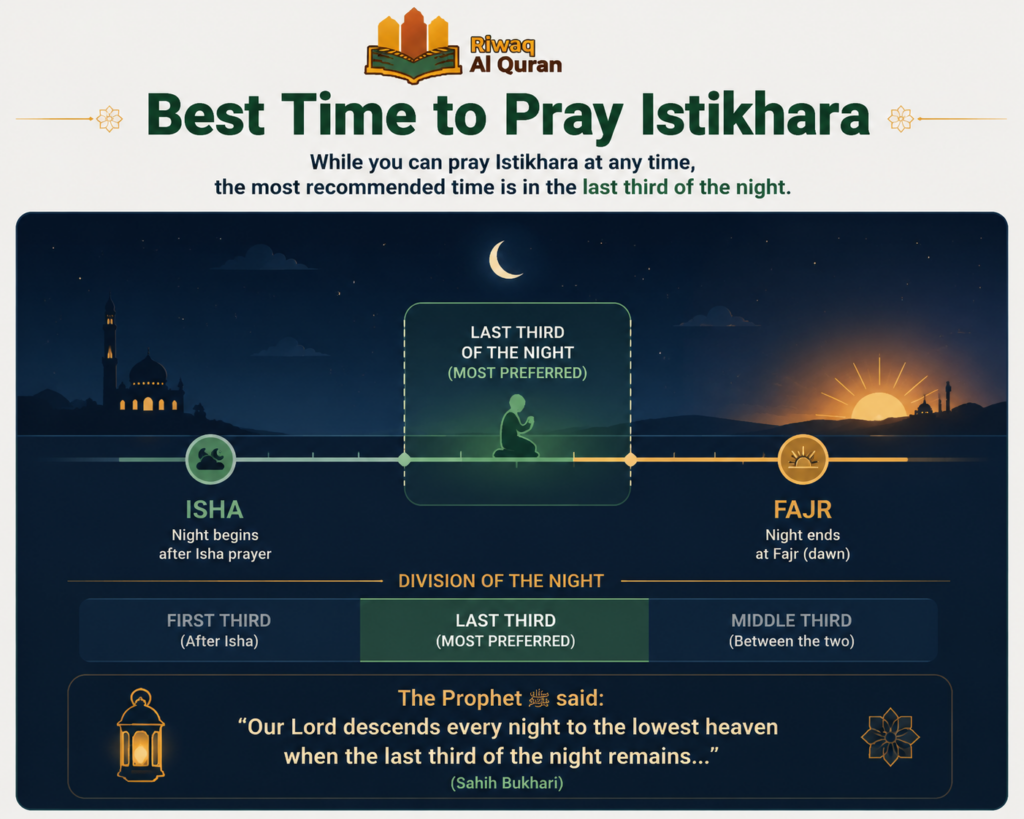
Preferred:
The last third of the night, after Isha and before Fajr. This window is considered especially favorable in Islamic teaching — it’s the time described in hadith as when supplications are most readily answered, and practically, it’s also when the mind is quietest and least crowded by the day’s distractions.
The two rak’ahs plus the dua take under ten minutes, so it fits even a short window before Fajr.
Also valid:
Any time voluntary prayer is permitted, outside the few times prayer is forbidden (right after Fajr until sunrise, and the period right before sunset). If you’re facing a decision and the night hasn’t come yet, praying earlier still counts — don’t delay a decision that needs attention just to wait for the “ideal” hour.
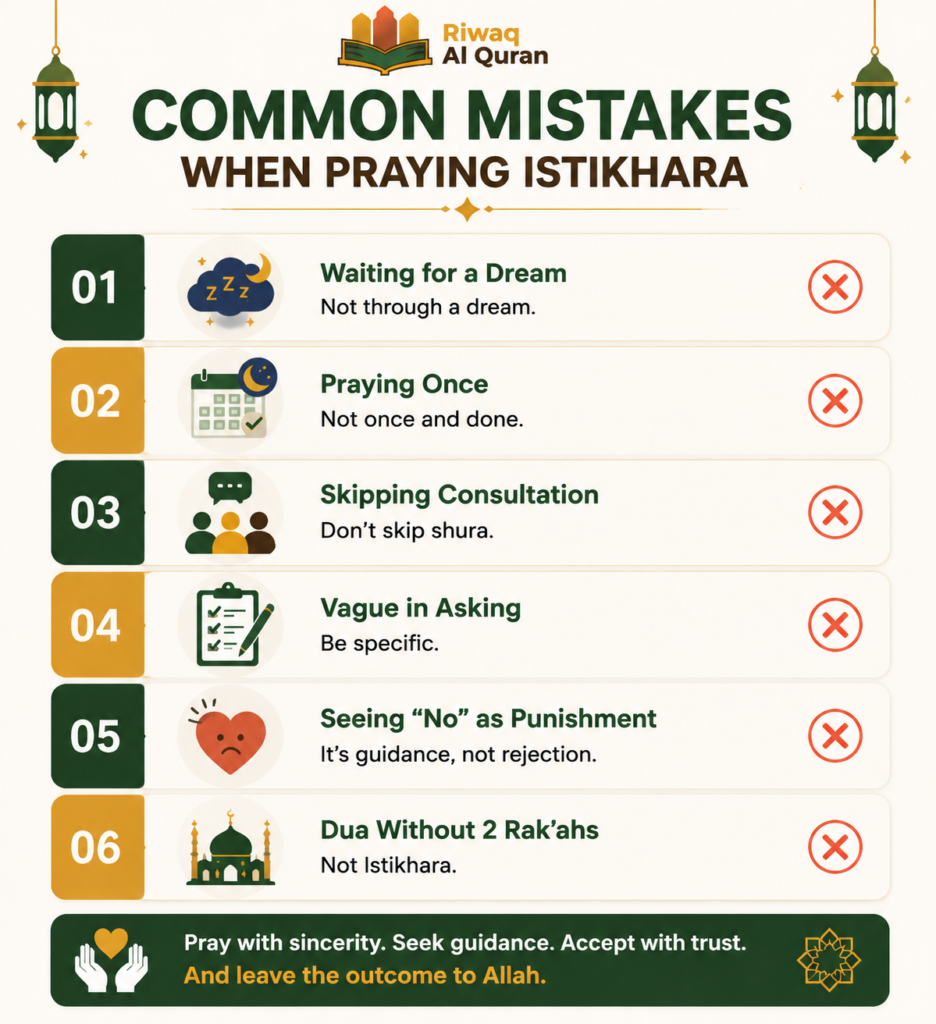
Common Mistakes When Praying Istikhara for Marriage
Most people who feel Istikhara “didn’t work” made one of these errors rather than the prayer failing them.
1.Waiting for a Dream: The Prophet ﷺ never taught that the answer comes through a vision. Treating dreams as the only valid outcome causes people to ignore the actual guidance — ease, difficulty, clarity, or unrest — happening in front of them.
2. Praying It Once and Expecting Instant Certainty: Istikhara can be repeated over multiple nights if you remain unsure. There is no fixed limit, but tradition supports repeating it for several nights rather than abandoning it after one attempt.
3. Skipping Consultation (Shura): Istikhara complements research and advice from people you trust — it does not replace it. Praying Istikhara without ever asking a parent, scholar, or someone who knows the person in question skips half of how Islamic decision-making is meant to work.
4. Reciting It in Vague Terms: Saying “this matter” without mentally or verbally naming the specific proposal weakens your ability to later connect what happens with what you asked for. Name it clearly, every time you pray it.
5. Treating an Uncomfortable Outcome as a Punishment: If the signs point away from a proposal, that is guidance, not rejection. Reading it as a personal failure is a misunderstanding of what the prayer is for — the outcome is protection, not a verdict on your worth.
6. Reciting the Dua Without Praying the Two Rak’ahs: Some people skip the prayer entirely and just say the words of the dua on their own. The two rak’ahs are part of the act, not an optional prelude — without them, it isn’t Istikhara in the way it was taught, just a supplication.
How to Read Istikhara Signs for Marriage
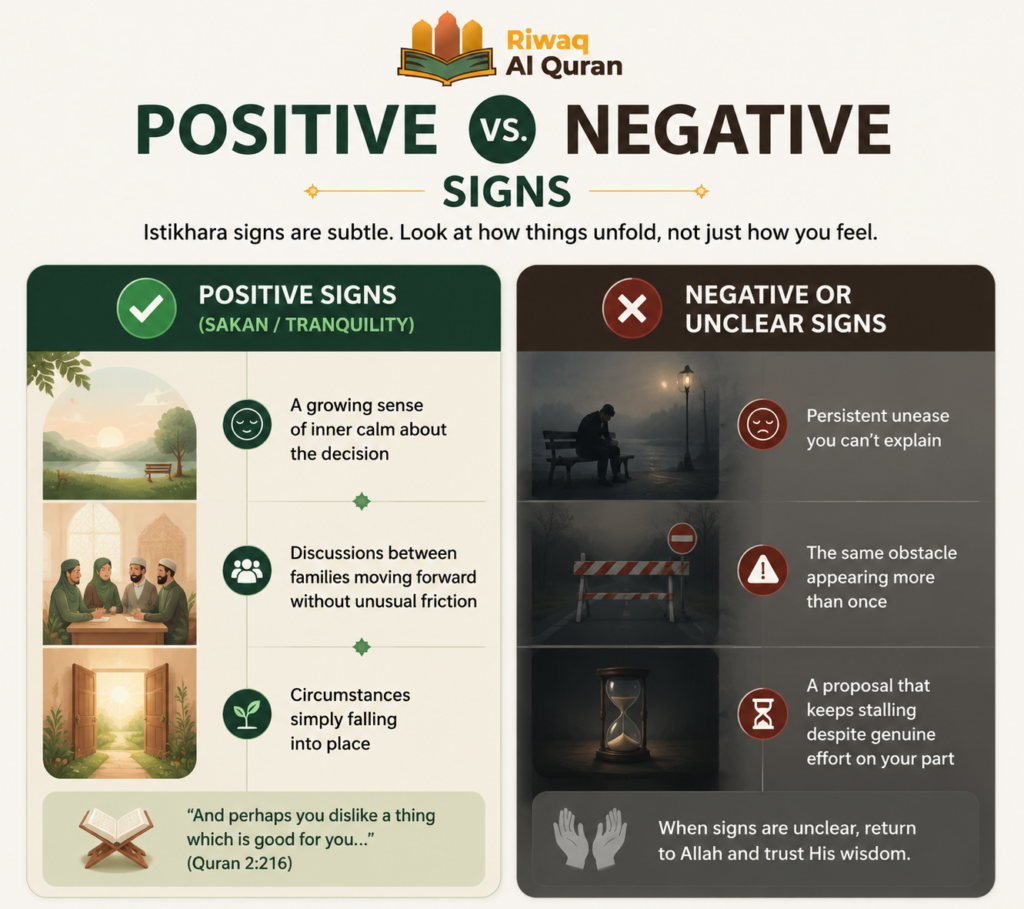
After Istikhara, guidance usually shows up through how things unfold rather than through anything supernatural. For a deeper breakdown of every sign type, see our full guide to Istikhara signs of response. It helps to separate what you’re looking for into two categories, and then know what to do if neither shows up clearly.
a) Positive vs. Negative Signs
Before choosing between the two, it helps to see them side by side — Istikhara signs generally fall into one of these two patterns:
| Positive Signs (Sakan / Tranquility) | Negative or Unclear Signs |
|---|---|
| A growing sense of inner calm about the decision | Persistent unease you can’t explain |
| Discussions between families moving forward without unusual friction | The same obstacle appearing more than once |
| Circumstances simply falling into place | A proposal that keeps stalling despite genuine effort on your part |
The signal in both columns is the pattern, not one good or bad day.
b) What Should You Do If No Sign Appears At All?
If nothing feels obvious after praying and waiting, that is not a failed Istikhara — it means you decide using the next available guidance, which is consultation. A simple three-part check helps here:
- Weigh your own heart (Istikhara).
- Weigh the practical circumstances in front of you.
- Weigh the counsel of someone trustworthy.
The Qur’an pairs exactly this combination together:
(وَشَاوِرْهُمْ فِي الْأَمْرِ ۖ فَإِذَا عَزَمْتَ فَتَوَكَّلْ عَلَى اللَّهِ ۚ إِنَّ اللَّهَ يُحِبُّ الْمُتَوَكِّلِينَ)
“And consult them in the matter. And when you have decided, then rely upon Allah. Indeed, Allah loves those who rely [upon Him].” — Surah Aal-Imran, 3:159
Praying Istikhara, then still making a reasoned decision with good counsel, is not a lack of faith — it’s the model the Qur’an itself lays out.
Can Someone Else Pray Istikhara for Your Marriage?
No — the actual Istikhara prayer should be done by the individual facing the decision, since it is a personal request built on your own intention and connection with Allah.
- What others can do: a parent, sibling, or scholar can make general dua for your guidance and well-being.
- What it can’t replace: your own Istikhara before deciding — if you’re overwhelmed and someone offers to pray on your behalf, accept it as additional support, not a substitute.
Benefits of Praying Istikhara Before Marriage
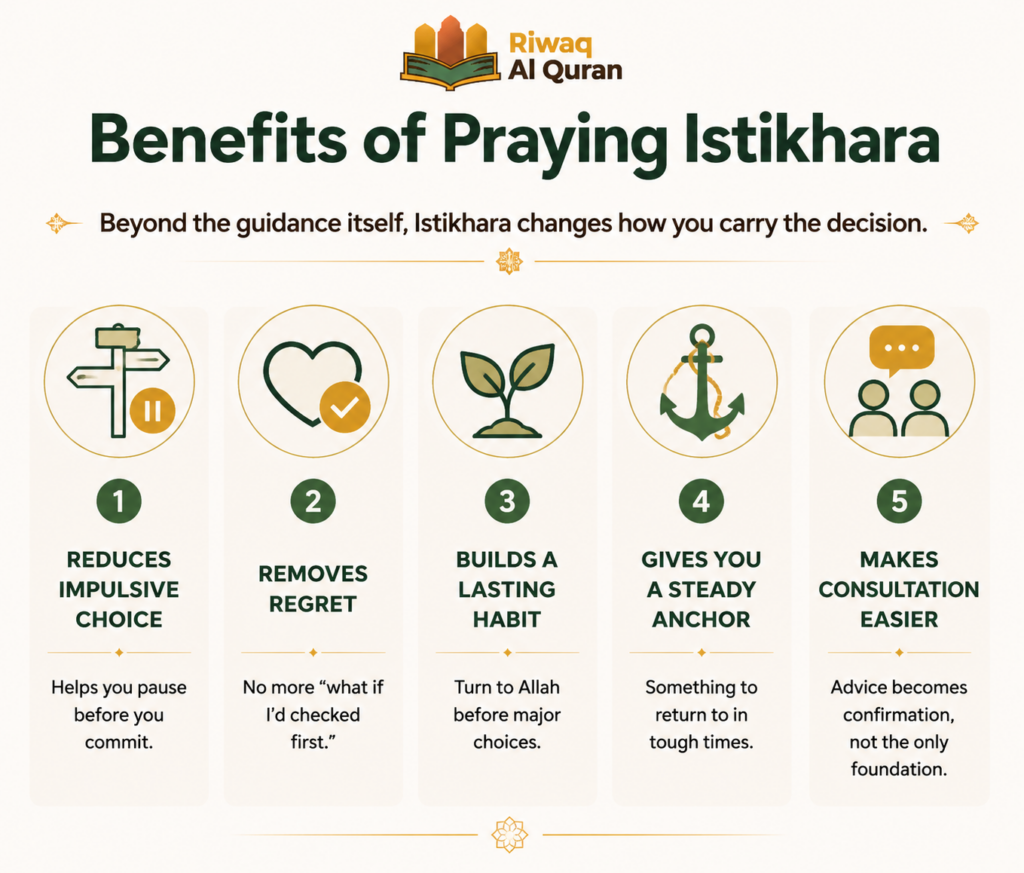
Beyond the guidance itself, Istikhara changes how you carry the decision:
- Reduces the odds of an impulsive choice made purely on attraction or family pressure, since it forces a pause before you commit.
- Removes a specific kind of regret — the “what if I’d checked first” feeling — because you’re entering the marriage having already asked.
- Builds a habit that outlasts this one decision: turning to Allah before major choices instead of only after something goes wrong.
- Reduces the odds of an impulsive choice made purely on attraction or family pressure, since it forces a pause before you commit.
- Removes a specific kind of regret — the “what if I’d checked first” feeling — because you’re entering the marriage having already asked.
- Builds a habit that outlasts this one decision: turning to Allah before major choices instead of only after something goes wrong.
- Gives you something steady to return to later — when a marriage hits a hard patch, as most eventually do, knowing you didn’t rush into it and asked for guidance honestly is its own kind of anchor.
- Makes consultation easier instead of harder — since you’ve already asked Allah first, input from a parent or trusted advisor becomes confirmation of a decision in progress, not the sole thing it’s resting on.
Deepen Your Connection With the Qur’an Before You Decide
Praying Istikhara well starts with being comfortable with the Qur’an itself — reciting it correctly, understanding the verses behind it, and building a daily connection that doesn’t disappear once the decision is made.
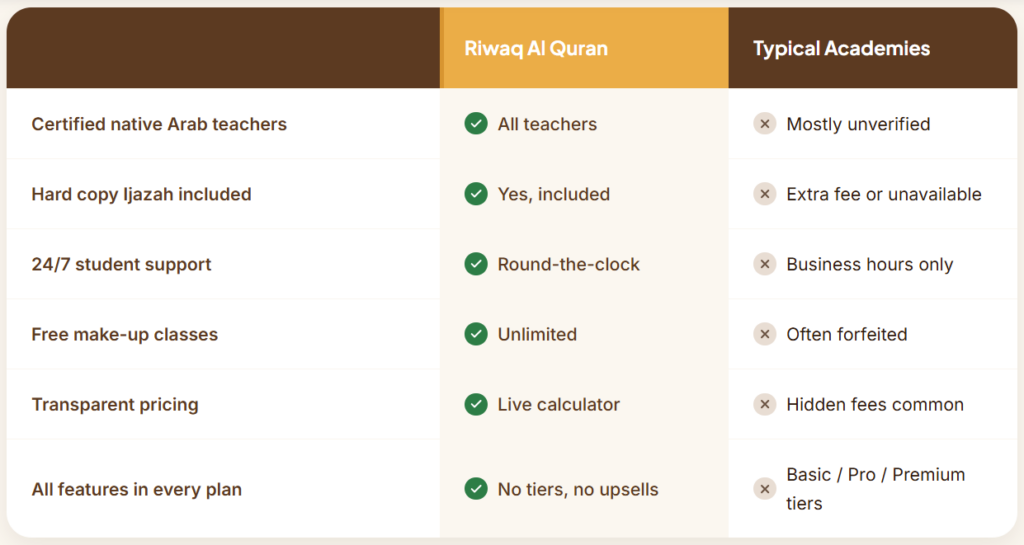
Riwaq Al Quran offers personalized, one-to-one online Quran, Arabic, and Islamic Studies classes for students of all ages and backgrounds, with instructors who follow a structured curriculum in Tajweed, Tafsir, and memorization — built around your pace, not a fixed classroom schedule.


Here’s a quick look at what our Quran recitation classes actually look like in practice:
A few courses worth a look depending on where you’re starting from:
- New to reading Quranic Arabic? Start with Noorani Qaida Online.
- Want to recite with confidence? Online Quran Recitation Course and Online Tajweed Classes both build this from the ground up.
- Working toward memorization? Quran Memorization Online Course is built for exactly that.
- Curious about different recitation styles? Explore the Online Qirat Course.
- Teaching a child? Online Quran Classes for Kids is designed to build that connection early.
Conclusion
Istikhara dua for marriage isn’t a fortune-telling ritual — it’s a specific, authentic prayer: two rak’ahs followed by the exact wording taught in Sahih al-Bukhari, asking Allah to steer you toward whatever outcome is genuinely good for your faith and your life, even when that isn’t the outcome you were hoping for.
Getting it right comes down to a handful of things this guide walked through: praying with the matter named clearly rather than left vague, weighing the decision honestly against what the Prophet ﷺ said actually makes a spouse a good choice, watching how things unfold afterward instead of waiting on a dream, and pairing that observation with real consultation when the picture still isn’t clear.
None of that guarantees an easy answer. What it guarantees is that you enter the decision — and the marriage — having actually asked. Prayed this way, Istikhara for marriage stops being about predicting the future and becomes what it was always meant to be: a way to move forward with fewer regrets, trusting that the One who knows what you can’t see has already weighed it for you.
FAQs
A few quick answers to the questions people ask most often about Istikhara before marriage:
How do you pray Istikhara for marriage?
You pray two rak’ahs of voluntary (Nafl) prayer, then recite the Istikhara dua from Sahih al-Bukhari, replacing “this matter” with the specific person or proposal you’re deciding on.
Can you pray Istikhara to get married sooner?
Yes — you can pray Istikhara asking Allah for guidance on timing as well as on a specific person, since the dua is not restricted to yes-or-no decisions about one proposal.
Does Istikhara work immediately, or does it take time?
It varies. Some people feel clarity right after praying, while for others the guidance unfolds over days through how circumstances develop, so patience matters as much as the prayer itself.
Can you pray Istikhara without knowing Arabic?
Yes — reciting the transliteration or the English translation with sincerity is valid if you’re not yet comfortable with the Arabic text, though many people work toward learning the Arabic over time.
Can women pray Istikhara for marriage during their period?
A woman on her period can recite the Istikhara dua itself, since dua is not restricted by purity, but the two rak’ahs of Nafl prayer should wait until she is able to pray again.
Do you need to see a dream after Istikhara?
No — this is a common misconception. The Prophet ﷺ never taught that a dream is the expected outcome; the actual guidance comes through ease, difficulty, or a settled feeling in the heart.