Most Muslims recite the Quran daily without ever asking whether the Prophet Muhammad ﷺ himself said anything about how that recitation should sound. He did, repeatedly, and in specific terms. The hadiths about Tajweed are not a modern scholarly invention layered onto the text afterward — they are the Prophet’s own descriptions of how the Quran was recited in his presence, why certain reciters were praised by name, and what reward is attached to getting it right.
Tajweed is the set of rules that govern how each Arabic letter of the Quran is pronounced, elongated, or paused on, so that recitation matches the way the Quran was revealed to Prophet Muhammad ﷺ. The word itself does not appear in the hadith texts, but its substance — articulation, pacing, tone, and reward — is described directly, hadith after hadith.
This article works through ten authentic hadiths, the Quranic verses (in the original Arabic, with tashkeel) that command measured recitation, and the specific Tajweed mechanics — Makharij al-Huruf, Madd, and Waqf — that each hadith points back to.
Table of Contents
A Quick Reference to the Ten Hadiths at a Glance
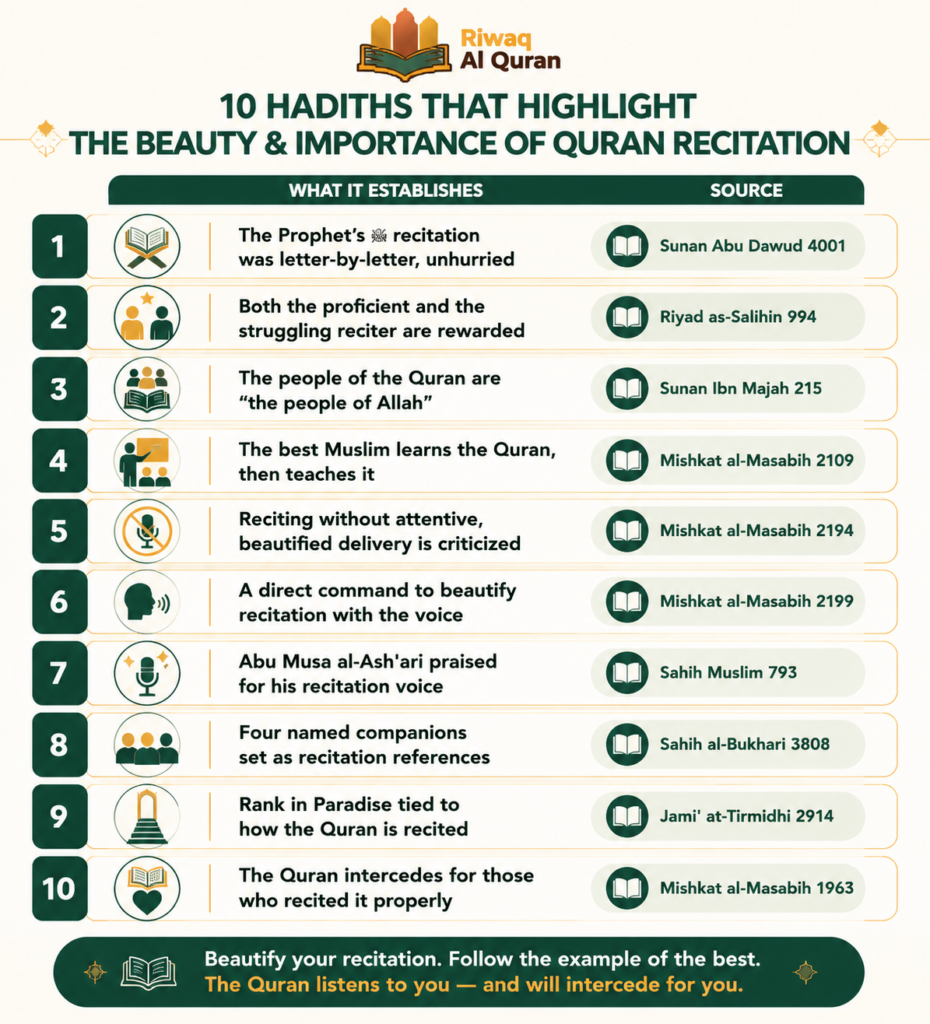
Skim the table below for what each hadith establishes and its exact source before working through the full Arabic text, translation, and commentary — useful if you’re short on time, already know which hadith you’re looking for, or just want the citation confirmed before reading the Quran today.
| # | What It Establishes | Source |
|---|---|---|
| 1 | The Prophet’s ﷺ recitation was letter-by-letter, unhurried | Sunan Abu Dawud 4001 |
| 2 | Both the proficient and the struggling reciter are rewarded | Riyad as-Salihin 994 |
| 3 | The people of the Quran are “the people of Allah” | Sunan Ibn Majah 215 |
| 4 | The best Muslim learns the Quran, then teaches it | Mishkat al-Masabih 2109 |
| 5 | Reciting without attentive, beautified delivery is criticized | Mishkat al-Masabih 2194 |
| 6 | A direct command to beautify recitation with the voice | Mishkat al-Masabih 2199 |
| 7 | Abu Musa al-Ash’ari praised for his recitation voice | Sahih Muslim 793 |
| 8 | Four named companions set as recitation references | Sahih al-Bukhari 3808 |
| 9 | Rank in Paradise tied to how the Quran is recited | Jami’ at-Tirmidhi 2914 |
| 10 | The Quran intercedes for those who recited it properly | Mishkat al-Masabih 1963 |
What Do the Hadiths Say About Tajweed?
The Sunnah of Prophet Muhammad ﷺ is the second source of Islamic legislation, after the Quran itself. None of the hadiths below use the word “Tajweed” — the term was codified by later scholars — but each one describes a specific element of correct recitation that Tajweed rules formalize.
For a 60-second version of why this matters before going hadith by hadith, watch:
The ten hadiths are grouped below by what they establish: how the Prophet ﷺ himself recited, how he ranked reciters, and what reward recitation carries:
1. The Prophet’s ﷺ Recitation Was Clear, Letter by Letter
Umm Salamah, the Prophet’s wife, described his recitation as distinct and unhurried, with each letter given its own separate weight rather than blended into the next.
(كَانَتْ قِرَاءَتُهُ مُفَسَّرَةً حَرْفًا حَرْفًا)
“His recitation was clearly distinguished, letter by letter.”(Sunan Abu Dawud 4001)
— graded sahih by Al-Albani in Sahih Abi Dawud, recorded in the Book of Dialects and Readings of the Quran (Kitab al-Huruf wa al-Qira’at).
This is the earliest evidence for Makharij al-Huruf — the specific points in the mouth and throat where each Arabic letter is produced. A reciter who rushes or blends adjacent letters is departing from the pattern Umm Salamah described.
In practice, the letters most often blended by beginners are the mutashabihat — pairs that sound close to a non-trained ear but come from different exit points: ذ and ز, ض and ظ, ح and ه, ث and س.
Reading silently doesn’t expose this problem; it only surfaces when the recitation is heard aloud and compared letter by letter against a correct model, which is exactly why this hadith is framed around what Umm Salamah heard, not what the Prophet ﷺ intended.
2. The Proficient Reciter and the Struggling Reciter Both Earn Reward
The Prophet ﷺ set out two categories of reciters and a reward for each, rather than praising only the accomplished one.
(الَّذِي يَقْرَأُ الْقُرْآنَ وَهُوَ مَاهِرٌ بِهِ مَعَ السَّفَرَةِ الْكِرَامِ الْبَرَرَةِ، وَالَّذِي يَقْرَأُ الْقُرْآنَ وَيَتَتَعْتَعُ فِيهِ وَهُوَ عَلَيْهِ شَاقٌّ لَهُ أَجْرَانِ)
“The one who is proficient in the recitation of the Quran will be with the honorable and obedient scribes (angels), and he who recites the Quran and finds it difficult, doing his best, will have two rewards.” Narrated by Aisha, agreed upon by Al-Bukhari and Muslim, collected in Riyad as-Salihin 994.
Imam An-Nawawi’s commentary on this hadith explains yatata’ta’u (يتتعتع) as the stammering, halting quality of someone who reads with visible difficulty — not a sinful hesitance, but an honest description of a beginner’s struggle.
That distinction matters for how the hadith gets used: it’s the single most-cited hadith for adult beginners and new Muslims starting Quran study, precisely because it removes the fear that imperfect recitation disqualifies the effort.
It is worth being precise about what this hadith does not say. It is sometimes quoted to argue that Tajweed doesn’t matter since both reciters are rewarded.
The hadith doesn’t remove the obligation to keep working toward the mahir (proficient) category — it removes despair for someone who is still on the way there. The two rewards are for the recitation and for the struggle, not a substitute for the goal of correct recitation.
3. The People of the Quran Are Called the People of Allah
The Prophet ﷺ identified a specific group among believers as having a distinct closeness to Allah.
(إِنَّ لِلَّهِ أَهْلِينَ مِنَ النَّاسِ، قَالُوا: يَا رَسُولَ اللَّهِ مَنْ هُمْ؟ قَالَ: هُمْ أَهْلُ الْقُرْآنِ، أَهْلُ اللَّهِ وَخَاصَّتُهُ)
“Allah has His own people among mankind.” They asked, “Who are they, O Messenger of Allah?” He said, “The people of the Quran, the people of Allah and those closest to Him.”Narrated by Anas ibn Malik, Sunan Ibn Majah 215
— graded sahih by Al-Albani in Sahih Ibn Majah, also recorded in Musnad Ahmad.
Commentators draw a line here between two things that sound similar but aren’t: memorizing the Quran’s wording, and being “of the Quran” in the sense this hadith describes.
A hafiz is a technical term for someone who has memorized the text. “Ahl al-Quran” is broader — it describes someone whose recitation, understanding, and conduct are shaped by what they’ve memorized, which is why correct recitation (not just complete memorization) is treated as part of qualifying for this description.
The practical implication for a learner: rushing to finish memorizing more surahs while carrying uncorrected Tajweed mistakes forward gets the volume right and the substance of this hadith wrong.
Scholars who teach memorization typically slow a student down at exactly this point — correct a portion fully before adding the next, rather than accumulating errors across more text.
4. The Best Muslim Is the One Who Learns and Teaches the Quran
The Prophet ﷺ tied excellence directly to a two-step process: learning correctly, then passing it on.
(خَيْرُكُمْ مَنْ تَعَلَّمَ الْقُرْآنَ وَعَلَّمَهُ)
“The best among you is he who learns and teaches the Quran.”Narrated by Uthman ibn Affan, Sahih al-Bukhari 5027, Kitab Fada’il al-Qur’an — also collected in Mishkat al-Masabih 2109.
The identity of the narrator carries its own weight here. Uthman ibn Affan is the same companion credited with standardizing the written Quran (the Uthmani mushaf) to remove ambiguity between regional dialect variations — so his narration of a hadith about correct learning and teaching connects directly to his own historical role in protecting the text from drift.
This hadith is the standard citation Quran teachers use to justify why instruction is structured as a chain — a student learns from a teacher who was themselves corrected by a teacher, rather than certifying their own recitation from self-study.
That chain is what an Ijazah formally documents: not just that someone finished a course, but that a qualified teacher listened to their recitation start to finish and confirmed it matched what was passed down.
5. Chanting the Quran Is Part of Belonging to the Prophet’s ﷺ Community
The Prophet ﷺ used unusually direct language to describe a reciter who does not attend to the sound of their recitation.
(لَيْسَ مِنَّا مَنْ لَمْ يَتَغَنَّ بِالْقُرْآنِ)
“He does not belong to us who does not chant the Quran.”Narrated by Abu Hurairah, Sahih al-Bukhari 7527 — also collected in Mishkat al-Masabih 2194.
Ibn Hajar’s commentary in Fath al-Bari catalogs three classical interpretations of yataghanna: reciting with a beautified voice, reciting from a position of contentment that doesn’t need anything from people (istighna), or reciting with light melodic modulation that stops short of musical instrumentation.
The majority reading — and the one reflected in how this hadith is taught today — is the first: a deliberate, beautified voice applied within the boundaries of correct pronunciation.
The severity of the phrase “does not belong to us” is part of why this hadith gets quoted often: it treats attentive, unhurried delivery as a marker of belonging to the Prophet’s ﷺ community, not an optional stylistic preference.
6. Beautify the Quran With Your Voice
This is a direct instruction, not a description of someone else’s practice.
(زَيِّنُوا الْقُرْآنَ بِأَصْوَاتِكُمْ)
“Beautify the Quran with your voices.”Narrated by Al-Bara’ ibn Azib, Sunan Abu Dawud 1468 and Sunan Ibn Majah — graded hasan sahih by Al-Albani, collected in Mishkat al-Masabih 2199.
Beautification here assumes correct pronunciation is already in place — a pleasant voice reciting mispronounced letters is not what this hadith describes. Tajweed is the floor beneath vocal beauty, not a separate, optional layer on top of it.
This is also the hadith classical reciters point to when discussing the regional vocal styles (maqamat) used in different parts of the Muslim world for Quran recitation.
Scholars who permit their use attach one condition consistently: the style can shape tone and delivery, but it cannot be allowed to stretch a Madd beyond its correct count or shorten a Ghunnah to fit a melodic phrase. Beauty is welcomed; distortion of the letters is not — which is the same boundary the previous hadith on chanting draws.
7. Abu Musa al-Ash’ari Was Praised for His Recitation Voice
The Prophet ﷺ once overheard Abu Musa al-Ash’ari reciting at night and told him directly what he thought of it.
( لَقَدْ أُوتِيتَ مِزْمَارًا مِنْ مَزَامِيرِ آلِ دَاوُدَ)
“You have been given one of the melodious voices of the family of Dawud.”Narrated by Abu Musa al-Ash’ari, agreed upon: Sahih Muslim 793 and Sahih al-Bukhari 5048.
The fuller narration recorded by Muslim adds a detail that changes how the hadith reads: the Prophet ﷺ had stopped outside Abu Musa’s door at night and stood listening without announcing his presence.
Abu Musa’s reply — that he would have recited even more beautifully had he known — was not corrected or discouraged, which is the detail scholars point to when arguing that deliberate effort to recite well is praiseworthy rather than a form of showing off, since Abu Musa’s recitation was praised precisely when he believed no one was listening.
Abu Musa is referenced elsewhere in classical Qira’at literature as a companion whose vocal delivery was treated as a model distinct from pronunciation accuracy — a reminder that Tajweed governs correctness, while voice quality is a separate, additional virtue this hadith commends on top of it.
8. Learn Recitation From Those Who Master It
The Prophet ﷺ did not leave reciters to work it out alone. He named specific companions as reference points.
(خُذُوا الْقُرْآنَ مِنْ أَرْبَعَةٍ: مِنْ عَبْدِ اللَّهِ بْنِ مَسْعُودٍ، وَسَالِمٍ، وَمُعَاذٍ، وَأُبَيِّ بْنِ كَعْبٍ)
“Take the Quran from four: Abdullah ibn Mas’ud, Salim, Mu’adh, and Ubai ibn Ka’b.”Narrated by Abdullah ibn Amr ibn al-As, Sahih al-Bukhari 3808, with a close variant in Sahih Muslim 2464.
This hadith is the earliest basis for the chain of transmission (isnad) that every Tajweed rule ultimately traces back through — the same chain that Ijazah certification formalizes today. It has a direct, traceable line to present-day recitation: Ibn Mas’ud’s recitation passed through Alqamah and Ibrahim al-Nakha’i to later transmitters, feeding into the chain behind Hafs ‘an Asim — the reading used in the overwhelming majority of printed Mushafs in circulation today.
A reciter following that reading is, in a literal chain-of-custody sense, reciting the way this hadith instructed.
The practical point still holds sixteen centuries later: recitation is corrected by a qualified person listening and correcting in real time, not learned from an app or a written description alone.
9. Your Rank in Paradise Matches How You Recite the Last Verse
This hadith addresses the person who memorized the Quran, specifically.
(يُقَالُ لِصَاحِبِ الْقُرْآنِ: اقْرَأْ وَارْتَقِ، وَرَتِّلْ كَمَا كُنْتَ تُرَتِّلُ فِي الدُّنْيَا، فَإِنَّ مَنْزِلَتَكَ عِنْدَ آخِرِ آيَةٍ تَقْرَؤُهَا)
“It will be said to the companion of the Quran: recite and rise, and recite with tarteel as you used to recite with tarteel in the world, for your rank will be at the last verse you recite.”Narrated by Abdullah ibn Amr ibn al-As, Jami’ at-Tirmidhi 2914 — graded hasan sahih by At-Tirmidhi, also recorded in Sunan Abu Dawud and Sunan an-Nasa’i.
The verb used is tarteel, not a general word for reading — the hadith directly ties a person’s rank to how they recited with measured pacing, not merely how much they memorized. Scholars cite this hadith specifically when advising memorizers (huffaz) that the speed of completing memorization matters less than the quality of tarteel sustained while reciting from memory.
A large, quickly-memorized portion recited without care is not what this hadith is describing as the standard.
10. The Quran Intercedes for Those Who Recited It Properly
The final hadith pairs the Quran with fasting as two forms of worship that speak on a person’s behalf.
(الصِّيَامُ وَالْقُرْآنُ يَشْفَعَانِ لِلْعَبْدِ، يَقُولُ الصِّيَامُ: أَيْ رَبِّ، إِنِّي مَنَعْتُهُ الطَّعَامَ وَالشَّهَوَاتِ بِالنَّهَارِ فَشَفِّعْنِي فِيهِ، وَيَقُولُ الْقُرْآنُ: مَنَعْتُهُ النَّوْمَ بِاللَّيْلِ فَشَفِّعْنِي فِيهِ، فَيُشَفَّعَانِ)
“Fasting and the Quran intercede for a servant. Fasting says: ‘O Lord, I prevented him from food and desires by day, so accept my intercession for him.’ The Quran says: ‘I prevented him from sleep by night, so accept my intercession for him.’ Then their intercession is accepted.”Narrated by Abdullah ibn Amr ibn al-As, recorded in Musnad Ahmad, graded hasan by Al-Albani in Sahih al-Targhib, collected in Mishkat al-Masabih 1963.
The pairing in this hadith is deliberate: fasting and night recitation are described as parallel forms of voluntary hardship — one gives up food and desire by day, the other gives up sleep by night.
That detail matters for how “kept him from sleep” should be read. It describes deliberate, attentive nightly recitation, not a rushed pass through a memorization quota before bed. The intercession being described is tied to the quality of the time spent with the Quran, in the same way the earlier hadiths tie reward to the quality of recitation itself, not just its volume.
What Does the Quran Say About Reciting With Tajweed?
The hadiths describe how the Prophet ﷺ recited; the Quran itself gives the underlying command. Four verses use the specific Arabic root ر-ت-ل (r-t-l), meaning to recite in a slow, measured, distinct manner — the same root Tajweed scholars use when they discuss Tarteel.
a. The Command to Recite the Quran With Tarteel
This verse is addressed to the Prophet ﷺ directly, instructing him on how to recite what he receives.
(أَوْ زِدْ عَلَيْهِ وَرَتِّلِ الْقُرْآنَ تَرْتِيلًا).
“..or add to it, and recite the Quran with measured recitation.” Surah Al-Muzzammil, 73:4
Commentators attribute to Ali ibn Abi Talib a definition of Tarteel as knowing the correct articulation of the letters (tajweed al-huruf) together with knowing where to pause (ma’rifat al-wuquf) — making this verse the Quranic anchor for both Makharij and Waqf.
b. Why the Quran Was Revealed Gradually, With Measured Recitation
This verse responds to those who asked why the Quran was not revealed all at once.
(وَقَالَ الَّذِينَ كَفَرُوا لَوْلَا نُزِّلَ عَلَيْهِ الْقُرْآنُ جُمْلَةً وَاحِدَةً ۚ كَذَٰلِكَ لِنُثَبِّتَ بِهِ فُؤَادَكَ ۖ وَرَتَّلْنَاهُ تَرْتِيلًا)
“…and We have recited it in gradual, measured recitation.” Surah Al-Furqan, 25:32
c. Reciting the Quran “As It Deserves to Be Recited”
This verse ties correct recitation directly to belief in the Quran, not just familiarity with it.
(الَّذِينَ آتَيْنَاهُمُ الْكِتَابَ يَتْلُونَهُ حَقَّ تِلَاوَتِهِ أُولَٰئِكَ يُؤْمِنُونَ بِهِ ۗ وَمَن يَكْفُرْ بِهِ فَأُولَٰئِكَ هُمُ الْخَاسِرُونَ)
“Those to whom We have given the Book recite it as it deserves to be recited; it is they who believe in it.” Surah Al-Baqarah, 2:121
d. The Command to Listen Attentively When the Quran Is Recited
This verse governs the listener’s side of recitation, which is relevant in group Quran sessions and prayer led by an imam.
(وَإِذَا قُرِئَ الْقُرْآنُ فَاسْتَمِعُوا لَهُ وَأَنصِتُوا لَعَلَّكُمْ تُرْحَمُونَ)
“When the Quran is recited, listen to it attentively and be silent, so that you may receive mercy.” Surah Al-A’raf, 7:204
What Tajweed Rules Do These Hadiths and Verses Point To?
The hadiths above describe recitation qualities; Tajweed scholars later organized those qualities into named, teachable rules. Three of them come up directly in the texts above.
a. Makharij al-Huruf and Where Each Letter Is Pronounced
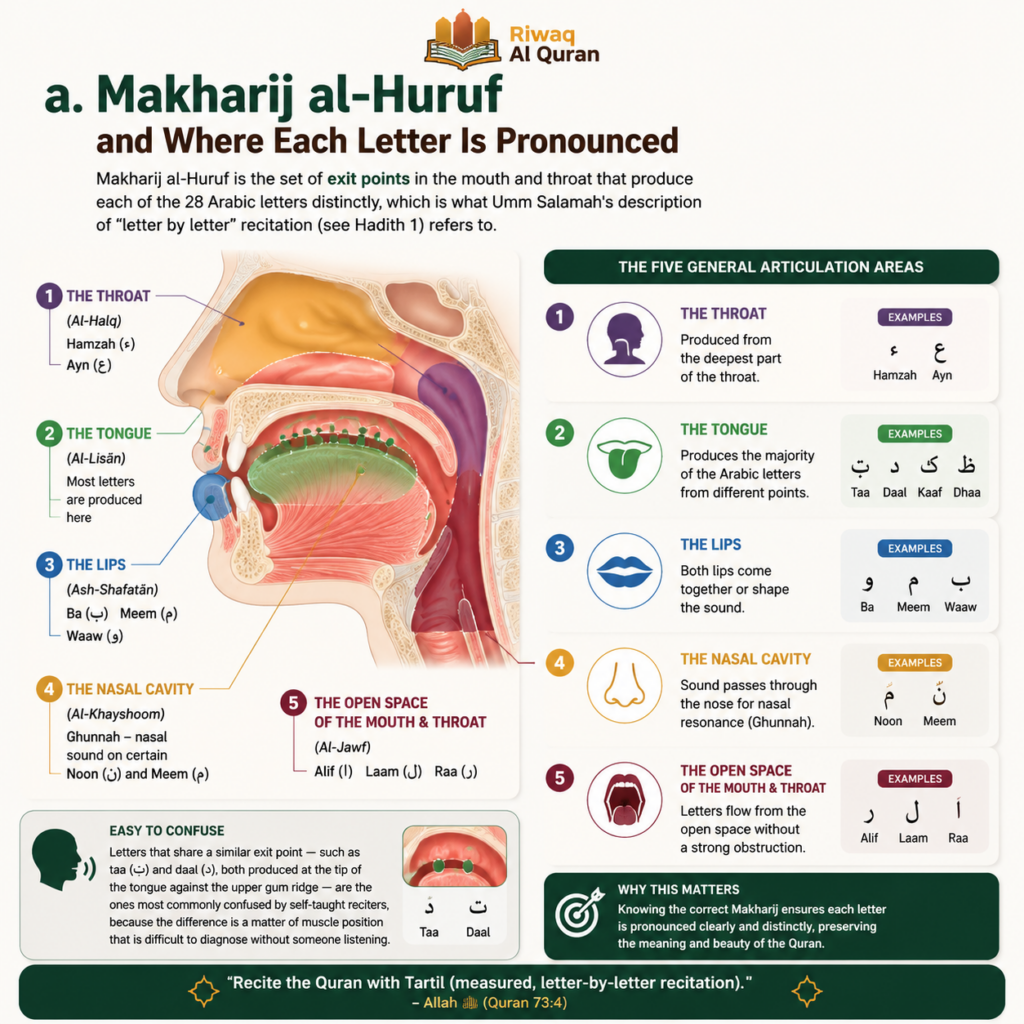
Makharij al-Huruf is the set of exit points in the mouth and throat that produce each of the 28 Arabic letters distinctly, which is what Umm Salamah’s description of “letter by letter” recitation (see Hadith 1) refers to.
There are five general articulation areas:
- The throat, producing letters like hamzah and ayn
- The tongue, producing the majority of letters
- The lips, producing ba, meem, and waaw
- The nasal cavity, producing Ghunnah — the two-count nasal hum required on certain noon and meem letters
- The open space of the mouth and throat, producing the three elongation letters
Letters that share a similar exit point — such as taa and daal, both produced at the tip of the tongue against the upper gum ridge — are the ones most commonly confused by self-taught reciters, because the difference is a matter of muscle position that is difficult to diagnose without someone listening.
b. Madd and When and How Long to Elongate a Letter
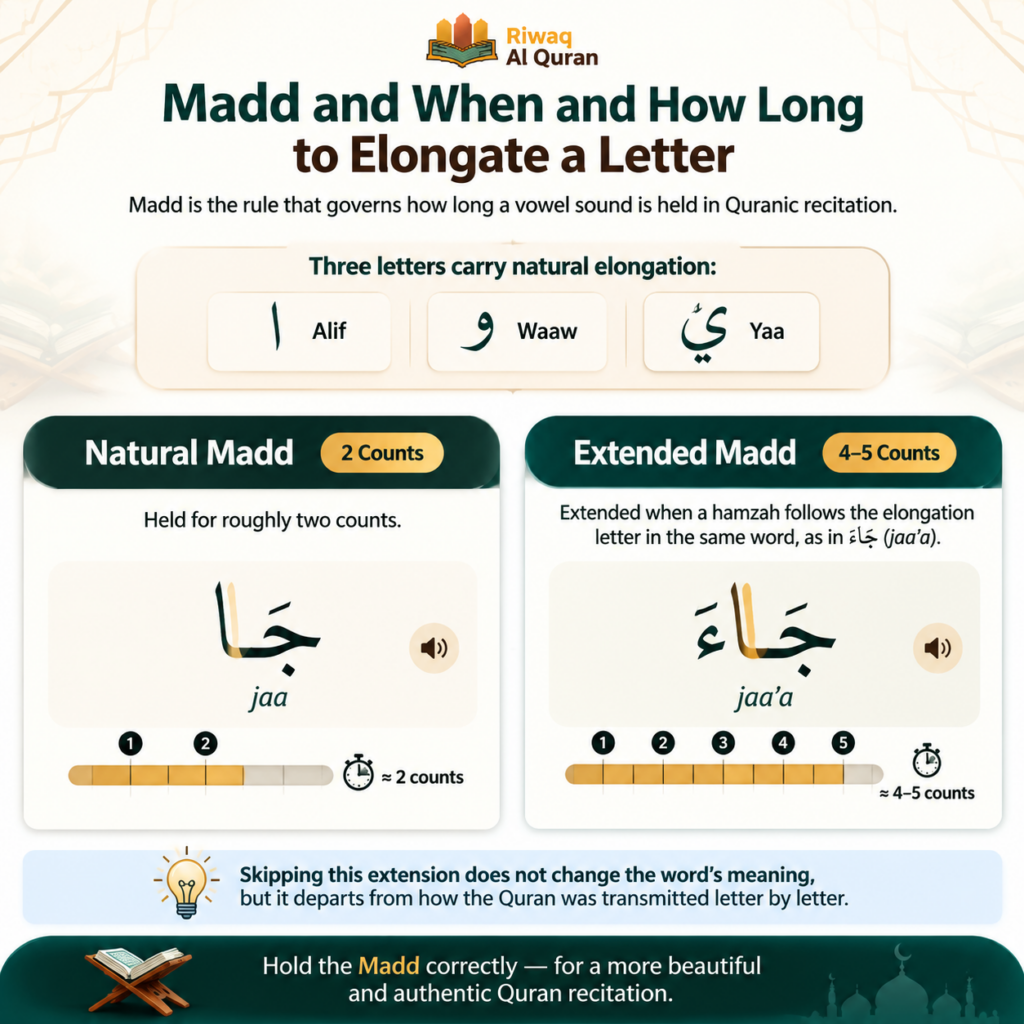
Madd is the rule governing how long a vowel sound is held, and it is the mechanic behind the Prophet’s ﷺ instruction to beautify recitation and Abu Musa’s praised, melodious voice.
Arabic has three letters that carry natural elongation: alif, waaw, and yaa.
- A natural Madd is held for roughly two counts.
- Madd is extended further under specific conditions — for example, when a hamzah follows the elongation letter within the same word, as in جَاءَ (jaa’a), where the hold extends to four or five counts.
Skipping this extension does not necessarily change a word’s meaning, but it does depart from how the Quran was transmitted letter by letter.
c. Waqf and Where to Pause Without Breaking the Meaning
Waqf is the practice of pausing at specific points in a verse, and it is the second half of Ali ibn Abi Talib’s definition of Tarteel alongside correct articulation, drawn from Surah Al-Muzzammil, 73:4.
A pause placed in the wrong location can separate a phrase from the clause it depends on grammatically, changing what the sentence appears to say even though every letter was pronounced correctly.
This is one of the specific corrections a live Tajweed teacher makes in real time — pause placement is something a reciter typically cannot hear as wrong in their own recitation, since the sentence still sounds complete to them.
Tarteel and Tajweed and the Difference Between Them
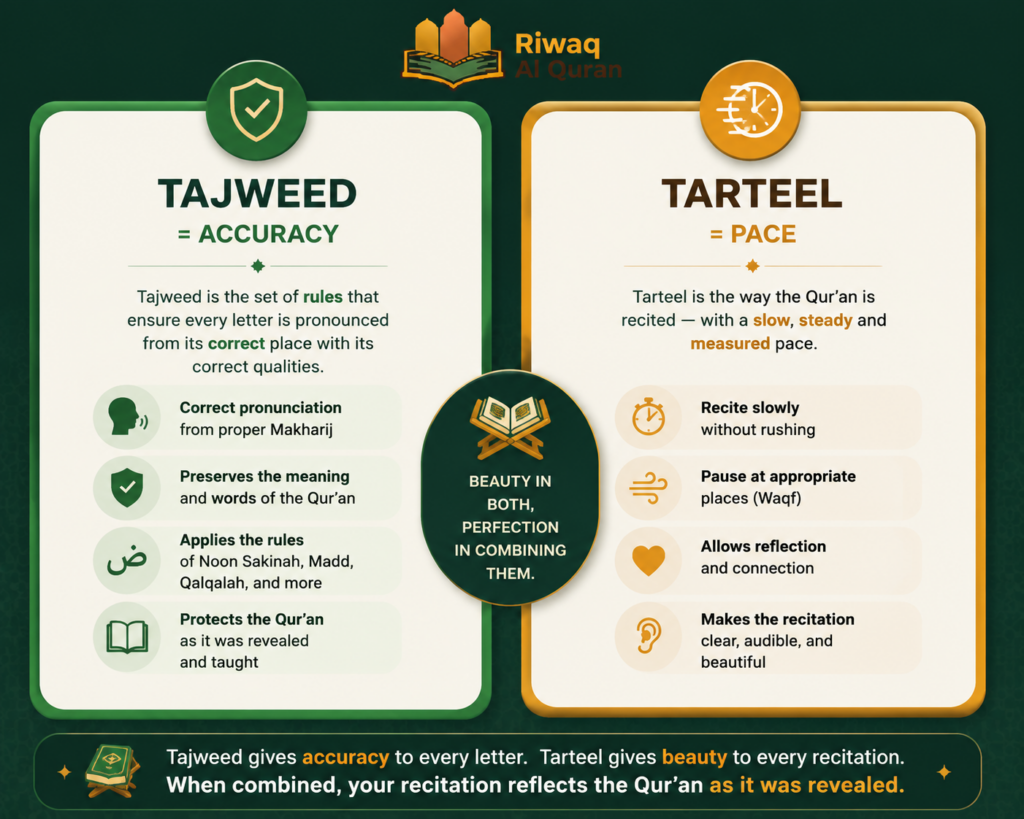
Tajweed and Tarteel are related but not identical: Tajweed is the set of correct-pronunciation rules themselves, while Tarteel is the slow, deliberate manner of applying those rules while reciting.
- Tajweed is the accuracy — the correct pronunciation, elongation, and pause rules.
- Tarteel is the pace — the slow, deliberate delivery those rules are applied within.
A reciter can technically know every Tajweed rule and still recite too quickly for Tarteel, blending words together in a way that undermines the pacing Surah Al-Muzzammil (73:4) commands.
Where Mispronunciation Actually Changes a Verse’s Meaning
Not every Tajweed error carries the same weight. Scholars distinguish between mistakes that alter meaning and mistakes that only affect the quality of recitation.
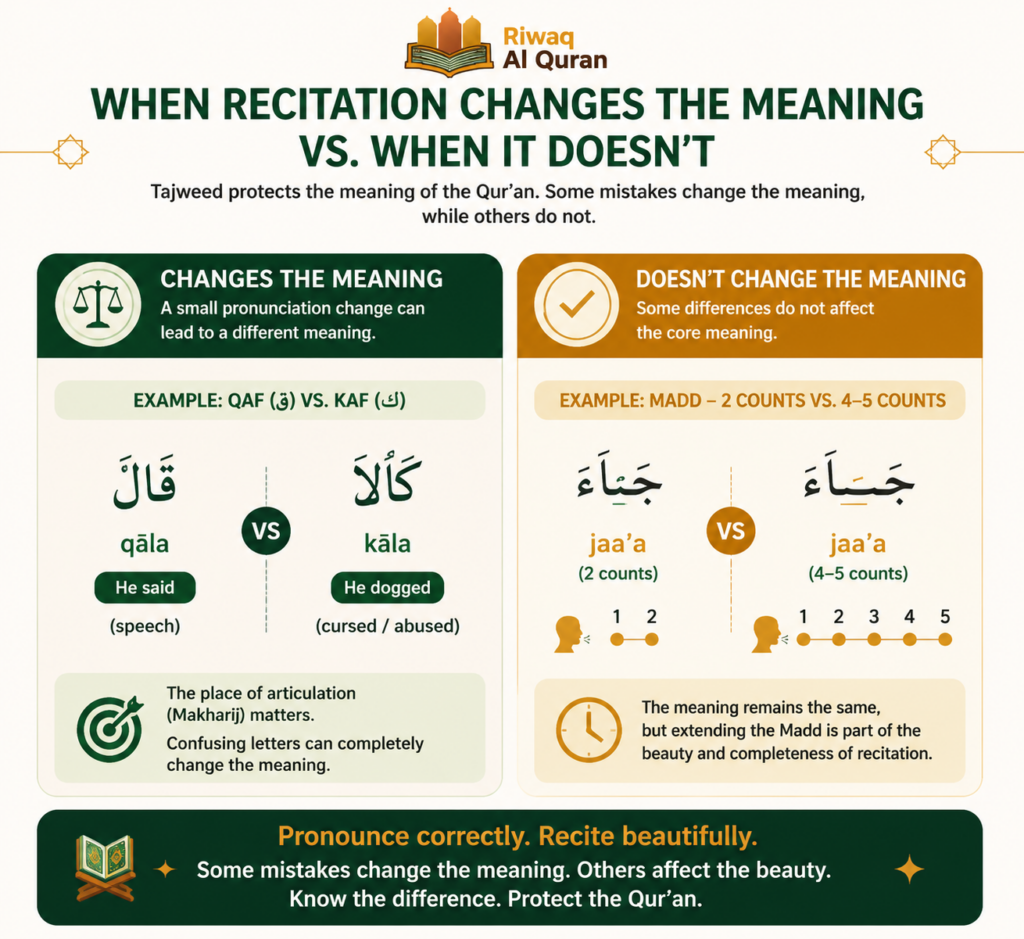
a. Meaning-Changing Mistakes (Lahn Jali)
A meaning-changing mistake, or Lahn Jali, occurs when a mispronounced letter turns one word into a different word entirely.
The example most commonly used to teach this distinction is the confusion between qaf and kaf, two letters produced close to each other at the back of the tongue: mispronouncing the qaf in a word can shift it toward a completely different meaning, which is exactly the kind of error Makharij al-Huruf training is designed to eliminate before it becomes a habit.
b. Non-Meaning-Changing Mistakes (Lahn Khafi)
A non-meaning-changing mistake, or Lahn Khafi, affects the quality of recitation without altering what a word or verse actually means.
Holding a Madd for one count instead of two, or shortening a Ghunnah’s nasal duration, falls into this category. A common pattern among self-taught reciters is memorizing surahs from audio recordings alone, with no one correcting the pacing in real time — the surah gets memorized accurately in meaning but the Lahn Khafi errors get memorized right along with it, and become far harder to unlearn once they’re habitual.
These errors do not invalidate a verse’s meaning, but they are still departures from how the Prophet ﷺ recited, which is why correcting them — session by session, with someone qualified to hear the difference — remains part of learning Tajweed properly rather than an optional refinement.
Is Learning Tajweed a Religious Obligation?
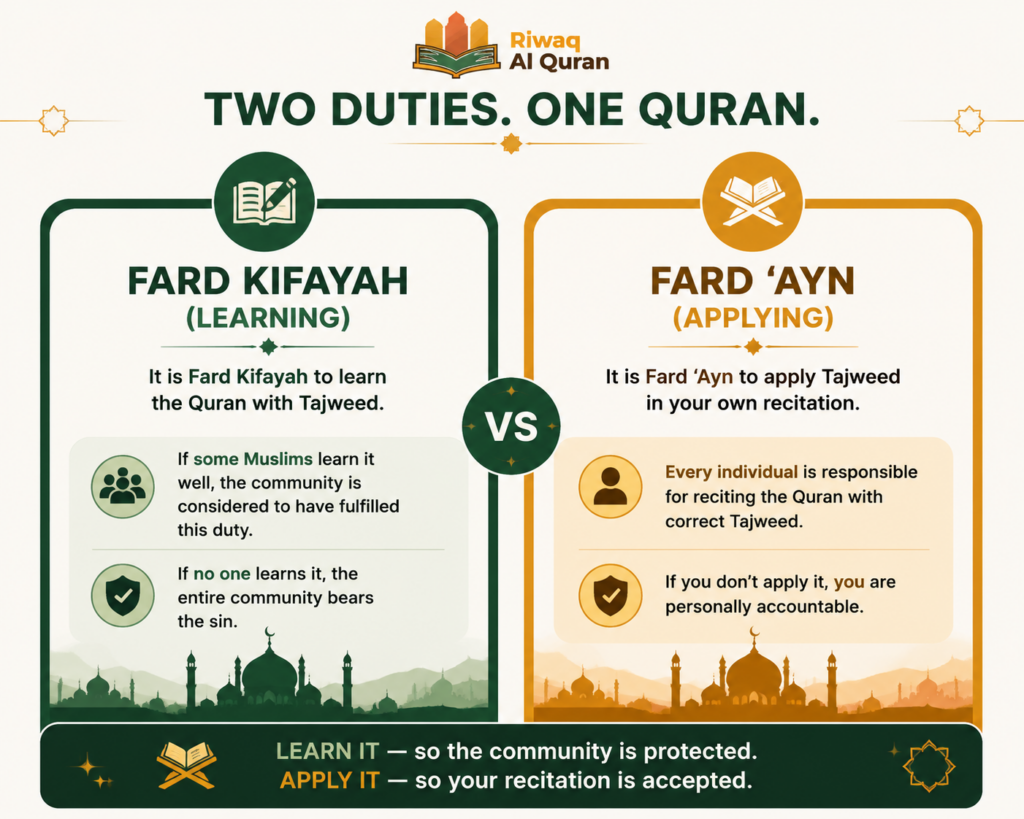
Scholars of Tajweed draw a distinction between learning the rules and applying them, and the obligation differs between the two.
- Learning the theoretical rules — knowing what Makharij, Madd, and Waqf are — is classified as Fard Kifayah, a communal obligation that is satisfied as long as enough people in the community have this knowledge.
- Applying those rules correctly while reciting, particularly in Surah Al-Fatiha during the five daily prayers, is classified as Fard ‘Ayn, an individual obligation on every Muslim capable of learning it.
This is why a prayer with a mispronounced Al-Fatiha may still be technically valid if the meaning is not altered, while consistently reciting it incorrectly out of neglect remains something scholars instruct Muslims to correct.
Start Correcting Your Recitation With a Qualified Tajweed Teacher
Reading about Makharij, Madd, and Waqf will not correct a habit your own ear cannot detect. A teacher listening to you recite, letter by letter, can.
Riwaq Al Quran is a comprehensive online platform that offers personalized Quran, Arabic, and Islamic Studies online classes for individuals of all ages and backgrounds. Their experienced instructors use a structured curriculum to cover Tajweed, Tafsir, and Memorization, providing easy and effective access to learning the Quran.
Before booking a session, see how many of these common beginner mistakes show up in your own recitation:
The advanced online classes allow for seamless communication and interaction between students and teachers. Join Riwaq Al Quran for a deeper connection with the Quran.
We offer several course categories:
- Online courses for kids
- Online Quran classes for kids and adults
- Online Arabic courses
- Online Ijazah courses
- Online Islamic Studies courses
Here is a sample from our full range of Quran Courses that will be helpful for you:


| Course | What It Covers |
|---|---|
| Online Tafseer Course | Delve into Quranic meanings with our insightful online Tafseer course. |
| Noorani Qaida Online | Learn Quranic basics efficiently through our Noorani Qaida online program. |
| Online Quran Recitation Course | Enhance Quranic recitation skills through our expert-led online course. |
| Online Tajweed Classes | Master Tajweed rules for beautiful Quranic recitation in online classes. |
| Quran Memorization Online Course | Memorize the Quran effectively with our specialized online memorization course. |
| Online Qirat Course | Explore diverse Qirat styles with our comprehensive online Qirat course. |
| Online Quran Classes for Kids | Nurture a love for the Quran in kids through interactive online classes. |
Each session works the way the hadith on learning from qualified reciters describes: a teacher listens, corrects, and repeats until the pronunciation is right — not a recorded lesson you replay alone.

Conclusion
Across the ten hadiths above, three patterns repeat: the Prophet ﷺ was reported reciting with unhurried, letter-by-letter clarity; specific companions — Ibn Mas’ud, Salim, Mu’adh, Ubai ibn Ka’b, Abu Musa al-Ash’ari — were named directly as recitation references, not left to the reader to infer; and reward was attached to both the reciter who has mastered the text and the one who is still struggling through it. None of the hadiths use the word “Tajweed,” but together they describe every part of what the term later came to organize: articulation, pacing, tone, and consequence.
The Quran supplies the command those hadiths are built on. Four verses across four different surahs use the same root — ر-ت-ل — for measured, deliberate recitation, addressed at different points to the Prophet ﷺ, to believers reciting, and to believers listening. Read next to the hadiths, the verses and the reports are not two separate arguments for Tajweed; they are the same instruction stated twice, once as revelation and once as demonstrated practice.
The practical takeaway is narrower than “learn Tajweed” as a general aspiration. It is this: Makharij, Madd, and Waqf are not scholarly refinements added on top of correct recitation — they are what the hadiths about Tajweed describe the Prophet ﷺ actually doing, and Fard ‘Ayn makes applying them, at minimum in Surah Al-Fatiha, a standing obligation rather than an optional improvement. Reading about these rules identifies what to fix. Fixing them requires a teacher who can hear the difference a reciter’s own ear misses — which is the same model the hadiths themselves describe: recite, be heard, be corrected, repeat.
Frequently Asked Questions
The questions below are the ones readers most often ask after going through the hadiths and the benefits of Tajweed above — covering obligation, common mistakes, the Tajweed/Tarteel distinction, and how to start correcting recitation properly.
Is the word “Tajweed” mentioned in the hadith?
No, the specific word “Tajweed” does not appear in the hadith texts. The hadiths describe its components directly — clear, letter-by-letter articulation, beautified voice, and measured pacing — which scholars later organized and named as the science of Tajweed.
Is learning Tajweed obligatory in Islam?
Applying Tajweed correctly while reciting is an individual obligation (Fard ‘Ayn), particularly for Surah Al-Fatiha in the five daily prayers. Learning the full theoretical rule set is a communal obligation (Fard Kifayah), satisfied once enough qualified teachers exist in the community.
What happens if I mispronounce a letter while reciting?
It depends on whether the mistake changes the word’s meaning. A meaning-changing mistake (Lahn Jali), such as confusing qaf and kaf, is treated seriously and should be corrected; a mistake that only affects elongation or nasal duration (Lahn Khafi) reduces recitation quality without altering meani
Do I still get rewarded if I struggle with Tajweed?
Yes. The hadith recorded in Riyad as-Salihin 994 states that a reciter who struggles and does their best receives two rewards, one for reciting and one for the effort, while a proficient reciter is ranked with the noble angels.
What is the difference between Tajweed and Tarteel?
Tajweed is the set of rules for correctly pronouncing each letter of the Quran. Tarteel is the slow, deliberate pace at which those rules are applied during recitation, as commanded in Surah Al-Muzzammil (73:4).
How can I start learning Tajweed correctly?
The most reliable way is direct correction from a qualified teacher who listens to your recitation in real time, since most Tajweed errors are ones a reciter cannot hear in themselves. Riwaq Al Quran’s live Tajweed courses are structured around this exact model, for both beginners and reciters correcting existing habits.