
Say the word “من” (min) once with a nasal hum trailing off the Noon, and once with the Noon cut clean and clear. That difference — hum or no hum — is the entire subject of Izhar. Izhar (also spelled Idhhar, إظهار) is the Tajweed ruling that tells a reciter exactly when to pronounce Noon Sakinah, Tanween, or Meem Sakinah fully and clearly, with no nasal sound attached.
Get this ruling wrong in either direction — adding a hum where none belongs, or clipping the Noon too fast — and the recitation drifts away from how the Quran was transmitted through an unbroken chain of teachers back to the Prophet ﷺ. That is why Izhar sits at the center of any serious study of Tajweed, alongside its counterpart rulings Ikhfa, Idgham, and Iqlab.
This guide covers what Izhar means linguistically and in Tajweed, the six Izhar letters and where each is articulated, the rules that trigger the ruling, worked Quranic examples for every letter, the four recognized types of Izhar, the mistakes reciters make most often, and a practice method for fixing them.
What you’ll learn in this article:
- The exact definition of Izhar, both as an everyday Arabic sound rule and as a Tajweed term.
- The six Izhar letters, grouped by where they’re articulated in the throat.
- The two conditions that must both be true before Izhar applies.
- All four types of Izhar — Halqi, Shafawi, Mutlak, and Riwaya — with a Quranic example for each.
- The most common Izhar mistakes and a short checklist for correcting them.
A quick reminder before we get into the rules — why precision in Tajweed matters in the first place:
Table of Contents
What Is Izhar (Idhhar الإظهار) in Tajweed?
Izhar is the Tajweed ruling requiring Noon Sakinah, Tanween, or Meem Sakinah to be pronounced fully and clearly, without any nasal resonance (Ghunnah), whenever a specific following letter is met.
The word itself is ordinary Arabic before it’s ever a Tajweed term:
a) Izhar as an Everyday Arabic Sound Rule
Linguistically, “Izhar” means “to make clear” or “to manifest.” Arabic speakers apply it unconsciously outside the Quran too — in the verb “ينهون,” the Noon Sakinah is followed by هـ, and native speakers voice that Noon distinctly without thinking about it. Tajweed simply names and formalizes a rule that already exists in the language.
b) Izhar as a Tajweed Term
In Tajweed, Izhar refers specifically to what happens when Noon Sakinah, Tanween, or Meem Sakinah is followed by one of a defined set of letters: the sound is pronounced in full, at its normal single-beat length, with the nasal Ghunnah switched off.
This is one of four possible outcomes for Noon Sakinah and Tanween in Quranic recitation — the others being Idgham, Iqlab, and Ikhfa — and it’s the only one of the four that adds no coloring to the sound at all.
The Six Izhar Letters (Huroof Al-Halq)
There are six Izhar letters: ء (hamza), هـ (ha), ع (‘ayn), ح (haa), غ (ghain), and خ (kha). Whenever any of these six follows Noon Sakinah or the Noon sound of Tanween, Izhar applies and the Noon is voiced without nasalization.
These six are also called Huroof Al-Halq — “letters of the throat” — because every one of them is articulated somewhere along the throat rather than the mouth.
That shared origin point is exactly why they force clear articulation instead of a nasal blend: the vocal tract has already committed to a throat position, so gliding into a nasal hum would require an extra, unnatural movement.
Where Each Letter Is Articulated
Tajweed manuals divide the throat into three zones, and the six Izhar letters split evenly across them:
| Letters | Throat zone | Position |
|---|---|---|
| ء, هـ | Aqsa al-Halq | Deepest part of the throat |
| ع, ح | Wasat al-Halq | Middle of the throat |
| غ, خ | Adna al-Halq | Nearest part of the throat, closest to the mouth |
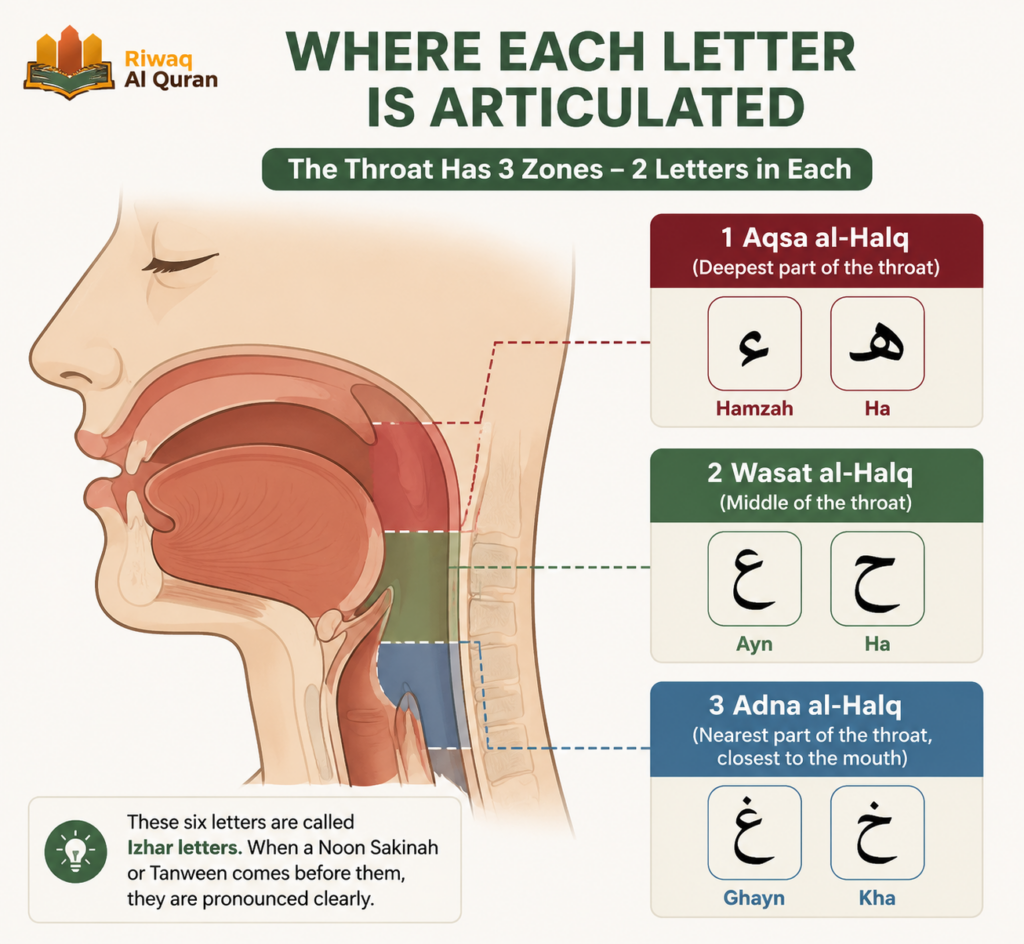
Knowing the zone matters in practice: letters from the same zone (like ع and ح) are the easiest pair to confuse, because the tongue root barely moves between them.
Reciters who mix up ع and ح, or غ and خ, are usually not making an Izhar-ruling mistake — they’re making a makhraj (articulation point) mistake that happens to surface inside an Izhar word.
learn how to pronounce the Noon Sakinah with Izhar, as opposed to other rulings of Noon Sakinah, is to listen to a well-versed Quran instructor to guide and correct you, giving you the proper feedback. You can choose from our experienced mentors at Riwaq Al Quran.
A Quranic Example for Each Izhar Letter
Every one of the six letters below triggers Izhar the same way: Noon Sakinah or Tanween stays fully voiced, no Ghunnah.
1. ء (Hamza)
(وَلَمْ يَكُن لَّهُۥ كُفُوًا أَحَدٌ)
“And there is none comparable to Him. “(Surah Al-Ikhlas, 112:4)
The Tanween on “كُفُوًا” is followed directly by “أَحَدٌ,” which opens with hamza.
2. هـ (Ha)
(قَالُوٓا۟ إِنْ هَـٰذَٰنِ لَسَـٰحِرَٰنِ)
“They said, “These two are certainly magicians.”(Surah Ta-Ha, 20:63)
The Noon Sakinah in “إِنْ” meets هـ in “هَـٰذَٰنِ.”
3. ع (‘Ayn)
(لَوْ أَنَّ لَهُم مَّا فِى ٱلْأَرْضِ جَمِيعًۭا وَمِثْلَهُۥ مَعَهُۥ لِيَفْتَدُوا۟ بِهِۦ مِنْ عَذَابِ)
“If those who disbelieved possessed everything on earth and as much more besides to ransom themselves from the punishment, it would never be accepted from them.”(Surah Al-Ma’idah, 5:36)
The Noon Sakinah in “مِنْ” meets ع in “عَذَابِ.”
4. ح (Haa)
(تَصْلَىٰ نَارًا حَامِيَةًۭ)
“They will burn in a blazing Fire.”(Surah Al-Ghashiyah, 88:4)
The Tanween on “نَارًا” meets ح in “حَامِيَةًۭ.”
5. غ (Ghain)
(أَمْ خُلِقُوا۟ مِنْ غَيْرِ شَىْءٍ)
“Or were they created by nothing, or are they their own creators?”(Surah At-Tur, 52:35)
The Noon Sakinah in “مِنْ” meets غ in “غَيْرِ.”
6. خ (Kha)
(ٱلَّذِىٓ أَطْعَمَهُم مِّن جُوعٍ وَءَامَنَهُم مِّنْ خَوْفٍ)
“Who has fed them against hunger and made them secure against fear.”(Surah Quraysh, 106:4)
The Noon Sakinah in “مِّنْ” meets خ in “خَوْفٍ.”
When the Izhar Ruling Applies
Izhar only applies when two conditions are both met at once: the Noon or Meem must be Sakinah, and the next letter must be one of the defined Izhar letters. Miss either condition and a different ruling — Idgham, Iqlab, or Ikhfa — takes over instead.
1. The Noon or Meem Must Be Sakinah
Noon Sakinah and Meem Sakinah carry a Sukoon (ْ) or no vowel mark at all — they are not followed by a Harakah. A Noon carrying Fatha, Kasra, or Damma is never eligible for Izhar, no matter what letter comes next.
(وَأَنَّ هَـٰذَا صِرَٰطِى مُسْتَقِيمًۭا فَٱتَّبِعُوهُ)
“Indeed, this is My Straight Path, so follow it”(Surah Al-An’am, 6:153)
The Noon in “أَنَّ” carries Fatha and Shadda — it is not Sakinah, so Izhar does not apply here even though هـ follows.
(قَالُوٓا۟ إِنْ هَـٰذَٰنِ لَسَـٰحِرَٰنِ)
“They said, “These two are certainly magicians.””(Surah Ta-Ha, 20:63)
Compare that to “إِنْ”: the Noon here is Sakinah, and هـ follows, so Izhar applies and the Noon must be voiced clearly.
2. There Is No Ghunnah in Izhar
Ghunnah is the roughly two-beat nasal resonance that sometimes rides along with Noon or Meem. Izhar is the one ruling among the four Noon Sakinah outcomes that carries none of it — the sound is articulated at its normal length and released cleanly through the mouth, not the nose.
Reading about the difference only goes so far; the gap between “voiced with a trace of nasal hum” and “voiced with none at all” is genuinely hard to hear in your own recitation without a second set of ears.
A live Tajweed tutor who can stop you mid-verse and replay the sound back is usually what closes that gap — which is exactly the kind of real-time correction built into Riwaq Al Quran’s one-on-one sessions with our experienced tutors.
Types of Izhar in Tajweed
This four-way classification — Izhar, Idgham, Iqlab, and Ikhfa — is classically taught in Ibn al-Jazari’s Muqaddimah al-Jazariyyah, the foundational primer still used across many Tajweed curricula.
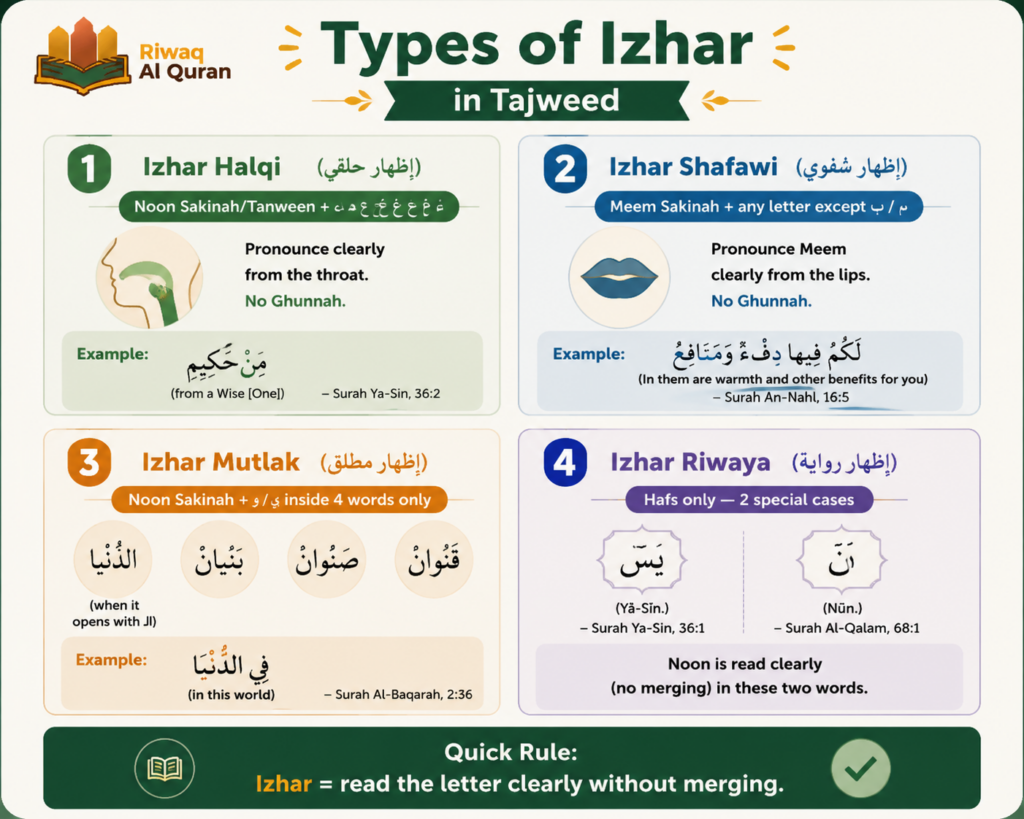
1. Izhar Halqi (إظهار حلقي)
The standard form covered above: Noon Sakinah or Tanween followed by one of the six throat letters (ء هـ ع ح غ خ), pronounced clearly with no Ghunnah. It’s named Halqi — “of the throat” — because all six triggering letters are Huroof Al-Halq.
2. Izhar Shafawi (إظهار شفوي)
Applies to Meem Sakinah rather than Noon. When Meem Sakinah is followed by any letter other than Baa (ب) or Meem (م), it is pronounced as a clear, unnasalized Meem. It’s named Shafawi — “of the lips” — since Meem is a labial letter.
(لَكُمْ فِيهَا دِفْءٌۭ وَمَنَـٰفِعُ)
“In them are warmth and other benefits for you”(Surah An-Nahl, 16:5)
“لَكُمْ” ends in Meem Sakinah, and the next word, “فِيهَا,” opens with ف — not ب or م — so the Meem is voiced clearly.
For a deeper walkthrough of Izhar Shafawi with more Quranic examples, see our dedicated Izhar Shafawi guide.
3. Izhar Mutlak (إظهار مطلق)
The narrowest of the four rulings: it applies only inside four specific Quranic words, where Noon Sakinah is followed by و or ي within the same word.
- الدنيا (only when it opens with الـ)
- بنيان
- صنوان
- قنوان
A common misconception worth correcting directly: و and ي are normally letters of Idgham, and some explanations generalize Izhar Mutlak to “any Noon Sakinah followed by Waw or Yaa.” That’s inaccurate.
The ruling is restricted to these four exact words. Idgham is skipped here specifically because merging the Noon into و or ي inside these particular words would blur or change their meaning — not because Noon-plus-Waw or Noon-plus-Yaa is broadly exempt from Idgham elsewhere.
All Ten Qira’at agree on treating these four words as Izhar — a point of cross-qira’at agreement catalogued in Ibn al-Jazari’s An-Nashr fi al-Qira’at al-‘Ashr, the classical reference for where the Ten Readings concur and differ — which is why the ruling is called Mutlak (absolute).
4. Izhar Riwaya (إظهار رواية)
The narrowest ruling of all — it applies to Noon Sakinah in exactly two words in the entire Quran, and only within Hafs narration, the recitation most widely read and taught today.
(يسٓ ١ وَٱلْقُرْءَانِ ٱلْحَكِيمِ)
“Yâ-Sĩn. By the Wise Quran.”(Surah Ya-Sin, 36:1-2)
(نٓ ۚ وَٱلْقَلَمِ وَمَا يَسْطُرُونَ)
“Nũn. By the pen and what everyone writes!”(Surah Al-Qalam, 68:1)
In both cases, the Noon at the end of the disconnected letter (يسٓ, نٓ) is voiced clearly under Hafs narration rather than merged into the letter that follows.
Izhar Types at a Glance
Before diving into how to apply each ruling, it helps to see all four side by side. The table below summarizes what triggers each type, which letter it governs, and how often you’ll actually encounter it in recitation:
| Type | Applies to | Triggering letters/words | Scope |
|---|---|---|---|
| Izhar Halqi | Noon Sakinah / Tanween | 6 throat letters (ء هـ ع ح غ خ) | Occurs constantly throughout the Quran |
| Izhar Shafawi | Meem Sakinah | Any letter except ب and م | Occurs constantly throughout the Quran |
| Izhar Mutlak | Noon Sakinah | و or ي, same word only | Exactly 4 fixed words |
| Izhar Riwaya | Noon Sakinah (disconnected letters) | Hafs narration only | Exactly 2 words |
How To Tell Them Apart While Reciting
Run through this in order whenever Izhar seems to apply:
- First, check which letter is Sakinah. Meem Sakinah followed by anything but ب or م is Izhar Shafawi — stop there. Noon Sakinah or Tanween followed by one of the six throat letters is Izhar Halqi.
- If neither of those fits, check whether the Noon Sakinah is followed by و or ي inside the same word. If the word is one of the four fixed exceptions (الدنيا، بنيان، صنوان، قنوان), it’s Izhar Mutlak, not Idgham.
- If you’re reciting a disconnected letter (يسٓ or نٓ) under Hafs narration, that’s Izhar Riwaya — a narration-specific case, not a general rule.
A Common Mistake With These Four Types
Students who memorize Izhar Mutlak as “Noon Sakinah before و or ي is Izhar” tend to misapply it everywhere they see that letter combination — but the ruling only holds inside four specific words. Outside of those four, Noon Sakinah before و or ي follows the normal Idgham rule instead.
The same caution applies to Izhar Riwaya: it’s tied specifically to Hafs. Reciting the same disconnected letters under a different riwayah can call for a different ruling, so treat Izhar Riwaya as narration-specific rather than universal.
How Izhar Compares to Idgham, Iqlab, and Ikhfa
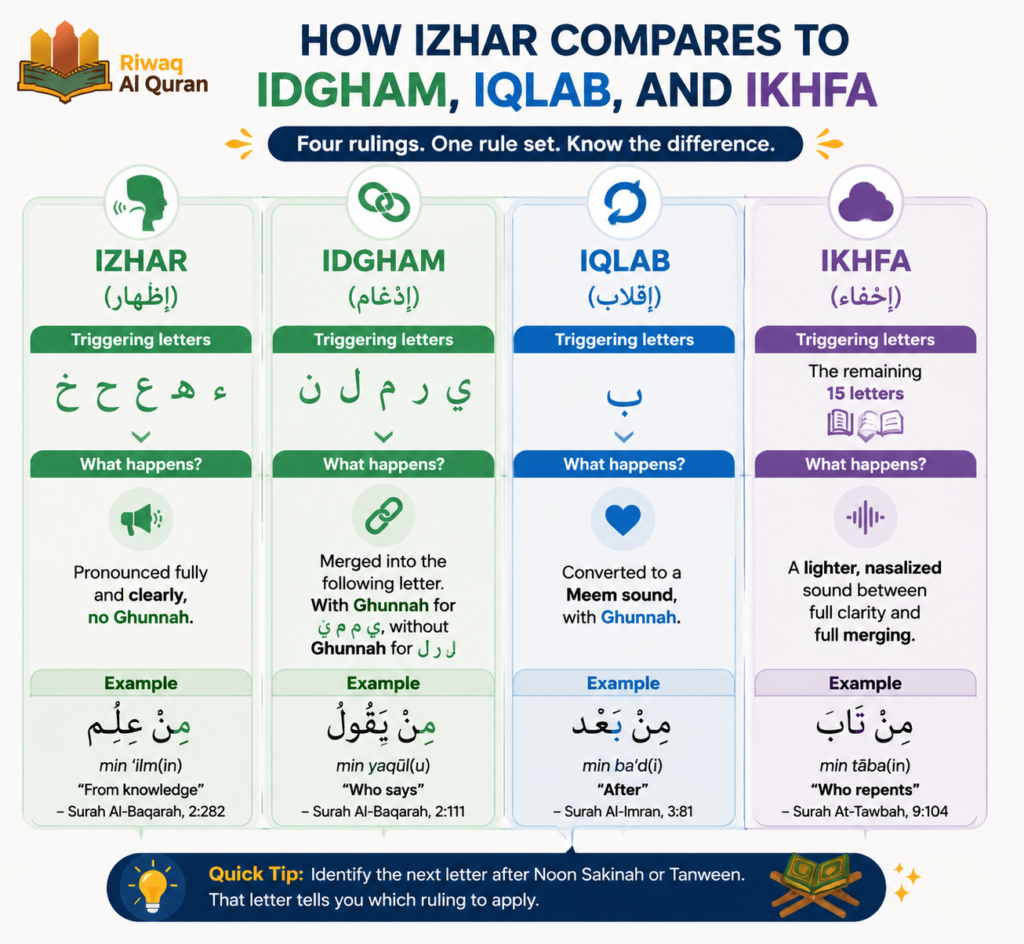
Izhar is one of four possible outcomes for Noon Sakinah and Tanween. Seeing them side by side makes it easier to recognize which ruling you’re dealing with.
| Ruling | Triggering letters | What happens to the Noon/Tanween sound |
|---|---|---|
| Izhar | ء هـ ع ح غ خ | Pronounced fully and clearly, no Ghunnah |
| Idgham | ي ر م ل و ن | Merged into the following letter (with Ghunnah for ي ن م و, without for ل ر) |
| Iqlab | ب | Converted to a Meem sound, with Ghunnah |
| Ikhfa | The remaining 15 letters | A lighter, nasalized sound between full clarity and full merging |
For a full side-by-side breakdown of all four rulings with more examples, see Ikhfa, Idgham, Izhar, and Iqlab With Examples.
Common Mistakes Reciters Make With Izhar
Most Izhar errors aren’t about knowing the rule — they’re about what the mouth does out of habit. Three patterns come up often enough to be worth naming directly.
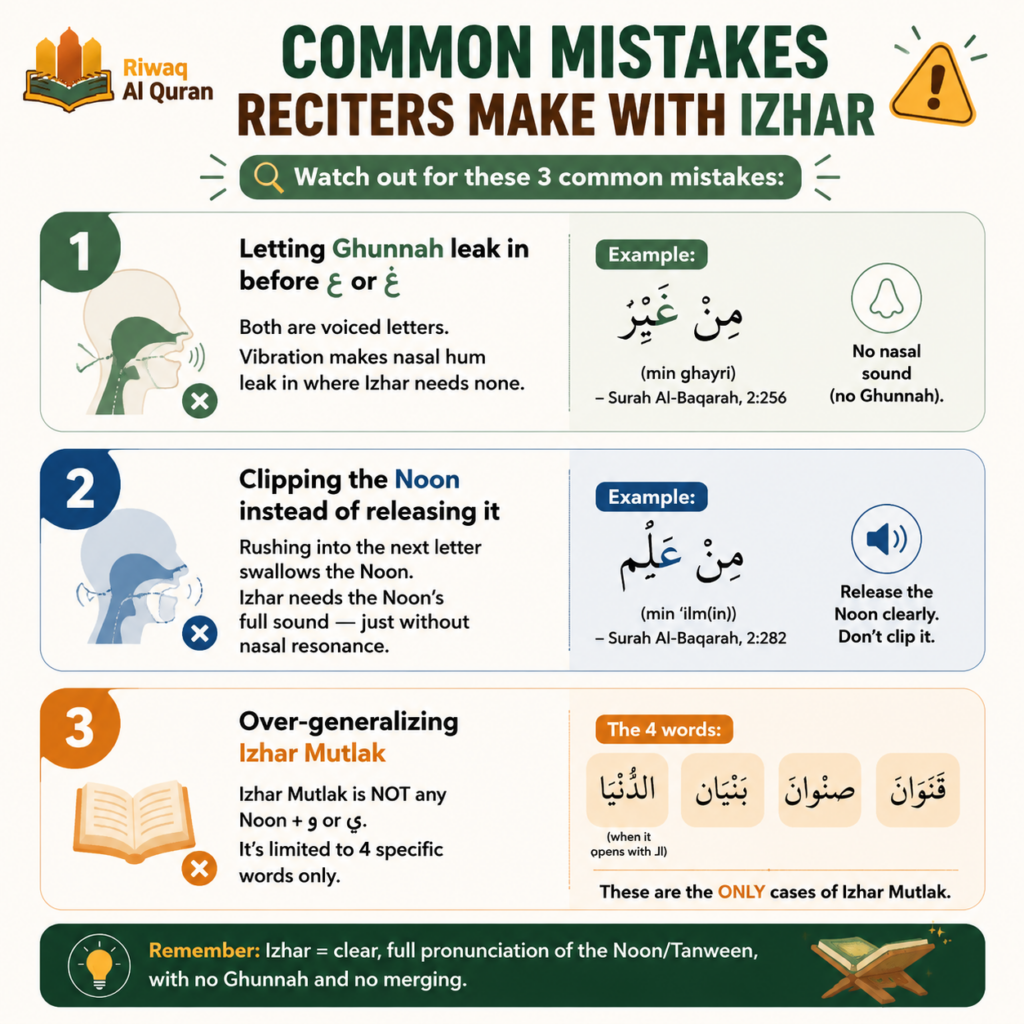
1. Letting Ghunnah leak in before ع or غ: Both letters are voiced consonants, meaning the vocal cords are already vibrating before the Noon is released. That vibration makes it easy to let a trace of nasal hum bleed through where Izhar requires none at all.
2. Clipping the Noon instead of releasing it: The opposite mistake: rushing straight into the next letter and swallowing the Noon almost entirely, so it barely registers. Izhar still needs the Noon articulated at its normal length — just without the nasal resonance, not without the sound.
3. Over-generalizing Izhar Mutlak: Treating any Noon-Sakinah-plus-Waw or Noon-Sakinah-plus-Yaa combination as automatically exempt from Idgham, rather than recognizing it’s limited to the four specific words listed above.
A tutor listening in real time catches these far faster than self-review, since the reciter making the mistake is often the last person to hear it — one of the reasons structured, corrected practice tends to outpace independent listening alone.
These same three mistakes show up often enough that we broke them down separately — worth the 43 seconds:
How to Practice Izhar Correctly
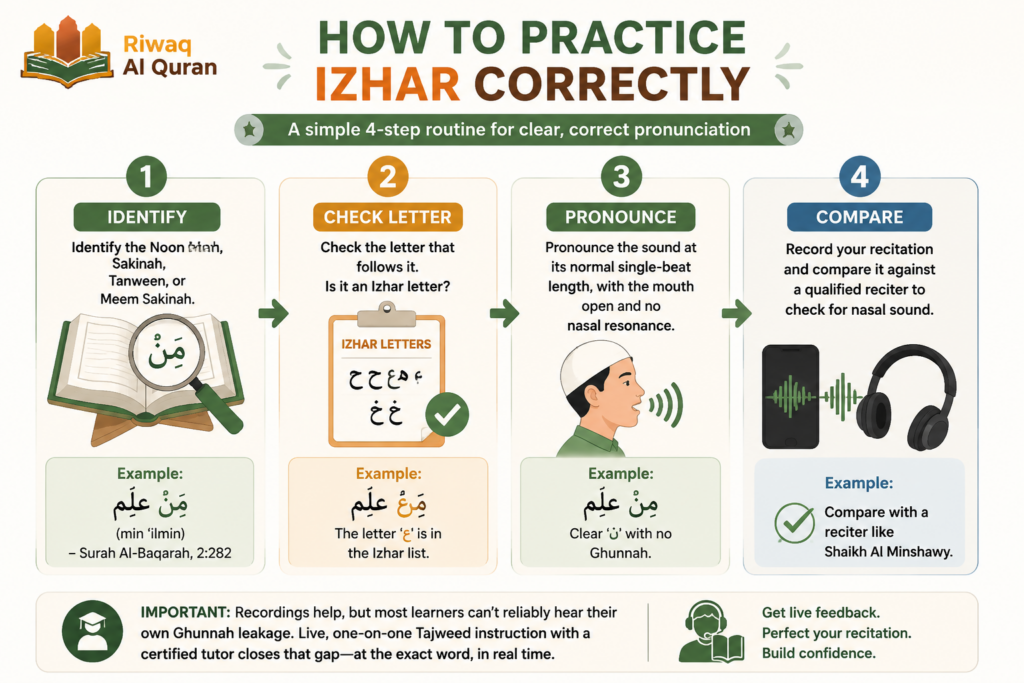
Fixing Izhar pronunciation is less about memorizing the rule and more about training the ear to catch the difference between clear and nasalized. A simple four-step routine works for most learners:
- Identify the Noon Sakinah, Tanween, or Meem Sakinah in the word before deciding on a ruling.
- Check the letter that follows it against the Izhar letter list (or the Baa/Meem exception for Shafawi).
- Pronounce the sound at its normal single-beat length, with the mouth open and no nasal resonance.
- Record the recitation and compare it against a qualified reciter, such as Shaikh Al Minshawy, to check where the nasal sound is creeping in.
Self-correction through recordings closes part of the gap, but it has a ceiling — most learners can’t reliably hear their own Ghunnah leakage. That’s the specific gap live, one-on-one Tajweed instruction is built to close, with a certified tutor stopping the recitation at the exact word and demonstrating the correction on the spot.
Book Your Free Tajweed Trial Session
Reading the rules gets you halfway there. Hearing your own Izhar corrected in real time, word by word, is what actually changes how you recite. A live trial session pairs you with a certified Tajweed tutor who listens to your recitation and corrects Izhar, Ghunnah, and the other Noon Sakinah rulings as they happen — not after the fact.
Learn Quran, Arabic, and Islamic Studies Online With Riwaq Al Quran
Riwaq Al Quran is a comprehensive online platform offering personalized Quran, Arabic, and Islamic Studies classes for learners of all ages and backgrounds. Our instructors follow a structured curriculum covering Tajweed, Tafsir, and memorization, and the live, interactive format keeps communication between student and teacher direct throughout every session.

Courses are organized into five broad categories, each covering multiple age groups and levels:
a) Courses for kids
b) Quran classes for kids and adults
c) Arabic courses
d) Ijazah courses
e) Islamic Studies courses


Within those categories, here’s a sample of specific courses that build directly on what this article covers:
| Course | What it covers |
|---|---|
| Online Tafseer Course | Quranic meanings and interpretation |
| Noorani Qaida Online | Foundational Quranic reading basics |
| Online Quran Recitation Course | Expert-led recitation skill-building |
| Online Tajweed Classes | Full Tajweed rules, Izhar included |
| Quran Memorization Online Course | Structured memorization with Tajweed |
| Online Qirat Course | The Ten Qira’at, explored in depth |
| Online Quran Classes for Kids | Interactive lessons for children |

Conclusion
Izhar is the answer to that “من” test from the opening: hum trailing off the Noon means the ruling wasn’t applied; a clean, full release means it was. That’s the entire ruling in practice — Noon Sakinah, Tanween, or Meem Sakinah pronounced fully and clearly, with no Ghunnah, whenever one of the defined triggering letters follows.
Two conditions decide whether Izhar applies at all: the Noon or Meem has to be Sakinah, and the next letter has to be one of the set that triggers it — the six throat letters for Izhar Halqi, any letter but Baa or Meem for Izhar Shafawi, or one of the closed word-lists behind Izhar Mutlak and Izhar Riwaya. Get either condition wrong, and Idgham, Iqlab, or Ikhfa takes over instead — which is exactly why confusing Izhar with its counterparts changes how a verse is meant to sound, not just how it’s labeled.
None of this is a rule you can absorb by reading it once. The mistakes reciters actually make — a stray hum before ع or غ, a Noon clipped too short, Izhar Mutlak over-applied outside its four words — are habits of the mouth, and habits of the mouth only get corrected by someone listening while you recite, not by re-reading the definition.
That’s the one thing worth carrying out of this guide: know the six letters, know the two conditions, know which of the four types you’re applying — then say it out loud, get corrected, and say it again until the hum is gone for good.
Frequently Asked Questions About Izhar
The questions below cover the points readers ask most often about Izhar — from the basic definition to how it’s distinguished from the other Noon Sakinah rulings. (Kept as individual headings rather than a merged list, since separate Q&A headings are what search engines and AI answers pull from directly.)
1. What is Izhar in Tajweed?
Izhar is the Tajweed ruling requiring Noon Sakinah, Tanween, or Meem Sakinah to be pronounced clearly, with no nasal Ghunnah, when followed by a specific triggering letter. It is one of four possible rulings for Noon Sakinah, alongside Idgham, Iqlab, and Ikhfa.
2. How many Izhar letters are there?
There are six Izhar letters, also called Huroof Al-Halq: ء, هـ, ع, ح, غ, and خ. Any of these six following Noon Sakinah or Tanween triggers Izhar Halqi, requiring the Noon to be voiced clearly without nasalization.
3. What is the difference between Izhar and Ikhfa?
Izhar pronounces Noon Sakinah or Tanween fully clear with no nasal sound at all, while Ikhfa pronounces it with a lighter, partly nasalized sound. Izhar is triggered by six specific throat letters; Ikhfa is triggered by the remaining fifteen letters not covered by Izhar, Idgham, or Iqlab.
4. Does Izhar include any Ghunnah?
No. Izhar is defined specifically by the absence of Ghunnah — the Noon or Meem is released at its normal length with no nasal resonance, unlike Idgham with Ghunnah or Ikhfa, which both carry some nasal coloring.
5. What are the Izhar Mutlak words in the Quran?
Izhar Mutlak applies to exactly four words: الدنيا (only when it begins with الـ), بنيان, صنوان, and قنوان. In each, Noon Sakinah is followed by و or ي within the same word, and Idgham is deliberately avoided to preserve the word’s meaning.
6. Can Izhar apply to Meem Sakinah as well as Noon Sakinah?
Yes. When Meem Sakinah is followed by any letter other than Baa (ب) or Meem (م), the ruling is called Izhar Shafawi, and the Meem is pronounced clearly without nasalization — the same principle as Izhar Halqi, applied to a different letter.