The difference between Ikhfa, Idgham, Izhar, and Iqlab comes down to one thing: what happens to the Noon Sakinah (نْ), Tanween, or Meem Sakinah sound depending on the letter that comes right after it in recitation. Get the rule wrong and a word either loses its nasal quality, keeps a sound that should have disappeared, or blends into the next word in a way that changes how the verse is heard.
Every Arabic speaker already applies a version of these rules without thinking — no one says “min ba’d” with a hard, separated noon; it comes out closer to “mim ba’d.” Quranic recitation formalizes that instinct into four named, testable rules, and it does so on direct instruction:
“أَوْ زِدْ عَلَيْهِ وَرَتِّلِ ٱلْقُرْءَانَ تَرْتِيلًا”
“or a little more, and recite the Qur’an with measured recitation” (Surah Al-Muzzammil, 73:4).
Tajweed rules like Izhar, Idgham, Iqlab, and Ikhfa are how tarteel — measured, distinct recitation — is actually carried out letter by letter.
This guide walks through Izhar, Idgham, Iqlab, and Ikhfa one at a time, with their subtypes, the letters that trigger each one, Quranic examples with full tashkeel, and the specific mistakes reciters make with each rule.
“Before going through each rule individually, here’s a short breakdown of why tarteel and Tajweed matter in the first place:
What You’ll Learn in This Article
- The exact letter groups that trigger Izhar, Idgham, Iqlab, and Ikhfa, and why each rule happens mechanically.
- How Meem Sakinah has its own separate version of Izhar and Ikhfa.
- A quick way to identify which of the four rules applies to any Noon Sakinah or Tanween you see.
- The specific pronunciation mistakes reciters make with each rule, and how to correct them.
- How to tell the Iqlab symbol apart from the Mandatory Stop symbol in the Mushaf.
Table of Contents
Noon Sakinah, Tanween, and the Four Rules: Izhar, Idgham, Iqlab, and Ikhfa
Before Izhar, Idgham, Iqlab, and Ikhfa make sense individually, four building blocks need to be defined, since all four rules are really just four different answers to the same question: what happens to this sound next?
1. Noon Sakinah (النون الساكنة)
Noon Sakinah is a Noon letter (ن) carrying a sukoon, meaning it has no vowel of its own and produces a bare nasal “n” sound. Because it has no vowel to anchor it, its pronunciation is entirely shaped by whatever letter follows it — which is the reason Izhar, Idgham, Iqlab, and Ikhfa exist in the first place.
2. Tanween (التنوين)
Tanween is the doubled vowel mark — fathatain, kasratain, or dammatain — that appears at the end of certain words and produces the same nasal “n” sound as Noon Sakinah, without an actual Noon letter being written. Because Noon Sakinah and Tanween are pronounced identically, Tajweed treats them as one group; scholars sometimes call them “non-identical twins” since they look different on the page but behave the same way in recitation.
3. Meem Sakinah (الميم الساكنة)
Meem Sakinah is a Meem letter (م) carrying a sukoon. It follows its own version of Izhar and Ikhfa (Izhar Shafawi and Ikhfa Shafawi), which are covered under each rule below, but it is never affected by Iqlab.
4. Ghunnah (الغنة)
Ghunnah is the nasal hum produced through the nose rather than the mouth, held for roughly two counts (harakat) in Idgham with Ghunnah, Iqlab, and Ikhfa. It is the sound quality that makes these three rules distinguishable from a plain, clear Izhar.
This is also the quality the Prophet ﷺ pointed to directly when he said:
“زَيِّنُوا الْقُرْآنَ بِأَصْوَاتِكُمْ”
“Beautify the Qur’an with your voices” (narrated by Al-Bara’ ibn ‘Azib, Sunan Abi Dawud 1468
— graded sahih by Al-Albani). A correctly held ghunnah is part of what that beautification looks like in practice — it’s not ornamentation, it’s the rule being applied properly.
Riwaq Al Quran’s Tajweed tutors typically start a new student here, on these four terms, before touching Izhar, Idgham, Iqlab, or Ikhfa — a student who can’t yet hear the difference between Noon Sakinah and Tanween by ear has no foundation to apply the four rules correctly, no matter how well they’ve memorized the letter lists.
What is Izhar in Tajweed?
Izhar (الإظهار) means “to make clear” in Arabic, and it is the rule of pronouncing Noon Sakinah, Tanween, or Meem Sakinah plainly and distinctly, with no ghunnah and no blending into the next letter.
Mechanically, Izhar happens because the letters that trigger it are articulated from the throat — far from the tongue-tip position of Noon — so forcing a merge would require an unnatural jump between articulation points. Pronouncing the Noon cleanly and moving on is the more natural path.
1. Izhar Halqi (إظهار حلقي)
Izhar Halqi applies when Noon Sakinah or Tanween is followed by one of six throat letters (حروف الحلق): ء – هـ – ع – ح – غ – خ. It is called Halqi because these six letters are articulated directly from the throat.
An everyday Arabic example: in “ينهون” (yanhawn), the Noon Sakinah is followed by هـ, so the noon sound stays clear.
A Quranic example:
“تَصْلَىٰ نَارًا حَامِيَةً”
“They will burn in a blazing Fire”(Surah Al-Ghashiyah, 88:4).
The Tanween on “نَارًا” is followed by ح, so it is pronounced as a clear, separated “n” — heard as “naaran haamiyah,” not blended into the ح.
2. Izhar Shafawi (إظهار شفوي)
Izhar Shafawi is the Meem Sakinah version of the same principle: whenever Meem Sakinah is followed by any letter except Baa (ب) or Meem (م), it is pronounced as a clear, voiced Meem with no ghunnah held. It is called Shafawi because Meem is articulated from the lips.
An everyday example: in “الحمد لله” (al-hamdu lillah), the Meem Sakinah in “الحمد” is followed by د, so it stays clear.
A Quranic example:
“وَٱلْأَنْعَـٰمَ خَلَقَهَا ۗ لَكُمْ فِيهَا دِفْءٌ وَمَنَـٰفِعُ وَمِنْهَا تَأْكُلُونَ”
“And He created the cattle for you. In them are warmth and other benefits, and from them you eat”(Surah An-Nahl, 16:5).
The Meem Sakinah in “لَكُمْ” is followed by ف in “فِيهَا,” so it is pronounced clearly.
3. Izhar Mutlaq (إظهار مطلق)
Izhar Mutlaq is a narrow exception that applies to only four specific words in the entire Quran: الدنيا (only when it opens with الـ), بنيان, صنوان, and قنوان.
Each of these words contains a ي or و directly after Noon Sakinah — letters that normally trigger Idgham — but Idgham is deliberately blocked here because merging would distort the word’s meaning.It is called “Mutlaq” (absolute) because every one of the Ten Qira’at agrees on applying Izhar in these four words without exception.
4. Izhar Riwaya (إظهار رواية)
Izhar Riwaya is narrower still: it applies to only two words in the Quran, and only within Hafs narration (رواية حفص), the recitation most widely taught and printed today.
“يسٓ ١ وَٱلْقُرْءَانِ ٱلْحَكِيمِ”
“Yâ-Sĩn.”By the Wise Quran.”(Surah Ya-Sin, 36:1–2)
“نٓ ۚ وَٱلْقَلَمِ وَمَا يَسْطُرُونَ”
“Nũn. By the pen and what everyone writes!” (Surah Al-Qalam, 68:1)
-both keep the Noon of the disjointed letters (يسٓ / نٓ) clear before the following word, under Hafs’s narration specifically. A reciter trained in a different narration may pronounce these two instances differently, which is exactly why this exception is labeled by narration (Riwaya) rather than by letter group.
Learning to hear these distinctions by ear, rather than only recognizing the letter lists on paper, is one of the clearest gaps between self-taught reciters and students working through Riwaq Al Quran’s live Tajweed classes with a tutor correcting them verse by verse.
What is Idgham in Tajweed?
Idgham (الإدغام) means “to merge into” and describes combining two sounds into one doubled sound (a shadda), where the first letter is Sakin and the second is Mutaharrik.
In practice, this is what happens when Noon Sakinah or Tanween is immediately followed by one of six letters, collected in the mnemonic word “يرملون” (Yarmaloon): ي – ر – م – ل – و – ن.
Idgham happens here specifically because these six letters share an articulation point close to Noon’s own — either at the tongue-tip or through the nasal passage — so a full merge is physically natural in a way it isn’t with the throat letters of Izhar.
1. Idgham with Ghunnah (إدغام بغنة)
Idgham with Ghunnah applies to four of the six Idgham letters, collected in the word “ينمو” (Yanmu): ي – ن – م – و. The merge is held with a two-count nasal hum — roughly 50% through the mouth, 50% through the nose.
An everyday example: “خيرٌ وفير” — the Tanween in “خيرٌ” is followed by و, so the Noon sound of the Tanween disappears into the و while a ghunnah is held.
A Quranic example:
“فَمَن يَعْمَلْ مِثْقَالَ ذَرَّةٍ خَيْرًا يَرَهُۥ”
“So whoever does an atom’s weight of good will see it.” (Surah Az-Zalzalah, 99:7).
The Tanween on “خَيْرًا” merges into the ي of “يَرَهُ” with ghunnah — you hear “khairañ-yarah,” not a separated “khairan yarah.”
2. Idgham without Ghunnah (إدغام بدون غنة)
Idgham without Ghunnah applies to the remaining two letters, ل and ر. Here the merge is complete — 100% oral, with no nasal trace of the Noon left at all.
An everyday example: “شيخٌ لبيب” — the Tanween in “شيخٌ” merges fully into the ل of “لبيب,” with no ghunnah.
A Quranic example:
“إِنَّ ٱللَّهَ لَا يَظْلِمُ مِثْقَالَ ذَرَّةٍ ۖ وَإِن تَكُ حَسَنَةً يُضَـٰعِفْهَا وَيُؤْتِ مِن لَّدُنْهُ أَجْرًا عَظِيمًا”
” ndeed, Allah does not wrong anyone even by an atom’s weight. And if there is a good deed, He multiplies it and grants from Himself a great reward.” (Surah An-Nisa, 4:40).
The Tanween on “ذَرَّةٍ” merges into the ل of “لَّدُنْهُ,” and no trace of the Noon sound survives, from either the mouth or the nose.
What is Iqlab in Tajweed?
Iqlab (الإقلاب) means “transformation” or “conversion,” and it is the rule of converting the Noon Sakinah or Tanween sound into a Meem sound, but only when the very next letter is Baa (ب).
Iqlab exists for a physical reason: moving directly from a Noon (tongue-and-nose articulation) to a Baa (pure lips) is an awkward jump. Meem solves this because it is articulated at the lips like Baa, while still carrying the same nasal quality as Noon — it is the bridge sound between the two. Even outside Quranic recitation, Arabic speakers do this automatically; “من بعد” is rarely pronounced with a hard, separated noon.
Iqlab has only one trigger letter: ب.
An everyday example: in “جنب,” the ن automatically shifts toward an م sound because it is followed by ب.
A Quranic example:
“ٱللَّهُ يَصْطَفِى مِنَ ٱلْمَلَـٰٓئِكَةِ رُسُلًا وَمِنَ ٱلنَّاسِ ۚ إِنَّ ٱللَّهَ سَمِيعٌۢ بَصِيرٌ”
“Allah chooses messengers from among the angels and from among the people. Surely Allah is All-Hearing, All-Seeing.” (Surah Al-Hajj, 22:75).
The Tanween on “سَمِيعٌ” shifts to an م sound before the ب of “بَصِيرٌ.”
1. The Three Contexts Where Iqlab Occurs
Iqlab shows up in three distinct positions, and recognizing all three matters more than most students expect, since the “two words” and “Tanween” cases are the ones reciters most often miss.
1. In one word:
“أَنۢبِئْهُم” in “قَالَ يَـٰٓـَٔادَمُ أَنۢبِئْهُم بِأَسْمَآئِهِمْ”
“O Adam! Inform them of their names.”” (Surah Al-Baqarah, 2:33)
— the small م symbol appears directly above the ن.
2. Across two words:
“أَنۢ بُورِكَ” in “نُودِىَ أَنۢ بُورِكَ مَن فِى ٱلنَّارِ” “
“Blessed is whoever is in the fire and whoever is around it.””(Surah An-Naml, 27:8)
— the Noon at the end of one word converts because the next word starts with ب.
3. With Tanween:
“لَنَسْفَعًۢا بِٱلنَّاصِيَةِ”
“We will certainly seize him by the forelock.”(Surah Al-Alaq, 96:15)
— the Iqlab mark appears above the Tanween itself, not above a standalone Noon letter.
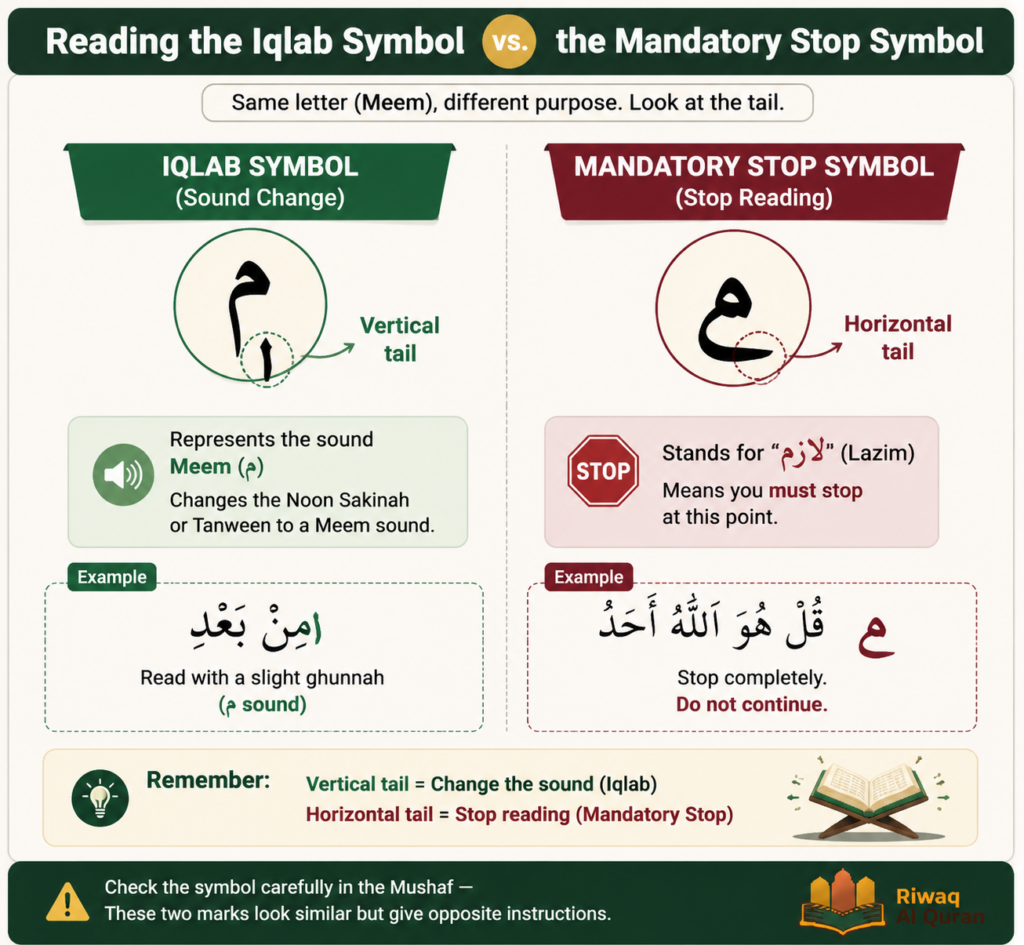
2. Reading the Iqlab Symbol vs. the Mandatory Stop Symbol
Both symbols use the same Arabic letter, Meem, which is where most reading confusion starts. In Iqlab, the small Meem represents the actual sound (م); in a Mandatory Stop, it is an abbreviation for “لازم” (mandatory), unrelated to pronunciation.
The visual difference is in the tail: the Iqlab Meem is drawn with a vertical tail, while the Mandatory Stop Meem has a horizontal tail. It’s a detail worth checking directly against a Mushaf, since the two marks are easy to mix up at a glance and lead to opposite reading decisions — one changes a sound, the other tells you to stop reading.
If reading Mushaf symbols correctly still feels uncertain, that’s typically the point where a live tutor session is worth more than another article — Riwaq Al Quran’s certified instructors review these marks directly on the page with each student until identifying them becomes automatic.
What is Ikhfa in Tajweed?
Ikhfa (الإخفاء) means “hiding” or “concealing,” and it describes the middle ground between Izhar’s full clarity and Idgham’s full merge: the Noon Sakinah or Tanween sound is neither pronounced plainly nor fully absorbed into the next letter, but held as a ghunnah for two counts while the tongue prepares for the next sound.
Ikhfa applies whenever Noon Sakinah or Tanween is followed by one of fifteen letters — every Arabic letter not already assigned to Izhar, Idgham, or Iqlab:
ت – ث – ج – د – ذ – ز – س – ش – ص – ض – ط – ظ – ف – ق – ك
These fifteen letters sit at articulation points close enough to Noon that forcing full separation (Izhar) would feel unnatural, but not close enough to justify a full merge (Idgham) — which is exactly why the sound is held in between, as a ghunnah, rather than resolved either way.
1. Ikhfa Haqiqi (الإخفاء الحقيقي)
Ikhfa Haqiqi is “real” or “clear” Ikhfa — it applies to Noon Sakinah and Tanween specifically, and its ghunnah is the more pronounced of the two Ikhfa types.
An everyday example:
“طفلٌ صغير” — the ص after the Tanween in “طفلٌ” hides the noon sound while the ghunnah is kept.
A Quranic example:
“إِن تَسْتَفْتِحُوا۟ فَقَدْ جَآءَكُمُ ٱلْفَتْحُ ۖ وَإِن تَنتَهُوا۟ فَهُوَ خَيْرٌ لَّكُمْ”
“If you sought the decisive victory, then victory has already come to you. But if you desist, it is better for you” (Surah Al-Anfal, 8:19).
The Tanween on “خَيْرٌ” is concealed before the ل of “لَّكُمْ,” held as a hum rather than pronounced clearly or merged.
2. Ikhfa Shafawi (الإخفاء الشفوي)
Ikhfa Shafawi is the Meem Sakinah counterpart: it applies only when Meem Sakinah is followed by ب, and it conceals part of the Meem’s sound while keeping a lighter ghunnah than Ikhfa Haqiqi. It only ever occurs across two words, never within one.
An everyday example:
“هم بارون” — the ب after the Meem Sakinah in “هم” hides part of the meem sound.
A Quranic example:
“تَرْمِيهِم بِحِجَارَةٍ مِّن سِجِّيلٍ”
“Pelting them with stones of baked clay.” (Surah Al-Fil, 105:4).
The ب of “بِحِجَارَةٍ” partially conceals the final meem of “تَرْمِيهِم,” while the ghunnah is kept.
Ikhfa Haqiqi and Ikhfa Shafawi both retain a ghunnah, but the ghunnah in Ikhfa Haqiqi is noticeably clearer than the lighter one in Ikhfa Shafawi — a distinction that’s easy to read about and genuinely difficult to produce correctly without hearing it modeled by a tutor first.
The Next Letter Check as a Quick Way to Identify Which Rule Applies
This section answers: how do you quickly work out whether Izhar, Idgham, Iqlab, or Ikhfa applies to a given Noon Sakinah or Tanween?
All four rules are determined by exactly one thing: the letter that comes immediately after the Noon Sakinah, Tanween, or Meem Sakinah. Once that’s isolated, the decision is a lookup, not a judgment call.
- Is the next letter ب? Apply Iqlab — convert the sound to a Meem with ghunnah.
- Is the next letter one of the six throat letters (ء هـ ع ح غ خ)? Apply Izhar — pronounce clearly, no ghunnah.
- Is the next letter one of the six Yarmaloon letters (ي ر م ل و ن)? Apply Idgham — merge fully, with ghunnah for ي ن م و, without ghunnah for ل ر.
- Is the next letter one of the remaining fifteen letters? Apply Ikhfa — hold the sound as a two-count ghunnah, neither clear nor merged.
The only two exceptions to run this check against afterward are Izhar Mutlaq (the four fixed words where Idgham is blocked) and Izhar Riwaya (the two Hafs-specific words) — both covered above, and both narrow enough to simply memorize rather than reason through each time.
Common Mistakes When Pronouncing Izhar, Idgham, Iqlab, and Ikhfa
Here are the specific pronunciation errors reciters make with each of the four rules:
- Izhar: the most frequent error is adding a faint ghunnah out of habit, or pausing briefly on the Noon before the throat letter. Izhar should be crisp and immediate — pronounce the “n” and move on, with no lingering hum.
- Idgham with Ghunnah: reciters often cut the two-count hum short, especially when merging into و or م, which flattens the melodic quality the rule is meant to produce.
- Idgham without Ghunnah: the opposite mistake shows up here — a slight nasal trace creeps in, particularly before ل, when the rule calls for a complete, dry merge with no ghunnah at all.
- Iqlab: the most common error is pressing the lips together too firmly, producing a hard “m” instead of the light touch the rule requires. The lips should meet gently while the ghunnah carries the sound, not clamp shut.
- Ikhfa Haqiqi: many reciters either pronounce the Noon too clearly (drifting toward Izhar) or merge it too fully (drifting toward Idgham), instead of holding it in the true middle position the rule describes.
- Ikhfa Shafawi: because the ghunnah here is naturally lighter than in Ikhfa Haqiqi, students frequently either skip it entirely or overcorrect and apply the heavier Ikhfa Haqiqi hum instead — the two are not interchangeable.

Making these mistakes while learning is not treated in Islamic teaching as a failure to take lightly, but it is also not held against the learner the way it might feel. The Prophet ﷺ said:
“الْمَاهِرُ بِالْقُرْآنِ مَعَ السَّفَرَةِ الْكِرَامِ الْبَرَرَةِ، وَالَّذِي يَقْرَأُ الْقُرْآنَ وَيَتَتَعْتَعُ فِيهِ وَهُوَ عَلَيْهِ شَاقٌّ لَهُ أَجْرَانِ”
“The one who is skilled in the Qur’an is with the noble, righteous scribes, and the one who reads the Qur’an and stumbles over it, finding it difficult, will have a double reward” (narrated by Aisha, Sahih Muslim 798a, also collected in Sahih al-Bukhari 4993).
— Struggling through Ikhfa or Iqlab while learning is, by this hadith, still counted — not a reason to stop practicing.
None of these corrections are things a reader can reliably self-diagnose from text alone; they’re audible errors, which is precisely why Tajweed is traditionally taught with direct correction from a tutor rather than from a book on its own.
This is the exact gap Riwaq Al Quran’s live Tajweed sessions are built to close — an instructor listens to each of these six patterns in real time and flags the drift before it becomes a habit.
Here’s a quick breakdown of these same mistakes in practice:
Difference Between Ikhfa Idgham Izhar Iqlab
Placed side by side, the four rules make it easier to see exactly where each one starts, stops, and overlaps with the others.
| Izhar | Idgham | Iqlab | Ikhfa | |
|---|---|---|---|---|
| Meaning | To make clear | To merge | To convert | To hide |
| Effect on the sound | Pronounced clearly, no ghunnah | Fully merged into the next letter | Converted to a Meem sound | Held as a ghunnah, neither clear nor merged |
| Trigger letters | ء هـ ع ح غ خ (6 throat letters) | ي ر م ل و ن (6 letters, Yarmaloon) | ب (1 letter only) | 15 remaining letters |
| Ghunnah? | No | Yes (ي ن م و) / No (ل ر) | Yes, light | Yes, 2 counts |
| Subtypes | Halqi, Shafawi, Mutlaq, Riwaya | With Ghunnah, Without Ghunnah | One word, two words, Tanween | Haqiqi, Shafawi |
| Applies to Meem Sakinah? | Yes (Izhar Shafawi) | No | No | Yes (Ikhfa Shafawi) |
| Mushaf symbol | None | None | Small م above the Noon/Tanween | None |
Perfect These Rules with a Certified Tajweed Tutor
Reading about Izhar, Idgham, Iqlab, and Ikhfa builds the theory; correcting how they actually sound in your own recitation takes a trained ear listening back to you.
Riwaq Al Quran is an online platform offering personalized Quran, Arabic, and Islamic Studies classes for learners of every age and background. Instructors work from a structured curriculum covering Tajweed, Tafsir, and memorization, delivered through live, two-way sessions rather than pre-recorded material — which is exactly the format the corrections in this article require.
Beyond Tajweed specifically, the same platform runs Quran classes for kids and adults, Arabic language courses, Ijazah certification tracks, and Islamic Studies courses, alongside a dedicated curriculum for kids that starts from the basics.


A few of the specific courses most relevant to what’s covered in this article:
| Course | What it covers |
|---|---|
| Online Tajweed Classes | Master Izhar, Idgham, Iqlab, Ikhfa, and the rest of the Tajweed rules for accurate, beautiful recitation. |
| Online Quran Recitation Course | Build recitation skills more broadly, with an instructor correcting pronunciation in real time. |
| Quran Memorization Online Course | Memorize the Qur’an with a specialized, structured memorization program. |
| Online Tafseer Course | Go deeper into the meaning behind the verses cited throughout this guide. |
| Noorani Qaida Online | Learn the letter-recognition basics that these four rules build on, if you’re starting from zero. |
| Online Qirat Course | Explore how rules like Izhar Riwaya shift across the Ten Qira’at in more depth. |
| Online Quran Classes for Kids | Introduce these same rules to children through an interactive, age-appropriate curriculum. |
Riwaq Al Quran’s certified tutors review these four rules verse by verse, catch the exact drift described above — a rushed ghunnah, an over-pressed Iqlab, a too-clear Ikhfa — and correct it before it sets as habit.

Conclusion
Izhar, Idgham, Iqlab, and Ikhfa all answer the same question — what happens to the Noon Sakinah, Tanween, or Meem Sakinah sound when it meets the next letter — and the answer is always decided by that next letter alone, never by guesswork.
- Izhar keeps the sound clear before the six throat letters, with narrower exceptions in Izhar Mutlaq and Izhar Riwaya.
- Idgham merges it fully into six letters collected in “Yarmaloon,” with or without ghunnah depending on which of the six is involved.
- Iqlab converts it into a Meem sound before ب alone, marked in the Mushaf with a small vertical-tailed meem easily confused with the horizontal-tailed Mandatory Stop symbol.
- Ikhfa holds it as a two-count hum before the remaining fifteen letters, in two forms — Haqiqi for Noon Sakinah and Tanween, Shafawi for Meem Sakinah.
The rules themselves are a short lookup once the next letter is identified. What actually takes practice is producing the sound correctly — timing the ghunnah, softening the Iqlab lips, holding Ikhfa in its true middle position — and that part is heard, not read. That is why Izhar, Idgham, Iqlab, and Ikhfa are traditionally corrected by a tutor rather than mastered from a page alone, and why the command to recite “with tarteel” was given as something to be practiced, verse by verse, not memorized once and left alone.
Frequently Asked Questions
The six questions below are the ones learners ask most often once they’ve gone through Izhar, Idgham, Iqlab, and Ikhfa — quick, direct answers to each.
What is the main difference between Ikhfa and Idgham?
Idgham fully merges the Noon Sakinah or Tanween sound into the next letter, so no trace of the Noon remains; Ikhfa only partially hides the sound, holding it as a two-count ghunnah before the next letter is pronounced. Idgham applies to six letters (ي ر م ل و ن); Ikhfa applies to fifteen.
How many Ikhfa letters are there in Tajweed?
There are fifteen Ikhfa letters: ت ث ج د ذ ز س ش ص ض ط ظ ف ق ك. They cover every Arabic letter not already assigned to Izhar’s six throat letters, Idgham’s six Yarmaloon letters, or Iqlab’s single letter, ب.
Why does Iqlab only apply to one letter?
Iqlab applies only to ب because converting Noon directly to Baa’s lip articulation is physically awkward; Meem solves this since it shares Baa’s lip articulation while keeping Noon’s nasal quality. No other letter creates that specific mismatch, so no other letter triggers Iqlab.
What is Ghunnah and how long should it last?
Ghunnah is the nasal hum produced through the nose rather than the mouth, and in Idgham with Ghunnah, Iqlab, and Ikhfa it is held for approximately two harakat, roughly the time it takes to pronounce two short vowels in sequence.
Does Izhar apply to Meem Sakinah as well as Noon Sakinah?
Yes. Izhar Shafawi is the Meem Sakinah version of Izhar: whenever Meem Sakinah is followed by any letter except ب or م, it is pronounced clearly with no ghunnah, the same principle as Izhar Halqi applied to a different letter.
What is the difference between Ikhfa Haqiqi and Ikhfa Shafawi?
Ikhfa Haqiqi applies to Noon Sakinah and Tanween before any of the fifteen Ikhfa letters, with a clearer ghunnah. Ikhfa Shafawi applies only to Meem Sakinah before ب, across two words, and carries a noticeably lighter ghunnah than Ikhfa Haqiqi.
Is it sinful to mispronounce these rules while learning?
No. Getting Izhar, Idgham, Iqlab, or Ikhfa wrong while you are still learning is not treated as a fault to be punished. The Prophet ﷺ said the one who reads the Qur’an and struggles with it, finding it difficult, earns a double reward (Sahih Muslim 798a) — the effort itself is credited, which is why continued practice with correction matters more than getting every rule right immediately.