Every time you encounter Meem Sakinah in the Quran, one of three Tajweed rulings applies — and choosing the wrong one is a recitation error, even if it sounds nearly correct to the ear. Of the three, Izhar Shafawi is by far the most common, covering 26 of the 28 Arabic letters. Yet it is also the ruling where subtle mistakes — particularly adding an unwanted Ghunnah or blurring the Meem before Waw and Faa — go unnoticed for years without a qualified teacher listening.
This article breaks down Izhar Shafawi completely: its definition, the full list of all 26 triggering letters, its three governing pronunciation rules, verified Quranic examples with full Arabic tashkeel across both one-word and two-word contexts, a side-by-side comparison with the other two Meem Sakinah rulings, and the most common mistakes students make — so you can identify and correct them before they become embedded habits.
What You’ll Learn in This Article:
- The precise definition of Izhar Shafawi and the phonological reason it is called “Shafawi”.
- The complete list of all 26 letters that trigger this ruling.
- The three rules that govern how Meem Sakinah is pronounced in Izhar Shafawi.
- Quranic examples with full Arabic text, diacritical marks, and Surah references — in one word and across two words.
- How Izhar Shafawi differs from Ikhfaa Shafawi and Idgham Shafawi.
- The four most common recitation mistakes with this ruling — and how to fix each one.
Before diving into the rules, this short clip from Riwaq Al Quran explains exactly why Tajweed matters — and why reciting the Quran correctly is not optional:
Table of Contents
The Quranic and Prophetic Mandate for Precise Recitation
Tajweed is not a scholarly invention. Its authority derives directly from the Quran and the authenticated Sunnah — which means every Tajweed rule, including Izhar Shafawi, carries a divine mandate behind it. Three key texts establish that mandate.
1. The Command to Recite with Measured Deliberateness
Allah says:
“وَرَتِّلِ الْقُرْآنَ تَرْتِيلًا”
“And recite the Quran with measured recitation.”— Al-Muzzammil, 73:4
The word “Tarteel” (تَرْتِيل) is the Quranic term from which the science of Tajweed derives its theological legitimacy. Ibn Kathir records in his Tafsir that Ali ibn Abi Talib (رضي الله عنه) defined Tarteel as: “proper Tajweed of the letters and knowledge of the stopping places.” This verse is a direct divine command — not a scholarly recommendation — to give every letter its full, correct articulation.
Izhar Shafawi is one precise expression of that command: when Meem Sakinah meets any of the 26 triggering letters, the obligation of Tarteel requires that the lips press fully together, the Meem sounds completely, and the transition to the next letter happens cleanly, without rush or blur.
2. The Prophetic Reward for Those Who Recite Properly — and Those Who Struggle
The Prophet Muhammad ﷺ said:
“الْمَاهِرُ بِالْقُرْآنِ مَعَ السَّفَرَةِ الْكِرَامِ الْبَرَرَةِ، وَالَّذِي يَقْرَأُ الْقُرْآنَ وَيَتَتَعْتَعُ فِيهِ وَهُوَ عَلَيْهِ شَاقٌّ لَهُ أَجْرَانِ”
“The proficient reciter of the Quran will be with the noble, righteous scribes (angels). And the one who recites the Quran haltingly and with difficulty — finding it hard — will have two rewards.”— Narrated by Aisha (رضي الله عنها) | Sahih Muslim, 798 | Also in Sahih al-Bukhari, 4937
This hadith divides Quran reciters into two groups — and honors both. The proficient reciter, who has mastered the rulings (including the Meem Sakinah rulings covered in this article), is ranked with the noble angels who carry the Revelation. The struggling student — the one who finds Meem before Waw and Faa difficult, or who is still calibrating the two-count duration — earns a double reward: one for the recitation, and one for the effort.
The hadith removes the false choice between “recite correctly or not at all.” It encourages precision and effort simultaneously, which is exactly the mindset required for serious Tajweed study.
3. The Standard Allah Expects of Those Given the Book
Allah also says:
“الَّذِينَ آتَيْنَاهُمُ الْكِتَابَ يَتْلُونَهُ حَقَّ تِلَاوَتِهِ”
“Those to whom We have given the Book recite it with its true recitation.”— Al-Baqarah, 2:121
The phrase “Haqqa tilawatihi” (حَقَّ تِلَاوَتِهِ) — its true, full, due recitation — is the Quranic benchmark that Tajweed scholars cite as the scriptural foundation of their discipline.
To recite the Quran with its true recitation means giving it back as it was revealed: with every letter from its correct Makhraj, and every ruling — including Izhar Shafawi — applied faithfully. This verse sets the bar. Tajweed is the methodology for reaching it.
What Is Izhar Shafawi in Tajweed?
Izhar Shafawi is one of three Tajweed rulings that govern how Meem Sakinah (مْ) is recited, each triggered by a different following letter. Understanding Izhar Shafawi starts with understanding Meem Sakinah itself and the phonological logic that gave this ruling its name.
a. The Definition of Izhar Shafawi
Izhar Shafawi is the Tajweed rule that requires Meem Sakinah to be pronounced clearly and distinctly — without any nasalization — whenever it is followed by any Arabic letter except Baa (ب) or Meem (م).
The term “Izhar” (إظهار) means clearness or distinctness in Arabic, referring to the unobstructed, fully voiced articulation of the Meem sound. Meem Sakinah is a Meem (م) carrying a Sukoon (ْ), or appearing at the end of a word with no vowel, and it can occur in the middle or at the end of any Arabic word.
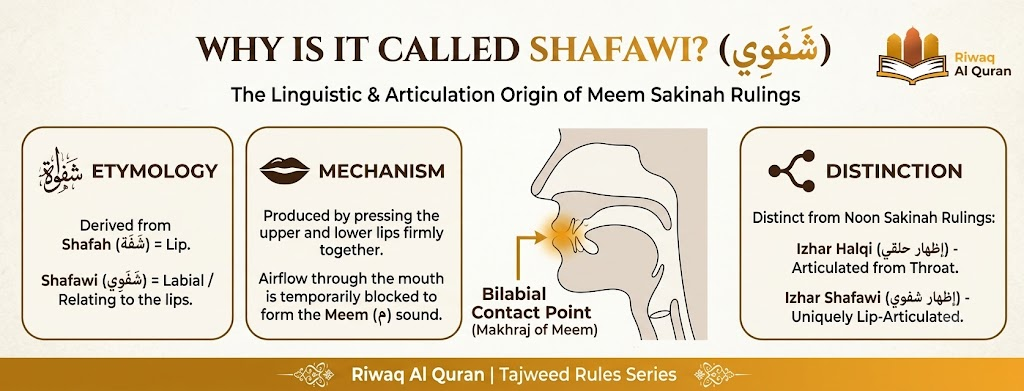
b. Why Is It Called Shafawi?
The word “Shafawi” (شَفَوِي) derives from the Arabic root “Shafah” (شَفَة), meaning “lip.” The ruling is called Shafawi because Meem is a bilabial consonant — articulated entirely by the two lips pressing firmly together.
This designation also separates the Meem Sakinah rulings from the Izhar Halqi and Izhar Mutlaq rulings that govern Noon Sakinah and Tanween, which involve the throat and nasal passage rather than the lips.
The Letters of Izhar Shafawi
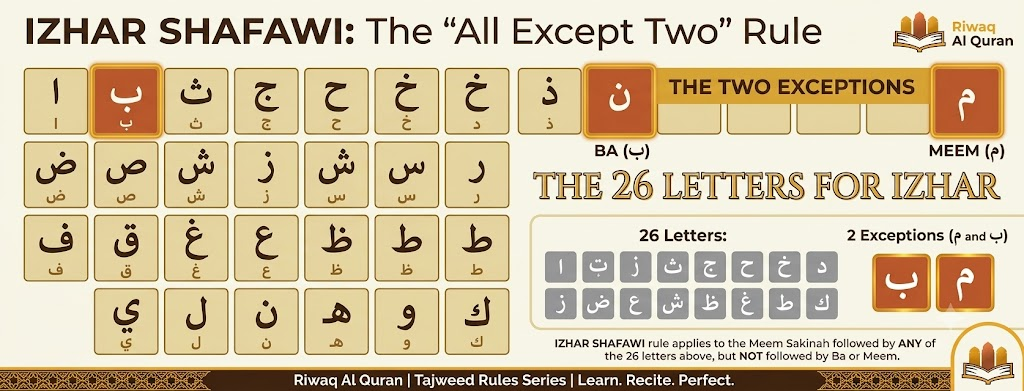
Every Arabic letter except Baa (ب) and Meem (م) triggers Izhar Shafawi when it follows Meem Sakinah. Baa is excluded because it triggers Ikhfaa Shafawi; Meem is excluded because it triggers Idgham Shafawi.
The remaining 26 letters all require the same response: clear, voiced pronunciation of Meem Sakinah with no Ghunnah.
a. The Full List of All 26 Izhar Shafawi Letters
The 26 letters that trigger Izhar Shafawi are:
ا ، ت ، ث ، ج ، ح ، خ ، د ، ذ ، ر ، ز ، س ، ش ، ص ، ض ، ط ، ظ ، ع ، غ ، ف ، ق ، ك ، ل ، ن ، ه ، و ، ي
This is the complete Arabic alphabet of 28 letters minus ب and م. When Meem Sakinah is followed by any one of these — whether inside the same word or at the start of the next — the reciter must:
- Press both lips together firmly.
- Voice the Meem fully for two Harakat.
- Release into the following letter with no nasalization whatsoever.
b. Where Izhar Shafawi Occurs in the Quran
Because 26 of 28 Arabic letters trigger it, Izhar Shafawi is by far the most frequently occurring Meem Sakinah ruling in the Quran — appearing hundreds of times across the Mushaf. It occurs in two positions:
- Within a single word: Meem Sakinah sits inside a word and the immediately following letter is one of the 26.
- Across two words: A word ends with Meem Sakinah and the next word begins with one of those 26 letters.
Students who are working through the Quran for the first time benefit from marking Meem Sakinah positions in a dedicated color during their study sessions — a technique used in structured online Tajweed classes to train the eye to spot the ruling before the tongue produces it.
The Three Rules of Izhar Shafawi
Identifying the correct ruling is only the first step. Three specific pronunciation rules govern how Meem Sakinah is actually recited in Izhar Shafawi positions. Missing any one of them produces a recitation error even when the ruling itself is correctly identified.
Rule 1 – How Meem Sakinah Is Pronounced
In Izhar Shafawi, both lips are pressed firmly together for the duration of two counts — two Harakat, where one Haraka is measured as one finger tap at a steady, moderate pace — before releasing into the following letter. The Meem sound must be fully formed and clearly audible: neither cut short nor extended beyond its count.
“وَٱلْأَنْعَـٰمَ خَلَقَهَا ۗ لَكُمْ فِيهَا دِفْءٌ وَمَنَـٰفِعُ وَمِنْهَا تَأْكُلُونَ”
“And the grazing livestock He has created for you; in them is warmth and [numerous] benefits, and from them you eat.”— An-Nahl, 16:5
In “لَكُمْ فِيهَا”, the Meem Sakinah at the end of “لَكُمْ” is followed by Faa (ف) at the start of “فِيهَا”. This is one of the highest-risk Izhar positions precisely because Faa is labio-dental — involving the lower lip — which sits adjacent to the Meem’s bilabial articulation point. The verse is a practical test of Rule 1 and Rule 3 together: the Meem must be held for its full two counts with complete lip contact before the lips release into Faa.
Rule 2 – No Ghunnah in Izhar Shafawi
Producing a Ghunnah — the nasal resonance of approximately two counts produced through the nose — is explicitly forbidden in Izhar Shafawi. The Meem sound exits entirely through the mouth, via the two lips. Ghunnah belongs to Ikhfaa Shafawi and Idgham Shafawi; in Izhar Shafawi, its presence is a recitation mistake regardless of how subtle it is.
“وَهُمْ صَـٰغِرُونَ”“…while they are humbled.”
In “هُمْ صَـٰغِرُونَ”, Meem Sakinah is followed by Sad (ص) — a letter with no proximity to the lips or nasal passage. There is zero phonological reason to add Ghunnah here, yet students who have internalized Ghunnah as a default response to Meem Sakinah will often add it automatically.
This verse is a clean test case: if you hear any nasal resonance after the Meem, the Ghunnah has leaked in where it does not belong.
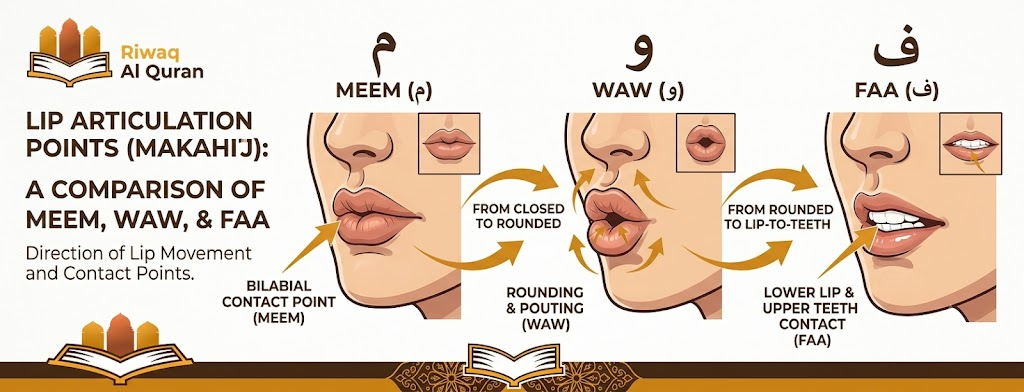
Rule 3: Extra Clarity Before Waw (و) and Faa (ف)
When Meem Sakinah is followed specifically by Waw (و) or Faa (ف), an extra degree of deliberate articulation is required. Meem is bilabial (both lips press together), Waw is labio-velar (lips rounded outward), and Faa is labio-dental (lower lip meets upper teeth). Because all three involve the lips or lower lip, their articulation points sit close together.
Without conscious effort, the Meem Sakinah can blur into the following Waw or Faa before it is fully voiced. Tajweed scholars identify this as the highest-risk Izhar Shafawi position for students and advanced reciters alike.
“أَمْوَٰتٌ غَيْرُ أَحْيَآءٍ”
“…dead, not alive…”— An-Nahl, 16:21
In “أَمْوَٰتٌ”, the Meem Sakinah inside the word precedes Waw (و). The lips close for the Meem, then immediately round outward for the Waw — two adjacent movements that feel nearly simultaneous.
There is weight in reading this correctly: a blurred Meem before Waw produces a sound that is itself indistinct — an ironic failure in a verse about things that lack definition and clarity.
“وَيَتَوَلَّوا۟ وَّهُمْ فَرِحُونَ”
“…and they turn away rejoicing.”— At-Tawbah, 9:50
In “هُمْ فَرِحُونَ”, Meem Sakinah in “هُمْ” precedes Faa (ف). The Tajweed instruction here is precise: the Meem must be complete before the Faa begins. In practice, slow the recitation at this juncture, feel the full lip contact of the Meem, and consciously separate it from the lower-lip movement of the Faa.
The Prophet Muhammad ﷺ also said:
“زَيِّنُوا الْقُرْآنَ بِأَصْوَاتِكُمْ”
“Adorn the Quran with your voices.”— Sunan Abi Dawud, 1468 | Also in Sunan Ibn Majah, 1342
Tajweed scholars interpret this hadith as a command to recite with clarity, beauty, and proper articulation. A Meem Sakinah that is clearly voiced before Waw and Faa, held for its full two-count duration, and free of unwanted Ghunnah, is a Meem Sakinah that adorns the verse rather than muddying it. The hadith is not about vocal beauty alone; it is about the discipline of giving each sound its full, correct form.
Quranic Examples of Izhar Shafawi
The examples below cover both categories — Meem Sakinah within a single word, and Meem Sakinah across two words — with the relevant triggering letter identified and a translation provided in each case.
For a broader look at all four types of Izhar in Tajweed, see the full guide on Izhar: Types, Letters, Rules, and Examples.
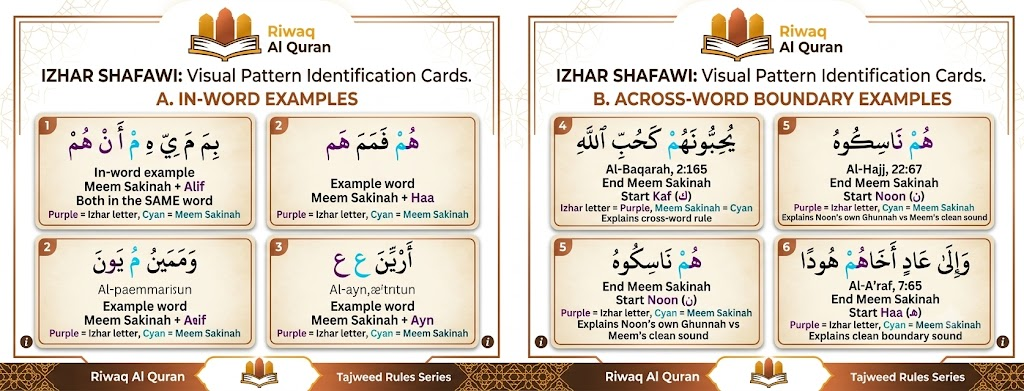
A. Examples of Izhar Shafawi in One Word
“وَلَا تَحْزَنْ عَلَيْهِمْ وَلَا تَكُن فِى ضَيْقٍ مِّمَّا يَمْكُرُونَ”
“And do not grieve over them, and do not be in distress over what they conspire.”— An-Naml, 27:70
In “يَمْكُرُونَ”, Meem Sakinah (مْ) is followed by Kaf (ك) within the same word. The verse is addressed to the Prophet ﷺ as a divine consolation — reading it with a grounded, clear Meem before the Kaf mirrors the steadiness of that assurance.
“فَلْيُمْلِلْ وَلِيُّهُ”
“…then let his guardian dictate…”— Al-Baqarah, 2:282
In “يُمْلِلْ”, Meem Sakinah (مْ) is followed by Lam (ل) within the same word. The Meem must be fully sounded before the Lam begins.
“وَمَن يَكْتُمْهَا فَإِنَّهُۥٓ ءَاثِمٌ قَلْبُهُ”
“And whoever conceals testimony — his heart is indeed sinful.”— Al-Baqarah, 2:283
In “يَكْتُمْهَا”, Meem Sakinah (مْ) is followed by Haa (هـ) within the same word. The clear Meem before Haa gives the word its full phonological integrity.
In all three, the following letter is neither Baa nor Meem — Izhar Shafawi applies and the Meem is voiced without nasalization.
B. Examples of Izhar Shafawi in Two Words
“يُحِبُّونَهُمْ كَحُبِّ ٱللَّهِ”
“…loving them as they [should] love Allah…”— Al-Baqarah, 2:165
“يُحِبُّونَهُمْ” ends with Meem Sakinah; “كَحُبِّ” begins with Kaf (ك) — Izhar Shafawi applies across the word boundary.
“هُمْ نَاسِكُوهُ”
“…they are to perform it…”— Al-Hajj, 22:67
“هُمْ” ends with Meem Sakinah; “نَاسِكُوهُ” begins with Noon (ن). Note: Noon is itself a Ghunnah letter, but that Ghunnah belongs to the Noon alone — the Meem Sakinah before it carries none.
“وَإِلَىٰ عَادٍ أَخَاهُمْ هُودًا”
“And to ‘Aad [We sent] their brother Hud.”— Al-A’raf, 7:65
“أَخَاهُمْ” ends with Meem Sakinah; “هُودًا” begins with Haa (هـ) — the Meem sounds cleanly at the boundary with no merging and no nasal resonance.
Izhar Shafawi vs. Ikhfaa Shafawi vs. Idgham Shafawi
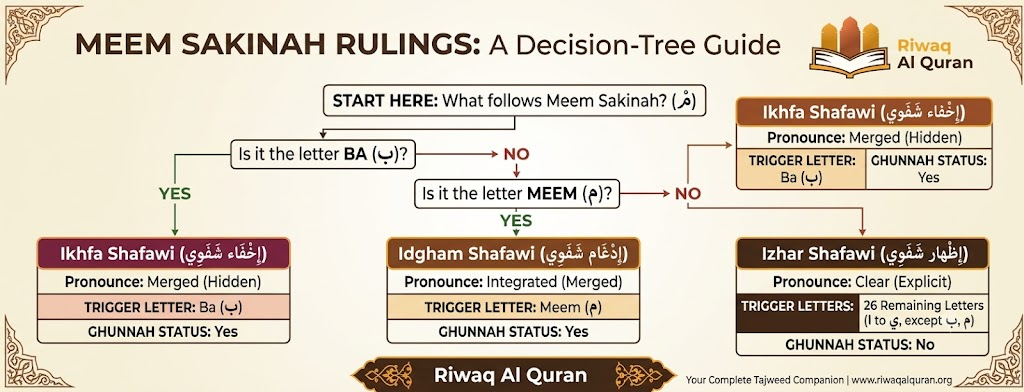
All three Meem Sakinah rulings share the same starting condition: Meem Sakinah in the middle or end of a word. The sole differentiator is the letter that immediately follows it. The table below maps each ruling, its trigger, its pronunciation requirement, and whether Ghunnah applies.
| Ruling | Arabic Term | Trigger Letter | Pronunciation | Ghunnah |
|---|---|---|---|---|
| Izhar Shafawi | إظهار شفوي | Any letter except ب and م — 26 letters total | Meem voiced fully and clearly; both lips press together then release | None |
| Ikhfaa Shafawi | إخفاء شفوي | Baa (ب) only | Meem partially concealed; lips held slightly apart, not fully closed | Yes — 2 counts |
| Idgham Shafawi | إدغام شفوي | Meem (م) only | Meem merges completely into the following Meem; one extended Meem sound | Yes — 2 counts |
A practical three-step check for every Meem Sakinah position: Look at the letter that immediately follows the Meem Sakinah:
- If it is Baa (ب) → Ikhfaa Shafawi.
- If it is Meem (م) → Idgham Shafawi.
- If it is any other letter → Izhar Shafawi.
Applying this check consistently removes the hesitation that causes most Meem Sakinah errors during recitation.
Common Mistakes Students Make with Izhar Shafawi
Even after correctly identifying the Izhar Shafawi ruling, four pronunciation errors appear consistently in practice. Each one has a direct fix:
- Adding Ghunnah in an Izhar Shafawi position. Students who have recently learned Ikhfaa Shafawi or Idgham Shafawi often carry the Ghunnah habit into Izhar positions, because Ghunnah becomes a default response to Meem Sakinah in general. When the letter following Meem Sakinah is not Baa or Meem, consciously route the Meem sound through the mouth and lips only — no nasal resonance.
- Blurring Meem into Waw or Faa. Because Waw, Faa, and Meem all involve the lips or lower lip, students frequently let the Meem slide into the following letter before it is fully articulated. The fix: slow the recitation at those positions, exaggerate the lip contact for the Meem, and consciously separate it from the following letter. Practicing these positions in isolation — not inside a running recitation — is the most effective method.
- Confusing Izhar Shafawi with Idgham Shafawi at word boundaries. When a word ends in Meem Sakinah and the next word begins with Meem, the correct ruling is Idgham Shafawi — the two Meems merge into one with Ghunnah. Some students apply Izhar in this position and produce two separate Meem sounds instead of one merged sound. The three-step check above prevents this error entirely.
- Shortening the Meem below its two-count duration. When reciting at pace, students often cut the Meem Sakinah to less than its required two counts. This produces a rushed, underweight Meem that loses its distinctness. The Meem must be held for a full two-count beat before the next letter begins.
The Prophet ﷺ’s hadith on double reward (cited above) is directly relevant here: these errors are the exact points where a student “finds it hard.” Identifying them, naming them, and working through them in a live session with a qualified teacher is what converts difficulty into double reward — and eventually into proficiency.
These are the exact types of errors a qualified teacher catches in real time — something no article alone can replicate:
Start Learning Tajweed with a Certified Native Tutor Today
Tajweed rules like Izhar Shafawi are straightforward to understand — but correct pronunciation is only confirmed through the ear of a qualified teacher. You can read every rule and study every example, and still carry a subtle error that self-study alone cannot catch.
Riwaq Al Quran is a comprehensive online platform offering personalized Quran, Arabic, and Islamic Studies classes for individuals of all ages and backgrounds. Experienced native instructors use a structured curriculum covering Tajweed, Tafsir, and Memorization — with live sessions that allow seamless communication between students and teachers, from anywhere in the world.

Looking to go deeper? Here is a selection from the full Quran courses library:
- Online Tajweed Classes — Master every Tajweed rule, including all three Meem Sakinah rulings, in structured live sessions with certified tutors.
- Quran Memorization Online Course — Memorize with correct Tajweed built in from day one, so no errors become habits.
- Online Quran Recitation Course — Improve overall recitation accuracy through expert-guided practice at your own pace.
- Noorani Qaida Online — The ideal foundation course if you are starting from Quranic fundamentals.
- Online Tafseer Course — Go beyond recitation into the meaning and context of every verse you recite.
- Online Qirat Course — For advanced students exploring the ten established recitation traditions.
- Online Quran Classes for Kids — Interactive, age-appropriate sessions that make Tajweed engaging and enjoyable for young learners.

Conclusion
Izhar Shafawi is the Tajweed ruling that applies to Meem Sakinah whenever it is followed by any of the 26 Arabic letters that are not Baa or Meem. The pronunciation is clear and voiced — both lips pressed fully together, no Ghunnah, no nasalization. Special care is required before Waw (و) and Faa (ف) specifically, because their articulation points sit close to Meem’s, creating a real risk of sounds blurring without deliberate effort.
This ruling is not a technicality. It is a direct expression of the divine command in Al-Muzzammil 73:4 to recite the Quran with measured, precise articulation — and of the standard set in Al-Baqarah 2:121 to recite it with its true, full recitation. Mastering it means knowing all three Meem Sakinah rulings and the letter that triggers each: Baa for Ikhfaa Shafawi, Meem for Idgham Shafawi, and all remaining 26 letters for Izhar Shafawi.
Apply the three-letter check at every Meem Sakinah in the Quran, keep the Ghunnah out of Izhar positions, and give each Meem its full two-count articulation. These three habits, applied consistently, produce a technically correct recitation of this ruling throughout the Quran — and as the Prophet ﷺ confirmed in Sahih Muslim 798, every step of that effort carries its own reward.
Frequently Asked Questions About Izhar Shafawi
The following questions cover the most commonly searched points about Izhar Shafawi — its definition, letters, rules, and how it compares to the other Meem Sakinah rulings.
What is Izhar Shafawi?
Izhar Shafawi is a Tajweed rule that applies to Meem Sakinah: when Meem Sakinah is followed by any Arabic letter except Baa (ب) or Meem (م), it must be pronounced clearly and distinctly — both lips pressed fully together, no Ghunnah — before transitioning to the next letter. It is the most common of the three Meem Sakinah rulings, triggered by 26 of the 28 Arabic letters.
How many letters trigger Izhar Shafawi?
Izhar Shafawi is triggered by 26 Arabic letters — the full Arabic alphabet of 28 letters minus Baa (ب) and Meem (م). Baa triggers Ikhfaa Shafawi and Meem triggers Idgham Shafawi; all other 26 letters require Izhar Shafawi.
Is there a Ghunnah in Izhar Shafawi?
No. Ghunnah is forbidden in Izhar Shafawi. The Meem Sakinah is produced entirely through the lips with no nasal resonance. Adding Ghunnah in an Izhar Shafawi position is a Tajweed error, even when subtle.
What is the difference between Izhar Shafawi and Ikhfaa Shafawi?
Izhar Shafawi occurs when Meem Sakinah is followed by any of 26 letters (not Baa or Meem), and requires a clear, fully voiced Meem with no Ghunnah. Ikhfaa Shafawi occurs only when Meem Sakinah is followed by Baa (ب), and requires the Meem to be partially concealed — lips not fully closed — with a Ghunnah of two counts. The triggering letter is the sole difference between the two rulings.
Why does Izhar Shafawi require extra care before Waw and Faa specifically?
Meem (bilabial), Waw (labio-velar), and Faa (labio-dental) are all articulated using the lips or lower lip, placing their Makhraj close together. This proximity means the Meem Sakinah can blur into the following Waw or Faa before it is fully voiced. Tajweed scholars identify this as the highest-risk Izhar Shafawi position — the reciter must deliberately complete the Meem before beginning the Waw or Faa.
Can Izhar Shafawi occur within a single word?
Yes. Izhar Shafawi applies both within a single word — when Meem Sakinah appears inside a word followed by one of the 26 letters in that same word — and across two words, when a word ends with Meem Sakinah and the following word begins with one of those letters. The ruling and pronunciation requirement are identical in both positions.