Reciting a dua before reading the Quran is a small, deliberate pause that sets the intention for what follows — asking Allah for understanding, sincerity, and benefit before the first verse is even read. Different situations call for different duas: a short opening supplication for daily reading, and a longer, more detailed one for a deeper, more reflective session.
This guide gives you the main dua recommended before reading the Quran in Arabic, English, and transliteration, a shorter alternative for everyday use, a specific dua attributed to Imam Ja’far al-Sadiq from the Shia devotional tradition, and the broader preparation rituals — wudu, a quiet space, and focus — that go alongside it.
What You’ll Learn in This Article
- The main dua recommended before reading the Quran, in full Arabic, English, and transliteration.
- A shorter opening supplication suited to everyday, quick reading sessions.
- The specific dua attributed to Imam Ja’far al-Sadiq, and where it comes from.
- Why the Prophet ﷺ specifically warned against fast, unreflective recitation.
- The five preparation steps that go alongside the dua itself.
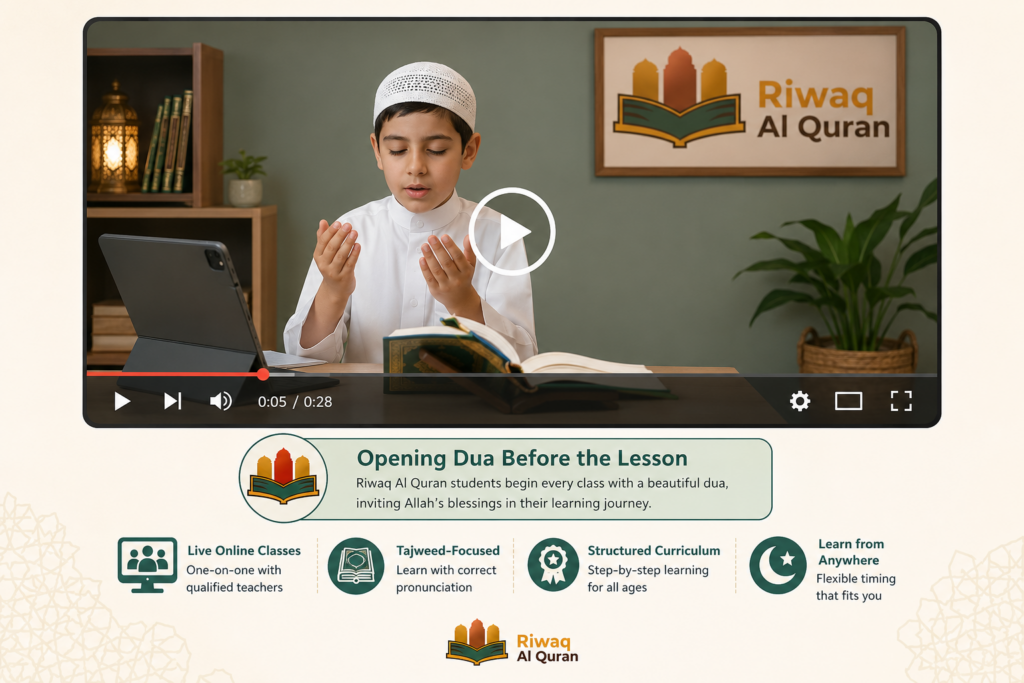
Table of Contents
The Recommended Supplication Before Reading the Quran
Every recitation session begins the same way any act of worship in Islam does — with Allah’s name, followed by a fuller dua asking for the specific benefits a sincere reading is meant to bring.
a. Start With Bismillah
Before anything else, say:
(بِسْمِ اللَّهِ الرَّحْمَٰنِ الرَّحِيمِ)
“In the name of Allah, the Most Gracious, the Most Merciful.” (Surah Al-Fatihah, Ayah 1)
This isn’t unique to reading the Quran specifically — it’s the same opening used before most acts of worship — but it’s the first thing said regardless of which dua follows it.
b. The Main Dua Before Reading the Quran
Beyond Bismillah, a fuller dua is commonly recommended before starting to recite, asking directly for the benefits a sincere reading is meant to bring:
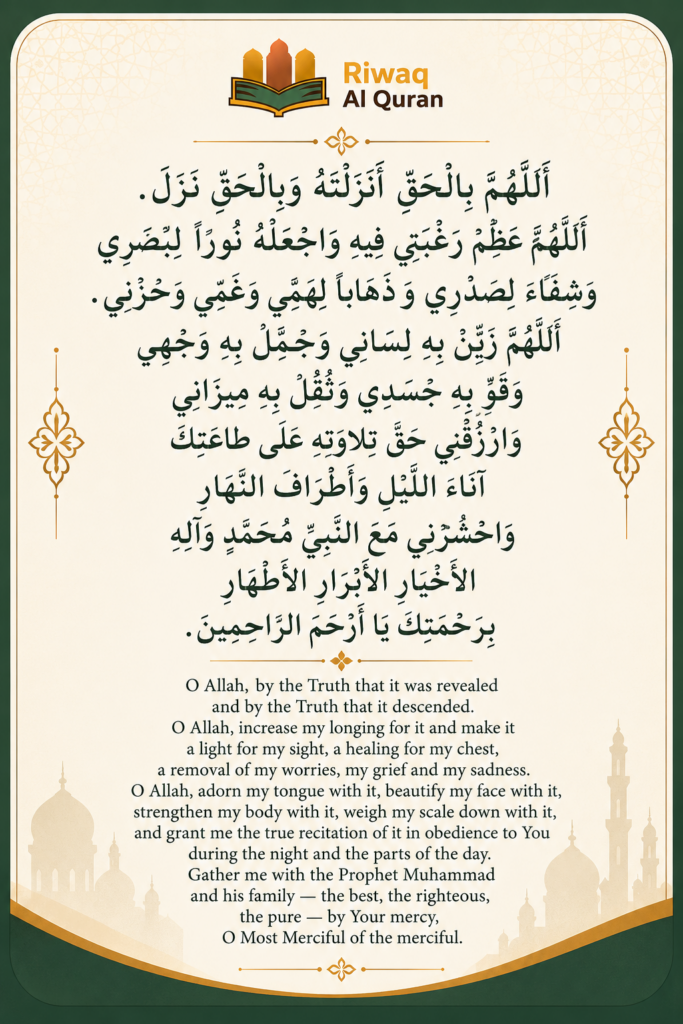
(أَللّهُمَّ بِالْحَقِّ أَنْزَلْتَهُ وَبِالْحَقِّ نَزَلَ. أَللّهُمَّ عَظِّمْ رَغْبَتِي فِيهِ وَاجْعَلْهُ نُوراً لِبَصَرِي وَشِفَاءً لِصَدْرِي وَذَهَاباً لِهَمِّي وَغَمِّي وَحُزْنِي. أَللّهُمَّ زَيِّنْ بِهِ لِسَانِي وَجَمِّلْ بِهِ وَجْهِي وَقَوِّ بِهِ جَسَدِي وَثَقِّلْ بِهِ مِيزَانِي وَارْزُقْنِي حَقَّ تِلَاوَتِهِ عَلَى طَاعَتِكَ آنَاءَ اللَّيْلِ وَأَطْرَافَ النَّهَارِ وَاحْشُرْنِي مَعَ النَّبِيِّ مُحَمَّدٍ وَآلِهِ الأَخْيَارِ الأَبْرَارِ الأَطْهَارِ بِرَحْمَتِكَ يَا أَرْحَمَ الرَّاحِمِينَ.)
- Translation: “O Allah, just as You have revealed it with the truth, make it a source of greatness for me, a light for my sight, a cure for my chest, and a relief from my worries, sadness, and grief. O Allah, beautify my tongue with it, adorn my face with it, strengthen my body with it, and make it heavy on my scale of good deeds. Grant me the true recitation of it, in obedience to You, throughout the night and the day, and gather me with the Prophet Muhammad and his righteous, pure family, through Your mercy, O Most Merciful of the merciful.”
- Transliteration: “Allahumma bilhaqqi anzaltahu wa bilhaqqi nazala. Allahumma azhim raghbati fihi waj’alhu nooran li basari wa shifaa’an li sadri wa dhahaban li hammi wa ghammi wa huzni. Allahumma zayyin bihi lisani wa jammil bihi wajhi wa quwwa bihi jasadi wa thaqqil bihi mizani warzuqni haqqa tilawatihi ala ta’atika ana’al layli wa atrafa an-nahari. Wahshurni ma’a an-nabiyyi Muhammadin wa alihi al-akhyari al-abrari al-at-hari bi-rahmatika ya arhamar rahimin.”
This dua asks for a specific chain of outcomes, not just a general blessing: the Quran’s light for the eyes, healing for the chest, relief from grief, and finally a heavier scale of good deeds — each phrase names a distinct benefit rather than repeating the same idea in different words.
A Shorter Opening Dua for Everyday Reading
For a quicker daily reading session, a shorter opening supplication is a common alternative to the fuller dua above — not a replacement, but a lighter option for moments when a longer dua isn’t practical:
(سُبْحَانَكَ اللَّهُمَّ وَبِحَمْدِكَ وَتَبَارَكَ اسْمُكَ وَتَعَالَى جَدُّكَ وَلَا إِلَٰهَ غَيْرُكَ)
“Glory be to You, O Allah, and praise be to You. Blessed is Your name, and exalted is Your majesty, and there is no god but You.”
This dua acknowledges Allah’s greatness directly before reciting, without the additional specific requests found in the longer dua — a genuinely useful option when you’re picking up the Quran for a short session rather than settling in for extended reading.
If you want to build a consistent daily reading habit rather than relying on memory for which dua fits which moment, Riwaq Al Quran’s online Quran classes work through recitation habits like these directly with a qualified instructor.
Here’s a look at what that kind of guided recitation practice actually looks like in a live class:
The Dua of Imam Ja’far al-Sadiq Before Reading the Quran
Beyond the two duas above, a specific supplication is recorded in the Shia devotional tradition as one Imam Ja’far al-Sadiq used to recite before beginning to read the Quran, preserved in collections like Mafatih al-Jinan:
(اللَّهُمَّ إِنِّي أَشْهَدُ أَنَّ هَذَا كِتَابُكَ الْمُنْزَلُ مِنْ عِنْدِكَ عَلَى رَسُولِكَ مُحَمَّدِ بْنِ عَبْدِ اللَّهِ صَلَّى اللَّهُ عَلَيْهِ وَآلِهِ، وَكِتَابُكَ النَّاطِقُ عَلَى لِسَانِ رَسُولِكَ، فِيهِ حُكْمُكَ وَشَرَائِعُ دِينِكَ، أَنْزَلْتَهُ عَلَى نَبِيِّكَ، وَجَعَلْتَهُ عَهْداً مِنْكَ إِلَى خَلْقِكَ وَحَبْلاً مُتَّصِلاً فِيمَا بَيْنَكَ وَبَيْنَ عِبَادِكَ.)
“O Allah, I bear witness that this is Your revealed Book, sent down from You to Your Messenger Muhammad ibn Abdullah, peace be upon him and his family — Your spoken word on the tongue of Your Messenger, containing Your judgment and the laws of Your religion. You revealed it to Your Prophet and made it a covenant from You to Your creation, a connected rope between You and Your servants.”
The dua continues with a specific request worth highlighting on its own: rather than asking only for reward, it asks Allah not to let the reading become “mere recitation” without reflection — a distinction between reading words and genuinely engaging with their meaning that runs through the entire supplication, and one that connects directly to a warning the Prophet ﷺ gave about recitation without reflection, covered later in this guide.
Understanding what a dua like this is actually asking for — not just memorizing the words — is exactly the kind of study Riwaq Al Quran’s online Tafseer course is built around, working through meaning verse by verse with a qualified instructor.
The Ritual Before Reading the Quran
Beyond the dua itself, several preparation steps are commonly practiced together to create the right conditions for engaging with the Quran seriously. Allah instructs believers to approach recitation with care, not haste:
(وَرَتِّلِ الْقُرْآنَ تَرْتِيلًا)
“And recite the Quran with measured, deliberate recitation.” (Surah Al-Muzzammil, 73:4)
This instruction to recite deliberately is the underlying principle behind each of the five steps below — none of them are about ritual for its own sake, they’re about creating the conditions for that same measured, attentive engagement.
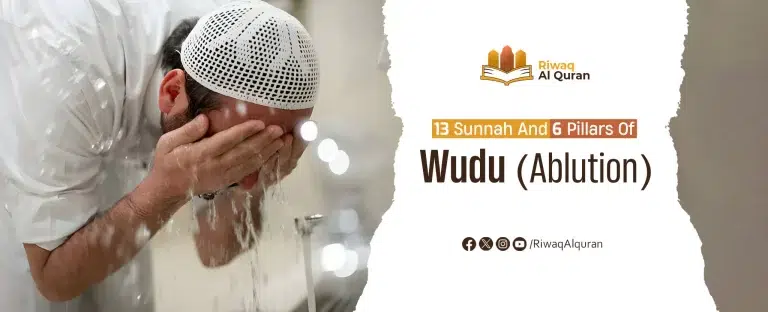
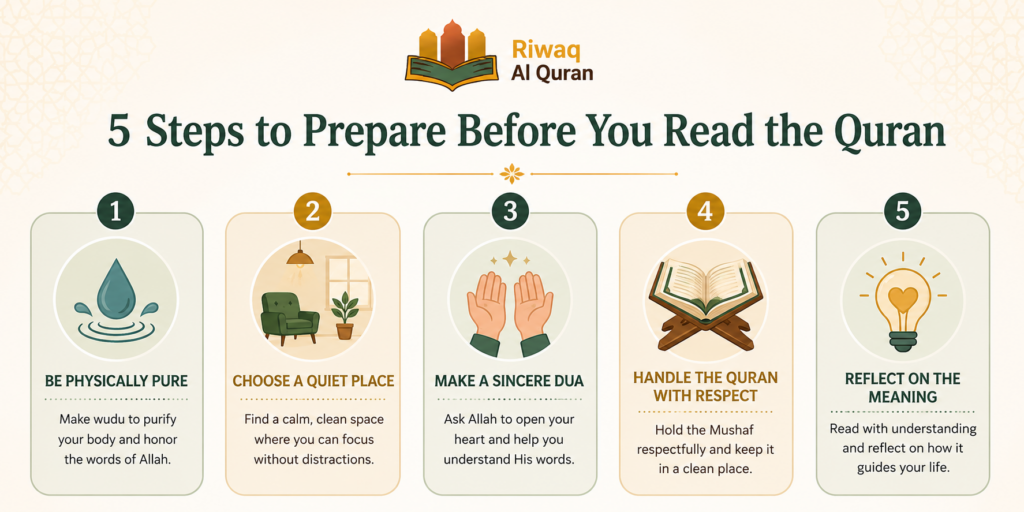
a. Perform Wudu
Washing the hands, face, and feet before reading is a common practice, treating the physical state of the reader as connected to the seriousness of the act. This isn’t just cultural habit — it has a direct basis in the Quran itself:
إِنَّهُ لَقُرْآنٌ كَرِيمٌ )( فِي كِتَابٍ مَّكْنُونٍ)( لَّا يَمَسُّهُ إِلَّا الْمُطَهَّرُونَ))
“Indeed, it is a noble Quran, in a Register well-protected; none touch it except the purified.” (Surah Al-Waqi’ah, 56:77-79) — read on Quran.com
This is reinforced by an authentic hadith the Prophet ﷺ wrote to the people of Yemen:
(لَا يَمَسُّ الْقُرْآنَ إِلَّا طَاهِرٌ)
“No one should touch the Quran except one who is pure.” (Narrated by An-Nasa’i, Ad-Daraqutni, and Al-Bayhaqi; Ibn Abdul Barr described its chain of transmission as mutawatir) — source
b. Find a Clean, Quiet Space
A distraction-free setting supports the same focus the dua itself is asking Allah to grant. Allah commands this attentiveness directly in the Quran:
(وَإِذَا قُرِئَ الْقُرْآنُ فَاسْتَمِعُوا لَهُ وَأَنصِتُوا لَعَلَّكُمْ تُرْحَمُونَ)
“So when the Quran is recited, then listen to it and pay attention that you may receive mercy.” (Surah Al-A’raf, 7:204) — read on Quran.com
c. Recite the Dua Itself
Whichever dua fits the moment — the fuller one, the shorter one, or the one attributed to Imam Ja’far al-Sadiq — this is the specific step this article covers in detail above. But before any of those duas, the Quran itself commands a specific first step that’s easy to overlook because it’s so short: seeking refuge in Allah from Satan.
(فَإِذَا قَرَأْتَ الْقُرْآنَ فَاسْتَعِذْ بِاللَّهِ مِنَ الشَّيْطَانِ الرَّجِيمِ)
“So when you recite the Quran, [first] seek refuge in Allah from Satan, the expelled [from His mercy].” (Surah An-Nahl, 16:98) — read on Quran.com
This is said by reciting “A’udhu billahi min ash-shaytan ir-rajim” (I seek refuge in Allah from Satan, the accursed). The majority of scholars hold that this isti’adhah is sunnah muakkadah — a strongly emphasized practice — before every recitation session, precisely because recitation is one of the greatest acts of worship, and it’s exactly the point at which distraction and doubt are most likely to creep in. — source: SeekersGuidance
d. Observe Proper Etiquette With the Physical Quran
- Avoid placing it on the ground.
- Hold it with visible respect.
- Avoid interruptions like phone calls during reading.
This etiquette isn’t a modern add-on — classical scholars established it as a point of consensus. Imam Nawawi stated that scholars agree unanimously on the obligation to respect the Quran, while Imam Al-Qurtubi ruled explicitly that nothing should be placed on top of the Mushaf and that it should not be set on the ground. — source: IslamQA
This respect extends beyond the physical book itself to the person carrying its meaning in their heart. The Prophet ﷺ tied honoring the Quran directly to honoring Allah:
(إِنَّ مِنْ إِجْلَالِ اللَّهِ إِكْرَامَ ذِي الشَّيْبَةِ الْمُسْلِمِ وَحَامِلِ الْقُرْآنِ غَيْرِ الْغَالِي فِيهِ وَالْجَافِي عَنْهُ)
“Glorifying Allah involves showing honor to a grey-haired Muslim and to the bearer of the Quran, who is neither extravagant regarding it, nor negligent of it, and to honor the just ruler.” (Sunan Abi Dawud 4843) — read on Sunnah.com
e. Approach the Text With a Reflective Mindset, Not Just Speed
This is the step the dua of Imam Ja’far al-Sadiq specifically warns against neglecting, and it has a direct basis in the companion Abdullah ibn Mas’ud’s own teaching:
(لَا تَنْثُرُوهُ نَثْرَ الدَّقَلِ، وَلَا تَهُذُّوهُ هَذَّ الشِّعْرِ، قِفُوا عِنْدَ عَجَائِبِهِ، وَحَرِّكُوا بِهِ الْقُلُوبَ، وَلَا يَكُنْ هَمُّ أَحَدِكُمْ آخِرَ السُّورَةِ)
“Do not scatter the recitation of the Quran like scattered dates, and do not race through it the way poetry is recited quickly. Pause at its wonders, and let it move your hearts, and let none of you make it your concern only to reach the end of the chapter.” (Recorded by Al-Baghawi, cited in Tafsir Ibn Kathir)
This is exactly the mindset the ritual steps above are meant to protect — reading quickly enough to finish a session isn’t the same as reading in a way that lets the words actually settle, which is the specific distinction Ibn Mas’ud is drawing here.
Allah Himself states the purpose of revelation in these terms:
(كِتَابٌ أَنزَلْنَاهُ إِلَيْكَ مُبَارَكٌ لِّيَدَّبَّرُوا آيَاتِهِ وَلِيَتَذَكَّرَ أُولُو الْأَلْبَابِ)
“This is a blessed Book which We have revealed to you, that they may reflect upon its verses, and that those of understanding may take heed.” (Surah Sad, 38:29) — read on Quran.com
And the Prophet ﷺ gave practical, real-world guidance on pacing recitation to protect this reflection. When Abdullah ibn Amr told him he finished the entire Quran every single night, the Prophet ﷺ redirected him step by step until settling on:
(اقْرَإِ الْقُرْآنَ فِي سَبْعٍ)
“Recite the Quran in seven days.” (Sahih al-Bukhari 5052) — read on Sunnah.com
Build a Real, Reflective Reading Habit With Riwaq Al Quran
Knowing which dua to say is one step — building genuine understanding of what you’re reading is what makes the whole practice meaningful over time. Riwaq Al Quran is a comprehensive online platform that offers personalized Quran, Arabic, and Islamic Studies online classes for individuals of all ages and backgrounds.
Their experienced instructors use a structured curriculum to cover Tajweed, Tafsir, and Memorization, providing easy and effective access to learning the Quran. The advanced online classes allow for seamless communication and interaction between students and teachers. Join Riwaq Al Quran for a deeper connection with the Quran.
Hear directly from a student about what that consistent, guided study looks like over time:
We offer several courses, such as:
- Online courses for kids
- Online Quran classes for kids and adults
- Online Arabic courses
- Online Ijazah courses
- Online Islamic Studies courses

Here’s a sample of our set of Quran courses that will be helpful for you:
- Online Tafseer Course: Delve into Quranic meanings with our insightful online Tafseer course.
- Noorani Qaida Online: Learn Quranic basics efficiently through our Noorani Qaida online program.
- Online Quran Recitation Course: Enhance Quranic recitation skills through our expert-led online course.
- Online Tajweed Classes: Master Tajweed rules for beautiful Quranic recitation in online classes.
- Quran Memorization Online Course: Memorize the Quran effectively with our specialized online memorization course.
- Online Qirat Course: Explore diverse Qirat styles with our comprehensive online Qirat course.
- Online Quran Classes for Kids: Nurture a love for the Quran in kids through interactive online classes.

Conclusion
Saying a dua before reading the Quran is more than a formality — it’s the moment intention is set before the first verse is even read. This guide has covered several ways to make that moment count:
- The duas themselves: Bismillah opens every session, followed by whichever fuller dua fits the moment: the detailed supplication asking for light, healing, and a heavier scale of good deeds; the shorter alternative suited to quick daily reading; or the dua attributed to Imam Ja’far al-Sadiq, which asks specifically that the reading become genuine reflection rather than empty recitation.
- The ritual around the dua: Wudu, a quiet space, respectful handling of the physical Quran, and a reflective mindset all work together to support what the dua itself is asking for — they aren’t separate rules, but conditions that make the dua’s request possible to fulfill.
- The underlying principle: Every element in this guide traces back to the same instruction: recite with tarteel — measured, deliberate recitation — not haste. Ibn Mas’ud’s warning against “scattering” the Quran like loose dates makes the same point the dua of Imam Ja’far al-Sadiq makes in different words: reaching the end of a chapter isn’t the goal. Letting the words settle is.
Whichever dua a reader chooses, the point is the same one running through this whole guide — recitation without reflection is just words; recitation paired with genuine engagement is worship. Building that habit consistently, with guidance rather than guesswork, is exactly what structured study with a qualified instructor is for.
FAQs
Here are direct answers to the questions that come up most once the main duas and the ritual around them are clear.
What is the most common dua to say before reading the Quran?
The most commonly recommended dua begins “Allahumma bilhaqqi anzaltahu wa bilhaqqi nazala,” asking Allah to make the Quran a light for the eyes, a cure for the chest, and a source of relief from grief.
Is there a shorter dua for quick daily reading?
Yes, “Subhanakallahumma wa bihamdika” is a shorter opening supplication commonly used before a quick reading session, as an alternative to the longer, more detailed dua.
Is wudu required before reading the Quran?
Performing wudu before reading is a widely recommended practice reflecting the seriousness of engaging with the text, though scholarly views vary on whether it’s strictly required for reading versus reciting from memory.
What is the dua attributed to Imam Ja’far al-Sadiq before reading the Quran?
It’s a supplication preserved in the Shia devotional tradition, recorded in collections like Mafatih al-Jinan, asking Allah to make the reading an act of genuine reflection rather than recitation without understanding.
Why did the companion Ibn Mas’ud warn against reading the Quran quickly?
He compared rushing through recitation to scattering loose dates or racing through poetry, warning that reading only to reach the end of a chapter defeats the purpose of letting the words genuinely move the heart.