| Key Takeaways |
| Allah revealed the Quran in Arabic because Prophet Muhammad ﷺ was Arab, and every messenger received revelation in his people’s language. |
| Arabic is linguistically the richest Semitic language, possessing unmatched capacity for nuance, synonymy, and layered meaning no other language matches. |
| The Quran’s Arabic enabled its miraculous inimitability (I’jaz), challenging Arabia’s greatest poets and orators — a challenge that remains unanswered today. |
| Arabic’s structural stability and resistance to linguistic decay made it uniquely suited to preserve a final, eternal scripture across centuries. |
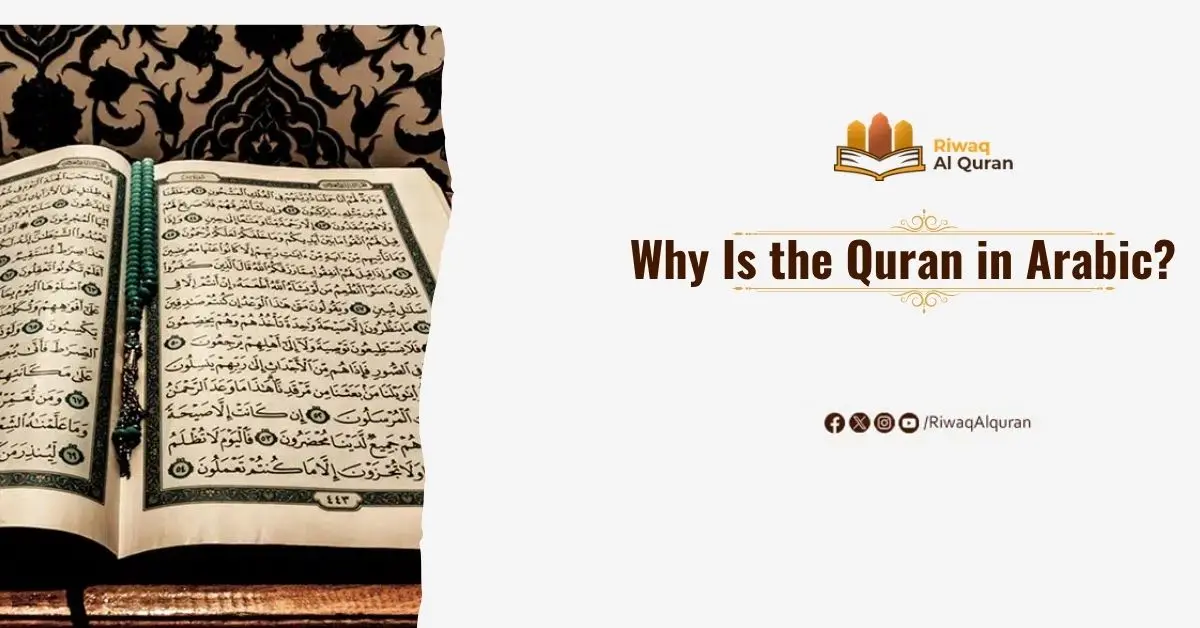
Every Muslim recites the Quran in Arabic — whether they were born in Makka, Chicago, or Kuala Lumpur. For non-Arabic speakers, this raises a sincere and legitimate question: why Arabic specifically?
Arabic was chosen through divine wisdom that intersects linguistics, prophethood, miraculous proof, and the preservation of revelation itself. Understanding these reasons doesn’t just satisfy curiosity — it deepens your connection to every word you recite.
Table of Contents
1. The Quran Is in Arabic Because Every Prophet Spoke to His Own People First
Allah’s consistent practice across all prophetic missions is that revelation arrives in the native language of the receiving community. The Quran states this principle directly:
وَمَا أَرْسَلْنَا مِن رَّسُولٍ إِلَّا بِلِسَانِ قَوْمِهِ لِيُبَيِّنَ لَهُمْ
Wa mā arsalnā min rasūlin illā bilisāni qawmihi liyubayyina lahum
“And We did not send any messenger except [speaking] in the language of his people to state clearly for them.” (Ibrahim 14:4)
Prophet Muhammad ﷺ was Arab, born among the Quraysh of Mecca. Arabic was his mother tongue and the language of the community he first addressed.
Revelation in any other language would have created an immediate barrier between the Prophet ﷺ and his first audience.
The message begins locally, in a language people can immediately engage with, before spreading universally.
2. Arabic Possesses Linguistic Qualities No Other Language Can Replicate for Quranic Revelation
Arabic is not simply one language among equals. Among all Semitic languages — Hebrew, Aramaic, Syriac — Arabic stands alone in its structural depth, expressive range, and capacity to hold layered meaning within a single word.
The French orientalist Ernest Renan, in his History of Semitic Languages, noted with evident astonishment that Arabic emerged fully formed from the Arabian Desert, surpassing its sister languages in the sheer volume of its vocabulary, the precision of its meanings, and the elegance of its grammatical architecture — without ever having passed through a recognizable stage of childhood or deterioration.
Several specific features make Arabic uniquely suited to carry divine speech:
| Linguistic Feature | What It Means | Why It Matters for Quran |
| Vast synonym network | Hundreds of words for a single concept (e.g., 50+ words for “lion”) | Allows precise selection of the single most accurate word |
| Root-based derivation (Ishtiqaq) | Every word traces to a 3-letter root with consistent meaning threads | Enables miraculous density of meaning per syllable |
| Grammatical flexibility (Tasrif) | Verb conjugations carry tense, gender, number, and mood simultaneously | Removes ambiguity while maintaining expressive richness |
| Metaphor and figurative layers (Majaz) | Formal system of implied, extended, and transposed meanings | Allows the Quran to address multiple audiences simultaneously |
| Sound-meaning alignment | Words often sound like what they describe | Creates a recitation experience that mirrors meaning physically |
At Riwaq Al Quran, our Azhari-certified instructors regularly demonstrate this to students in our Quranic Arabic Course — showing how a single Arabic word in a verse can carry three or four simultaneous meanings that would require an entire English sentence to approximate.
Book Your FREE Trial in Riwaq’s Quranic Arabic Classes
3. Arabic Was Preserved in Purity Precisely So It Could Carry the Final Scripture
One of the most remarkable facts about Classical Arabic is that it arrived at the moment of revelation without the contamination that centuries of cultural mixing typically introduce into a language.
The Arabs of the Arabian Peninsula lived in geographic isolation — surrounded by desert that served as a natural boundary separating them from Persian, Byzantine, and other civilizational influences.
The Arabs’ language developed organically, purified through centuries of intense poetic competition and oral tradition. They held their language sacred long before the Quran arrived.
This isolation was not coincidental. Islamic scholarly tradition holds that Allah preserved the linguistic integrity of the Arabs specifically so their language would be ready to receive and carry His final word.
When the Quran descended, it met a language that was already at its peak — and then became the permanent anchor that prevented that language from ever declining.
The Quran itself became the protective seal on Arabic’s purity. Today, Classical Arabic — the language of the Quran — remains readable and fully accessible to scholars, unlike Latin or ancient Greek, which require specialized training to access even partially.
Experience Riwaq Al Quran Classes
Watch real moments from our live sessions at Riwaq Al Quran and see how we bring learning to life. These clips highlight our interactive, student-focused approach designed to keep learners engaged, motivated, and actively involved in every step of their educational journey.
4. The Quran’s Arabic Constitutes the Proof of Its Divine Origin Through Linguistic Miracle
The most compelling reason the Quran arrived in Arabic is that Arabic was the medium through which its miraculous nature — its I’jaz — could be demonstrated and verified.
The Arabs of the 7th century were not scientifically or militarily dominant. Their greatness was linguistic. Poetry was their highest art form. They held annual competitions at markets like Souq Ukaz, where the finest poets competed for prestige across the entire peninsula. The best poems were written in gold and hung on the Kaaba.
Into this environment, the Prophet Muhammad ﷺ brought the Quran — and issued a layered challenge documented in the Quran itself:
وَإِن كُنتُمْ فِي رَيْبٍ مِّمَّا نَزَّلْنَا عَلَى عَبْدِنَا فَأْتُواْ بِسُورَةٍ مِّن مِّثْلِهِ
Wa in kuntum fī raybin mimmā nazzalnā ʿalā ʿabdinā fa’tū bisūratin min mithlihi
“And if you are in doubt about what We have sent down upon Our Servant, then produce a surah the like thereof.” (Al-Baqarah 2:23)
The challenge escalated across three stages: produce something like the entire Quran, then ten chapters, then a single chapter. The Arabs — who had every political and social motivation to disprove Muhammad ﷺ — failed at every level. Their failure was itself evidence.
Had the Quran arrived in a language these masters did not know, the miracle could not have been witnessed. The I’jaz had to occur in the language of those best positioned to recognize it.
5. Arabic’s Structural Longevity Made It the Right Vessel for an Eternal Final Message
The Quran is described in Islamic belief as the final scripture — not a message for one generation, but for all of humanity until the end of time. This places an extraordinary demand on the language carrying it.
Arabic meets this demand in ways no other language has historically demonstrated. Consider:
- Classical Arabic has not undergone structural collapse the way Latin evolved into mutually unintelligible Romance languages
- The Quran itself standardized Arabic grammar — the science of Nahw (Arabic syntax) was developed largely to protect Quranic recitation from error
- Arabic’s root system makes new vocabulary derivable without abandoning classical forms, keeping the language alive without corrupting its core
The scholars of Riwaq Al Quran note that students who learn proper Tajweed rules are, in effect, engaging with a phonetic tradition that has been transmitted without interruption for over 1,400 years. The Arabic you recite today is the Arabic of the companions.
No other living language carries a sacred text and its accompanying oral tradition with this degree of continuity and precision.
Why Is Arabic Written from Right to Left?
Arabic is written right-to-left because this was the established convention of the ancient Semitic writing systems from which Arabic script descends — including Aramaic, Hebrew, and Phoenician. This is a linguistic and historical reality, not a feature exclusive to the Quran.
Within the context of Quranic recitation, the right-to-left orientation carries no theological significance beyond the practical.
What matters is mastering the script so that the reciter can engage with the Arabic text directly, rather than depending entirely on transliteration — which cannot capture the phonetic precision that proper Tajweed requires.
Why Is the Quran Written the Way It Is — The Uthmani Script
The Quran is written in the Uthmani rasm — a standardized script established during the caliphate of Uthman ibn Affan (may Allah be pleased with him) to ensure a single, authoritative written form of revelation. This script differs from modern Arabic in deliberate ways, preserving recitation modes (qira’at) that reflect authentic Prophetic transmission.
Certain letters are written without full diacritical marks in specific positions to accommodate multiple valid recitations — all of which trace back to the Prophet ﷺ through verified chains. This is not an error or archaism; it is a deliberate linguistic encoding system.
The Uthmani script is inseparable from the Quran’s identity as a recited text. Understanding this resolves confusion for many students who notice differences between Quranic Arabic script and modern Arabic writing.
If you want to explore the full depth of Quranic recitation traditions, Riwaq Al Quran’s Qirat Course covers all ten authentic recitation modes with Ijazah-certified instructors.
Begin Learning Qirat with a FREE trial lesson

Did Allah Create Arabic?
Yes! Allah Created everything, not just Arabic. Allah Created the Arabic language and all languages. Then He chose Arabic as the most suitable one to teach humanity about Himself and themselves.
Allah says:
“Read in the name of your Lord who Created. He Created man from a [clinging substant]. Read and your Lord is the most noble. He is the one who taught with the pen. He Taught man what he didn’t know.” Surat Al-Alaq
All knowledge, all science, and all languages are ultimately because Allah taught it to us.
Is Arabic a Holy Language?
Arabic is not considered inherently holy in the sense that the language itself possesses divine status independent of the Quran. Classical Islamic scholars distinguished between the sanctity of the Quranic text — which is divine speech — and the Arabic language as a human tongue that Allah chose as the vessel for that speech.
Why is Arabic written the way it is?
Arabic isn’t the only language written from right to left. Many languages are written the same way, like Hebrew or Aramaic for example.
The reason Why Arabic is always on the right is believed to be the (Nabatean Tribes) that used this convention and it became widespread in the region.
In the end, the characteristics of a language are unique to each language. And one of the ways that makes Arabic unique is the way it is written.
How to Read the Quran If You Don’t Know Arabic?
Not knowing Arabic does not exclude you from the Quran — it simply defines your starting point. There is a clear, structured path forward, and millions of non-Arabic speaking Muslims walk it successfully every year.
Here is how scholars and experienced Quran tutors recommend approaching this:
1. Learn to recite the Quran first.
Tajweed-accurate recitation of Arabic sounds can be learned even without understanding the meaning. This is both valid and rewarded.
Enroll Now in the Best Online Tajweed Classes
2. Study Tafsir alongside recitation.
Riwaq Al Quran’s Online Quran Tafseer Course pairs meaning with recitation, so comprehension grows alongside your pronunciation.
Enroll Now in Riwaq’s Tafseer Course with a FREE trial

3. Learn foundational Quranic Arabic.
Understanding even 300–500 high-frequency Quranic words — which cover a significant portion of the Quran’s vocabulary — transforms your listening experience entirely.
4. Never abandon Arabic for translation alone.
Translations are aids, not replacements. Reading only a translation means reading an interpretation of the Quran, not the Quran itself.
At Riwaq Al Quran, our Azhari-certified tutors work with non-Arabic speakers at every level — from students who cannot yet read Arabic script to those refining advanced Quranic recitation. The starting point does not determine the destination.
The Prophet ﷺ addressed this directly, saying:
“The one who recites the Quran and is proficient in it will be with the noble, righteous messenger-angels. And the one who recites the Quran and stutters therein, and it is difficult upon him, will receive two rewards.” (Sahih Muslim 798)
Struggling with Arabic recitation is not a barrier — according to this hadith, it is itself a source of doubled reward.
Today, that same path is accessible through structured online learning. Our Online Quran Memorization Course at Riwaq Al Quran is designed specifically for non-Arabic speaking students — beginning with correct recitation and building toward deep comprehension, guided by Azhari-certified instructors.
Start your Hifz journey with a Free Trial
Why Students Love Learning with Riwaq Al Quran
Hear directly from our students about how Riwaq Al Quran Academy has transformed their connection with the Book of Allah. Their experiences reflect the dedication, care, and quality that guide every step of our teaching.
Begin Your Quranic Arabic Journey with Riwaq Al Quran
The Quran was revealed in Arabic for profound reasons — linguistic, prophetic, and miraculous. Engaging with it in Arabic is both your right and your opportunity.
Riwaq Al Quran has helped thousands of non-Arabic speaking Muslims since 2017 build genuine, lasting connections with the Quran:
- Azhari-certified instructors trained at Al-Azhar University, Egypt
- One-on-one personalized sessions tailored to your level and pace
- Flexible scheduling — 24/7 availability across all time zones
- 2 free trial classes with no commitment required
- 100% money-back guarantee
Book your free trial today and begin the engagement with the Quran’s language that its revelation invites.
We offer courses in Online Quran & Tajweed Classes, Arabic Language, and Islamic Studies.
- Online Quran Memorization Course
- Recitation Course
- Tafseer Course
- Tajweed Classes
- Online Quran Classes for Kids.
- Ijazah Program.
- Qira’at Course.
- Arabic Language Classes.
- Islamic Studies Courses.
Enroll now for 2 Free Trial Classes
Conclusion
The Quran is in Arabic because Arabic was uniquely prepared — historically, linguistically, and providentially — to carry a final, eternal, and miraculous divine speech. It was the language of the Prophet ﷺ, the language of the first audience, and the only language whose architecture could hold the Quran’s layered meaning without collapse.
For non-Arabic speakers, this is not a barrier — it is an invitation. Reciting in Arabic is worship. Understanding it is a lifelong pursuit worth beginning today. The path is well-traveled, and the reward is certain, Insha’Allah.
Frequently Asked Questions About Why the Quran Is in Arabic
Why did Allah choose Arabic specifically for the Quran?
Arabic was chosen because Prophet Muhammad ﷺ was Arab, and Allah’s consistent practice is to send revelation in the messenger’s native language. Additionally, Arabic possesses unique linguistic qualities — including its root-based structure, vast vocabulary, and expressive depth — that made it uniquely capable of carrying the Quran’s layered meanings with precision.
Can the Quran be recited or prayed in a language other than Arabic?
No — the obligatory recitation in Salah (prayer) must be in Arabic. Scholarly consensus across all four major schools of Islamic jurisprudence holds that reciting translations in formal prayer is not valid. However, translations are strongly encouraged for comprehension, study, and reflection outside of formal recitation contexts.
Does reciting the Quran in Arabic have reward even if I don’t understand it?
Yes. The Prophet ﷺ confirmed that every letter of Quranic recitation carries reward, regardless of comprehension level. Struggling through recitation earns double reward. Understanding Arabic enriches the experience, but the act of faithful recitation in Arabic is itself an independent act of worship with its own merit.
Is it possible for non-Arabic speakers to memorize the Quran?
Absolutely — and thousands do so every year. Non-Arabic speakers who follow structured Quran memorization techniques with qualified teachers have achieved full Hifz. The key is consistent repetition, correct pronunciation from the start, and a realistic memorization schedule suited to your capacity.
Should I learn Arabic to understand the Quran better?
Yes — learning Quranic Arabic significantly deepens your relationship with the text. Even basic vocabulary knowledge transforms recitation from phonetic repetition into conscious engagement. Our Quranic Arabic Course at Riwaq Al Quran is specifically designed for Muslim adults who want to understand the Quran word by word without requiring prior Arabic knowledge.