Every session you spend with the Quran closes with a choice: put it down and move on, or seal it deliberately with words that protect the reward you just earned. The Prophet ﷺ made that choice consistently — and the hadith that records his practice explains exactly why. This article gives you every dua after reading the Quran as a complete, grouped unit — Arabic text with full diacritics, transliteration, English meaning, hadith source with a verified link, and scholarly commentary — so you understand not just what to say, but why it matters.
Before every session begins, there is also an etiquette to observe — if you have not read the dua before reading the Quran, that is the companion piece to this one. And if you want to deepen what you understand while you read, this guide on what the Quran says about reading the Quran offers important grounding.
You will also find the answer most articles avoid: whether “Sadaqa Allahu al-Azim” is confirmed Sunnah or a widespread custom, with the exact hadith basis and the ruling of named scholars.
What you’ll learn in this article:
- Why the moments after Quran recitation are among the most spiritually significant in Islamic worship.
- The confirmed prophetic dua for closing a recitation session, with its hadith source and link.
- The scholarly ruling on “Sadaqa Allahu al-Azim” — and the hadith it comes from.
- Three supplementary duas, each with Arabic, transliteration, and meaning grouped together.
- The complete khatam al-Quran dua, corrected and verified.
- The four conditions classical scholars identify for dua to be most likely accepted.
- One common mistake that undercuts the impact of the closing dua.
Table of Contents
Why Dua After Reading The Quran is Important
Closing a Quran session is not a neutral moment. Islamic theology treats the end of a righteous act as one of the highest-value windows for supplication — because you are still in the state that the act produced. Understanding this theologically changes how you approach the dua after reading the Quran: it is not a formality you complete after worship is over; it is itself an act of worship that multiplies what came before.
1. The Quran’s Promise of Mercy and Healing
Allah describes what the Quran does to those who recite it sincerely:
وَنُنَزِّلُ مِنَ الْقُرْآنِ مَا هُوَ شِفَاءٌ وَرَحْمَةٌ لِّلْمُؤْمِنِينَ ۙ وَلَا يَزِيدُ الظَّالِمِينَ إِلَّا خَسَارًا
“And We send down of the Quran that which is healing and mercy for the believers, and it does not increase the wrongdoers except in loss.” — Surah Al-Isra (17:82)
The word shifā’ (شِفَاءٌ) in this verse is indefinite in Arabic — it does not say the healing; it says a healing, broad and unrestricted. Scholars of tafseer, including Ibn Kathir, note this indefiniteness indicates that the Quran heals across every dimension: spiritual, psychological, and moral. When you close your session with dua, you are asking Allah to activate that healing specifically in your own life — converting a general promise into a personal request.
2. Why Allah Responds to Dua After Recitation
Allah’s readiness to answer supplication is not abstract. He states it directly:
“وَإِذَا سَأَلَكَ عِبَادِي عَنِّي فَإِنِّي قَرِيبٌ ۖ أُجِيبُ دَعْوَةَ الدَّاعِ إِذَا دَعَانِ ۖ فَلْيَسْتَجِيبُوا لِي وَلْيُؤْمِنُوا بِي لَعَلَّهُمْ يَرْشُدُونَ”
“And when My servants ask you about Me — indeed I am near. I respond to the supplication of the caller when he calls upon Me. So let them respond to Me and believe in Me, that they may be guided.” — Surah Al-Baqarah (2:186)
This verse appears in the middle of the Ramadan fasting verses — placed there, scholars note, to indicate that states of heightened worship (fasting, night prayer, Quran recitation) bring the servant closer to the condition described: falyastajeebū lī — “let them respond to Me.” The dua after Quran recitation is your response. Allah has already spoken to you through His Book; the closing dua is how you speak back.
3. The Quran as Your Intercessor — Earning That Promise
The stakes of how you close a recitation session become clearer when you understand what the Quran does for its reciter in the next life. The Prophet ﷺ said:
“عن أبي أمامة الباهلي رضي الله عنه قال: سمعتُ رسولَ اللهِ ﷺ يقول: «اقرؤوا القرآنَ، فإنه يأتي يومَ القيامةِ شفيعًا لأصحابِه»
““Read the Quran, for it will come as an intercessor for its reciters on the Day of Resurrection.” — Sahih Muslim, Hadith 804
The word shafī’ (شافع — intercessor) implies an active advocate, not a passive certificate. This hadith explains why the khatam dua specifically asks Allah to make the Quran a ḥujjah (proof) in the reciter’s favor: you are directly invoking the intercession the Prophet ﷺ promised. Ending a session or a full Quran completion with dua is how you formally submit that request.
The Prophet ﷺ also said:
“خَيْرُكُمْ مَنْ تَعَلَّمَ الْقُرْآنَ وَعَلَّمَهُ”
“The best among you are those who learn the Quran and teach it.” — Sahih Bukhari, Hadith 5027
The virtue described here applies to those who treat the Quran as a living commitment — learning it, refining it, and transmitting it — not a book they completed once. The closing dua reinforces this orientation: you ask Allah to sustain your recitation (warzuqnī tilāwatah — “grant me its recitation”), making every completion a renewal of commitment, not an endpoint.
The Confirmed Dua After Reading the Quran
This section covers the two most common responses after Quran recitation, ranked by their hadith authentication. One is confirmed prophetic Sunnah. The other has a basis but has been widely misunderstood. Both are presented with their full source and commentary so you can apply them correctly.
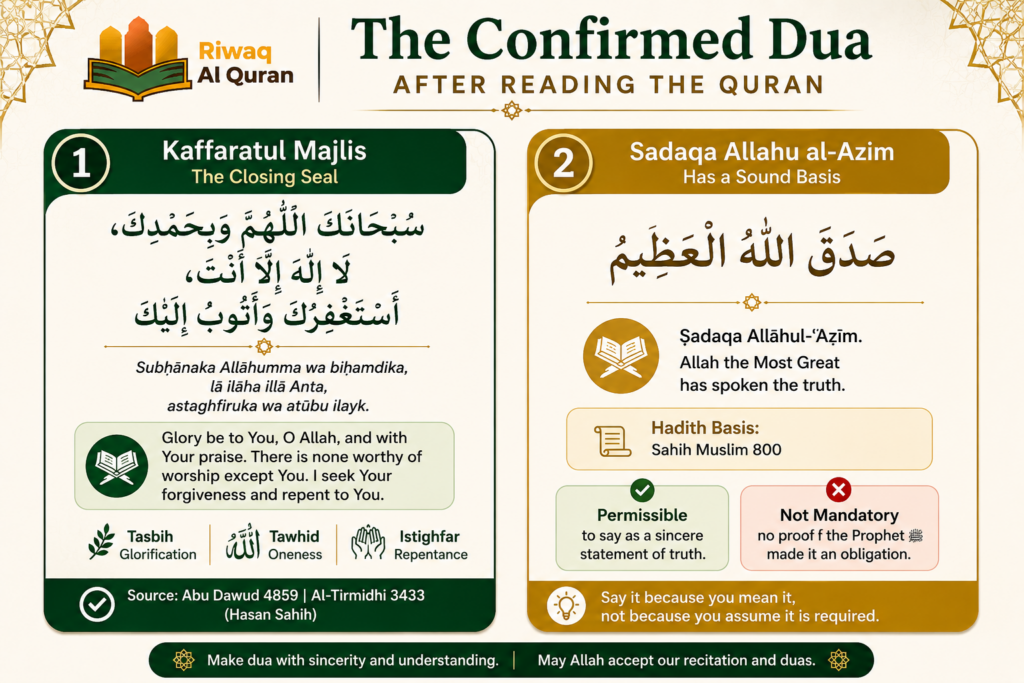
1. Kaffaratul Majlis — The Closing Seal of Every Recitation Session
Aishah (may Allah be pleased with her) narrated that the Prophet ﷺ would close every sitting — including his Quran recitation sessions — with this specific supplication. When she asked him about it, he explained:
“سُبْحَانَكَ اللَّهُمَّ وَبِحَمْدِكَ، لَا إِلَهَ إِلَّا أَنْتَ، أَسْتَغْفِرُكَ وَأَتُوبُ إِلَيْكَ”
“It is expiation for what occurred in the sitting.” — Abu Dawud, Hadith 4859— Al-Tirmidhi, Hadith 3433
Below is the complete supplication with its Arabic text, pronunciation guide, and meaning:
| Source | Sunan Abi Dawud 4859 / Jami’ al-Tirmidhi 3433 |
|---|---|
| Arabic | سُبْحَانَكَ اللَّهُمَّ وَبِحَمْدِكَ، لَا إِلَهَ إِلَّا أَنْتَ، أَسْتَغْفِرُكَ وَأَتُوبُ إِلَيْكَ |
| Transliteration | Subḥānaka Allāhumma wa biḥamdika, lā ilāha illā Anta, astaghfiruka wa atūbu ilayk. |
| English | Glory be to You, O Allah, and with Your praise. There is none worthy of worship except You. I seek Your forgiveness and repent to You. |
This single sentence covers three acts of worship simultaneously:
- Tasbih — glorification of Allah (subhānaka).
- Tawhid — affirmation of His oneness (lā ilāha illā Anta).
- Istighfar — sincere repentance (astaghfiruka wa atūbu ilayk).
The structure is deliberate: it begins by declaring what Allah is, then removes any partner from that declaration, then positions the servant as one who falls short. This sequence trains the worshipper in the correct posture after worship — gratitude, not self-congratulation. Al-Tirmidhi graded the chain of this hadith as Hasan Sahih.
2. Sadaqa Allahu al-Azim — The Full Scholarly Picture
This is the most widely recited phrase after Quran reading, yet most articles present it without any scholarly context. Here is the complete picture — the Arabic text, its origin, and what scholars actually rule.
| Source | – |
|---|---|
| Arabic | صَدَقَ اللهُ الْعَظِيمُ |
| Transliteration | Ṣadaqa Allāhul-ʿAẓīm. |
| English | Allah the Most Great has spoken the truth. |
Hadith basis:
“عن عبدالله بن مسعود رضي الله عنه قال: قال لي رسولُ اللهِ ﷺ: «اقرأ عليَّ». قلتُ: يا رسولَ اللهِ، أقرأُ عليكَ وعليكَ أُنزل؟! قال: «إني أُحِبُّ أن أسمعَه من غيري». فقرأتُ عليه سورةَ النساءِ حتى أتيتُ إلى هذه الآيةِ: ﴿فَكَيْفَ إِذَا جِئْنَا مِن كُلِّ أُمَّةٍ بِشَهِيدٍ وَجِئْنَا بِكَ عَلَىٰ هَٰؤُلَاءِ شَهِيدًا﴾ (النساء: 41)، قال: «حسبُكَ الآن». فالتفتُّ إليه فإذا عيناه تذرفانِ””﴿فَكَيْفَ إِذَا جِئْنَا مِن كُلِّ أُمَّةٍ بِشَهِيدٍ وَجِئْنَا بِكَ عَلَىٰ هَٰؤُلَاءِ شَهِيدًا﴾
Abdullah ibn Mas’ud (may Allah be pleased with him) recited Surah An-Nisa to the Prophet ﷺ until he reached the verse: “So how will it be when We bring from every nation a witness and We bring you, [O Muhammad], against these people as a witness?” (4:41). The Prophet ﷺ said: “Enough — stop there.” Ibn Mas’ud looked up and saw that the Prophet’s eyes were streaming with tears. — Sahih Muslim, Hadith 800
This hadith is the strongest basis for the phrase — it was said in the presence of the Prophet ﷺ in the context of Quran recitation. However, note that the Prophet ﷺ himself did not instruct others to say it after recitation as a formula. Scholars including Ibn Baz and Ibn Uthaymeen clarified:
- Saying Ṣadaqa Allāhul-ʿAẓīm as a sincere statement of truth is permissible and has a sound basis.
- Treating it as a mandatory closing phrase — the way a greeting is obligatory — is without prophetic basis and should be avoided.
The distinction matters: say it because you mean it, not because you assume it is required.

Three Additional Duas After Reading the Quran
These supplications are widely transmitted in classical Islamic literature and have been recited by scholars and students of Quran for centuries.
They are not specifically attributed to a single Sahih hadith as a post-Quran formula, but they are comprehensive, Islamically sound, and cover the full spiritual range of what a believer needs after engaging with Allah’s Book. Each is presented as one complete block — Arabic, transliteration, English meaning, and commentary together.
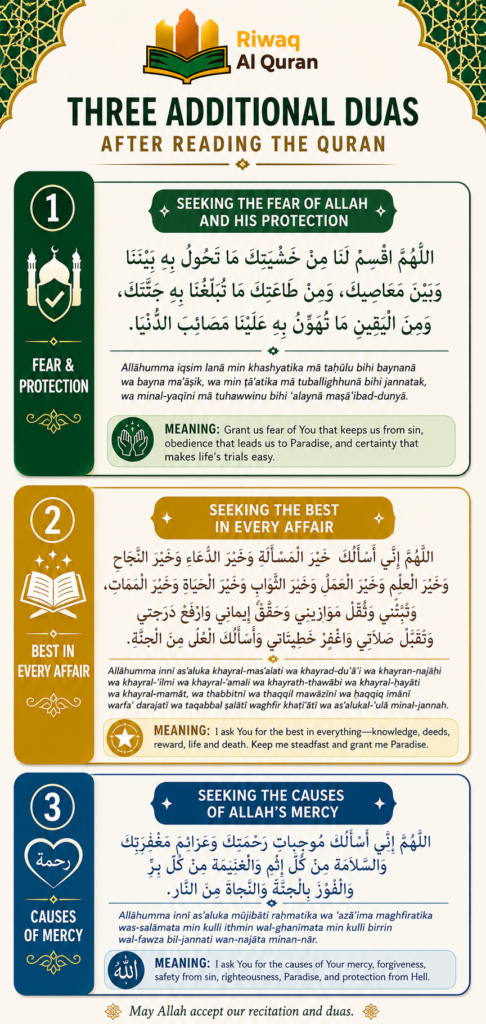
1. Seeking the Fear of Allah and His Protection
This dua covers three pillars in sequence — the fear that prevents sin, the obedience that earns Paradise, and the certainty that makes worldly trials bearable.
| Source | Jami’ al-Tirmidhi 3502 |
|---|---|
| Arabic | اللَّهُمَّ اقْسِمْ لَنَا مِنْ خَشْيَتِكَ مَا تَحُولُ بِهِ بَيْنَنَا وَبَيْنَ مَعَاصِيكَ، وَمِنْ طَاعَتِكَ مَا تُبَلِّغُنَا بِهِ جَنَّتَكَ، وَمِنَ الْيَقِينِ مَا تُهَوِّنُ بِهِ عَلَيْنَا مَصَائِبَ الدُّنْيَا. اللَّهُمَّ مَتِّعْنَا بِأَسْمَاعِنَا وَأَبْصَارِنَا وَقُوَّتِنَا مَا أَحْيَيْتَنَا، وَاجْعَلْهُ الْوَارِثَ مِنَّا، وَاجْعَلْ ثَأْرَنَا عَلَى مَنْ ظَلَمَنَا، وَانْصُرْنَا عَلَى مَنْ عَادَانَا، وَلَا تَجْعَلْ مُصِيبَتَنَا فِي دِينِنَا، وَلَا تَجْعَلِ الدُّنْيَا أَكْبَرَ هَمِّنَا وَلَا مَبْلَغَ عِلْمِنَا، وَلَا تُسَلِّطْ عَلَيْنَا مَنْ لَا يَرْحَمُنَا |
| Transliteration | Allāhumma iqsim lanā min khashyatika mā taḥūlu bihi baynanā wa bayna maʿāṣīk, wa min ṭāʿatika mā tuballighhunā bihi jannatak, wa minal-yaqīni mā tuhawwinu bihi ʿalaynā maṣāʾibad-dunyā. Allāhumma mattiʿnā bi-asmāʿinā wa abṣārinā wa quwwatinā mā aḥyaytanā, wajʿalhu al-wāritha minnā, wajʿal thaʾranā ʿalā man ẓalamanā, wanṣurnā ʿalā man ʿādānā, wa lā tajʿal muṣībatanā fī dīninā, wa lā tajʿalid-dunyā akbara hamminā wa lā mablagha ʿilminā, wa lā tusallliṭ ʿalaynā man lā yarḥamunā. |
| English | O Allah, grant us such fear of You as will stand between us and acts of disobedience, and such obedience as will bring us to Your Paradise, and such certainty as will make the afflictions of this world feel light. O Allah, let us benefit from our hearing, sight, and strength for as long as You keep us alive, and let these remain until our death. Give us justice against those who have wronged us, grant us victory over our enemies, and do not make our affliction fall upon our religion. Do not make this world the greatest of our concerns or the limit of our knowledge, and do not give power over us to those who show no mercy. |
The phrase lā taj’alid-dunyā akbara hamminā — “do not make this world the greatest of our concerns” — is particularly significant after Quran recitation. The Quran repeatedly orients the believer toward the akhirah; this dua asks Allah to keep that orientation in place when the Mushaf is closed and worldly life resumes. It is a request for continuity between the state of recitation and the state of living.
2. Seeking the Best in Every Affair
This dua opens with a meta-supplication — asking Allah for the very ability to ask correctly before asking for anything else.
| source | Narrated by Umm Salamah, reported by Al-Hakim in Al-Mustadrak. |
|---|---|
| Arabic | اللَّهُمَّ إِنِّي أَسْأَلُكَ خَيْرَ الْمَسْأَلَةِ وَخَيْرَ الدُّعَاءِ وَخَيْرَ النَّجَاحِ وَخَيْرَ الْعِلْمِ وَخَيْرَ الْعَمَلِ وَخَيْرَ الثَّوَابِ وَخَيْرَ الْحَيَاةِ وَخَيْرَ الْمَمَاتِ، وَثَبِّتْنِي وَثَقِّلْ مَوَازِينِي وَحَقِّقْ إِيمَانِي وَارْفَعْ دَرَجَتِي وَتَقَبَّلْ صَلَاتِي وَاغْفِرْ خَطِيئَاتِي وَأَسْأَلُكَ الْعُلَا مِنَ الْجَنَّةِ |
| Transliteration | Allāhumma innī asʾaluka khayral-masʾalati wa khayrad-duʿāʾi wa khayran-najāḥi wa khayral-ʿilmi wa khayral-ʿamali wa khayrath-thawābi wa khayral-ḥayāti wa khayral-mamāt, wa thabbitnī wa thaqqil mawāzīnī wa ḥaqqiq īmānī warfaʿ darajatī wa taqabbal ṣalātī waghfir khaṭīʾātī wa asʾalukal-ʿulā minal-jannah. |
| English | O Allah, I ask You for the best of asking, the best of supplication, the best of success, the best of knowledge, the best of deeds, the best of reward, the best of life, and the best of death. Keep me steadfast, make my scales heavy with good deeds, confirm my faith, elevate my rank, accept my prayers, forgive my sins, and grant me the highest levels of Paradise. |
The opening phrase khayral-masʾalah — “the best of asking” — is a meta-supplication: you begin by asking Allah for the ability to ask correctly. Classical scholars identify this as a mark of advanced supplication; the believer who knows their own asking may be deficient asks Allah to perfect even the act of dua itself.
This dua is particularly fitting after Quran recitation because the Quran is khayrul-ʿilm — the best of knowledge — and this supplication asks that the knowledge gained translate into the best of deeds and reward.
3. Seeking the Causes of Allah’s Mercy
This dua is a three-line theological summary of what every Muslim ultimately wants — not just mercy, but the conditions that necessitate mercy.
| source | Narrated by Ibn Mas‘ud, reported by Al-Hakim in Al-Mustadrak. |
|---|---|
| Arabic | اللَّهُمَّ إِنِّي أَسْأَلُكَ مُوجِبَاتِ رَحْمَتِكَ وَعَزَائِمَ مَغْفِرَتِكَ وَالسَّلَامَةَ مِنْ كُلِّ إِثْمٍ وَالْغَنِيمَةَ مِنْ كُلِّ بِرٍّ وَالْفَوْزَ بِالْجَنَّةِ وَالنَّجَاةَ مِنَ النَّارِ |
| Transliteration | Allāhumma innī asʾaluka mūjibāti raḥmatika wa ʿazāʾima maghfiratika was-salāmata min kulli ithmin wal-ghanīmata min kulli birrin wal-fawza bil-jannati wan-najāta minan-nār. |
| English | O Allah, I ask You for the causes of Your mercy, the means of Your forgiveness, safety from every sin, the gain from every righteous deed, success in Paradise, and salvation from the Fire. |
The word mūjibāt (مُوجِبَاتِ — causes/obligations) is theologically precise: it asks Allah not just for His mercy, but for the conditions and acts that necessitate His mercy. This is a dua of understanding — the worshipper acknowledges that mercy is earned through means, and asks Allah to provide access to those means. Paired with ʿazāʾima maghfiratika — “the firm decisions of Your forgiveness” — the dua asks for both the pathway and the destination.
Dua After Completing the Entire Quran (Khatam al-Quran)
Completing the full Quran — the khatam — is a milestone that scholars across the major madhabs treat as one of the highest-value moments for supplication in a Muslim’s life. The evidence is direct: dua at the point of completing a major act of worship, in a state of wudhu, facing the qiblah, is precisely the convergence of conditions classical scholars identify as most favorable for acceptance.
1. The Khatam Dua — Full Arabic, Transliteration, and Meaning
This supplication encodes a complete theology of the Quran in five words: imāman wa nūran wa hudan wa raḥmah — and then asks Allah to make that theology real in your life.
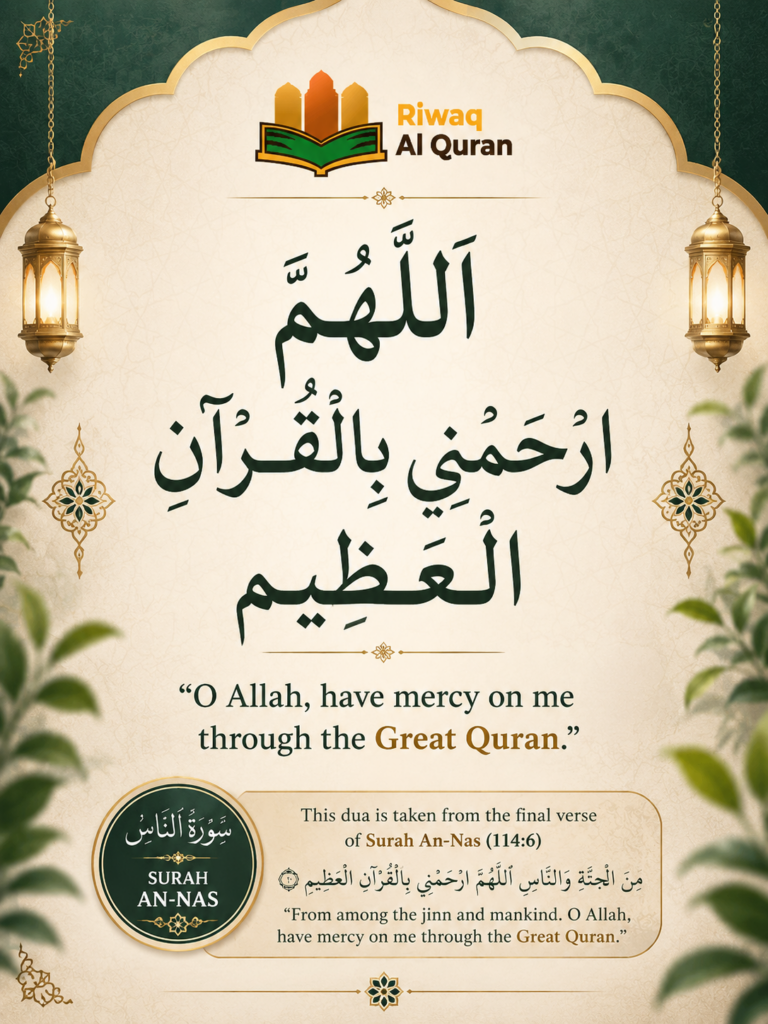
“اللَّهُمَّ ارْحَمْنِي بِالْقُرْآنِ الْعَظِيمِ، وَاجْعَلْهُ لِي إِمَامًا وَنُورًا وَهُدًى وَرَحْمَةً. اللَّهُمَّ ذَكِّرْنِي مِنْهُ مَا نَسِيتُ، وَعَلِّمْنِي مِنْهُ مَا جَهِلْتُ، وَارْزُقْنِي تِلَاوَتَهُ آنَاءَ اللَّيْلِ وَأَطْرَافَ النَّهَارِ، وَاجْعَلْهُ لِي حُجَّةً يَا رَبَّ الْعَالَمِينَ”
“Allāhumma irḥamnī bil-Qurʾānil-ʿAẓīm, wajʿalhu lī imāman wa nūran wa hudan wa raḥmah. Allāhumma dhakkirnī minhu mā nasītu, wa ʿallimnī minhu mā jahiltu, warzuqnī tilāwatahu ānāʾal-layli wa aṭrāfan-nahār, wajʿalhu lī ḥujjatan yā Rabbal-ʿĀlamīn.“”O Allah, have mercy on me through the Noble Quran, and make it my leader, a light, a guide, and a mercy. O Allah, remind me of what I have forgotten from it, teach me what I am ignorant of, grant me the ability to recite it during the hours of the night and at the edges of the day, and make it my proof on the Day of Judgment, O Lord of the Worlds.” A well-known traditional supplication (not authentically established as a marfu‘ hadith from the Prophet ﷺ).
By reciting these words at khatam, the believer actively assigns the Quran its role in their life — asking Allah to enforce those roles in practice, not just in aspiration. The closing request — wajʿalhu lī ḥujjatan (“make it a proof for me”) — connects directly to the hadith of Sahih Muslim 804: the Quran will intercede; this dua is how you formally ask for that intercession by name.
2. When and How to Recite the Khatam Dua
Recite this dua immediately upon completing the last ayah of Surah An-Nas. To make the most of this window, follow this sequence:
- Before the final juz: Write down your personal duas — requests for yourself, your family, and the Muslim Ummah. Have them ready.
- Upon completing Surah An-Nas: Recite the khatam dua first, without delay.
- Immediately after: Raise your personal duas while still in that state of completion.
- Do not: Close the Mushaf, speak about unrelated matters, or move to other activities before making dua.
The window of the khatam is specific. Scholars like Ibn Taymiyyah and al-Nawawi treat it as one of the most recommended times for accepted supplication — treat it accordingly.
What Makes Dua Accepted After Quran Recitation
Understanding the conditions for accepted dua is what separates reciting the closing dua as a habit from reciting it as a functioning act of worship. Classical scholarship is specific about this — and the conditions align precisely with the state that correct Quran recitation produces.
1. The Four Conditions Classical Scholars Identify
Allah sets out the spiritual posture required for dua in Surah Al-A’raf (7:55–56):
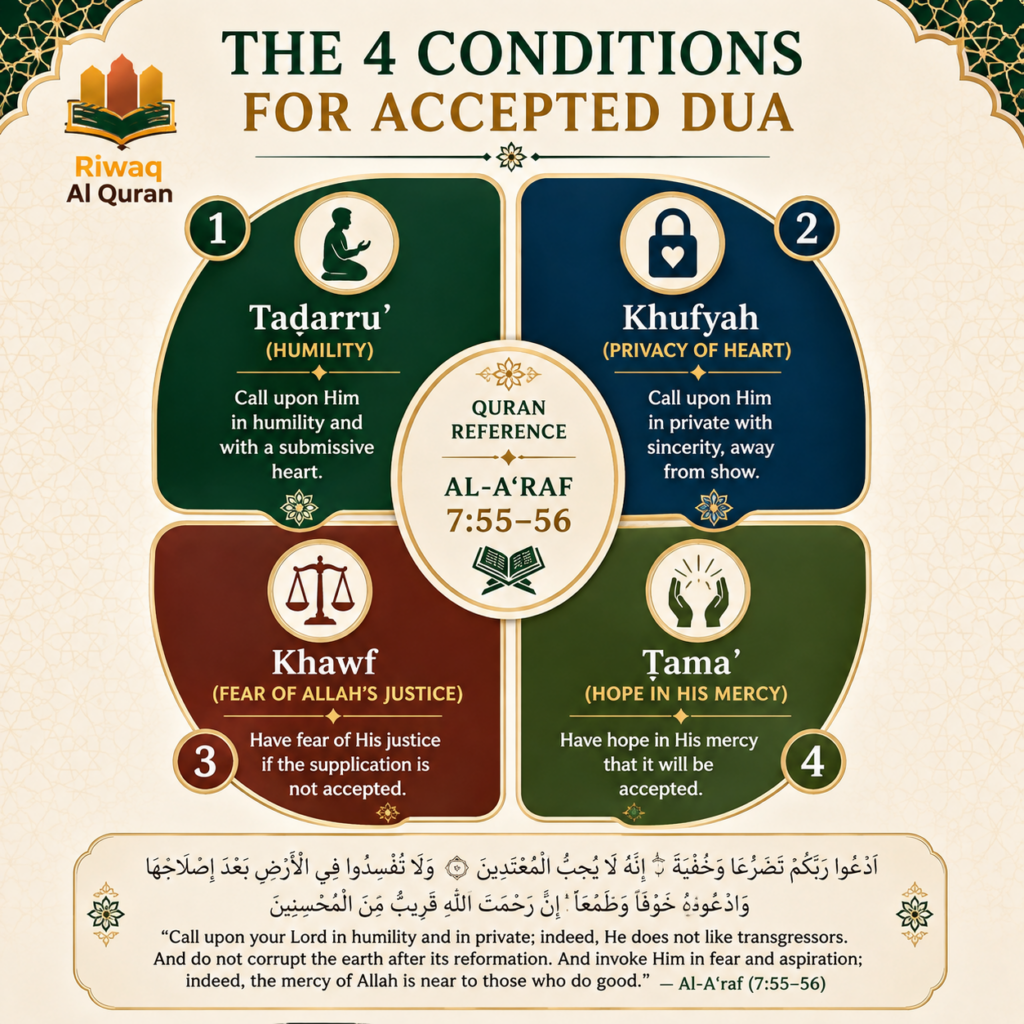
“ادْعُوا رَبَّكُمْ تَضَرُّعًا وَخُفْيَةً ۚ إِنَّهُ لَا يُحِبُّ الْمُعْتَدِينَ ۞ وَلَا تُفْسِدُوا فِي الْأَرْضِ بَعْدَ إِصْلَاحِهَا وَادْعُوهُ خَوْفًا وَطَمَعًا ۚ إِنَّ رَحْمَتَ اللهِ قَرِيبٌ مِّنَ الْمُحْسِنِينَ”
“Call upon your Lord in humility and in private; indeed, He does not like transgressors. And do not corrupt the earth after its reformation. And invoke Him in fear and aspiration; indeed, the mercy of Allah is near to those who do good.” — Surah Al-A’raf (7:55–56)
Ibn al-Qayyim extracts four active conditions from these two verses in Zad al-Maʿad:
- Taḍarruʿ — humility on the tongue and in manner.
- Khufyah — quietness and sincerity in the heart, away from showing off.
- Khawf — fear of Allah’s justice if the supplication is not accepted.
- Ṭamaʿ — genuine hope in His mercy that it will be.
A Quran recitation session, done correctly, produces all four of these states in the worshipper. This is precisely why the moment after recitation is among the most potent for dua: the sitting itself has prepared you.
The Prophet ﷺ also observed:
“The supplication of the person who has recited the Quran is not turned away.”
This narration — reported in the context of khatam gatherings — is the reason scholars like Ibn Taymiyyah and al-Nawawi specifically highlight the dua of khatam as among the most likely to be answered.
2. The Common Mistake That Reduces the Impact of Closing Dua
The single most common error is reciting the closing dua while already mentally somewhere else — closing the Mushaf, thinking about the next task, or reciting the words on autopilot without any activation of meaning.
Scholars of tafseer note that Allah’s statement “I respond to the supplication of the caller when he calls upon Me” (Al-Baqarah 2:186) contains a condition embedded in its phrasing: idhā daʿān — “when he calls upon Me” — implying a genuine act of calling, not a verbal formula. The Hanbali scholar Ibn Rajab al-Hanbali noted in Jāmiʿ al-ʿUlūm wal-Ḥikam that dua recited without the heart’s presence is like a bow without an arrow: the form is there, but it will not reach its target.
The practical fix is simple: before beginning the closing dua, pause for three seconds. Recall that you have just completed a session with Allah’s own words. Then recite.
Benefits of Making Dua After Reading the Quran
Each benefit below is grounded in what the closing dua actually produces — not a general statement about dua being valuable.
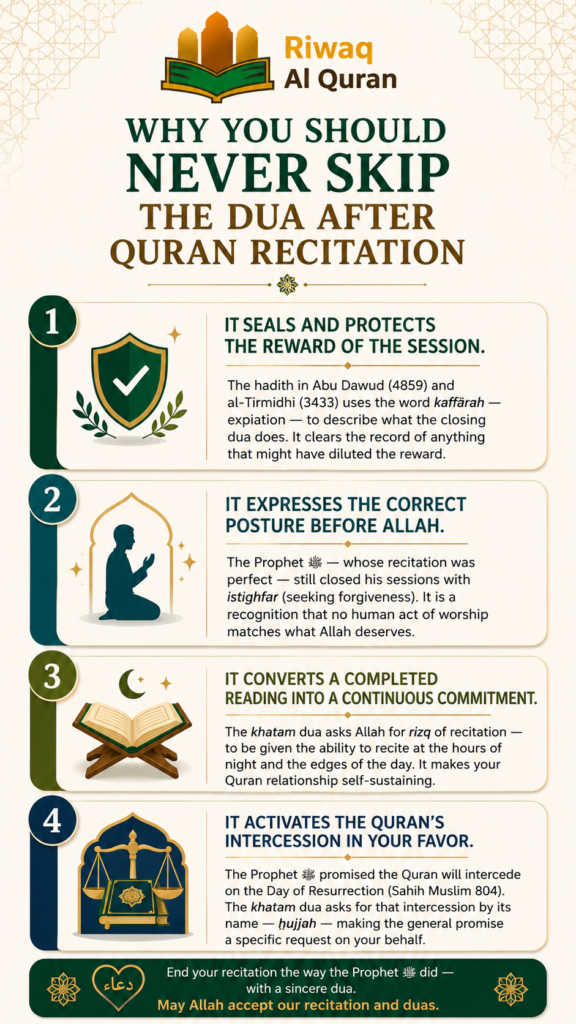
- It seals and protects the reward of the session. The hadith in Abu Dawud (4859) and al-Tirmidhi (3433) uses the word kaffārah — expiation — to describe what the closing dua does. In Islamic theology, kaffārah does not mean the deed was imperfect; it means the record is cleared of anything that might have diluted the reward. The closing dua is protective, not remedial.
- It expresses the correct posture before Allah. The Prophet ﷺ — whose recitation was perfect — still closed his sessions with istighfar (seeking forgiveness). This is not humility as a performance; it is a recognition that no human act of worship matches what Allah deserves. The reciter who ends with astaghfiruka wa atūbu ilayk is the one who has understood the nature of servitude.
- It converts a completed reading into a continuous commitment. The khatam dua asks Allah for rizq of recitation — to be given the ability to recite at the hours of night and the edges of the day. This is asking Allah to make your Quran relationship self-sustaining. It is the difference between completing the Quran and becoming someone who completes the Quran.
- It activates the Quran’s intercession in your favor. The Prophet ﷺ explicitly promised the Quran will intercede on the Day of Resurrection (Sahih Muslim 804). The khatam dua asks for that intercession by its Islamic legal name — ḥujjah. Asking for it directly, at the moment of completion, is how the general promise becomes a specific, named request on your behalf.
Begin Your Quran Journey the Right Way
The duas in this article are part of a full practice of Quran recitation — one that includes correct pronunciation, proper Tajweed rules, and the complete etiquette of sitting with Allah’s Book. Knowing what to say after you finish is only one piece; knowing how to recite so that every letter carries its full reward is the foundation.
At Riwaq Al-Quran, certified instructors guide students through every stage of their Quran journey — from the first correct pronunciation of the basmalah through to Ijazah certification — in live, one-on-one sessions tailored to your level.
Watch real moments from our live sessions at Riwaq Al Quran and see how we bring learning to life:
Here is a sample of courses available:
- Online Quran Recitation Course — Enhance your recitation skills with expert-led guidance
- Online Tajweed Classes — Master the Tajweed rules that give every letter its due
- Online Tafseer Course — Understand the meaning of what you are reciting
- Quran Memorization Online Course — Memorize the Quran with structure and retention
- Online Ijazah Course — Earn a certified chain of transmission in Quran recitation
- Noorani Qaida Online — Build the right foundation from the very first lesson
- Online Quran Classes for Kids — Nurture a love for the Quran from an early age
Your first session is completely free. No obligation. Just start.
Conclusion
The dua after reading the Quran is the moment where recitation becomes conversation. The most authenticated closing supplication — Subḥānaka Allāhumma wa biḥamdika… — is graded Sahih in Abu Dawud and al-Tirmidhi, and its function is expiation and sealing. Saying Ṣadaqa Allāhul-ʿAẓīm is permissible with a sound basis in Sahih Muslim 800, but is not an obligatory formula and should be said sincerely rather than mechanically.
The three supplementary duas cover fear, righteous achievement, and mercy — the full arc of what a believer needs after engaging with the Quran. The khatam dua directly invokes the Quran’s intercession by name, at one of the most favorable times for acceptance that classical scholars identify.
The Quran promises healing and mercy (Al-Isra 17:82). Allah promises to respond when called (Al-Baqarah 2:186). The Prophet ﷺ promised the Quran will intercede (Sahih Muslim 804). The closing dua is how you connect all three — in ten seconds, after every session.
Frequently Asked Questions
The questions below address the most common points of confusion surrounding the dua after reading the Quran — covering obligation, authentication, language, and the best time for acceptance.
Is it obligatory to recite a dua after reading the Quran?
No. The closing dua is a confirmed Sunnah, not an obligation (fardh). The Prophet ﷺ practiced it consistently and explained its benefit when asked, but no scholar has ruled its omission as sinful. The recommendation is strong; the obligation is not there.
What is the most authentic dua after reading the Quran?
The most authenticated is: Subḥānaka Allāhumma wa biḥamdika, lā ilāha illā Anta, astaghfiruka wa atūbu ilayk. Graded Hasan Sahih, recorded in Abu Dawud (4859) and al-Tirmidhi (3433). It is the only closing supplication with direct prophetic attribution in a Sahih-graded chain specifically tied to recitation sittings.
Should I say “Sadaqa Allahu al-Azim” after finishing Quran recitation?
Saying it is permissible — its basis is in Sahih Muslim (800) in the context of Quran recitation with the Prophet ﷺ. The scholarly caution from Ibn Baz and Ibn Uthaymeen is against treating it as a mandatory formula. Say it as a sincere truthful statement; do not treat it as an obligatory closing that replaces the kaffaratul majlis dua.
Can I recite the dua after reading the Quran in English?
Yes. Dua is valid in any language. The Arabic duas carry the advantage of exact prophetic wording. Reciting them in English, with full understanding of the meaning, is valid in all four major madhabs. Scholars of usul al-fiqh generally favor the recitation with genuine comprehension over mechanical Arabic recitation without understanding.
What is the dua for completing the entire Quran?
It begins: Allāhumma irḥamnī bil-Qurʾānil-ʿAẓīm… — asking Allah for mercy, guidance, light, and for the Quran to serve as your proof on the Day of Judgment. Recite it immediately after completing Surah An-Nas, then raise any personal supplications you have prepared, as classical scholars identify that moment as a prime window of acceptance.
When is the dua most likely to be accepted after Quran recitation?
Ibn al-Qayyim in Zad al-Maʿad and Ibn Taymiyyah in Majmuʿ al-Fatawa both point to the moment of khatam as among the most favored times for accepted supplication. The four conditions from Surah Al-A’raf (7:55–56) — humility, privacy, fear, and hope — are all present in a worshipper who has just completed a full recitation with presence of heart. Prepare your duas in advance of the final session so you can raise them without delay.
Sources
- Surah Al-Isra (17:82) | Quran.com
- Surah Al-Baqarah (2:186) | Quran.com
- Surah Al-A’raf (7:55–56) | Quran.com
- Abu Dawud, Sunan, Hadith 4859 | Sunnah.com
- Al-Tirmidhi, Sunan, Hadith 3433 | Sunnah.com
- Al-Tirmidhi, Sunan, Hadith 2910 | Sunnah.com
- Sahih Muslim, Hadith 800 | Sunnah.com
- Sahih Muslim, Hadith 804 | Sunnah.com
- Sahih Bukhari, Hadith 5027 | Sunnah.com
- Ibn al-Qayyim, Zad al-Maʿad
- Ibn Taymiyyah, Majmuʿ al-Fatawa
- Ibn Rajab al-Hanbali, Jāmiʿ al-ʿUlūm wal-Ḥikam