The most repeated words in the Quran are not scattered by chance — Allah (الله) appears roughly 2,698 times, and words like Patience, Mercy, and Knowledge repeat with a frequency that reflects what the Quran emphasizes most. Understanding these words gives students, teachers, and readers a direct way into the Quran’s core themes.
This guide walks through the top repeated words and word-pairs in the Quran, what each one means, and why the repetition matters. It also explains a pattern scholars have noted: several concepts appear in matched pairs with identical frequency, which is worth understanding on its own.
What You’ll Learn in This Article?
- The exact approximate frequency of Allah’s name and the next most repeated words in the Quran.
- Why several word-pairs (Life/Death, Patience/Hardship, World/Hereafter) repeat the same number of times.
- What each of the 19 most repeated words or word-pairs means, with Quranic examples for each.
- How to use word-frequency study as a tool for learning Quranic Arabic.
The same idea behind word frequency applies to whole Surahs, too — here’s a short look at why one Surah in particular is recited more than any other.
Table of Contents
The Most Repeated Words in the Quran
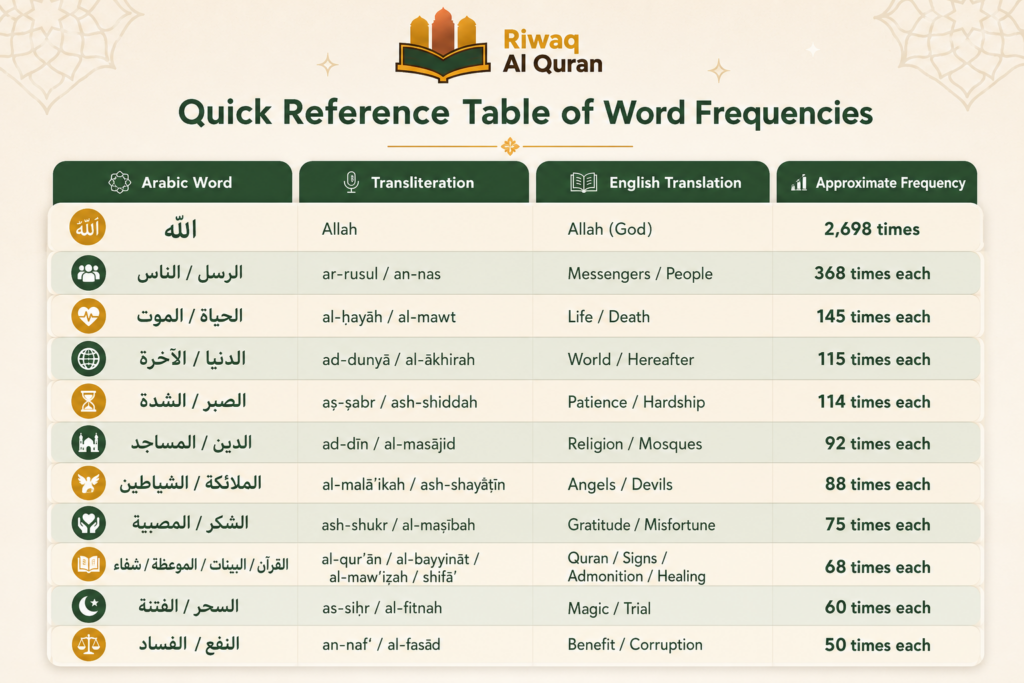
The Quran repeats certain words far more often than others, and this repetition is one of the clearest ways to identify its central themes. Before listing each word individually, the table below gives a quick reference to how often the most frequent terms appear.
Quick Reference Table of Word Frequencies
| Word (Arabic) | Translation | Approximate Frequency |
|---|---|---|
| الله | Allah (God) | 2,698 times |
| الرسل | Messengers | 368 times |
| الحياة / الموت | Life / Death | 145 times each |
| الصبر / الشدة | Patience / Hardship | 114 times each |
| الدنيا / الآخرة | World / Hereafter | 115 times each |
| الملائكة / الشياطين | Angels / Devils | 88 times each |
| الدين / المساجد | Religion / Mosques | 92 times each |
| القرآن | Quran | 68 times |
| الشكر / المصيبة | Gratitude / Misfortune | 75 times each |
The Most Repeated Words in the Quran and Their Meanings
Each word below carries its own theological weight, and several appear alongside a paired opposite or counterpart at the exact same frequency. The list moves from the single most repeated word, Allah, through the paired concepts that build the Quran’s moral framework — each with two or three verses showing the word in context.
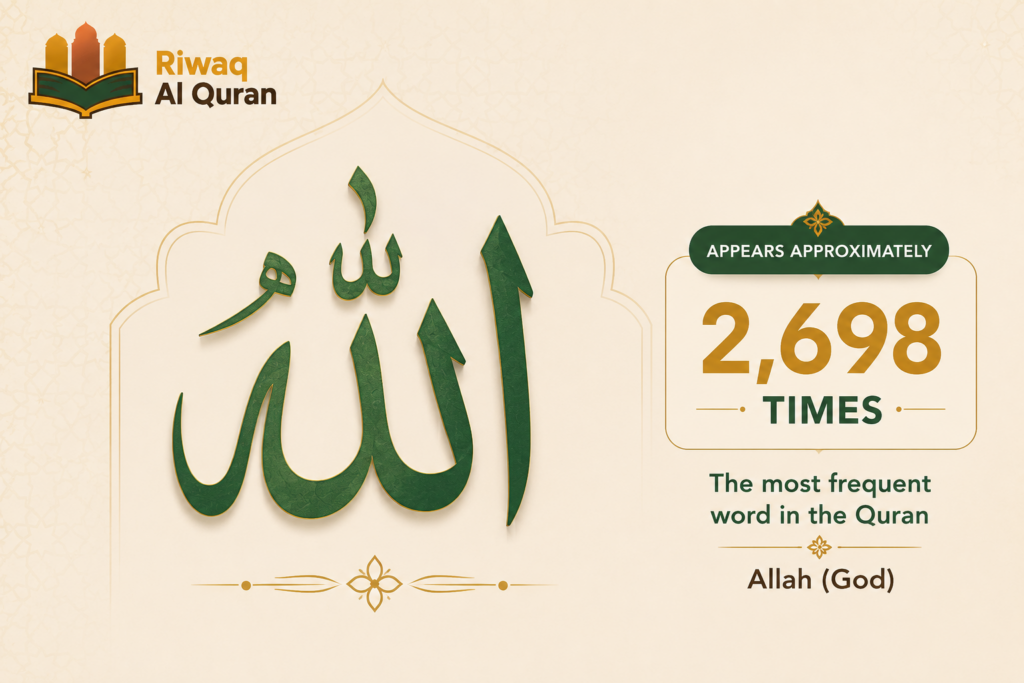
1. Allah (الله) — Approximately 2,698 Mentions
Allah is, unsurprisingly, the single most repeated word in the Quran. What’s worth noticing is how it repeats — not as a static label, but attached to different attributes throughout the text: His mercy, His power, His knowledge, His role in creation.
The sheer frequency is itself a form of emphasis: Tawhid, the oneness of God, isn’t stated once and left — it’s restated in nearly every context the Quran addresses.
To see this range in practice, look at how the same name of God appears across three very different contexts — describing creation, affirming His eternal nature, and establishing His oneness directly:
( اللَّهُ نُورُ السَّمَاوَاتِ وَالْأَرْضِ )”
Allah is the Light of the heavens and the earth.” — Surah An-Nur, Ayah 35
This verse uses light as a metaphor for guidance, not a literal description, which is why classical commentators spent entire chapters unpacking just this one line.
( اللَّهُ لَا إِلَٰهَ إِلَّا هُوَ الْحَيُّ الْقَيُّومُ )”
Allah! There is no god ˹worthy of worship˺ except Him, the Ever-Living, All-Sustaining.” — Surah Al-Baqarah, Ayah 255 (Ayat al-Kursi)
Al-Hayy and Al-Qayyum here are two of Allah’s names built from roots meaning “life” and “standing/sustaining,” which is why this verse alone contains four separate divine attributes in a single sentence.
( وَإِلَٰهُكُمْ إِلَٰهٌ وَاحِدٌ ۖ لَّا إِلَٰهَ إِلَّا هُوَ الرَّحْمَٰنُ الرَّحِيمُ )”
Your God is ˹only˺ One God. There is no god ˹worthy of worship˺ except Him—the Most Compassionate, Most Merciful.” — (Surah Al-Baqarah, Ayah 163)
Since “Allah” itself is a proper name rather than a derived word, it has no root pattern to track — which is exactly why memorizing it comes first for beginners: it’s the one high-frequency word in the Quran that never changes form.
Read also about :How to Explain Allah to a Child.
2. Ilm (Knowledge) علم
Ilm is the Quranic term for knowledge, built from the three-letter root ع-ل-م (ʿ-l-m), one of the most productive roots in the Quran — the same root produces ʿAlim (“Knowing,” a name of Allah), muʿallim (“teacher”), and taʿlim (“teaching”).
Recognizing this one root lets a learner pick out related words across dozens of unrelated verses.
The Quran repeatedly draws a line between what people assume and what they actually know, and one exchange makes this distinction explicit — the angels themselves admitting the limits of their own knowledge:
( وَاللَّهُ يَعْلَمُ وَأَنتُمْ لَا تَعْلَمُونَ )
“But Allah knows, and you do not know.”— (Surah Al-Baqarah, Ayah 216)
This line closes a verse about a command believers found difficult, using knowledge specifically to justify trusting a ruling whose wisdom isn’t immediately obvious.
( قَالُوا سُبْحَانَكَ لَا عِلْمَ لَنَا إِلَّا مَا عَلَّمْتَنَا ۖ إِنَّكَ أَنتَ الْعَلِيمُ الْحَكِيمُ )
“They replied, “Glory be to You! We have no knowledge except what You have taught us. Indeed, You alone are the All-Knowing, All-Wise.” — (Surah Al-Baqarah, Ayah 32)
Notably, this is the angels speaking, which makes their admission of limited knowledge a deliberate contrast to human overconfidence.
( وَقُل رَّبِّ زِدْنِي عِلْمًا )
“And say, “My Lord, increase me in knowledge.” — (Surah Ta-Ha, Ayah 114)
One of the shortest, most frequently memorized duas in the Quran, precisely because of its brevity and direct request.
3. Rahmah (رحمة) — Mercy as a Recurring Attribute
Rahmah comes from the root ر-ح-م (r-ḥ-m), the same root behind Ar-Rahman and Ar-Rahim, two of Allah’s most frequently invoked names — meaning a learner who masters this one root instantly recognizes it in the Basmalah recited before nearly every Surah.
One verse in particular ties mercy directly to conduct, not just belief — worth reading closely rather than skimming past as a general statement about God’s character:
( وَرَحْمَتِي وَسِعَتْ كُلَّ شَيْءٍ )
“My mercy encompasses all things” — (Surah Al-A’raf, Ayah 156)
part of a longer verse where Allah’s mercy is described as broader than His punishment, a detail scholars often cite when discussing divine attributes in balance.
( رَبَّنَا هَبْ لَنَا مِن لَّدُنكَ رَحْمَةً ۚ إِنَّكَ أَنتَ الْوَهَّابُ )
“Our Lord! Grant us mercy from Yourself. Indeed, You are the Supreme Bestower.” — (Surah Aal-Imran, Ayah 8)
( فَبِمَا رَحْمَةٍ مِّنَ اللَّهِ لِنتَ لَهُمْ )
“It is out of Allah’s mercy that you have been lenient with them.” — (Surah Aal-Imran, Ayah 159)
Here mercy explains a specific behavior (leniency toward companions after a difficult battle), showing the word used as a cause, not just a description.
4. Ayah (Sign/Verse) آية, One Word, Two Meanings
Ayah does double duty in the Quran — it means both a verse of scripture and a sign in the natural world. That overlap isn’t incidental: when the text uses the same word for its own verses and for signs in creation, it reinforces that both the universe and the revelation function as evidence pointing the same direction.
This dual meaning is also why the word plural, ayat, shows up constantly in discussions of both Quranic exegesis and natural phenomena.
Examples:
( وَلَئِن أَتَيْتَ الَّذِينَ أُوتُوا الْكِتَابَ بِكُلِّ آيَةٍ مَّا تَبِعُوا قِبْلَتَكَ )
“Even if you were to bring every sign to those who were given the Scripture, they would not follow your direction of prayer.” — (Surah Al-Baqarah, Ayah 145)
A verse specifically about the change of Qibla, showing “ayah” used to mean convincing proof rather than a Quranic verse.
( سَلْ بَنِي إِسْرَائِيلَ كَمْ آتَيْنَاهُم مِّنْ آيَةٍ بَيِّنَةٍ )
“Ask the Children of Israel how many clear signs We have given them.”— (Surah Al-Baqarah, Ayah 211)
Here referring to miracles given to Musa, another distinct sense of the same word.
( إِنَّ فِي ذَلِكَ لَآيَةً لِّمَن يَخْشَىٰ )
“Surely in this is a lesson for whoever fears” — (Surah An-Nazi’at, Verse 26)
This pattern, ending a story with “in this is a sign,” recurs throughout the Quran’s narrative sections and is worth watching for once you recognize it.
Read more about: [The 400 Most Common Words in the Quran]
5. Amr (Command) أمر, Divine Command as a Legal Foundation
Amr, from the root أ-م-ر, refers to divine command or instruction, and it shows up constantly across legal and narrative passages alike.
This word grounds one of Islamic jurisprudence’s basic premises: rulings trace back to command, not custom — a distinction that matters directly if you’re studying fiqh alongside Quranic Arabic.
Examples:
( لَيْسَ لَكَ مِنَ الْأَمْرِ شَيْءٌ أَوْ يَتُوبَ عَلَيْهِمْ )
“You ˹O Prophet˺ have no say in the matter. Whether He turns to them in mercy…”— (Surah Aal-Imran, Ayah 128)
A striking verse limiting even the Prophet’s ﷺ own authority over outcomes, reserving that decision to Allah alone.
( قُلْ إِنَّ الْأَمْرَ كُلَّهُ لِلَّهِ )
“Say, ˹O Prophet,˺ “Indeed, all matters are entirely in the Hands of Allah.” — (Surah Aal-Imran, Ayah 154)
A direct instruction to affirm the same point stated more implicitly in the previous verse.
6. Quran, Light, Wisdom, Revelation — All at 68 Times
Here’s a detail most word-frequency lists skip entirely: the word “Quran” (القرآن) itself appears 68 times — and so do three of its other names, “Light” (النور), “Wisdom” (الحكمة), and “Revelation” (التنزيل). Four different names for the same book sharing the exact same frequency is one of the stronger arguments for treating this repetition pattern as structural rather than coincidental, and it’s a useful memory anchor: learning one of these four names makes the shared frequency of the others easier to recall.
It’s one of the stronger arguments for treating this repetition pattern as structural rather than coincidental.
Examples:
( إِنَّا أَنزَلْنَاهُ قُرْآنًا عَرَبِيًّا لَّعَلَّكُمْ تَعْقِلُونَ )
“Indeed, We have revealed it as an Arabic Quran so that you may understand” — (Surah Yusuf, Ayah 2)
This verse ties the Quran’s Arabic language directly to comprehension, which is often cited as one reason Arabic-language study specifically (not just translation) is emphasized.
( شَهْرُ رَمَضَانَ الَّذِي أُنزِلَ فِيهِ الْقُرْآنُ )
“The month of Ramadan is the one in which the Quran was revealed” — (Surah Al-Baqarah, Ayah 185)
( وَإِذَا قُرِئَ الْقُرْآنُ فَاسْتَمِعُوا لَهُ وَأَنصِتُوا )
“When the Quran is recited, listen to it attentively and be silent, so you may be shown mercy.”— (Surah Al-A’raf, Ayah 204)
7. Signs (البينات)
Al-Bayyinat, “clear signs,” refers to unmistakable proofs — not ambiguous hints — of God’s existence and truth.
The word carries the same frequency as “Quran” itself, which fits: both are framed in the text as evidence meant to be recognized, not debated. Notice the shared root ب-ي-ن (clarity, distinctness) — the same root behind “bayan,” meaning clear explanation.
Examples:
( وَلَقَدْ آتَيْنَا مُوسَىٰ تِسْعَ آيَاتٍ بَيِّنَاتٍ )
“We certainly gave Moses nine clear signs.” — (Surah Al-Isra, Ayah 101)
— referring to the nine miracles associated with Musa’s confrontation with Pharaoh.
وَمَا يَجْحَدُ بِآيَاتِنَا إِلَّا الظَّالِمُونَ )
“None reject Our revelations except the wrongdoers. “— (Surah Al-Ankabut, Ayah 49)
( تِلْكَ آيَاتُ اللَّهِ نَتْلُوهَا عَلَيْكَ بِالْحَقِّ )
“These are the verses of Allah which We recite to you in truth. “— (Surah Aal-Imran, Ayah 108)
8. Admonition / Al-Maw’izah (الموعظة) — 68 Times
Al-Maw’izah means counsel or reminder — the kind of guidance meant to correct course rather than simply inform. It shares the same 68-time frequency as the words above, reinforcing that revelation, evidence, and reminder are treated as one connected function in the text.
Examples:
( فَذَكِّرْ إِن نَّفَعَتِ الذِّكْرَىٰ )
” So remind, if the reminder is beneficial.”— (Surah Al-A’la, Ayah 9)
( هَـٰذَا بَيَانٌ لِّلنَّاسِ وَهُدًى وَمَوْعِظَةٌ لِّلْمُتَّقِينَ )
“This ˹Quran˺ is a clear message to humanity, a guide, and a lesson for those mindful of Allah. ” — (Surah Aal-Imran, Ayah 138)
— worth noting how three distinct functions (bayan, huda, maw’izah) are stacked in a single verse, each describing a different aspect of what the Quran does.
( يَا أَيُّهَا النَّاسُ قَد جَاءَتْكُم مَّوْعِظَةٌ مِّن رَّبِّكُمْ وَشِفَاءٌ لِّمَا فِي الصُّدُورِ )
“O humanity! Indeed, there has come to you a warning from your Lord, a cure for what is in the hearts, a guide, and a mercy for the believers.” — (Surah Yunus, Ayah 57)
— this same verse reappears under “Healing” below, since it’s one of the rare lines where two high-frequency words occur together.
9. Healing (شفاء) at 68 Times
Shifa, healing, is used in the Quran for both physical and spiritual restoration — a dual meaning that later became the basis for Ruqyah, the practice of reciting specific Quranic verses as a form of spiritual treatment.
Its frequency matching “Quran,” “Signs,” and “Admonition” ties healing directly to the same structural pattern as the Quran’s other core self-descriptions.
Examples:
( يَا أَيُّهَا النَّاسُ قَد جَاءَتْكُم مَّوْعِظَةٌ مِّن رَّبِّكُمْ وَشِفَاءٌ لِّمَا فِي الصُّدُورِ )
“O humanity! Indeed, there has come to you a warning from your Lord, a cure for what is in the hearts, a guide, and a mercy for the believers. “— (Surah Yunus, Ayah 57)
( وَنُنَزِّلُ مِنَ الْقُرْآنِ مَا هُوَ شِفَاءٌ وَرَحْمَةٌ لِّلْمُؤْمِنِينَ )
“We send down the Quran as a healing and mercy for the believers. ” — (Surah Al-Isra, Ayah 82)
— the phrase “for the believers” is a condition worth noticing: the same verse continues by saying this healing only increases wrongdoers in loss, meaning the effect is tied to sincerity, not the words alone.
( قُل هُوَ لِلَّذِينَ آمَنُوا هُدًى وَشِفَاءٌ )
“Say, “It is a guide and a healing for those who believe.” — (Surah Fussilat, Ayah 44)
10. Misfortune / Al-Musibah (المصيبة) — 75 Times
Misfortune and Gratitude each appear 75 times — and reading them as a pair, rather than separately, is where the real insight is. The Quran doesn’t treat hardship and thankfulness as opposites; it treats them as a single expected cycle, where gratitude is the appropriate response on both sides of misfortune, not just its absence.
Examples:
( مَا أَصَابَ مِن مُّصِيبَةٍ إِلَّا بِإِذْنِ اللَّهِ )
” No misfortune ever befalls except by the permission of Allah.”— (Surah At-Taghabun, Ayah 11)
( الَّذِينَ إِذَا أَصَابَتْهُم مُّصِيبَةٌ قَالُوا إِنَّا لِلَّهِ وَإِنَّا إِلَيْهِ رَاجِعُونَ )
” Who, when struck by a disaster, say, “Surely to Allah we belong and to Him we will all return.” — (Surah Al-Baqarah, Ayah 156)
— this exact phrase, Inna lillahi wa inna ilayhi raji’un, is recited by Muslims worldwide upon hearing of a death, making it one of the most practically memorized lines in this entire list.
( وَمَا أَصَابَكُم مِّن مُّصِيبَةٍ فَبِمَا كَسَبَتْ أَيْدِيكُمْ )
“Whatever affliction befalls you is because of what your own hands have committed, although He pardons much. ” — (Surah Ash-Shura, Ayah 30)
11. Gratitude (الشكر)
Gratitude is mentioned the same number of times as Misfortune — the pairing noted above. The Quran repeatedly encourages gratitude to Allah for His countless blessings and reminds believers to be thankful in both times of ease and difficulty.
Examples:
( لَئِن شَكَرْتُمْ لَأَزِيدَنَّكُمْ وَلَئِن كَفَرْتُمْ إِنَّ عَذَابِي لَشَدِيدٌ )
“If you are grateful, I will certainly give you more. But if you are ungrateful, surely My punishment is severe. ” — (Surah Ibrahim, Ayah 7)
— a direct conditional statement, structured as promise-and-warning in a single line, which makes it a common reference point in discussions of gratitude in Islamic ethics.
( وَاشْكُرُوا لِي وَلَا تَكْفُرُونِ )
“Be grateful to Me and never be ungrateful. ” — (Surah Al-Baqarah, Ayah 152)
( فَاذْكُرُونِي أَذْكُرْكُمْ وَاشْكُرُوا لِي وَلَا تَكْفُرُونِ )
“So remember Me; I will remember you. Be grateful to Me, and do not be ungrateful. ” — (Surah Al-Baqarah, Ayah 152)
12. Religion and Mosques, Matched at 92 Times
Al-Din, religion or submission to Allah, and Al-Masajid, mosques, share the same frequency, 92 times each. The pairing reflects something practical: faith in the Quran isn’t framed as a private conviction alone, but as one expressed through a physical place of gathering and worship.
Examples:
( إِنَّ الدِّينَ عِندَ اللَّهِ الْإِسْلَامُ )
“Indeed, the religion in the sight of Allah is Islam. ” — (Surah Aal-Imran, Ayah 19)
— the closing verse of one of the shortest Surahs in the Quran, frequently cited in discussions of religious coexistence.
( لَكُمْ دِينُكُمْ وَلِيَ دِينِ )
” You have your way, and I have my Way.” — (Surah Al-Kafirun, Ayah 6)
( وَأَنَّ الْمَسَاجِدَ لِلَّهِ فَلَا تَدْعُوا مَعَ اللَّهِ أَحَدًا )”
The places of worship are for Allah alone, so do not invoke anyone besides Allah.” — (Surah Al-Jinn, Ayah 18)
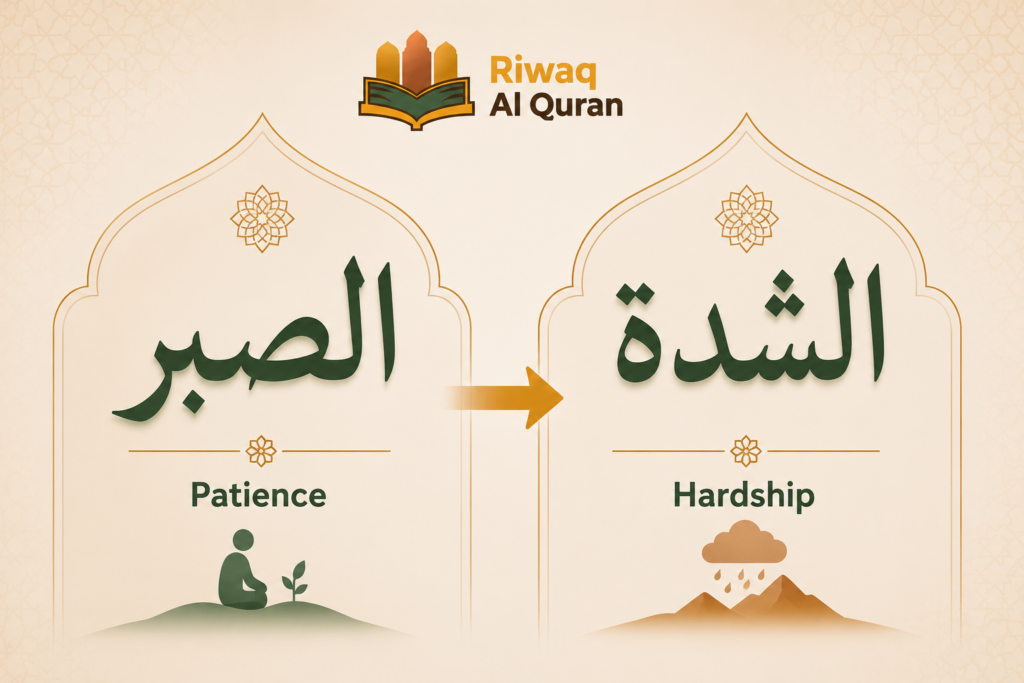
13. Patience / Al-Sabr (الصبر) and Hardship / Al-Shiddah (الشدة) — 114 Times Each
Patience and Hardship repeat the exact same number of times. This is one of the clearer examples of the Quran’s paired-frequency pattern: patience isn’t presented as a virtue in isolation, it’s presented specifically as the response hardship requires.
Students of Tajweed and memorization notice this pairing firsthand — the discipline needed to master recitation consistently mirrors the patience the text itself describes, which is part of why structured, paced study, rather than rushed memorization, tends to hold up better long-term.
Examples:
( وَاسْتَعِينُوا بِالصَّبْرِ وَالصَّلَاةِ ۚ وَإِنَّهَا لَكَبِيرَةٌ إِلَّا عَلَى الْخَاشِعِينَ )
“Seek help through patience and prayer. Indeed, it is a burden except for the humble. “— (Surah Al-Baqarah, Ayah 45)
— patience and prayer are paired here as the two practical tools the Quran offers for facing hardship, not abstract advice.
( إِنَّمَا يُوَفَّى الصَّابِرُونَ أَجْرَهُم بِغَيْرِ حِسَابٍ )
“Indeed, the patient will be given their reward without measure. ” — (Surah Az-Zumar, Ayah 10)
( يَا أَيُّهَا الَّذِينَ آمَنُوا اصْبِرُوا وَصَابِرُوا وَرَابِطُوا )
“O believers! Be patient, persevere, stand firm, and be mindful of Allah so that you may be successful. “— (Surah Aal-Imran, Ayah 200)
— three distinct derivatives of the same root (sabr) appear in one line, a good example of how one root can be layered for emphasis.
14. Angels and Devils, Matched at 88 Times
Al-Mala’ikah (الملائكة) and Al-Shayatin (الشياطين) — angels and devils — appear 88 times each, a pairing that reflects the Quran’s consistent framing of unseen influence as a contest between two forces, not a single threat believers face alone.
Examples:
( وَإِذْ قَالَ رَبُّكَ لِلْمَلَائِكَةِ إِنِّي جَاعِلٌ فِي الْأَرْضِ خَلِيفَةً )
“And ˹remember˺ when your Lord said to the angels, “I am going to place a successive authority on earth. ” — (Surah Al-Baqarah, Ayah 30)
— the opening of the well-known account of Adam’s creation and the angels’ initial questioning of it.
( وَاتَّبَعُوا مَا تَتْلُو الشَّيَاطِينُ عَلَىٰ مُلْكِ سُلَيْمَانَ )
” They instead followed what the devils had falsely attributed to the reign of Solomon.”— (Surah Al-Baqarah, Ayah 102)
- ( إِنَّ الشَّيْطَانَ لَكُمْ عَدُوٌّ فَاتَّخِذُوهُ عَدُوًّا )” Surely Satan is an enemy to you, so take him as an enemy.” — (Surah Fatir, Ayah 6)
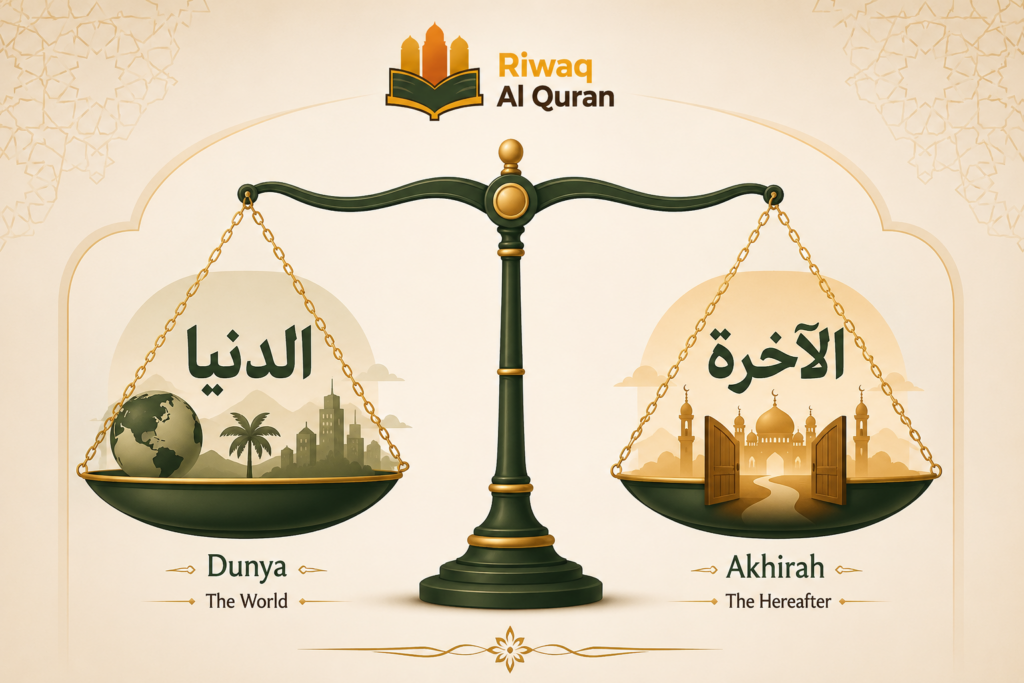
15. World and Hereafter, Matched at 115 Times
Al-Dunya (الدنيا) and Al-Akhirah (الآخرة) — this world and the hereafter — share a frequency of 115 mentions each. Scholars frequently point to this as intentional balance: neither concept is allowed to dominate the text numerically, which mirrors the instruction to hold both in view rather than prioritizing one entirely.
Examples:
( وَمَا الْحَيَاةُ الدُّنْيَا إِلَّا مَتَاعُ الْغُرُورِ )
“And ˹remember˺ when your Lord said to the angels, “I am going to place a successive authority on earth. ” — (Surah Aal-Imran, Ayah 185)
( وَلَلدَّارُ الْآخِرَةُ خَيْرٌ لِّلَّذِينَ يَتَّقُونَ )
“They instead followed what the devils had falsely attributed to the reign of Solomon “— (Surah Al-An’am, Ayah 32)
( بَل تُؤْثِرُونَ الْحَيَاةَ الدُّنْيَا وَالْآخِرَةُ خَيْرٌ وَأَبْقَىٰ )
” Surely Satan is an enemy to you, so take him as an enemy.”— (Surah Al-A’la, Ayahs 16–17)
16. Life / Al-Hayah (الحياة) and Death / Al-Mawt (الموت) — 145 Times Each
Al-Hayah (الحياة) and Al-Mawt (الموت) are the most-repeated matched pair on this list, at 145 times each. The frequency itself becomes part of the message: life and death are treated as equally weighted subjects, not as one being the “real” topic and the other an afterthought.
Examples:
( الَّذِي خَلَقَ الْمَوْتَ وَالْحَيَاةَ لِيَبْلُوَكُمْ أَيُّكُمْ أَحْسَنُ عَمَلًا )
“˹He is the One˺ Who created death and life in order to test which of you is best in deeds. ” — (Surah Al-Mulk, Ayah 2)
— notice death is named before life in the Arabic word order, a detail commentators read as emphasizing that death isn’t an afterthought to life but is treated with equal or greater weight.
( كُلُّ نَفْسٍ ذَائِقَةُ الْمَوْتِ )
” Every soul will taste death.” — (Surah Aal-Imran, Ayah 185)
( وَقَالُوا مَا هِيَ إِلَّا حَيَاتُنَا الدُّنْيَا نَمُوتُ وَنَحْيَا )
” They say, “There is nothing beyond our worldly life. We die and we live…”— (Surah Al-Jathiyah, Ayah 24)
17. Benefit and Corruption, Matched at 50 Times
The word “Benefit” (النفع) and its derivatives appear 50 times in the Quran, along with the word “Corruption” (الفساد), which is mentioned the same number of times.
This highlights the contrast between what is beneficial for individuals and society versus what leads to harm and destruction, urging believers to seek goodness and avoid evil.
Examples:
( وَلَا تُفْسِدُوا فِي الْأَرْضِ بَعْدَ إِصْلَاحِهَا ) “
Do not spread corruption in the land after it has been set right. ” — (Surah Al-A’raf, Ayah 56)
( ظَهَرَ الْفَسَادُ فِي الْبَرِّ وَالْبَحْرِ بِمَا كَسَبَتْ أَيْدِي النَّاسِ )
” Corruption has spread on land and sea as a result of what people’s hands have done.” — (Surah Ar-Rum, Ayah 41)
— frequently cited in discussions of environmental responsibility in Islamic thought, since it directly links corruption in nature to human action.
( قُل لَّا يَسْتَوِي الْخَبِيثُ وَالطَّيِّبُ وَلَوْ أَعْجَبَكَ كَثْرَةُ الْخَبِيثِ )
“Say, “The evil and the good are not equal, even though the abundance of evil may impress you. “— (Surah Al-Ma’idah, Ayah 100)
18. Messengers (الرسل)
“Messengers” (الرسل) and its derivatives appear 368 times in the Quran, as does the word “People” (الناس). This repetition underscores the significance of the prophets and their mission to guide humanity, and it reminds believers that the message of the Quran is for all people, regardless of time and place.
Examples:
( وَمَا أَرْسَلْنَاكَ إِلَّا كَافَّةً لِّلنَّاسِ بَشِيرًا وَنَذِيرًا )
” We have sent you ˹O Prophet˺ only as a deliverer of good news and a warner to all people.” — (Surah Saba, Ayah 28)
( لَقَد جَاءَتْكُمْ رُسُلُنَا بِالْبَيِّنَاتِ )
” Indeed, Our messengers came to you with clear proofs.”— (Surah Al-A’raf, Ayah 53)
( يَا أَيُّهَا النَّاسُ إِنَّا خَلَقْنَاكُم مِّن ذَكَرٍ وَأُنثَىٰ )
“O humanity! Indeed, We created you from a male and a female. ” — (Surah Al-Hujurat, Ayah 13)
— this verse continues into a well-known statement on human equality across nations and tribes, frequently cited in discussions of Islamic views on race and ethnicity.
19. Magic / Al-Sihr (السحر) and Trial / Al-Fitnah (الفتنة) — 60 Times Each
Al-Sihr (السحر) and Al-Fitnah (الفتنة) — magic and trial — close out the list at 60 times each, tying two forms of deception together: one supernatural, one circumstantial, both treated as tests requiring the same underlying caution.
Examples:
( وَاتَّقُوا فِتْنَةً لَّا تُصِيبَنَّ الَّذِينَ ظَلَمُوا مِنكُمْ خَاصَّةً )
“Beware of a trial that will not only affect the wrongdoers among you. ” — (Surah Al-Anfal, Ayah 25)
— a verse often cited to argue that communal wrongdoing carries communal consequence, not just individual punishment.
( وَاتَّبَعُوا مَا تَتْلُو الشَّيَاطِينُ عَلَىٰ مُلْكِ سُلَيْمَانَ ۚ وَمَا كَفَرَ سُلَيْمَانُ وَلَـٰكِنَّ الشَّيْطَانَ كَفَرَ يُعَلِّمُ النَّاسَ السِّحْرَ )
“They instead followed what the devils had falsely attributed to the reign of Solomon. It was not Solomon who disbelieved; rather, the devils disbelieved, teaching people magic. ” — (Surah Al-Baqarah, Ayah 102)
— this verse specifically clears Prophet Sulaiman of the accusation of practicing magic, redirecting the charge to the devils who falsely attributed it to him
Why Do So Many Words Repeat the Same Number of Times?
Many scholars read this symmetry as evidence of deliberate balance built into the Quran’s structure — every challenge paired with the virtue needed to face it, every worldly concept mirrored by its spiritual counterpart. Whether or not a reader takes this as intentional design, it’s a genuinely useful study tool in practice: learning one word in a pair makes the other easier to place, since paired terms tend to surface in related passages.
Use Word Frequency to Learn Quranic Arabic More Efficiently
Knowing which words repeat most often is one of the most practical ways to build a working vocabulary in Quranic Arabic. Since a small number of root words account for a large share of the Quran’s total word count, focusing study time on the top repeated terms — rather than trying to memorize vocabulary at random — gets a learner reading comprehension faster.
Learn Quran, Arabic, and Islamic Studies Online With the Best Native Tutors
Riwaq Al Quran is a comprehensive online platform that offers personalized Quran, Arabic, and Islamic Studies classes for individuals of all ages and backgrounds. Their experienced instructors use a structured curriculum to cover Tajweed, Tafsir, and Memorization, providing easy and effective access to learning the Quran. The advanced online classes allow for seamless communication and interaction between students and teachers.
Here’s what that kind of focused study can lead to — one of our students placing first in Juz’ memorization.
Join Riwaq Al Quran for a deeper connection with the Quran,We offer several courses such as:
- Online courses for kids
- Online Quran classes for kids and adults
- Online Arabic courses
- Online Ijazah courses
- Online Islamic Studies courses

Here is a sample of our Quran Courses that will be helpful for you:
- Online Tafseer Course: Delve into Quranic meanings with our insightful online Tafseer course.
- Noorani Qaida Online: Learn Quranic basics efficiently through our Noorani Qaida online program.
- Online Quran Recitation Course: Enhance Quranic recitation skills through our expert-led online course.
- Online Tajweed Classes: Master Tajweed rules for beautiful Quranic recitation in online classes.
- Quran Memorization Online Course: Memorize the Quran effectively with our specialized online memorization course.
- Online Qirat Course: Explore diverse Qirat styles with our comprehensive online Qirat course.
- Online Quran Classes for Kids: Nurture a love for the Quran in kids through interactive online classes.
Conclusion
The most repeated words in the Quran are not merely linguistic statistics — they are a window into the divine curriculum Allah designed for humanity. When you notice that Life and Death each appear 145 times, or that Patience is matched equally by Hardship in 114 verses, you begin to see the Quran not just as a book to recite, but as a perfectly balanced guide for navigating every dimension of human existence.
Key takeaways from this analysis:
- Monotheism (Tawhid) is the Quran’s heartbeat — Allah’s name appears nearly 2,700 times, reminding believers of His presence in every moment.
- Balance is built into the Quran’s structure — paired concepts like World/Hereafter and Gratitude/Misfortune reflect a complete moral framework.
- Knowledge, Mercy, and Patience are the Quran’s top virtues — their high frequency signals what Allah values most in His servants.
- Every word has purpose — even the least repeated words contribute to the Quran’s unmatched linguistic and spiritual depth.
Whether you are a student, teacher, or lifelong learner, studying Quranic word frequency is one of the most powerful ways to deepen your understanding of Islam’s core message. Start with the words Allah repeats most, and let them shape your worship, your character, and your daily life
Frequently Asked Questions About Quran Word Frequency
The list above covers the most repeated words individually, but a few specific numbers and claims come up often enough to deserve their own direct answers. The questions below cover those.
What is the most repeated word in the Quran?
The most repeated word in the Quran is Allah (الله), appearing approximately 2,698 times. This frequency reflects the central Islamic principle of Tawhid — the absolute oneness of God.
How many times is the word Allah repeated in the Quran?
The word “Allah” is repeated approximately 2,698 times in the Quran. This high frequency underscores Allah’s central role in the Islamic faith, reinforcing the principles of monotheism, divine attributes, and the relationship between God and His creation.
Which is the least repeated word in the Quran?
Identifying the single least repeated word in the Quran is difficult, because a large number of unique words appear only once. These are typically proper nouns or context-specific terms tied to a single event, and their rarity reflects the Quran’s linguistic diversity rather than lesser importance.
What word appears exactly 115 times in the Quran?
Both “World” (الدنيا) and “Hereafter” (الآخرة) appear 115 times each. This shared frequency is often cited as a deliberate balance highlighting that worldly life and eternal life carry equal weight in a believer’s consciousness.
Why does the Quran repeat certain words the same number of times?
Several paired concepts — Life/Death, Patience/Hardship, and Gratitude/Misfortune among them — appear with identical frequency. Many scholars read this as a reflection of built-in balance: every challenge in the Quran is matched by the virtue needed to face it.
How many unique words are in the Quran?
The Quran contains approximately 77,430 words in total, with around 14,870 unique root words — one of the reasons it’s considered a linguistically dense text relative to its length.
What is the exact frequency of the word ‘Islam’ in the Quran?
The word “Islam” (الإسلام) appears exactly 8 times in the Quran in its definite noun form. Related derivatives of the same root appear separately and are not included in this specific count.