Most Muslims reach for their phone dozens of times a day. But when that phone has a Quran app open, a question surfaces: does reading the Quran on your phone without wudu cross a religious line? The answer is clear — and more nuanced than a simple yes or no.
This guide covers the actual scholarly ruling, the Quranic and hadith evidence behind it, how a phone differs from a physical mushaf in Islamic law, and how the ruling shifts across different real-life situations — including the one scenario where the phone does not provide an exemption.
What You’ll Learn in This Article
- Reading the Quran on your phone without wudu is permissible — here is why.
- How the phone differs from a physical mushaf in Islamic jurisprudence.
- Exactly when wudu becomes obligatory regardless of device.
- How the four schools of Islamic law approach this question.
- Practical habits that honor the Quran whether or not wudu is required.
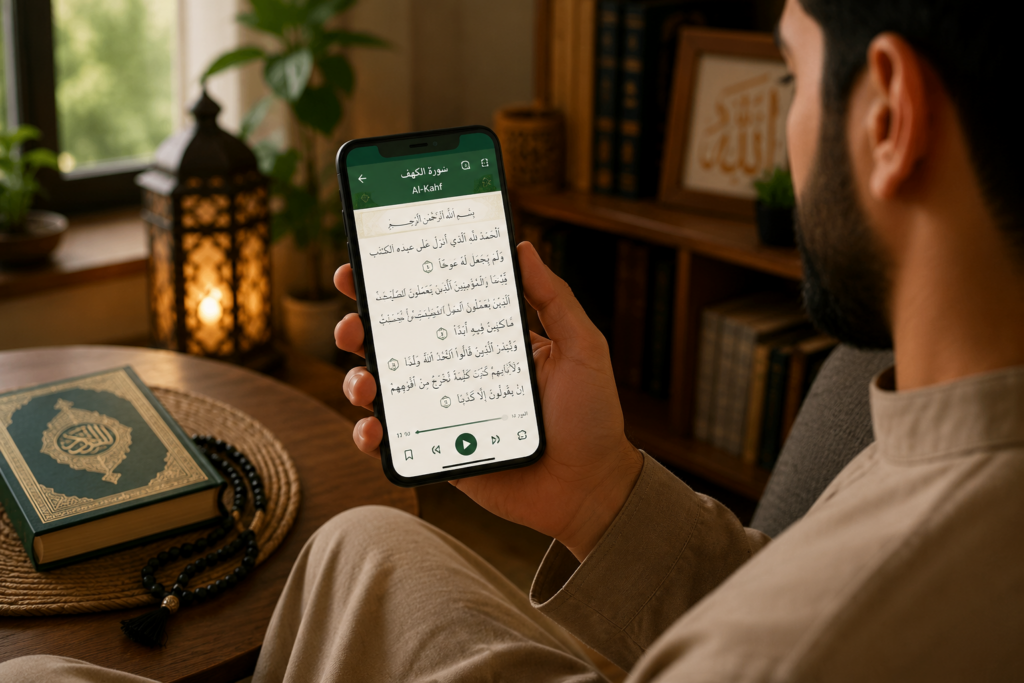
Table of Contents
Reading The Quran without Wudu on The Phone— The Ruling
Reading the Quran on your phone without wudu is permissible according to the overwhelming majority of contemporary Islamic scholars. The ruling rests on a foundational distinction in Islamic jurisprudence: the phone is not a mushaf, and the classical legal requirements attached to the physical mushaf do not automatically transfer to a device that displays Quranic text.
A mushaf is a physical, bound copy of the Quran — an object whose entire purpose is to carry the words of Allah in a tangible, permanent form. A phone screen renders text generated by software and also displays messages, news, and social media. In Islamic legal reasoning, the sacred status (hukm) of the mushaf derives from the physical object itself, not from any text that can appear on a surface.
Whether you are commuting, traveling, or simply away from your physical Quran, your phone brings the words of Allah within reach — and the ruling confirms it is fully permissible to use it:
Why The Phone Screen Is Not a Mushaf in Islamic Law
The verse most commonly cited by scholars when discussing purity and the Quran is from Surah Al-Waqi’ah:
لَّا يَمَسُّهُ إِلَّا الْمُطَهَّرُونَ
“None touch it except the purified ones.” (Surah Al-Waqi’ah, 56:79)
Classical scholars of tafsir — including Ibn Kathir and Al-Tabari — understood the pronoun “it” (هُ) in this verse to refer specifically to the physical mushaf in the earthly sense, or to the preserved Tablet (Al-Lawh Al-Mahfuz) in the heavenly sense. Either reading leads to the same conclusion: the verse is not describing every surface that displays Quranic letters, but a specific sacred object.
A phone screen, which cycles between the Quran, WhatsApp messages, and social media feeds, does not share the permanence or singular purpose that defines the mushaf as an object of divine status. Contemporary scholars from Al-Azhar University, the Permanent Committee for Islamic Research and Fatwas (Lajnah Da’imah) in Saudi Arabia, and major fatwa councils in the UAE and Egypt have consistently ruled on this basis: phones are general-purpose devices, and the obligation of ritual purity before interaction does not apply to them.
A common mistake in practice is to treat any device containing a Quran app as functionally equivalent to a mushaf, concluding that the phone can never be used without wudu. This is an over-application of the classical ruling that the scholarly evidence does not support.
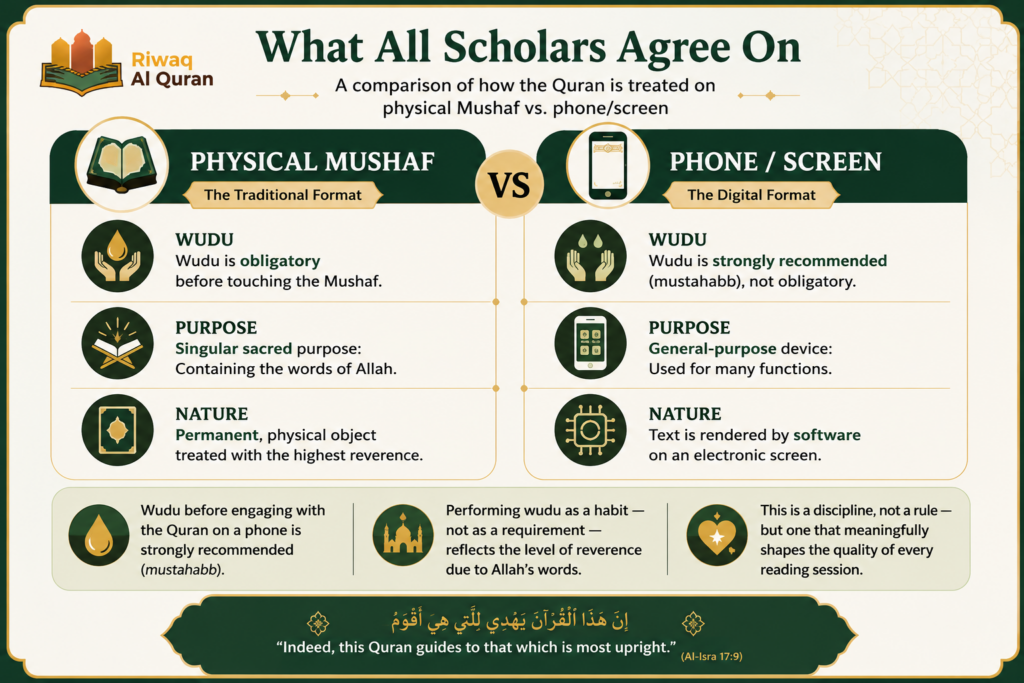
What All Scholars Agree On
The permissibility ruling does not mean treatment of the Quran on a phone is identical to handling any other content. Key points of unanimous scholarly agreement:
- Wudu before engaging with the Quran on a phone is strongly recommended (mustahabb) even when not obligatory
- Performing wudu as a habit — not as a requirement — reflects the level of reverence due to Allah’s words
- This is a discipline, not a rule — but one that meaningfully shapes the quality of every reading session
Can You Touch the Physical Quran without Wudu?
The ruling on a physical mushaf is meaningfully stricter, and understanding this difference is what makes the phone ruling make sense. The majority of Islamic scholars — across all four schools of jurisprudence — hold that touching a physical copy of the Quran requires ritual purity (tahara). Below is the textual evidence behind this ruling and the practical guidance for when your state of purity changes mid-reading.
a. The Hadith Evidence Behind the Ruling
For minor impurity (hadath asghar), wudu is required before touching the mushaf. For major impurity (hadath akbar), ghusl must be performed first. The primary hadith evidence comes from a letter of the Prophet ﷺ to Amr ibn Hazm, recorded in Al-Muwatta of Imam Malik:
(لَا يَمَسُّ الْقُرْآنَ إِلَّا طَاهِرٌ)
“None should touch the Quran except one who is pure.”(Al-Muwatta of Imam Malik, authenticated in the Mustadrak of Al-Hakim)
This narration comes from a letter dictated by the Prophet ﷺ to Amr ibn Hazm and transmitted through multiple chains. Scholars have cited it as establishing the baseline ruling for the physical mushaf. It does not mention electronic devices — because none existed — and classical jurists applied its ruling to the object it describes: a tangible copy of the Quran.
This is precisely why contemporary scholars could extend the ruling’s logic forward: when the object in question is not a mushaf, this narration’s prohibition does not reach it.
b. The Quranic Basis for Ritual Purity
The broader command to approach acts of worship in a state of purity comes from:
(يَا أَيُّهَا الَّذِينَ آمَنُوا إِذَا قُمْتُمْ إِلَى الصَّلَاةِ فَاغْسِلُوا وُجُوهَكُمْ وَأَيْدِيَكُمْ إِلَى الْمَرَافِقِ وَامْسَحُوا بِرُءُوسِكُمْ وَأَرْجُلَكُمْ إِلَى الْكَعْبَيْنِ)
“O you who believe, when you rise to perform prayer, wash your faces and your forearms to the elbows, wipe over your heads, and wash your feet to the ankles.”(Surah Al-Ma’idah, 5:6)
This verse establishes the wudu obligation for salah, and scholars applied its underlying principle — that acts of worship require a prepared, purified state — to the handling of the mushaf. The reasoning is a form of qiyas (analogical inference): if standing before Allah in prayer requires purification, then holding His physical Book deserves the same preparation.
Crucially, this analogy was always understood by jurists to target physical contact with the mushaf — not every form of Quranic engagement. Memory recitation, listening, and digital reading fall outside the analogy’s scope because they do not involve touching the sacred object.
For a complete step-by-step breakdown of how to perform wudu correctly, Riwaq Al Quran’s dedicated guide covers each stage in full.
c. If Your Wudu Breaks Mid-Session
Knowing what to do when your state of purity changes unexpectedly is a practical question many readers face:
- Reading a physical mushaf: Stop handling the book, close it respectfully, perform wudu, and return. There is no sin for an involuntary break — the obligation applies to intentional handling without purification, not to accidents.
- Reading on a phone or Quran app: Continue reading. Because wudu was not obligatory for phone reading to begin with, breaking wudu mid-session does not obligate you to stop.
The Hadith Evidence — Why Purity Matters for Every Form of Worship
Understanding why scholars take the purity question so seriously begins with understanding what Islamic law says about purification itself. The Prophet ﷺ said:
(الطُّهُورُ شَطْرُ الْإِيمَانِ… وَالْقُرْآنُ حُجَّةٌ لَكَ أَوْ عَلَيْكَ)
“Cleanliness is half of faith… and the Holy Quran is a proof on your behalf or against you.”(Sahih Muslim 223 — narrated by Abu Malik Al-Ash’ari)
This hadith links two things directly relevant here:
- Purification (tahara) is not a minor ritual formality — it constitutes half of a Muslim’s iman. This explains why the question of wudu around the Quran carries such weight in Islamic law: it touches the foundations of faith, not just etiquette.
- The Quran is a proof on your behalf or against you. How you approach recitation — with what level of preparation, attention, and reverence — shapes what it witnesses for or against you. Performing wudu before opening your Quran app, even when not required, changes the character of what follows.
To deepen your relationship with the Quran beyond recitation, Riwaq Al Quran’s blog explores what the Quran teaches and its importance in a Muslim’s life.
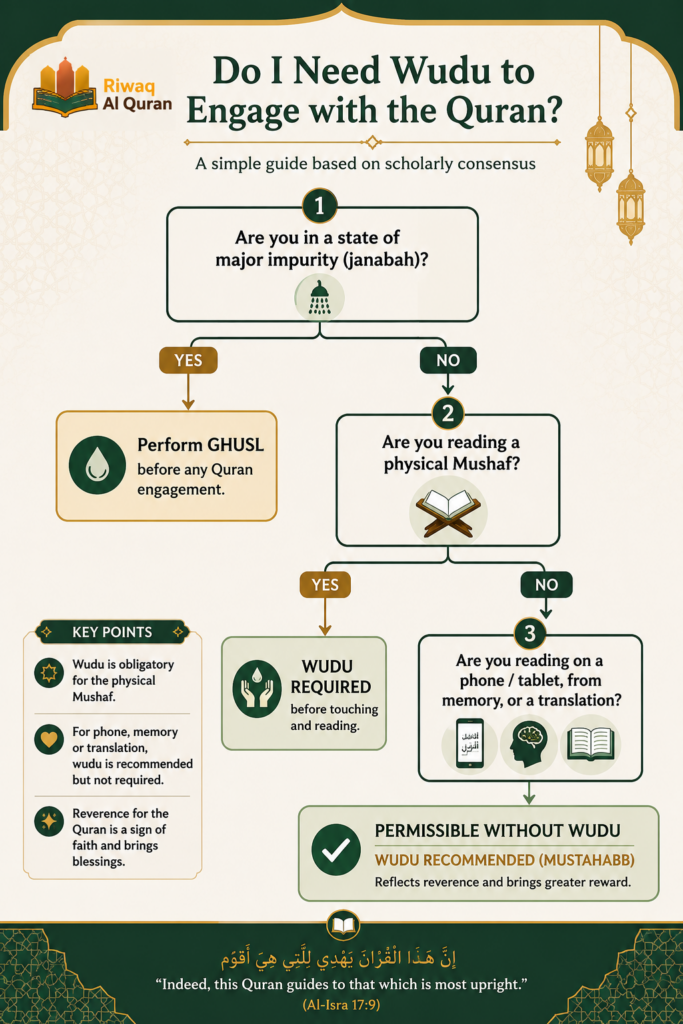
Rulings by Situation: A Practical Decision Guide
The wudu ruling shifts across different types of Quranic engagement. The table below gives a quick reference for the most common scenarios, followed by the full ruling and evidence for each.
| Situation | Ruling | Key Note |
|---|---|---|
| Reading Quran on phone — minor impurity | Permissible, no wudu required | Wudu still strongly recommended |
| Reciting from memory — minor impurity | Permissible, no wudu required | Same reasoning as phone reading |
| Reading a non-Arabic translation | Permissible, no wudu required | Applies to physical copies too |
| Touching a physical mushaf | Wudu obligatory | Ghusl required for major impurity |
| Any Quran reading while in janabah | Prohibited until ghusl performed | Phone provides no exemption here |
1. Reading from Memory without Wudu
Reciting the Quran from memory without wudu is permissible when in a state of minor impurity:
- The ruling on the mushaf applies to the physical object, not to words stored in the heart.
- A hafiz — someone who has memorized the full Quran — can recite at any time without wudu.
- This has been the consistent position of scholars across all four schools.
The distinction that many miss: the permissibility for memory recitation ends when major impurity (janabah) is present. This is covered in section 3 below.
2. Reading an English Translation without Wudu
Reading an English — or any non-Arabic — translation of the Quran without wudu is permissible, including handling a physical copy of the translation:
- Translations are classified in Islamic law as explanatory works (tafsir) rather than the Quran itself.
- The Quran, as defined by scholars, is specifically the Arabic revelation — the divine speech in its original language.
- Translations convey meaning, not the sacred speech itself, so the purity requirement does not attach to them.
For more on whether reading the Quran in English carries the same reward as reciting in Arabic, Riwaq Al Quran’s dedicated guide addresses this in full. You may also want to read about reading the Quran on a phone for further related rulings.
3. Reading the Quran While in a State of Major Impurity (Janabah)
Janabah — major ritual impurity resulting from sexual intercourse or nocturnal emission — prohibits Quranic recitation and reading in all forms until ghusl (a full ritual bath) is performed. This ruling applies to:
- Reciting from memory.
- Reading a physical mushaf.
- Reading a Quran app on your phone.
This is the one scenario where being on a phone provides no exemption. The prohibition during janabah is tied to the person’s state, not to the object or device. The hadith most cited as evidence is narrated by Ali ibn Abi Talib ﵁ and recorded by Abu Dawud 229:
“كَانَ لَا يَحْجُزُهُ ـ أَوْ قَالَ: لَا يَحْجُبُهُ ـ عَنِ الْقُرْآنِ شَيْءٌ إِلَّا الْجَنَابَةُ“
“Nothing prevented the Messenger of Allah ﷺ — or he said: nothing held him back — from the Quran except sexual defilement (janabah).”
Al-Albani graded this particular chain as Da’if (weak) — an important disclosure. However, the ruling that janabah prohibits Quran recitation does not rest on this narration alone. It is established by:
- Scholarly consensus (ijma) across all four schools of Islamic law.
- Corroborating narrations in other hadith collections.
- The transmitted practice of the Companions.
Ibn Taymiyyah and Ibn al-Qayyim both discussed this prohibition at length without relying solely on this chain. The Da’if grading on this particular narration does not undermine the ruling, but it is worth knowing when evaluating citations encountered online.
If you are building a Quran memorization practice and want to ensure you are reciting accurately — with correct pronunciation and Tajweed — Riwaq Al Quran’s memorization and Tajweed program offers certified live sessions with qualified teachers worldwide.
How the Four Schools of Islamic Law View the Phone Question
The Hanafi, Maliki, Shafi’i, and Hanbali schools all formed their foundational rulings centuries before mobile technology. Their positions on phone screens are therefore extrapolations made by contemporary scholars within each school’s legal framework — not direct rulings from classical texts.
This is practically important: many rulings circulating online cite the opinion of one school without naming it, which explains why you may encounter contradictory answers.
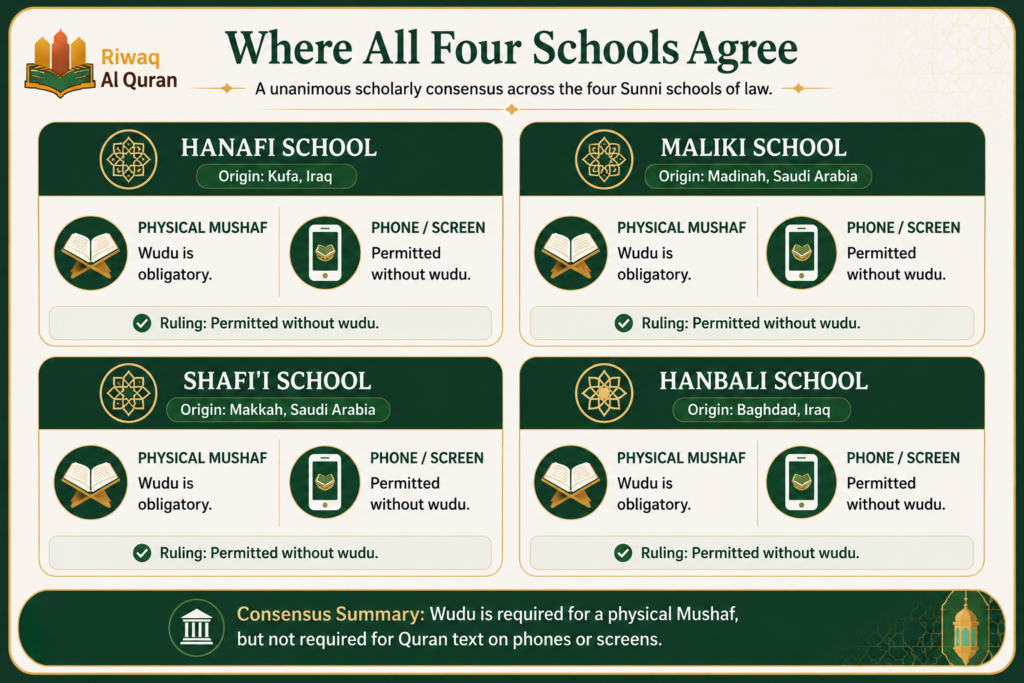
a. Where All Four Schools Agree
All four schools require wudu for touching a physical mushaf. On phone screens, the consensus is equally clear. The table below summarizes each school’s position:
| School of Law | Ruling on Physical Mushaf | Ruling on Phone/Screen |
|---|---|---|
| Hanafi | Wudu obligatory | Permitted without wudu |
| Maliki | Wudu obligatory | Permitted without wudu |
| Shafi’i | Wudu obligatory | Permitted without wudu |
| Hanbali | Wudu obligatory | Permitted without wudu |
The reasoning is identical across all four: the phone is not a mushaf under the definition established in classical fiqh. The fatwas from the Lajnah Da’imah, Al-Azhar, and the European Council for Fatwa and Research all reach the same conclusion.
b. The Minority Position Worth Knowing
A minority of scholars — drawing on Maliki principles about treating objects associated with the Quran with heightened respect — have argued that:
- A phone used exclusively as a Quran reader, with all other apps removed, begins to approach the respect level of a mushaf even if it does not attain its legal status.
- Under this view, wudu remains recommended but not obligatory even for such a device.
- No major fatwa body applies this position in a way that changes the permissibility ruling for ordinary smartphones.
Knowing this spectrum of opinion explains why some scholars speak with extra caution on the topic.
Best Practices When Reading the Quran on Your Phone
Permissibility and best practice are two different things. The habits below do not change what is required — they raise the quality of your engagement with the Quran, which is the real goal of reading the Quran in the first place.
1. Perform Wudu Before Reading When You Can
Allah describes His love for those who seek purity:
“إِنَّ اللَّهَ يُحِبُّ التَّوَّابِينَ وَيُحِبُّ الْمُتَطَهَّرِينَ“
“Indeed, Allah loves those who are constantly repentant and loves those who purify themselves.”
(Surah Al-Baqarah, 2:222)
This verse identifies purification as something Allah loves — not merely something He requires in specific rulings. A Muslim who performs wudu before opening a Quran app is acting in a way that invites Allah’s love, regardless of whether wudu is legally obligatory.
Making wudu a default before reading transforms it from a legal threshold into an act of taqarrub — drawing closer to Allah. It is a signal to yourself that what follows is different from scrolling through messages.


2. Silence Notifications Before You Begin
One of the most common practical mistakes when reading the Quran on a phone is leaving notifications active. Simple steps to protect focus:
- Enable Do Not Disturb or airplane mode before beginning each session.
- A message alert mid-recitation immediately breaks focus and reframes the device as a communication tool.
- This single adjustment improves the depth of recitation more than most other changes.
3. Read for Reward — Every Letter Counts
Reading the Quran on your phone is not spiritually inferior to reading from a physical copy in terms of the reward received. The Prophet ﷺ said:
“مَنْ قَرَأَ حَرْفًا مِنْ كِتَابِ اللَّهِ فَلَهُ بِهِ حَسَنَةٌ، وَالْحَسَنَةُ بِعَشْرِ أَمْثَالِهَا، لَا أَقُولُ الم حَرْفٌ، وَلَكِنْ أَلِفٌ حَرْفٌ، وَلَامٌ حَرْفٌ، وَمِيمٌ حَرْفٌ“
“Whoever recites a letter from the Book of Allah receives one good deed for it, and a good deed is multiplied ten times. I do not say that Alif Lam Mim is one letter — rather Alif is a letter, Lam is a letter, and Mim is a letter.”
(Jami’ at-Tirmidhi 2910 — narrated by Ibn Masud, graded Hasan)
The reward of recitation scales with the letters recited, not the medium they appear on. Key implications:
- A Muslim reading Surah Al-Baqarah on a phone app earns reward for every one of its 6,140+ letters — each multiplied tenfold.
- Quran apps are genuinely valuable tools for accumulating recitation time on a commute, during a break, or between appointments.
- The accumulation of that reward is real and documented in the Sunnah.

4. Keep the Screen Clean
Wiping the screen before a reading session serves two purposes:
- It is a small act of respect for the words of Allah displayed on it.
- Practically, a clean screen reduces eye fatigue during extended reading — particularly for those working through longer passages or memorization review.
5. Recite with Proper Tajweed, Not Just Speed
A specific risk with phone-based Quran reading is that the informal context of the device encourages rushing. Readers tend to scroll faster than they would turn pages in a mushaf, leading to:
- Skipping elongation rules (madd).
- Compressing stops (waqf)
- Flattening the distinction between heavy (mufakhkham) and light (muraqqaq) letters
Tajweed is not a stylistic addition to recitation — it is the recitation standard the Prophet ﷺ transmitted and lived by, affirmed in the hadith narrated by Uthman ibn Affan:
“خَيْرُكُمْ مَنْ تَعَلَّمَ الْقُرْآنَ وَعَلَّمَهُ“
“The best among you are those who learn the Quran and teach it.”
(Sahih Al-Bukhari 5027 — narrated by Uthman ibn Affan)
Learning the Quran (ta’allum) in this hadith means learning it correctly — with proper pronunciation, recitation rules, and understanding. The Prophet ﷺ connected excellence to the quality of learning, not the volume of pages covered. Phone-based recitation should be no different: use it to recite properly, not just quickly.
If your recitation has developed habits you are unsure about, working with a certified Tajweed instructor through Riwaq Al Quran’s online recitation course is the most reliable way to identify and correct them — at any level, from beginners to those preparing for Ijazah.
Start Reciting the Quran Correctly — Book Your Free Trial at Riwaq Al Quran
Your phone puts the Quran within reach at any moment. What turns that access into a lasting connection is reciting it correctly — with the pronunciation, rhythm, and rules that Allah’s words deserve.
Riwaq Al Quran is a comprehensive online platform offering personalized Quran, Arabic, and Islamic Studies classes for individuals of all ages and backgrounds. Experienced, certified instructors use a structured curriculum covering Tajweed, Tafsir, and Memorization — with advanced live sessions designed for seamless interaction between students and teachers, wherever you are in the world.
See what a live Riwaq Al Quran recitation session looks like — and what you can build from your very first class:
Find the course that matches your goal:
| Your Goal | Recommended Course |
|---|---|
| Build Quranic basics from scratch | Noorani Qaida Online |
| Master Tajweed rules and recitation | Online Tajweed & Memorization Course |
| Expert-guided recitation practice | Online Quran Recitation Course |
| Understand the Quran’s deeper meanings | Online Tafseer Course |
| Explore diverse recitation styles | Online Qirat Course |
| Memorize the Quran with a structured plan | Quran Memorization Online Course |
| Quran learning designed for your child | Online Quran Classes for Kids |
Beyond individual courses, Riwaq Al Quran offers full learning tracks across Quran classes for all ages, Arabic language, Ijazah certification, Islamic Studies, and specialized programs for children — all taught live, one-on-one, by qualified teachers.

Conclusion
Reading the Quran on your phone without wudu is permissible according to scholarly consensus. The phone is not a mushaf, and the classical ruling requiring ritual purity before touching the Quran applies to the physical book — not to a device that renders text on a screen. The one firm exception is janabah: major ritual impurity requires ghusl before engaging with the Quran in any form, including on a phone.
Wudu before reading on your phone remains recommended even when not required — because the goal of reading the Quran is not merely to see the words, but to connect with them. Purification is half of faith, the Quran is a proof on your behalf or against you, and every letter carries ten rewards. Purity, focus, proper recitation, and understanding the Quran together determine how much you take from that connection. Every one of those elements can be developed — and for those who want to take their recitation further, that development is exactly what Riwaq Al Quran is built for.
Frequently Asked Questions
The questions below cover the rulings Muslims most commonly search for — from the basic permissibility ruling to the nuances that most articles leave unanswered.
Does reading the Quran on a phone without wudu break any Islamic rule?
No. Reading the Quran on a phone without wudu is classified as permissible (mubah) by the majority of contemporary Islamic scholars. The phone is not a mushaf, so the wudu obligation that applies to handling a physical Quran does not apply to a phone screen. There is no sin and the reading is valid.
Is it haram to read the Quran on your phone without wudu?
It is not haram. The ruling is permissible, not prohibited. Wudu before reading on a phone is recommended as an act of spiritual reverence — and as the verse in Surah Al-Baqarah (2:222) reminds us, Allah loves those who purify themselves — but its absence does not make the reading sinful or invalidate it.
Can you read the Quran on your phone while in a state of janabah?
No. Janabah — major ritual impurity after sexual intercourse or nocturnal emission — prohibits Quranic recitation and reading in all forms, including on a phone, until ghusl is performed. This is the one case where the phone does not provide an exemption, because the prohibition is tied to the person’s state, not the object or device. The ruling is established by scholarly consensus across all four schools.
If your wudu breaks while reading the Quran on your phone, must you stop?
No. Because wudu is not obligatory for phone-based Quran reading, breaking wudu mid-session does not obligate you to stop. For reading a physical mushaf, however, the correct practice is to close the book and perform wudu before continuing to handle it.
Is reading an English translation of the Quran without wudu allowed?
Yes, including a physical printed copy. Translations are classified in Islamic law as explanatory works (tafsir), not the Quran itself — which is defined as the original Arabic revelation. The purity requirement attaches to the Arabic text, not to translations in other languages. A related question many ask is whether listening to the Quran without wudu carries the same permissibility — that ruling is addressed in a dedicated guide.
Can a child use a Quran app without wudu?
Yes. Children who have not reached puberty are not bound by the full adult obligations of tahara. They are encouraged to build habits of purity early, but using a Quran app without wudu is not sinful for a child. Teaching them to perform wudu before reading is a sound practice, framed as an act of love for the Quran rather than a strict legal requirement.
Does the reward for reading the Quran on a phone count the same as reading from a physical copy?
Yes. Reward for recitation is tied to the letters recited, not the medium. The Prophet ﷺ said every letter of the Quran earns one good deed multiplied by ten (Tirmidhi 2910) — and that ruling makes no distinction between a mushaf and a screen. What the physical copy offers is a stronger spiritual atmosphere and additional blessing (barakah) — but the reward for the recitation act itself is the same.