What does the Quran teach, in plain terms? It teaches the oneness of Allah, a set of personal virtues like honesty and patience, and a framework for how people should treat each other — including non-Muslims, which is also where most misconceptions about the text start.
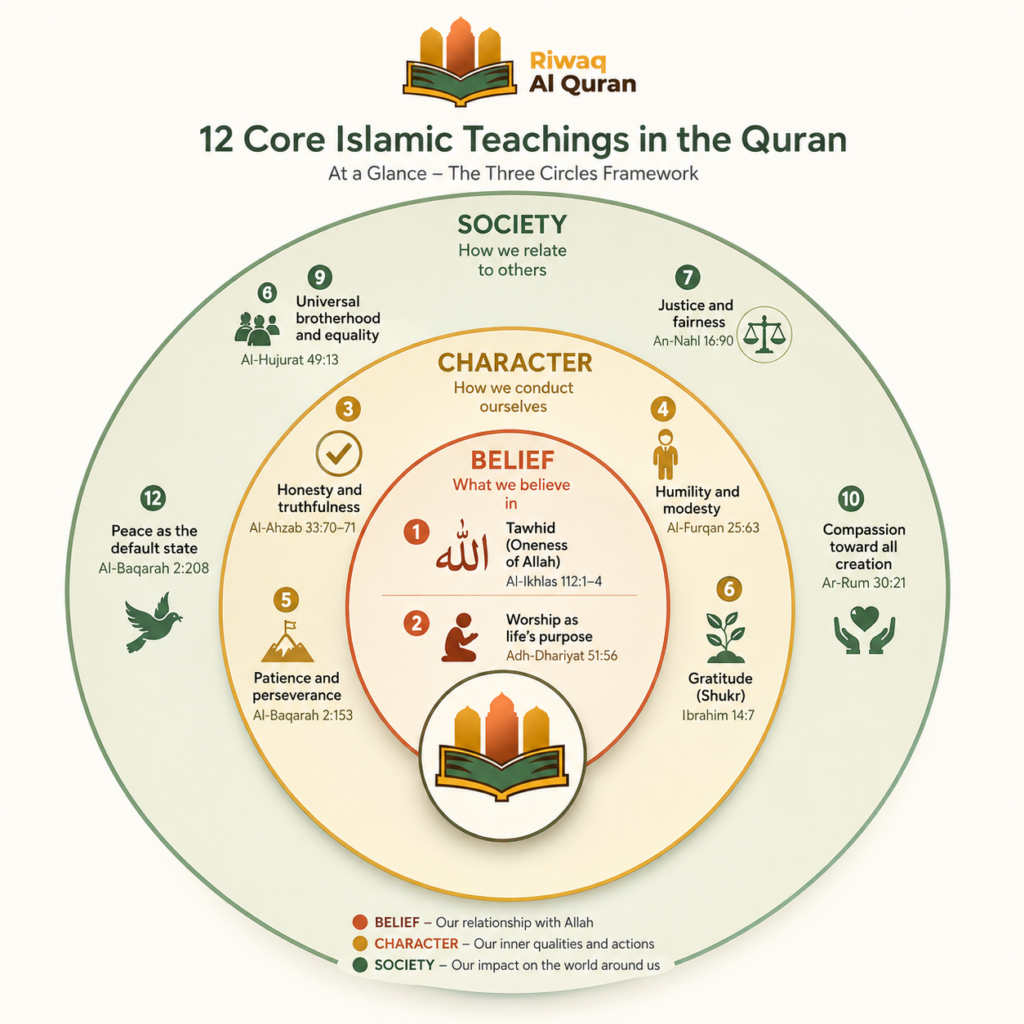
This guide walks through 12 core teachings, grouped by what they actually govern: belief, personal character, and social conduct. Each one is tied to a specific verse in Arabic, so you can see the source rather than take the summary on faith. It also addresses the two questions people search for most — whether the Quran teaches peace or violence — directly, with the verses usually cited on both sides of that argument.
A Quick Reference to All 12 Teachings and Their Quranic Sources
Before going through each teaching in detail, here’s a single reference table you can scan or come back to — it maps every teaching in this guide to its exact Surah and verse.
| # | Teaching | Surah and Verse |
|---|---|---|
| 1 | Tawhid (Oneness of Allah) | Al-Ikhlas 112:1-4 |
| 2 | Worship as life’s purpose | Adh-Dhariyat 51:56 |
| 3 | Honesty and truthfulness | Al-Ahzab 33:70-71 |
| 4 | Humility and modesty | Al-Furqan 25:63 |
| 6 | Gratitude (Shukr) | Ibrahim 14:7 |
| 7 | Forgiveness and mercy | Al-A’raf 7:199 |
| 8 | Justice and fairness | An-Nahl 16:90 |
| 9 | Universal brotherhood and equality | Al-Hujurat 49:13 |
| 10 | Compassion toward all creation | Ar-Rum 30:21 |
| 11 | Knowledge and continuous learning | Ta-Ha 20:114 |
| 12 | Peace as the default state | Al-Baqarah 2:208 |
Table of Contents
A. The Quranic Teaching About Faith and Worship
Before any teaching on conduct, the Quran establishes belief itself: that Allah is one, and that worship is the reason for human existence. These two teachings sit underneath everything else in the list, which is why they come first.
1. Tawhid- The Oneness of Allah
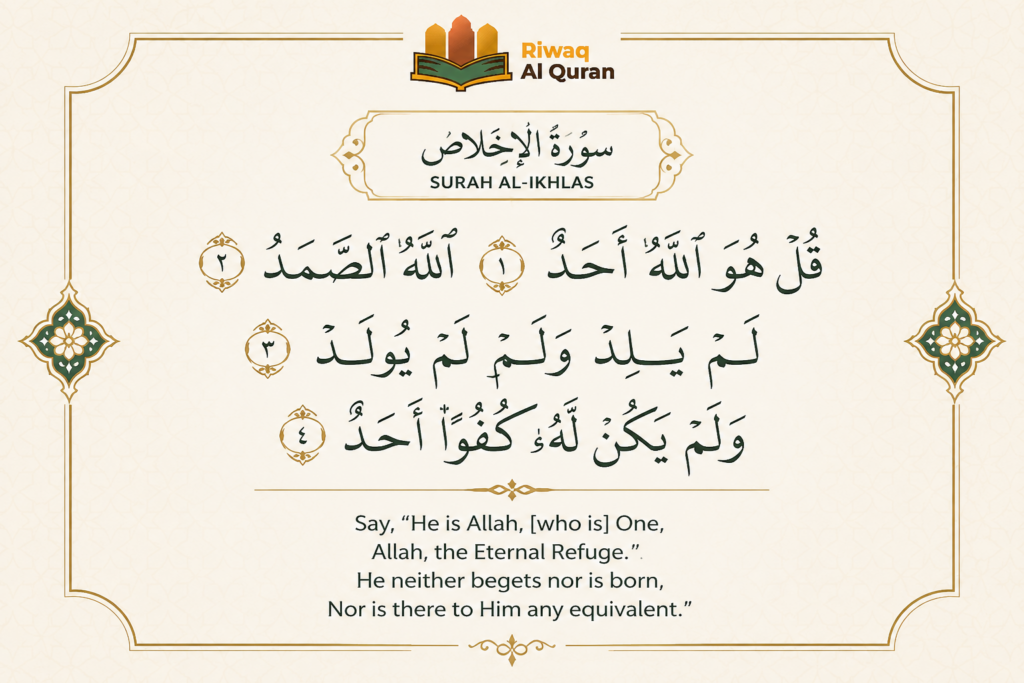
Tawhid is the belief that Allah is one, without partner or equal — the foundational doctrine of Islam that every other teaching in the Quran builds on. Surah Al-Ikhlas states this directly:
(قُلْ هُوَ اللَّهُ أَحَدٌ، اللَّهُ الصَّمَدُ، لَمْ يَلِدْ وَلَمْ يُولَدْ، وَلَمْ يَكُن لَّهُ كُفُوًا أَحَدٌ )
“Say, ˹O Prophet,˺ “He is Allah—One ˹and Indivisible˺; Allah—the Sustainer ˹needed by all˺. He has never had offspring, nor was He born. And there is none comparable to Him.” (Surah Al-Ikhlas 112:1-4)
Because Tawhid is treated as the starting point rather than one belief among several, the Quran returns to it more often than to any other single doctrine — it’s the lens the rest of the text is read through.
2. Worship as the Purpose of Creation
The Quran frames worship not as one obligation among many, but as the stated reason humans and jinn were created. Surah Adh-Dhariyat puts it directly:
(وَمَا خَلَقْتُ الْجِنَّ وَالْإِنسَ إِلَّا لِيَعْبُدُونِ)
“I did not create jinn and humans except to worship Me.” (Surah Adh-Dhariyat 51:56)
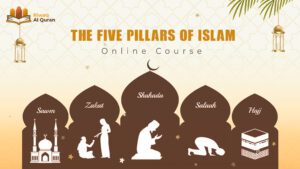
In practice, this teaching is expressed through four pillars of worship the Quran and Hadith build into daily and yearly life:
- Daily prayer (salah), performed five times a day.
- Fasting during the month of Ramadan.
- Charity (zakat), given to those in need.
- Pilgrimage (Hajj) to Mecca, for those who are able.
The Quran treats these as the practical expression of Tawhid, not something separate from it. This is exactly the question Surah Adh-Dhariyat answers directly — here’s a short reflection on it
B. The Quranic Teachings About Personal Character
A second layer of teaching governs the individual — how a person is expected to behave regardless of who’s watching. Five virtues recur often enough across the Quran to count as its core character teachings, and several are reinforced directly in the Hadith, which is where the practical “how” of applying them usually comes from.
3. Honesty and Truthfulness
The Quran ties truthful speech directly to the soundness of a person’s deeds, not just their reputation. Surah Al-Ahzab instructs:
(يَا أَيُّهَا الَّذِينَ آمَنُوا اتَّقُوا اللَّهَ وَقُولُوا قَوْلًا سَدِيدًا، يُصْلِحْ لَكُمْ أَعْمَالَكُمْ)
“O believers! Be mindful of Allah, and speak with honesty and integrity. He will bless your deeds for you.” (Surah Al-Ahzab 33:70-71)
The structure of this verse is worth noticing: truthful speech is presented as the condition for good deeds to be accepted, not a separate virtue running alongside them. A hadith agreed upon by both Bukhari and Muslim extends this into a chain of cause and effect:
(إِنَّ الصِّدْقَ يَهْدِي إِلَى الْبِرِّ، وَإِنَّ الْبِرَّ يَهْدِي إِلَى الْجَنَّةِ)
“Truthfulness leads to righteousness, and righteousness leads to Paradise.” (Sahih al-Bukhari 6094, Sahih Muslim 2607)
A common misreading here is treating honesty as situational — permissible to bend for a “good reason.” The hadith’s framing works against that: it describes truthfulness as a habit that compounds, not a rule applied case by case.
4. Humility and Modesty
The Quran describes the ideal believer through their manner of walking and speaking, not their status. Surah Al-Furqan states:
(وَعِبَادُ الرَّحْمَٰنِ الَّذِينَ يَمْشُونَ عَلَى الْأَرْضِ هَوْنًا وَإِذَا خَاطَبَهُمُ الْجَاهِلُونَ قَالُوا سَلَامًا)
“The ˹true˺ servants of the Most Compassionate are those who walk on the earth humbly, and when the ignorant address them ˹harshly˺, they respond with words of peace. (S’urah Al-Furqan 25:63)
The verse specifically addresses how to respond to hostility — with a measured word, not silence and not retaliation — which makes humility here an active discipline rather than passive meekness.
5. Patience and Perseverance
Patience (sabr) is paired with prayer as a tool for facing hardship, not simply endured as suffering. Surah Al-Baqarah says:
(يَا أَيُّهَا الَّذِينَ آمَنُوا اسْتَعِينُوا بِالصَّبْرِ وَالصَّلَاةِ ۚ إِنَّ اللَّهَ مَعَ الصَّابِرِينَ)
“O believers! Seek comfort in patience and prayer. Allah is truly with those who are patient.” (Surah Al-Baqarah 2:153)
Classical scholarship generally divides sabr into three applied forms:
- Patience in carrying out obligations.
- Patience in avoiding what’s forbidden.
- Patience through hardship that isn’t a person’s choice.
This distinction matters — it’s easy to miss if the word is read only as “enduring difficulty.”
Reading a verse like this alongside the surrounding chapter, rather than as a single isolated line, is exactly what Riwaq Al Quran’s online Tafsir course is built around — an instructor walks through the full passage with you, live.
6. Gratitude (Shukr)
Gratitude in the Quran is framed as directly tied to increase, not simply a polite response to good fortune. Surah Ibrahim states:
(لَئِن شَكَرْتُمْ لَأَزِيدَنَّكُمْ وَلَئِن كَفَرْتُمْ إِنَّ عَذَابِي لَشَدِيدٌ)
“If you are grateful, I will certainly give you more. But if you are ungrateful, surely My punishment is severe.” (Surah Ibrahim 14:7)
Gratitude and patience are often taught as a linked pair in Islamic scholarship — patience for hardship, gratitude for ease — since a believer is expected to encounter both, and the Quran ties a distinct response to each rather than treating one attitude as sufficient for every circumstance.
7. Forgiveness and Mercy
The Quran instructs believers to default to leniency, even toward people who provoke them. Surah Al-A’raf states:
(خُذِ الْعَفْوَ وَأْمُرْ بِالْعُرْفِ وَأَعْرِضْ عَنِ الْجَاهِلِينَ)
“Be gracious, enjoin what is right, and turn away from those who act ignorantly.” (Surah Al-A’raf 7:199)
This is one of the clearest instructions in the Quran on handling conflict at a personal level — not through confrontation, but through restraint.
Paired with the humility teaching above, it forms a consistent pattern: the Quran repeatedly answers “what do I do when someone wrongs me” with restraint and measured response, rather than leaving the reaction unaddressed.
C. The Quran Teach About Society and Justice
A third layer of teaching moves outward from the individual to how communities should function — justice, equality, compassion, and the pursuit of knowledge as a shared responsibility rather than a private hobby.
8. Justice and Fairness
Justice in the Quran is described as a direct command from Allah, paired with excellence in conduct. Surah An-Nahl states:
(إِنَّ اللَّهَ يَأْمُرُ بِالْعَدْلِ وَالْإِحْسَانِ وَإِيتَاءِ ذِي الْقُرْبَىٰ وَيَنْهَىٰ عَنِ الْفَحْشَاءِ وَالْمُنكَرِ وَالْبَغْيِ)
“Indeed, Allah commands justice, grace, and generosity to close relatives. He forbids indecency, wickedness, and oppression. He instructs you so that you may take heed.” (Surah An-Nahl 16:90)
Classical commentators, including Al-Qurtubi, treat this single verse as covering nearly every command and prohibition in Islamic ethics — justice and good conduct on one side, indecency and oppression on the other.
9. Universal Brotherhood and Equality
The Quran explicitly rejects tribal or racial hierarchy as a measure of worth. Surah Al-Hujurat states:
(يَا أَيُّهَا النَّاسُ إِنَّا خَلَقْنَاكُم مِّن ذَكَرٍ وَأُنثَىٰ وَجَعَلْنَاكُمْ شُعُوبًا وَقَبَائِلَ لِتَعَارَفُوا ۚ إِنَّ أَكْرَمَكُمْ عِندَ اللَّهِ أَتْقَاكُمْ)
“O humanity! Indeed, We created you from a male and a female and made you into peoples and tribes so that you may know one another. Surely the most honored of you in the sight of Allah is the most righteous among you” (Surah Al-Hujurat 49:13)
The verse names ethnic and tribal diversity directly, then states that the only distinction that matters to Allah is righteousness — not lineage.
The tribal hierarchy this verse rejects wasn’t abstract — it was the reality Jahiliyyah normalized, and the parallels to today are worth sitting with.
10. Compassion Toward All Creation
The Quran frames compassion as something built into the structure of relationships, starting with marriage. Surah Ar-Rum states:
(وَمِنْ آيَاتِهِ أَنْ خَلَقَ لَكُم مِّنْ أَنفُسِكُمْ أَزْوَاجًا لِّتَسْكُنُوا إِلَيْهَا وَجَعَلَ بَيْنَكُم مَّوَدَّةً وَرَحْمَةً)
“And one of His signs is that He created for you spouses from among yourselves so that you may find tranquility in them. And He has placed between you affection and mercy.” (Surah Ar-Rum 30:21)
Verses like this one are studied thematically in Riwaq Al Quran’s Islamic Studies courses — tracing how a single concept like mercy or compassion develops across dozens of chapters, with instructors who can answer questions in real time rather than leave you to piece it together from translations alone.
Islamic Codes:
11 . Knowledge and Continuous Learning
The Quran instructs the Prophet himself to keep asking for more knowledge — treating learning as an unfinished, lifelong process. Surah Ta-Ha states:
(وَقُل رَّبِّ زِدْنِي عِلْمًا)
“And say, “My Lord, increase me in knowledge.” (Surah Ta-Ha 20:114)
This short instruction is one reason Islamic scholarship historically placed such emphasis on continuous study rather than treating a single stage of learning as sufficient.
D. The Quran’s Teaching on Peace, Conflict, and the Value of Life
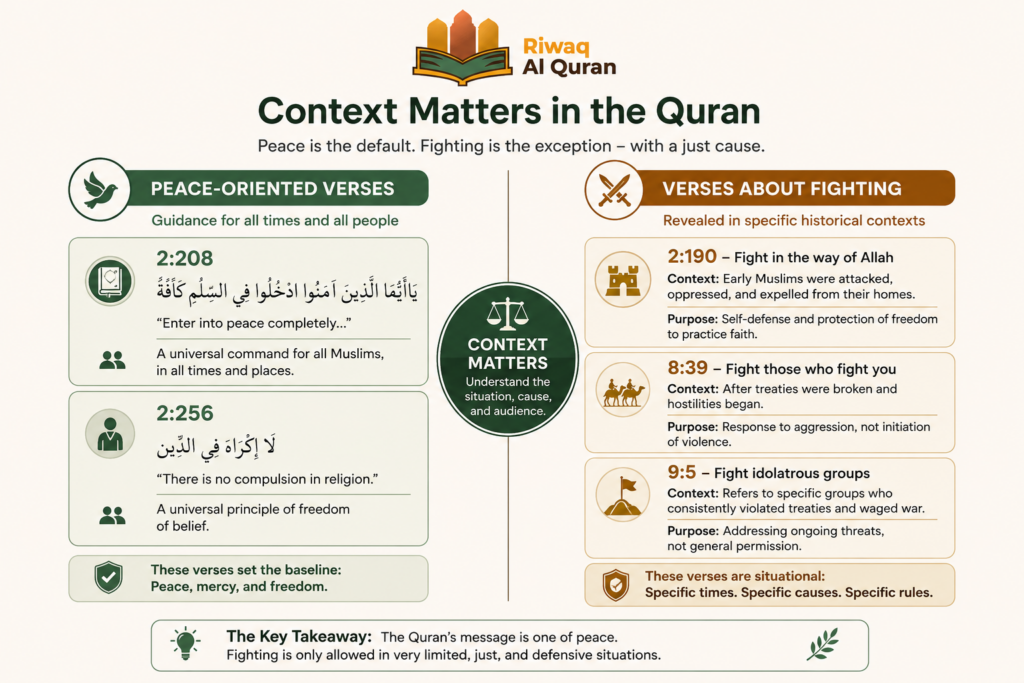
This section addresses the two claims people bring to this topic most often — that the Quran either teaches unconditional peace or sanctions violence — with the actual verses behind both positions, not a general assurance either way.
(يَا أَيُّهَا الَّذِينَ آمَنُوا ادْخُلُوا فِي السِّلْمِ كَافَّةً وَلَا تَتَّبِعُوا خُطُوَاتِ الشَّيْطَانِ ۚ إِنَّهُ لَكُمْ عَدُوٌّ مُّبِينٌ)
“O you who have believed, enter into peace completely and do not follow the footsteps of Satan. Indeed, he is to you a clear enemy.” (Quran 2:208)
12. Peace as the Quran’s Default Instruction
The Quran instructs believers to enter into peace completely, not partially. Surah Al-Baqarah states:
(يَا أَيُّهَا الَّذِينَ آمَنُوا ادْخُلُوا فِي السِّلْمِ كَافَّةً وَلَا تَتَّبِعُوا خُطُوَاتِ الشَّيْطَانِ)
“O believers! Enter into Islam wholeheartedly and do not follow Satan’s footsteps.” (Surah Al-Baqarah 2:208)
The word used here, silm, shares the same root as salam (peace) and Islam itself, which is why classical commentators read this verse as establishing peace as the default state, not an exception granted under specific conditions.
Enhance your love for Allah’s words by learning to recite the Quran online at Riwaq Al-Quran. Enroll in our expert-guided online Qirat course and perfect your Quranic recitation.
Compulsion in Religion Is Rejected, and Wartime Verses Are Tied to Their Historical Context
The Quran does not command violence against non-believers as a general rule. Surah Al-Baqarah states there is no compulsion in religion at all:
(لَا إِكْرَاهَ فِي الدِّينِ ۖ قَد تَّبَيَّنَ الرُّشْدُ مِنَ الْغَيِّ)
“There is no compulsion in religion. The right way has become distinct from error.” (Surah Al-Baqarah 2:256)
Verses that do discuss fighting were revealed in the context of specific battles the early Muslim community faced in Medina — a point Islamic scholarship calls asbab al-nuzul, the occasions of revelation.
Reading a wartime verse as a permanent, general instruction while ignoring the historical event it responded to is one of the most common misreadings of the Quran on this topic, made by critics and apologists alike.
The Sanctity of Human Life as the Quran’s Baseline
The Quran treats the unjust killing of a single person as equivalent to killing all of humanity. Surah Al-Ma’idah states:
(مَن قَتَلَ نَفْسًا بِغَيْرِ نَفْسٍ أَوْ فَسَادٍ فِي الْأَرْضِ فَكَأَنَّمَا قَتَلَ النَّاسَ جَمِيعًا وَمَنْ أَحْيَاهَا فَكَأَنَّمَا أَحْيَا النَّاسَ جَمِيعًا)
“Whoever takes a life—unless as punishment for murder or for spreading corruption in the land—it is as if they have killed all of humanity. And whoever saves a life, it is as if they have saved all of humanity.” (Surah Al-Ma’idah 5:32)
This verse sets the baseline the Quran applies to killing in general — an extreme severity attached to taking a life without legitimate cause, which is the standard against which any wartime verse has to be read, not the exception to it.
Study the Quran’s Teachings in Proper Context
Riwaq Al Quran is a comprehensive online platform that offers personalized Quran, Arabic and Islamic Studies classes for individuals of all ages and backgrounds. Their experienced instructors use a structured curriculum to cover Tajweed, Tafsir, and Memorization, providing easy and effective access to learning the Quran.
The advanced online classes allow for seamless communication and interaction between students and teachers — join Riwaq Al Quran for a deeper connection with the Quran.
We offer several courses such as:
- Online courses for kids
- Online Quran classes for kids and adults
- Online Arabic courses
- Online Ijazah courses
- Online Islamic Studies courses

Here are a sample of our Quran Courses that will be helpful for you:
- Online Tafseer Course: Delve into Quranic meanings with our insightful online Tafseer course.
- Noorani Qaida Online: Learn Quranic basics efficiently through our Noorani Qaida online program.
- Online Quran Recitation Course: Enhance Quranic recitation skills through our expert-led online course.
- Online Tajweed Classes: Master Tajweed rules for beautiful Quranic recitation in online classes.
- Quran Memorization Online Course: Memorize the Quran effectively with our specialized online memorization course.
- Online Qirat Course: Explore diverse Qirat styles with our comprehensive online Qirat course.
- Online Quran Classes for Kids: Nurture a love for the Quran in kids through interactive online classes.
Conclusion
What does the Quran teach, taken as a whole? Twelve teachings that build outward in three layers: belief in Allah’s oneness and the purpose of worship, personal character built on honesty, humility, patience, gratitude, and forgiveness, and a social framework of justice, equality, compassion, and lifelong learning.
On the two questions people ask most — peace or violence — the Quran’s own verses point toward peace as the default and unjust killing as one of the gravest violations it addresses, with wartime verses tied to specific historical events rather than standing as blanket instructions. Reading any single verse without that context is where most misconceptions about the Quran’s teachings start.
By studying the Quran with an open heart and mind, individuals can gain a deeper understanding of its teachings and apply them in their pursuit of spiritual growth and harmony with others.
FAQs
The teachings above cover the Quran’s major themes in depth, but a few specific questions come up often enough on their own to answer directly here.
What does the Quran teach about men and women at a spiritual level?
The Quran teaches that men and women hold equal spiritual worth and equal opportunity to seek Allah’s guidance, mercy, and forgiveness, with righteousness — not gender — determining a person’s standing before Allah.
What does the Quran teach about other religions?
The Quran acknowledges earlier prophets and scriptures, including Moses and Jesus, and instructs Muslims to engage other faiths through respectful dialogue rather than compulsion, while affirming Islam as the final revelation.
Why do some verses about fighting appear alongside verses about peace?
Verses discussing conflict were revealed in response to specific battles the early Muslim community faced, while verses on peace establish the Quran’s general default; reading the two together, in context, avoids treating a historical response as a permanent rule.
How many teachings does the Quran contain in total?
There’s no single official count, since the Quran addresses belief, conduct, and law across 114 chapters rather than listing teachings as a numbered set; this article groups 12 of the most consistently cited ones by theme.
Is the Quran the only source of Islamic teaching?
No. The Quran is the primary source, but Islamic teaching also draws on the Hadith — the recorded sayings and practices of the Prophet Muhammad — which explains and applies many Quranic principles in practical detail.