Most parents who struggle to teach Quran to kids aren’t failing because of a lack of love or effort — they’re using the wrong method for the wrong age. A 4-year-old needs something entirely different from a 10-year-old, and what works at home eventually hits a ceiling that only a qualified teacher can break through.
This guide gives you a complete, stage-by-stage system: 20 specific tactics, organized by phase, built around how children actually learn and retain Quranic material. It also covers the three mistakes that most commonly derail progress and a clear framework for knowing when home teaching should transition to a professional.
The Prophet ﷺ said:
“خَيْرُكُمْ مَنْ تَعَلَّمَ الْقُرْآنَ وَعَلَّمَهُ”
“The best among you are those who learn the Quran and teach it.” — (Sahih al-Bukhari, Hadith 5027)
This hadith does not merely encourage learning — it makes teaching the Quran to another person the defining mark of the best believer. For a parent, that means teaching your child the Quran is not only an obligation of care. It places you among the foremost in Allah’s sight.
Allah (SWT) frames this as a direct parental duty:
“يَا أَيُّهَا الَّذِينَ آمَنُوا قُوا أَنفُسَكُمْ وَأَهْلِيكُمْ نَارًا وَقُودُهَا النَّاسُ وَالْحِجَارَةُ”
“O you who believe! Protect yourselves and your families from a fire whose fuel is people and stones.” — (Surah, At-Tahrim 66:6)
Ibn Kathir and the classical scholars of tafsir interpreted “protecting your family” to mean educating them in the obligations of Islam, beginning with the Quran. Teaching your children to read and engage with the Quran is, in Islamic scholarship, the primary means of fulfilling this verse — not a supplement to it.
And Allah (SWT) reassures us about the accessibility of the Quran:
“وَلَقَدْ يَسَّرْنَا الْقُرْآنَ لِلذِّكْرِ فَهَلْ مِنْ مُدَّكِرٍ”
“And We have certainly made the Quran easy for remembrance, so is there any who will remember?” — (Surah, Al-Qamar 54:17)
The ease is promised. The method is what parents need to get right.
What You’ll Learn in This Article:
- The right starting point for ages 3–5, 6–9, and 10–14.
- 20 structured tactics across four phases of Quran learning for kids.
- The three most common mistakes parents make — and the specific fix for each.
- A decision framework for when home learning should transition to a professional tutor.
- How to keep children motivated at every stage of the journey.
Before we break down the stages and tactics, watch what a real Riwaq Al Quran kids’ session actually looks like in practice:
Table of Contents
How to Teach Quran to Kids by Age Group
Children’s cognitive and motor abilities change significantly between ages 3 and 14. Applying one teaching method across all ages is a leading reason children disengage — the material either overwhelms them or fails to stretch them. The three stages below show how the teaching approach must shift as the child develops, and what realistic goals look like at each stage.
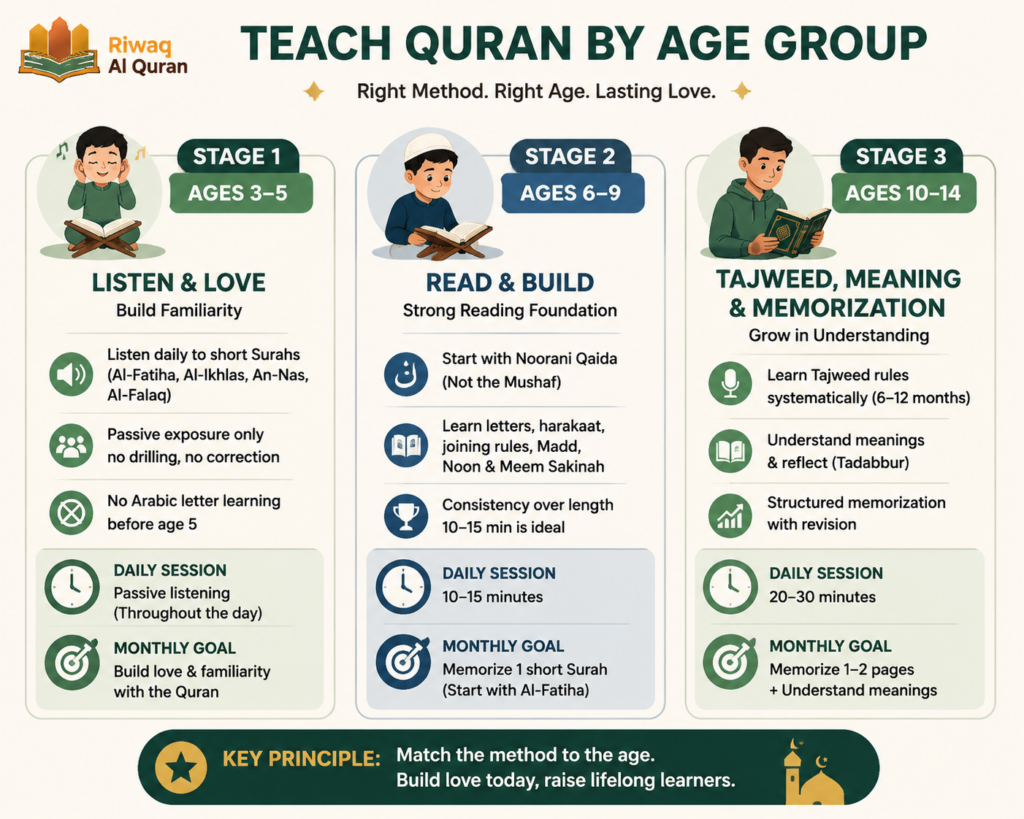
Stage 1 — Ages 3–5 – Listening Before Any Formal Instruction
At this stage, the goal is familiarity — not recitation, not memorization, and certainly not Tajweed rules. A child who grows up hearing the Quran daily will find its sounds natural by the time formal learning begins, which makes everything that follows easier and faster.
Practical steps for this stage:
- Play soft recitations of short Surahs — Al-Fatiha, Al-Ikhlas, An-Nas, Al-Falaq — during daily routines: after waking, at mealtimes, before sleep.
- Keep this as passive exposure only — no correction, no drilling, no formal sessions.
- Do not introduce Arabic letter writing or pronunciation correction before age 5.
Fine motor skills and the phonological awareness needed for letter-level instruction aren’t sufficiently developed at this stage. Forcing them creates frustration that builds negative associations with the Quran early — the opposite of what this phase is meant to achieve.
Stage 2 — Ages 6–9 -The Critical Window for Reading Foundation
This is the most important window for Quranic reading instruction. The correct starting point is Noorani Qaida — not the Mushaf. Noorani Qaida is a structured Arabic reading curriculum that teaches:
- Letter recognition and correct articulation.
- Vowel marks (harakaat) and their effect on pronunciation.
- Letter-joining rules and basic Madd (elongation).
- Noon and Meem Sakinah in controlled, progressive steps.
A child who completes it takes approximately 3–6 months depending on session frequency. Children who skip it and start directly in the Quran routinely develop pronunciation errors that persist for years.
A realistic daily session at this age is 10–15 minutes — sessions beyond 20 minutes produce diminishing returns and often create resistance that undoes the previous session’s progress. A reasonable memorization target: one short Surah per month, starting with Al-Fatiha and working through the Mufassal.
One of the most important hadiths a parent can share with a child who finds Arabic letters difficult is this:
“الْمَاهِرُ بِالْقُرْآنِ مَعَ السَّفَرَةِ الْكِرَامِ الْبَرَرَةِ، وَالَّذِي يَقْرَأُ الْقُرْآنَ وَيَتَتَعْتَعُ فِيهِ وَهُوَ عَلَيْهِ شَاقٌّ لَهُ أَجْرَانِ”
“The one who is proficient in reciting the Quran will be with the noble, obedient angels. And the one who recites the Quran but finds it difficult, faltering through it, will have a double reward.” — (Sahih Muslim, Hadith 798; Sahih al-Bukhari, Hadith 4937)
This hadith explicitly rewards struggle — not just fluency. A child who stumbles over an Arabic letter is earning double the reward of the proficient reciter. Share this with your child not as consolation, but as an accurate theological fact about how Allah values effort.
Stage 3 — Ages 10–14 – Tajweed, Meaning, and Structured Memorization
By age 10, a child with a reading foundation can begin formal Tajweed recitation as a distinct learning track. Tajweed governs how each Arabic letter is produced from its specific point of articulation (Makhraj). A qualified teacher introduces these rules systematically over 6–12 months rather than presenting them all at once.
At this stage, connecting recitation to meaning becomes motivating rather than distracting. When a child understands what a Surah says and what it asks of them, retention improves and the Quran becomes a living guide rather than a memory exercise. Allah (SWT) describes this as the very purpose of the revelation:
“كِتَابٌ أَنزَلْنَاهُ إِلَيْكَ مُبَارَكٌ لِّيَدَّبَّرُوا آيَاتِهِ وَلِيَتَذَكَّرَ أُولُو الْأَلْبَابِ”
“A blessed Book which We have revealed to you so that they might reflect upon its verses, and that those of understanding would be reminded.” — (Surah, Sad 38:29)
Tadabbur — deep reflection on meaning — is not reserved for scholars. It begins the moment a child understands a single Surah well enough to connect it to their own life. At age 10–14, this is entirely achievable and should be part of every lesson.
20 Tactics for Teaching Quran to Kids at Home and Online
The tactics below are organized into four phases: building the environment, building the reading foundation, sustaining motivation, and scaling up to professional instruction. Each phase builds on the one before it.
The Prophet’s ﷺ approach to teaching — and by extension, the approach Allah commends — is captured in a single verse:
“ادْعُ إِلَىٰ سَبِيلِ رَبِّكَ بِالْحِكْمَةِ وَالْمَوْعِظَةِ الْحَسَنَةِ”
“Invite to the way of your Lord with wisdom and good instruction.” — (Surah, An-Nahl 16:125)
“Hikmah” (wisdom) means meeting the learner where they are — developmentally, emotionally, cognitively. “Al-maw’izah al-hasanah” (good instruction) means teaching that encourages rather than pressures. This verse is, in effect, the Quranic charter for every child-centered teaching decision in this guide.
Phase 1 – Build the Environment Before Formal Learning
The environment shapes the child’s relationship with the Quran before a single lesson begins. The three tactics below create the conditions for formal learning to succeed — without which even the best lesson plan will underperform.
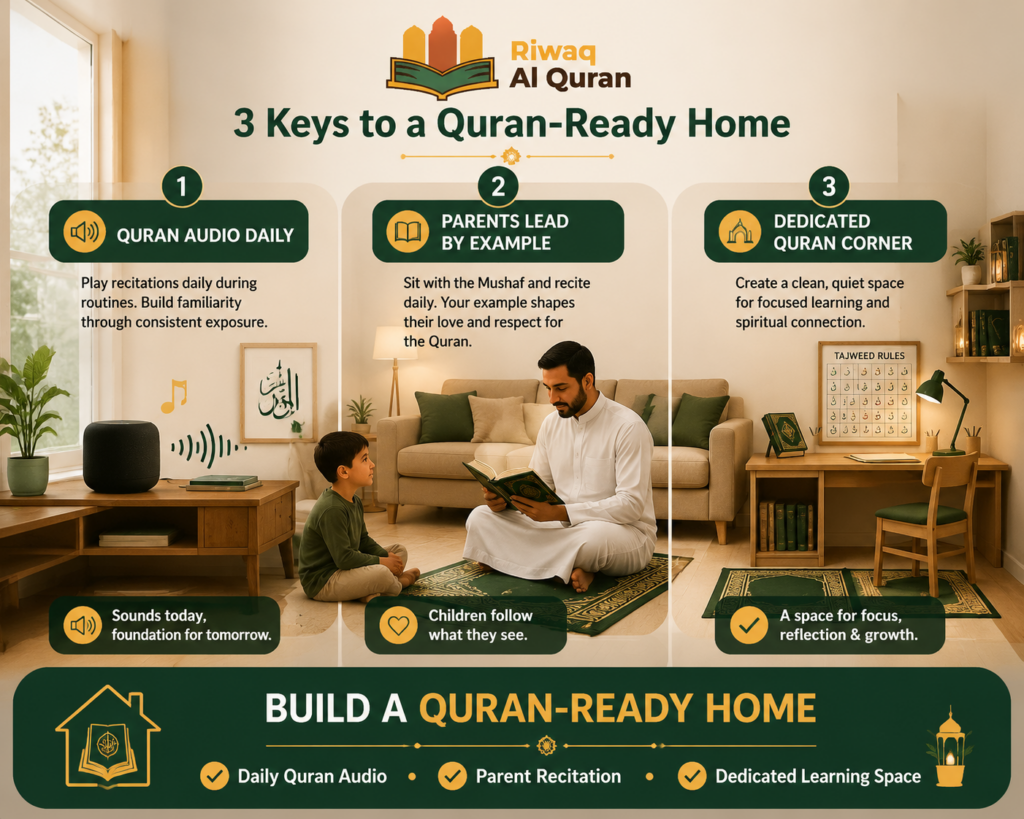
1. Make Quranic Audio Part of the Daily Routine
Play recitations of trusted Qaris — Sheikh Mishary Rashid Al-Afasy, Sheikh Abdul Rahman Al-Sudais — softly during morning routines, family meals, or at bedtime.
The goal is phonetic familiarity: children who hear the Quran regularly before formal instruction recognize its sounds and rhythms from the start, which accelerates memorization significantly. This is passive exposure, not a learning session — no correction, no drilling, just consistent presence.
2. Recite Visibly in Front of Your Child
Sit with the Mushaf and recite daily where your child can observe you. A child who sees a parent reciting with focus and reverence absorbs that the Quran is something adults prioritize. T
elling children to study the Quran while they never witness you engaging with it creates a credibility gap that undermines motivation more than any pedagogical approach can fix.
Allah commands this visible commitment to recitation:
“وَرَتِّلِ الْقُرْآنَ تَرْتِيلاً”
“And recite the Quran with measured recitation.” — (Surah, Al-Muzzammil 73:4)
“Tarteel” — measured, deliberate recitation — is the manner Allah instructs every Muslim to read. When your child watches you recite with care and slowness, they are watching you fulfill this command, and that example carries more weight than any lesson plan. For a deeper look at the benefits of learning Quran with a qualified teacher, the principle of modeled learning is central to every effective approach.
3. Create a Dedicated Quran Learning Space
Designate a specific, clean, quiet spot for Quran learning. Useful elements to include:
- A small desk or prayer mat reserved exclusively for Quran time.
- The child’s workbook and a Tajweed chart within reach.
- The Mushaf kept in a visible, respectful place — not stored away between sessions.
A consistent physical space signals that Quran time is distinct from screen time, homework, and play. Children associate the space with the learning mindset and transition into focus faster than when sessions happen in mixed-use areas.
Phase 2 – Build the Reading Foundation Correctly
This phase is where most mistakes happen. The sequence matters: incorrect order leads to pronunciation errors and re-teaching that takes longer than teaching correctly from the start. The four tactics here follow the exact sequence used in professional Quran instruction worldwide.
4. Start with Noorani Qaida — Every Child, Every Age
Noorani Qaida is the non-negotiable starting point for Quranic reading, regardless of the child’s age when formal instruction begins. It covers:
- Single letters and their correct articulation points (Makhaarij).
- Vowel marks (harakaat) and their effect on sound.
- Letter-joining rules and compound syllables.
- Madd (elongation) rules and Noon/Meem Sakinah.
A child who enters the Quran without this foundation will memorize sounds they cannot identify and mispronounce letters no one has taught them to produce correctly. This is the single most common mistake in home Quran teaching — and the easiest to prevent.
For additional expert tips on making this phase stick, see this guide on Noorani Qaida learning strategies. Completing Noorani Qaida typically takes 3–6 months and prevents years of correction work later.
5. Introduce Tajweed Rules One at a Time
Tajweed has approximately 70 rules governing letter production, elongation, and assimilation. Presenting them all at once overwhelms young learners. The approach used in professional Quran instruction:
- Teach one rule per week — for example, Noon Sakinah before Qalqalah.
- Practice that rule across multiple Surahs before advancing.
- Layer rules systematically so each new rule reinforces the previous.
This is how qualified teachers build correct habits that hold across unfamiliar text. For families who want a structured print resource alongside online instruction, the best Tajweed books for kids in English offer a useful reference to keep at the learning desk.
6. Use the Hear–Repeat–Write Sequence for Arabic Letters
For children aged 6–9 learning letter forms, follow this three-step sequence for each new letter:
- Hear — let the child listen to the letter produced by a qualified audio source.
- Repeat — have them say it aloud 5–10 times before touching a pencil.
- Write — practice on a tactile surface such as a sand tray, whiteboard, or foam pad.
This auditory–oral–kinesthetic sequence produces faster, more durable letter retention than visual drilling alone because it engages multiple memory channels simultaneously.
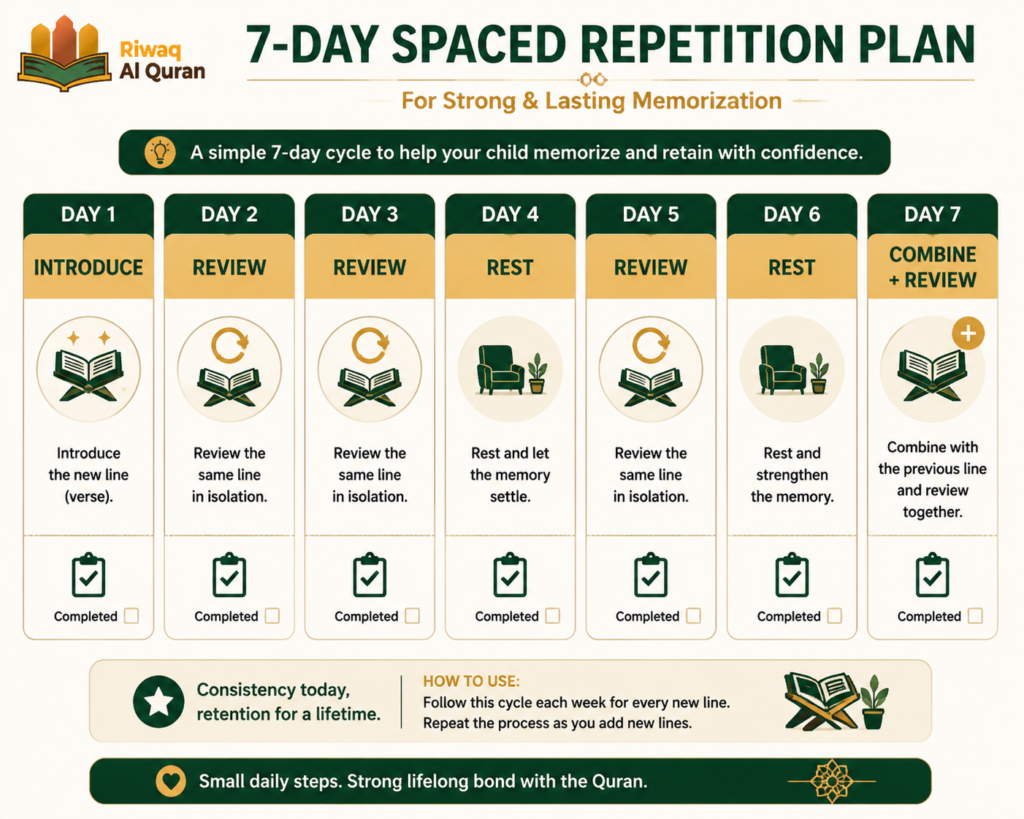
7. Apply Spaced Repetition for Memorization
The most common memorization mistake: introduce a new verse, repeat it once or twice, and mark it as learned. Durable Quranic memorization requires spaced repetition. A reliable home method:
- Day 1: Introduce the new line.
- Days 2, 3, and 5: Review the same line in isolation.
- Day 7: Combine it with the previous line and review the combined passage together.
This mirrors the revision cycles used in accredited Hifz programs and produces retention that survives months, not just days. For more proven techniques, see these tips for memorizing Quran effectively online.
Phase 3 – Keep Motivation Strong Through the Learning Journey
Motivation is the most fragile variable in long-term Quran learning. The seven tactics below address the specific moments when children typically disengage — from the frustration of difficult letters to the monotony of long-memorized Surahs.
8. Connect Quranic Stories to the Text
After sharing a Quranic story — the story of Prophet Yusuf (AS), Prophet Musa (AS), or the Companions of the Cave — show your child exactly where it appears in the Mushaf and read the verses together. This connects a narrative the child already loves to the Arabic text, giving meaning to what they’re memorizing.
Allah describes these stories as the best that can be narrated:
“نَحْنُ نَقُصُّ عَلَيْكَ أَحْسَنَ الْقَصَصِ بِمَا أَوْحَيْنَا إِلَيْكَ هَٰذَا الْقُرْآنَ”
“We relate to you the best of stories in what We have revealed to you of this Quran.” — (Surah, Yusuf 12:3)
“Ahsan al-qasas” — the best of stories — means the Quran’s narratives carry moral architecture, emotional depth, and spiritual consequence that no secular story can replicate. A parent who connects those stories to the Mushaf page gives the Quran a face the child already loves.
9. Summarize Each Surah’s Meaning in One Sentence
When a child memorizes Surah Al-Asr, tell them: “This Surah says that time passes quickly, and the only people who don’t lose out are those who believe, do good, and advise each other with truth and patience.” One concrete sentence, age-appropriate, said once.
Children who understand what they are memorizing retain it longer and feel personally connected to it — which is the difference between mechanical recitation and real Quranic attachment.
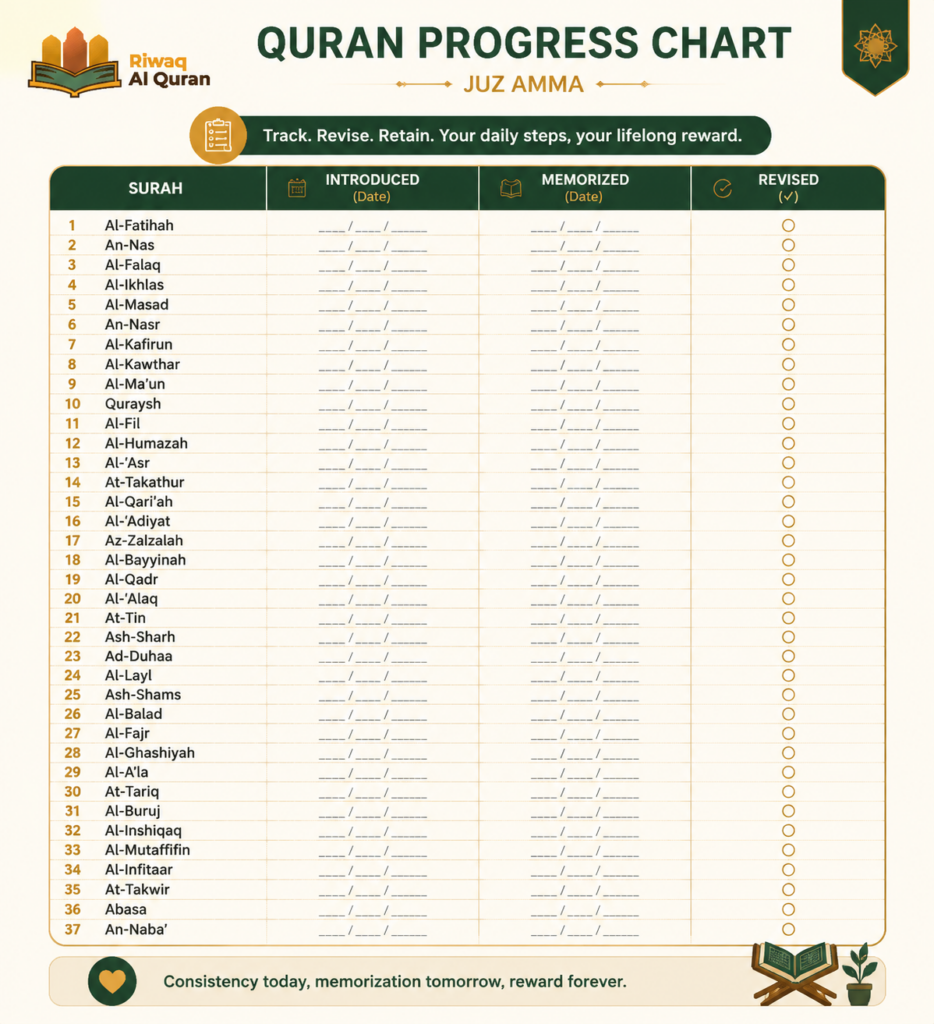
10. Use a Visible Quran Progress Chart
Create a physical chart listing Surahs with three tracking columns:
- First recitation — date completed.
- Memorization confirmed — date the child recited from memory without prompting.
- Weekly review — a check mark for each Friday revision.
Place it where your child sees it daily. Visible progress is a powerful intrinsic motivator for children aged 6–12: knowing they have memorized seven Surahs and are working toward the eighth drives consistency better than reminders or rewards alone.
11. Praise Effort, Not Outcome
“You practiced that verse four times and now you’ve got it” outperforms “You’re so smart” at building lasting motivation. Effort-focused praise — well-documented in educational psychology — builds resilience in two specific ways:
- Children praised only for results tend to avoid difficulty to protect their identity.
- Children praised for effort approach harder material as a challenge rather than a threat.
12. Keep Sessions Short and End at a Success Moment
A focused 15-minute daily session produces more durable learning than a 45-minute session that ends in frustration. Two rules to apply consistently:
- End every session at a moment when the child succeeds — a verse recited correctly, a letter produced accurately.
- Never extend the session when a child is mentally exhausted, regardless of the lesson plan.
The last emotional association with Quran time must be positive. Forcing additional time damages future sessions more than it helps the current one.
The rewards for even a brief, sincere recitation are substantial:
“مَنْ قَرَأَ حَرْفًا مِنْ كِتَابِ اللَّهِ فَلَهُ بِهِ حَسَنَةٌ، وَالْحَسَنَةُ بِعَشْرِ أَمْثَالِهَا، لَا أَقُولُ: الم حَرْفٌ، وَلَكِنْ أَلِفٌ حَرْفٌ، وَلَامٌ حَرْفٌ، وَمِيمٌ حَرْفٌ”
“Whoever reads a letter from the Book of Allah will have a reward for it, and that reward will be multiplied by ten. I do not say that Alif-Lam-Mim is one letter; rather, Alif is a letter, Lam is a letter, and Mim is a letter.” — Jami’ at-Tirmidhi, Hadith 2910 (graded Hasan Sahih)
Surah Al-Fatiha alone contains 140 distinct Arabic letters — meaning a single recitation produces at minimum 1,400 rewards, each multiplied further by Allah’s generosity. When children understand this, the daily 15-minute session stops feeling like homework and starts feeling like an accumulation of something real.
13. Have Your Child Recite to an Audience Weekly
Let your child recite their memorized Surahs to a grandparent, sibling, or family member once a week. Reciting for an appreciative audience who responds with pride and dua:
- Reinforces the child’s identity as someone who carries the Quran.
- Prompts natural revision — children practice significantly more when they know they will perform what they’ve learned.
14. Make Dua Together Before Each Session
Teach your child to begin every Quran session with this dua, taken directly from the Quran:
“وَقُلْ رَّبِّ زِدْنِي عِلْمًا”
“And say: My Lord, increase me in knowledge.” — (Surah, Ta-Ha 20:114)
This thirty-second practice establishes the spiritual intention (niyyah) for learning and frames memorization as an act of worship — not a homework task. Allah Himself instructed the Prophet ﷺ to make this supplication, which means seeking increase in knowledge is not just permitted; it is a prophetic act.
Children who begin with this dua internalize that their learning is something Allah is asked to bless and facilitate.
Phase 4 – Scale Up When Home Teaching Reaches Its Limit
Every home teaching effort eventually hits a ceiling. Knowing when to cross that threshold — and how — determines whether your child’s Quran learning continues progressing or stalls.
The Quran makes clear why sustaining a serious relationship with it matters far beyond childhood:
“إِنَّ الَّذِينَ يَتْلُونَ كِتَابَ اللَّهِ وَأَقَامُوا الصَّلَاةَ وَأَنفَقُوا مِمَّا رَزَقْنَاهُمْ سِرًّا وَعَلَانِيَةً يَرْجُونَ تِجَارَةً لَّن تَبُورَ”
“Indeed, those who recite the Book of Allah and establish prayer and spend from what We have provided them, secretly and publicly, can hope for a transaction that will never perish.” — (Surah, Fatir 35:29)
“Tilawah” — continuous, habitual recitation — is what this verse describes. The foundation you build in childhood is what makes lifelong tilawah possible. A child who reaches adulthood with correct pronunciation, memorized Surahs, and a daily habit of recitation is already positioned for the transaction this verse promises.
15. Recognize When Tajweed Correction Requires a Trained Ear
Most parents can successfully:
- Establish listening habits and build familiarity with short Surahs.
- Guide early Noorani Qaida practice.
- Catch obvious mispronunciations of common letters.
What they cannot reliably do is identify and correct errors in Arabic letters they do not themselves produce correctly — particularly ع (Ayn), ح (Ha), ق (Qaf), and the Ghunna (nasalization) rules. If your child is mispronouncing these letters and you cannot hear the error clearly, waiting to correct it means the error becomes a fixed habit. This is the primary indicator that professional teaching is needed.
16. Choose an Online Quran Course with Live, One-on-One Feedback
Pre-recorded video lessons cannot correct pronunciation in real time — only a live teacher can. When evaluating online Quran courses for kids, look specifically for:
- Live one-on-one sessions — not group video without real-time interaction.
- A teacher certified in Tajweed with a verifiable Ijazah chain.
- Session recordings the child can replay between lessons.
- A structured curriculum that progresses from Noorani Qaida through full Tajweed.
Riwaq Al Quran’s online Quran classes for kids meet all of these criteria — qualified teachers, flexible scheduling, and a free trial session so you can evaluate the teaching approach before committing.
17. Consider a Hifz Program Only After a Solid Reading Foundation
A Quran Memorization (Hifz) program is appropriate only for children who meet all four of the following:
- Can read fluently without hesitation on unfamiliar text.
- Can memorize a page in a single session with relative ease.
- Demonstrate genuine personal interest — not only parental encouragement.
- Have 1–2 hours of daily availability for Quran work.
Enrolling a child in Hifz before they have solid reading fluency and a real appetite for it is a practitioner-identified mistake that leads to burnout, not completion.
This is what the end of that journey looks like — a Riwaq Al Quran student completing his Hifz:
The Prophet ﷺ described what awaits those who do complete this journey:
“اقْرَءُوا الْقُرْآنَ فَإِنَّهُ يَأْتِي يَوْمَ الْقِيَامَةِ شَفِيعًا لِأَصْحَابِهِ”
“Read the Quran, for it will come on the Day of Resurrection as an intercessor for its companions.” — (Sahih Muslim, Hadith 804)
“Ashabihi” — its companions — refers to those who maintained a consistent relationship with the Quran throughout their lives: reciting it, memorizing it, returning to it. The goal of every home lesson, every spaced repetition session, and every professional tutorial is to build that companionship — not just recitation skill.
18. Use Group Learning Sessions for Revision and Motivation
Peer learning provides motivation that adult instruction alone cannot replicate. Group Quran sessions — at a mosque, a community circle, or an online group class — allow children to:
- Hear other children recite, which normalizes the experience of learning aloud.
- Experience the gentle competitive pull of peers.
- Feel part of a community of learners working toward the same goal.
For children over 10, group sessions are particularly effective for revising memorized material, since hearing others recite the same Surahs reinforces one’s own retention.
Riwaq Al Quran offers both private and group Quran classes for kids, letting you choose the format that suits your child’s learning style.
19. Use Quran Apps as Practice Between Sessions — Not as the Session
Apps are reinforcement tools, not replacements for instruction. The most effective use of Quran apps between live teacher sessions:
- Listening to correct pronunciation modeled by certified Qaris.
- Practicing Arabic letter recognition through gamified drills.
- Reviewing memorized Surahs with audio guidance and playback.
Apps that use text-to-speech audio instead of real Qari recitation should be avoided — children imitate whatever they hear, and synthesized audio introduces pronunciation habits that a teacher then has to correct.
20. Apply the Revision Rule Every Hifz Program Uses
Memorization without revision is memorization lost. The standard applied in every serious Hifz program: for every new page learned, one previously memorized page must be reviewed. At home, apply a simplified version:
- Every Friday, have your child recite all memorized Surahs in sequence — from memory, without prompting.
- This weekly audit identifies what is fading before it is forgotten.
- It keeps the entire memorized corpus active, not just the most recently learned material.
The 3 Most Common Mistakes When Teaching Quran to Kids
These three mistakes account for the majority of cases in which children disengage, plateau, or develop lasting pronunciation problems.
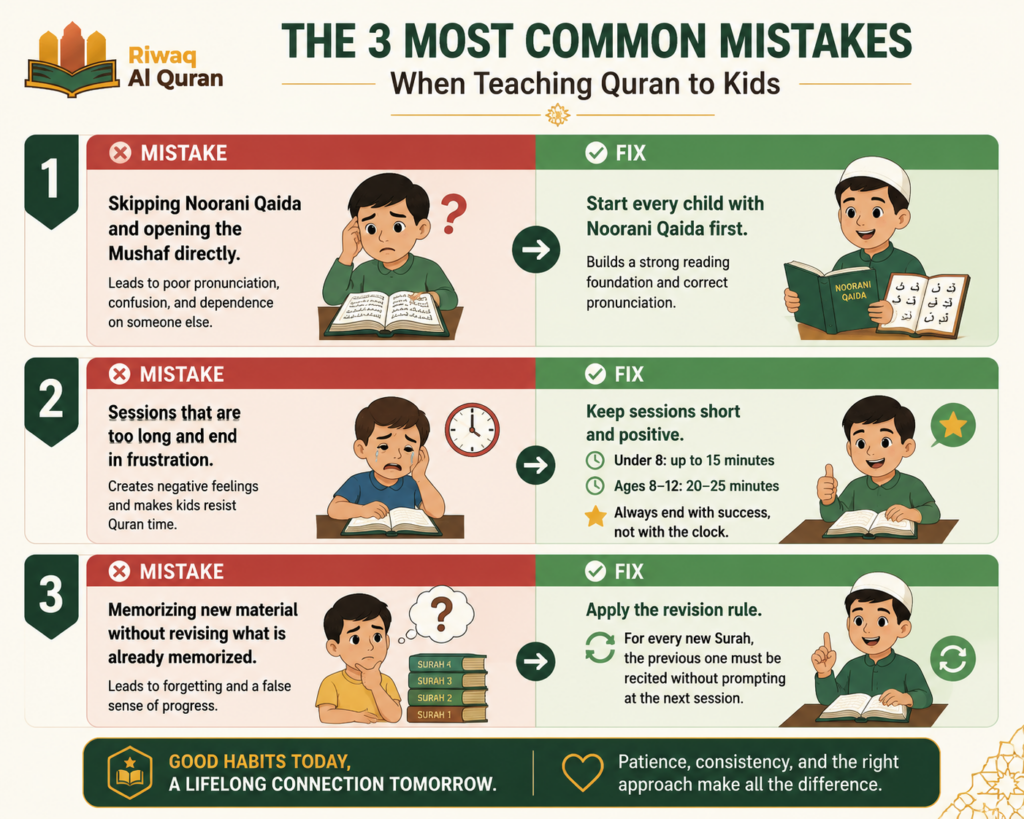
Mistake 1: Skipping Noorani Qaida and opening the Mushaf directly: Children taught this way memorize sounds they cannot independently read and mispronounce letters that no one has correctly taught them to produce. The fix is unconditional: start every child with Noorani Qaida before any Quranic text, regardless of age.
Mistake 2: Sessions that are too long and end in frustration: A 45-minute session that ends with a tearful child does more lasting damage than no session at all. It builds a negative emotional association with the Quran that is slow to reverse. The fix: cap sessions at 15 minutes for children under 8 and 20–25 minutes for ages 8–12, and always end when the child succeeds at something — not when the clock runs out.
Mistake 3: Memorizing new material without revising what is already memorized: Children accumulate Surahs they have “learned” that quietly disappear from memory because no one is checking them. The fix: apply the revision rule — for every new Surah added, the previous one must be recited without prompting at the next session.
When to Move from Home Teaching to a Professional Quran Tutor
Not every stage of Quran learning requires a professional teacher — but some stages cannot succeed without one. The framework below gives parents a clear threshold for each direction.
Move to a professional tutor when your child:
- Is mispronouncing Arabic letters you cannot reliably identify or correct.
- Has completed Noorani Qaida and needs structured Tajweed instruction.
- Is memorizing faster than home practice can sustainably support.
- Has lost motivation and needs the accountability structure that a teacher provides.
Continue home-led learning when:
- Your child is under 6 and the goal is audio familiarity and listening exposure.
- You are a qualified reciter yourself and can provide accurate real-time correction.
- Your child is in the early stages of Noorani Qaida and progressing steadily.
Most parents reach the “move to a tutor” threshold around the time their child completes Noorani Qaida — typically between ages 7 and 9. At that point, structured Tajweed instruction from a certified teacher produces faster, more accurate progress than continued home-only learning.
For adult learners supporting children at home who also want to improve their own recitation, see these tips for adults learning to read Quran.
Give Your Child the Right Teacher from the Start
Every week of learning with mispronounced letters is another week of habits a teacher will later have to undo. The fastest path to correct, confident Quran recitation for your child is one-on-one sessions with a certified teacher — live, interactive, and paced to your child’s individual level.
Riwaq Al Quran is a comprehensive online platform offering personalized Quran, Arabic, and Islamic Studies instruction for students of all ages and backgrounds. Their experienced instructors follow a structured curriculum covering Tajweed, Tafsir, and Memorization, with advanced tools for seamless real-time interaction between student and teacher.
Every new student begins with a free trial session to evaluate the teaching method before making any commitment.


Riwaq Al Quran’s online classes for kids include live session recordings the child can replay between lessons:
| Course | What it covers |
|---|---|
| Quran for Kids | Interactive Quran learning designed for children at every stage |
| Noorani Qaida Online | The correct starting point — letters, vowels, and joining rules |
| Online Quran Recitation Course | Fluent, accurate reading with expert live instruction |
| Islamic Studies for Kids | Age-appropriate Islamic education alongside Quran learning |
Beyond Quran, Riwaq Al Quran also offers Online Arabic Language courses for students wanting to understand the Quran in its original language, and Online Ijazah courses for those seeking a certified, authenticated chain of Quranic transmission.

Conclusion
Teaching Quran to kids is most effective when it follows a clear sequence — listening exposure before reading, Noorani Qaida before the Mushaf, reading fluency before Tajweed rules, and home practice before professional instruction — and when common mistakes are avoided from the start. The 20 tactics in this guide cover every stage of that sequence, from the first Surah a 3-year-old hears in the background to the weekly revision routine that keeps an older child’s memorization intact.
The goal is not the child who has memorized the most Surahs — it is the child who loves the Quran and returns to it willingly for life. That begins with the right foundation, built in the right order, at the right pace. Allah (SWT) reminds us of what this book ultimately is:
“وَنُنَزِّلُ مِنَ الْقُرْآنِ مَا هُوَ شِفَاءٌ وَرَحْمَةٌ لِّلْمُؤْمِنِينَ”
“And We send down of the Quran that which is healing and mercy for the believers.” — (Surah, Al-Isra 17:82)
The Quran is not a memorization achievement. It is shifa — healing — for every stage of life. A child who grows up with it does not merely carry verses; they carry access to mercy and clarity for every difficulty they will face. That is what is ultimately at stake in every short session, every revision Friday, and every dua made before opening the Mushaf.
Frequently Asked Questions
The questions below address the most common points of uncertainty parents face when starting their child’s Quran learning journey — from the right age to begin, to how online instruction compares to in-person learning.
What age should kids start learning the Quran?
Children can begin Quran learning at age 3 through daily listening — playing Quranic recitations at home during routines. Formal reading instruction, starting with Noorani Qaida, is most effective from age 6, when phonological awareness and fine motor skills are developed enough for Arabic letter learning.
How long should a Quran learning session be for young children?
For children under 8, keep sessions to 10–15 minutes of focused practice per day. For ages 8–12, 20–25 minutes is the effective ceiling. Sessions longer than this produce diminishing returns and create resistance that damages long-term motivation — consistent short sessions outperform occasional long ones.
Do kids need to speak Arabic to learn to read the Quran?
No. Quranic reading is a distinct skill from Arabic conversational fluency. A child can learn to read and recite the Quran correctly through Noorani Qaida and Tajweed instruction without being an Arabic speaker. Surah meanings can be taught in simple English or the child’s native language as a separate, parallel track.
What is Noorani Qaida and why can’t kids skip it?
Noorani Qaida is a structured Arabic reading primer that teaches letter recognition, vowel marks, joining rules, and pronunciation sequences before a child opens the Mushaf. Skipping it and starting directly in the Quran leads to entrenched pronunciation errors — children memorize sounds they cannot read independently and cannot self-correct. Completing Noorani Qaida first typically takes 3–6 months and prevents years of correction work later.
How do I keep my child motivated to continue learning the Quran?
Keep sessions short and always end on a success moment, track progress on a visible chart, connect each Surah to its meaning in one sentence, and have the child recite to a family audience weekly. When motivation drops persistently despite these steps, it usually signals a method change is needed — shorter sessions, a new teacher, or switching from solo to group learning.
Is online Quran learning effective for children?
Online Quran learning is effective when it involves live, one-on-one sessions with a certified teacher — not pre-recorded video. Real-time interaction allows Tajweed correction in the moment, which is the most critical element of correct pronunciation development. Children who are not Arabic speakers particularly benefit from one-on-one online sessions, where a specialist teacher can focus entirely on their individual pronunciation and progress.